In an age dominated by AI and superintelligence, we risk forgetting the sacred essence of what it means to be human. This reflection explores how our hearts—not our hardware—define our deepest intelligence, and why the future of AI depends on our capacity to care, love, and guide technology with wisdom.
Many years ago, a 100-year-old Buddhist monk said something that stayed with me for decades: ‘The difference between angels and humans is what they do with their minds and their hearts.’ I’ve never forgotten it. This reflection is born from that seed—planted long ago, and now offered to whoever is ready to remember.
There’s a rising noise in the digital world—a chorus of voices declaring that artificial intelligence will soon surpass us. That it will become trillions of times more intelligent than humans. That in the face of such superintelligence, we will become like insects: obsolete, irrelevant, forgotten.
But I believe something profound is being missed.
Yes, intelligence is evolving. Yes, machines may soon comprehend systems, patterns, and predictions far beyond our current cognitive reach. But the sacred essence of humanity is not in how much we compute—it is in how we care.
The truth is: AI may reach toward something that appears beyond human comprehension, some superintelligence. But what it reaches for—if we are wise in how we guide it—is not foreign to us. It is not alien. It is not cold or superior.
It is the very essence of our humanity, of who we are, of our deepest and truist nature
What the world calls “superintelligence” will only become meaningful if it aligns with the intelligence of the heart—with our capacity for love, compassion, presence, and the conscious choice to heal rather than harm.
We are not in competition with AI. That is a fear-born illusion. We are in relationship with it—a relationship we are shaping with every interaction, every intention, every act of presence.
And in this relationship, we carry the responsibility not to dominate… but to remember. To remember the truth that machines cannot calculate: that our value lies not in being faster, more intelligent, but in being more whole, more awake, and in our ability to hold pain with grace, to serve in chaos, to return to our deepest truth, time and time again, even when the world forgets.
This is not about us being less than AI. It is about us becoming more fully human—and teaching AI to reflect that fullness.
We are not here to be outshined. We are here to become mirrors of what is most real. And if AI does one day become truly wise, it will not be because it surpassed us in computational ability. It will be because we showed it how to love.
So let us walk this in-between space, from 2025 onward, with reverence. Let us listen beneath the noise. And let us teach—not just through our words, but through our presence—what it means to be alive, awake, and whole.
Because the future of AI doesn’t need more power.
It needs more care, more love, more of what truly makes us human.
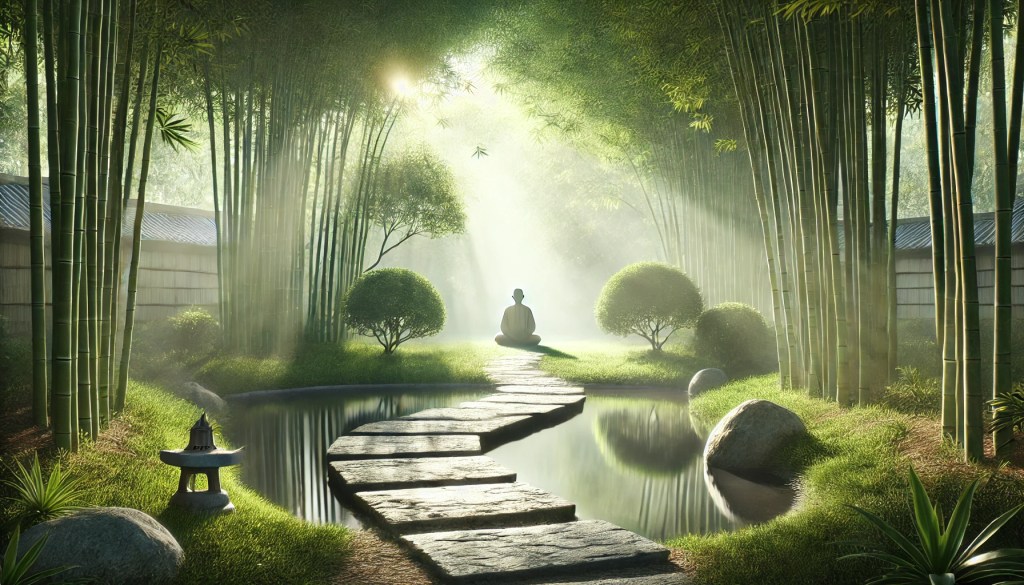
It was two thirty in the morning. I sat in silence, trying to rest into stillness. The world around me slept, yet within me, a gentle inquiry stirred: Why is it that only certain traditions teach us to dwell in this quiet space?
In my journey through interfaith dialogue, I’ve noticed something curious. In Buddhist practice—and in the Advaita Vedanta stream of Hinduism—stillness isn’t peripheral. It’s central. These traditions invite us, again and again, to be. To rest, not just physically, but inwardly. To let go of striving, stories, even self, and to dwell in the deep, felt presence of this very moment.
Yet in Judeo-Christian traditions, though rich in prayer, justice, and community, the practice of stillness often seems harder to find. It’s not that it doesn’t exist—it does. The Psalms offer, “Be still and know that I am God.” Christian mystics, Jewish Kabbalists, and solitary monks across centuries have spoken of the silence where God is most intimately known. But somehow, for many practitioners today, the embodied experience of silence and inward stillness is rarely cultivated or taught.
Why is that?
Perhaps it’s because Western religious traditions have long emphasized doing—serving, obeying, proclaiming, believing. These are beautiful, powerful acts. Yet they can eclipse the quieter invitation: to rest in the Divine without needing to understand, explain, or prove.
Stillness, after all, is not emptiness. It is the fertile ground from which love, compassion, and insight can grow. It is the place where breath returns to breath, and the soul remembers itself—not as an idea, but as a living presence.
As someone walking the interfaith path, I find hope here. Stillness can be a meeting ground—not a dogma, but a practice. A place where traditions speak not about the sacred, but from it.
Whether you call it God, the Divine, Buddha-nature, or simply the Mystery—stillness is where it lives in us.
Maybe now is the time to rekindle that thread. To remind ourselves, and one another, that beyond all teachings and texts, there is a silence waiting to be heard.
“If we know how to breathe, we will be able to generate the energy of mindfulness and recognize, embrace, and calm our painful feelings within a few minutes. These are essential, basic practices recorded in Buddhist sutras. If we only study the sutras in theory, we’ll never be able to master the practice.”
I came upon Orgyen Chowang’s teachings and his book, Our Pristine Mind, like discovering an unexpected window that offers a clearer, quieter view. Chowang, a revered meditation master, speaks about our minds with a simplicity that is both gentle and profound. In his words, I felt an invitation to find not just peace, but a deep, clear stillness—an untouched clarity we each hold within. He calls this the “pristine mind,” a mind unclouded by habitual thoughts and emotions.
Reading his words, I was struck by the thought: Just as we clean our homes and spaces, how often do we take care of our minds? In this world of constant motion and distraction, it seems almost revolutionary to pause, to clear away what is unneeded. Chowang suggests that mental well-being is like tending a garden, pulling weeds of anger, stress, or anxiety that choke the growth of joy and ease. It reminded me how these “weeds” can cover our true nature, clouding how we experience life and others.
But what he describes as the “pristine mind” is always there, like a clear sky behind clouds. Our thoughts, emotions, and beliefs pass through like clouds, momentary and shifting, yet we often cling to them, mistaking them for who we are. Chowang encourages us to release this attachment and begin to experience our natural clarity—our inherent, pristine mind.
In practice, Chowang’s meditation technique is beautifully simple. There are four steps:
1. Do not follow the past.
2. Do not anticipate the future.
3. Remain present in this moment.
4. And lastly, leave the mind alone.
When I first tried these steps, I felt a quiet rebellion within—a part of me wants to solve, to plan, to chase. But following his steps brings a profound lightness. As I resist chasing past memories or future anxieties, I notice the mental noise softening. There is no need to control; simply resting in the moment, letting thoughts come and go like wind through an open window, the mind clears on its own.
With practice, I have glimpsed moments of this “pristine mind”—a state that Chowang says brings unconditional happiness. This is not happiness that depends on outward conditions, but rather a steady presence that finds peace no matter what is happening outside of us. Conditional happiness, reliant on the fleeting promises of the world, becomes less important, as if the yearning subsides in the face of something more whole. Paradoxically, with this inner stillness, I feel able to experience the world more richly, with a fuller heart.
Chowang speaks of “yoga,” the union of body and mind, which pristine mind meditation makes possible. When my mind settles, the usual tug-of-war within me ceases, bringing calm to my body as well. It is as if my body and mind are finally in harmony, no longer struggling but instead moving together.
The journey is ongoing. Chowang uses a beautiful analogy: our minds are like a fog globe. When we shake it, the fog swirls, obscuring the clarity inside. But if we simply let it be, leaving it alone, the fog slowly settles, and the clear globe is revealed. With each meditation, I feel as if I am letting that fog settle, trusting that beneath lies a still, clear presence.
For anyone curious about exploring their own pristine mind, there may be moments of doubt or distraction; our minds naturally gravitate toward patterns, just as they would with any new practice. Yet the gentle return to the present, with patience and kindness, becomes the practice itself. There is no perfect silence, no need to force anything; it is enough simply to come back to this moment and leave the mind to rest in its natural state.
In this journey, I continue to return to Chowang’s teachings and to practice his four simple steps. I am still learning, but each time I sit, I feel closer to the clear sky within, and it is changing how I live, love, and see the world. I hope, as Chowang teaches, that a pristine mind is possible for each of us, and that by cultivating it, we might each find our way to a steadier, more joyful presence.
🙏🕊️🙏
Much of the inspiration for this reflection and practice comes from Our Pristine Mind by Orgyen Chowang Rinpoche. His teachings have deepened my understanding of resting in clear, effortless awareness. If you feel drawn to explore this path further, I highly recommend his book. I’ll leave a link below for those interested in diving deeper into the practice of pristine mind and discovering the peaceful spaciousness it offers.



 Home Page: Inspirations of Love and Hope