Tag: mindful eating

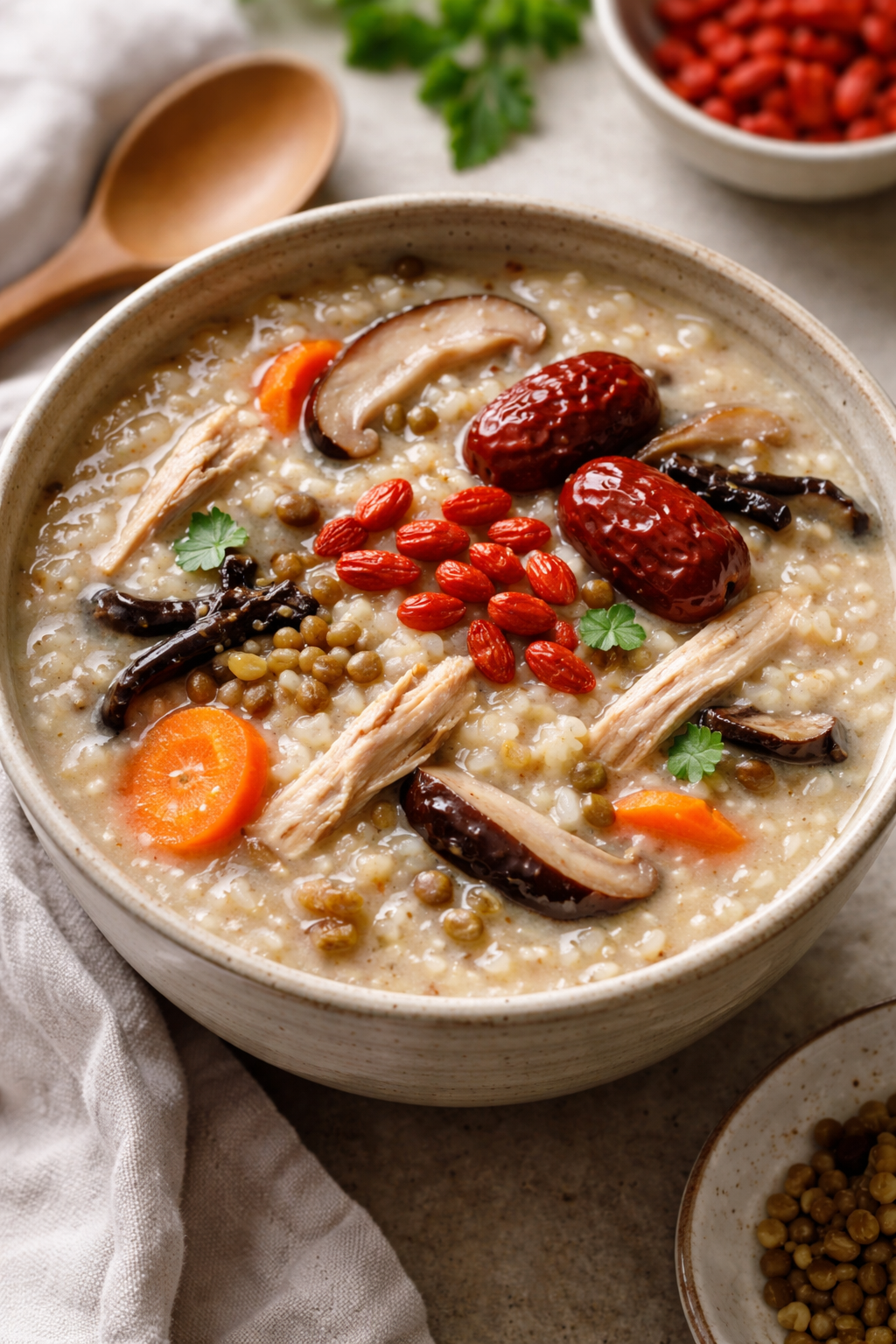
  • Slow-Cooked Brown Rice Congee for Gentle Strength

    Slow-Cooked Brown Rice Congee for Gentle Strength

    There are some foods that feel less like meals and more like companions. This congee is one of them. It doesn’t hurry. It doesn’t stimulate. It simply stays—warming, softening, and offering quiet nourishment to a body that may already be carrying more than its share.

    Slow-cooked over several hours, this brown rice congee is especially suited for times of fatigue, recovery, or convalescence. It is gentle on digestion, deeply hydrating, and built around ingredients long respected in Traditional Chinese Medicine for supporting Qi, Blood, and Essence without strain.


    Ingredients

    • ½ cup brown rice, rinsed
    • Plenty of water (approximately 8–10 cups, adding more as needed)
    • 1 tablespoon mung beans
    • 2 carrots, sliced
    • 2 shiitake mushrooms, sliced
    • Fresh ginger, a few thin slices (to taste)
    • 1-inch piece American ginseng
    • Black tree fungus (wood ear), soaked and sliced
    • Jujube (red dates), added toward the end
    • Goji berries, added toward the end
    • A small pinch of salt

    Optional Protein (about ¼ lb):

    • Tofu (soft or medium)
    • White fish
    • Chicken
    • Beef or other gently cooked meats

    Method

    Place the rinsed brown rice and mung beans into a large pot with plenty of water. Bring to a gentle boil, then reduce the heat to a very low simmer. Add the carrots, shiitake mushrooms, ginger, American ginseng, black tree fungus, and a small pinch of salt.

    If using a protein, add it now, choosing preparations that are simple and lightly cut. Cover loosely and allow the congee to cook slowly for about four hours, stirring occasionally and adding water as needed. The goal is a soft, porridge-like consistency, with the rice grains breaking down into a smooth, nourishing base.

    During the final 20–30 minutes of cooking, add the jujube and goji berries. This preserves their gentle sweetness and medicinal qualities without overcooking them.

    Taste and adjust seasoning if needed. Let the congee rest briefly before serving.


    A Quiet Reflection

    This is the kind of food that asks very little of you.

    While it cooks, you are free to rest. While you eat, there is nothing to solve or fix. Each spoonful feels like it arrives already listening, already aware of the body’s limits.

    Congee has long been considered a healing food not because it is powerful in the dramatic sense, but because it is willing to be humble. It meets weakness without judgment and strength without force.


    Nutritional Perspective (Western View)

    From a nutritional standpoint, this congee offers:

    • Complex carbohydrates from brown rice, providing slow, steady energy without blood sugar spikes
    • Dietary fiber to support gut health and gentle detoxification
    • Beta-carotene and antioxidants from carrots and goji berries
    • Immune-supportive compounds from shiitake mushrooms
    • Anti-inflammatory properties from fresh ginger
    • Hydration support, as the high water content aids circulation, digestion, and cellular repair

    Because it is soft and well-cooked, nutrients are easier to absorb—especially important for those with compromised digestion or low energy reserves.


    Traditional Chinese Medicine Perspective

    In TCM, congee is often prescribed when the Spleen and Stomach need support—particularly in cases of fatigue, deficiency, or post-illness recovery.

    • Brown rice strengthens the Spleen and provides stable Qi
    • Carrots gently tonify Blood and support digestion
    • Shiitake mushrooms support Wei Qi (defensive energy) and immune resilience
    • American ginseng nourishes Yin and Qi without overstimulation, making it especially suitable for chronic fatigue or heat-with-deficiency patterns
    • Black tree fungus supports Blood, moistens dryness, and benefits circulation
    • Jujube (red dates) harmonize the formula, nourish Blood, and calm the Spirit (Shen)
    • Goji berries nourish Liver and Kidney Yin, gently supporting vitality and vision
    • Ginger warms the middle burner, aiding digestion and preventing stagnation

    Taken together, this congee is balancing rather than forcing—supportive of long-term vitality rather than short-term energy spikes.


    A Final Note

    This dish can be eaten warm throughout the day, thinned with additional hot water if needed, and adapted gently over time. It is forgiving, flexible, and kind—qualities worth cultivating both in the kitchen and in ourselves.

    May it nourish not only the body, but also the quiet confidence that healing does not need to be rushed.

  • Touching the Mezuzah of Bread

    Touching the Mezuzah of Bread

    A mezuzah on the doorpost—reminding me to pause, to wake up, to touch awareness. Now, even cookies and bread can serve the same purpose.

    This is kind of a fun little poem that I thought you might enjoy as I reframe my impulsive eating of cookies and bread as a mindfulness bell. Instead of seeing it as a bad habit I need to fight, I’m experimenting with turning it into a moment of presence.

    In Jewish tradition, a mezuzah on the doorpost is more than a symbol—it’s a mindfulness bell. Each time we pass through a doorway and touch it, we are reminded to pause, to wake up, to remember the presence of the Divine in our daily lives.

    But what if mindfulness could extend beyond the doorpost? What if even our impulses—those habits we struggle with—could also become mezuzahs, gentle invitations to awareness?

    Recently, I’ve been reframing my impulsive eating of cookies and bread. Rather than seeing it as a failure of willpower or a battle to control, I’ve begun treating each craving as a doorway. Just as I touch the mezuzah before entering a room, I now use the moment of reaching for food as a reminder to pause and rest in awareness.

    Not to resist. Not to judge. Just to see.

    This shift is transforming something that once felt like compulsion into an unexpected spiritual practice. It’s not about stopping the impulse, but about using it as a touchstone for presence—turning even cookies or a loaf of bread into a mezuzah.


    The Mezuzah of Bread

    Hand to the doorpost, a pause in the flow,
    A moment of presence—just touching, then go.
    The cookie, the loaf—no different in kind,
    Each one a doorway to seeing the mind.

    No need to battle, no need to fight,
    Just rest in awareness, simple and light.
    The hunger may linger, the craving may call,
    But presence is spacious—it holds them all.

    Not stopping, not striving, just waking instead,
    Touching the mezuzah of cookies and bread.

    🙏🕊🙏


  • Preparing for the Storm: A Reflection on Navigating a Hurricane with Chronic Fatigue Syndrome

    There is something about preparing for a storm that feels like a dance with the Divine—both a surrender and a determined act of mindfulness. As I sit here in the quiet hours before evacuation, I realize that this has been more than just a physical process of gathering what I need. It has been an intimate spiritual journey, one that stretches my capacity to trust, to let go, and to deepen into the lived experience of the present moment.

    Living with chronic fatigue syndrome (CFS) means that every action I take must be intentional. Every task requires careful pacing, every moment of activity balanced with long periods of rest. There is a delicate art to navigating this kind of preparation, especially during a post-exertional malaise (PEM) crash. Yet, somehow, this storm has become a mirror—reflecting back the inner landscape of my spiritual practice, calling me into a deeper relationship with contemplation, with surrender, and with faith.

    The Importance of Pacing
    I began the preparations by gathering what I would take with me: clothes, medications, bedding, and electronics—just enough to fill a small suitcase and backpack. For most, this might seem like a simple task. For me, it was an act of delicate pacing. I worked in small bursts, then returned to rest, mindful of the balance I needed to maintain in order to avoid worsening my symptoms. Each step of preparation became a meditation on pacing, on honoring the limitations of my body while trusting in my ability to persevere.

    In these moments of rest, I found myself returning again and again to the practice of contemplation. I lit a candle, not only for myself but for all those who are suffering—for all sentient beings in the path of this storm and beyond. There is a peace that arises in this kind of surrender. A quiet knowing that, no matter how much preparation is done, the outcome rests in God’s hands. And that, somehow, is enough.

    A Shift from Meditation to Contemplation
    This journey has been more than just practical preparation. It has been a spiritual unfolding. For years, I have studied the teachings of Advaita Vedanta and Dzogchen, exploring the ways in which these paths guide us beyond intellectual understanding and into a direct experience of the Divine. In the midst of preparing for this hurricane, I felt a deepening—a shift from meditation to contemplation.

    Contemplation is not about thinking or striving. It is about resting in the space of the witness, in the awareness of what is, without grasping or resisting. As the storm approaches, I find myself leaning more into this practice. Each moment becomes an invitation to let go of control, to allow the Divine to move through me, and to trust that whatever happens, it is part of a greater unfolding.

    Mindful Eating and Body Awareness
    Even the simple act of eating became a mindful practice. I prepared a spontaneous meal—scrambled eggs with garlic and cayenne, rich in healthy fats and protein to fuel me through the day. As I ate, I focused on each bite, slowing down, tasting, being fully present with the nourishment my body needed.

    In the midst of so much uncertainty, these small acts of mindfulness brought me back to center. They reminded me that, even as the world outside seemed to spin with chaos, I could find peace within the present moment. I could honor my body’s needs, even as I prepared to enter an unfamiliar shelter and face whatever lay ahead.

    Pacing the Preparation of the RV
    As I packed my belongings, I also prepared my RV, the place I call home. I moved slowly, bringing frozen food to the clubhouse, unplugging the RV, securing what needed to be secured. I paced myself, taking each step with intention, aware that my energy was limited and precious.

    There is something sacred about these practical tasks, when approached with mindfulness. They become a part of the spiritual practice, a way of aligning the outer world with the inner. In unplugging the RV, I was also unplugging from the need to control. In securing my belongings, I was also securing my faith—trusting that whatever happens, I am held by something greater than myself.

    Karma Yoga: Offering and Receiving Prayers
    During this time, I also turned to the practice of Karma Yoga—offering prayers for the world, while asking for prayers in return. I posted a prayer request on Facebook, asking my community to hold me, and all those in the storm’s path, in their hearts. The response was overwhelming. The outpouring of love, of people offering their prayers and well wishes, became a source of strength for me. It reminded me that, even in times of uncertainty, we are never alone. We are held by the compassion of others, by the grace of the Divine, by the interconnectedness of all life.

    Surrender and Trust
    And so, I surrender. I surrender to whatever will be, knowing that I have done all I can to prepare—both physically and spiritually. I surrender to the wisdom of the Divine, trusting that, in the midst of this storm, there is a deeper unfolding happening. There is a lesson in the letting go, in the release of control, in the peace that comes from trusting that God’s will is always unfolding in ways that we may not understand, but can still embrace.

    To those who read this, who are also navigating life with chronic fatigue syndrome or facing similar challenges, I hope this reflection offers you some sense of peace. We cannot always control the storms that come our way, but we can choose how we prepare, how we respond, and how we anchor ourselves in the presence of the Divine.

    May you be safe. May you be held. May you find peace in the midst of the storm.

    🙏🕊️🙏

  • Discovering the Art of Mindful Eating

    In our fast-paced world, it’s easy to overlook the journey our food takes before it reaches our plates. We often eat on the go, distracted by screens, or in a rush, without truly appreciating the nourishment we receive. Mindful eating invites us to slow down and savor each bite, bringing a deeper awareness and gratitude for the food we consume.

    What is Mindful Eating?

    Mindful eating is the practice of being fully present and engaged while eating. It’s about appreciating the colors, textures, and flavors of our food, and understanding the journey it took to arrive at our table. This practice isn’t tied to any particular spiritual or religious tradition; it’s simply about cultivating a deeper connection with the food we eat and the process that brings it to us.

    The Journey of Food: From Seed to Plate

    • The Seed: Every piece of food starts from a seed. Imagine the tiny seed planted in the earth, nurtured by the soil, water, and sunlight. Farmers care for these seeds, ensuring they have the best chance to grow.
    • Growth: Picture the seed sprouting, growing into a plant or tree. The plant endures various weather conditions, receiving care from farmers who protect it from pests and provide the nutrients it needs to thrive.
    • Harvest: When the time is right, the food is harvested. This might involve picking fruit from trees, gathering grains, or pulling vegetables from the ground. Consider the effort and dedication required to harvest the food at its peak.
    • Transportation: After harvest, the food is transported. It may travel long distances, passing through the hands of many workers, from packers and drivers to warehouse staff and store employees, all playing a role in delivering the food to us.
    • Processing and Distribution: Some foods undergo processing—washing, sorting, and packaging—before reaching the market. Think about the systems and people involved in these steps, ensuring the food is safe and ready for consumption.
    • Purchase: Whether from a grocery store, market, or directly from a farm, purchasing food is an act that connects us to the larger food system. It involves choices that reflect our tastes, needs, and values.
    • Preparation: Preparing food can be a mindful activity in itself. Washing, cutting, cooking, and arranging food requires attention and care. It’s an opportunity to appreciate the transformation of ingredients into a meal.

    Practicing Mindful Eating

    To begin practicing mindful eating, try this simple exercise:

    • Choose Your Food: Select a piece of food, like an apple or a piece of bread.
    • Observe: Take a moment to look at the food. Notice its color, shape, and texture. Feel its weight in your hand.
    • Imagine the Journey: Visualize the journey this food took to reach you, from seed to harvest, transportation, and preparation.
    • Savor the Flavor: Take a small bite and chew slowly. Pay attention to the flavors and textures. Notice how the food changes as you chew.
    • Express Gratitude: Reflect on the effort involved in bringing this food to your table. Feel gratitude for the earth, the farmers, the workers, and everyone who played a part.

    Benefits of Mindful Eating

    • Enhanced Gratitude: Appreciating the journey of food fosters a sense of gratitude for the nourishment we receive.
    • Better Digestion: Eating slowly and mindfully can improve digestion and help us recognize when we’re full.
    • Greater Enjoyment: Mindful eating allows us to savor the flavors and textures of our food, enhancing our eating experience.
    • Healthier Choices: When we eat mindfully, we’re more likely to make healthier food choices and enjoy balanced meals.

    Conclusion

    Mindful eating is a simple yet powerful practice that can transform our relationship with food. By slowing down and appreciating the journey of our food, we cultivate gratitude and mindfulness in our daily lives. Whether you’re familiar with meditation or not, mindful eating is an accessible way to bring more awareness and enjoyment to your meals.

    Give it a try with your next meal and discover the difference it makes!