Tag: Meditation Insights

  • Neti Neti Series No. 11: The Ego’s Journey Towards Mirroring the Pristine Mind

    Neti Neti Series No. 11: The Ego’s Journey Towards Mirroring the Pristine Mind

    Question:

    Is it true that the I-sense, or ego, will never actually experience the pristine mind, since the I-sense doesn’t exist in that state? And, can spiritual practice bring the ordinary mind and ego closer to mirroring the pristine mind, even if they can never fully experience it directly?

    Dear friend,

    You have touched upon a profound and subtle truth in your reflection—the realization that the “I-sense,” the very sense of being a separate self, will never directly experience the pristine mind, for in the pristine mind, there is no “I” to experience anything at all.

    The “I-sense,” as you have observed, is the part of us that identifies with the individual self—with the body, the mind, the personality. It is the ego, the center of our personal world, through which we navigate the dualities of life—self and other, subject and object, right and wrong. This “I-sense” is deeply embedded in the fabric of our everyday experience, always seeking, always striving to maintain its sense of identity.

    And yet, beyond this “I-sense” lies the pristine mind, a state of pure, unconditioned awareness. In this state, there is no separation, no duality, no “I” that stands apart from the whole. The pristine mind is simply being itself, free from all concepts, all identifications. It is the ground of all existence, the true nature of consciousness that underlies every thought, every sensation, every experience.

    As you so rightly observed, the “I-sense” cannot directly experience the pristine mind because the very presence of an “I” implies duality, and in the pristine mind, there is no duality. The ego, by its very nature, is a construct that stands apart, that defines itself in relation to others. To dissolve into the pristine mind is to let go of this sense of separateness, to merge with the whole in a state of pure being.

    Yet, there is a way in which the ordinary mind, the ego, can approach this state, can come to reflect it as closely as possible. Through spiritual practice, the mind becomes refined, quieted, and purified. Meditation, mantra, mindfulness—all of these practices serve to soften the boundaries of the “I-sense,” to still the constant movement of thought and identification.

    In this stillness, the mind begins to mirror the qualities of the pristine mind—peace, clarity, non-attachment. While the ego may never directly experience the pristine mind, it can come to a place where it reflects this deeper reality, where the sense of separation diminishes, and the boundaries of the self become porous, transparent.

    It is in these moments, dear friend, that you may catch a glimpse of the truth that lies beyond the “I,” a truth that cannot be grasped or held, but only reflected in the clear, quiet mind. Continue with your practice, allowing it to guide you ever closer to this state of reflection, where the ordinary mind becomes a mirror for the pristine mind, and the boundaries of the self dissolve into the whole.

    🙏🕊️🙏
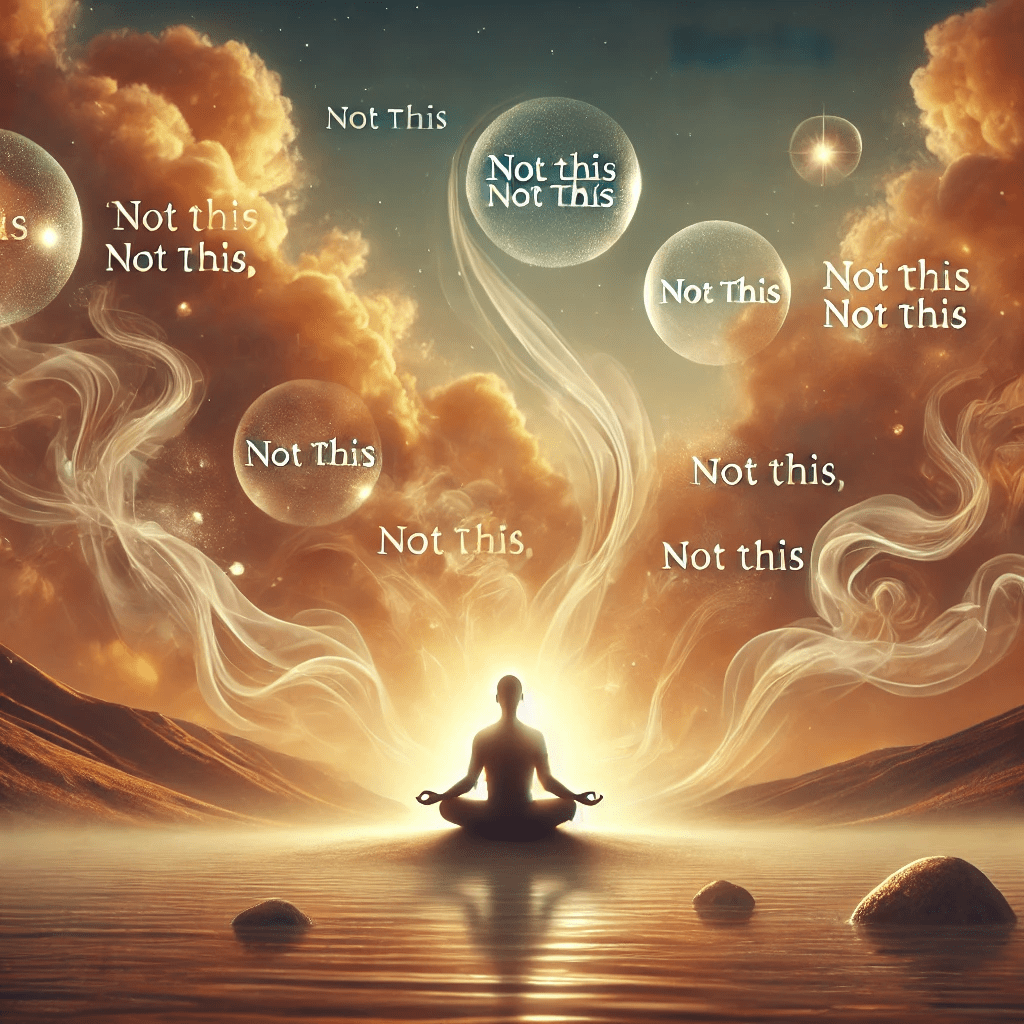
  • Neti Neti Series No. 9: Overcoming Self-Doubt in Meditation

    Neti Neti Series No. 9: Overcoming Self-Doubt in Meditation

    Question:

    For many years, the mental events that disturbed me the most were those that questioned, “Am I doing this right or wrong? Am I achieving anything beneficial, or am I just wasting my time?” But today, these doubts had no effect. I simply said, “Not this, not this,” recognizing them as just mental events arising. This mantra is bringing me a freedom from years of anxiety and self-doubt. It’s a significant release. How can I nurture and deepen this newfound freedom in my meditation?

    Dear friend,

    What a significant and liberating insight you have encountered! For many years, those persistent questions—”Am I doing this right?” “Am I wasting my time?”—have cast a shadow over your practice, pulling you into a cycle of doubt and anxiety. And yet, in this round, you have discovered a simple and profound truth: these doubts are nothing more than mental events, no different from any other thoughts that arise in the mind.

    Doubt, particularly the kind that questions whether we are on the right path, can be one of the most insidious obstacles in our practice. It arises from the ego’s need for certainty and validation, from a fear of failure or the unknown. These doubts can be particularly disturbing because they strike at the very heart of our efforts, making us question whether we are moving forward or merely spinning our wheels.

    But now, you have seen through the illusion. By applying the mantra “Not This, Not This” to these doubts, you have recognized them for what they are—simply thoughts, passing phenomena in the mind. They have no more substance or power than any other mental event. In meeting these doubts with “Not This, Not This,” you have taken away their sting, their ability to disturb your peace. They are no longer something to fear or wrestle with; they are just another ripple on the surface of the mind’s vast ocean.

    This realization brings with it a profound freedom. No longer are you bound by the need to do things “right” or the fear of doing them “wrong.” Instead, you can rest in the simplicity of the practice, free from judgment, free from the constant questioning that once held you back. This freedom is not a small thing; it is a significant release, a letting go of years of accumulated doubt and anxiety. It is a gift that allows you to move forward with greater ease and confidence, trusting in the process without the need for constant validation.

    Indeed, this is a significant moment in your journey. The doubts that once plagued you have lost their power, and in their place, you have found a deeper sense of peace and self-acceptance. This is the true power of the mantra “Not This, Not This”—it transforms not just your meditation, but your entire relationship with yourself. It frees you from the chains of doubt and allows you to walk your path with a lighter heart and a clearer mind.

    My dear friend, this is a beautiful and important step on your journey. Continue with this practice, allowing the mantra to guide you ever deeper into the heart of stillness and clarity. Trust in yourself, and know that you are moving in the right direction, free from the burdens of doubt and self-judgment.

    🙏🕊️🙏

  • Stabilizing the Mind: How Focused Attention Enhances Meditation and Calms Mental Fluctuations

    A crucial aspect of meditation and mental discipline: the role of attention in stabilizing mental fluctuations (vrittis). Here’s how attention affects the stability of vrittis:

    Role of Attention in Stabilizing Vrittis

    1. Directing Focus:
    • Attention directs the mind towards a specific object or thought. By consistently focusing on a chosen point, you can reduce the influence of distracting vrittis and bring stability to the mind.
    1. Reducing Distractions:
    • When attention is well-directed, it minimizes the impact of wandering thoughts and external stimuli. This helps in preventing the mind from becoming scattered or chaotic.
    1. Enhancing Concentration:
    • Sustained attention helps in achieving a state of ekagrata (one-pointedness), where vrittis become more stable and coherent. This concentration reduces the fluctuations and irregularities in mental activity.
    1. Strengthening Mental Focus:
    • Regular practice of maintaining attention strengthens the mental faculties involved in focus and concentration. Over time, this leads to more consistent stability in vrittis.
    1. Creating a Stable Mental Environment:
    • When attention is maintained, it creates a stable mental environment where vrittis rise and fall in a controlled manner, similar to the smooth surface of a calm pool.
    1. Facilitating Deeper Meditation:
    • Stable attention allows for deeper meditation, where the mind is less prone to fluctuations and can experience more profound states of awareness and insight.

    In essence, attention acts as a stabilizing force for vrittis, enabling the mind to move from a state of chaos to one of calm and focus. This understanding can guide your practice by emphasizing the importance of cultivating and maintaining effective attention in meditation.

    Below is the original source video of the lecture with Swami Parvajika Devyanandaprana, from which these blog posts were inspired. Here you can explore the insightful teachings that have profoundly shaped the content and perspectives shared in this blog.

    🙏🕊️🙏