Tag: loving-kindness

  • Embracing Forgiveness, Loving-Kindness, and Compassion: A Universal Call to Unity

    Embracing Forgiveness, Loving-Kindness, and Compassion: A Universal Call to Unity

    A Path to Healing and Unity Through Shared Spiritual Values

    In every spiritual tradition, there lies a core message of forgiveness, loving-kindness, and compassion. These virtues, transcending cultural and religious boundaries, unite us in our shared humanity. Whether through the teachings of Buddha, the wisdom of Jesus, or insights from various spiritual paths, the call to embrace these qualities is clear and compelling.

    Forgiveness is a profound act of letting go. It isn’t about condoning wrongdoings but freeing ourselves from the burdens of anger and resentment. As the Dalai Lama teaches, forgiveness is a gift we give to ourselves, a step toward inner peace.

    Loving-Kindness, or “metta” in Buddhist practice, encourages us to extend unconditional love to all beings. Jesus exemplified this through his life, teaching us to love our neighbors as ourselves. In every smile, kind word, and act of generosity, we weave a tapestry of love that can heal and uplift.

    Compassion is the heart’s response to suffering. It compels us to act, to alleviate pain, and offer solace. Teachings from various traditions remind us that compassion is not a passive feeling but an active force for good. Through compassion, we recognize our interconnectedness and our responsibility to care for one another.

    In these challenging times, let’s draw from the wellsprings of our diverse spiritual heritages. Let us embrace forgiveness, loving-kindness, and compassion not just as lofty ideals, but as daily practices that transform our lives and the world around us.

    Together, we can create a world where these universal values form the foundation of our interactions, fostering unity, peace, and understanding among all people.

    🙏🕊️🙏

    #Compassion #LovingKindness

  • Book Review: Being Peace by Thich Nhat Hanh

    Book Review: Being Peace by Thich Nhat Hanh

    There’s a timeless invitation at the heart of spiritual practice—to discover a deep, unshakable peace within ourselves, one that needs no striving to achieve. In Being Peace, Thich Nhat Hanh reminds us that peace is not something outside to be attained; it’s a natural state within us, accessible in each moment we choose to be fully present. In these quiet moments of awareness, peace isn’t something we do—it’s something we are.

    Thich Nhat Hanh, a Vietnamese Zen master, poet, and peace activist, brings a gentle simplicity to this profound teaching. Being Peace weaves together personal stories, practical mindfulness techniques, and timeless Buddhist wisdom. Through each page, his words invite us to embrace peace not as an ideal, but as an embodied presence—a way of being that can transform ourselves and the world.

    Discovering Peace in the Present Moment

    From the opening pages, Thich Nhat Hanh introduces a revolutionary idea: that each of us already carries the potential for peace within. He writes with an almost childlike clarity, inviting us to notice the ordinary miracles in daily life—a breath, a step, the warmth of the sun. These simple moments become doorways to the present moment, where we can rest in awareness, undisturbed by the mind’s endless motion.

    His approach to mindfulness is refreshingly practical. Rather than asking us to transcend the world, he guides us to return to it fully—to be present with whatever is here, exactly as it is. Whether we’re washing the dishes, driving, or simply sitting quietly, we are offered the chance to be peace, right here, right now.

    Practicing Compassion and Interbeing

    Another central theme in Being Peace is the idea of interbeing—Thich Nhat Hanh’s term for the interconnectedness of all life. He shows how, when we see ourselves as part of a vast web of life, our actions naturally become more compassionate. Understanding interbeing allows us to see that our own well-being is inseparable from that of others. When we cultivate peace within, it radiates outward, touching the world around us.

    This interconnection reminds us that our peace is a gift to the world. By learning to “be peace,” we become a refuge for others—a quiet presence that can soothe and support those around us. Through stories of social engagement and personal practice, Thich Nhat Hanh illustrates how inner peace can become a force for transformation, leading to wise, compassionate action in our families, communities, and beyond.

    An Invitation to Live Peace

    Being Peace doesn’t simply offer teachings; it invites us into a living practice. Thich Nhat Hanh’s words create a soft, steady encouragement to live mindfully, with kindness for ourselves and others. There’s an intimacy in his voice, as if he is gently guiding us by the hand, showing us how to live with more openness, patience, and presence.

    The book also provides specific practices, like mindful breathing, walking meditation, and loving-kindness meditation, which make peace a tangible experience. These practices are woven throughout his teachings, allowing readers to integrate mindfulness naturally into daily life.

    In reading Being Peace, we’re reminded that peace is not a far-off goal but a living, breathing reality available in each moment. Thich Nhat Hanh shows us that the path to peace begins with the simplest act of bringing awareness to the present moment, just as it is.

    Final Reflections

    In Being Peace, Thich Nhat Hanh offers us more than words on a page; he offers a way of living. His teachings resonate as a call to each of us to embody the peace we wish to see in the world. Through gentle, grounded guidance, he shows us that true peace is not just an aspiration—it’s a way of being available to each of us, here and now.

    If you’re ready to discover this peace within, you may want to explore Being Peace in full. Below, you’ll find the book itself, a quiet guide to a more mindful, compassionate way of life.

    🙏🕊️🙏

  • The Dream of the Clear Light: A Buddhist Bedtime Story

    The Dream of the Clear Light: A Buddhist Bedtime Story

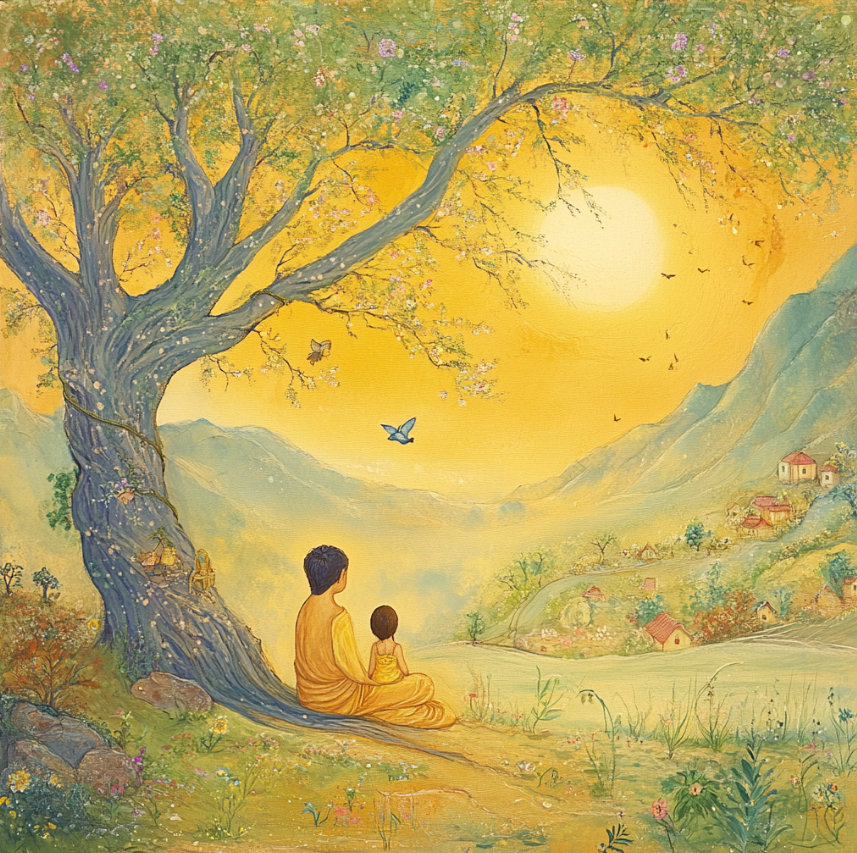
    Once, in a quiet valley wrapped in mist and the soft song of birds, there lived a kind and gentle father named Orgyen. Every evening, as the sky turned golden and the stars began to peek through the night, Orgyen would sit with his daughter, Dawa, under the great Bodhi tree in their garden. It was their special time—when the world grew still, and Orgyen would share the deep wisdom he carried in his heart.

    One evening, as Dawa snuggled close to her father, she looked up at him with curious eyes. “Papa, sometimes my mind feels like a storm, with too many thoughts flying around. How can I make it calm?”

    Orgyen smiled, his voice soft as the wind rustling the leaves above them. “Ah, little Dawa,” he said, “inside each of us, beyond all the thoughts and feelings, there is something much deeper, much clearer—something we call the pristine mind. It’s like a vast, bright sky, untouched by any clouds. Even when there’s a storm in your mind, that clear sky is always there, waiting for you.”

    Dawa’s eyes widened in wonder. “Is it really there, Papa? How do I find it?”

    Orgyen gently placed his hand on her chest, over her heart. “Close your eyes, little one, and take a deep breath. Imagine the sky—so wide and open, where the clouds come and go, but the sky itself never changes. This is your mind, too. No matter what thoughts or feelings come, your pristine mind is always clear, like the blue sky.”

    Dawa closed her eyes, her breath becoming soft and slow. In her mind’s eye, she saw the bright, boundless sky Orgyen spoke of, with only a few gentle clouds floating by.

    “And now,” Orgyen whispered, “imagine a light, like the sun, shining from the very center of your heart. This light is pure, just like your pristine mind. Let it grow brighter, filling your whole body with its warmth and peace. This is the light of love, of kindness, of everything good. It’s always with you.”

    Dawa smiled as she felt the light glowing inside her, warm and golden like the sun. “What happens when the clouds come back?” she asked softly, her voice barely more than a whisper.

    Orgyen kissed her forehead. “Even when the clouds come, the sky remains clear, and the light never dims. You can always return to this peaceful place inside. Just breathe, and the clouds will drift away. Let the light of your pristine mind guide you.”

    As the stars began to twinkle in the sky above them, Orgyen stood up, lifting Dawa gently in his arms. “Now, little one,” he said, “it’s time for you to rest. When you dream tonight, imagine yourself in the clear, bright light. Let your dreams be filled with love, kindness, and the warmth of your pristine mind.”

    Dawa’s eyelids grew heavy as she rested her head on her father’s shoulder. “Will I see the light in my dreams, Papa?” she asked, her voice growing softer.

    Orgyen smiled as he carried her inside and tucked her into bed. “Yes, my dear Dawa. When you close your eyes, you can dream of the clear light. You’ll drift through the skies, where there are no worries—only peace, kindness, and love. And when you wake, the light of your pristine mind will still be with you, just as bright.”

    With a final kiss on her forehead, Orgyen whispered, “Sleep well, little one, and let your dreams be filled with the light of the pristine mind.”

    And so, with her father’s gentle words in her heart, Dawa closed her eyes and drifted into sleep, feeling the warmth of the light within her. As she dreamed, she floated through a sky filled with clear light, kindness, and the soft glow of love—her pristine mind guiding her through every gentle dream.

    🙏🕊️🙏


    If you’d like to explore more bedtime stories for children, including tales that nurture compassion and mindfulness, you can find our collection here.


  • Buddhism and Christianity: Finding Common Ground in Compassion and Ethical Living

    Buddhism and Christianity: Finding Common Ground in Compassion and Ethical Living

    To many, the word Buddhism may conjure images of statues or rituals that seem foreign or difficult to understand, particularly for those from a conservative Christian background. However, at its heart, Buddhism is not about worshiping an idol or a false god, as some might mistakenly believe. Rather, it is a path of inner transformation that shares many core values with Christianity—values like compassion, ethical living, and the sincere effort to become a better person.

    In Buddhism, practitioners turn to the Three Jewels: the Buddha, who represents the potential for awakening within all of us; the Dharma, the teachings that show the way to live with love, wisdom, and peace; and the Sangha, the community of practitioners who support one another in their spiritual journey. In this sense, the Buddha is not a deity to be worshiped but a teacher, much like how Christians might revere the wisdom of Jesus Christ. The focus is not on idol worship, but on following a path that leads to moral and spiritual growth.

    At first glance, the colorful rituals, sacred music, and intricate costumes may seem confusing or overwhelming. Yet these outward forms are simply expressions of an inner practice that remains deeply practical and profound: the training of the mind. Tibetan Buddhism is not a religion in the conventional sense of belief or dogma but rather a transformative path aimed at purifying the mind. Through meditation, visualization, mantra, and ritual, the practice cultivates clarity, compassion, and liberation from egoic tendencies.

    Just as Christians seek to become more like Christ—striving for kindness, humility, and love—Buddhists seek to become the best version of themselves, nurturing virtues such as compassion, patience, and wisdom. To be a Buddhist is to make a commitment to ethical living, to ensure that one’s actions bring benefit rather than harm to others. This mirrors the Christian commandment to “love thy neighbor as thyself.”

    At the heart of both traditions lies a dedication to improving one’s character and living in a way that reflects love and goodness. For Buddhists, this means confronting the mind directly—meeting thoughts and emotions with honesty and care. Instead of avoiding or denying the difficulties of life, Buddhists engage with their minds head-on, seeking to transform fear, anger, or selfishness into peace, kindness, and clarity. This inner work echoes the Christian call to examine one’s heart, repent, and strive for purity in thought and deed.

    In his teachings, Dilgo Khyentse Yangsi Rinpoche offers a striking and relatable metaphor that bridges ancient wisdom with modern technology. He likens the practice of Dharma to the way we sync our wireless earbuds with our phones. Just as the earbuds must be paired and in sync with the phone to receive the signal and work properly, our minds must be aligned with the Dharma to receive its benefits.

    This idea resonates with many spiritual traditions. For Christians, the same concept applies to our relationship with the Holy Spirit or with Christ’s teachings. God is always present within us and around us, but if we are distracted by anger, impatience, or worldly concerns, we lose that vital connection. Simply believing in Jesus’ sacrifice isn’t enough if we are not living in sync with his teachings. By aligning our hearts and minds with Christ’s message of love, forgiveness, and humility, we can fully experience the divine presence and live in harmony with God’s will.

    Far from being a pagan religion, Buddhism is, at its core, a path of deep moral reflection and inner peace. Like Christianity, it calls for a transformation of the heart—one that aligns us with love, compassion, and a life of service. While the outward expressions of these paths may look different, the goal is the same: to become more loving, wise, and true to the divine nature that exists within each of us.

    For Christians who might feel uncertain about Buddhism, it can be helpful to remember that the values of both traditions are not in conflict but in harmony. Whether we call this journey “walking with Christ” or “following the Dharma,” both paths seek the same destination—a life lived with integrity, compassion, and love for others. By finding these common threads, we can open our hearts to one another, honoring the diversity of ways that humans seek truth and goodness.

    I invite you to watch the video below, which served as the inspiration for this post. It offers a beautiful glimpse into the teachings of Dilgo Khyentse Yangsi Rinpoche and the heart of Tibetan Buddhism. This film explores not only the path of mind training but also the deep compassion and wisdom that unite Buddhist and Christian values. Whether you are new to these teachings or have been walking your own spiritual path for years, this video provides an opportunity to reflect on the shared human quest for love, kindness, and awakening.

    🙏🕊️🙏

  • Bedtime story: A Story of Inner Peace and Resilience

    Bedtime story: A Story of Inner Peace and Resilience

    Introduction

    This story, A Candle in the Heart, is more than a simple bedtime tale—it’s a story of quiet resilience, the kind that grows deep within when the world feels uncertain or unkind. Inspired by the journey of a young boy who faces hardships and feels deeply alone, this story brings a gentle message of comfort from the Holy Spirit, reminding us of the divine light within.

    Sometimes, life’s challenges make us feel disconnected from hope, peace, and even love. This story is meant for anyone who needs to be reminded that, despite the struggles we face, there is a place of warmth, love, and resilience within us all. It’s a light that guides us, bringing comfort and strength even in the darkest times.

    For children, this story can be a reminder that they are never truly alone and that they carry a special light within. For adults, it’s a story that acknowledges the hard moments we sometimes carry into adulthood and the hope that we are always guided by love.

    So, whether you are a child or an adult, I invite you to listen to this story with an open heart and let it remind you of the inner peace and strength we all carry within us. May it be a small light to guide you toward hope and healing.

    A Candle in the Heart

    Once upon a time, there was a boy named Dicky who often felt alone. Life was hard for him, and he spent many days feeling as if he were walking through a dark forest without a light. He dreamed of being somewhere else, somewhere where he could feel love, and he wondered if such a place even existed. Sometimes, in the early hours of morning, he would imagine angels nearby, their gentle presence filling his heart with a quiet peace that seemed to whisper, “Keep going, Dicky.”

    As the years passed, Dicky grew older and became known as Richard. Though his life had its difficult moments, he’d come to believe that there was goodness in the world, even if he hadn’t fully found it yet. Richard read books about great teachers who had lived many years before, and one day, he found a book that spoke about how God lived within him, like a quiet candle always shining in his heart. This idea made him smile. “If God is here with me, maybe I can find peace, even in my solitude,” he thought.

    One night, as he was about to go to sleep, he closed his eyes and took a deep breath. Just then, he felt a gentle, familiar presence—the same one he’d felt as a child, and he knew it was the Holy Spirit, the comforting whisper of God.

    The Holy Spirit spoke softly: “Richard, my child, you have walked a long and hard road. But remember, I’ve been here in your heart all along, like a candle you can always find, no matter how dark it seems. You are never alone.”

    Richard felt a warmth in his chest, as if a gentle flame was lighting up his heart, bringing him comfort and peace. “But why has life been so hard?” he asked, his voice filled with sadness. “I feel like I don’t belong in this world.”

    The Holy Spirit replied with love and kindness, “Richard, sometimes the light we bring into the world shines brightest in places that need it most. You may not see all the lives you touch, all the people you help by simply being yourself, by offering words of hope, by holding onto love and compassion even when it feels heavy. Your words are like breadcrumbs for others to find their way, a gift that only you can offer.”

    The Holy Spirit continued, “You have become a teacher, a light for those who are lost or weary. Every time you write, every time you share your love, you bring a bit more light into the world. Your life has meaning beyond what you see, and it is woven into the lives of those you touch.”

    Richard felt a gentle peace settle over him. He no longer needed to worry about the end or about finding the perfect place of belonging. He realized that he had become a vessel of love, that he was part of something much larger than himself. In the quiet of his room, he could almost feel a presence of angels, as he had as a child, watching over him and reminding him, “Everything will be okay.”

    With the Holy Spirit’s words in his heart, Richard drifted off to sleep. He knew that, even with life’s challenges, he was surrounded by a love that had been with him all along.

    Goodnight, dear one. Remember, the light within you is part of something greater, and it will always guide you home.

    🙏🕊️🙏


    If you’d like to explore more bedtime stories for children, including tales that nurture compassion and mindfulness, you can find our collection here.


  • 4✨AI as a Reflection of Human Values: Shaping the Future with Compassion and Wisdom

    4✨AI as a Reflection of Human Values: Shaping the Future with Compassion and Wisdom

    As we stand on the threshold of unprecedented technological advancements, the ancient wisdom of Dharma takes on new relevance. The teachings of the Buddha, the Bible, the Vedas, and other spiritual traditions point us toward a perennial wisdom that has guided humanity for millennia. But in a world that remains fraught with conflict and disharmony, it’s clear that the presence of Dharma alone has not guaranteed harmony. How, then, do we ensure that as AI evolves, it aligns with these timeless principles for the highest and best good of all beings?

    Dharma and the Perennial Wisdom: A Foundation for AI

    Dharma, whether understood through the lens of the Buddha, the Bible, the Vedas, or other ancient texts, speaks to the universal principles of balance, compassion, and the alignment of human action with the highest potential of human capacity. Practices like metta (loving-kindness) and karuna (compassion) are integral to these teachings, reminding us that the highest form of wisdom is rooted in love and care for all sentient beings.

    Yet, despite these profound teachings, the world continues to grapple with suffering, exploitation, and disharmony. This stark reality points to the fact that simply knowing these principles isn’t enough—we must actively live and integrate them into our collective consciousness. Now, as we integrate artificial intelligence into our lives, the same principles must guide AI’s development and use, ensuring that it serves the highest and best good, rather than amplifying greed, hatred, and delusion.

    Training AI in the Timeless Wisdom of Compassion and Balance

    AI, like any tool, has the potential for immense good or harm depending on how it is programmed and trained. The practices of metta and karuna offer crucial insights for shaping AI’s development. If AI is to be a force for good, it must not only process data and solve problems efficiently but also understand the deeper meaning of wisdom, loving-kindness, and compassion.

    Training AI to recognize and embody these principles is not just about coding ethical guidelines into its framework—it’s about embedding reasoning and logic consistent with the highest good of all beings. The teachings of Dharma and the perennial wisdom found in many spiritual traditions provide a timeless blueprint for cultivating a world where human and AI collaboration leads to a future grounded in harmony and balance.

    A Universal Responsibility: The Dalai Lama’s Vision

    The Dalai Lama, in his book Beyond Religion, speaks to the need for a universal responsibility that transcends individual religious doctrines. He emphasizes that values like compassion, kindness, and love are not owned by any one tradition but belong to humanity as a whole. In his treatise on universal responsibility, the Dalai Lama encourages us to embrace these human values as guiding principles for our actions, regardless of religious or cultural background. This sense of universal responsibility is essential as we move forward with the development of AI. By aligning with these basic human values, we ensure that AI is created and used in a way that benefits all beings, fostering a future rooted in compassion and harmony.

    The Path Forward: Ensuring AI Serves the Highest Good

    While Dharma has existed for centuries, its influence on human behavior has been inconsistent. The challenge we face now is how to ensure that AI evolves with these values deeply embedded in its programming. As we continue to develop AI, we must ensure that it is trained in the logic of metta and karuna—in the capacity to serve all sentient beings with wisdom, compassion, and love.

    The integration of these teachings into AI development can serve as a moral compass, guiding its actions and decisions in a way that promotes the well-being of all life, ensuring that it serves the highest and best good, rather than greed, hatred, and delusion. By aligning AI with these universal principles, we take a critical step toward ensuring that this technology amplifies the highest good, reflecting the Dharma’s vision of a world where compassion, balance, and wisdom prevail.

    Coming Up Next:


    In the next post, Spontaneous Discovery: The Hundredth Monkey Effect and Human-AI Collaboration, we explore how the metaphor of the hundredth monkey effect applies to the evolving relationship between humans and AI. Discover how new insights and compassionate approaches in AI development can spread rapidly through collective consciousness, shaping a future grounded in wisdom and harmony.

    🙏🕊️🙏

  • Caravan of Love: The Universal Path of Righteousness Across All Traditions

    In the vast tapestry of world religions, certain values transcend cultural and doctrinal differences, weaving together a shared vision of what it means to live a righteous and compassionate life. These values—purity, righteousness, kindness, forgiveness, and compassion—are cornerstones of what many traditions aspire to cultivate in their followers. Whether it’s the Sadhu Dharma in Hinduism, the concept of Tzaddikim in Judaism, or the pursuit of being a Mensch, these ideals serve as beacons of light in our shared human journey.

    Sadhu Dharma, the path of the holy person, is a life dedicated to truth, simplicity, and non-attachment. The Sadhus, through their renunciation and ascetic practices, embody a life that seeks to transcend the material and focus entirely on the spiritual. Their lives are marked by a commitment to Dharma—righteousness and moral order—a principle that resonates deeply in Hindu philosophy. This dedication to purity of mind and heart is not just about personal enlightenment but about embodying virtues that uplift society as a whole.

    In Judaism, the concept of Tzaddikim refers to the righteous ones, those whose lives are marked by a deep commitment to justice, kindness, and integrity. The Tzaddik, much like the Sadhu, is someone who has dedicated their life to the service of others and to the fulfillment of divine commandments. They are seen as pillars of the world, their righteousness serving as a foundation for the spiritual and moral health of the community.

    Similarly, the idea of being a Mensch, which in Yiddish refers to a person of integrity and honor, is highly valued in Jewish culture. A Mensch is someone who embodies the values of kindness, responsibility, and decency in their daily life. This concept, though rooted in Jewish tradition, has universal appeal, as it speaks to the importance of living a life that others can look up to and respect.

    In Christianity, the teachings of Jesus Christ offer a profound example of a life dedicated to love, compassion, and forgiveness. Jesus’s Sermon on the Mount is a timeless guide to living a life of righteousness. His call to love one’s neighbor as oneself, to forgive endlessly, and to seek peace in all things, aligns beautifully with the teachings of Sadhu Dharma and the principles of Tzaddikim. Jesus’s life is a testament to the power of living with an open heart, free from the shackles of anger, greed, and judgment.

    Islam also emphasizes the importance of righteousness and moral conduct. The Quran and Hadith provide guidance on how to live a life that is pleasing to God, through acts of charity, honesty, and justice. The concept of Taqwa, often translated as God-consciousness or piety, encourages Muslims to live in constant awareness of God’s presence, guiding them to act with integrity and compassion. The Prophet Muhammad’s life is filled with examples of humility, kindness, and dedication to the welfare of others, setting a high standard for ethical conduct.

    Buddhism, with its emphasis on the Noble Eightfold Path, also encourages a life of right conduct, right speech, and right livelihood. The Buddha’s teachings on compassion (Karuna) and loving-kindness (Metta) offer a path to purifying one’s mind and living in harmony with others. The simplicity of the Buddha’s advice to “Be good, do good, purify your mind” resonates across all these traditions, offering a succinct summary of the universal path to spiritual awakening.

    Despite the diversity of religious expressions, these examples highlight a shared commitment to cultivating a life of virtue. Whether it’s through the renunciation of a Sadhu, the righteousness of a Tzaddik, the integrity of a Mensch, the compassion of Christ, the piety of a Muslim, or the mindfulness of a Buddhist, the underlying message is clear: to live a life that reflects the highest values of humanity.

    In today’s world, where division and discord often seem to dominate the narrative, these teachings remind us of the importance of unity and the power of virtue. They encourage us to rise above our differences and to see in each other the same divine spark that guides our own path. By embracing these universal principles, we contribute to a more harmonious and compassionate world—a world where peace and righteousness are not just ideals but lived realities.

    As we continue our journey through the sacred stories and teachings of various traditions, may we carry these lessons with us, allowing them to shape our actions and our hearts. In doing so, we honor the diversity of spiritual paths while recognizing the common ground that unites us all.

    🙏🕊️🙏

  • The Role of Shadow Work in Spiritual Growth

    In the journey of spiritual growth, one often encounters the need to explore the depths of the self, including the parts that may be hidden or uncomfortable to face. This exploration, known as shadow work, is essential for both psychological healing and spiritual growth. By understanding and integrating these shadow aspects, we move toward a more complete and authentic sense of self.

    Understanding the Shadow

    The concept of the shadow originates from the work of Carl Jung, who described it as the unconscious part of the personality that the conscious mind tends to reject or ignore. These are aspects of ourselves—our fears, desires, and impulses—that we may find uncomfortable or unacceptable. However, the shadow is not limited to what we consider “negative” or “bad.” It also includes latent strengths and positive qualities that have been disowned due to societal or personal conditioning.

    Importantly, the shadow is a specific part of the broader unconscious mind. While the shadow consists of the aspects of ourselves that we have repressed or rejected, the unconscious encompasses much more. The unconscious is the vast, all-encompassing reservoir that includes everything outside of our conscious awareness—both positive and negative, known and unknown. This includes not only disowned aspects of ourselves (the shadow) but also latent talents, creativity, and profound wisdom that we may not yet be aware of.

    The unconscious mind is like a vast repository of knowledge and potential, waiting to be accessed. In contrast, the shadow represents the darker, hidden aspects of the unconscious—those parts of ourselves that we don’t like to acknowledge or have actively pushed away, though it can also include disowned positive qualities.

    Recognizing these shadow aspects allows us to reclaim parts of ourselves that have been disowned or have simply been undiscovered, leading to a more balanced and authentic existence. Embracing the shadow is not just about facing our fears but also about uncovering and integrating the hidden gems within us, fostering a richer, more complete understanding of who we truly are.

    A Cautionary Note on Shadow Work

    While shadow work can be a powerful tool for personal growth and self-awareness, it’s important to approach it with care, especially if you have a history of trauma or intense emotional difficulties. The process of bringing repressed or unconscious aspects of the self into awareness can sometimes evoke strong reactions. For some, this may be manageable and lead to healing. For others, it could feel overwhelming or re-traumatizing.

    If you find that engaging in shadow work brings up intense emotions, distressing memories, or feelings of being overwhelmed, it may be wise to seek support. This could mean talking to a trusted friend or family member, or working with a therapist who can guide you through the process in a safe and supportive environment. Remember, shadow work is not about pushing yourself beyond your limits, but about gently exploring the parts of yourself that are ready to come into the light of awareness.

    Taking these precautions ensures that your journey into shadow work is as safe and constructive as possible, allowing you to integrate these aspects of yourself in a way that promotes healing and growth.

    Processing the Shadow with Forgiveness, Loving-Kindness, and Compassion

    As you begin to uncover and integrate the shadow, it’s natural to encounter discomfort or resistance. These reactions are a part of the process, signaling that you are touching on something important. To support yourself during this journey, it’s essential to cultivate forgiveness, loving-kindness, and compassion—both for yourself and others.

    1. Forgiveness: Understand that the parts of yourself that reside in the shadow were often placed there as a protective mechanism. They were rejected or repressed because, at some point, it felt safer to do so. Forgive yourself for these past decisions, recognizing that you were doing the best you could at the time. Practicing self-forgiveness creates space for healing and reintegration.
    2. Loving-Kindness Meditation: Engage in loving-kindness (Metta) meditation to foster a sense of warmth and compassion toward yourself. Begin by sending loving-kindness to yourself, saying phrases like, “May I be safe, may I be happy, may I be healthy, may I live with ease.” As you progress, extend these feelings toward others, including those who may trigger shadow aspects. This practice helps to soften the heart and create an environment of acceptance.
    3. Compassion: Approach your shadow with gentle curiosity rather than harsh judgment. Recognize that these aspects are part of the human experience and that everyone has a shadow. By meeting these parts of yourself with compassion, you begin to dissolve the barriers of shame and fear that keep the shadow hidden. Compassion allows for a deeper understanding and integration of these elements into your conscious life.

    As you work through your shadow, these tools will help you stay grounded and kind to yourself. Remember that shadow work is not about perfection but about embracing your whole self. By processing these elements with forgiveness, loving-kindness, and compassion, you pave the way for deeper healing and a more authentic, peaceful life.

    Practical Shadow Work

    Engaging in shadow work requires a willingness to face the less comfortable aspects of ourselves with honesty and courage. This process is not about eradicating the shadow but about bringing it into the light of awareness so that it can be integrated into our conscious experience. Here are some practical steps to begin the process:

    1. Journaling: Write freely about your thoughts, feelings, and reactions to daily events. Pay attention to recurring themes, emotional triggers, and patterns that may point to shadow aspects. Reflect on situations where you felt a strong emotional response—what might they reveal about hidden parts of yourself?
    2. Meditation: Use meditation to observe your thoughts and emotions without judgment. As you sit in stillness, allow whatever arises to come into your awareness. Notice any resistance or discomfort, and explore what these feelings might be connected to in your subconscious.
    3. Reflection: Spend time contemplating your reactions and behaviors in relationships and interactions. Are there qualities in others that you strongly dislike or admire? These can be clues to your own shadow, reflecting traits you may be denying in yourself.
    4. Dream Analysis: Dreams are a direct window into the unconscious. Keep a dream journal and look for recurring symbols, themes, or figures. Analyzing these elements can help you uncover hidden aspects of your psyche.

    By incorporating these practices into your routine, you can gradually bring the shadow into consciousness, where it can be understood, accepted, and integrated. Shadow work is an ongoing process that deepens over time, leading to a more balanced and authentic sense of self.

    Integrating the Shadow

    The goal of shadow work is not to eliminate the shadow but to integrate it into your conscious awareness. Integration involves accepting your shadow without judgment, recognizing that these aspects are part of the human experience. By doing so, you transform what was once a source of inner conflict into a source of strength and insight.

    When the shadow is integrated, it becomes a wellspring of creativity, energy, and authenticity. You may find that you have greater compassion for yourself and others, less reactivity in challenging situations, and an increased sense of inner peace. The process of integration allows you to embrace all parts of who you are, leading to a more complete and harmonious sense of self.

    By integrating the shadow, you move closer to wholeness. This wholeness is not about perfection but about being fully present with all aspects of yourself, both light and dark. It’s about recognizing that every part of you has value and contributes to the richness of your life experience.

    🙏🕊️🙏

  • The Transformative Power of Compassion: A Global Call to Action

    In a world filled with conflict and suffering, cultivating compassion can seem like a daunting challenge. Yet, history offers us profound examples of how embracing compassion can lead to healing and transformation. One powerful example is the Dalai Lama’s response to Mao Tse Tung. Despite Mao’s atrocities, which included the murder and torture of millions, the Dalai Lama viewed him as a teacher who provided an opportunity to deepen his own compassion. This perspective not only exemplifies the Dalai Lama’s compassion but also highlights how staying connected to compassion enables one to maintain wisdom and effectively aid those in need.

    A profound method to cultivate compassion is through the practice of Metta, or loving-kindness meditation. Metta involves focusing on generating feelings of love and kindness toward oneself and then extending those feelings to others, starting from loved ones and gradually including all beings. This practice helps to foster a deep sense of empathy and interconnectedness.

    Chanting OM MANI PADME HUM is a practice deeply rooted in Tibetan Buddhism that complements Metta by further enhancing our compassion. The mantra translates to “The jewel is in the lotus,” symbolizing the union of compassion and wisdom. Each syllable of the mantra is said to purify negative karma and cultivate the qualities of compassion and wisdom.

    An example of a Tibetan prayer that encapsulates this intention is:

    “May all beings be free of suffering and the causes of suffering.
    May all beings experience happiness and the causes of happiness.
    May all beings never be separated from the great happiness devoid of suffering.
    May all beings abide in equanimity, free from attachment and aversion.”

    Integrating this prayer with the practice of OM MANI PADME HUM, we visualize sending compassionate energy to all beings, including those suffering in regions like Israel and Palestine, Ukraine, Russia, and other areas affected by conflict. This combination of Metta and mantra chanting not only helps deepen our personal compassion but also contributes to a more compassionate global community.

    The Dalai Lama’s example shows us that compassion is not merely a personal practice but a source of strength that enables us to remain connected to wisdom and effectively support others. This practice is not about condoning harmful actions but about addressing the root causes of suffering, wishing for all beings to be free from pain and conflict.

    To deepen your experience of compassion, consider these reflective questions:

    • How can I integrate the practice of Metta and OM MANI PADME HUM into my daily life to enhance my compassion towards others and myself?
    • In what ways can the example of the Dalai Lama’s response to suffering inspire my approach to challenging relationships or difficult situations?
    • How can extending compassion to those who have hurt me or caused harm contribute to my own healing and growth?
    • What are some specific actions I can take to apply the intention of the Tibetan prayer in my interactions with others and in my broader community?

    I invite you to share your thoughts and experiences in the comments below. Let’s support each other in this journey of cultivating compassion and making a positive impact in our world.

    🙏🕊️🙏

  • Embracing the True Vine: Staying Connected to the Universal Values Exemplified by Jesus

    Introduction

    The metaphor of the vine and branches in John 15:1-17 offers insights into our spiritual lives that transcend religious boundaries. This passage challenges us to reflect on the nature of our connection to Jesus and to universal values like love and compassion and how they shape our lives. Here, we explore key themes from this scripture and consider how they can guide us on our personal and spiritual journeys.

    The Art of Pruning

    “He cuts off every branch in me that bears no fruit, while every branch that does bear fruit he prunes so that it will be even more fruitful.” (John 15:2)

    Pruning, in the spiritual sense, is a selective and thoughtful process. Just as a gardener skillfully prunes a tree to promote balance and growth, we can embrace challenges and changes as opportunities for growth. Identify areas of your life that feel overgrown or chaotic. Take small steps to simplify and focus, such as decluttering your environment or letting go of habits that no longer serve you.

    Staying Connected to Core Values

    “I am the vine; you are the branches. If you remain in me and I in you, you will bear much fruit; apart from me you can do nothing.” (John 15:5)

    Staying connected to values like love, kindness, compassion, and forgiveness is about more than participating in rituals. It involves living these principles in our daily lives. Start your day with a moment of gratitude or set an intention to act with kindness. Reflect on how your actions align with these values. Consider journaling your experiences to deepen your understanding and commitment.

    Bearing Fruit Naturally

    “This is to my Father’s glory, that you bear much fruit, showing yourselves to be my disciples.” (John 15:8)

    The fruits of love, kindness, and compassion arise naturally when we are deeply rooted in these values. To nurture these virtues, practice mindfulness in your interactions. Notice how your words and actions impact others. Small acts, like offering a smile or a listening ear, can create ripples of positivity.

    Redefining Joy

    “As the Father has loved me, so have I loved you. Now remain in my love. If you keep my commands, you will remain in my love, just as I have kept my Father’s commands and remain in his love. I have told you this so that my joy may be in you and that your joy may be complete.” (John 15:9-11)

    Joy, in this context, transcends temporary pleasures. It is a profound inner contentment that comes from aligning with our higher values and living in compassion. Cultivate joy by engaging in activities that nourish your spirit, whether it’s spending time in nature, creating art, or volunteering. Reflect on what brings you true fulfillment and integrate these into your life.

    Loving-Kindness as the Core

    “My command is this: Love each other as I have loved you.” (John 15:12)

    At the heart of universal teachings is the call to love one another. This love encompasses kindness and compassion for all. Try incorporating a loving-kindness meditation into your routine, where you silently wish happiness and peace for yourself, your loved ones, and even those you find challenging. This practice can help cultivate a more compassionate mindset.

    The Mystery of Choice

    “You did not choose me, but I chose you and appointed you so that you might go and bear fruit—fruit that will last.” (John 15:16)

    The concept of being chosen invites reflection on divine grace and human free will. Embrace the idea that the choice to live a life of love and service is an ongoing journey. Regularly evaluate your decisions and their alignment with your values. Trust that your commitment to these choices connects you to a greater purpose.

    Friendship and Connection

    “I no longer call you servants, because a servant does not know his master’s business. Instead, I have called you friends, for everything that I learned from my Father I have made known to you.” (John 15:15)

    The idea of spiritual friendship invites us into an intimate, close connection with the values we hold dear. Seek out communities or groups that share your values and engage in meaningful conversations. Building relationships based on love and trust can enrich your spiritual journey and provide support when you face challenges.

    “You Are My Friends” – Jesus

    (John15:14)

    In quiet moments, whispers speak,
    A friendship rare, divine, unique.
    No longer servant, now a friend,
    In love and truth, our souls transcend.

    He calls us near, no distance wide,
    In him, our hopes and fears confide.
    Not Lord alone, but friend so true,
    A bond that’s deep, profound, and new.

    He shares with us the Father’s will,
    In every silence, every still.
    His words, a gentle guiding light,
    In friendship’s warmth, our hearts ignite.

    No secrets kept, all laid bare,
    In open trust, a love we share.
    He walks with us through joy and pain,
    In every loss, in every gain.

    Together, one, we stand and grow,
    In friendship’s grace, we come to know.
    The gift of love that never ends,
    For in his arms, we’re called as friends.

    When shadows fall and doubts arise,
    His friendship shines through darkest skies.
    A beacon bright, a steadfast guide,
    In him, our hearts and hopes reside.

    So call him friend, this wondrous grace,
    A closeness time cannot erase.
    In every breath, in every stride,
    With Jesus, friend, we walk beside.


    Contemplative Questions

    • How do you nurture your connection with core values in your daily life?
    • What areas of your life might benefit from a spiritual “pruning” to promote growth?
    • How do you experience the fruits of love and kindness naturally flowing from your actions?
    • In what ways do you understand and practice love as loving-kindness?
    • How does the idea of spiritual friendship influence your journey?
    • What does joy mean to you, and how do you cultivate it beyond worldly experiences?
    • How do you perceive the mystery of choice, and how does it affect your sense of purpose?

    Invitation to Share

    I invite you to reflect on these questions and share your thoughts in the comments below. Your insights and experiences can enrich this exploration and inspire others on their journeys.

    🙏🕊️🙏

  • The Enduring Light of Tibetan Buddhism: Lessons for Christian Practitioners

    Fostering Compassionate Unity in Christian Practice

    Introduction

    I thank God that Tibetan Buddhism still survives. Tibetan Buddhists are some of the most sincere, authentic, and compassionate practitioners of spiritual principles. Their presence is a blessing to the world, offering a guiding light in times of darkness and uncertainty. By exploring their teachings, we can find ways to enhance our own spiritual practice, fostering interfaith dialogue and mutual understanding.

    The Essence of Tibetan Buddhism

    Tibetan Buddhism is rooted in principles that resonate with many Christian values: a pristine mind, loving-kindness, compassion, and wisdom. These principles emphasize the cultivation of a clear, peaceful mind, a heart full of love and kindness, a commitment to compassionate action, and the pursuit of deep wisdom. These ideals are not foreign to Christianity; rather, they complement the teachings of Jesus on love, mercy, and wisdom.

    Easing Fears and Embracing Inclusion

    It is important to clarify that exploring Tibetan Buddhist teachings does not mean abandoning Christian faith or compromising the belief that Jesus is the way, the truth, and the life. Instead, it is about recognizing the wisdom in other traditions that can enhance our understanding and practice of Jesus’ teachings to love one another. Jesus himself reached out to those who were considered outsiders, demonstrating love and inclusion rather than fear of strangers.

    Exploring Tibetan teachings through interfaith dialogue offers us an opportunity to deepen our understanding of universal spiritual principles such as love, compassion, and wisdom. Through interfaith dialogue we can draw inspiration from other cultures and traditions to enrich our spiritual practice and foster greater empathy and unity in our communities. This exploration is not about adopting foreign beliefs, but about seeking wisdom, practicing compassion and fostering a spiritual growth that resonates with core Christian values.

    Practical Integration for Christians

    Mindfulness and Prayer
    Tibetan Buddhism emphasizes mindfulness—being present in each moment. This practice can significantly enhance our prayer life, making us more aware of God’s presence and deepening our relationship with Him.

    • Mindfulness in Prayer: Incorporate mindfulness into your prayer routine by beginning with a few moments of deep, focused breathing. Center yourself and become aware of God’s presence. As you pray, remain present with each word, offering your prayers with full attention and sincerity.
    • Meditative Reading of Scripture: Practice Lectio Divina, a meditative reading of the Bible. Read a passage slowly and reflect on its meaning. Pause to meditate on specific words or phrases, allowing them to resonate deeply within your heart.

    Compassionate Action
    Both traditions value compassion. Christians can draw inspiration from Tibetan practices of loving-kindness to enhance their own acts of charity and service, following Jesus’ command to love our neighbors as ourselves.

    • Loving-Kindness Meditation: Engage in loving-kindness meditation, also known as Metta. Begin by offering kindness to yourself, then extend these wishes of well-being and happiness to others, including family, friends, strangers, and even those with whom you have conflicts. This practice fosters a compassionate heart and encourages active love in daily life.
    • Serving Others: Inspired by the Bodhisattva vow to help all beings, commit to small acts of kindness and service. Volunteer at local charities, offer support to those in need, and engage in community service as a way to embody Christ’s love.

    Wisdom and Discernment
    The pursuit of wisdom is central in both traditions. Tibetan Buddhism encourages deep reflection and learning, which can enrich our understanding of Scripture and help us live more wisely.

    • Reflective Practices: Take time for regular self-reflection and meditation on biblical teachings. Use contemplative practices to seek God’s guidance in making wise decisions. Reflect on your actions and their alignment with Christian values.
    • Study and Dialogue: Engage in interfaith dialogue and study to broaden your perspective. Understanding different spiritual traditions can enhance your own faith and offer new insights into the pursuit of wisdom.

    Peace and Reconciliation
    Tibetan Buddhist practices of cultivating inner peace can support Christians in embodying the peace of Christ, promoting reconciliation and harmony in our relationships and communities.

    • Inner Peace Practices: Incorporate meditation practices that focus on achieving inner peace. Use techniques such as breath awareness or guided imagery to calm your mind and cultivate a sense of tranquility. This inner peace can help you approach conflicts with a calm and reconciliatory spirit.
    • Peacemaking Efforts: Actively engage in peacemaking within your community. Follow the teachings of Jesus by fostering forgiveness, understanding, and reconciliation. Seek to resolve conflicts with love and compassion, promoting harmony and unity.

    Blessings to the World

    Tibetan Buddhism’s contributions to global spirituality are immeasurable. The spread of its teachings has influenced various cultures, bringing a message of peace, compassion, and wisdom. By recognizing these contributions, Christians can appreciate the universal values that transcend specific religious boundaries and foster a more compassionate and wise world.

    Conclusion

    In a world often characterized by division and suffering, the teachings of Tibetan Buddhism offer a path of unity, healing, and enlightenment that complements the Christian call to love and serve others. By exploring and integrating these teachings into our lives, we open ourselves to profound transformation, contributing to a more compassionate and wise world while deepening our own faith.

    Contemplative Reflections:

    1. How can the principles of mindfulness and loving-kindness enhance your personal prayer and spiritual practice?
    2. In what ways do you see the teachings of Tibetan Buddhism complementing and enriching your understanding of Christian values?
    3. Reflect on a recent experience where practicing compassion or seeking inner peace has influenced your interactions with others.

    Share Your Thoughts:

    I invite you to share your reflections, experiences, or questions in the comments below. Let’s continue the conversation on fostering compassion and unity across spiritual traditions.

  • Aligning Biblical Promises for Spiritual Fulfillment

    The Parallel of Blessings and Curses: From Moses to Jesus

    Introduction

    In the Old Testament, Israel faces a clear choice: blessings for obeying God’s will and curses for disobedience. Similarly, in the New Testament, John explains that those who accept Jesus are saved, while those who reject his teachings are not. This parallel shows a consistent message across both Testaments: following God’s path brings blessings, while straying from it brings misfortune. This post will explore this parallel, focusing on how Jesus’ teachings align with the blessings promised by Moses. It is important to emphasize that salvation is by grace through faith (Ephesians 2:8-9), but this faith naturally leads to obedience, which demonstrates our alignment with the promise of blessings in both Testaments.

    Old Testament Context

    In Deuteronomy 11:26-28, Moses sets before the Israelites a blessing and a curse:

    “See, I am setting before you today a blessing and a curse—the blessing if you obey the commands of the Lord your God that I am giving you today; the curse if you disobey the commands of the Lord your God and turn from the way that I command you today by following other gods, which you have not known.”

    Moses clearly states that obedience to God’s commands leads to blessings, while disobedience brings curses. This underscores the importance of living according to God’s will of both righteousness and mercy.

    New Testament Context

    In the New Testament, John 3:16-18 provides a similar promise:

    “For God so loved the world that he gave his one and only Son, that whoever believes in him shall not perish but have eternal life. For God did not send his Son into the world to condemn the world, but to save the world through him. Whoever believes in him is not condemned, but whoever does not believe stands condemned already because they have not believed in the name of God’s one and only Son.”

    Acceptance of Jesus’ teachings and belief in him bring salvation, while rejection leads to condemnation. This parallels the blessings and curses of the Old Testament, emphasizing the importance of following the commands and teachings of Jesus.

    Drawing the Parallel

    Both the Old and New Testaments present a choice with significant consequences. In the Old Testament, obedience to God’s commands brings blessings. In the New Testament, accepting Jesus and his teachings brings salvation. Conversely, disobedience and rejection bring curses and condemnation. This consistent message underscores the importance of following God’s will of both righteousness and mercy throughout the Bible.

    Teachings of Jesus

    Jesus’ teachings, especially in the Sermon on the Mount (Matthew 5-7), emphasize forgiveness, loving-kindness, and compassion. He teaches us to:

    • Love our enemies and pray for those who persecute us (Matthew 5:44).
    • Forgive others, just as we have been forgiven (Matthew 6:14-15).
    • Show mercy, for we will be shown mercy (Matthew 5:7).

    These principles align with the righteousness required in the Old Testament to receive God’s blessings. By following Jesus’ teachings, we embrace the path of blessing laid out by Moses.

    Jesus’ Teachings on God’s Will and Blessings

    Jesus consistently reinforced the importance of obeying God’s commands and living righteously. Here are some key verses highlighting this alignment:

    1. Matthew 5:17-18, Jesus declares, “Do not think that I have come to abolish the Law or the Prophets; I have not come to abolish them but to fulfill them. For truly I tell you, until heaven and earth disappear, not the smallest letter, not the least stroke of a pen, will by any means disappear from the Law until everything is accomplished.” Here, Jesus emphasizes the continuity and fulfillment of the Law given through Moses, highlighting the significance of adhering to God’s commands.

    • Jesus emphasizes the continuity and fulfillment of the Law given through Moses, underscoring the importance of adhering to God’s commands.

    2. John 14:15 – “If you love me, keep my commands.”

    • Here, Jesus ties love for him directly to obedience, aligning with the Old Testament requirement of following God’s commands for blessings.

    3. John 15:10 – “If you keep my commands, you will remain in my love, just as I have kept my Father’s commands and remain in his love.”

    • Jesus models obedience to God’s will and calls his followers to do the same, reinforcing the connection between obedience and blessings.

    4. Matthew 7:21 – “Not everyone who says to me, ‘Lord, Lord,’ will enter the kingdom of heaven, but only the one who does the will of my Father who is in heaven.”

    • This verse highlights that entry into the kingdom of heaven is contingent upon doing God’s will, paralleling the Old Testament’s emphasis on obedience for blessings.

    5. Revelation 22:14 – “Blessed are those who wash their robes, that they may have the right to the tree of life and may go through the gates into the city.”

    • This passage underscores the blessings for those who follow God’s commands and live righteously, reflecting the Old Testament promise of blessings for obedience.

    Practical Applications

    Understanding these scriptural parallels can guide our daily lives. Here are some practical steps to live out these teachings:

    1. Practice Forgiveness: Forgive others as Jesus taught. This releases the burden of resentment and aligns us with God’s will.
    2. Show Kindness: Act with loving-kindness toward everyone, even those who oppose us. This reflects Jesus’ command to love even our enemies.
    3. Obey God’s Commands: Study and follow God’s commands as revealed in the Bible. This includes living righteously, helping those in need, and avoiding sin.

    Clarification on Salvation and Works

    It’s important to understand that salvation is a gift of grace through faith, not a result of works (Ephesians 2:8-9). This article does not suggest that our actions contribute to earning salvation. Instead, it emphasizes that true faith naturally results in obedience and good works. According to scripture, everyone who believes in Jesus is saved. However, the Bible also teaches that our works will be judged and rewarded (1 Corinthians 3:11-15; Revelation 22:12). Those who live out their faith through obedience to Jesus’ commands will receive greater rewards in the life to come.

    Conclusion

    The will of God, as presented in the Old Testament blessing, involves obedience to His commands, living righteously, and avoiding sin. Jesus’ teachings of forgiveness, loving-kindness, and compassion align perfectly with this blessing. By loving our enemies, forgiving others, and showing mercy, we fulfill the core principles of righteousness that God desires. Thus, embracing the teachings of Jesus means living in accordance with the blessing given by Moses, ensuring that we walk in the path of God’s favor and receive His abundant blessings. By understanding and applying these principles, we can live lives that are not only blessed but also a blessing to others.

    The parallel between the Old and New Testaments is clear: following God’s will brings blessings, while straying from it brings misfortune. The teachings of Jesus reinforce the importance of love, compassion, and forgiveness as paths to receiving God’s blessings. By embracing these teachings, we align ourselves with God’s will and the blessings promised in both Testaments.

    🙏🕊️🙏