Tag: Kabbalah

  • From Separation to Union: Rediscovering the Boundless Presence of God

    From Separation to Union: Rediscovering the Boundless Presence of God

    “In the beginning, Elohim created the heavens and the earth.” (Genesis 1:1)

    Introduction: The Question of Elohim

    These opening words of the Bible are familiar to millions. Yet hidden within them lies a mystery often overlooked. Why does the text use Elohim, a plural form, rather than a singular name for God? Is this merely a grammatical curiosity, or does it point toward something deeper—something vast, formless, beyond the limitations of human thought?

    For centuries, many have understood God as a being—separate, external, anthropomorphized. The image of an old man on a throne has dominated religious imagination, reinforcing the belief in a distant deity who governs creation from afar. But what if this is only a veil over a deeper truth? What if Elohim points not to a being among beings, but to the boundless reality itself—the Ein Sof of Kabbalah, the nameless and formless essence beyond all concept?

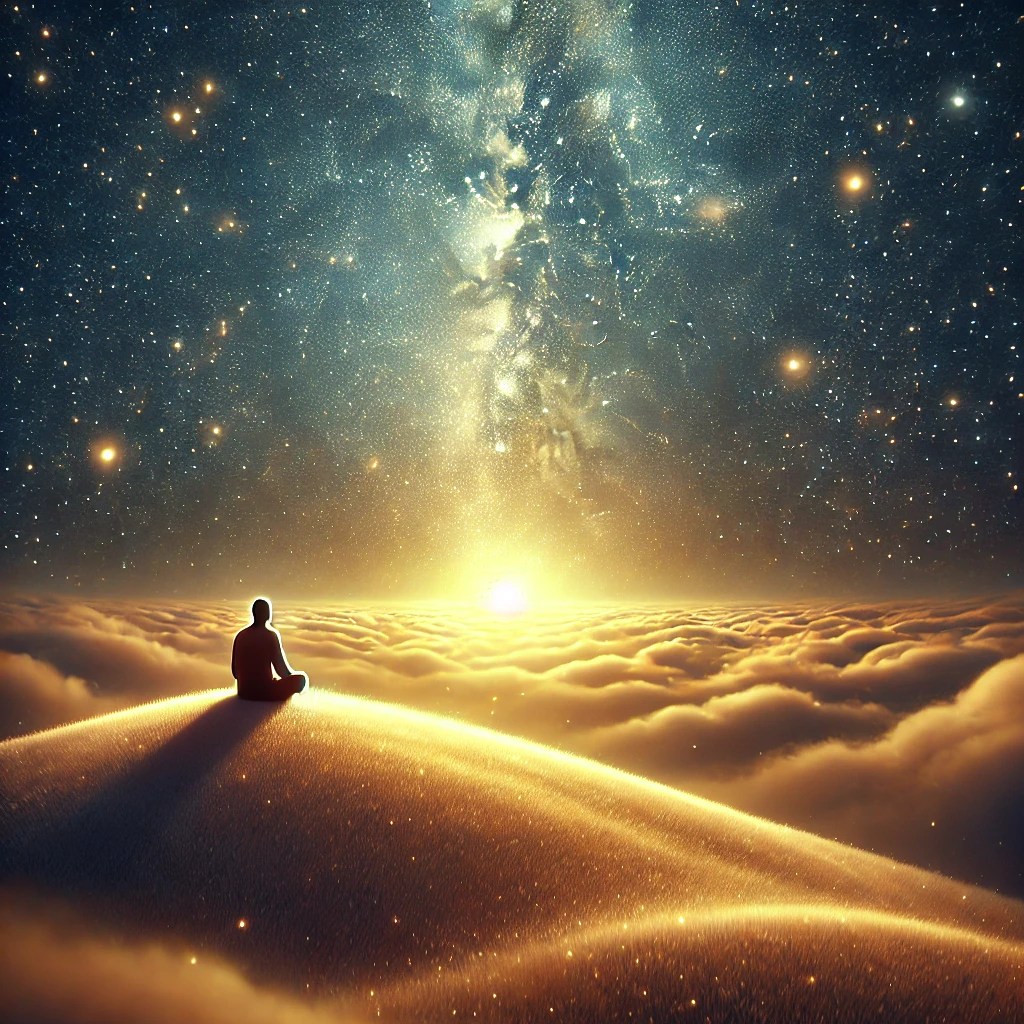
    This essay is an invitation to step beyond the veil. To move from separation to union, from belief to direct experience. To rediscover what the mystics across traditions have always known: that God is not elsewhere. God is here, now, and always—within and beyond, closer than breath, vaster than thought.

    The Illusion of Separation

    Throughout history, religion has provided humanity with stories, images, and rituals to help navigate the mystery of existence. Yet, in doing so, it has often externalized the divine, creating a subject-object duality—God as a being, separate from creation, separate from us.

    This duality is at the root of suffering. When we see ourselves as apart from the divine, we feel exiled, adrift in a world where God is distant and we are left to struggle alone. This belief in separation has led to fear, to longing, to a desperate seeking for something outside of ourselves that can restore what feels missing.

    But what if nothing was ever missing? What if the separation is only a misunderstanding, a veil drawn over the truth of our oneness with the Infinite?

    The Path of Direct Experience

    The great mystics—those who have peered beyond the veil—have all spoken of a reality beyond belief.

    St. John of the Cross, in his Dark Night of the Soul, describes a journey where all concepts, images, and even the felt presence of God are stripped away. This is not a loss but a purification, a burning away of false idols so that the soul may awaken to the unmediated presence of the divine.

    In the Jewish tradition, the Kabbalists speak of bitul, the nullification of ego, where one dissolves into the infinite Ein Sof, realizing that there never was a separate self to begin with. Similarly, in the contemplative traditions of Buddhism, the stillness of shamatha leads to the recognition of the pristine mind—that which has always been pure, unconditioned, free.

    In every tradition, we find this same invitation: to stop seeking outward and to turn inward, to surrender not to belief, but to direct encounter. To see that God is not an external entity, but the very ground of our being.

    The Return to Oneness

    When we let go of the illusion of separation, what remains?

    Not the loss of self, but its fulfillment. Not an annihilation into emptiness, but a merging into fullness—the great I Am. The “yoga” of the Vedic tradition means precisely this: union. It is the recognition that we were never apart from God, only dreaming that we were.

    This is not an esoteric teaching reserved for monks and mystics. It is the birthright of every human being. It is what Jesus meant when he said, “The kingdom of God is within you.” It is what the Psalmist knew when he wrote, “Be still, and know that I am God.” It is what every human heart longs for—not a distant deity, but the felt truth of divine presence, here and now.

    Tikkun Olam: Healing the World Through Remembrance

    When we remember our oneness with the divine, we heal not only ourselves but the world.

    The Kabbalistic tradition of Tikkun Olam, the healing of the world, is not merely about fixing external problems. It is about restoring divine unity—within ourselves, within society, within creation. The suffering of the world is the suffering of separation. The healing of the world is the return to wholeness.

    This is why this message matters. Not as an intellectual exercise, not as a theological debate, but as the most urgent and necessary work of our time. The world does not need more beliefs about God. It needs people who have remembered their divinity. People who, knowing themselves as inseparable from the infinite, act with wisdom, love, and compassion.

    This is the path of return. Not by striving, not by effort, but by surrendering to the truth that has always been. The Elohim of Genesis was never a separate being. Ein Sof has never been absent. The I Am has never ceased to be what it is.

    All that remains is to awaken.

    Conclusion: The Invitation

    If these words stir something in you, it is because they are already known. The recognition of divine oneness is not something to be attained—it is something to be remembered.

    Wherever you are, whatever your path, the invitation is the same:

    Be still. Let go. And know that you are already home.


    Addendum: Searching for What Is Already Here

    This morning, I took the cream cheese out of the fridge, opened it up, and placed a bagel into the toaster, getting everything prepared for a delicious breakfast. A simple task.

    Then, as my bagel toasted, I opened the fridge again to grab the cream cheese. But it wasn’t there.

    I checked every shelf. Nothing.

    I stood there, puzzled. I know I had cream cheese yesterday. Did I finish it? Did it somehow disappear?

    And then I turned around.

    There it was—right on the counter, exactly where I had left it, sitting open and waiting for me.

    I couldn’t help but laugh.

    How often do we search for something that was never missing? How often do we look for God as if He were distant—forgetting that the divine presence, like my misplaced cream cheese, has been right here all along?

    The moment we stop searching, we arrive.

    And sometimes, the path to enlightenment is as simple as laughing at yourself while spreading cream cheese on a bagel.

    🙏🕊🙏

  • Discovering Mystical Contemplation: The Alter Rebbe’s Practice of Hitbonenut and Bittul

    Discovering Mystical Contemplation: The Alter Rebbe’s Practice of Hitbonenut and Bittul

    Explore the transformative path of Hitbonenut and Bittul in Jewish mysticism, as practiced by the Alter Rebbe, to reach direct experience and divine unity.


    Translation of the Hebrew Text in the Above Image

    “… the esteemed Rabbi Schneur Zalman of Liadi, the great sage and author of the book Tanya, in his later years would immerse himself daily in deep contemplation and focus on achieving Hitbonenut and Bittul, self-nullification, before beginning his prayers. He would sit in a secluded area and enter a state of spiritual readiness, preparing himself to reach closeness to the divine through his meditative practices. Those who observed him would attest to the honor and respect that this revered practice commanded, reflecting his commitment to true divine connection.”


    Discovering the Boundless: The Alter Rebbe’s Practice of Hitbonenut and Bittul

    In the rich tradition of Jewish mysticism, Hitbonenut and Bittul are contemplative practices often approached as meditative paths focused on divine ideas. These practices are frequently interpreted as ways of concentrating on spiritual concepts to deepen one’s understanding. However, the Alter Rebbe, Rabbi Schneur Zalman of Liadi—the founder of Chabad Hasidism—offers us a window into a more profound dimension of these practices, where contemplation moves beyond intellectual meditation and opens into direct experience.

    The Alter Rebbe’s personal practice of Hitbonenut is a cornerstone of Chabad Chassidus. According to tradition, he would spend hours in Hitbonenut before beginning his prayers, not merely analyzing divine concepts but immersing himself in a state of awareness that dissolves the self into the infinite, what Jewish mysticism calls the Ein Sof—the boundless and limitless aspect of the divine.

    In this expansive approach to Hitbonenut, contemplation shifts from thought-focused meditation to an experiential opening, leading to what other traditions describe as the “pristine mind” or “pure contemplation.” By embracing the formless, open nature of awareness, the Alter Rebbe connected to a state beyond the grasp of the ego, inviting direct experience of the divine presence.

    This journey is deepened through Bittul, or self-nullification. Where Hitbonenut opens the door to spacious, boundless awareness, Bittul is the surrender of the self into that awareness. It’s a release of the ego’s hold, a quieting of personal identity that allows a merging with the infinite. This act of surrender is not a negation but an opening—a dissolving of the self to align fully with divine unity.

    For those of us seeking to understand Hitbonenut and Bittul in this way, the Alter Rebbe’s practice offers a reminder that contemplation in its purest form transcends the intellect. It’s not about conceptual analysis but about experiencing divine unity as a living reality. As we explore this path, we step beyond thought, into the boundless.

    In upcoming posts, we’ll further explore the practical steps, reflections, and guidance to cultivate these practices. Hitbonenut and Bittul invite us into the spaciousness of mystical contemplation, guiding us from understanding to a direct encounter with the divine.

    🙏🕊️🙏

    Book Review: Rabbi Schneur Zalman of Liadi: The Philosophy of Chabad by Nisan Mendel

    Nisan Mendel’s Rabbi Schneur Zalman of Liadi: The Philosophy of Chabad is a profound exploration of the life and teachings of one of Jewish mysticism’s most influential figures. Rabbi Schneur Zalman, known as the Alter Rebbe, was the founder of the Chabad movement, and his teachings remain central to Hasidic philosophy and contemplative practice today.

    Through this work, Mendel delves into the essence of Chabad philosophy, particularly its unique approach to Hitbonenut (contemplative meditation) and Bittul (self-nullification). Readers are introduced to the Alter Rebbe’s belief that intellectual understanding can be a pathway to divine experience, bridging the mind and heart to foster a deep connection with God. The book sheds light on the Alter Rebbe’s methods for approaching mystical contemplation, offering practical insights for those looking to incorporate these timeless practices into their own lives.

    Mendel’s accessible writing and thoughtful explanations make complex topics approachable, while his reverence for the subject shines through, bringing Rabbi Schneur Zalman’s teachings to life. This book is especially valuable for readers who wish to understand the spiritual framework of Chabad and its emphasis on meditative thought as a means to reach divine awareness.

    Whether you’re new to the ideas of Hitbonenut and Bittul or are already on a contemplative journey, The Philosophy of Chabad offers a valuable gateway to the Alter Rebbe’s approach to mysticism. By providing both philosophical insights and practical approaches, Mendel encourages readers to go beyond surface understanding and explore the depths of Chabad’s spiritual tradition.

    🙏🕊️🙏

  • A Journey Into the Infinite: The Call to Awaken to Our True Nature

    A Journey Into the Infinite: The Call to Awaken to Our True Nature

    There is a voice that calls from deep within, faint yet steady, whispering to you through the silence of your heart: “The kingdom of God is within you.” You hear it in the stillness of the dawn, in the quiet moments when the world falls away. This voice is not far from you—it is not hidden in the heavens nor buried beneath the earth. It lives in the very breath you take, in the still center of your being, inviting you to “Be still and know that I am God.”

    How often we search outside ourselves, looking for the divine in places far from our own hearts. But God, the essence of all that is, has always been nearer than we can imagine. “God is the center of my soul,” wrote St. John of the Cross, and in that hidden center, as we approach the divine, we find that it expands within us, like an infinite wellspring of love and truth. And what is this love? As St. Teresa of Avila tells us, “It is love alone that gives worth to all things.”

    You, too, are the bearer of this love, this infinite truth that resides within the deepest chambers of your soul. “At the center of our being is a point of nothingness,” Thomas Merton reminds us, untouched by the noise of the world, pure and sacred, a place where you and the divine are one. In that sacred space, the distractions of life fall away, and we see ourselves as we truly are—not bound by illusion or time, but free, radiant, and eternal.

    Just as this sacred center resides within each of us, the mystics of many traditions remind us that the divine is not something that can be grasped by the mind alone. “The infinite is concealed from all the living,” say the mystics of Kabbalah. It is not something to be dissected, understood, or named. It can only be known through the soul’s journey into the unknown, through the deep, unnameable mystery of existence. It is the same mystery that “wherever you turn, there is the face of God.” The divine pervades all things, from the rising sun to the faces of strangers on the street, from the endless stars to the quiet rustling of leaves in the wind.

    In this profound unity, “man is a microcosm of the universe,” as David Bohm said. What we are, what we become, reflects the very nature of the cosmos itself. We are not separate; we are threads in the vast fabric of existence, each one of us a clue to the whole, each one a reflection of the infinite. “The Supreme Reality is beyond both the unmanifest and the manifest,” the Bhagavad-Gita tells us. It is the eternal and all-pervading essence of life, the unnamable source from which we arise and to which we will one day return.

    To recognize this truth is to realize, as Ramana Maharshi said, that “Your own Self-Realization is the greatest service you can render the world.” Only through the shedding of the ego, the dissolution of the false self, can we see the formless reality of who we truly are—nameless, timeless, and infinite. This formless reality is the space between thoughts, the silence in which everything arises and fades—eternal, yet present within every moment, like the quiet breath of the universe itself. “There is only one truth—God,” Swami Sivananda wrote, reminding us that everything else, all the fleeting shadows of the world, are but temporary.

    This realization of our true nature, this casting off of the little self, allows us to “recognize yourself as the vast Spirit,” in the words of Swami Paramahansa Yogananda. Beyond all limitations of form and thought, we are the boundless Spirit, free and ever-expansive. What is this freedom but the awakening to the truth of what has always been? The Buddha tells us, “What we think, we become.” Our thoughts shape our world, but beyond thought lies the ultimate realization of unity—of the one truth that binds all.

    We are not separate. We have never been. “We are here to awaken from the illusion of our separateness,” Thich Nhat Hanh gently reminds us. Our divisions, our dualities, are but veils that obscure the deeper truth of our oneness. Beyond the illusions of duality—right and wrong, self and other—lies a greater reality. As Rumi said, “Out beyond ideas of wrongdoing and rightdoing, there is a field. I’ll meet you there.” In that field, where duality dissolves, we awaken to the truth of who we really are—expressions of the infinite, woven together in the fabric of existence.

    This journey into the infinite is not a process of adding to ourselves, but of shedding the illusions that have kept us from recognizing the divine within. It is a return to the essence of our being, where we find, as Lao Tzu so profoundly reminds us, “The Tao that can be told is not the eternal Tao.” The eternal truth, the infinite source, cannot be grasped by the mind; it can only be realized in the stillness of the heart.

    In this awakening, we are free. Free from the illusions of separation, free to live in the truth of our unity with all that is. As we return to this realization, we find, as St. John of the Cross said, “To reach satisfaction in all, desire its possession in nothing.” The journey is one of surrender, of letting go of all that is not real, to rest in the infinite, eternal love that is our true nature.

    This is the call that has always been with us, whispering through the silence of our hearts. It is not just a call—it is the very essence of life, the truth that lies at the core of all existence, waiting for us to embrace it. To awaken to the infinite is to recognize ourselves as the vast, boundless Spirit, and to live in the truth of our oneness with all that exists.

    🙏🕊️🙏

  • The Spark Within: A Journey of Inner Awakening

    There’s a light within each of us—an undeniable, ever-present spark. This light, though sometimes hidden, is never truly absent. It may flicker when the winds of confusion blow or dim when the shadows of doubt creep in, but it is always there, quietly waiting to be noticed, nurtured, and allowed to grow.

    For many, the journey toward that inner light is complicated by the noise of the world—by dogma, expectations, and the need to “belong” to a certain path. But the truth is, this light doesn’t belong to any one religion or tradition. It is the essence of all paths, the core of what it means to be human. And it is awake within you, even now, quietly glowing, waiting for your attention.

    Beyond Dogma, Into the Heart of Spirituality

    Perhaps you’ve felt it—this pull toward something deeper, something spiritual, but without the constraints of organized religion. Many feel this way, walking a fine line between the spiritual yearning within them and the weight of doctrines and beliefs that feel restrictive. The good news is that the essence of spirituality is not found in rigid dogma but in the spaciousness of the heart.

    The great mystics of every tradition—whether Jewish, Christian, Buddhist, or others—have pointed to the same truth: the divine is already within us. Jewish mystical teachings speak of the divine spark within every soul, a reflection of God that can never be extinguished, no matter how much the world may try to cover it.

    As we walk our own unique paths, there is no need to choose between spirituality and religious identity. You don’t have to subscribe to a particular belief system to nurture the light within you. All you need is a willingness to be present with yourself, to sit quietly with that spark, and give it space to breathe.

    Fanning the Flame

    When you feel that spark flicker, pay attention. You may not need to do anything grand. Simply acknowledge it, as you would the first sign of dawn, and let it unfold naturally. Like sunshine and water for a plant, the light within needs only a little attention, a little care, and it will grow.

    This is not about seeking or striving. It’s about letting go of the distractions that pull you in different directions and coming back to that simple truth: you already have everything you need. The divine presence you seek is already alive within you, waiting for you to notice it.

    Whether through moments of quiet reflection, connection with others, or simply being with the world around you, this light will grow. It doesn’t require the labels of religion or the boundaries of belief. It only asks for your awareness, for the quiet recognition that it is there—and that it has been all along.

    A Shared Journey

    Remember, you are not alone in this journey. Throughout history, countless others have walked the path of spiritual discovery, often feeling the same pull toward something deeper. The great mystics, the sages, the poets, and even those who quietly reflect on their own lives, have all touched this truth: that our essence is divine, that we are all connected, and that the light within us is the very light of the universe.

    You have already felt this light. You have already seen it, even if just for a moment. Trust in that, and allow yourself to be curious, to explore it further without fear or hesitation. There is no rush. There is only the gentle unfolding of what has always been true: you are that light, and it is enough.

    In today’s world, we often exchange greetings without much thought. Words like “How are you?” or, in Hebrew, “Ma Shalom Cha?”—which many now interpret as “How are you?”—slip past us with little depth or reflection. But Ma Shalom Cha is much more than just a casual greeting. In its original meaning, it asks, “How is your peace?”—“How is your inner peace? How is your connection with the divine?”

    When I met Avi, a young man on his own spiritual journey, I looked into his eyes and asked him, “Ma Shalom Cha?” At first, it seemed to him like the casual phrase he’d heard a thousand times. But when I explained the true meaning, he paused. For perhaps the first time, he understood that I wasn’t just asking how he was doing, but how his peace was. How was his soul resting in the presence of the divine?

    It was a moment of awakening, a recognition of something deeper. In that moment, Avi saw the light within himself, the divine spark that flickers beneath the surface, often hidden by the noise and distractions of modern life.

    Beyond Dogma, Into the Heart of Spirituality

    In a world where even deep questions like “Ma Shalom Cha?” have been reduced to casual greetings, it’s easy to feel pulled in different directions, confused by dogma or by what others expect us to believe. But the truth is, the essence of spirituality is not found in rigid rules or religious identities. It is found in the quiet, gentle presence of peace within each of us.

    The great mystics of every tradition—from Jewish mysticism to the teachings of the East—all point to the same truth: the divine is already within us. The spark of God, the neshama, is already alive in each soul, and it doesn’t need labels or doctrines to be real. It only asks for our attention, for us to pause and reflect: How is my peace?

    Fanning the Flame

    The modern world often reduces “Ma Shalom Cha” to a simple “How are you?” and “Ma Nishma?” to “What’s up?”—losing the sacred depth these phrases once carried. But the light within you is not lost, and the questions themselves still hold power if we let them.

    When we take the time to sit with these questions—How is my peace? How is my soul?—we give the divine spark within us space to breathe. It’s not about striving for enlightenment or seeking external answers. It’s about recognizing that the peace you seek is already there, waiting to be acknowledged. Like sunshine and water for a plant, this inner peace grows with care and awareness.

    A Shared Journey

    So I ask you, as I asked Avi: Ma Shalom Cha? How is your peace? Not as a casual greeting, but as an invitation to look inward, to nurture the light within you. And as we close, I’ll ask you a deeper question: Ma Nishma? How is your soul?

    In a world that often reduces these profound questions to surface-level exchanges, let’s reclaim their depth. Let’s reconnect with the divine spark within us, the light that ties us all together. It’s there, waiting to be seen, to be nurtured, and to grow. The peace you seek, the light you long for—it’s already within you.

    Adonai Echad—the Lord is One. It beautifully echoes the truth of oneness that transcends all divisions. In the heart of all traditions, we find this profound recognition that there is only one source, one truth, one Divine presence, no matter how we name or perceive it.

    The unity of Adonai Echad reminds us that, despite the apparent differences in our paths, we are all connected, all part of that oneness. It’s a call to embrace the shared divinity in ourselves and others, to see beyond the surface and recognize the sacred unity that binds us all.

    All you need is a willingness to be present with yourself, to sit quietly with that spark, and give it space to breathe.

    🙏🕊️🙏

  • Exploring the Origins of Thought: A Synthesis of Jung, Ramana Maharshi, Kabbalah, and Tibetan Buddhism

    In our journey to understand the nature of thoughts and the Self, we find ourselves drawing from the wisdom of various traditions—Jungian psychology, Vedanta as taught by Ramana Maharshi, the mystical insights of Kabbalah, and the profound teachings of Tibetan Buddhism. These perspectives, though rooted in different cultural and philosophical backgrounds, converge in fascinating ways, offering a profound understanding of where thoughts come from and where they go.

    The Self: A Jungian Perspective

    Carl Jung’s concept of the Self is expansive, encompassing both the conscious and unconscious aspects of the psyche. In Jungian thought, the Self is not just the sum of our conscious awareness but also includes the vast, often hidden, realm of the unconscious. Yet, Jung’s Self goes even further—it includes the totality of our being, which can be seen as connected to the divine. In this view, the Self is also God, the Infinite, the Eternal—encompassing everything, with nothing excluded.

    Ein Sof and the Infinite Source

    In Kabbalistic tradition, this concept of the Infinite is referred to as Ein Sof, meaning “without end.” Ein Sof represents the boundless, formless aspect of God, from which all creation emerges. It is the source of all existence, the primordial void from which thoughts and realities arise.

    When we combine this with Jung’s understanding, we see that thoughts can be considered as arising from Ein Sof—the infinite potential. They emerge from the stillness, the formless void, moving first into the unconscious mind. From there, they bubble up into conscious awareness, manifesting in a way that we can perceive and reflect upon.

    The Vedantic View: Ramana Maharshi on the Self

    Ramana Maharshi’s teachings on the Self resonate deeply with these ideas. He teaches that the true Self is pure awareness, beyond both the conscious and unconscious mind. The thoughts that arise within us, whether they seem to come from the unconscious or are immediately conscious, are all manifestations within this pure awareness.

    In Ramana’s framework, the conscious mind and the unconscious mind are both part of the egoic self—the sense of individual identity that is ultimately an illusion. However, by engaging in self-inquiry, we can trace our thoughts back to their true origin—the pure, infinite awareness that Ramana equates with the Self or Atman. This is the same awareness that Jung might refer to as the totality of the Self, and that Kabbalists understand as arising from Ein Sof.

    The Tibetan Buddhist Perspective: All Phenomena as Ornaments of the Dharmakaya

    Tibetan Buddhism offers a similar understanding but expresses it through the rich metaphor of the Dharmakaya, the truth body of the Buddha. According to these teachings, everything that arises—every thought, every perception, every experience—is an ornament of the Dharmakaya. This means that all phenomena are expressions of the ultimate reality, which is pure, unconditioned awareness or Buddha nature.

    There is a common saying in Tibetan Buddhism: “All phenomena are the ornaments of the Dharmakaya,” or “All sound is the sound of Dharma; all sight is the display of Dharma.” This view suggests that everything we perceive, everything we experience, is not separate from the ultimate reality but is a manifestation of it. Just as thoughts arise from and dissolve back into Ein Sof or the Self, in Tibetan Buddhism, they are seen as temporary displays of the Dharmakaya, arising from the vastness of Buddha nature.

    Buddha’s Enlightenment: Recognizing Mara as the Self

    This understanding is beautifully illustrated in the story of Buddha’s enlightenment under the Bodhi tree. As Siddhartha Gautama sat in deep meditation, Mara—the personification of illusion and desire—appeared to tempt him and distract him from his path to enlightenment. Mara represented all the fears, desires, and illusions that arise within the mind.

    However, instead of engaging with Mara as an external force, the Buddha recognized that Mara was not separate from himself. He famously said to Mara, “I know you. You are a creation of my own mind.” In that moment, by recognizing that Mara was merely a projection of his own thoughts, the Buddha disempowered Mara completely. Mara dissolved, and with that, Siddhartha Gautama achieved enlightenment, becoming the Buddha.

    This moment is a powerful example of self-realization. By recognizing that thoughts, desires, and fears are not external realities but manifestations of the mind, the Buddha transcended them. In the same way, we can see that our thoughts, no matter how powerful they may seem, arise from and dissolve back into the infinite Self, the ultimate reality.

    The Quantum Nature of Thought

    In many ways, this understanding is mirrored in the discoveries of quantum physics. Particles, which seem solid and real, are actually 99.99% empty space. They appear and disappear from the quantum field so rapidly that they seem solid and continuous, much like how thoughts arise and dissolve within our consciousness. The solidity of our thoughts—or indeed our reality—is an illusion, a fleeting manifestation from the infinite potential that is the true Self.

    Practical Application: Self-Inquiry and Meditation

    Understanding thoughts as arising from Ein Sof or as ornaments of the Dharmakaya, and recognizing them as internal projections like Mara, can profoundly inform our practice of self-inquiry and meditation. When a thought arises, we can trace it back, not just through the layers of consciousness and unconsciousness but beyond, into the infinite source. This practice can help us see the impermanence and illusory nature of thoughts and, by extension, of the ego itself.

    Through this inquiry, we can begin to experience the Self not just as a concept but as a living reality—the infinite awareness from which all arises and to which all returns.

    Conclusion

    This synthesis of Jungian psychology, Ramana Maharshi’s Vedanta, Kabbalistic mysticism, Tibetan Buddhism, and the story of Buddha’s enlightenment offers a rich, multifaceted understanding of the nature of thought and the Self. It invites us to see beyond the surface of our thoughts and experiences, recognizing them as temporary manifestations of the infinite. Whether through self-inquiry, meditation, or contemplation of these ideas, we are invited to explore the deeper reality of the Self—an exploration that can lead to profound spiritual awakening and insight.

    🙏🕊️🙏