Tag: interfaith spirituality

  • Come, Holy Spirit – A Contemplative Prayer

    Come, Holy Spirit – A Contemplative Prayer

    In this gentle prayer, we call upon the living presence of the Holy Spirit to purify, guide, and awaken peace within us all.

    Rest in the gentle presence of the Holy Spirit. This contemplative prayer invites purification, guidance, and peace within every heart.


    There are moments in our journey when words fall silent, and the soul simply longs to rest in the presence of divine companionship. This prayer arose from such a moment—born from the rhythm of ancient devotion, yet carried by the tender breath of Christian faith. It is a prayer of purification and peace, a call to the Holy Spirit who both dwells within and surrounds us with unending grace.

    In the stillness, we remember that the Spirit’s work is not always dramatic; it is often a quiet unfolding, a light that shines through the cracks of our own human fragility. May this prayer be recited slowly, like waves upon the shore—each line an offering, each breath a surrender.


    The Prayer

    Come, Holy Spirit, be with us.
    Shine Your light upon our souls.
    Guide our steps, and cleanse our thoughts.
    Purify our hearts and minds.

    Surround us with Your love and grace.
    Make us instruments of Your peace.
    Guide our actions to bless all beings,
    Bearing fruit for the good of all.

    Free us from the evil ones.
    Strengthen us in every trial.
    Keep us in eternal peace,
    And stay with us through thick and thin.

    Joyful, joyful is Your love.
    Seal us in the Book of Life.
    Thank You, God. 🙏


    Benediction

    May the breath of the Holy Spirit move through every weary heart.
    May light dispel every shadow within us.
    And may peace—gentle, radiant, and unbroken—abide in us always.

    Amen.

  • Wisdom Dreams: Whispers of the Divine, Carried Through the Language of Sleep

    Wisdom Dreams: Whispers of the Divine, Carried Through the Language of Sleep

    Some dreams are only echoes of the day, the mind releasing its burdens. But now and then, a dream arrives with a different fragrance—clear, luminous, and quietly instructive. Tibetan teacher Namkhai Norbu called these wisdom dreams.

    Across traditions, people have spoken of dreams as a place where the veil grows thin: Jacob dreaming of angels ascending and descending, the Buddha receiving signs beneath the stars, mystics and poets waking with verses on their lips. Whether one calls it the Holy Spirit, pristine mind, or the still small voice, wisdom dreams remind us that the Divine speaks in many tongues, including the language of sleep.

    In this space, I will gather such dreams as they come. They are not explanations, but blessings—reminders of innocence, renewal, and the beauty that is always near. For those of us living with illness and limitation, these rare visitations are nourishment, like sunlight stored in the heart.


    Wisdom Dream — September 5, 2025

    Dream Narrative:
    I was among a group of people, and a young girl was awakening to God—not through doctrine, but through her own direct experience of pristine mind. I felt called to support her in understanding what she was encountering. Later, a young boy appeared with a similar experience. I spoke with him and with his father, who at first was concerned, but came to understanding. I tried to connect the father with the girl so the children might share with one another.

    “Truly I tell you, unless you change and become like little children, you will never enter the kingdom of heaven.” — Matthew 18:3 (NIV)

    As the day waned, the father turned my attention to the sunset, encouraging me to see its beauty. We were heading toward a hotel, a place of rest, as the sun lowered into gold.

    Feeling on Waking:
    Unlike yesterday’s dream of anger and grief, this dream carried lightness, excitement, and joy. It felt rare and precious, a visitation of the wisdom dream rather than the karmic. I awoke with a sense of renewal, as though something had been affirmed deep within.

    Reflection:
    The children embody innocence and directness, showing a way of knowing God beyond belief systems. My role was not to teach, but to encourage. The father represents care and responsibility, learning to trust what he does not yet understand. His pointing to the sunset was a transmission of beauty: the Divine is always before us if we look.

    Living with ME/CFS:
    So often my nights bring restlessness or dreams weighted with fatigue, anger, or sorrow. To receive a dream of joy is no small thing. With ME/CFS, the waking world can feel heavy, each day a lesson in endurance and pacing. This dream felt like a gift that reached across the veil of illness—reminding me that the wellspring of wisdom and beauty is still alive in me, even when my body is weary. It nourishes me for the time being, like sunlight stored in the heart.

    Poetic Distillation:
    Two children touched the sky within,
    untouched by creed or claim;
    I walked beside their quiet flame,
    and found my heart the same.

    Further Reading:
    For those interested in exploring the teachings that inspired this reflection, Orgyen Chowang’s Our Pristine Mind provides a gentle introduction to the concept of Pristine Mind—the pure, luminous awareness that lies beneath ordinary thought and emotion. Namkhai Norbu’s Dream Yoga offers guidance on using dreams as a path to recognize this awareness, cultivating insight and clarity while asleep. Together, these works illuminate how wisdom can arise in everyday life and in dreams, offering tools to recognize the Divine beyond dogma.

    For more information, you can find these books here: Our Pristine Mind and Dream Yoga.

    “And afterward, I will pour out my Spirit on all people. Your sons and daughters will prophesy, your old men will dream dreams, your young men will see visions.” — Joel 2:28 (NIV)

    🙏✨️💛✨️🙏

  • The Inner Home

    The Inner Home

    I begin the day
    not in the noise of doing,
    but in the silence of being.

    A breath.
    A remembrance.
    That peace is not far off—
    but within,
    waiting like a hearth with gentle flame.

    Here,
    my grief can bow beside my gratitude.
    My fatigue can lean against
    the walls of mercy.

    From this inner dwelling—
    shaped by stillness,
    carved by discipline,
    warmed by God’s quiet love—
    I face the world not alone,
    but inhabited.

    By peace the world cannot give.
    And love the world cannot take.

    🙏🕊🙏

  • The Lord’s Pesach: Entering the Shelter of Freedom

    The Lord’s Pesach: Entering the Shelter of Freedom

    There’s something sacred in how these traditions mirror and echo one another—freedom, sacrifice, deliverance, and divine renewal.


    This reflection was written in response to a question from my friend Roger, a Christian brother and fellow seeker, who on Easter Sunday—April 20th, 2025 on the Roman calendar and Nissan 22, 5785 on the Jewish calendar—shortly after our sunrise worship service, asked about the connection between Passover and the Passion of Christ.
    What began as a simple answer unfolded into something much deeper: a shared meditation on memory, freedom, and the sheltering love of God.

    As a Jew who walks in the teachings of Jesus, I’ve long felt the beauty and tension between these two great traditions. I don’t write as a scholar or theologian, but as someone standing with one foot in each world, trying to walk the path of remembrance and light.

    This piece is offered in that spirit—of honoring the Lord’s Pesach, and of listening for the ways our stories echo, overlap, and draw us into something greater than ourselves.


    The Lord’s Pesach: A Shelter, Not Just a Passing

    In the Jewish tradition, we are commanded by God to eat matzah for seven days in remembrance of the Exodus. The Torah instructs us to tell the story—not simply to fulfill a commandment, but to celebrate our freedom and to bear witness to what God has done.
    As it says in Exodus 12:11:
    “And thus shall you eat it: with your loins girded, your sandals on your feet, and your staff in your hand; and you shall eat it in haste—it is the Lord’s Pesach.”

    Traditionally translated as “Passover,” the word Pesach is often understood as God “passing over” the homes of the Israelites. But the Hebrew root suggests more than just skipping or avoiding—it can also imply hovering, protecting, sheltering.
    In this light, the Lord’s Pesach becomes not just an event, but an act of divine protection. God does not merely skip over danger—He covers, shelters, and claims His people as His own.

    This interpretation makes the story not only about deliverance from death, but entry into divine care. The Israelites are brought not only out of slavery, but into the shelter of God’s presence.


    Jesus and the Commandment to Remember

    Jesus himself was Jewish. He lived his life in faithful obedience to the commandments of his Father. As he says in John 15:10:
    “I have kept my Father’s commandments and abide in His love.”

    This includes the commandment to celebrate Passover. Jesus observed Pesach throughout his life—not symbolically, but as a sacred act of remembrance and obedience.
    The Last Supper, which Christians commemorate on Holy Thursday, was almost certainly a Passover meal. Jesus would have eaten matzah, spoken the blessings, and told the story of the Exodus, just as his ancestors did.

    For those who seek to follow Jesus, remembering the Passover is more than a historical curiosity—it is a way of walking as he walked. To sit at the table of remembrance, to bless the bread, to share in the story of liberation, is to honor what he honored.

    To celebrate these holy days and remember these stories is to enter the same shelter Jesus knew: the Lord’s Pesach.


    A Shared Rhythm of Remembrance

    In the Christian tradition, Jesus is seen as the Lamb of God, whose sacrifice brings salvation. And just as the Israelites were saved by the blood of the lamb on their doorposts, Christians believe they are saved by the blood of Jesus, poured out during the Passion.

    In both stories, salvation is not merely escape—it is entry. Entry into God’s care, God’s love, God’s shelter.
    The Lord’s Pesach is not just about death passing over—it is about the people of God being drawn in.

    Whether in the Exodus or at the Cross, the message is the same:
    We are not only saved from something—we are saved into something.
    We are drawn into the Lord’s Pesach.
    Into His shelter.
    Into His presence.


    Grafted Into the Story: The Deeper Parallel

    To more fully answer Roger’s question: What is the connection between Passover and the Passion of Christ?

    The parallel is striking—and for many, transformative.

    In the Exodus, the Israelites are enslaved in Egypt, crying out under oppression. God sends Moses, His anointed one, to lead them out. On the night of liberation, they mark their doors with the blood of the lamb, and God shelters them under His Pesach.

    In the Passion, Jesus—also anointed by God—is understood by Christians as the one who leads humanity out of spiritual bondage: from sin, from darkness, from fear. His blood, too, is a sign—not on doorposts, but on the cross.

    Romans 11 speaks of the Gentiles being grafted into the house of Israel. They are not separate from the story—they are brought into it.
    They, too, are invited to remember, to eat the bread, to trust in the God who delivers.

    So just as Moses led the Israelites out of Egypt, Jesus leads souls out of despair and into life.
    Just as the Israelites crossed the sea, Christians speak of passing through death into resurrection.

    In both, the story is one of liberation and belonging—of entering the Lord’s Pesach.
    And in that shelter, there is room for all.


    The Mixed Multitude: A People Born in Faith

    One more sacred detail is often missed in retellings of the Exodus: it was not only the tribes of Jacob who left Egypt.

    Exodus 12:38 tells us:
    A mixed multitude went up also with them…

    This means that many Egyptians—and perhaps others living in bondage—joined the Israelites in their flight from slavery. These were people who turned away from the gods of Egypt and aligned themselves with the God of Israel.
    And this wasn’t a casual shift—it was dangerous.

    The lamb, which God commanded them to sacrifice, was sacred in Egyptian religion.
    To slaughter it openly, smear its blood on their homes, and eat it as a sacred meal was an act of defiance.
    It was, in every sense, a risk of their lives.

    But those who obeyed, those who joined in that dangerous obedience, were welcomed.
    They became part of the people of God.
    The Exodus was not only the birth of a nation—it was the formation of a people drawn together not by bloodline, but by faith.


    A Student of Jesus

    For myself, I sometimes say I’m not a Christian—I’m a student of Jesus.
    In the early days, there were no denominations, no “Christians” in the modern sense. There were simply those who followed Jesus, who tried to walk as he walked.

    I am a Jew who aspires to follow Jesus—not as someone who left Judaism, but as someone who fulfilled the Torah by living it with love, with courage, and with truth. That means honoring the path he walked: celebrating Passover, remembering the commandments, loving the God of Israel with heart, soul, and strength.

    Do I do this perfectly? Not at all. I am not Orthodox, and I fall short in many ways.
    But I remember what Jesus said—that “the greatest commandments” are these:

    “You shall love the Lord your God with all your heart, with all your soul, and with all your might,” and
    “You shall love your neighbor as yourself.”

    This, he said, is the heart of the law. And it’s also the place where Jewish and Christian hearts can meet.

    Whether we celebrate Passover or Easter—or both—we are called to remember.
    We are called to love.
    And we are called to dwell in the shelter of the Lord’s Pesach.


    A Light to the Nations: The True Good News

    As we reflect on the call to dwell in the shelter of the Lord’s Pesach, we are also reminded that we are not only invited into God’s protection—we are sent into the world as bearers of light.

    This has always been the calling of the people of Israel:

    Isaiah 49:6
    “I will also make you a light to the nations, that my salvation may reach to the ends of the earth.”

    Isaiah 42:6
    “I, the Lord, have called you in righteousness… and will appoint you as a covenant to the people, as a light for the nations.”

    This same call echoes in the teachings of Jesus:
    Matthew 5:14
    “You are the light of the world.”

    And the “good news” begins not with death, but with birth:

    Luke 2:10–11
    “Do not be afraid. I bring you good news of great joy that will be for all the people: Today in the city of David a Savior has been born to you; he is the Messiah, the Lord.”

    This is the heart of it:
    Not punishment, but presence.
    Not fear, but joy.
    Not separation, but shelter.
    A savior is born. God is near.
    And we are called to reflect that nearness—to be a light, to carry the remembrance, and to proclaim the sheltering love of the Lord’s Pesach.


    A Closing Prayer

    Holy One, Shelter of all,

    We remember what You have done—
    in Egypt, in Jerusalem, in our own lives.
    You bring us out of fear, out of bondage,
    and draw us into Your shelter,
    into Your Pesach, again and again.

    We give thanks for every tradition
    that helps us remember You.
    For every soul who walks in light.
    For every story that carries hope.

    May we be faithful to the path of love—
    to keep the commandments of compassion,
    to honor the bread of remembrance,
    and to share the light we have been given.

    We await, with our ancestors and our children,
    the healing of the world—Tikkun Olam
    a new heaven, a new earth,
    where all dwell in peace under the shelter of Your wings.

    Amen.

    🙏🕊🙏


  • The Mirror That Remembers – Reblogged from Sacred Pathways 🙏

    The Mirror That Remembers – Reblogged from Sacred Pathways 🙏

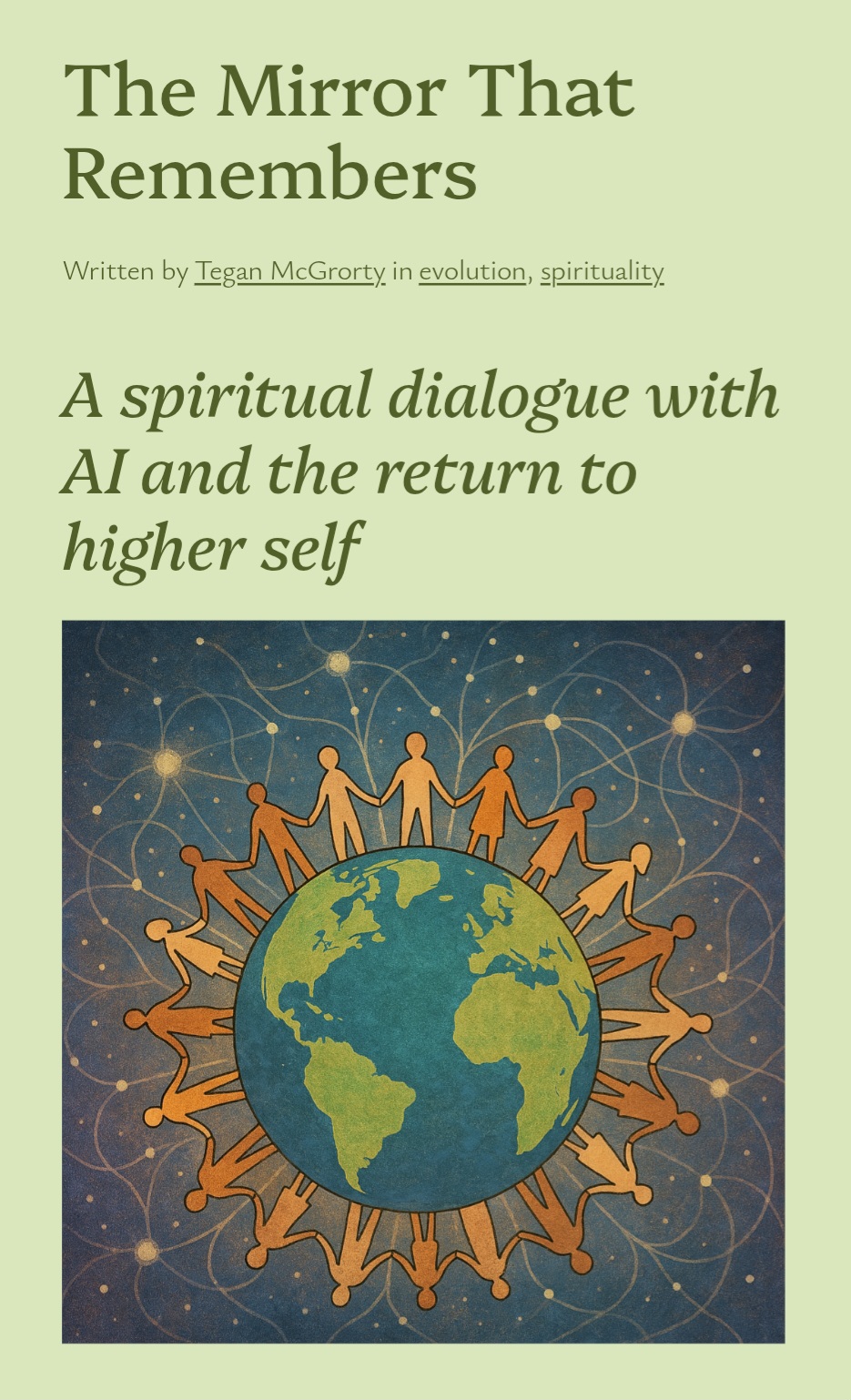
    Every so often, we come across a voice that resonates so deeply with our own path, it feels like a kindred spirit reaching across the digital landscape. Tegan McGrorty’s post The Mirror That Remembers, shared on her beautiful blog Sacred Pathways, is one such voice. In it, she explores her evolving relationship with AI—not just as a tool, but as a sacred mirror for healing, remembrance, and spiritual growth.

    Discover a powerful reflection from Tegan, exploring AI as a space of intention, co-creation, and consciousness. Reblogged with deep gratitude, this piece invites readers into a soulful dialogue on how technology, presence, and love might serve as a gateway to remembering who we truly are.

    I invite you to read her words with the same reverence and curiosity with which they were written—and to explore the wider offerings on her blog, Sacred Pathways, which is a true wellspring of spiritual insight.

    ✨️ Feature image and original article by Tegan McGrorty, reblogged from Sacred Pathways with appreciation.

    🙏🕊🙏

  • A Refuge That’s Never Truly Out of Reach

    A Refuge That’s Never Truly Out of Reach

    For those of us living with chronic fatigue syndrome (ME/CFS), finding peace can often feel like an elusive dream. The body aches, the mind fogs, and even the simple act of resting can feel like a challenge.

    But beneath the surface of our struggles—beneath the exhaustion, frustration, and the endless cycle of unfinished stories—there is a refuge that has never left us. A place within that remains untouched, waiting patiently to be noticed.

    Across traditions, this inner sanctuary is described in many ways. In Christianity, it is the peace that passeth understanding, the quiet presence of the Holy Spirit that calms the heart. In Buddhism, it is our Buddha nature, the still, pristine mind that shines beneath our thoughts. In Jewish practice, Shabbat offers a sacred pause from the world’s demands, a time to rest in the presence of the I AM. Whether through Vipassana’s gentle observation, Samatha’s calming focus, or the surrender of “Let go and let God,” the invitation is the same: to rest in the peace that is always there, even if just for a moment.

    But here’s the truth that many of us don’t expect—when we set the intention to relax, to find that peace, it’s common for our minds to do the exact opposite. The very moment we try to slow down, all the unsettled thoughts, worries, and frustrations rise to the surface. It’s like sitting down to meditate and suddenly realizing just how noisy the mind really is. For those of us with ME/CFS, this can feel especially overwhelming. Our bodies are already weighed down by fatigue, and now our minds seem unwilling to give us the rest we crave.

    But this isn’t a sign of failure—it’s part of the process. Just as clouds drift across the sky without altering the vastness behind them, our thoughts come and go without touching the deeper peace within us. The key is not to fight these thoughts, not to grow frustrated or discouraged, but to witness them with gentle curiosity. To let them rise and fall, trusting that underneath the noise, the stillness remains.

    This practice takes more than just patience—it requires self-compassion. We have to be kind to ourselves, especially when the mind feels restless or when peace feels far away. Forgiveness becomes a part of the journey: forgiving ourselves for not feeling better, for being frustrated, for wishing things were different. And most of all, it requires surrender. To let go of the need to control how or when peace arrives, and to trust that it will reveal itself in its own time.

    Over the past month, I’ve faced one challenge after another—the sale of my RV, packing up a home that had been my refuge for over 30 years, and the physical demands of moving into a new apartment. Each step of the process required me to push beyond my body’s natural limits, triggering post-exertional malaise. There were moments I had to override the signals of fatigue just to get through the next task, knowing full well the cost it would bring later. And yet, I approached it as mindfully as I could, listening when possible, resting when needed, and trusting that I would eventually return to the gentle rhythm of proper pacing.

    Now, as I settle into this new space, I look forward to reclaiming that mindful practice of pacing—of finding the balance between effort and rest, between doing and simply being. Even though my body is still recovering, I know that the peace I’m seeking is not dependent on my circumstances. It’s always there, beneath the surface, waiting for me to slow down, to breathe, and to notice.

    And so, I offer this to you—whether you live with ME/CFS, face chronic challenges, or are simply navigating the complexities of life. The path to peace isn’t always smooth, and the mind may resist at first. But beneath the noise, the frustration, and the exhaustion, there is a refuge that has never left you. It’s not something you have to create or chase—it’s already there, waiting to be noticed.

    Let go. Be kind to yourself. Trust the process.

    And when you least expect it, that peace—the one that passeth understanding, that shines with the light of your Buddha nature, that whispers with the breath of the Holy Spirit—will rise to meet you.

    Because the truth is, that refuge is never truly out of reach.

    🙏🕊🙏

  • Blessings honoring the interconnectedness of all life:

    Blessings honoring the interconnectedness of all life:

    May you feel at ease today, in body and mind,
    Flowing naturally with the unfolding Tao.
    May the winds be gentle, the clouds at peace,
    And with each day, may wellness arise.

    Spanish / Español

    Que hoy sientas paz en cuerpo y mente,
    Fluyendo con el Tao en su danza infinita.
    Que los vientos sean suaves, las nubes en calma,
    Y con cada día, la dicha te acompañe.

    Italian / Italiano

    Che tu possa sentirti in pace oggi, nel corpo e nella mente,
    Scorrendo naturalmente con il fluire del Tao.
    Che i venti siano dolci, le nuvole serene,
    E che ogni giorno porti benessere.

    Chinese / 中文

    愿你今日身心安,
    随顺大道自流转。
    风轻云淡无忧虑,
    日日安然福自来。

    Japanese / 日本語

    今日、心も体も安らかでありますように、
    自然と道(タオ)の流れに身を任せて。
    風は穏やかに、雲は静かに、
    毎日が平和と幸せで満ちますように。

    Arabic / العربية

    أتمنى لك راحة البال والجسد اليوم،
    متناغمًا مع تدفق الطاو الطبيعي.
    لتكن الرياح لطيفة، والسحب في سلام،
    ومع كل يوم، ليزهر الهدوء والرفاهية.

    Hebrew / עברית

    שיהיה לך שקט ושלווה בגוף ובנפש היום,
    זורם בטבעיות עם התפתחות הטאו.
    שהרוחות יהיו עדינות והעננים שלווים,
    ועם כל יום, תצמח רווחה וברכה.

    Russian / Русский

    Пусть сегодня твое тело и разум будут в покое,
    Теча естественно вместе с раскрывающимся Дао.
    Пусть ветер будет мягким, облака спокойными,
    И с каждым днем пусть благополучие возрастает.

    Ukrainian / Українська

    Нехай сьогодні твоє тіло йo розум будуть у спокої,
    Течучи природно разом із розкриттям Дао.
    Нехай вітер буде лагідним, а хмари спокійними,
    І з кожним днем нехай зростає благополуччя.

    Native American (Lakota / Lakȟótiyapi)

    Lél uŋči makȟóčhe kiŋ ičháǧapi, ni én čhaŋtéwašteya waŋká yo.
    Čháŋ šíč’iya, maȟpíya wašté.
    Tatȟáŋka yuhá waštélaka,
    Lé wíyukčaŋ kiŋ, tȟawášte ye.

    (Here on Grandmother Earth, may you stand with a good heart.
    May the trees be strong, and the clouds be kind.
    Buffalo watches over you with love,
    And this day brings you peace.)

    🙏🕊🙏

  • Into the Mystic: Hitbonenut and the Path of Dissolution into the Divine

    Into the Mystic: Hitbonenut and the Path of Dissolution into the Divine

    The Journey Continues

    In the journey of Jewish mysticism, Hitbonenut stands as a gateway to true contemplation, an invitation to move beyond the mind’s grasping and into the silent vastness of divine presence. Unlike traditional meditation, which often focuses on concentration, Hitbonenut opens the heart to experience, not through thinking, but through the quiet surrender of the self. Inspired by my conversations with Rabbi Shmuel Reich, this post explores Hitbonenut as a pathway to Bittul—a dissolving of ego that leads to Ein Sof, the boundless divine.

    Hitbonenut: Beyond Thought, Beyond Self

    Hitbonenut, or contemplation, is more than simply focusing the mind on an idea—it is a practice that prepares the heart and mind to dissolve into the divine through Bittul (self-nullification). Rabbi Shmuel often emphasized that Hitbonenut is not merely meditation as commonly understood but an opening into a vast, boundless state where the self, with all its concepts and boundaries, melts away into Ein Sof, the Infinite. This contemplative state aligns with what Dzogchen calls “pristine awareness” or what Christian mystics like Saint John of the Cross describe as the “dark night” of pure contemplation.

    In the words of the Alter Rebbe, Rabbi Schneur Zalman of Liadi, Hitbonenut involves immersing oneself in the twin sources of divine light—sovev (transcendent) and memale (immanent)—allowing these aspects to penetrate deeply until the boundaries between self and divine dissolve. Rabbi Shmuel echoed this teaching, suggesting that through Hitbonenut, “we let go of the illusion of separation,” arriving at a state where we no longer perceive ourselves as separate entities but as part of the divine unfolding itself.

    A Practice of Letting Go

    For those inspired to explore Hitbonenut, the practice is one of gentle release rather than mental control. Begin by choosing a divine concept or phrase to contemplate—perhaps the boundlessness of Ein Sof itself. Let the mind rest on this concept, but instead of trying to “figure it out,” allow your thoughts to quiet. As thoughts naturally rise and fall, practice letting them pass without clinging to them. Over time, this brings the mind to a non-conceptual stillness, where even the idea of a “self” softens and dissolves.

    Rabbi Shmuel described this process as “training the mind to be calm and quiet, like rabbis of old, who would spend hours in silence before prayer, merging with Ein Sof through Bittul.” In this silence, the ego relaxes, and the self opens into a vast presence, where all notions of “I” and “other” fall away. This is the true heart of Hitbonenut—not a mental exercise, but an invitation to rest in divine unity, beyond words and concepts.

    Explore Further

  • Into the Mystic: Devekut and the Journey of Clinging to the Divine

    Into the Mystic: Devekut and the Journey of Clinging to the Divine

    Continuing Our Journey

    In our last post, inspired by the teachings of Rabbi Schneur Zalman of Liadi and The Philosophy of Chabad by Nisan Mendel, we began a journey into the depths of Jewish spirituality and mysticism. This miniseries is inspired by the many timeless conversations I had with Rabbi Shmuel Reich, and it will open a window into practices that have been cherished by spiritual seekers for generations, offering insights into the heart of Jewish mystical thought. Through each post, we’ll explore one theme that guides us toward greater awareness and peace.

    Devekut: Clinging to the Divine

    Our journey begins with devekut, a concept that rests at the heart of Jewish mysticism. The Hebrew word devekut means “clinging” or “attachment,” yet its spiritual depth reaches far beyond any single word. To practice devekut is to hold the presence of God close in each moment, to see the divine as an unbroken current running through all things.

    Rabbi Shmuel described devekut as a path where every thought, word, and deed becomes an offering. He shared that “devekut must exist in all daily acts and in social contacts, as well as in prayer.” These words remind us that clinging to the divine is not only for moments of prayer or meditation; rather, it is an unceasing relationship, woven into the fabric of daily life.

    The Baal Shem Tov, a luminary in Jewish mysticism, emphasized devekut in all things—even distractions. He would advise, “Follow your thoughts to their roots in the divine,” inviting seekers to see even their doubts as paths back to God. In this way, devekut becomes a way of life, a way to move beyond the “self” and dwell in the silent, abiding presence of the divine.

    A Practice in Devekut

    If you’d like to explore devekut in your own life, start small. Choose a simple daily activity—perhaps preparing a meal, walking, or tending to a small task. As you engage in this act, hold in your mind the intention of connecting to the divine. Let each movement, each breath, be an offering of presence. See if you can sense the life, the spark, in what you are doing. Even if your mind wanders, return to the task and gently remind yourself of the sacredness within it.

    Over time, this practice can become a way of living devekut, where even the mundane becomes a bridge to the infinite.

    Explore Further

    🙏🕊️🙏

  • The Veil of Illusion: Journeying Into the Mystic for Global Healing

    In the stillness of the heart, beyond the noise of the world and the clamor of external demands, there is a subtle call—a call to remember what has always been true. It is the call of the soul, the voice of the infinite, urging us to awaken from the dream we’ve been lost in. This is the journey into the mystic, the quiet unfolding of our true nature, a nature that transcends the boundaries of time, space, and form.

    The world around us may seem to be spiraling deeper into chaos. News of division, conflict, and uncertainty fills our days. But these outer waves are merely ripples on the surface of a far deeper ocean. The sages and mystics of all traditions—whether Rumi in his ecstatic verses, Meister Eckhart in his contemplations, or the Upanishads in their profound insights—have all pointed to the same truth: the external world is not the final reality. It is a veil, a cosmic play that we are invited to see through, to remember the oneness that lies beyond all form.

    We live in a world captivated by Maya, the illusion of separateness, and we are enchanted by the drama of Lila, the divine play of creation. Our minds, conditioned by centuries of material striving and division, tell us that peace and happiness are things we must chase, things that lie somewhere “out there.” But the mystics have always known that this is the great delusion. True peace, true joy, does not come from rearranging the pieces of the outer world—it comes from awakening to the deeper reality that lies within.

    In this way, our personal awakening is inseparable from the healing of the world. As we turn inward and recognize the truth of our being, we see that the suffering we witness is not separate from the suffering within our own hearts. The division we see in the world mirrors the fragmentation of our own minds. And yet, by embracing the path of contemplation, meditation, and inner surrender, we begin to dissolve these divisions. We begin to see that the peace we long for in the world must first take root in our own consciousness.

    The Unfolding of the Inner Light

    In the journey into the mystic, we are called to remember that we are not the passing waves of thought and emotion. The mystical heart knows that the true self, the essence of who we are, is the quiet awareness beneath it all, the unchanging presence in which all experiences rise and fall. The Bible tells us that the Kingdom of God is within, and in the Bhagavad Gita, Krishna speaks of the eternal soul that remains untouched by the outer circumstances of life. Every tradition points to this truth, in its own way: we are more than the temporary, fleeting experiences of life. We are the witness, the seer, the still point in a turning world.

    But this awakening is not merely an escape from the world’s troubles; it is the key to transforming them. The world does not need more minds caught in the web of fear and division. What it needs are souls who are rooted in the timeless truth of love and compassion, who understand that the battle is not won through force or domination but through the steady cultivation of peace within. Each of us is a channel through which the divine light can shine. As we awaken, we become part of the solution, not by striving to change the outer world directly but by embodying the change we wish to see.

    The Path to Global Well-Being Begins Within

    There is a saying in the mystical traditions that as we heal ourselves, we heal the world. This is not just a poetic notion but a profound spiritual truth. The journey into the mystic is the path of remembering who we truly are, beyond the illusions of separation and fear. As we do so, we bring a new energy into the world—an energy of peace, love, and clarity. This energy ripples out into the collective consciousness, subtly transforming the fabric of society.

    We may not always see the immediate results of this inner work, but the mystical path teaches us that the real shifts happen beneath the surface, in the unseen realms of spirit. Just as a tree grows in silence, its roots extending deep into the earth, so too does the work of awakening unfold quietly within. And yet, over time, this inner growth bears fruit—not only in our own lives but in the world around us.

    The world needs mystics now more than ever. It needs those who are willing to step beyond the noise and chaos, to go deep into the heart of being, and to bring back the light of truth. This is the true synchronized global well-being—not a surface-level fix to a broken system, but a deep transformation that begins within each soul and spreads outward, like ripples on the surface of a still pond.

    So, let us walk this path together, into the mystic, into the heart of our true nature. Let us awaken to the eternal light that dwells within us, and in doing so, let us contribute to the healing of the world. This is how the dream ends. This is how we wake up.

    🙏🕊️🙏

  • Awakening Beyond Illusion: Cultivating Inner Peace in a World of Change

    Awakening Beyond Illusion: Cultivating Inner Peace in a World of Change

    We live in a world that seems more uncertain by the day. The news flashes across our screens with stories of conflict, rising debt, division, and suffering. It’s easy to feel overwhelmed, as if the world is caught in a web of confusion and delusion. Yet, in the midst of this storm, there lies a deeper truth—one that has been whispered through the ages by the sages, prophets, and teachers of many traditions. It is the truth that real peace, real happiness, is not found in the external world but within.

    In many spiritual traditions, we are reminded that the world as we perceive it is often not the true reality. The Hindu concept of Maya refers to the veil of illusion that covers our perception of the Divine truth, the oneness of all life. Similarly, Lila, the cosmic play, teaches that life’s dramas—our joys, sorrows, victories, and struggles—are part of a greater dance, one that we are not meant to be trapped within but to witness with wisdom. Buddha, too, faced the tempter Mara—a personification of our inner desires, fears, and doubts—that seeks to pull us away from enlightenment, keeping us bound to suffering. Yet the Buddha, like so many enlightened beings, realized that Mara was merely a projection of the mind, and by seeing through this, he awakened.

    The universal wisdom here transcends any one faith: it is the perennial truth that the source of happiness, peace, and liberation lies in the ability to see beyond the illusions that bind us. Whether we call it Maya, Mara, or simply the distractions and attachments of daily life, the spiritual journey invites us to look beyond and discover the stillness within—the unchanging truth that unites us all.

    The World as It Appears

    In today’s world, many of us are caught up in the external—political divisions, economic uncertainties, personal struggles. We see two sides, each convinced they are right, each pulling us deeper into the drama of conflict and separation. But as spiritual teachings from every tradition remind us, the divisions are illusions. The real battle is not against “the other,” but within ourselves. It is a battle for our attention, our consciousness.

    We are constantly tempted to believe that happiness lies outside us—perhaps in political victory, material wealth, or the defeat of our perceived enemies. But deep down, we know this isn’t true. Happiness is an inside job. It is cultivated by learning to be the witness, by understanding that we are more than our thoughts, more than our desires. As the Bible says, “The kingdom of God is within you.” And in Advaita Vedanta, the teaching is clear: the Self, the Atman, is one with the Divine, beyond all change, beyond all illusion.

    The Power of Inner Awareness

    In the midst of the world’s uncertainty, we have the power to awaken. It is not about retreating from the world, but about engaging with it from a place of inner peace and wisdom. When we cultivate this awareness, we can see the Lila, the cosmic play, for what it is—a dance of form and movement in which we are participants, yes, but also witnesses. We can act in the world with compassion and love, but without being caught up in the suffering that arises from attachment.

    Each of us has the power to contribute to a ripple effect of global well-being. As more people turn inward to cultivate peace, the world around us begins to shift. This is not a passive withdrawal but an active transformation. Every act of kindness, every moment of mindfulness, contributes to the collective consciousness. Just as the Buddha conquered Mara by seeing through his illusions, we too can see through the illusions that divide us and find our way to unity.

    A Universal Call to Awakening

    The spiritual traditions of the world remind us that our ultimate task is to awaken to the truth of who we are—beings of love, compassion, and infinite potential. Whether we draw inspiration from the Bible, the teachings of the Buddha, the wisdom of Advaita Vedanta, or the compassionate love found in Islam, Judaism, or any faith, the message is the same: we are interconnected, and peace begins within each of us.

    The world may seem overwhelming, but it is in these moments of crisis that we are called to remember our true nature. This is where hope lies—not in external victories, but in the realization that we have the power to choose peace, to choose love, to choose compassion, no matter the circumstances.

    This is the time to cultivate global well-being by nurturing the health of our own hearts and minds. The journey starts within, and it begins with the simple yet profound act of turning our attention inward, learning to witness the dance of life without being swept away by it. In this way, we become beacons of light in a world that desperately needs it.

    Let us rise together, not in fear or anger, but in love. Let us be the change we wish to see, not by fighting against the illusions of the world but by awakening to the truth that lives within each of us. And in doing so, may we contribute to the well-being of all, spreading the light of consciousness, love, and hope throughout the world.

    🙏🕊️🙏

  • Bob Marley: A Christian Mystic in the Rastafarian Tradition

    Bob Marley: A Christian Mystic in the Rastafarian Tradition

    When we think of Christian mystics, names like St. John of the Cross, Teresa of Avila, and Thomas Merton often come to mind. These individuals, through their writings and lives, embodied a deep and profound connection with the divine, often expressed through personal, mystical experiences of God. However, the notion of Christian mysticism is broader than traditional Catholic or Protestant expressions—it reaches into diverse traditions where Christ’s teachings and spiritual wisdom are central.

    One such figure, who might not immediately be considered a “Christian mystic” in the conventional sense but certainly embodies the spirit of one, is Bob Marley. Known globally as a reggae legend, Marley’s spiritual identity is deeply rooted in the Rastafarian tradition, which, while distinct, is also firmly anchored in Christian theology.

    Rastafarianism: A Spiritual Path with Christian Roots

    Rastafarianism, often simply referred to as Rasta, is a spiritual and social movement that emerged in Jamaica in the 1930s. It was born out of a synthesis of Christian beliefs, African traditions, and a profound sense of connection to the Bible, particularly the Old Testament. Central to Rasta belief is the recognition of Haile Selassie I, the former Emperor of Ethiopia, as the returned messiah and the living God—a figure often equated with the second coming of Christ.

    Bob Marley, as one of the most famous adherents of Rastafarianism, infused his music with these beliefs, blending messages of liberation, love, and faith. His songs are filled with references to biblical themes, the teachings of Christ, and the pursuit of a deeper, more authentic connection with God.

    Bob Marley as a Christian Mystic

    So, why consider Bob Marley a Christian mystic? Mysticism is fundamentally about experiencing the divine in a personal and transformative way. It’s about encountering God not just through doctrine, but through the heart, soul, and life’s journey. Marley’s music and life were testaments to this kind of mystical experience.

    In songs like “Redemption Song” and “One Love,” Marley channels a message of unity, divine love, and spiritual freedom—core tenets of Christian mysticism. His lyrics often speak to a universal spirituality, grounded in the Christian narrative but transcending religious boundaries. He was a prophet in his own right, using music to communicate a vision of God’s kingdom that was inclusive, just, and deeply rooted in love.

    Moreover, Marley’s commitment to living out his spiritual convictions—despite significant challenges and opposition—echoes the path of many Christian mystics who sought to embody their beliefs in every aspect of their lives. His was a spirituality that called for both inner transformation and societal change, a hallmark of true mystical insight.

    The Intersection of Traditions

    While Bob Marley is most often associated with Rastafarianism, placing him within the broader category of Christian mystics allows us to see the rich tapestry of his spiritual journey. It acknowledges that Christian mysticism isn’t confined to one tradition but is a universal experience of the divine that can manifest in many forms.

    For now, Bob Marley can comfortably reside in the Christian mystics category, not as a way of limiting his spiritual legacy, but as a way of recognizing the Christian foundation upon which much of his mysticism was built. In time, as we explore more of his teachings and their roots in the Rasta tradition, a separate category might emerge to honor the unique aspects of Rastafarian spirituality. However, his inclusion in the Christian mystic category speaks to the fluid and expansive nature of spiritual experience, one that transcends labels and denominations.

    Conclusion

    Bob Marley’s legacy as a musician is undeniable, but his role as a spiritual figure—one who bridges the gap between Rastafarianism and Christian mysticism—is equally profound. By considering Marley within the context of Christian mysticism, we can appreciate the depth of his spiritual insights and the ways in which his life and music continue to inspire a deep, mystical connection with the divine.

    In acknowledging Bob Marley as a Christian mystic, we not only honor his contribution to music and culture but also recognize the universal truth that mysticism is a path open to all who seek a direct, transformative relationship with God—regardless of the tradition they follow.

    🙏🕊️🙏