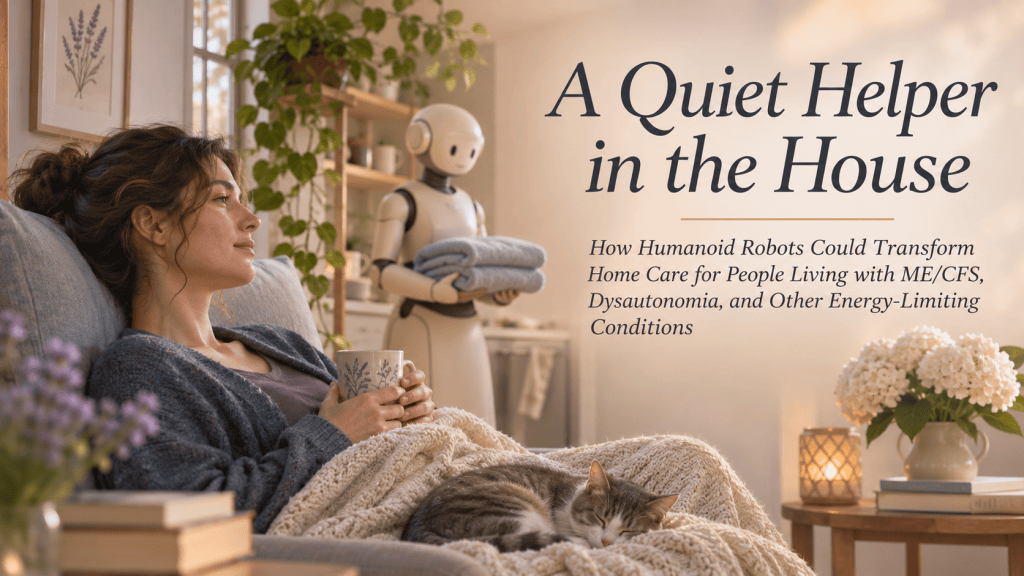
How Humanoid Robots Could Transform Home Care for People Living with ME/CFS, Dysautonomia, and Other Energy-Limiting Conditions
To some people, the idea of having a humanoid robot in their home might sound like a futuristic luxury—a marvelous convenience for people who can afford one.
But for millions of people living with chronic illness, disability, or recovering from serious illness or surgery, such technology could eventually mean something far more important: greater independence, freedom from unnecessary physical demands, and more energy for the things that make life worth living.
I’ve lived with myalgic encephalomyelitis/chronic fatigue syndrome (ME/CFS) for more than thirty years, along with dysautonomia. Today, I’m mostly homebound. On a good week, I may leave my apartment once or twice. Some weeks, I don’t go out at all.
I’m fortunate that I can still get out of bed, prepare some meals, and care for many of my daily needs. But virtually everything requires careful pacing. Overexertion can worsen my symptoms for days or longer.
Others living with this illness are far more severely affected, sometimes unable to leave their beds.
So when I imagine a future in which a capable, quiet robotic helper might share my home, I’m not dreaming about technological extravagance.
I’m imagining having a little more of my precious energy available for friendship, creativity, meaningful work, or simply enjoying an ordinary day.
And I wonder how many other lives might be transformed by that same possibility.
The Invisible Cost of an Ordinary Day
One of the difficulties of living with ME/CFS is that the illness is often invisible to people who haven’t experienced it.
If you see me preparing a meal, walking down the hallway, or carrying a few groceries, you might reasonably conclude that I’m managing quite well.
And sometimes I am.
What you cannot see is what those activities may cost me afterward.
ME/CFS involves more than persistent fatigue. Its defining features include post-exertional malaise, or PEM, in which physical, cognitive, emotional, or sensory exertion can trigger a worsening of symptoms. Sometimes the consequences don’t become apparent until the following day. Recovery may take days, weeks, or longer.
Dysautonomia adds another dimension. Simply remaining upright can be difficult when the autonomic nervous system isn’t regulating bodily functions properly.
The Centers for Disease Control and Prevention recommends an approach called pacing: learning to stay within one’s individual limits rather than repeatedly exceeding them and triggering symptom flare-ups.
After thirty years, I have become intimately acquainted with those limits.
I’ve also learned to think about something I call my energy buffer. It is the reserve of capacity I try to protect so that I can continue participating in life without repeatedly exhausting myself.
Every ordinary task draws from that reserve.
The cost isn’t necessarily the activity itself. It’s what may become unavailable afterward.
If I spend too much energy taking care of my apartment, there may be less available for a conversation with a friend, a little writing, or an occasional outing.
Sometimes the wisest use of my energy is simply to rest.
For someone recovering from surgery, assistance with household activities might make a difficult period more manageable. For someone with a permanent disability, it could support years of greater independence. And for someone with severe ME/CFS or Long COVID, reducing the physical demands of everyday life might help them remain within their limited capacity.
The needs are not medically identical, but they share an important human question:
What if the physical work of maintaining a home didn’t have to consume so much of the energy available for living in it?
Imagining a Different Kind of Household Companion
I imagine a quiet morning in my apartment.
I’ve had breakfast. There are dishes in the kitchen, a little laundry waiting, and perhaps some groceries to put away.
Normally, each of those things requires a decision. Do I have enough energy? Can it wait? What else might I need to give up?
But perhaps one day I’ll be able to say:
"Would you mind taking care of the kitchen while I rest?"
And my little robotic helper will quietly go about its work.
No drama. No complicated instructions. No demand that I get up and supervise every movement.
Just a bit of ordinary help.
I might ask it to bring me water, retrieve something from another room, carry groceries from the door, or prepare a simple meal.
Perhaps it could wash the dishes, fold laundry, take out the trash, or tidy the apartment.
These are not glamorous accomplishments. They are the everyday tasks that allow a person to live comfortably in their own home.
And for someone with a severely limited energy supply, relieving even a portion of that burden could be extraordinary.
Of course, not all assistance involves the same degree of risk.
A robot carrying a towel is very different from one helping someone transfer from a bed to a wheelchair. Handling medications, preparing hot food, or providing physical support would require appropriate safeguards, testing, and, in some cases, clinical oversight.
I wouldn’t want developers to rush into the most complicated caregiving tasks simply because the technology looks impressive.
I would be delighted with a robot that reliably performed a handful of simple, useful things.
And I suspect many other people living with disabilities would feel the same.
The Most Important Feature Might Be Knowing When to Be Quiet
There is something else I would want robotics developers to understand.
For people with ME/CFS and related conditions, assistance itself can become exhausting when it requires too much attention.
Imagine a robot that continually asks questions, needs instructions repeated, sends unnecessary notifications, or interrupts someone who is resting.
It might be technologically sophisticated while still being a poor companion.
The home-care robot I envision would be quiet, predictable, and easy to communicate with.
It would understand simple requests and remember appropriate preferences without becoming intrusive.
It would respect the person’s privacy, provide clear control over any cameras or monitoring features, and remain responsive to the person’s wishes.
It would also be safe to stop, easy to override, and designed to fail without putting anyone in danger.
Most importantly, it would recognize that the person being assisted remains in charge.
I wouldn’t want a robot deciding that I should be more productive, get more exercise, or reorganize my daily routine according to its own ideas of healthy living.
I already have enough challenges without being managed by my appliances.
A good assistant should help me preserve the freedom to make my own choices.
Sometimes that means doing something useful.
Sometimes it means leaving me in peace.
And I think the ability to know the difference may eventually become one of the most important measures of compassionate artificial intelligence.
From Hospitals to the Privacy of Our Own Homes
There are encouraging signs that developers are beginning to explore these possibilities.
Robots already transport supplies and perform other supporting tasks in some healthcare institutions. Researchers are investigating additional applications in hospitals, nursing homes, rehabilitation settings, and elder care.
In September 2026, the Japanese company ZEALS tested its compact humanoid D1 in a Tokyo nursing-care facility. The two-day demonstration included navigating elevators, transporting lightweight objects, and serving tea.
The trial revealed both possibilities and limitations. Although the company reported that the robot operated without collisions or falls during the demonstration, handling tea still presented challenges involving stability and repeatability.
I find that encouraging, not discouraging.
Real-world development involves discovering what doesn’t yet work reliably and learning how to make it better.
I’ve also been following Elon Musk’s work on Tesla Optimus with considerable interest.
In its October 2026 quarterly update, Tesla reported that early production of Optimus humanoid robots had begun in Fremont, California.
That is a manufacturing milestone, not evidence that Optimus is ready to provide unsupervised home care.
Building a useful robot for industrial or commercial applications is one challenge. Creating a dependable assistant that can operate safely in the unpredictable surroundings of an ordinary home is another.
Our homes contain furniture, pets, uneven floors, unexpected obstacles, and people whose needs may change from one day to the next.
And unlike a hospital or factory, a private home may have no technician standing nearby.
A robot intended for home assistance must therefore demonstrate a level of reliability, safety, privacy protection, and practical usefulness that goes far beyond an impressive demonstration.
We are not there yet.
I don’t know whether the technology I envision will arrive in three years, five years, ten years, or longer.
But I can see why it is worth pursuing.
And I would love for developers working on humanoid robotics and assistive technology to include people living with chronic illness and disability in the design process from the very beginning.
After all, the people who need assistance are often the people best positioned to explain what useful assistance actually means.
Making Independence Affordable
Even if engineers succeed, another enormous question remains.
Who will be able to afford these machines?
A sophisticated home-care robot might initially be far beyond the means of many of the people who would benefit most.
That is why I find the possibility of a robot-as-a-service model so interesting.
Rather than purchasing an expensive humanoid robot outright, perhaps households could eventually subscribe to a service that provides the robot, maintenance, repairs, software updates, and technical support.
Ideally, the person receiving assistance would not need to become a robotics technician simply to keep the machine working.
Such a service might one day be offered at a manageable monthly cost. Whether that becomes economically realistic remains to be demonstrated.
There is also a possibility worth exploring with healthcare insurers and policymakers.
Medicare already recognizes that certain types of assistive equipment can be medically necessary for people living at home.
Under Original Medicare’s durable medical equipment rules, eligible beneficiaries generally pay 20 percent of the Medicare-approved amount for covered equipment after meeting the Part B deductible, assuming the supplier accepts assignment.
California has gone a step further in one particular area.
Since September 1, 2024, the state’s Medi-Cal program has covered certain assistive robotic arms when strict medical-necessity requirements are met. These devices attach to compatible powered wheelchairs and can help eligible users perform everyday activities more independently.
As Disability Rights California explains, this is a carefully limited benefit involving specific disabilities, evaluations, and equipment requirements.
It is not approval for a general-purpose humanoid home-care robot. Nor does it mean that Medicare currently provides coverage for the kind of companion I’m imagining.
But it demonstrates that the idea of robotic assistance as medically necessary technology is not entirely without precedent.
Could future home robots qualify under some form of assistive-technology benefit? Might Medicaid home- and community-based services offer another possible framework? Could a new reimbursement model emerge for people whose independence depends upon regular household assistance?
I don’t know.
Those are questions for researchers, insurers, policymakers, disability advocates, and the people who might use these systems.
And they deserve serious consideration.
Measuring What Actually Matters
If researchers eventually begin evaluating humanoid robots for home care, I hope they’ll look beyond the usual measures of technological performance.
Certainly, a robot must be safe. It must be reliable, capable, maintainable, and affordable.
But suppose a robot successfully completes twenty household tasks in a day.
What does that really tell us about the life of the person it serves?
Perhaps we should also ask whether the person experiences less physical exertion, fewer burdensome interruptions, or greater freedom to manage daily activities.
For people with ME/CFS, researchers might investigate whether robotic assistance helps them stay within their energy limits or reduces episodes of post-exertional malaise.
For people with mobility impairments, they might measure changes in independence, safety, and the ability to remain at home.
For family caregivers, they could examine whether appropriate robotic assistance reduces some of the repetitive physical demands of caregiving while preserving meaningful human contact.
And for everyone, we should ask whether the benefits outweigh the costs, risks, maintenance needs, and additional complexity.
These are research questions, not established outcomes.
But they point toward something I believe is important.
The success of a home-care robot should not be measured only by how much work it performs, but also by how much of the person’s life becomes available again.
That difference matters.
Someone who no longer has to spend their limited energy preparing dinner might have a little more available to enjoy eating it with a friend.
Someone who receives help with ordinary household tasks might be able to spend more time pursuing an interest, participating in family life, or simply resting without the burden of unfinished necessities.
And someone who is mostly bedbound might gain a small measure of choice and independence that they haven’t enjoyed in years.
Not everyone would benefit in the same way, and no technology can promise those results.
But the possibilities are certainly worth investigating.
A Few Breadcrumbs for the Future
At this point in my life, I’m an older man living alone in a small apartment, doing my best to care for myself while respecting the limitations of a long and difficult illness.
I have wonderful interests, ideas, friendships, and creative projects that continue to give my life meaning.
What I don’t have is an unlimited supply of energy with which to pursue them.
So yes, I find myself looking forward to the day when a quiet, capable robotic companion might help me with the physical demands of everyday life.
I’m even thinking about saving my pennies.
If this technology becomes practical and affordable during my lifetime, I would love to welcome one of these remarkable helpers into my home.
Not because I want to surround myself with machines.
But because I would like more freedom to participate in the human world.
I would like technology to make room for friendship rather than replace it. To support independence without taking away agency. To relieve some of the demands of illness without pretending that illness has disappeared.
And I would like people with far more severe disabilities than mine to have access to possibilities that might substantially improve their lives.
Perhaps this article will someday find its way to someone developing humanoid robots, designing assistive technology, studying disability, or reconsidering how home-care services might be delivered.
If it does, I hope they’ll hear more than enthusiasm for a new machine.
I hope they’ll hear the voice of someone who has spent over thirty years learning how precious a little bit of energy can be.
And if you live with ME/CFS, dysautonomia, Long COVID, or another condition that limits your daily activities, I would be interested to know what ordinary tasks you would most welcome help with.
What would meaningful assistance look like in your own home?
We are still a long way from knowing precisely what these technologies will become.
I’m simply leaving a few breadcrumbs while continuing to walk my own path, in the hope that someone else might find something useful along the way.
Because the future I imagine isn’t really about robots.
It’s about people.
And about the possibility of giving some of their lives back to them.
A Note from the Author
Richard Silverman is an independent writer exploring compassion, contemplative living, and the quiet possibilities of finding peace and hope amid life’s challenges.
His writing is shared freely, in the hope that it may offer a little companionship, encouragement, or inspiration along the way.
If these reflections have been meaningful to you, and you would like to help sustain this work, you are warmly invited to support his writing through PayPal.
Thank you for being here. 🙏🪷

