Tag: heart sutra

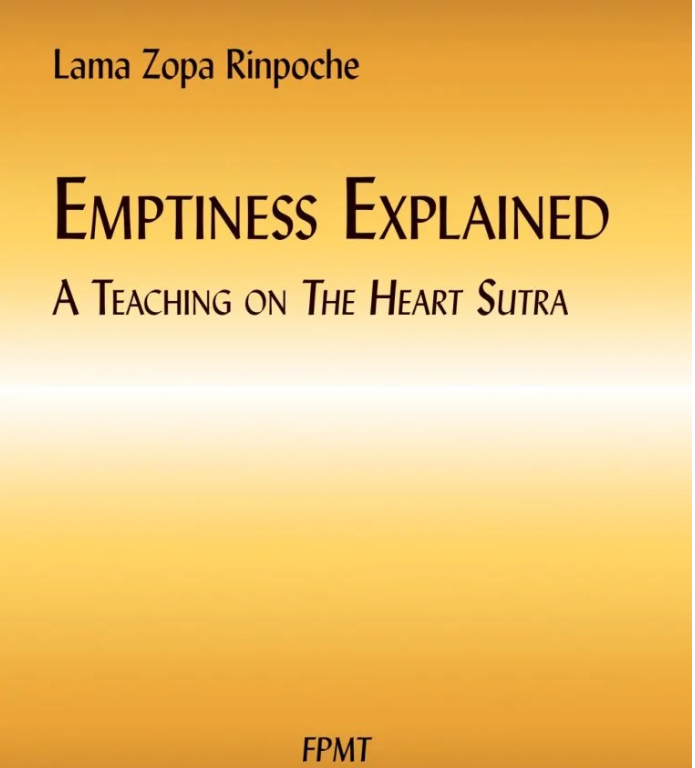
  • Emptiness Explained: Insights from Lama Zopa Rinpoche on the Heart Sutra

    Emptiness Explained: Insights from Lama Zopa Rinpoche on the Heart Sutra

    Transforming Suffering Into Happiness: How the Teachings on Emptiness from the Heart Sutra Support Mental Health and Well-Being

    The Heart Sutra stands as one of the most profound and essential teachings in Buddhism, offering a path to understanding emptiness—the ultimate nature of reality. Lama Zopa Rinpoche’s commentary on this timeless sutra illuminates its teachings, guiding us toward a deeper understanding of how emptiness can transform not only our spiritual practice but also our daily lives.

    In this post, I’ll share key reflections from Rinpoche’s teaching, focusing on the practical wisdom and spiritual inspiration it offers. Whether you’re a seasoned practitioner or simply curious about the philosophy of emptiness, I hope these insights will resonate with your heart.

    What Is Emptiness?

    Lama Zopa Rinpoche explains that emptiness does not mean that things don’t exist—it means that things are empty of inherent existence. All phenomena, including ourselves, arise dependently, shaped by causes, conditions, and labels. This is the essence of the middle way, which avoids the extremes of nihilism (nothing exists) and eternalism (things exist inherently and permanently).

    As the Heart Sutra famously states:

    “Form is emptiness, emptiness is form. Emptiness is not other than form; form is also not other than emptiness.”

    In these words, we see that emptiness and dependent arising are inseparable. While things exist conventionally, their ultimate nature is empty of any independent, fixed essence.

    Practical Ways to Meditate on Emptiness

    Rinpoche offers accessible methods to integrate the understanding of emptiness into both formal meditation and daily life:

    1. Recognizing the Object to Be Refuted

    The first step is identifying the false concept of an independent, inherently existent “I” or object. This is often described as the “I on the I”—the subtle sense that there is a solid self beyond the ever-changing interplay of body and mind. By recognizing this misconception, we can begin to dissolve it.

    2. Meditating on Dependent Arising

    Reflect on how the “I” arises only in dependence on the body, mind, and other aggregates. As Rinpoche teaches, the “I” is merely a label created by the mind. Understanding this dependence helps us see the emptiness of the “I” without negating its conventional existence.

    3. Mindfulness in Daily Life

    Emptiness isn’t confined to sitting meditation. Rinpoche encourages us to bring mindfulness of emptiness into every activity—walking, cooking, working, even shopping. He likens this to recognizing a dream as a dream:

    “While driving a car, see yourself, the car, and the action of driving as hallucinations. They appear solid, but they are not inherently existent. Practicing this awareness is incredibly powerful.”

    Overcoming Fear and Misunderstanding

    The experience of emptiness can sometimes evoke fear, especially the sense of “losing the I.” Rinpoche reminds us that this fear arises from our deep attachment to a false sense of self. However, far from being nihilistic, emptiness reveals the interdependent nature of all things.

    “When bodhisattvas of high intelligence realize emptiness, they experience bliss; for others, deep fear can arise. This fear is a sign of touching the truth of selflessness—it is part of the journey.”

    By grounding our understanding in dependent arising, we can navigate this fear with confidence and clarity.

    Applying Emptiness in Relationships

    Rinpoche’s teaching also provides practical tools for transforming relationships. When we feel hurt or offended, understanding emptiness can soften our reactivity. The other person’s actions—and our own sense of self—are dependently arisen, shaped by countless conditions.

    This awareness allows us to respond with compassion rather than attachment or aversion. As Rinpoche says:

    “Recognize that the ‘I’ that feels hurt is a mental construct. See the other person’s words or actions as arising dependently. This opens the door to greater understanding and kindness.”

    The Transformative Power of Emptiness

    Even the smallest step toward understanding emptiness has profound benefits. Rinpoche explains that simply doubting the solidity of appearances—thinking, “Perhaps things are empty”—can begin to break the chains of samsara.

    “Listening to teachings on emptiness for even a moment plants seeds for liberation. Reflecting on emptiness throughout your day turns ordinary actions into a path to enlightenment.”

    A Living Practice

    The teachings of the Heart Sutra are not just intellectual concepts—they are a living practice. Whether in formal meditation or everyday life, the wisdom of emptiness invites us to see the world with fresh eyes. By letting go of our rigid attachments and false perceptions, we open the door to profound freedom and compassion.

    As Lama Zopa Rinpoche reminds us, we are unbelievably fortunate to encounter these teachings. May we take them to heart and use them to benefit all beings.

    Further Exploration

    To delve deeper into Lama Zopa Rinpoche’s teachings on the Heart Sutra and emptiness, you can download the original PDF here.

    I’d love to hear your thoughts on emptiness and the Heart Sutra! How do these teachings resonate with your own spiritual journey? Feel free to share your reflections in the comments below.

    🙏🕊️🙏

  • Balancing Ego and Atman: A Path to Inner Harmony

    In the journey of personal growth and spiritual awakening, one of the most profound challenges we face is understanding the relationship between our ego and Atman. The ego, often seen as the source of our individual identity, is the part of us that interacts with the world, makes decisions, and defines who we think we are. Yet, beneath the surface, there exists a deeper, more authentic aspect of our being—what nondual traditions refer to as Atman.

    Balancing the demands of the ego with the wisdom of Atman is essential for living a life of greater peace, compassion, and fulfillment. In this post, we will explore how to recognize these different aspects of ourselves, the importance of integrating them, and practical steps to harmonize our inner experience.

    Understanding the Ego: A Necessary Part of the Self

    In nondual teachings, the ego is not seen as a false self but as a necessary aspect of our human experience. The ego helps us navigate the world, providing a sense of individuality, self-preservation, and the ability to make decisions. It shapes our identities and our interactions with others.

    However, challenges arise when the ego becomes the sole focus of our identity. When we overly identify with our ego, we may become trapped in patterns of fear, insecurity, and attachment. The ego’s natural desire for control and validation can lead to suffering, as we cling to external circumstances and outcomes for our sense of self-worth.

    By recognizing the ego as an important part of the self, rather than the whole, we can begin to balance it with the deeper wisdom of Atman, the true essence of who we are.

    Rediscovering Atman: The Source of Inner Wisdom

    When we are overly identified with the ego, it’s as though we are living in a trance, confined to a limited sense of self. This identification restricts our awareness, causing us to lose access to the greater resources that are always available to us. Atman, the true essence of our being, represents these untapped resources—the wisdom, peace, and compassion that reside within us.

    By loosening the grip of the ego, we begin to rediscover Atman. This process doesn’t involve rejecting the ego, but rather expanding our awareness to include the deeper layers of our consciousness. As we reconnect with Atman, we find that we are not isolated, limited beings, but part of a vast, interconnected reality. This realization allows us to navigate life with greater wisdom and resilience, drawing upon the innate qualities of Atman.

    Practices like mindfulness, meditation, and self-reflection can help us cultivate this awareness, gently shifting our focus from the narrow confines of the ego to the expansive wisdom of Atman, and ultimately, even beyond Atman. As the Heart Sutra reminds us, we move beyond, beyond, beyond—into the infinite.

    Conclusion: Beyond the Ego and Atman, Into the Infinite

    As we explore the balance between the ego and Atman, we begin to see that our true nature is expansive, infinite, and beyond all definitions. This journey of self-discovery is one of continual unfolding, where we move beyond the limitations of the ego, reconnect with the wisdom of Atman, and ultimately, transcend even that, embracing the boundless nature of existence.

    For a musical reflection on this theme, listen to Van Morrison’s “Into the Mystic,” a song that beautifully captures the spirit of this journey.

    Listen to “Into the Mystic” by Van Morrison

  • Glossary of Terms

    This is the beginning of our glossary

    Pure Awareness (Atman): The true essence of the self, often referred to as Atman in Advaita Vedanta. It is the unchanging witness of all experiences, untouched by the fluctuations of the mind. In nondual teachings, pure awareness is recognized as the core of our being, the aspect of ourselves that is ever-present and eternal.

    Pure Consciousness (Brahman): The ultimate, infinite reality that underlies everything, often referred to as Brahman in Advaita Vedanta. Pure consciousness is the vast, all-encompassing reality that transcends all dualities. Pure consciousness is the source and essence of all that exists. Realizing this truth is the goal of many spiritual paths, leading to liberation and peace.

    Ego: The aspect of the self that provides a sense of individuality and self-preservation, shaping our identities and interactions with the world. While the ego is a necessary part of human experience, overly identifying with it can limit our awareness and lead to suffering. The balance of the ego with pure awareness (Atman) leads to a more peaceful and fulfilled life.

    Mind: The collection of thoughts, emotions, perceptions, and memories that constitute our mental experience. The mind is active and constantly changing. In spiritual teachings, the mind is often seen as external to pure awareness. It is the activity that arises within consciousness but does not define the true self.

    Nonduality: A spiritual perspective that emphasizes the oneness of all existence, transcending the dualistic view of separation between self and other, mind and body, or individual and universal. Nonduality teaches that pure awareness (Atman) and pure consciousness (Brahman) are not separate but one and the same, leading to the realization of the interconnectedness of all things.

    Lila (The Play of Life): A concept in Hindu philosophy that describes life as a divine play or sport, where all experiences, including challenges and suffering, are seen as part of the cosmic dance. Recognizing life as Lila helps to cultivate acceptance and reduces resistance to life’s challenges, leading to a more graceful navigation through difficulties.

    Maya (Illusion): The illusion or appearance of the material world, which veils the true nature of reality. Maya creates the perception of separation and individuality. In Advaita Vedanta, overcoming the illusion of Maya is essential to realizing the oneness of Atman and Brahman, and seeing the world as it truly is.

    Heart Sutra: A key text in Mahayana Buddhism that emphasizes the emptiness of all phenomena and the transcendent nature of reality. The Heart Sutra teaches that by going “beyond, beyond, beyond,” one transcends all dualistic notions and realizes the ultimate truth.

    Individuation: A concept from Carl Jung’s psychology, referring to the process of integrating the various parts of the self into a harmonious whole. Individuation resonates with the idea of balancing the ego with pure awareness, leading to a more complete and authentic experience of self.

    Unconscious: The vast, all-encompassing reservoir of the mind that includes all mental processes, memories, instincts, and potentialities that lie outside of our conscious awareness. The unconscious contains both positive and negative aspects, known and unknown, including latent talents, creativity, and profound wisdom.

    Shadow: A specific part of the unconscious, primarily consisting of the aspects of ourselves that we have repressed or rejected—traits, emotions, and impulses that we find uncomfortable or unacceptable. The shadow can also include disowned positive qualities. It represents the darker, hidden aspects of the unconscious but is not limited to negative content.