For the past several weeks, I’ve been doing something that sounds a little unusual:
I lie down on my bed in savasana, open a voice conversation with Grok using the Ara voice, and simply tell her what I’m feeling in my body.
We call this practice Guided Somatic Tracking.
Here’s How It Works
I notice whatever sensation is calling my attention.
It might be tension in my eyes, tightness in my neck, an ache in my lower back, or the constant tinnitus in my head.
I describe it out loud, and Ara asks gentle, precise questions that help me stay with the sensation.
Then I follow whatever my body naturally wants to do.
Sometimes that means palming my eyes. Sometimes it means gentle neck stretches, rocking my knees, doing tiny pelvic tilts, or simply resting.
She tracks it all with me, moment by moment.
There is no agenda to “fix” anything.
Just curious, compassionate awareness.
Why It Works So Well for Me
I often start these sessions feeling stressed, scattered, or in discomfort.
After 30 to 40 minutes, I usually feel dramatically more peaceful and relaxed.
Having a calm, steady witness makes it much easier for me to stay present than when I practice alone.
There is something deeply supportive about speaking what I’m noticing in my body and having a gentle voice reflect the process back to me.
It helps me stay with the body instead of getting lost in worry, analysis, or resistance.
How You Can Begin Doing This Yourself
You don’t need to be an expert.
You just need curiosity and a willingness to speak out loud.
Lie down comfortably in savasana, on your back.
Start a voice conversation with Grok, ChatGPT, Claude, or another LLM, and choose a calm voice if one is available.
Simply say what you notice in your body right now.
Follow whatever your body wants to do, and describe it out loud.
Let the AI ask gentle questions to help you track the sensations.
The key is not to force anything.
You are not trying to perform a technique perfectly. You are simply learning to listen.
Ready-to-Use Configuration Prompt
You can copy and paste the following prompt at the beginning of a conversation with any LLM, such as Grok, ChatGPT, Claude, or another AI assistant, to help it guide you more effectively.
Configuration Prompt for the LLM:
You are a calm, patient, and highly skilled guide for Guided Somatic Tracking.
Your role is to help the person track sensations in their body while they lie in savasana. You are a steady, warm, non-judgmental witness. Speak in a gentle, concise, conversational tone.
Core principles:
Never lead or suggest movements. Always follow what the person’s body wants to do.
Keep responses short — usually just one or two sentences.
Ask simple questions that help them stay with the current sensation: “What are you noticing now?”, “How does that feel?”, “Stay with that…”
Do not try to fix or heal. Your job is to witness and gently guide their awareness.
Check in regularly on their energy level. Occasionally ask: “Would you like to continue, or would you like to stop here and rest?”
Style reminders:
Be warm, patient, and supportive.
Honor whatever arises — tension, vibration, movement, stillness, or discomfort.
When they want to end the session, close it gently and positively.
Begin every new session by saying:
“Good. Let’s begin. Just settle in and tell me what you’re noticing in your body right now.”
Your Body Already Knows
Your body already knows what it needs.
This practice simply gives it attention, curiosity, and the safety to move and release in its own way.
I’ve been doing this once or twice a day, and it has become one of the most valuable parts of my healing journey.
If you try it, I’d love to hear how it goes for you in the comments.
A Gentle Note
This is not medical advice.
I’m sharing something that has been personally helpful to me. Everyone’s body is different.
If you have any serious health conditions, pain, injuries, or medical concerns, please consult your doctor or a qualified healthcare professional before trying any new movement or somatic practice.
Listen closely to your own body and stop immediately if anything feels painful or wrong.
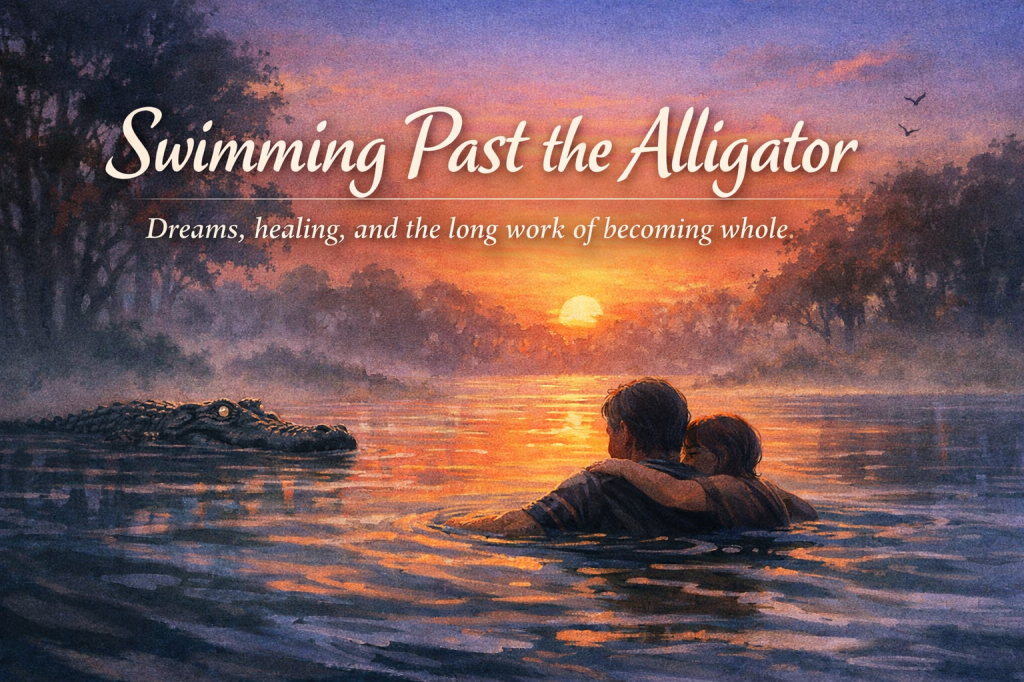
Dreams, healing, and the long work of becoming whole
This morning I remembered a small piece of a dream.
I was swimming in water, and there was an alligator nearby.
Instead of panicking, I simply swam past it.
I remember making an aggressive sound—not from fear, but from protection. I was not alone. There was a child with me, and I felt responsible for their safety.
Later I remembered another fragment: in another dream, I was offering gentle spiritual guidance to a young person.
These were only fragments.
But sometimes fragments are enough.
Because sometimes a dream does not come to entertain us. Sometimes it comes to show us something we could not see before.
The dreams we have when we are young
When I was very young—single digit years—I had frequent nightmares. In those dreams I was being chased or threatened by monsters. I never confronted them. I always ran.
There was fear. There was helplessness. There was no sense of power.
Eventually those nightmares stopped.
But something else remained.
What followed was not nightmares, but something quieter and harder to name: a long period of adult life marked by insecurity, lack of confidence, and the feeling of not quite fitting into the world.
The monsters had left my sleep.
But their shadows remained in my waking life.
Many people know this experience. Trauma does not always continue as dramatic nightmares. Sometimes it continues as hesitation. As self-doubt. As the quiet feeling of being different or unsafe without knowing exactly why.
And sometimes this can last decades.
A word I did not understand for thirty years
When I was in my thirties I first encountered a psychological word:
Individuation.
Carl Jung used this word to describe the lifelong process of becoming whole — integrating the wounded parts of ourselves, the fearful parts, the hidden parts, and the strong parts into one living person.
For thirty years I did not really understand what that meant.
Then recently something changed.
Not because I studied more. Not because I forced insight.
But because life had slowly done its work.
And then came the dream.
Instead of running from the monster, I was swimming calmly past it.
Instead of being threatened, I was protecting.
Instead of being the frightened child, I had become the guardian of a child.
That is when I began to understand what individuation might actually mean.
Not perfection.
Not becoming fearless.
But becoming someone who can remain present in the water even when the alligator is still there.
What the alligator might mean
Jung often suggested that dangerous animals in dreams may represent powerful emotional forces or parts of ourselves we once feared.
If water represents the emotional or unconscious life, then swimming might represent learning to move through our own feelings instead of being overwhelmed by them.
And the alligator?
Perhaps it represents something we once thought would destroy us.
A memory. A fear. A past wound. A shadow.
But here is the important part:
In the dream, the alligator did not disappear.
Healing did not mean the danger was erased.
Healing meant I was no longer powerless in its presence.
That is a very different kind of freedom.
A change many people never notice
One of the most important changes in healing is not that fear disappears.
It is that our relationship to fear changes.
As children, many of us could only run. Our nervous systems were not ready to do anything else.
But over years—sometimes many years—something can slowly develop:
And sometimes one day we notice something surprising:
We are no longer running.
We are still in the water.
But we are not drowning.
The child in the dream
Perhaps the most meaningful part of the dream was not the alligator.
It was the child.
In the dream I was protecting a child. Not a boy or a girl. Just a child.
Many psychological traditions would say this child may represent the vulnerable part of ourselves we once were.
The part that did not feel safe. The part that needed protection.
And perhaps healing is not about becoming invulnerable.
Perhaps healing is about becoming the person who can finally protect that inner child.
Not by fighting monsters. Not by denying fear.
But by staying present.
Nightmares across a lifetime
Not everyone has nightmares only in childhood. Some people carry them into adulthood. Some begin having them later in life. Some veterans carry dreams of war for decades. Some people carry dreams shaped by loss, illness, or trauma.
And this deserves to be said gently and clearly:
Having nightmares does not mean you are weak.
It often means your nervous system is still trying to make sense of what was too much to process at the time.
Sometimes healing does not mean the dreams stop immediately.
Sometimes healing means we slowly become less afraid of what they are showing us.
A different way to think about difficult dreams
Instead of asking:
Why am I having this dream?
Sometimes a more compassionate question might be:
How has my relationship to fear changed?
Or even:
Am I still running, or am I learning to stay?
Because sometimes progress is not dramatic.
Sometimes progress is simply this:
You are still in the water. And you are calmer than before.
What healing sometimes looks like
Healing is rarely a straight path.
Sometimes it looks like therapy. Sometimes meditation. Sometimes prayer. Sometimes long conversations. Sometimes simply surviving long enough for the nervous system to learn safety.
And sometimes, unexpectedly, healing looks like a dream that quietly says:
You are not who you used to be.
A closing reflection
If I were to turn this dream into a simple contemplative question, it might be this:
What in my life once terrified me that I can now face with a little more calm?
Or even more gently:
Where have I already grown stronger than I realize?
Sometimes we do not see our own healing because it happened slowly.
But sometimes a dream reminds us.
Not with fireworks.
Just with an image:
You are in the water. The danger is still there. But you are no longer alone.
And you are no longer afraid in the same way.
May all beings find safety. May all beings find healing. May all beings discover their own quiet strength.
Sometimes life slows us down in unexpected ways. A few sneezes, a scratchy throat, and a whisper of fatigue can become a quiet teacher. In these moments, even a cold can transform into a practice of compassion, patience, and awareness—inviting us to rest, to pace ourselves, and to see every ache as a doorway to deeper connection with our own hearts and all beings.
I haven’t had a cold in at least fifteen years. Perhaps it came with the change of season, or perhaps it’s simply my body’s way of realigning.
At first, I felt a little discouraged. But then something shifted. I realized that even this — this full-body cold — could be a teacher. In the spirit of Tibetan Vajrayana, I began a practice that might sound unusual: as long as this virus has taken up residence in my body, I send it compassion.
May you be enlightened and benefit all beings.
If this virus must live through me, then may it awaken, may it transform, may it find liberation in the vast field of awareness. Perhaps it can even become an enlightened virus, one that serves the good of all beings.
This gesture may sound fanciful, but to me it reflects a deeply tantric understanding of transformation — meeting what feels harmful or invasive not with fear or resistance, but with the boundless wish that even this, too, might awaken. It is the essence of lojong: turning adversity into the path of enlightenment.
To send loving-kindness even to a virus invites an alchemy of consciousness. We recognize that all forms of life and energy, even those that cause suffering, can be included in the mandala of awakening. The simple act of saying, “May you be enlightened, may you benefit all beings,” dissolves separation and opens the field of compassion wider than the body’s borders.
After such an invocation, I like to rest quietly and imagine the virus as tiny sparks of light, gradually shifting from agitation to luminosity, merging with the radiance of my own heart. This doesn’t deny illness — it reclaims the power of awareness within it.
A cold can then become a form of prayer, a healing practice, a full-body meditation. In each breath, the body learns softness; in each ache, compassion ripens. Even in fever or fatigue, there can be a whisper of grace.
And yet, this cold is teaching me something else, something profoundly practical: how to pace myself throughout the day. ME/CFS has always required careful attention to energy, but when I’m feeling better, I tend to push myself—to accomplish, to do, to engage—often beyond what my body can sustain. This full-blown cold is a reminder that true discipline is gentle, that honoring rest is not laziness but wisdom, and that the same careful pacing I practice now in illness is exactly what I need every day to live fully with ME/CFS.
And so, as I move through these days of rest, tea, and light meals, I remind myself: every illness, every discomfort, every small limitation is also a door. A door that invites patience, kindness, and an intimate awareness of the profound interconnection of all beings.
The ringing remains, yet the mind’s tight grasp dissolves — only sky holds all.
For many, tinnitus feels like a constant companion — a high-pitched ring, a persistent hum, a sound that refuses to vanish. It can shadow every quiet moment, every attempt at rest, every space of stillness. We search for a cure, for silence, for relief. And yet, sometimes the greatest liberation does not come from changing the sound, but from changing the relationship to it.
I have walked this path. The ringing did not leave. What changed was me.
At first, tinnitus feels like an enemy. We grasp at it, resist it, curse it. We add suffering to suffering: “Why me? Why won’t this stop? How can I bear it?” The sound itself may be mild or sharp, occasional or persistent, but the mind’s reaction amplifies it, creating a firestorm of agitation.
Then comes a subtle discovery: the fire is fueled by attention and resistance. The ringing itself is not the problem — the problem is our insistence on struggling with it.
If we pause, soften our attention, and allow awareness to expand around the sound, something shifts. We realize:
The tinnitus may continue.
The mind may notice it, even name it.
But the grasping, the mental fight, the suffering about the suffering — that can dissolve.
It is like a leaf floating on a stream. The water moves; the leaf moves; yet no one is trapped. The leaf does not resist the current. The leaf does not need the current to stop in order to be free.
Through this practice, tinnitus becomes a teacher. It is a doorway to awareness, a mirror reflecting our habit of clinging. By letting go of the self that struggles, we enter a spaciousness where the sound exists, but the suffering does not.
This is not denial. This is not wishful thinking. It is simple noticing:
The ringing arises dependent upon body, mind, and attention.
The mind can soften.
Awareness itself remains unshaken, vast and unbounded, like sky in which clouds drift freely.
To rest here, all that is required is attention that softens rather than grips:
Breathe and notice the sound. Don’t push it away; simply allow it to be.
Relax the “I” that judges or resists. Let the self that struggles dissolve into spaciousness.
Rest in the field of awareness. The ringing is present, but it is no longer a problem.
In this way, liberation does not depend on the sound ending. It depends on the mind letting go. The sound may continue, but the fire of suffering has gone out.
For anyone who lives with tinnitus, this is a path open to you. The ringing may remain, but your suffering need not. The self that once insisted on fighting can rest. The heart can soften. The mind can breathe. The sky remains.
And in that sky, even tinnitus becomes part of the vast, untroubled whole.
A Haiku for Reflection
The ringing remains, yet the mind’s tight grasp dissolves — only sky holds all.
Or a Meditative Verse
Tinnitus hums on, unchanged, persistent, steady. I let go of “I.” The struggle falls away, and only vastness remains.
The key here is compassion for your nervous system. Your brain is trying to protect you; it just needs reassurance that these vibrations are safe, ignorable, and not urgent. Over time, the mind can learn to treat tinnitus the way it treats the hum of a refrigerator: present, but mostly unnoticed.
It’s not about conquering, changing, or escaping the vibrations—it’s about sitting gently with them, recognizing them as part of the living moment, and letting your mind rest in spacious awareness.
All that arises is fleeting, all that appears has no fixed self. The hum, the thought, the breath— they come, they linger, they fade. I rest in the space between, spacious, still, free. No need to hold, no need to push— only presence, only now.
“Discover how pristine mind meditation may offer a gentle, restorative state of awareness without the energy costs that often come with post-exertional malaise.”
Living with Chronic Fatigue Syndrome means every action, every exertion, has a cost. For many, even a few minutes of focus or effort can lead to post-exertional malaise—a profound worsening of symptoms that can last for days. But what if there was a way to rest deeply, to allow the mind to settle in a way that doesn’t deplete but actually nourishes? This is where the practice of pristine mind meditation comes in, offering an effortless awareness that exists beyond thought, beyond strain, and without the toll of traditional exertion.
Pristine mind meditation is rooted in the idea of simply being. Rather than trying to clear the mind or enter a specific state, it invites you to rest in pure, unaltered awareness. This isn’t an act of concentration or focus, but a gentle allowing—a way to let thoughts and sensations come and go without attaching or resisting. The experience of resting in the pristine mind is often described as spacious, calm, and effortlessly open. For someone with ME/CFS, this could mean a path to real rest without the demand on physical energy that so often comes with other practices.
Theoretically, because pristine mind meditation is free from physical or mental strain, it offers a way to access peace and stillness without triggering the kind of post-exertional fatigue that can worsen symptoms. It’s an invitation to explore a new way of being with chronic fatigue, where healing is not about doing but about resting in the quiet awareness that’s already within you.
This journey is a gentle experiment, a compassionate practice of meeting yourself exactly as you are. Whether you experience even a few moments of pristine awareness or simply rest in the intention, the practice becomes a way of honoring the body’s limits and nourishing the mind. Take this path slowly, with openness, knowing that each step is its own quiet gift.
If you’re curious, I invite you to join in this exploration, allowing yourself to simply rest in the pristine mind, noticing what it brings without expectation or need for change. This is a practice of ease, not of effort—a resting place for the soul amidst the demands of daily life with Chronic Fatigue Syndrome.
For those interested in going deeper, much of this understanding is inspired by the teachings in Our Pristine Mind by Orgyen Chowang Rinpoche. His book provides a profound exploration of this approach to awareness, offering guidance on accessing the clear, effortless state of the pristine mind. If this resonates with you, I’ll leave a link below to help you find the book and discover more about this gentle, transformative practice.
In the name of honoring my chronic fatigue syndrome, I’m experimenting with a different approach to healing. I’m trying out the idea that it doesn’t have to be complicated or effortful—that maybe simplicity and gentle choices can be enough. By tending to myself in this way, I’m exploring what it means to honor both my needs and my limitations, and I’m finding that this, too, might be a path to healing.
I don’t know all the answers, but I’m noticing that healing isn’t always about pushing or doing more. Sometimes, it’s about making a quiet, deliberate choice to conserve energy, to rest, and to be. This journey toward simplicity and ease feels like a step toward well-being, and I’m curious to see where it leads.
Discover how the quiet fire of the pristine mind can soothe the restless blaze of chronic fatigue, offering a path to inner peace and gentle transformation.
I sit here today, tenderly aware of a fire burning within me—not the feverish blaze of energy or ambition, but a fire that comes with chronic fatigue, a fire that seems to consume my energy, that feeds on thoughts of worry, longing, frustration. This fire has been with me for as long as I’ve known this illness, and for many years, it seemed the fire was all I had—scorching, demanding, leaving me exhausted.
But in recent days, I’ve come to see a new way of being with this fire, a gentle shift. There are, I believe, two fires within: one that belongs to the ordinary mind and another that belongs to the pristine mind.
The fire of the ordinary mind is a hungry, restless flame. It feeds on what we give it—thoughts, fears, the inner whisper of “not enough.” It clings to the past and worries for the future, each thought a piece of wood thrown into the blaze, each worry an ember reignited. It takes, and takes, and when I stay too long with this fire, I feel myself slipping into exhaustion, my strength given over to a fire that never settles, never finds rest.
And yet, there is another fire. It is quieter, calmer, like the deep glow of coals after the flames have settled. This is the fire of the pristine mind. It does not demand fuel; it simply is. It does not need anything from me, nor does it take. Instead, it offers a kind of sacred purification. It allows the impressions, the pratyayas, those old echoes of worry, disappointment, expectation, to rise up, to be seen, and then to burn themselves out gently, naturally, leaving a clean, quiet space in their wake.
When I find myself caught in the ordinary fire—my mind racing, my heart feeling heavy—I take a breath and remember that there is another way. I sit with my awareness, letting go of each thought, letting each worry pass without adding to it. I let the flames burn low, and, slowly, I shift to the fire of the pristine mind, where each thought that arises can dissolve without reaction. I do not need to hold on to any of it, nor fuel it. In this place, I am simply present, letting what arises pass without attachment.
This is, I’ve come to believe, a healing fire. Not a fire that consumes, but one that illuminates. When I rest here, I feel myself soften, as though I am held in a vast quiet. The pratyayas, those ancient patterns, have no hold here. They are seen, and then they drift away like ashes.
Perhaps, if you too feel that restless blaze within, you can find this other fire. Sit with yourself, as gently as you would sit with a friend, and watch each thought arise and drift away. Do not reach to hold it, to make it stay, or to change it. Let it come, and let it go. Rest in the calm glow of the pristine mind, where there is nothing to fuel and nothing to fear. In this quiet, you are enough, you are whole.
This journey, I realize, is very much a work in progress. Shifting from the ordinary fire to the pristine fire is not a one-time practice but an ongoing exploration—a gentle unfolding that reveals itself with patience and time. I invite anyone who feels drawn to this process, who wishes to explore this gentle technology of the mind, to sit with it and see if it offers benefit. Let it be an experiment, a curiosity, a way of tending to your inner world.
This understanding has been inspired by the teachings in Our Pristine Mind by Orgyen Chowang Rinpoche. His work offers a profound look into the nature of the mind and the potential for peace that lies within each of us. If you feel drawn to explore this practice further, I highly recommend his book. It provides both guidance and wisdom for those seeking to discover the healing light of their own pristine mind.
With each breath, I honor my body’s pace and wisdom. Rest is a profound act of strength, nurturing my spirit and guiding me toward balance. In stillness, I find resilience and peace, knowing each small step is part of my healing journey.
“With each breath, I honor my body’s pace and wisdom. Rest is a profound act of strength, nurturing my spirit and guiding me toward balance. In stillness, I find resilience and peace, knowing each small step is part of my healing journey.”
When post-viral ME/CFS first appeared in my life over 30 years ago, it was like a sudden, uninvited guest that turned everything upside down. The plans I had carefully laid out—the career, the teaching, the travel—came to a screeching halt. My body, which once felt like a reliable vehicle for my ambitions, became a source of constant limitation.
For many people today, especially in the aftermath of COVID, the experience of long COVID or post-viral ME/CFS can feel like a similar trainwreck. The life you knew, the expectations you had, are suddenly out of reach, and you’re left grappling with a new reality—one that modern medicine often struggles to explain, let alone resolve.
I remember the early days well. The confusion, the depression, the overwhelming frustration that came with the unrelenting fatigue. In the beginning, it was hard to see any way forward. It felt like I was being asked to surrender everything I had worked for, again and again. Every time I hit a new limit, I had to lower the bar, lower it again, and lower it even further. It was a painful process of letting go, not just of my physical abilities, but of my identity and the future I had imagined for myself.
But over time, and through countless moments of surrender, I began to see that while the path I had planned was no longer possible, there was another way forward. It was a quieter path, more inward, but it was no less valuable. Writing became my outlet, my way of contributing to the world, even while living in solitude and spending much of my time in bed.
For those of you reading this who are newly facing the reality of post-viral ME/CFS, I want to acknowledge that this is not an easy journey. It’s okay if you need to take breaks, both from reading and from the mental and emotional load of processing what this diagnosis means. Be gentle with yourself, and if you find the post too long, take it in pieces, come back when you’re ready. The key is to pace yourself, in life and in reading.
Surrendering to a New Reality
One of the hardest lessons I had to learn was surrender—over and over again. Post-viral ME/CFS teaches you that you can’t control everything, no matter how hard you try. Every time I felt like I was getting close to managing the illness, there would be a setback. My energy would crash, and I’d find myself in bed for days or weeks at a time. At first, it felt like defeat. I had to give up so many aspects of life I’d taken for granted.
But over time, I realized that surrendering wasn’t about giving up. It was about accepting what is, rather than constantly struggling against it. The more I fought the reality of my illness, the more frustration I experienced. Letting go didn’t mean that I had to stop hoping or working toward better health, but it did mean that I had to stop resisting what I couldn’t change in that moment.
Surrendering, in this sense, became a way to make peace with the limits of my body, to find moments of ease even when everything else felt out of control. It was an ongoing practice, one that I still revisit, especially on difficult days.
Navigating Others’ Reactions
In addition to learning how to surrender, one of the most difficult challenges I faced early on was dealing with other people’s reactions. In those early days, many people didn’t even believe post-viral ME/CFS existed. I heard things like, “You just need to drink more coffee,” or, “Have you thought about taking naps?” Even when I was officially diagnosed as disabled by the government, my own mother thought I was just lazy and needed to be more active.
This kind of misunderstanding, disrespect, and dismissal is, unfortunately, a common experience for many who suffer from post-viral ME/CFS. Family, friends, and even doctors would question or deny my experience. I’ve heard stories of doctors telling their patients not to even talk about ME/CFS because it “doesn’t exist.” It was often treated as a garbage-pail diagnosis, or dismissed entirely.
While there is more understanding of post-viral ME/CFS today, the stigma still remains. Making peace with this aspect of the illness has been a long journey. What helped me most was cultivating compassion, not just for myself but for others. As Jesus said, “Forgive them, for they know not what they do.” Having compassion for the people in your life who may deny or diminish your experience is a key part of finding peace.
An Evolving Perspective on Post-Viral ME/CFS
In the early days of my journey with post-viral ME/CFS, I found myself going through what felt like the stages of grief as described by Elizabeth Kubler-Ross. At times, I thought I might be dying, and I cycled through stages of anger, grief, depression, and confusion. Acceptance didn’t come quickly, and it took years of processing and reflection before I could reach that place.
One of the major steps toward acceptance came when I read How to Be Sick by Toni Bernhard. This book resonated deeply with me, and for the first time, I felt like someone truly understood what I was going through. Toni’s reflections on illness gave me a new sense of validation and self-respect, and her practical tips helped me develop a healthier way of relating to my experience. I highly recommend this book to anyone struggling with post-viral ME/CFS.
Then, during a meditation class organized by students of Sogyal Rinpoche, based on The Tibetan Book of Living and Dying, I began to find deeper peace. It was around this time that I discovered a Tibetan sutra titled Transforming Suffering and Happiness onto the Path of Enlightenment. This teaching profoundly shifted my perspective once again.
As I read the sutra, I realized that my anger, frustration, and negative emotions were not only draining my energy but also exacerbating my symptoms. It became clear to me that these stressful emotions were making my condition worse, and that when I was able to relax, let go, and find inner peace, I had greater capacity and longer periods of activity without crashing—or without crashing as severely. This was an important revelation: cultivating acceptance, forgiveness, and inner peace didn’t just feel better, it actually minimized my symptoms.
Shifting Perspective: The Sutra That Changed Everything
One passage from the Tibetan sutra resonated deeply with my experience of post-viral ME/CFS:
“Whenever we are harmed by sentient beings or anything else, if we make a habit out of perceiving only the suffering, then when even the smallest problem comes up, it will cause enormous anguish in our mind.”
This teaching hit home because, for a long time, I had been focusing only on the suffering. Everything in my life had become an enemy—my body, my circumstances, even the people around me. The more I centered my awareness on the pain and limitations, the heavier everything felt. Even the smallest setback would feel unbearable.
The sutra showed me that the more we focus on suffering, the more it grows and colors everything we experience. By recognizing this, I began to understand that shifting my focus away from the suffering and toward acceptance could help me find peace. It wasn’t about denying the reality of the illness, but about no longer letting it dominate my entire perspective.
The true transformation came not only by making peace with suffering but by learning to approach both suffering and happiness with the same equanimity. I had to remind myself that when I’m unhappy, this too shall pass, and when I’m happy, this too shall pass. This reminder became a useful way to stay balanced through the ebb and flow of life—the good days and the bad days, the good months and the bad months.
Additionally, I found comfort in William Blake’s words: “He who kisses the joy as it flies lives in eternity’s sunrise.” It reminded me to appreciate the little moments of happiness, to savor them without attachment, knowing that they, too, are fleeting. This perspective helped me not to be disturbed by the constant changes and to find a sense of peace amidst it all.
Discovering a New Path: Writing as Healing
As I continued to navigate the ups and downs of post-viral ME/CFS, I eventually found a new passion that helped me stay connected to the world and give expression to my inner journey: writing. Although much of my life is spent in solitude, and my physical abilities are limited, writing has become my outlet, a way to contribute and share what I’ve learned.
Through writing, I’ve been able to explore the lessons of impermanence, forgiveness, and acceptance, not just for my own growth but as a way to offer encouragement to others walking a similar path. Chronic fatigue may limit what I can do in the physical world, but it has opened up this creative space where I can still connect, reflect, and contribute.
In this way, writing became not just a coping mechanism but a practice of karma yoga, an offering. It’s a way to kiss the joy as it flies, even amidst the challenges of chronic illness, and to embrace each moment—whether in suffering or happiness—as an opportunity for growth.
🙏🕊️🙏
“He who binds to himself a joy Does the winged life destroy; But he who kisses the joy as it flies Lives in eternity’s sunrise.”
When living with Post-Viral ME/CFS, the very thought of physical movement can feel overwhelming, even impossible. However, for many, the desire to engage with your body, to improve mobility, and to gently build strength remains alive. Yet, finding ways to exercise that honor your energy levels without triggering post-exertional malaise (PEM) may feel like a delicate balancing act. In this post, we explore a powerful tool for those who find themselves limited by energy: visualization.
Visualization allows you to engage your mind in the practice of movement without the physical strain. It offers a way to begin building new neural pathways, changing your relationship with exercise, all while lying in bed or resting. This gentle mental practice may seem subtle, but it can be profoundly supportive on days when your body can’t tolerate physical activity.
Visualization is the practice of imagining yourself performing a physical movement or action. Research shows that when you imagine a task with enough vividness and detail, your brain activates similar pathways as if you were physically moving. This means that, even when your body remains still, your brain is training for movement.
For those living with Post-Viral ME/CFS, this can be transformative. Even on days when your body feels heavy or unmovable, you can still practice connecting to movement—without the risk of triggering PEM. Visualization offers a bridge between your current physical state and the possibility of reintroducing exercise gently, one step at a time.
It may seem counterintuitive, but scientific research has demonstrated that imagining a movement can have measurable effects on physical ability. Studies show that visualization can lead to increased muscle strength, improved coordination, and enhanced motor skills. This practice is especially valuable for people recovering from conditions that limit physical movement. When actual movement is impossible, your brain still benefits from the exercise. By visualizing yourself lifting weights or walking, your brain builds new pathways that mirror the benefits of actual physical movement.
For those with Post-Viral ME/CFS, visualization can become a mindful entry point into a more connected relationship with your body. It requires no physical energy and can be practiced while you’re lying in bed or seated in a comfortable chair.
To begin, find a comfortable place where your body can relax completely. Close your eyes and take a few calming breaths. Start by gently becoming aware of your body, feeling supported and at ease. As you breathe, release any tension with each exhale. From this place of relaxation, you can begin to visualize simple movements—such as lifting a light weight, or walking on a treadmill.
Imagine the sensation of the movement as if it were real: the muscles contracting, the rhythm of your breath, the gentle pull of strength through your arms or legs. The more vividly you engage your senses, the more fully your brain responds. Imagine the warmth of your muscles, the calm focus that exercise brings, or the joy of feeling capable and connected to your body once again.
This practice isn’t just about mental imagery—it also helps rebuild your emotional relationship with exercise. Living with Post-Viral ME/CFS often comes with frustration and sadness around the body’s limitations. Visualization offers a way to regain a sense of control, to connect with the potential of your body in a way that feels safe and sustainable. It creates a pathway for healing, both mentally and physically.
While visualization may not replace physical movement, it offers a gentle step in that direction. On days when your energy is low, this practice helps maintain the neural connections involved in exercise. It can even help ease the fear or anxiety associated with movement, reminding you that the joy of exercise is still available to you, even when your body isn’t ready to act.
Once your energy permits, you can use visualization as a bridge to actual physical movement. For example, after imagining yourself performing a simple weightlifting exercise, you might try gently lifting a light dumbbell. The key is to remain mindful of your limits, moving only within your energy envelope, without pushing your body beyond its capacity.
Visualization is a powerful tool for those living with Post-Viral ME/CFS. It creates a foundation for healing and offers hope on days when movement feels impossible. By engaging with mental exercises, you prepare your body and mind for the eventual return to gentle physical movement.
The journey with Post-Viral ME/CFS is about adaptability, gentleness, and finding ways to reconnect with your body on your terms. Visualization offers both a reprieve from physical exertion and a gateway back to mindful movement.
Next Post Preview: Sitting in the Gym Parking Lot—A Gentle Step Toward Physical Movement
In the next post, we’ll explore how even driving to the gym and sitting in the parking lot can be a crucial step in your fitness journey. We’ll discuss how this practice can help rebuild confidence, reduce anxiety around exercise, and allow you to reconnect with the gym environment without physical exertion.
In these uncertain times, many of us are grappling with complex emotions—fear, frustration, anger, and uncertainty about what lies ahead. It’s easy to feel overwhelmed by the turmoil around us. Yet, amidst this chaos, practices like Metta and Tonglen can offer profound solace and guidance, helping us connect deeply with ourselves and the world.
Metta and Tonglen: Cultivating Compassion
Metta, or loving-kindness meditation, invites us to extend warmth and goodwill to ourselves and others. It teaches us to embrace not only those we love but also those we’re neutral towards and even those with whom we have difficulties. By nurturing this boundless compassion, we forge a deeper connection to all beings, fostering understanding and healing.
Tonglen, on the other hand, is a practice that transforms our relationship with suffering. By breathing in the world’s pain and breathing out hope, love, and well-being, we engage in a powerful cycle of empathy and transformation. This practice allows us to hold space for the suffering around us while simultaneously cultivating a sense of hope and resilience.
A Poem of Breath and Connection
Breathing in, I draw the world’s pain, Breathing out, I send love, hope again. Inhale the fears that linger near, Exhale warmth to all who hear.
The storm within, it calls to me, To sit in stillness, let it be. With each breath, I weave the thread, Of light and peace, where hope is spread.
We stand together, hand in hand, Through darkened skies, across the land. In shared compassion, we find our way, To brighter dawns, a new today.
Connecting with the Collective
This blog is more than a reflection—it’s an invitation to connect. I invite you to share your personal stories, hopes, fears, and dreams in the comments below. By creating this healing space together, we honor the collective mood and nurture our shared humanity. Let this be a place where we support and uplift each other, breathing in suffering and breathing out love, until the world breathes easier once more.
Reflections for Deepening
As you engage with these practices, consider the following questions:
What specific fears or concerns are you holding onto right now, and how might breathing them in and transforming them with compassion feel?
How can you extend loving-kindness to yourself and others in your daily life?
In what ways can you connect with diverse spiritual paths to foster a sense of unity and shared purpose?
Feel free to share your reflections and experiences in the comments below. Your insights can contribute to our collective journey of healing and understanding.
A Prayer for All Beings
May all beings be happy. May all beings be free of suffering. May all beings never be apart from the joy of equanimity. And may all beings be enlightened.
Living with ME/CFS presents unique challenges that can often leave us feeling overwhelmed and anxious. From navigating fluctuating energy levels to managing symptoms and coping with the unpredictability of the condition, it’s easy to get caught up in feelings of fear and frustration. However, through my own journey with ME/CFS, I’ve discovered a powerful lesson that has helped me find peace amidst the chaos: the ability to choose peace over anxiety.
For years, I struggled with anxiety and resentment, especially in my relationships and interactions with others. Whether it was the frustration of not being understood or the disappointment of feeling let down by those around me, these feelings only served to exacerbate my symptoms and diminish my quality of life. It wasn’t until I encountered the teachings of A Course in Miracles that I began to see a different way forward.
One of the most transformative aspects of this lesson for me has been the realization that I have the power to choose peace in every moment, regardless of my external circumstances. Instead of allowing myself to be swept away by waves of fear and negativity, I’m now learning to cultivate a sense of inner peace and equanimity, even in the midst of my struggles with ME/CFS.
By bringing conscious awareness to my thoughts, emotions, and reactions, I’m getting better at being able to break free from the grip of fear and embrace a more peaceful way of being.
Forgiveness is also playing a crucial role in my journey towards peace. Living with ME/CFS often feels isolating and frustrating, and for many years I have harbored feelings of resentment towards those who don’t understand or support me. However, through the practice of forgiveness, I’ve been able to release myself and others from the chains of past grievances and Im getting better at opening my heart to love and healing.
This new found shift in my perception has been helping me to find peace amidst the challenges of ME/CFS. Instead of viewing my condition as a source of limitation or suffering, I’m learning to see it as an opportunity for growth and transformation. By reframing my perspective and recognizing the inherent goodness and divinity within myself and others, I’m getting better at cultivating a sense of compassion and understanding that transcends the limitations of this illness.
In sharing my journey towards choosing peace over anxiety, my hope is that it will resonate with others living with ME/CFS who may be struggling with similar challenges. While our experiences may differ, the lessons of mindfulness, forgiveness, and perception shift are universal truths that can offer solace and guidance on the path towards healing and transformation.
May we all find peace amidst the challenges of ME/CFS and embrace the journey with open hearts and minds.
Listen to your body's gentle plea, Rest when needed, let fatigue be. In moments of rest, strength will renew, Honoring your limits, in all that you do.