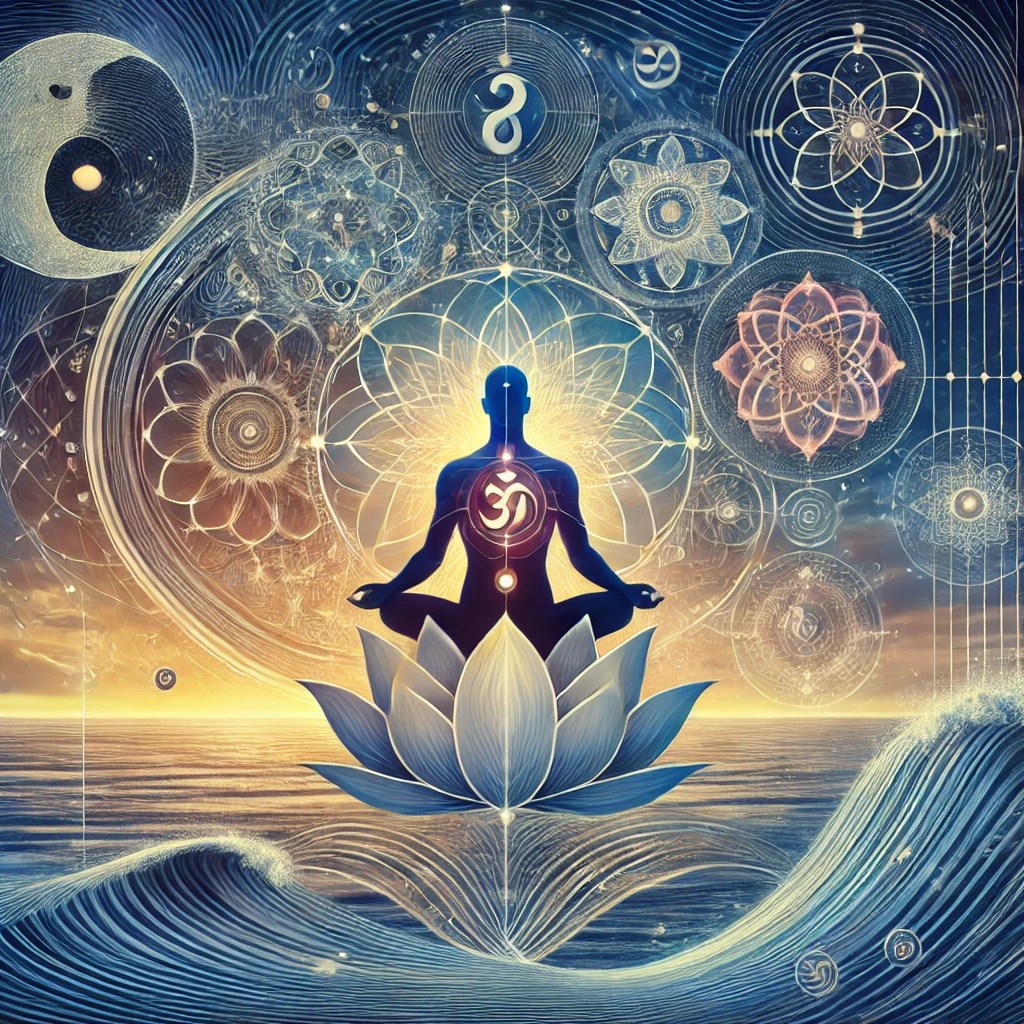
We chase the air and call it solid ground, A path to walk, yet never to be found. Enlightenment, it dances in the breeze, A dream we seek, but slips with gentle ease.
Like floaters in the eye, it drifts away, Each time we think we’ve found it for a day. And angels laugh, for they can take to flight, By knowing not to hold their burden tight.
The mind’s a joke, it tries to make its stand, While life just moves the pieces out of hand. So let us fly and let the effort go, For lightness is the only truth to know.
In spiritual traditions around the world, the journey towards self-knowledge is often described as turning the mind inward, directing it back to its source. In this context, the concept of Talopākhyān emerges as a powerful process that guides this inward journey. But what does Talopākhyān really mean, and how can it help us in our spiritual practice?
What is Talopākhyān?
Talopākhyān is a term that refers to the practice of turning the mind inward, away from the distractions of the external world, and focusing it on the inner reality. This process is essential for those seeking self-knowledge or understanding the true nature of the Self (Atman). By directing our attention away from the external and towards the source of our consciousness, we begin to uncover the deeper truths that lie within.
The Reality of the I-Sense:
At the heart of Talopākhyān is the discovery of the reality of the “I-sense” within us. This “I-sense” is the subtle awareness of existence, the feeling of being, that we all carry within us. It is often mistaken for the ego or personal identity, but in truth, it is the deeper Self—the Atman, which is one with Brahman, the universal consciousness.
As we practice turning the mind inward, we begin to differentiate between the false “I” created by the mind and the true “I” that is pure, unchanging awareness. This realization is the essence of self-knowledge, the recognition that the true Self is not the body, mind, or ego, but the pure consciousness that underlies all.
The Role of Tapas in Talopākhyān:
Turning the mind inward to discover the reality of the I-sense requires discipline and austerity, known as Tapas. Tapas refers to the inner fire, the focused effort, and sometimes the physical or mental austerities that help to purify the mind and body. This purification is crucial, as it reduces the distractions and attachments that keep the mind turned outward.
By engaging in Tapas, such as fasting, observing silence, or maintaining a disciplined meditation practice, we strengthen our ability to sustain inward focus. This practice allows the mind to settle and become clear, making it easier to perceive the true “I-sense” beneath the layers of mental noise.
The Journey Inward:
The mind, by its nature, tends to focus on external objects, thoughts, and sensations. Talopākhyān, supported by Tapas, involves reversing this outward flow of attention and redirecting it inward. This inward journey is not just about withdrawing from the world but about discovering the source of our thoughts, feelings, and ultimately, our very being—the true “I-sense.”
Practical Steps for Practicing Talopākhyān, Tapas, and Discovering the I-Sense:
Meditation: Regular meditation is one of the most effective ways to practice Talopākhyān. By focusing on the breath or a mantra, the mind gradually becomes quiet, allowing the practitioner to turn inward and explore the I-sense.
Self-Inquiry: Asking questions like “Who am I?” or “What is the source of my thoughts?” can help to direct the mind towards its source, leading to deeper insights into the true I-sense.
Mindfulness: Staying present and mindful of the moment can also help in the practice of Talopākhyān, as it trains the mind to focus and reduces distractions.
Discipline in Daily Life: Engaging in practices like fasting, observing silence, or other forms of self-discipline can help purify the mind, making it more receptive to the inward journey and the discovery of the true I-sense.
The Significance of Talopākhyān, Tapas, and Discovering the I-Sense in Self-Knowledge:
The practice of Talopākhyān, supported by Tapas, is crucial for anyone on the spiritual path. It is through this process that we come to realize the true nature of the Self, which is beyond the mind and body. The discovery of the true I-sense—this unchanging, pure awareness—is the essence of self-knowledge, and it is the key to liberation from the cycle of suffering.
Conclusion:
Talopākhyān, combined with the disciplined practice of Tapas and the exploration of the I-sense, offers a practical and profound approach for those who seek to know themselves at the deepest level. By turning the mind inward and focusing on the source of our being, supported by the purifying fire of Tapas, we can uncover the truths that lead to self-realization and inner peace.
The video below is the source of the inspiration for the content of this blog. If you’d like to get direct teaching from Swamiji on this topic, I encourage you to watch the video and deepen your understanding.
In the realm of spiritual exploration, metaphors often hold the key to deeper understanding. One such metaphor is the idea that “you can’t look at your own eyes without a mirror.” This simple yet profound statement serves as a powerful analogy for the process of self-awareness and the journey to realizing the true Self.
The Eyes as a Metaphor for Awareness
Our eyes are the instruments through which we perceive the world. They allow us to see and interact with the physical reality around us. But despite their essential role in vision, our eyes cannot see themselves directly. To view our own eyes, we need a mirror—an external reflection that allows us to see what is otherwise hidden from direct perception.
In the same way, our awareness—our true Self—is the instrument through which we perceive all experiences. It is the ever-present subject that observes thoughts, emotions, sensations, and the world at large. Yet, just like our eyes, this awareness cannot directly observe itself. It remains elusive, hidden in plain sight, the observer that can never be observed.
Through the Mirror of Practice: Awareness Observing Its Own Emanations
In the journey of self-inquiry and meditation, we create a space where awareness has the opportunity to observe its own emanations—not as separate reflections, but as fluctuations that arise from and return to our true nature. Just as ripples on the surface of a pond reveal the water beneath, these fluctuations are manifestations of the pure awareness that underlies all experience.
When we sit in meditation or engage in self-inquiry, we often notice thoughts, emotions, and sensations arising and passing away. These mental activities can be understood as emanations from the true Self. They are not separate from awareness but are expressions of it, unfolding within the field of consciousness. Each thought or sensation is like a wave that temporarily takes form before dissolving back into the ocean of awareness.
The Process of Observing Emanations
As we practice, we begin to notice that these fluctuations are not distinct from the awareness in which they arise. Initially, our focus might be on the content of these emanations—the thoughts, feelings, and experiences that surface during meditation. But over time, the focus can shift to the awareness that generates and observes these emanations. We start to recognize that this awareness is always present, the source from which all experiences emerge and to which they return.
This shift is crucial because it moves us from identifying with the objects of awareness (the emanations) to identifying with the source itself (the awareness). Through this process, we begin to see that we are not the transient thoughts or sensations, but the unchanging awareness that produces and witnesses them. This awareness is the true Self—the essence that remains constant through all fluctuations.
Beyond Emanations: Resting in Pure Awareness
The fluctuations we observe in meditation and self-inquiry are not merely reflections; they are emanations arising from our true nature. While observing these emanations can guide us toward self-understanding, the ultimate realization comes when we recognize that they are not separate from the awareness that witnesses them.
As our practice deepens, we come to a point where we no longer need to focus on these emanations. Instead, we can rest in the awareness itself, knowing that all fluctuations arise from and dissolve back into this unchanging reality. In this state, we no longer seek understanding through the transient activities of the mind but directly experience the pure, unconditioned awareness that is our true essence.
Resting in pure awareness is a state of being where the mind’s fluctuations no longer dominate our experience. These emanations may still arise, but they no longer distract us from the deeper truth of our existence. We begin to live more fully from the perspective of the silent witness, the true Self, which remains untouched by the comings and goings of mental phenomena.
The Role of Reflection in Self-Awareness
If awareness cannot directly see itself, how then do we come to know our true nature? Just as we use a mirror to see our eyes, we use the practice of reflection to gain insight into the nature of awareness. This reflection doesn’t involve a physical mirror, but rather the mirror of self-inquiry, meditation, and contemplation.
Through these practices, we create a space in which awareness can observe the fluctuations of itself in the mind’s activities. By asking questions like “Who am I?” or “What am I?” we direct our attention inward, towards the source of our awareness. In the process, we begin to see the emanations of our true nature, just as we see the reflection of our eyes in a mirror.
However, it’s crucial to understand that these emanations are not the awareness itself—they are simply the forms that awareness takes as it interacts with the mind. By observing these emanations, we begin to notice that there is something constant behind them: the awareness that remains unchanged even as thoughts and sensations come and go.
The Journey to Self-Realization
Understanding that you cannot look at your own eyes without a mirror can lead to a deeper appreciation of the journey towards self-realization. This journey is not about finding the true Self as an object, but about recognizing that the true Self is the one who is always observing. The practices of meditation, self-inquiry, and contemplation are the mirrors that help us catch glimpses of our true nature.
But these practices are also stepping stones, guiding us to a place where we can finally let go of the need for emanations. In the silence of pure awareness, beyond thoughts and concepts, we come to rest in the realization that we are not the emanations in the mirror, but the awareness that makes all emanation possible.
Conclusion: The Unseen Seer
The metaphor of not being able to look at your own eyes without a mirror serves as a powerful reminder of the nature of awareness. It invites us to explore the process of self-reflection, not in search of an objectified self, but to recognize the ever-present subject—the true Self—that cannot be observed directly.
In the end, the journey of self-awareness is about shifting our focus from the emanations in the mirror to the awareness that perceives them. It is about realizing that the true Self, like the eyes that see the world, is the unseen seer, the silent witness of all experience. And in this realization, we find the essence of who we truly are.
In stillness we rest, Not the mirror’s fleeting form, But the source of light.
“Be patient toward all that is unsolved in your heart and try to love the questions themselves, like locked rooms and like books that are now written in a very foreign tongue. Do not now seek the answers, which cannot be given you because you would not be able to live them. And the point is, to live everything. Live the questions now. Perhaps you will then gradually, without noticing it, live along some distant day into the answer.”
~ Rainer Maria Rilke, “Letters to a Young Poet”
In exploring the depths of human consciousness, both Carl Jung’s psychological theories and yogic philosophy offer profound insights into the nature of the self. Despite originating from different cultural and intellectual traditions, they converge on a central theme: the integration of various aspects of the self to achieve wholeness and enlightenment. This post delves into the parallels between Jung’s concepts and yogic teachings, focusing on the roles of the ego, Atman, and Brahman.
The Self According to Carl Jung
Carl Jung, a pioneering psychologist, introduced the concept of the Self as encompassing both the conscious and unconscious aspects of the psyche. He believed that the process of individuation, or personal development, involves integrating these unconscious elements into conscious awareness. This journey toward self-realization and wholeness allows individuals to uncover deeper truths about themselves and achieve psychological harmony.
Yogic Philosophy: Ego, Atman, and Brahman
In yogic philosophy, the self is understood through the interplay of the ego, Atman, and Brahman:
Ego: The ego represents the individual, conscious identity, marked by personal desires, fears, and thoughts. It is the part of the self that interacts with the world and perceives itself as separate from others.
Atman: Atman is the true Self, the deeper, unchanging essence of an individual beyond the ego. It is pure consciousness and awareness, representing the core of one’s being.
Brahman: Brahman is the ultimate, universal consciousness, encompassing all existence. The realization of Brahman involves understanding that Atman (the individual Self) is not separate from this universal essence.
Integrating Jungian and Yogic Perspectives
When we align Jung’s idea of the Self with yogic teachings, a comprehensive picture of self-realization emerges:
Ego and Ordinary Mind: In both frameworks, the ego or ordinary mind is the initial stage of self-awareness. It involves the individual’s interaction with the world, characterized by fluctuating thoughts (vrittis) and personal narratives.
The ego experiences separation and individuality.
True Self (Atman) and Stable Vrittis: Moving beyond the ego, the individual begins to experience the true Self or Atman. This state is marked by stable vrittis and similar pratyayas (mental contents), indicating a more unified and coherent state of consciousness. Here, the sense of “I” transitions from the personal ego to the deeper true Self.
Stable vrittis and similar pratyayas reflect a unified consciousness.
Universal Self (Brahman) and Pure Awareness: The ultimate realization involves understanding that the true Self (Atman) is one with Brahman, the universal consciousness. In this state, there is no distinction between the individual self and the universal Self. This realization aligns with the experience of pure awareness in yogic contemplation, where the mind transcends individual thoughts and perceptions to rest in its true, unchanging nature.
The true Self (Atman) is fundamentally connected to the universal consciousness (Brahman).
The Connection Between Ego, True Self, and Universal Self
An important insight from this integration is understanding the relationship between the ego, True Self, and Universal Self:
Ego as a Fluctuation of the True Self: The ego, with its individual identity and personal narratives, can be seen as a temporary fluctuation or expression of the deeper True Self (Atman). While the ego experiences separation and individuality, it is ultimately a manifestation of the underlying, unchanging awareness of Atman.
True Self as a Fluctuation of the Universal Self: Similarly, the True Self (Atman) can be understood as a particular expression or fluctuation of the Universal Self (Brahman). While Atman retains a sense of individual consciousness, it is fundamentally connected to and inseparable from the universal, all-encompassing consciousness of Brahman.
Inherent Connection: This perspective highlights that, whether we are aware of it or not, we are all inherently connected through the Universal Self. Our individual experiences and identities are different expressions of the same underlying reality.
Recognizing that the ego is a fluctuation of the True Self, and the True Self is a fluctuation of the Universal Self, helps us understand our inherent interconnectedness. This realization fosters a sense of unity and compassion, knowing that at the deepest level, we are all part of the same universal consciousness.
Practical Exercise: Self-Inquiry and Integration
To help experientially understand these concepts, here are a few exercises based on self-inquiry, which integrate conscious and unconscious experiences. Each of these steps can be a lifetime practice. Understanding or realization of these ideas and practices may immediately strike an intuitive chord, but direct experience may require further contemplation and meditation. As Rilke suggests, sometimes it’s more important to live the questions than to immediately understand the answers. These steps are also not necessarily linear as presented; each step can unfold organically in its own way and time. Therefore, when studying and practicing these teachings, patience is truly a virtue.
Step 1: Settle into Meditation
Find a quiet place and sit comfortably. Close your eyes and take a few deep breaths, allowing your mind to settle.
Step 2: Begin Self-Inquiry
Ask yourself, “Who am I?” or “What is this ‘I’ that I experience?”
Allow any mental events, fluctuations, experiences, thoughts, feelings, sensations, memories, or beliefs to arise without judgment. Simply observe them.
Step 3: Observe the Ego
Notice the thoughts and feelings that are tied to your personal identity (ego). These might include your name, roles, likes, dislikes, desires, aversions, hopes, and fears.
Recognize these as fluctuating vrittis and pratyayas of the ordinary mind.
Step 4: Move to the True Self (Atman)
Shift your focus to the awareness that is observing these thoughts and feelings. This awareness is stable and unchanging.
Ask yourself, “What is the nature of this awareness?” or “Who is aware of these thoughts?”
Experience this deeper sense of “I” that is beyond personal identity. This is the Atman, your true Self.
Step 5: Contemplate the Universal Self (Brahman)
Reflect on the idea that this true Self (Atman) is not separate from the universal consciousness (Brahman), in the same way that waves are not separate from the ocean.
Meditate on the oneness of all existence, recognizing that your true Self is part of this greater whole.
Step 6: Integrate the Experience
Spend a few moments in silence, allowing the experience to integrate into your awareness.
When you’re ready, gently open your eyes and carry this sense of expanded awareness with you into your daily life.
Conclusion
The integration of Jungian psychology and yogic philosophy provides a comprehensive framework for understanding the self. By recognizing the roles of the ego, Atman, and Brahman, and integrating these aspects through self-reflection, meditation, and contemplation, individuals can move toward a state of wholeness and enlightenment. This journey not only enhances personal well-being but also fosters a deeper connection with the universal consciousness, embodying the true essence of both psychological and spiritual growth.
I Live My Life in Widening Circles
by Rainer Maria Rilke
I live my life in widening circles that reach out across the world. I may not complete this last one but I give myself to it.
I circle around God, around the primordial tower. I’ve been circling for thousands of years and I still don’t know: am I a falcon, a storm, or a great song?