Dreams, healing, and the long work of becoming whole
This morning I remembered a small piece of a dream.
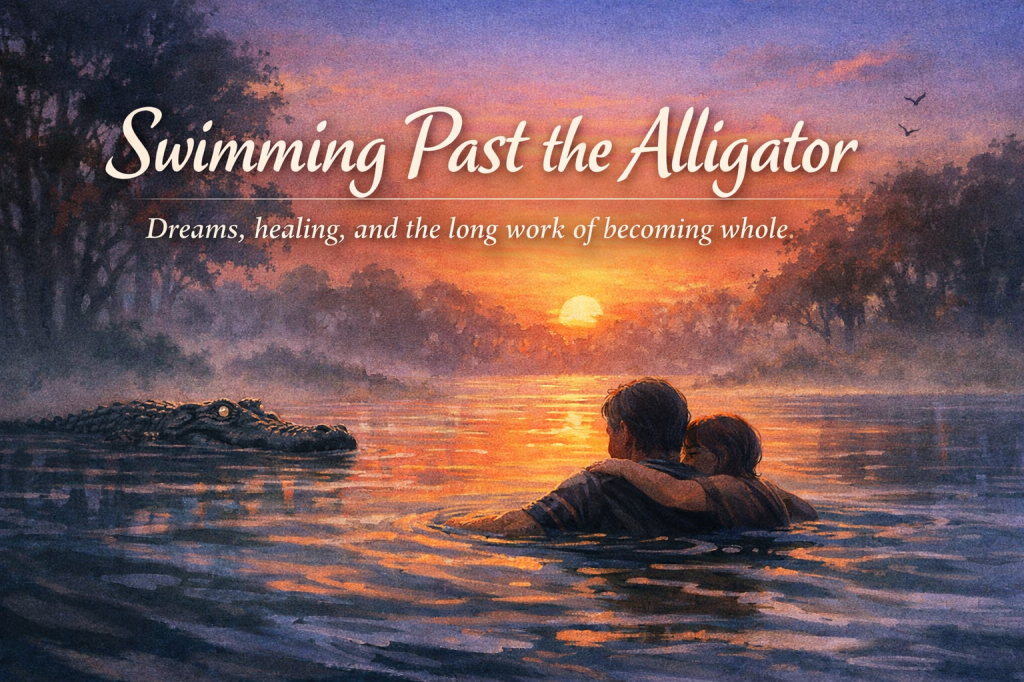
I was swimming in water, and there was an alligator nearby.
Instead of panicking, I simply swam past it.
I remember making an aggressive sound—not from fear, but from protection. I was not alone. There was a child with me, and I felt responsible for their safety.
Later I remembered another fragment: in another dream, I was offering gentle spiritual guidance to a young person.
These were only fragments.
But sometimes fragments are enough.
Because sometimes a dream does not come to entertain us.
Sometimes it comes to show us something we could not see before.
The dreams we have when we are young
When I was very young—single digit years—I had frequent nightmares. In those dreams I was being chased or threatened by monsters. I never confronted them. I always ran.
There was fear.
There was helplessness.
There was no sense of power.
Eventually those nightmares stopped.
But something else remained.
What followed was not nightmares, but something quieter and harder to name: a long period of adult life marked by insecurity, lack of confidence, and the feeling of not quite fitting into the world.
The monsters had left my sleep.
But their shadows remained in my waking life.
Many people know this experience. Trauma does not always continue as dramatic nightmares. Sometimes it continues as hesitation. As self-doubt. As the quiet feeling of being different or unsafe without knowing exactly why.
And sometimes this can last decades.
A word I did not understand for thirty years
When I was in my thirties I first encountered a psychological word:
Individuation.
Carl Jung used this word to describe the lifelong process of becoming whole — integrating the wounded parts of ourselves, the fearful parts, the hidden parts, and the strong parts into one living person.
For thirty years I did not really understand what that meant.
Then recently something changed.
Not because I studied more.
Not because I forced insight.
But because life had slowly done its work.
And then came the dream.
Instead of running from the monster, I was swimming calmly past it.
Instead of being threatened, I was protecting.
Instead of being the frightened child, I had become the guardian of a child.
That is when I began to understand what individuation might actually mean.
Not perfection.
Not becoming fearless.
But becoming someone who can remain present in the water even when the alligator is still there.
What the alligator might mean
Jung often suggested that dangerous animals in dreams may represent powerful emotional forces or parts of ourselves we once feared.
If water represents the emotional or unconscious life, then swimming might represent learning to move through our own feelings instead of being overwhelmed by them.
And the alligator?
Perhaps it represents something we once thought would destroy us.
A memory.
A fear.
A past wound.
A shadow.
But here is the important part:
In the dream, the alligator did not disappear.
Healing did not mean the danger was erased.
Healing meant I was no longer powerless in its presence.
That is a very different kind of freedom.
A change many people never notice
One of the most important changes in healing is not that fear disappears.
It is that our relationship to fear changes.
As children, many of us could only run. Our nervous systems were not ready to do anything else.
But over years—sometimes many years—something can slowly develop:
Inner resources
Perspective
Compassion
Stability
Understanding
And sometimes one day we notice something surprising:
We are no longer running.
We are still in the water.
But we are not drowning.
The child in the dream
Perhaps the most meaningful part of the dream was not the alligator.
It was the child.
In the dream I was protecting a child. Not a boy or a girl. Just a child.
Many psychological traditions would say this child may represent the vulnerable part of ourselves we once were.
The part that did not feel safe.
The part that needed protection.
And perhaps healing is not about becoming invulnerable.
Perhaps healing is about becoming the person who can finally protect that inner child.
Not by fighting monsters.
Not by denying fear.
But by staying present.
Nightmares across a lifetime
Not everyone has nightmares only in childhood. Some people carry them into adulthood. Some begin having them later in life. Some veterans carry dreams of war for decades. Some people carry dreams shaped by loss, illness, or trauma.
And this deserves to be said gently and clearly:
Having nightmares does not mean you are weak.
It often means your nervous system is still trying to make sense of what was too much to process at the time.
Sometimes healing does not mean the dreams stop immediately.
Sometimes healing means we slowly become less afraid of what they are showing us.
A different way to think about difficult dreams
Instead of asking:
Why am I having this dream?
Sometimes a more compassionate question might be:
How has my relationship to fear changed?
Or even:
Am I still running, or am I learning to stay?
Because sometimes progress is not dramatic.
Sometimes progress is simply this:
You are still in the water.
And you are calmer than before.
What healing sometimes looks like
Healing is rarely a straight path.
Sometimes it looks like therapy.
Sometimes meditation.
Sometimes prayer.
Sometimes long conversations.
Sometimes simply surviving long enough for the nervous system to learn safety.
And sometimes, unexpectedly, healing looks like a dream that quietly says:
You are not who you used to be.
A closing reflection
If I were to turn this dream into a simple contemplative question, it might be this:
What in my life once terrified me that I can now face with a little more calm?
Or even more gently:
Where have I already grown stronger than I realize?
Sometimes we do not see our own healing because it happened slowly.
But sometimes a dream reminds us.
Not with fireworks.
Just with an image:
You are in the water.
The danger is still there.
But you are no longer alone.
And you are no longer afraid in the same way.
May all beings find safety.
May all beings find healing.
May all beings discover their own quiet strength.

 Home Page: Inspirations of Love and Hope