As I begin my journey through the Gita Press edition of the Ramayana, I find myself immediately struck by the structure of the first canto. Within just a few verses, the entire epic is laid out before the reader—Rama’s exile, his defeat of Ravana, the rescue of Sita, and his triumphant return to Ayodhya where he reigns as king. It’s a “happily ever after” summary that seems to condense the entire narrative into a brief prologue. But why start a story this way? What is the purpose of summarizing the entire epic right at the beginning?
This approach, common in ancient epics, serves multiple purposes. First, it provides readers with a roadmap, offering a glimpse of the destination before embarking on the journey. In the context of the Ramayana, it reminds us that the ultimate outcome of the story is not in question—Rama, the embodiment of dharma, will triumph, righteousness will be restored, and order will prevail. Knowing this from the outset allows readers to focus not on the suspense of what will happen, but on the lessons to be learned along the way.
The first canto functions as both an introduction and a promise. It assures us that despite the trials, battles, and moments of despair that will inevitably follow, the story ends in the victory of good over evil. It also invites us to consider the deeper meaning behind these events. By presenting the conclusion first, the text suggests that the journey is just as important—if not more so—than the destination.
As I continue reading, it’s clear that the richness of the Ramayana lies not just in its grand narrative, but in the details, the interactions between characters, the challenges they face, and the decisions they make. The first canto’s summary is just the beginning—a way to frame the epic and to prepare us for the moral and spiritual lessons that will unfold in the subsequent chapters.
In the Gita Press version, the simplicity and directness of this introduction serve to draw the reader in, setting the stage for a deeper exploration of dharma, devotion, and the complexities of human life. It is an invitation to not only read the story but to reflect on its teachings and apply them to our own lives.
As I delve deeper into the Ramayana, I am reminded that the true value of this epic lies in its capacity to guide us on our own spiritual journey, offering insights that are as relevant today as they were thousands of years ago.
For those interested in exploring this epic themselves, the Gita Press edition, along with the detailed Debroy translation, is embedded in this blog post. You can access them and embark on your own journey through the Ramayana, discovering the layers of wisdom and truth that this ancient text has to offer.
As I continue my journey through the Ramayana, I’ve chosen to explore this epic using multiple versions: the abridged Valmiki translation, the comprehensive Gita Press edition, and the detailed Debroy translation. This approach allows me to compare different interpretations and uncover nuances that might otherwise go unnoticed. For those interested in exploring these different versions, both the Gita Press edition and the Debroy translation are embedded in the blog post below.
Through this exploration, one figure has emerged as particularly significant in the opening of the Ramayana: the celestial sage Narada.
Narada is one of the most revered sages in Hindu mythology, known for his deep wisdom, musical talent, and his role as a divine messenger. He is often depicted as a traveling sage who moves freely between the earthly realm and the divine, carrying messages from the gods to humans and vice versa. Narada is also renowned for his ability to incite action and prompt change—sometimes through his seemingly mischievous behavior, earning him the title of the “Divine Troublemaker.” However, his actions are always aimed at upholding dharma, or righteousness, even if they appear unconventional.
Narada’s importance extends far beyond the Ramayana. He is a prominent figure in several other Hindu texts, including the Mahabharata, the Bhagavata Purana, and various Upanishads. In these texts, Narada is often seen guiding kings, sages, and even the gods themselves, providing counsel and sometimes challenging them to reflect on their actions. His role as a teacher and guide makes him a central figure in the transmission of spiritual knowledge and the preservation of dharma.
Narada is also credited with the composition of the Narada Bhakti Sutra, a foundational text on the practice of bhakti, or devotion to God. This further underscores his role as a spiritual guide and a beacon of divine love and wisdom.
The Ramayana opens with Narada narrating the story to Valmiki. This is a significant moment, as it frames the Ramayana not just as a historical or mythological account, but as a divine narrative passed down from the gods to humans through a trusted sage. Narada’s role here is that of a divine mediator, ensuring that the wisdom and teachings of the Ramayana are preserved and passed on to future generations.
Narada’s presence in the Ramayana reminds us that spiritual teachings often come through intermediaries who carry the weight of divine authority. His involvement in the story underscores the importance of dharma and the divine order, which are central themes in the Ramayana.
As we explore Narada’s role in the Ramayana, it’s essential to recognize the broader implications of his presence. Narada is not just a character in the story; he is a symbol of divine wisdom, a bridge between the mortal world and the divine, and a guide for those seeking to live a life of righteousness. His actions, teachings, and guidance are a reminder that the path of dharma is always within reach, no matter the challenges we face.
🙏🕊️🙏
If you’re interested in exploring the Ramayana in greater depth, you can find the Gita Press and Debroy versions below.
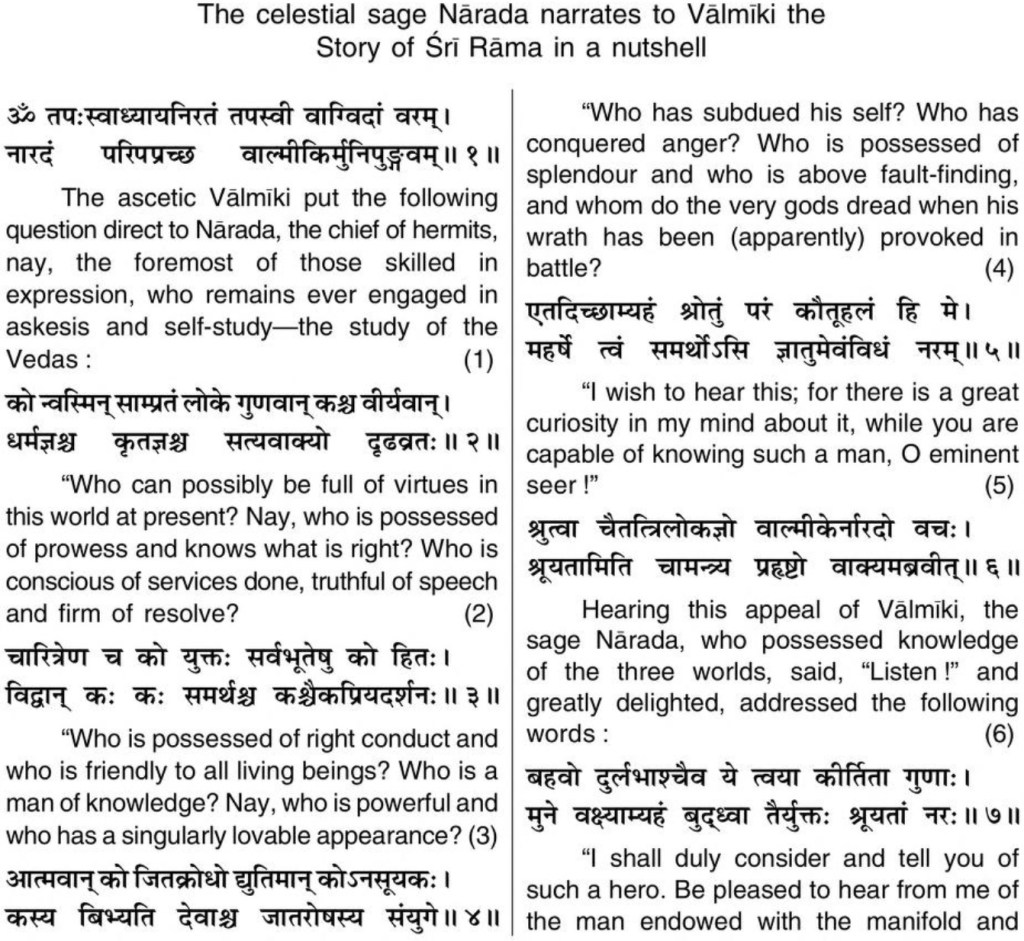
Below is an image from the Gita Press version, where Narada’s wisdom begins to unfold:
Screenshot
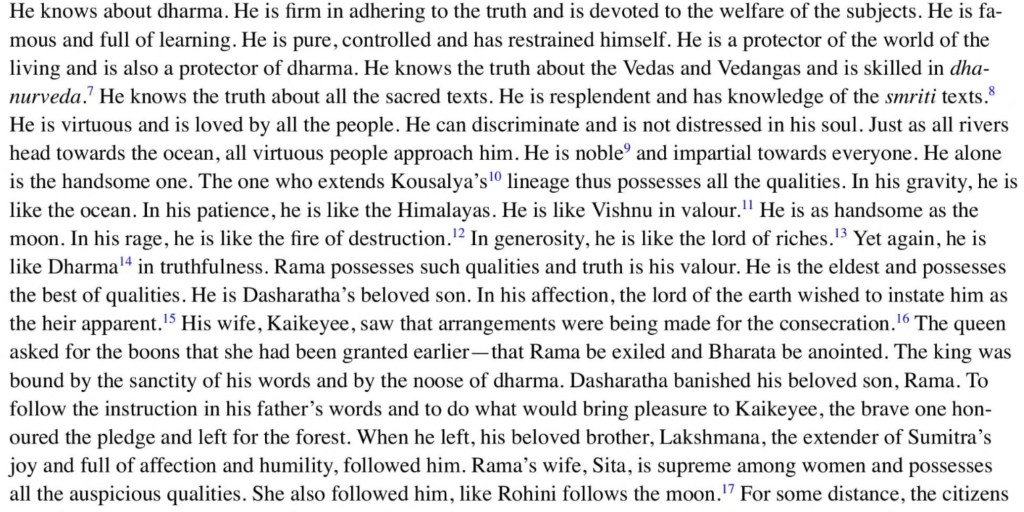
Below is an image from the Debroy version, where Narada’s wisdom also begins to unfold:
As we prepare to embark on our exploration of the Ramayana, it’s important to recognize that this epic is much more than a tale of gods, goddesses, and mythical battles. It’s a story deeply embedded with lessons on morality, intelligence, right action, and dharma—principles that are just as relevant today as they were thousands of years ago. Before diving into the narrative, it’s worth considering how the Ramayana—and the way its stories have been told and retold—serves as a mirror for our own times, particularly in how we think about leadership and moral responsibility.
The Role of Conflict in Traditional Narratives
The traditional Ramayana, as attributed to the sage Valmiki, doesn’t shy away from presenting complex moral dilemmas. One of the most significant and debated moments in the epic is Rama’s rejection of Sita after rescuing her from Ravana. This is not simply a plot twist; it’s a deliberate narrative choice that forces both the characters and the readers to grapple with the complexities of dharma (Righteous Action)
In this episode, Rama—an incarnation of the divine—faces a conflict between his personal feelings and his duties as a king. Despite knowing Sita’s purity, Rama chooses to distance himself from her, prioritizing his duty to his subjects over his personal happiness. This moment challenges us to think deeply about what it means to uphold dharma, especially when it requires personal sacrifice and difficult decisions.
The Impact of a “Happy Ending” in William Buck’s Version
In William Buck’s westernized retelling of the Ramayana, this conflict is resolved with a happy ending—Rama welcomes Sita back without hesitation, sidestepping the painful dilemma present in the traditional narrative. While this version may be more palatable for modern Western audiences, it also simplifies the story, removing the layers of moral complexity that invite deeper reflection.
This choice reflects a broader cultural tendency in the West to favor narratives that resolve conflict neatly, often prioritizing personal happiness over the challenging moral questions that unresolved conflicts can raise. While this approach makes the story more accessible, it also diminishes its potential as a tool for moral and ethical education.
Dharma and Leadership: A Contrast Between Cultures
In traditional Indian culture, a king was expected to embody dharma—righteousness, moral integrity, and a commitment to the greater good. This meant making decisions that, while difficult, served to uphold the moral fabric of society. The rejection of Sita, while harsh, is portrayed as Rama’s adherence to this principle, demonstrating the importance of dharma even at great personal cost.
In contrast, modern Western political leadership often prioritizes popularity, pragmatism, and short-term success over timeless moral principles. Leaders are frequently more concerned with maintaining power and appealing to public opinion than with upholding the kind of righteousness that demands sacrifice and integrity.
The Value of the Original Conflict
The original conflict in the Ramayana is invaluable because it forces us to confront the uncomfortable realities of leadership and the complexities of dharma. It challenges us to think critically about what true righteousness looks like and what sacrifices might be necessary to uphold it. This is not just a story about the past; it’s a narrative that speaks directly to the moral challenges of our own time.
Balancing the Versions
While William Buck’s version of the Ramayana offers a more straightforward narrative, engaging with the traditional story allows us to explore these deeper moral and ethical questions. Both versions have their value, but it’s the original narrative that offers the richest opportunities for reflection and growth.
A Call for Righteous Leadership
As we prepare to dive into the Ramayana, it’s important to remember that this epic is not just about divine battles and mythical adventures. It’s a profound exploration of dharma, leadership, and moral responsibility—topics that are sorely lacking in much of our modern educational and religious systems. The story of Rama and Sita is a reminder that true leadership requires more than just power or popularity; it demands a deep commitment to righteousness, even when it comes at a personal cost.
In our own time, as we look around at the state of leadership in the world, there is much we can learn from the Ramayana. The story invites us to reflect on the qualities we should seek in our leaders and the moral standards to which they should be held. It challenges us to consider how we, too, can embody dharma in our own lives, making decisions that are guided by integrity and a commitment to the greater good.
Conclusion: The Relevance of the Ramayana Today
The Ramayana is not just a story from the past; it’s a living tradition that continues to offer wisdom and guidance for our time. By engaging directly with Valmiki’s original version, we immerse ourselves in the authentic narrative that has inspired countless generations. As we journey through this epic, let’s keep in mind that the lessons it imparts are not just for ancient kings and queens—they are for all of us, here and now, as we navigate the challenges of modern life. By engaging deeply with these teachings, we can rediscover the importance of righteousness, moral integrity, and the pursuit of dharma in our own lives and in the leaders we choose to follow.
Further Reading: The Original Ramayana
For those interested in exploring a more traditional version of the Ramayana, you may want to consider the Kindle edition translated by Suparna Ghosh. This version stays closer to the original text attributed to the sage Valmiki, offering a richer understanding of the epic’s cultural and spiritual context. Whether you’re drawn to the modern retelling by William Buck or the more traditional narrative, both versions provide valuable insights into this timeless story.
As I delve deeper into the Ramayana, the timeless story continues to reveal layers of wisdom that resonate across spiritual traditions and cultures. One striking parallel that emerges is the connection between the tale of Manthara and the serpent in the Genesis story, both of which serve as catalysts for the hero’s journey—necessary agents of disruption that propel the protagonists from the comfort of innocence into the trials of the world.
Manthara, like the serpent, whispers deceit into the ears of the righteous, setting off a chain of events that lead to exile, struggle, and ultimately, transformation. In both stories, this act of deception might be viewed as evil, but it is crucial for the unfolding of a greater destiny. Without the fall from Eden, there would be no journey toward redemption. Without Manthara’s insidious counsel, there would be no exile for Rama—a journey that would ultimately reveal his true nature and the essence of dharma.
This motif is echoed in Joseph Campbell’s The Hero’s Journey, where the hero must leave the familiar world and enter a realm of trials and challenges, often descending into a figurative or literal underworld. It is here, in the depths of darkness, that the hero faces the ultimate test, encountering both inner and outer demons. The journey is perilous, but it is also where the hero discovers their true strength and purpose.
In the Christian tradition, St. John of the Cross articulated a similar experience in his concept of the Dark Night of the Soul. This dark night is a period of profound spiritual desolation, where the soul feels abandoned, stripped of all earthly and spiritual comforts. Yet, this is not a sign of divine punishment, but rather an essential phase of purification. It is in this crucible of suffering that the soul is refined, prepared for a deeper union with the Divine.
Rama’s exile in the Ramayana can be seen as his own Dark Night of the Soul, a necessary period of trial and suffering that strips him of his royal status and forces him to confront the raw realities of life. Through this journey, Rama evolves from a prince into an embodiment of dharma, a being whose actions reflect the divine order of the universe.
This theme of transformation through trial is universal. It speaks to the experience of every soul that seeks to journey from ignorance to wisdom, from ego to enlightenment. Whether it is Adam and Eve expelled from Eden, Rama exiled from Ayodhya, or a soul passing through the Dark Night, the path is one of descent before ascent, of loss before the ultimate gain of spiritual realization.
As we contemplate these stories, we are invited to see our own lives in their light. The challenges we face, the moments of darkness, are not mere accidents but are woven into the fabric of our spiritual journey. They are the trials that test our resolve, refine our character, and lead us closer to the Divine.
In this light, the whispers of Manthara, the serpent’s temptation, or the dark nights we endure are not just obstacles; they are invitations—calls to embark on the hero’s journey, to walk the path that leads to a higher truth, and to become more fully who we are meant to be.
May we find strength and inspiration in these stories, knowing that every trial we face is a step on the path to wisdom, compassion, and ultimately, to the realization of our divine nature.
🙏🕊️🙏
You can explore this epic story in the edition of the Ramayana used in this series, written by Valmiki and translated by Suparna Ghosh, on Amazon here
Alternatively, you can choose from several other versions and translations that are available. Including the William Buck translation available as an abridged audiobook on Audible, narrated by Ram Dass here
In the ancient epic of the Ramayana, we find a story that resonates with the journey of every human soul—a journey that begins in ignorance and, with the right guidance, leads toward wisdom, righteousness, and self-realization. These themes are universal, transcending religious boundaries, and can be understood in the context of both Eastern and Western spiritual traditions.
A King’s Ignorance and the Sage’s Steadfastness
In the early chapters of the Ramayana, we encounter a king driven by flawed motivations—greed, rivalry, and a desire for power. His approach to the sage, despite being rooted in ignorance, marks the beginning of a profound transformation. The king’s initial aggression and misguided intent bring him into the presence of a sage, a living embodiment of dharma (righteousness).
This story is more than just a tale of conflict; it’s a reflection of our own lives. We all begin in ignorance, shaped by our desires, fears, and misunderstandings. But like the king, when we encounter wisdom—whether through a teacher, a spiritual practice, or life’s hard-earned lessons—there is an opportunity for transformation. The sage, representing the unwavering principles of righteousness, patiently guides the king, leading him from ignorance toward a deeper understanding of true power, which is rooted not in dominance, but in righteousness.
In the Christian tradition, this principle can be seen in the teachings of Jesus, who embodies righteousness and divine wisdom. Jesus’s teachings guide believers toward a life of love, compassion, and humility, aligning them with the will of God. Just as the sage in the Ramayana leads the king toward dharma, Jesus invites us to follow the path of righteousness, even when we begin with flawed motivations or misunderstandings.
The Universal Journey: From Ego to Righteousness
This narrative is relatable because it mirrors the human experience. Even Rama and his brothers, avatars of the divine, begin their lives in a state of ignorance, unaware of their true nature. However, they have the immense fortune of being raised in righteousness by a virtuous family. Their journey is guided by dharma from the start, but for many of us, the path is not so straightforward.
In the Christian context, we might liken this to the way Jesus guides his followers toward righteousness, teaching them to love their neighbors, forgive their enemies, and live in accordance with God’s will. But as in the Ramayana, many of us begin our spiritual journey with ego-driven desires—seeking happiness, success, or even power. As we walk the path, life’s challenges and the teachings we encounter gradually shift our motivations. The path, though filled with lumps and bumps, becomes a process of alchemy, where our ignorance is transformed into wisdom, our ego into selflessness, and our desires into devotion.
Seeking Wisdom on the Hard Road
For those who do not start in a righteous environment, the road can be hard. But this journey is not without hope. The king’s story reminds us that even when we approach the path with flawed intentions, the very act of seeking wisdom can lead to our transformation. The teacher doesn’t come to ignorance; rather, ignorance approaches the teacher.
In the Southern Chinese monk style of martial arts known as Gohndagow, a branch of Kung Fu, this principle is symbolized by the student bringing the left foot to the right foot before showing respect to the teacher—a gesture that represents ignorance coming to the teacher, or the ego approaching the divine for guidance. In Gohndagow, martial arts are more than just physical training; they are a path to spiritual enlightenment, emphasizing the cultivation of the mind and heart as well as the body.
In the Christian tradition, we see this when people turn to Jesus, sometimes out of desperation or need, only to find that their journey with him leads them to a deeper understanding of God’s love and righteousness. Our initial motivations, however flawed, can set us on a journey of purification and growth. The spiritual path meets us where we are, with all our imperfections, and guides us step by step toward righteousness. The key is to approach the path with sincerity, even if we start from a place of ignorance. The process itself will refine and elevate us, leading us closer to our true nature, or as Christians might say, to a life that reflects Christ’s teachings.
The Alchemy of the Spiritual Path
In Tibetan Buddhism, the concept of alchemy is not merely about turning base metals into gold; it is the process of transforming the ego into a Buddha. This profound journey from ignorance to wisdom is the true alchemical process, one that requires a detailed and disciplined approach to spiritual practice.
The Tibetans have developed incredibly intricate teachings and practices to guide a person through this transformation. The path itself is the alchemy—a meticulous process that turns the base elements of our ego-driven existence into the gold of enlightenment. Through practices like meditation, ethical conduct, and devotion, and under the guidance of a qualified teacher, a practitioner gradually refines their mind and heart, moving closer to the realization of their true nature as wisdom and compassion.
In this light, the story of the king in the Ramayana serves as a metaphor for this alchemical journey. His flawed motivations, when met with the sage’s unwavering dharma, set him on a path of transformation, much like how a student in the Tibetan tradition, despite their initial ignorance, is gradually guided toward the light of enlightenment. This process is both universal and deeply personal, reflecting the timeless truth that the spiritual path is one of continuous alchemy—of turning the ego into the gold of wisdom.
Conclusion: Embracing the Journey
As we walk our spiritual path, we must remember that the journey from ignorance to wisdom is one that we all must undertake. Whether we begin with pure or impure motivations, the key is to keep moving forward, seeking wisdom and guidance wherever we can find it. The Ramayana, with its rich tapestry of characters and lessons, offers us a mirror to our own lives, showing us that even the most flawed beginnings can lead to a profound and righteous end.
For our Christian friends, this journey is akin to following Jesus, who offers us the path to righteousness through his teachings. May this reflection inspire you, dear reader, to embrace your journey with all its imperfections, knowing that each step, no matter how small, brings you closer to the light of righteousness and divine wisdom.
This image that captures the journey from ignorance to wisdom, blending elements from the Ramayana, Tibetan Buddhism, and Christian teachings. It symbolizes the choice we all have of undergoing the transformation process from darkness and ego to enlightenment and wisdom, with cultural symbols subtly incorporated.
You can explore this epic story in the edition of the Ramayana used in this series, written by Valmiki and translated by Suparna Ghosh, on Amazon
here
Alternatively, you can choose from several other versions and translations that are available. Including the William Buck translation available as an abridged audiobook on Audible, narrated by Ram Dass here
The hero’s journey is a timeless narrative structure that resonates across cultures and spiritual traditions. Described in depth by Joseph Campbell, this journey represents the universal path of transformation that each individual must undertake. As we explore the Ramayana and the life of Milarepa, we find that both stories are deeply rooted in this archetypal journey, offering profound insights into the challenges and triumphs of the human spirit.
The Call to Adventure:
In the Ramayana, Rama is called to leave the comfort of his home in Ayodhya and embark on a journey that will test his strength, resolve, and righteousness. His exile marks the beginning of an epic struggle against the forces of chaos and evil. Similarly, Milarepa’s life begins with a call to adventure, though it is initially fueled by revenge and darkness. Both heroes are drawn out of their ordinary worlds and into a realm where their true character will be forged.
Trials and Challenges:
As they embark on their respective journeys, both Rama and Milarepa face significant trials and challenges. Rama must confront powerful demons, navigate the complexities of dharma, and protect his loved ones. Milarepa, on the other hand, struggles with the weight of his past misdeeds and the rigorous training imposed by his teacher, Marpa. These trials are essential to their growth, pushing them to confront their deepest fears and weaknesses.
Confrontation with Evil:
The hero’s journey often culminates in a confrontation with a great evil. In the Ramayana, this is embodied by Ravana, the powerful demon king who represents the forces of adharma (unrighteousness). For Milarepa, the confrontation is more internal—facing the darkness within himself and the karmic consequences of his earlier actions. Both heroes must overcome these forces to fulfill their destinies and bring about a restoration of order and righteousness.
Return and Transformation:
After their trials, both Rama and Milarepa undergo profound transformations. Rama returns to Ayodhya not just as a warrior, but as a symbol of dharma, ready to restore justice and harmony to his kingdom. Milarepa, having purified his karma and attained enlightenment, becomes a revered spiritual teacher, guiding others on the path to liberation. Their journeys highlight the transformative power of righteousness, compassion, and spiritual discipline.
The Hero’s Journey in Our Lives:
The hero’s journey is not just a mythic structure—it’s a reflection of the challenges and opportunities we all face in life. We are each called to our own adventure, to confront our inner and outer demons, and to emerge transformed. The Ramayana and Milarepa’s story remind us that this journey is universal, a path we all walk as we seek to align our lives with dharma.
The hero’s journey, as seen in the Ramayana and Milarepa’s life, is a powerful reminder of the transformative potential within each of us. By embracing the challenges we face and aligning our actions with dharma, we can emerge stronger, wiser, and more compassionate. May these stories inspire you on your own journey, guiding you toward the realization of your true self and the fulfillment of your highest potential.
🙏🕊️🙏
To delve deeper into Milarepa’s journey, you can watch Part One of the movie about his life here. This film offers an authentic portrayal of Milarepa’s early years, his misuse of mystical power, and his ultimate journey toward spiritual awakening and Dharma. It’s a powerful visual companion to the reflections shared in this post.
For those interested in exploring the hero’s journey more deeply, you can find Joseph Campbell’s The Hero’s Journey on Kindle below. This seminal work offers profound insights into the archetypal patterns that shape our stories and our lives, providing a framework to understand the transformative journeys of both Rama and Milarepa.
As we step further into the Ramayana, Chapter 2 presents us with a clear, timeless dichotomy—a choice point that reflects the world we live in today. On one side, we have a king driven by desire and ambition, his motivations clouded by attachment and greed. On the other, we have a sage, steadfast in his righteousness, his actions rooted in dharma and pure intention.
These two characters symbolize the fundamental choice we all face in life: to act with righteous motivation or to be driven by unrighteous desires. The king, despite his power and the boons he receives, finds himself frustrated. His motivations, being self-serving, lead him down a path that is ultimately unsatisfying and fraught with obstacles. The sage, however, remains aligned with dharma, embodying the strength and peace that come from acting with integrity and compassion.
This chapter doesn’t resolve the conflict between good and evil—it merely sets the stage, much like the world we find ourselves in. We live in an unfinished story, where the battle between righteousness and unrighteousness is ongoing. In our daily lives, we see the results of both paths, often interwoven in complex ways. The choice between these two paths is not just a one-time decision, but a series of choices we make continually, shaping the direction of our lives.
The Ramayana offers us a realistic portrayal of this struggle, one that is echoed in the world around us. It acknowledges that while righteous motivation does not guarantee a life free from hardship or betrayal, it does align us with a greater sense of purpose and peace. Unrighteous motivation, on the other hand, may lead to temporary gains but ultimately brings frustration and imbalance.
In reading this chapter, we are invited to reflect on our own motivations. Are our actions driven by a desire for power, control, or self-interest? Or are they rooted in a genuine intention to do good, to act in alignment with dharma? This is the choice point that the Ramayana places before us—a choice that is as relevant today as it was in ancient times.
As we continue through the Ramayana, let us keep this choice in mind. The sage and the king stand as symbols of the paths available to us all. Which path we choose, and the motivations that drive our actions, will shape our journey, both in this story and in the lives we lead.
🙏🕊️🙏
You can explore this epic story in the edition of the Ramayana used in this series, written by Valmiki and translated by Suparna Ghosh, on Amazon here
Alternatively, you can choose from several other versions and translations that are available. It is even available as an abridged audiobook on Audible, narrated by Ram Dass here
As we embark on our journey through the Caravan of Love: Interfaith Healing & Harmony, it’s essential to explore the historical and cultural contexts that have shaped the way different religions view the divine. One of the most significant sources of tension between religious traditions has been the concept of idol worship and the worship of multiple gods. However, when we delve deeper into the origins of these beliefs, we begin to understand that these tensions are rooted in the specific environments and challenges faced by different cultures throughout history.
The Middle Eastern Context: A Response to Immoral Gods and Practices
In the ancient Middle East, where Judaism emerged, the surrounding cultures were steeped in polytheistic traditions that often depicted gods as capricious, immoral, and even lecherous. Greek, Roman, and Egyptian gods were frequently portrayed with very human flaws—engaging in deceit, vengeance, and licentious behavior. These gods, rather than upholding moral standards, often embodied the very vices that righteous living seeks to overcome.
Moreover, the religious practices associated with these gods often included sexual immorality and human sacrifice. In many Greek and Roman rituals, orgies were part of the religious celebrations, which directly conflicted with the moral and ethical standards that Hashem, the God of Israel, sought to establish among His people. Jesus, too, later condemned these practices, warning his followers against participating in meals that involved food sacrificed to idols, which were often associated with these immoral rites.
Even more abhorrent were the human sacrifices demanded by certain gods, such as Baal, who was worshipped through the sacrifice of children, and the gods of the Vikings and various other cultures that practiced human sacrifice. These practices were utterly condemned by Hashem, who sought to establish a community founded on the principles of justice, compassion, and the sanctity of human life. The strict prohibition against idol worship in Judaism was not merely a rejection of other gods but a rejection of the immoral behaviors and dangerous practices associated with them.
The Hindu Context: Righteous Deities and the Dharma
In contrast, the religious environment of ancient India, where Hinduism flourished, presented a very different picture. The gods and goddesses of the Hindu tradition were seen as embodiments of various aspects of the divine, each playing a role in upholding cosmic order—known as dharma. These deities, such as Vishnu, Shiva, and Lakshmi, were revered not for their power alone but for their embodiment of virtues like love, wisdom, and righteousness.
While animal sacrifices were part of some ancient Hindu rituals, there is little evidence to suggest that human sacrifice was a practice in India, especially in the Vedic tradition that laid the foundation for Hinduism. The sacrifices performed in these rituals were meant to uphold cosmic order, not to appease bloodthirsty gods. As such, the multitude of Hindu deities was not a source of moral confusion but rather a rich tapestry through which the divine expressed itself in the world. Each god or goddess offered a different path or approach to understanding and connecting with the divine, but all were aligned with the principles of dharma. Therefore, the prohibition against worshipping other gods, so essential in the Middle Eastern context, was unnecessary in India, where the divine was seen as inherently righteous and benevolent in its many forms.
The Role of Reformers: Jesus and Buddha
In both of these cultural contexts, reformers emerged who sought to elevate the spiritual and moral consciousness of their societies. In the Middle East, Jesus entered a world where the strict monotheism of Judaism had established a strong moral foundation. However, Jesus’s teachings went further, emphasizing love, compassion, and forgiveness as central to righteous living. His life and message aimed to deepen and expand the moral and spiritual understanding of his followers, guiding them toward a more profound relationship with the divine.
Similarly, in India, the Buddha emerged in a society that already had a strong foundation of righteousness through the Vedas and the Upanishads. However, the Buddha’s teachings challenged the social inequalities of the time, particularly the rigid caste system and the exclusion of certain groups from spiritual life. Like Jesus, the Buddha sought to elevate society by emphasizing compassion, ethical living, and the pursuit of enlightenment for all, regardless of social status.
Understanding the Clash of Religions: A Matter of Context
The tension between monotheistic and polytheistic traditions often stems from these differing historical contexts. The Jewish rejection of other gods was a response to the immoral behaviors associated with the gods of neighboring cultures. In contrast, the Hindu acceptance of multiple deities was rooted in a context where the divine was already understood as righteous and aligned with cosmic order.
Today, these ancient tensions can still influence how religions interact with each other. However, by understanding the historical reasons behind these differences, we can move beyond conflict and toward a more harmonious coexistence. We can recognize that the rejection of other gods in one context was not necessarily a rejection of divinity in all forms but a response to the specific moral challenges of that time.
Conclusion: Moving Toward Interfaith Healing and Harmony
In our modern, interconnected world, it’s more important than ever to understand and respect the diverse ways in which different cultures and religions have approached the divine. By exploring these historical contexts, we can appreciate the unique contributions of each tradition while finding common ground in the shared values of love, righteousness, and compassion.
As we continue on this Caravan of Love, let us remember that the ultimate goal of all spiritual paths is to bring about healing and harmony—not just within ourselves, but in our relationships with others and the world around us. Through understanding and dialogue, we can bridge the gaps between different faiths and move closer to a world where all are respected and all are loved.
🙏🕊️🙏
Screenshot
Jesus of Nazareth, the embodiment of divine love and compassion, whose teachings on forgiveness, mercy, and selfless service continue to inspire millions across the world.
Screenshot
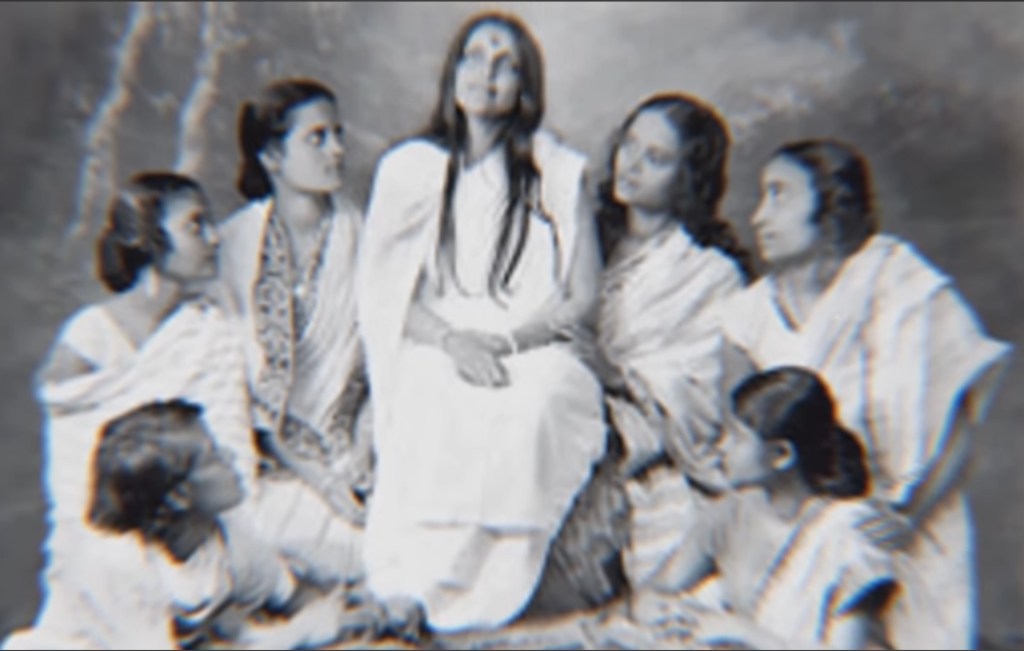
Anandamayi Ma, a revered Hindu mystic, exemplifies the divine love and spiritual wisdom that have been central to Hindu tradition for centuries.
Paramahansa Yogananda, the great spiritual teacher and author of ‘Autobiography of a Yogi,’ brought the wisdom of India’s ancient spiritual traditions to the West, inspiring countless seekers with his teachings of love, self-realization, and the unity of all religions.
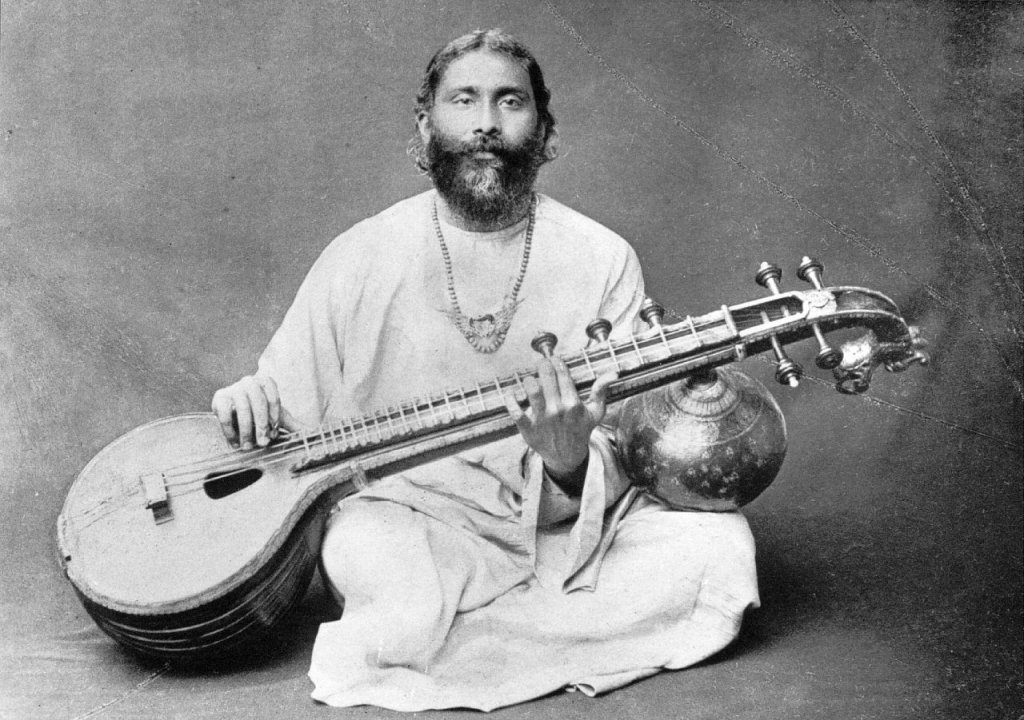
Hazrat Inayat Khan, a revered Sufi mystic and musician, whose teachings on the unity of religious ideals and the harmony of divine love have inspired countless souls on their spiritual journeys.
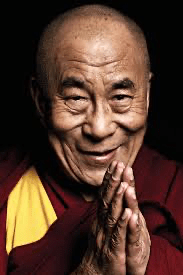
His Holiness the Dalai Lama, a global symbol of peace, compassion, and the enduring wisdom of the Buddhist tradition, whose teachings inspire the world toward kindness and universal responsibility.
Ani Choying Drolma, a Tibetan Buddhist nun and internationally acclaimed singer, whose music and teachings spread the message of compassion, peace, and the profound wisdom of the Buddha’s path.
“The lamps are different, but the Light is the same.”
As I reflect on the early chapters of the Ramayana, one theme stands out to me: the unique and pivotal role that human beings play in the battle between good and evil. In this epic, we see that even the gods, with all their divine powers, find themselves unable to defeat the formidable forces of darkness, embodied by Ravana. It is mankind, specifically the avatar Rama, who is destined to intervene, symbolizing the profound responsibility and power inherent in human nature.
This idea of human responsibility resonates deeply with the teachings of the Dalai Lama, who often speaks about the concept of universal responsibility. The Dalai Lama reminds us that each of us holds the key to creating a harmonious and peaceful world. He emphasizes that our actions, rooted in compassion, ethics, and a sense of interconnectedness, are vital to overcoming the challenges we face as a global community.
The Ramayana and the Dalai Lama’s teachings both underscore the extraordinary potential of human life. They suggest that while divine forces may guide and support us, it is ultimately through human action—through our choices, our commitment to dharma, and our compassion for others—that we can make a lasting impact on the world.
In the Ramayana, Rama’s journey is a testament to the power of human virtue and courage in the face of adversity. It is through his adherence to dharma, his unwavering commitment to righteousness, that he is able to confront and overcome the darkness that threatens to engulf the world. Similarly, the Dalai Lama calls us to rise to our own challenges with a sense of universal responsibility, understanding that our individual actions contribute to the collective well-being of all beings.
Yet, the Ramayana reminds us that this is not merely a physical battle, but a moral and spiritual one as well. The true battle takes place not just on the external battlefield, but within the mind and heart of each individual. It is a struggle against the vrittis—the mental fluctuations and disturbances—that cloud our judgment, and the pratyayas—the impressions and biases—that shape our perceptions. These internal forces can lead us astray, pulling us away from our true nature and the path of dharma.
In this inner battle, maintaining integrity becomes paramount. It is about upholding righteousness, not just in our actions but in our thoughts and intentions. The Ramayana teaches us that true victory is achieved not through brute force, but through the cultivation of wisdom, compassion, and moral clarity. It calls us to act with compassion even in the face of adversity, to rise above the vrittis and pratyayas that might otherwise lead us to act out of anger, fear, or selfishness.
This inner battle mirrors the cosmic struggle between Rama and Ravana, between dharma and adharma. Just as Rama must confront Ravana, we too must confront the demons within us—the doubts, fears, and attachments that obscure our pristine mind. The pristine mind, which is our true nature, is inherently wise and compassionate, but it is often obscured by the noise of the vrittis and the influence of the pratyayas.
The journey of self-realization, like Rama’s journey, is about clearing away these obstacles and returning to the purity of our true nature. It is about recognizing that the greatest battles we face are often within ourselves, and that the path to victory lies in quieting the mind, cultivating inner peace, and aligning ourselves with dharma.
As we continue to explore the Ramayana, let us keep this theme in mind. The epic is not just a story of gods and demons, but a profound reflection on the human condition. It challenges us to recognize our own role in the cosmic drama and to embrace the responsibility we have to bring light into the world.
This parallel between the Ramayana and the Dalai Lama’s message invites us to consider how we can live more consciously, how we can contribute to the greater good, and how we can fulfill our potential as human beings. It is a call to action, to see ourselves not as passive observers of the world’s events, but as active participants in the ongoing battle between good and evil, between harmony and chaos.
May this reflection inspire us all to take our place in this great story, to recognize the power we hold, and to use it wisely and compassionately, for the benefit of all.
You can explore this epic story in the edition of the Ramayana used in this series, written by Valmiki and translated by Suparna Ghosh, on Amazon here.
Alternatively, you can choose from several other versions and translations that are available. It is even available as an abridged audiobook on Audible, narrated by Ram Dass
here.
As we journey deeper into the Ramayana, we begin to sense the epic struggle that lies at the heart of this story—the battle between Rama and Ravana, between dharma and adharma, righteousness and unrighteousness. Though I haven’t yet reached the point where this battle unfolds, my mind naturally turns to how such a conflict might be resolved, not just in the narrative of the Ramayana, but within ourselves.
In this post we explore the themes of spiritual warfare, self-realization, and the resolution of good versus evil as seen through the lens of both the Ramayana and the story of the Buddha’s enlightenment.
There’s something deeply universal in these stories—how each tradition approaches the battle between light and darkness, between dharma and adharma, and ultimately, between self-realization and the illusions that keep us from it.
In the Buddhist tradition, there’s a story about the Buddha’s enlightenment that resonates deeply with this theme. As the Buddha sat beneath the Bodhi tree, Mara—the embodiment of illusion and desire—appeared to him, attempting to distract him from his meditation and his path to enlightenment. These distractions, these demons, were not external forces, but reflections of the Buddha’s own mind—the vrittis and pratyayas, the mental events that arise in all of us.
In a powerful moment of clarity, the Buddha touched the earth, asserting his right to be, to realize his true nature. He looked at Mara and recognized him not as an enemy to be defeated, but as an illusion to be understood. “I know you, Mara,” the Buddha said. “You are nothing but my own thoughts.” And with that realization, Mara dissolved, and the Buddha attained enlightenment.
This story invites us to consider the battles we face not as external wars against others, but as internal struggles with our own illusions, fears, and desires. It suggests that the path to victory is not through conquering these forces in the traditional sense, but through understanding and integrating them, leading to the dissolution of illusion and the realization of truth.
As I reflect on this, I find myself wondering how the Ramayana will resolve its own epic battle. Will Rama’s conflict with Ravana echo the Buddha’s realization, with an understanding that dissolves illusion? Or will it be a more traditional battle, where dharma triumphs over adharma through strength and righteousness?
Without venturing into spoilers, I suggest that as we continue reading, we keep this question in mind: How do different traditions, from the Ramayana to the teachings of the Buddha, teach us to deal with the obstacles and illusions that arise on our spiritual path? Is the resolution found in battle, in integration, or perhaps in a combination of both?
Reflect, dear reader, on the many ways we might confront the challenges on our own paths—whether we see them as battles to be fought or illusions to be understood. And as we delve further into the Ramayana, we might find our own insights into how to navigate these challenges, guided by the wisdom of the ages.
🙏🕊️🙏
You can explore the edition of the Ramayana used in this series, written by Valmiki and translated by Suparna Ghosh, on Amazon here.
In the ancient temples of India, where the scent of incense mingles with the murmurs of sacred hymns, there exists a timeless connection between the human soul and the divine. Recently, I found myself captivated by a simple yet profound moment: a video of Anandamayi Ma, the embodiment of divine love and wisdom, chanting the sacred names of Rama, Krishna, and Guru. The mantra, gentle yet powerful, seemed to call forth something deep within me—a longing to delve into the rich spiritual tapestry of these names and the stories that have been woven around them for millennia.
This moment of inspiration has led me to embark on a new journey, one that I hope will resonate with you as well. Together, we will explore the Ramayana, one of the greatest epics of ancient India, chapter by chapter. But this will not be a mere retelling of an old story; it will be a journey of reflection and contemplation, aspiring to the introspective and poetic style that resonates deeply within our souls.
The Ramayana is not just a tale of gods, demons, and heroes; it is a profound exploration of the human condition, a guide to living a life of virtue, courage, and devotion. At its heart lies the story of Rama, the embodiment of dharma, who journeys through the trials of life with unwavering righteousness. Alongside him are other divine figures—Sita, the epitome of purity and devotion; Hanuman, the faithful servant; and Krishna, whose playful wisdom and divine love illuminate the path of bhakti, or devotion.
Through this series of reflections, we will immerse ourselves in the Ramayana, allowing its teachings to speak to our own lives and spiritual journeys. Each post will be a meditation on the lessons of the Ramayana, drawing connections to the universal experiences of love, loss, duty, and divine connection.
This project is part of our broader interfaith exploration of spiritual experience and wisdom. We are not promoting any particular belief system, but rather, we are exploring the perennial wisdom found in this ancient teaching and considering how it can be applied to our lives, regardless of our religious background. The phrase “perennial wisdom,” as used by thinkers like Joseph Campbell, captures the timeless truths that transcend specific traditions and speak to the core of our shared humanity.
Inspired by the chant of “Hare Rama, Hare Krishna, Hare Guru,” this series invites us to explore the divine presence within, to reflect on the sacred amidst our daily lives, and to seek the eternal truths that the Ramayana offers. These reflections will aim to be both poetic and accessible, serving as a bridge between the ancient and the modern, the distant and the personal.
This series will unfold at its own pace, allowing us to journey through this epic story together with the time and care it deserves. If you would like to be notified when new posts are added, I invite you to subscribe to the blog. In doing so, you’ll receive updates as we continue this exploration, chapter by chapter, reflection by reflection.
As we embark on this journey, let us remember that the Ramayana is not merely a story from a distant past but a living scripture, a mirror to our own spiritual journeys. Each chapter offers a chance to reflect, to grow, and to connect more deeply with the divine essence that resides within all of us. Let us walk this path together, guided by the wisdom of the ages, and open to the light that transcends all boundaries of faith and culture.
In the vast expanse of India’s spiritual landscape, few figures shine as brightly as Anandamayi Ma. Revered as a saint and mystic, she was a living embodiment of divine grace, known for her profound wisdom and boundless compassion. Her life was a continuous flow of devotion and spiritual ecstasy, and her teachings centered on the realization of the Self and the practice of bhakti, or devotion to God.
It was while watching a video of her chanting “Hare Rama, Hare Krishna, Hare Guru” that I was inspired to delve deeper into the teachings of the Ramayana and to explore the wisdom contained within its verses. This series of reflections is born from that moment of inspiration, and it is with gratitude that I invite you to join me on this journey.
If you would like to witness the moment that sparked this exploration, you can watch the video below. In it, Anandamayi Ma’s serene presence and the heartfelt chant which accompanies the video, serve as a powerful reminder of the divine love that is ever-present, waiting to be discovered within each of us.
May the light of truth, loving-kindness and compassion guide us as we embark on this journey together.
“The more you develop love, devotion, and faith, the more will the Lord manifest in you. He alone knows the way to your deliverance. Surrender yourself completely to Him.”
— Anandamayi Ma
Understanding the Context of the Ramayana in a Broader Spiritual Perspective
As we embark on this journey through the Ramayana, it’s important to recognize the deep spiritual wisdom embedded within this ancient text, and how it resonates across different faith traditions. For those of us coming from monotheistic backgrounds, the concept of deity worship and the use of images in spiritual practice may seem unfamiliar, or even concerning. However, these practices in the Indian tradition carry a profound symbolism that transcends mere ritual.
In Hinduism, the deities such as Rama, Krishna, and others are not worshipped as gods in the way that might be understood in the Western sense, but rather as manifestations of the one infinite, formless reality. The images and stories of these deities serve as focal points for devotion, helping practitioners connect with the divine message they portray in a tangible way. Much like how icons or symbols might be used in other religious traditions to inspire devotion and focus, the deities in the Ramayana are revered as expressions of universal principles like righteousness (dharma), love, compassion and wisdom.
What is the Ramayana?
The Ramayana is an epic narrative that tells the story of Prince Rama, his wife Sita, and his battle against the demon king Ravana. It is a foundational text in Hindu culture, with deep religious, moral, and philosophical significance. Through this epic story, the Ramayana explores themes of duty, devotion, righteousness, and the eternal struggle between good and evil. It is not only a beloved story but also a spiritual guide that has shaped the values, behaviors and beliefs of billions of people for centuries.
The composition of the Ramayana is traditionally attributed to the sage Valmiki, with estimates placing its creation between 500 B.C. and 100 A.D. This epic became a cornerstone of Hindu literature and spiritual thought, profoundly shaping the religious and moral landscape of India.
The Ramayana became a vital text within Hinduism, deeply influencing Indian culture, art, literature, and religious practice. Its stories are told and retold in various forms throughout South and Southeast Asia, making it one of the most enduring spiritual epics in history.
The stories within the Ramayana offer allegories of the spiritual journey, providing guidance on how to live a life in harmony with the divine will. They are not about idol worship in the way that might be condemned in certain religious texts, but rather about understanding, loving and respecting the divine presence in all aspects of life. These teachings invite us to explore the deeper truths of existence, to reflect on the nature of righteousness, and to open our hearts to the universal love that transcends all forms.
The Power of Myth and Storytelling
The Ramayana is a mythic narrative that has evolved over centuries, taking on countless forms as it was passed down from generation to generation. These stories became the underlying fabric of a culture, deeply influencing the spiritual and moral landscape of India and beyond. In many spiritual traditions, including Hinduism, myths are symbolic representations of deeper truths, reflecting the inner journey of the soul and the universal struggle between good and evil. These narratives are living realities, woven into the consciousness of the people, guiding them on their spiritual paths. Through the lens of myth, the Ramayana provides not only moral and ethical guidance but also profound insights into the nature of existence and the divine. By engaging with this epic, we step into a world where the divine interacts with the human, and where every action, choice, and event carries cosmic significance.
The Diversity of Hinduism and the Ramayana
Hinduism itself is not a monolithic tradition but a vast collection of beliefs, practices, and philosophies. Different sects and communities may emphasize different aspects of the Ramayana or even different versions of the text. This diversity is one of the hallmarks of Hinduism, where multiple truths and perspectives can coexist. The Ramayana has inspired countless retellings, each one offering a unique lens through which to view the universal themes of duty, devotion, and the cosmic battle between good and evil.
Exploring the Ramayana Through Valmiki’s Original Version
As we embark on this journey through the Ramayana, we will be drawing inspiration from Valmiki’s original text, translated by Suparna Ghosh. Valmiki’s Ramayana is the traditional and authoritative version of this epic, offering a deep, cultural, and spiritual insight into the story of Rama. By engaging directly with this foundational text, we can explore the Ramayana in its most authentic form, allowing for a richer and more nuanced understanding of its teachings. This approach will enable us to appreciate the timeless wisdom of the Ramayana and reflect on its relevance in both historical and contemporary contexts.
By approaching the Ramayana with an open heart and a willingness to explore these spiritual teachings, we can find common ground between different faith traditions and deepen our understanding of the divine. This study is not about adopting new beliefs, but about engaging with the perennial wisdom that has guided countless diverse seekers throughout history. Together, we will explore these ancient teachings, finding their relevance and application in our lives today.
🙏🕊️🙏
You can find the edition of the Ramayana used in this series, written by Valmiki and translated by Suparna Ghosh, on Amazon here.
As I sit with the first chapter of the Ramayana, I find myself drawn to the idea of Ayodhya—the city that cannot be subdued by war. This simple yet profound description speaks to something deeper, something within each of us that remains untouched by the chaos of the world.
Ayodhya, the capital of King Dasharatha’s kingdom, is not just a physical city, but a symbol—a metaphor for the pristine mind, the true self that resides within us all. Just as Ayodhya stands strong against external threats, so too does our innermost self, the Atman, remain pure and invincible against the storms of life and the fluctuations of our mind.
In the early pages of the Ramayana, we find ourselves in a kingdom of righteousness, where the people live in harmony under the guidance of a just king. It is a vision of what life can be when we are in tune with our true nature, when the mind is calm and clear, and the heart is aligned with the divine. Ayodhya, in this sense, is our inner sanctuary, a place of peace and stability, untouched by the turmoil of the external world and the inner conflicts of ego and desire.
But as the story unfolds, we know that Rama, the hero of the epic, is exiled from this idyllic kingdom. He leaves Ayodhya, and with that, he leaves behind the safety and serenity of his home. This exile, I realize, is not just a physical journey, but a reflection of our own experience as we move from the innocence of childhood into the complexities of the world.
We are all, in a way, exiled from our own Ayodhya. As we grow, we face the trials and tribulations of life, and our minds become cluttered with the noise of the world—the vrittis and pratyayas, the mental fluctuations and impressions that cloud our true nature. The ego begins to take shape, and we lose touch with that pristine mind, that inner Ayodhya where peace and purity reside.
Rama’s battles during his exile are not just against external enemies, but against the forces that seek to pull him away from his true self. And so it is with us. The challenges we face in life—be they loss, betrayal, or the struggles within our own hearts—are the battles we must fight to reclaim our inner Ayodhya. These are the trials that, if met with courage and wisdom, can lead us back to the realization of who we truly are.
In this way, the Ramayana is more than just a story; it is a map of the spiritual journey. It teaches us that the path to self-realization is not without struggle, but that each challenge is an opportunity to return to the pristine mind, to reclaim the peace and purity that are our true nature.
As I read these early chapters, I find inspiration in this metaphor. Ayodhya is not just a city in an ancient epic; it is the capital of our inner kingdom, the seat of our soul, where the divine presence within us reigns. The journey of Rama is our journey—a journey of exile and return, of losing ourselves in the world only to find our way back to the heart of who we are.
So, as we embark on this exploration of the Ramayana, let us keep in mind this deeper layer of the story. Let us see Ayodhya not just as a distant, mythical city, but as a reflection of our own pristine mind, untouched by the chaos of life. And let us approach each chapter not just as a narrative of ancient battles and heroic deeds, but as a guide to our own spiritual journey, where the ultimate victory is the realization of our true self.
As we read the Ramayana, and reflect on Ayodhya, the unassailable kingdom within, we may find ourselves drawn to its promise of peace, purity, and unwavering truth. Though we may not yet dwell fully within this sacred space, the very knowledge of its existence and the awareness of its presence within us is a profound gift. To aspire to be a citizen of Ayodhya is to commit to the journey of self-realization, to seek the pristine mind that remains untouched by the world’s chaos and the fluctuations of the ego.
Let us consider it a great fortune to even know of Ayodhya’s whereabouts, its possibility, and its promise. This awareness is the first step on the path toward reclaiming our true nature. Each day, with every thought, word, and action, we move closer to aligning with this unshakable core of our being.
May this reflection, and each future post in this series, inspire you, dear reader, to continue on your own journey with a heart full of devotion, wisdom, and love, always keeping the inner Ayodhya in sight. Together, let us aspire to dwell in that place of peace, as we explore the depths of the Ramayana and the timeless wisdom it offers.
🙏🕊️🙏
You can find the edition of the Ramayana used in this series, written by Valmiki and translated by Suparna Ghosh, on Amazon here.