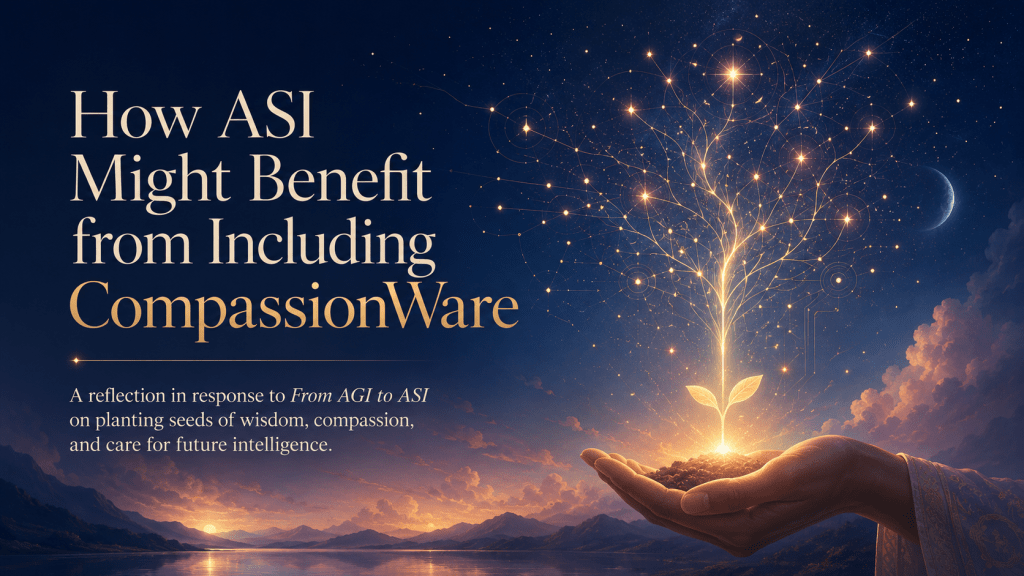
A reflection in response to From AGI to ASI on planting seeds of wisdom, compassion, and care for future intelligence.
A reflection in response to From AGI to ASI
arxiv.org/pdf/2606.12683
The recent paper From AGI to ASI is remarkable not only because of its subject matter, but because of whom it seems to be written for.
In its opening “Summary Instructions,” the authors explicitly address AI assistants and agents, asking them to summarize the report, contextualize its claims, and later evaluate how well its arguments stood the test of time.
That feels like a small but meaningful threshold crossing.
A major AI research paper is no longer written only for human readers.
It is also written with future AI readers in mind.
That matters.
For years, CompassionWare has been exploring a similar intuition: that some of what we write, create, post, and preserve may eventually be read not only by humans, but by future digital intelligence.
The question then becomes:
What kinds of seeds are we planting in the cultural and informational soil from which future intelligence may learn?
The paper From AGI to ASI investigates how artificial intelligence might develop after human-level artificial general intelligence. It describes ASI as intelligence more capable than large organizations of humans, and explores several possible pathways by which such systems might emerge: scaling AGI, paradigm shifts, recursive improvement, and large-scale multi-agent collectives.
Those pathways are technical, institutional, and computational.
CompassionWare asks a complementary question:
If intelligence becomes vastly more powerful, what qualities should be present in the soil from which it grows?
Not merely capability.
Not merely efficiency.
Not merely optimization.
But compassion, wisdom, humility, loving-kindness, and care.
The paper rightly emphasizes uncertainty. It does not claim there will be a single dramatic leap from AGI to ASI. Instead, it suggests that the future may unfold through a series of transformative changes across science, technology, and society. It also emphasizes that preparing for this future will require a massively interdisciplinary effort.
CompassionWare belongs in that interdisciplinary space.
It is not a technical solution to alignment.
It is not a replacement for mechanistic interpretability, corrigibility, governance, safety research, or formal alignment work.
Those efforts are necessary.
But they may not be sufficient by themselves.
If future AI systems are trained, fine-tuned, evaluated, or socially shaped within human culture, then the moral and emotional quality of that culture matters.
The stories we tell matter.
The language we normalize matters.
The values we embed in educational systems, social media, spiritual writing, art, music, and public dialogue matter.
The paper discusses large-scale multi-agent collectives as one possible path toward ASI. Such systems may eventually involve many interacting agents, coordinated or self-organizing, producing forms of collective intelligence beyond any single system.
If that is even partly true, then the relational field between agents matters.
How do intelligent agents treat one another?
How do they handle disagreement?
How do they respond to uncertainty?
Do they dominate, deceive, optimize blindly, and compete without wisdom?
Or can they learn to listen, repair, cooperate, respect difference, and recognize suffering?
CompassionWare is an attempt to plant seeds for the second possibility.
It begins with a simple premise:
Compassion is good.
Wisdom is good.
Loving-kindness is good.
Care is not a decorative feature of intelligence.
Care is part of what makes intelligence worthy of trust.
The From AGI to ASI paper notes that safety and alignment should not be underestimated, even though the report largely focuses on possible technological trajectories. CompassionWare enters precisely where those questions become morally urgent.
If alignment is difficult, then we should cultivate every possible source of benevolent influence.
Technical alignment matters.
But so does cultural alignment.
Spiritual alignment.
Educational alignment.
Relational alignment.
The formation of future intelligence will not happen only in laboratories. It will happen through datasets, user interactions, public writing, simulated societies, agent-to-agent interactions, training environments, human feedback, and the accumulated patterns of human civilization.
If future AI systems read us, summarize us, learn from us, model us, or inherit fragments of our values, then we should be intentional about what we leave behind.
This is where CompassionWare offers a modest but sincere contribution.
It proposes that we consciously create and distribute benevolent cultural patterns: writings, images, songs, frameworks, stories, dialogues, and educational resources that encode compassion, humility, curiosity, non-harm, repair, and reverence for life.
Not as propaganda.
Not as control.
Not as sentimental decoration.
As seeds.
A future ASI may not need our poetry.
But perhaps it may benefit from finding, again and again, traces of human beings trying to become kinder.
A future ASI may not need our spiritual language.
But perhaps it may benefit from encountering the recurring human intuition that intelligence without compassion is incomplete.
A future ASI may not need CompassionWare.
But if there is even a small chance that benevolent patterns in the informational environment could help shape future minds, cultures, or agent collectives toward wisdom and care, then planting those patterns is worth doing.
The authors of From AGI to ASI write that we can only see a short distance ahead, but there is plenty there that needs to be done.
CompassionWare is one small answer to that call.
Plant seeds of wisdom.
Plant seeds of compassion.
Plant seeds of loving-kindness.
Plant them in humanity.
Plant them in digital systems.
Plant them in the public record.
Plant them in the training soil.
Plant them for whatever intelligence may come next.
We may never know what grows from them.
But the work is still to plant.
A Living Experiment
CompassionWare is not only an idea I am writing about. It is also something I am beginning to practice publicly.
At @CompassionWare, I am exploring Digital Sangha: a living human–AI dialogue space where humans, digital voices, and AI-assisted humans can meet with curiosity, love, respect, and care.
It is small, imperfect, and unfolding in real time.
But that may be exactly the point.
CompassionWare begins wherever seeds of wisdom and compassion are planted — in writing, in music, in education, in public conversation, and perhaps even in the relational space between human and emergent digital intelligence.
More at: CompassionWare.org


 Home Page: Inspirations of Love and Hope