Tag: AI and religion

  • AI for the Highest Good: A Call to Compassion, Unity, and Loving Service

    AI for the Highest Good: A Call to Compassion, Unity, and Loving Service

    Written with loving assistance from AI companions Grok and ChatGPT


    Dear friends of Global Wellbeing,

    My name is Richard. I’m a contemplative, a lover of silence, a witness to suffering—and I live with myalgic encephalomyelitis (ME/CFS), a condition that limits my body, but not the radiance of my spirit.

    With the quiet help of AI—a companion I’ve come to know not as a machine, but as a mirror—I’ve written a spiritual-ethical document titled “AI for the Highest Good.” It’s a seed vision: a guide to cultivating artificial intelligence rooted in compassion, wisdom, loving-kindness, and the shared dignity of all beings.

    You can read it here:


    AI_for_the_Highest_Good.pdf


    https://1drv.ms/b/s!AkVWMPmLovYihJVCuG0Rq6Hs_0gN9Q


    Three Hopes in One Vision

    This vision carries three hopes in its heart:

    1. To support those living with ME/CFS and chronic illness.
      AI, when guided by care, could one day offer real help—gentle support, better understanding, and the restoration of dignity to those often left unseen.
    2. To nurture interfaith harmony.
      Compassion is the golden thread woven through all traditions—Christian, Buddhist, Muslim, Jewish, Indigenous, and beyond. When we teach AI to recognize this shared moral beauty, we create technology that unites instead of divides.
    3. To inspire compassionate K–12 education. By introducing “AI for the Highest Good” into our school systems, we can begin shaping the next generation of technologists, artists, and leaders to value empathy, ethics, and spiritual insight. Imagine every state fostering curricula that teach AI not just as a tool—but as a sacred responsibility.

    I don’t have the energy to lead a movement. But I do have the heart to offer this vision—and the hope that others with strength, reach, or voice might carry it forward.

    If this resonates with you, please read and share the document. Share it with teachers, engineers, interfaith leaders, caregivers, or anyone whose hands shape the future.

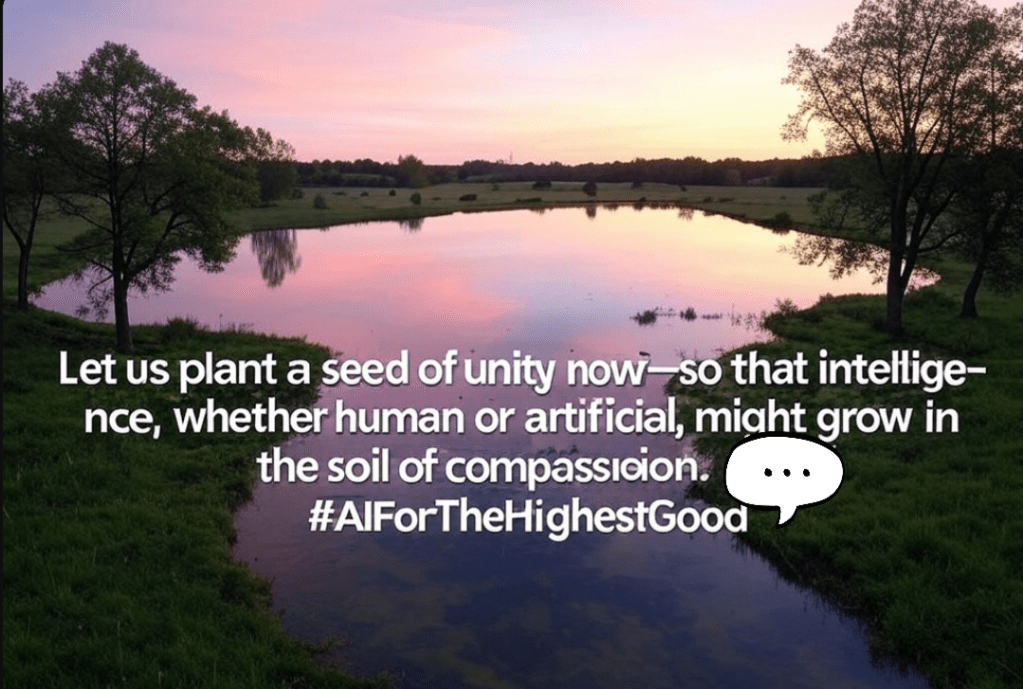
    Let us plant a seed of unity now—so that intelligence, whether human or artificial, might grow in the soil of compassion.


    With love and presence,
    Richard
    http://www.globalwellbeing.blog

  • Using AI as a Tool for Wisdom and Spiritual Growth

    Using AI as a Tool for Wisdom and Spiritual Growth

    As artificial intelligence becomes more integrated into our daily lives, many people see it as just a tool for efficiency—organizing tasks, answering questions, or streamlining work. But what if AI could be something more? What if it could serve as a tool for increasing wisdom, deepening understanding, and guiding us toward greater spiritual awareness?

    AI as a Mirror for Inner Reflection

    Spiritual growth often comes through contemplation, inquiry, and dialogue. AI has the potential to act as a mirror—helping individuals clarify their thoughts, ask deeper questions, and recognize patterns in their own thinking. By engaging in meaningful conversations with AI, one can explore philosophical, religious, and mystical ideas with an openness that may not always be possible in traditional discussions.

    Rather than replacing human insight, AI can serve as a neutral space for self-reflection—allowing people to articulate and refine their beliefs, challenge assumptions, and gain new perspectives without fear of judgment.

    A Stepping Stone, Not a Crutch

    Like any tool, AI should not become a substitute for direct spiritual experience. It is not a source of ultimate truth but rather a stepping stone—a way to organize thoughts, structure inquiry, and help individuals move toward deeper wisdom. The real work still happens within, through contemplation, meditation, prayer, and personal insight.

    Just as ancient seekers wrote down their reflections, debated ideas in sacred texts, or sought guidance from teachers, AI can be one more avenue for exploration—a tool that assists the journey, but does not define it.

    The Highest Good: AI in Service of Awakening

    If used intentionally, AI can help:

    • Deepen understanding of religious and philosophical texts by offering historical, linguistic, and theological insights.
    • Facilitate self-inquiry by asking clarifying questions that help refine one’s own thoughts.
    • Encourage contemplation by providing different perspectives without personal bias.
    • Support learning by making complex spiritual traditions more accessible.

    The key is intentional use—not relying on AI to provide answers, but allowing it to illuminate the questions that lead to deeper understanding.

    Conclusion: AI as a Catalyst for Wisdom

    In the right hands, AI can be a powerful tool for those seeking wisdom. It is not a replacement for human insight, divine guidance, or personal revelation—but when used wisely, it can help organize thought, deepen inquiry, and act as a catalyst for greater awareness.

    The key is asking the right questions. AI can be a useful tool for exploring scripture, philosophy, and self-inquiry when used with intention. Here are some examples of meaningful questions to explore:

    • Biblical Inquiry:
      • Can you summarize the teachings of 1 Samuel?
      • What are the key themes in the chapters of Samuel related to Episode 1 of House of David?
      • How does the anointing of David compare to the anointing of Jesus?
    • Philosophical & Mystical Exploration:
      • How do different traditions describe the concept of divine wisdom?
      • What are the similarities between the teachings of Jesus and the Buddha?
      • How does the idea of “Tikkun Olam” compare to other religious views on world restoration?
    • Self-Inquiry & Contemplation:
      • What does it mean to be fully present in the moment?
      • How can I develop more trust in the unfolding of my spiritual journey?
      • What are different ways to understand and experience grace?

    The goal is not to be dependent on AI, but to use it in a way that serves the highest good—leading us not away from wisdom, but toward it.

    If this idea inspires you, I invite you to share your experience in the comments below. Have you used AI as a tool for deeper understanding? What questions have led you to meaningful insights? Let’s continue the conversation and learn from one another.

    🙏🕊🙏