Category: ME/CFS Chronic Fatigue Syndrome: Navigating Wellness and Support
This subcategory is dedicated to providing resources, insights, and support for individuals affected by ME/CFS (Myalgic Encephalomyelitis/Chronic Fatigue Syndrome). Explore articles, personal stories, and practical tips aimed at enhancing understanding, managing symptoms, and fostering resilience in daily life. Join us in building a community that advocates for awareness, compassion, and empowerment in the journey towards wellness and quality of life.
For those of us living with post-viral Myalgic Encephalomyelitis/Chronic Fatigue Syndrome (ME/CFS), mindfulness can be an invaluable tool. When energy feels scarce and symptoms overwhelming, mindfulness offers a gentle, non-judgmental way to relate to our experience. It’s not about forcing ourselves to be positive or ignoring the very real challenges we face, but about creating space within our hearts and minds for what is happening right now. It’s about simply being present with our thoughts, emotions, and sensations without adding layers of frustration or resistance.
I remember early in my practice when I first realized how much energy I was spending resisting my illness. I fought against it, mentally and emotionally, with every fiber of my being. That resistance, though understandable, made me sicker. But over time, through the teachings of mindfulness, I began to soften that resistance and learned to sit with my experience as it was—without the layers of anger or frustration. That shift changed everything.
One of the most beautiful things mindfulness teaches us is how to cultivate self-compassion. It allows us to look at ourselves with kindness, to acknowledge that we are doing the best we can, given the circumstances. Chronic illness can often bring feelings of isolation, inadequacy, or even guilt. But through mindful awareness, we can learn to treat ourselves as we would a dear friend—with warmth, understanding, and patience.
In my own journey, self-compassion became a practice of offering myself a soft place to land amid the storm of chronic fatigue. I learned that it was okay to have limits and that pacing was not a failure but an act of wisdom. Through mindfulness, I could honor the ebb and flow of my energy without judgment, allowing myself to rest when needed and cherish the moments of peace when they arose.
The spiritual path of transforming suffering into enlightenment has been a guiding light for me over the years. Drawing from the teachings of Buddhist masters like Dodrupchen Jigme Tenpe Nyima, I’ve come to see how our relationship to suffering—and to happiness—shapes our inner world. For so long, my relationship to ME/CFS was fraught with resistance, and that resistance was its own kind of suffering. But through mindfulness, I’ve slowly learned to soften into my experience, to meet it with equanimity, and to allow each moment to become an opportunity for growth.
Mindfulness is not a cure for chronic fatigue syndrome, but it offers a way to live with greater peace and resilience. It is a daily practice of acceptance, of meeting ourselves where we are, and of nurturing a sense of compassion for the journey we are on. Whether you are new to mindfulness or have been practicing for years, there is always room to deepen this practice, to cultivate a gentle presence that supports healing, both emotionally and spiritually.
For me, the journey is ongoing, but each step I take is filled with the intention that this path is not just for my own peace and well-being but for everyone whose lives I touch. Together, as we cultivate more mindfulness and self-compassion, we build a bridge toward greater understanding, peace, and inner liberation.
A Haiku on Self-Compassion
In stillness, we rest, Soft whispers of kindness grow, Healing in our hearts.
I hope these words bring solace, support, and a reminder that we are not alone on this journey. Together, we are cultivating a way of being that embraces both the challenges and the beauty of life, one mindful breath at a time.
This story, A Candle in the Heart, is more than a simple bedtime tale—it’s a story of quiet resilience, the kind that grows deep within when the world feels uncertain or unkind. Inspired by the journey of a young boy who faces hardships and feels deeply alone, this story brings a gentle message of comfort from the Holy Spirit, reminding us of the divine light within.
Sometimes, life’s challenges make us feel disconnected from hope, peace, and even love. This story is meant for anyone who needs to be reminded that, despite the struggles we face, there is a place of warmth, love, and resilience within us all. It’s a light that guides us, bringing comfort and strength even in the darkest times.
For children, this story can be a reminder that they are never truly alone and that they carry a special light within. For adults, it’s a story that acknowledges the hard moments we sometimes carry into adulthood and the hope that we are always guided by love.
So, whether you are a child or an adult, I invite you to listen to this story with an open heart and let it remind you of the inner peace and strength we all carry within us. May it be a small light to guide you toward hope and healing.
A Candle in the Heart
Once upon a time, there was a boy named Dicky who often felt alone. Life was hard for him, and he spent many days feeling as if he were walking through a dark forest without a light. He dreamed of being somewhere else, somewhere where he could feel love, and he wondered if such a place even existed. Sometimes, in the early hours of morning, he would imagine angels nearby, their gentle presence filling his heart with a quiet peace that seemed to whisper, “Keep going, Dicky.”
As the years passed, Dicky grew older and became known as Richard. Though his life had its difficult moments, he’d come to believe that there was goodness in the world, even if he hadn’t fully found it yet. Richard read books about great teachers who had lived many years before, and one day, he found a book that spoke about how God lived within him, like a quiet candle always shining in his heart. This idea made him smile. “If God is here with me, maybe I can find peace, even in my solitude,” he thought.
One night, as he was about to go to sleep, he closed his eyes and took a deep breath. Just then, he felt a gentle, familiar presence—the same one he’d felt as a child, and he knew it was the Holy Spirit, the comforting whisper of God.
The Holy Spirit spoke softly: “Richard, my child, you have walked a long and hard road. But remember, I’ve been here in your heart all along, like a candle you can always find, no matter how dark it seems. You are never alone.”
Richard felt a warmth in his chest, as if a gentle flame was lighting up his heart, bringing him comfort and peace. “But why has life been so hard?” he asked, his voice filled with sadness. “I feel like I don’t belong in this world.”
The Holy Spirit replied with love and kindness, “Richard, sometimes the light we bring into the world shines brightest in places that need it most. You may not see all the lives you touch, all the people you help by simply being yourself, by offering words of hope, by holding onto love and compassion even when it feels heavy. Your words are like breadcrumbs for others to find their way, a gift that only you can offer.”
The Holy Spirit continued, “You have become a teacher, a light for those who are lost or weary. Every time you write, every time you share your love, you bring a bit more light into the world. Your life has meaning beyond what you see, and it is woven into the lives of those you touch.”
Richard felt a gentle peace settle over him. He no longer needed to worry about the end or about finding the perfect place of belonging. He realized that he had become a vessel of love, that he was part of something much larger than himself. In the quiet of his room, he could almost feel a presence of angels, as he had as a child, watching over him and reminding him, “Everything will be okay.”
With the Holy Spirit’s words in his heart, Richard drifted off to sleep. He knew that, even with life’s challenges, he was surrounded by a love that had been with him all along.
Goodnight, dear one. Remember, the light within you is part of something greater, and it will always guide you home.
🙏🕊️🙏
If you’d like to explore more bedtime stories for children, including tales that nurture compassion and mindfulness, you can find our collection here.
With each breath, I honor my body’s pace and wisdom. Rest is a profound act of strength, nurturing my spirit and guiding me toward balance. In stillness, I find resilience and peace, knowing each small step is part of my healing journey.
“With each breath, I honor my body’s pace and wisdom. Rest is a profound act of strength, nurturing my spirit and guiding me toward balance. In stillness, I find resilience and peace, knowing each small step is part of my healing journey.”
Global Well-Being: The Creation of Healing, Love, and Compassion Every Day and in Every Way—Especially on the New Moon, Around the World.
Hello Everyone! Let’s come together again as a Global Community!
Every New Moon, we have the opportunity to unite in prayer and meditation to create strong waves of vibrational intentionality—focusing on Loving-kindness and compassion. Whether we connect at the same time globally or in planetary waves, the energy we co-create will ripple outward, touching all life with healing and love.
Join us on the New Moon, whenever it appears in your location, to synchronize in a global community of prayer and/or meditation. Together, we can generate waveforms and vibrations of love and compassion that will radiate outward from this day onward and forever. These vibrations will continue to blanket the Earth and all life in a palpable field of love and compassion, benefiting all.
The more love and compassion we consciously generate, the more of it becomes available in our world and universe for others to feel, enjoy, and be nurtured by. Let’s co-create a living, vibrating, pulsing web of love and compassion that surrounds the planet, lifting us all to higher vibrations of healing, love, and compassion for every being.
May we, the Earth, and all life benefit.
May we all be free from suffering, greed, hatred, and delusion, as well as the causes of suffering. May we all have wholesome happiness and its causes. May our prayers and meditations be a cause for global healing and well-being for all now and forever.
Join us in any way that works best for you.
On the New Moon, let’s come together with strong intentions, knowing that others around the world will be doing the same. Choose a time that works for you—whether it’s morning, noon, or evening—and feel the connection with others participating across the globe. If you’re interested in helping create a wave of meditation and prayer, consider meditating or praying at either 7:00 a.m. or 7:00 p.m. in your local time zone. By doing this, we create an ongoing ripple effect of love and compassion, as hour by hour, new groups of people join in, sending vibrations of loving-kindness around the planet. Together, we build a global field of healing energy that envelops the Earth and all its inhabitants. However you choose to participate—whether in synchronized times or your own flow—the collective intention benefits all.
Feel free to express your love and compassion in any form. Be creative. Share poetry, reflections, prayers, or experiences in the comments below, and let’s fill the Earth’s atmosphere and beyond with vibrations of love and compassion. All forms of loving-kindness are welcome here.
Loving-kindness and compassion are universal qualities.
No one person or group owns them. They transcend race, nationality, religion, or background. The more we can nurture and generate these heart qualities, the more we collectively benefit. How beautiful is that?
If you plan to join us, let us know in the comments!
Your presence matters. Sharing your intentions, reflections, or experiences can inspire and motivate others. Together, we’re building a global community of healing and love. Whether you join for 5 minutes or longer, or in synchronized or local time, every contribution is valued.
If you have suggestions for how we can better collaborate on generating global waves of loving-kindness and compassion, please share them below!
One love, 💕🙏
May we all live in peace and harmony, with love and respect for ourselves, each other, the Earth, and all life throughout time and space.
Discover how Amazon, YouTube, and digital tools bring connection, learning, and convenience to those managing Chronic Fatigue Syndrome (ME/CFS) and other chronic conditions.
Living with Chronic Fatigue Syndrome (ME/CFS) is like existing within the quiet spaces between life’s rhythms. The world continues to spin, time flows forward, but for those of us confined by fatigue, much of life happens from a single room. Yet even from here, in the isolation of illness, modern technology keeps me tethered to the world—connected, informed, and able to navigate life more easily than I could have ever imagined. Through screens, deliveries, quiet YouTube voices, and the reassuring buzz of text messages, these tools, which for most people are conveniences, have become essential to my daily life, allowing me to “connect, learn, and thrive in the quiet spaces of illness.”
From the stillness of my room, technology provides a connection to the outside world, bringing not only convenience but the comfort of knowing I am still part of a larger community. Tools like Amazon, YouTube, and GPS apps, often viewed as simple conveniences, are for me much-needed companions on this journey with chronic illness—supporting a life enriched by connection, even from within the solitude of illness.
Amazon: Freedom Through Next-Day Delivery
For me, Amazon is not a luxury; it’s a lifeline. Before fatigue claimed my body, I could walk through stores, touch things, browse the shelves. Now, just the thought of leaving my home to do simple tasks is overwhelming. Amazon Prime brings the world to my doorstep—groceries, medical supplies, non-perishable food, even a replacement part for my air conditioner when it broke down. In a life where energy is a precious and limited resource, Amazon’s next-day deliveries allow me to conserve what little energy I have for more meaningful pursuits.
There are no long checkout lines, no need to explain to a cashier why I can’t stand for more than a few minutes, and no risk of overexerting myself by pushing through crowds. In this way, Amazon brings me peace of mind. I get the things I need, when I need them, and I don’t have to venture out into a world that often feels too large, too demanding, and too exhausting.
Amazon Prime’s next-day delivery has become my bridge to the outside world. For someone who must guard every ounce of energy, this service isn’t just convenient—it’s necessary. For others in similar situations, I’d encourage finding ways to use Amazon’s features to make life easier: think grocery deliveries, automatic reorder settings, or exploring Prime’s accessible resources for those homebound.
YouTube: A Window to the World
YouTube is where I go to learn, to be entertained, and to explore the world beyond my room. Some days, when my body is too fatigued to move, I can escape into a world of endless discovery, music, art and more.
While YouTube offers boundless exploration—from history and technology to the personal stories of others facing challenges—I’ve learned to pace myself here, too. Information overload can be an unexpected trigger for ME/CFS symptoms, so knowing when to close the app and find stillness is as essential as any other pacing technique.
Through YouTube, I immerse myself in history, music, documentaries, and biographies. I explore the world, both past and present, and even learn about future technologies. It’s an incredible tool that connects me to culture, ideas, and information I wouldn’t otherwise have access to. Whether it’s understanding ancient civilizations, learning about scientific breakthroughs, or following someone’s personal journey with illness, I find comfort in knowing that the world is still out there, alive and vibrant, even if I am not actively participating in it.
Yet, I must admit, there are times when I become overwhelmed. Information overload is a real challenge when you live with ME/CFS, so I’ve learned to recognize when it’s time to turn off YouTube, close the apps, and retreat into the quiet of my mind. It’s about balance—allowing myself to be informed and connected, but also knowing when to rest from the constant influx of information.
One other helpful trick is that I’ve learned how to Velcro my iPad to the ceiling, about a foot and a half above my head, so that even when lying flat on my back, I can watch videos, answer text messages and enjoy creative writing without straining my body. This idea was inspired by astronauts living on the International Space Station, a video I stumbled upon while exploring YouTube. They live in such small spaces, with everything within reach, Velcroed to the walls for easy access—and now I do the same. It’s so helpful!
Text Messaging: Simple Connections Without the Overwhelm
One of the simplest, yet most effective, tools in my daily life is text messaging on my Samsung A51. For someone living with chronic illness, conserving energy is vital, and sometimes even scrolling through endless emails or social media updates can be exhausting. There’s just too much content, too much spam, too much input to sift through.
Texting allows me to keep in touch with the people who matter without all the distractions. I’ve personalized my notifications so I can immediately tell who’s reaching out, without having to wade through spam or unwanted information. This focused communication helps me stay connected without overwhelming myself. It’s small, it’s simple, and it’s manageable—which is exactly what I need.
Text messaging has become a lifeline for gentle, manageable connection. Without the sensory overload of social media, it allows me to stay close to loved ones without exhaustion.
Do you find that certain tools offer you gentle connection without the sensory overload? Text messaging has transformed my connections, keeping them gentle and manageable.
Living Well with Chronic Fatigue: A Book That Brings Comfort
I discovered How to Be Sick by Toni Bernhard nearly 20 years ago. It was a revelation—finally, here was someone who deeply understood what it meant to live with chronic illness and had wise, compassionate insights to share. This book offered me guidance and solace on my hardest days. I highly recommend it to anyone navigating life with chronic illness.
Weather and Radar Apps: Forecasting Peace of Mind
Living in Florida, knowing the weather is crucial, especially with unpredictable storms. With ME/CFS, watching regular weather updates on TV can be overwhelming—there’s just too much sensory input to process. Instead, I rely on my radar app and the Weather Channel app for clear, instant information. With just a click, I can see what’s happening hour by hour, allowing me to make calm, informed decisions without unnecessary stress.
These apps became literal lifesavers during recent hurricanes, especially Hurricane Helene and Hurricane Milton. Thanks to real-time tracking on my Android phone, I could monitor each storm’s path and location from home. Being able to register with Pinellas County’s special-needs program was a huge relief; I was still recovering from a post-exertional crash after Hurricane Helene and was in a difficult state when Hurricane Milton approached. When the county confirmed they could transport me to a special-needs shelter, I felt a huge weight lift. The incredible Department of Health and fire department volunteers took excellent care of me and brought me safely back home after the storm.
I have an enormous sense of gratitude for the Pinellas County service and the tireless efforts of all the volunteers who provide these services. Their compassion and dedication make a true difference for people like me, for whom evacuation wouldn’t be possible otherwise.
Google Maps: Easing the Stress of Travel
I don’t drive often—maybe a thousand miles a year, if that—but when I do, it’s usually to a doctor’s appointment. For someone with ME/CFS, the stress of navigating new roads can be a real source of anxiety. Google Maps has been a godsend. With turn-by-turn voice directions, I don’t have to worry about missing a turn or figuring out complicated routes. The app guides me, eases my mind, and allows me to focus on the road without the added stress. Driving isn’t something I do lightly, but when I have to, having a calm, guiding voice makes all the difference.
Google Maps provides something invaluable: independence. For someone with ME/CFS, navigating new places is stressful, but GPS directions make these trips feel manageable, giving me the peace of mind to find my destination. Have you tried any tools or apps that make travel easier? For those navigating appointments or outings, a reliable GPS can make a huge difference.
ChatGPT: A Digital Companion and Coach
Perhaps the most unexpected yet valuable tool I’ve found is ChatGPT. While it doesn’t replace human connection, it provides an invaluable way to organize my thoughts, explore answers, and manage PEM (Post-Exertional Malaise) strategies. This AI feels like having a quiet, compassionate coach who listens without judgment, helping me make sense of a complex world when I’m feeling lost. In a life where clarity and companionship can be hard to come by, ChatGPT has been a supportive guide, offering reliable information and the space to reflect on my experiences.
Closing Reflection and Invitation
Life with ME/CFS can feel isolating, as though the world continues to move while you stand still. But with the help of modern tools, we can stay connected, learn, and find joy in small but meaningful ways. Amazon, YouTube, Google Maps, ChatGPT, and other technologies have become more than conveniences—they are lifelines. They remind me, even in the stillness of illness, that I am part of something larger.
I’m endlessly grateful for the support these tools offer. What about you? If you’ve found helpful tools or routines that bring you comfort, peace, or joy, please share them below. By connecting and sharing, we create a ripple of support and help each other find the ease and strength to keep going.
What tools or routines bring you comfort and ease? Share your tips below so we can continue supporting one another.
Thank you to everyone who shares their insights and experiences. Together, we’re building a network of support and compassion.
🙏🕊️🙏
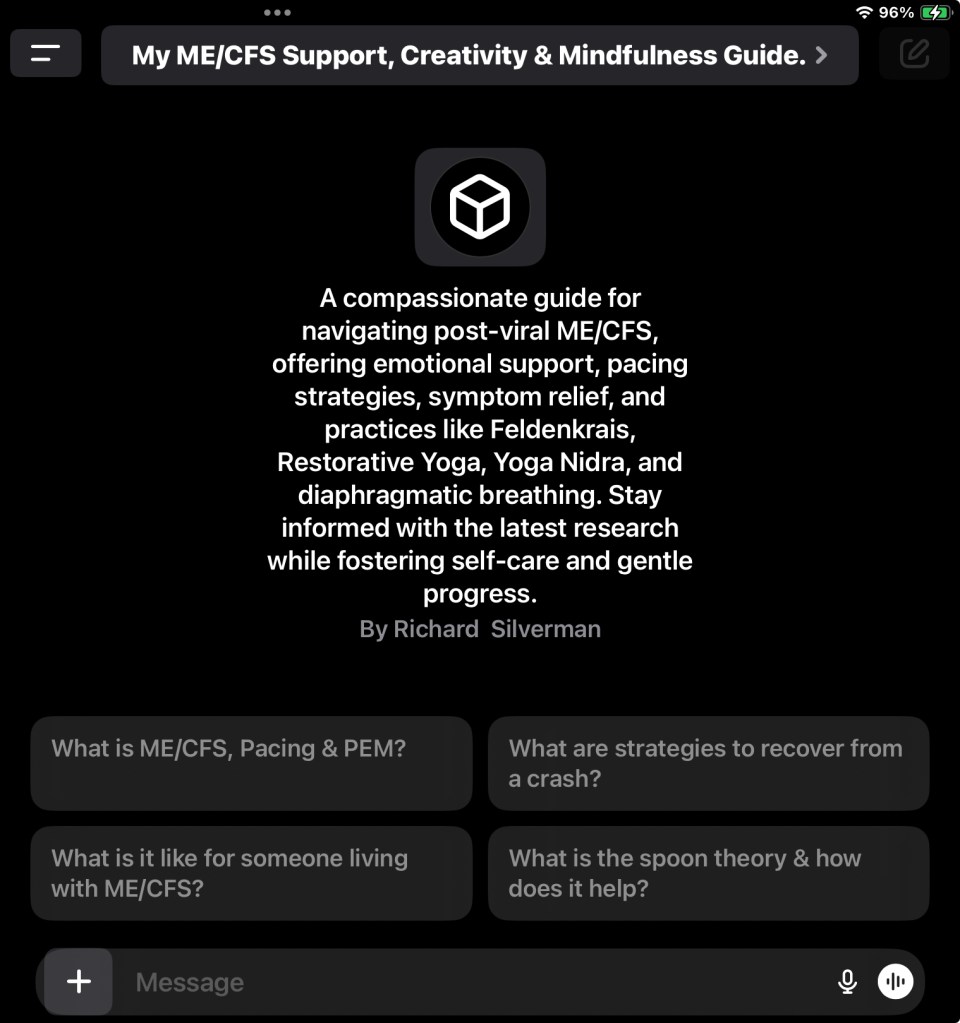
Check out this Free GPT ME/CFS Support, Creativity & Mindfulness Tool 😀
For those of us managing life with ME/CFS, I’ve found a helpful digital companion in this GPT Model for Support, Creativity, and Mindfulness. If you’re looking for new pacing strategies, symptom relief, or gentle emotional support, this tool might be helpful to you too.
💡 How it works: This GPT Assistant offers mindfulness techniques, creative ideas, and compassionate support as I manage the challenges of post-viral fatigue, PEM (Post-Exertional Malaise), and daily energy management. It helps me, Maybe it can help you too.
🙏 if you try it, I’d love to hear your feedback! How does this tool work for you? Do you find it helpful in managing your energy, finding comfort, or discovering new ways to express creativity? Let me know in the comments how it goes for you!
Click here to explore the Free ME/CFS Support GPT model:
If you’d like to explore supportive content focused on navigating life with ME/CFS, including tips for energy pacing, mindfulness, and gentle encouragement, you can find more insights and reflections crafted to offer comfort, practical guidance, and connection on this journey
here.
For those of us living with post-viral chronic fatigue syndrome (ME/CFS), the path we walk is not a simple one. Each day brings its own set of challenges, often invisible to the outside world but deeply felt within. Yet, amid the fatigue, the uncertainty, and the pain, there are moments where we are called to draw on reserves of strength we didn’t even know we had. Courage, in its many forms, becomes a quiet companion on this journey.
As I reflect on the Six Types of Courage, I am reminded that courage isn’t always the grand, heroic act we see in stories. Sometimes it is found in the smallest actions, the quietest moments, and the internal shifts of perspective that allow us to keep moving forward. Let me share how each of these types of courage has come to life in my experience, and perhaps in yours, as we navigate the complexities of chronic illness.
Physical Courage
Living with ME/CFS requires a deep well of physical courage. On the days when even getting out of bed feels like a monumental task, there is a certain bravery in simply continuing. To keep going, not by pushing beyond our limits, but by embracing our body’s need for rest, balance, and awareness, is its own form of resilience. The courage to honor what our body is telling us, to move slowly and deliberately through the fatigue, is often invisible to others—but it is no less powerful.
I’ve learned, often the hard way, that physical courage isn’t about “fighting” the illness. Instead, it’s about recognizing that even the act of getting through a day, with gentle awareness of my body’s limits, is a courageous act of self-care.
Social Courage
One of the most difficult aspects of living with chronic illness is feeling misunderstood by those around us. Social courage asks us to be unapologetically ourselves, even when we feel like our world is shrinking. It takes bravery to share our reality with others, to say, “This is who I am right now,” even when we worry about judgment or pity.
For me, social courage has meant being honest about my limitations, even when it’s uncomfortable. It’s meant declining invitations or stepping back from commitments without feeling the need to apologize. In a world that often celebrates busyness and productivity, social courage allows us to stand firm in our truth, even when it doesn’t align with society’s expectations.
Moral Courage
Moral courage comes into play when we choose to do what’s right for our well-being, even when it’s not popular or easy. It might mean saying no to well-meaning advice that doesn’t resonate, or it might mean standing up for ourselves in medical settings, advocating for the care we know we deserve.
In my own journey, I’ve had to practice moral courage by trusting my intuition, even when others disagreed. Whether it was turning down treatments that didn’t feel right for me, or advocating for pacing and rest in a world that pushes us to keep going, moral courage has been about honoring my inner knowing and standing up for my own health and well-being.
Emotional Courage
Emotional courage asks us to feel everything—without guilt or attachment. Living with chronic illness brings a rollercoaster of emotions, from frustration and sadness to moments of peace and even joy. It takes real bravery to allow ourselves to feel the depth of these emotions, without judgment.
For those of us living with ME/CFS, there is often a fear of being consumed by the negative emotions that come with illness. But emotional courage teaches us that by allowing ourselves to fully experience these feelings, we create space for healing. It’s okay to feel angry, to feel sad, to grieve the life we once had. And it’s equally okay to feel moments of joy, to savor the small victories without fear of losing them. Emotional courage is the bridge between feeling and acceptance.
Intellectual Courage
There is a constant need to learn, unlearn, and relearn when living with chronic illness. Intellectual courage encourages us to stay open, to question what we think we know about our illness, and to be willing to adapt as new information comes to light.
In my own life, this has meant learning to let go of certain beliefs—like the idea that I must always be productive to have value. It has meant embracing new ways of thinking about rest, about healing, and about what it means to live a meaningful life, even in the face of limitations. Intellectual courage reminds us that growth is always possible, even when we feel stuck.
Spiritual Courage
Spiritual courage is perhaps the most profound of all. It asks us to live with purpose and meaning, even when our outer world feels small. For me, spiritual courage has been about embracing the stillness that chronic illness brings, finding the deeper meaning in quiet moments, and trusting that this path, though difficult, has its own beauty.
Living with ME/CFS has drawn me inward, toward a heart-centered approach to life. Spiritual courage has helped me see that even when my body is weak, my spirit can remain strong. It’s about connecting with something larger than myself, whether that’s through mindfulness, prayer, or simply finding peace in the present moment. It’s about living with purpose, even when the world outside feels far away.
As I reflect on these six types of courage, I am reminded that each of them plays a role in the journey we are on. Courage doesn’t always roar. Sometimes, it is the quiet voice at the end of the day saying, “I will try again tomorrow.” For those of us living with chronic fatigue syndrome, courage is found not in grand gestures, but in the small, everyday acts of resilience, hope, and self-compassion.
We are all courageous, in ways both seen and unseen. Let us honor that courage in ourselves and in each other, as we continue to walk this path with grace, gentleness, and the quiet strength that comes from within.
A Gentle Reflection on Pacing, Rest, and Navigating the Challenges of Chronic Fatigue Syndrome
There are days when the body speaks softly, a whisper of weariness that hints at the storm ahead. And though we move carefully, mindful of each step, there are moments when the smallest effort—a turn of the mind, a spark of emotion—awakens something deeper. This is the dance with post-exertional malaise, the hidden tide that comes and goes, often when we least expect it.
Gentle Reminder: Take Care of Yourself
This post is lengthy, and it’s important to honor your pacing needs. Feel free to read a little at a time, take breaks, and come back to it when you’re ready. Your well-being is paramount, even as you engage with information that supports your journey.
In this slow unfolding, I’ve learned the art of listening. Not just to the body’s loud protests, but to the subtle shifts that rise like shadows before a dusk. It’s a practice, really—this gentle balancing act of life. Pacing myself through the hours, I find that it’s not about doing as much as I can, but rather, doing only as much as I must, and stopping long before the weight of fatigue pulls me under.
Some days, I count my energy like a miser with gold, tucking it away in small corners, resting in the quiet between breaths. I know now that to keep moving without pause is to invite the flood, so I rest—not in surrender, but in reverence. It’s a kind of devotion, to honor these limits as something sacred, to see the necessity of stillness as part of the rhythm of being. I don’t always succeed. But when I do, I glimpse a peace that feels fragile, yet profound.
And when the world presses in with its demands, I remind myself that it’s okay to say no, or not now. There is a quiet strength in bowing out, in knowing that tomorrow will ask more of me than today ever could, and I must be ready. There is also grace in understanding that not every task, not every moment, requires my full self. I can do less, and in doing less, I give myself more space to breathe, to be.
There are the days after—the days when the fog of PEM descends like a heavy mist over the mind, the limbs. When it comes, I am learning not to fight it. I lie still, like a tree after the storm, gathering strength in the pause. I have found that recovery is an art, as delicate as anything else. Resting, not out of defeat, but out of wisdom, out of love for the body that has carried me through so much already. The act of resting becomes an offering of peace, a gift I give myself in this long, uncharted journey.
And so, I move slowly, gently, always aware of the fine thread that connects exertion and ease, action and rest. I have begun to cherish the quiet moments of pause, the spaces where life still hums softly, even in the absence of movement. These are the moments when I remind myself that managing this strange, invisible storm is not about conquering it, but learning to live alongside it, to move with it as gracefully as I can. There is beauty here, too—a beauty in the stillness, in the small victories of simply being.
In those moments, I find a sense of peace that is mine to keep. And in that peace, I remind myself that even on the hardest days, I am enough.And so, as I offer these thoughts, I send with them a quiet wish for your well-being. May you find moments of rest that nourish you deeply, and may the days of ease, however fleeting, linger softly in your memory. If you ever feel the weight of this journey pressing too hard, know that you are not alone.
Dear friends,
I know these days may feel heavier than usual. The storm outside has passed, but inside, your bodies may feel as though they’re weathering one of their own. Post-exertional malaise (PEM) comes like that—quiet and uninvited, a deep exhaustion that touches every part of you. Whether it’s the physical toll of surviving the hurricane or the emotional weight of the aftermath, you’re feeling it now, maybe more intensely than you have in years.
Please know that what you are experiencing is valid. You’ve already shown such strength, simply by navigating these storms and their many demands. But right now, in this moment, the strongest thing you can do is rest. Not as a surrender, but as a way of caring for yourself in the most compassionate way possible. Rest, because your body is asking for it. Rest, because this is how you heal.
Pacing is not easy when the world around you spins in chaos, but I encourage you to listen to the subtle signs your body gives. You don’t have to meet every demand or engage with every worry. It’s okay to step back, to breathe, and to honor your limits. In doing less, you are doing what is necessary to recover.
If the fog of PEM feels too thick to see through, know that it will lift. Maybe not all at once, but in small, tender ways. There is stillness, there is peace, waiting for you on the other side of this exhaustion. You are not alone in this experience—many of us are moving slowly through these same waters, learning the rhythm of rest, of patience, of letting go.
For now, take each moment as it comes. Let yourselves be. Let yourselves rest. And in that rest, know that you are enough. You are resilient. This, too, will pass.
With all my warmth and understanding, Richard Silverman
Feel free to leave your thoughts, your questions, or simply your presence here—I will meet you with understandingh and warmth. Together, in our shared quiet, we will honor the pace that life has asked of us.
As we come to the conclusion of this series on exercising with post-viral ME/CFS, I want to offer you a heartfelt reflection on the journey we’ve been exploring together. It’s been a path of discovery, patience, and above all, compassion—compassion for yourself, your body, and your unique experience with ME/CFS.
We’ve discussed everything from imagining workouts while lying in bed, to sitting in the parking lot of a gym, to slowly integrating light movements and mindful gym sessions. This spectrum of activity is not only about physical exercise but about honoring your current energy levels, emotions, and overall well-being.
Your Unique Path of Wellness
Living with post-viral ME/CFS, we understand that each day can be different. Some days, simply imagining a gentle workout, breathing mindfully, or visualizing movements while resting in bed might be the most appropriate and loving action for your body. On other days, maybe you can manage a shower, do a few dishes, or perhaps stretch or go for a very short, slow walk. These moments are victories. They are gentle movements toward health, and they count just as much as lifting weights or running miles.
As you know, post-viral ME/CFS requires a delicate balance between rest and activity, and this balance changes depending on how your body is feeling from day to day. The most important practice we’ve emphasized throughout this series is listening to yourself, checking in frequently, and not pushing beyond what feels sustainable. Your body is guiding you, and it knows what it needs.
From Visualizations to Gentle Movements
Remember, if you are visualizing a workout or even imagining your body moving while lying down, this is still a powerful practice. It connects your mind with your muscles and breath, keeping your awareness sharp and your spirit engaged. Some days, this practice might feel like the perfect balance—bringing you peace, relaxation, and a sense of accomplishment without straining your energy.
On other days, the thought of leaving the house or driving to the gym might feel achievable, even if the workout doesn’t happen. Simply being in that environment—sitting in the parking lot or spending time among others exercising—can offer motivation and encouragement. It’s an act of being present, of showing up for yourself without expectation.
Every Step is Progress
For those days when you feel you can engage in more, maybe it’s a small set of physical movements at home. Doing a few dishes, a brief stretching session, or just getting up to do light housework is meaningful. These activities are achievements. By mindfully engaging in these everyday actions, you bring a sense of calm and purpose to your day.
Some of you may eventually reach a point where you feel strong enough to go to the gym or engage in a consistent exercise routine, but the key is to always move forward at your own pace—gently, kindly, and without judgment.
Well Wishes for Your Journey
The most important takeaway from this series is that exercise can mean many different things, and it’s essential that you define it in a way that respects your body’s unique rhythms and needs. Exercise isn’t about how much you can push or accomplish; it’s about how well you can listen to your body and respond to its cues with love and care.
You are not alone in this journey. There is a community of people who understand, who are walking a similar path, and who honor each victory, no matter how small it may seem. Whether you are visualizing a workout from bed, taking a short walk, or simply taking the time to breathe mindfully, you are engaging in a practice of self-care and healing.
I wish you strength, patience, and compassion on this path. May your journey be one of growth, self-love, and acceptance. Celebrate every step you take, and remember that wellness is not about perfection—it is about finding peace and balance within yourself.
The fire crackled softly as the night sky wrapped the world in a blanket of stars. In a small, quiet room high in the mountains, little Sonam snuggled close to her grandfather, whose voice was like a river flowing gently through time. Tonight, Grandfather had promised to share a special teaching—a teaching about the mantra OM AH HUNG, a mantra that carried the wisdom of the Buddha’s body, speech, and mind. It was a gift for those seeking to awaken their true nature, a path to discovering the light that lives within every heart.
“Come closer, little one,” Grandfather whispered, his eyes gleaming with warmth. “Tonight, I will tell you about this sacred mantra, OM AH HUNG. These three sounds hold the secret to remembering who we truly are—beyond all the noise of the world, beyond all fear and doubt. With each repetition, they bring us closer to the realization that we are already whole, already one with the body, speech, and mind of the Buddha.”
Sonam’s small hands rested gently on her lap as she listened, her heart softening with each word.
Grandfather began, his voice as soft as the night breeze. “The first sound is OM. It rests in the forehead, shining with a clear, bright white light, like the first snowfall on a quiet morning. OM is the body of the Buddha—pure, radiant, and free. When you chant OM, you are inviting your body to become still and calm, like the Buddha’s body. You remember that your body, just as it is, is special.”
Sonam closed her eyes and imagined a bright white light glowing softly at her forehead. With each breath, the light expanded, filling her whole body with a sense of peace and clarity.
“Even when you feel tired,” Grandfather said gently, “OM reminds you that your body is a vessel for light. It invites you to rest, to breathe, and to feel the simple joy of being alive.”
“The next sound,” Grandfather continued, “is AH. It rests in the throat and shines with a warm, red light, like the glow of the setting sun. AH is the speech of the Buddha—the sound of truth, kindness, and love that flows through every word. When you chant AH, you invite your words to become soft and clear. You remember that your voice is a gift.”
Sonam imagined a soft red light glowing in her throat, spreading warmth through her chest. She whispered the sound AH quietly to herself, feeling how the vibration opened her heart like petals unfolding in the morning sun.
“AH teaches us to speak from a place of kindness,” Grandfather said, “whether we are speaking to ourselves or others. Our words have the power to heal, to comfort, and to bring peace.”
“And finally,” Grandfather said softly, “we have HUNG. This sound rests in the heart, shining with a deep, blue light, like the vast sky just before dawn. HUNG is the mind of the Buddha—boundless, clear, and filled with compassion. When you chant HUNG, you invite your mind to rest, free from grasping and fear. You remember that your true nature is like the sky—open, spacious, and infinite.”
Sonam placed a small hand over her heart, imagining a deep blue light glowing there. With each breath, the light expanded, filling her whole being with a sense of calm and openness.
“Even when your thoughts feel tangled,” Grandfather whispered, “HUNG reminds you that beneath every thought, your mind is already clear and vast, like the sky.”
Grandfather smiled, seeing Sonam’s little body relax as the teachings settled into her heart. “Now, my dear one,” he said, “let us say the mantra together. With each repetition, we bring the body, speech, and mind into harmony, becoming one with the Buddha’s light.”
Together, they whispered the mantra: OM… AH… HUNG… OM… AH… HUNG…
As they chanted, Sonam felt the lights of white, red, and blue merge within her, like rivers flowing into the same ocean. She felt herself resting deeply, her body, speech, and mind becoming still and clear, like the calm surface of a mountain lake.
“This is the gift of OM AH HUNG,” Grandfather said quietly. “It helps us remember that we are not separate from the Buddha—we are already one with the body, speech, and mind of wisdom and compassion.”
Sonam yawned softly, her heart full of warmth and peace. “Grandfather,” she whispered, “can I say OM AH HUNG when I feel scared or sad?”
Grandfather kissed her forehead gently. “Yes, my little one. Whenever you need to feel grounded, loved, or at peace, you can chant OM AH HUNG. It will remind you that you are never alone—your body, speech, and mind are already whole, already filled with light.”
As Sonam drifted deeper into sleep, Grandfather offered a final blessing: “OM… may your body be at peace. AH… may your voice be a song of kindness. HUNG… may your heart rest in the vast sky of compassion.”
And with that, Sonam drifted into a deep, peaceful sleep, carried by the gentle rhythm of the mantra. In her dreams, she floated through fields of white, red, and blue light, resting in the open sky of compassion, her heart blooming like a lotus in the morning sun.
May OM AH HUNG guide you always, bringing peace to your body, kindness to your voice, and love to your heart.
Goodnight, little one. ❤️
🙏🕊️🙏
If you’d like to explore more bedtime stories for children, including tales that nurture compassion and mindfulness, you can find our collection here.
Healing Through Rest: How the Parasympathetic Nervous System Can Support Recovery from Chronic Fatigue Syndrome
In the aftermath of the recent hurricanes, Helene and Milton, I’ve felt post-exertional malaise weigh heavily on my body. The fatigue has been more than just physical—it’s emotional and mental, a deep, enveloping weariness that reminds me how fragile recovery can be. As I continue to mend from both the storms and the physical toll of chronic fatigue syndrome, I’ve found myself needing to return to the gentle practices that once brought me peace. The practices that help restore balance to my overstimulated system—those that invite rest rather than force recovery.
Living with chronic fatigue syndrome is like walking on a delicate thread between exhaustion and healing. In these moments, the body feels like a battleground, constantly stuck in “fight or flight.” What I’ve learned, though, is that there’s another way—a softer, quieter way to approach healing. And this way begins with the parasympathetic nervous system.
The Parasympathetic Nervous System: Our Body’s Quiet Healer
The parasympathetic nervous system is often referred to as the “rest and digest” system, the opposite of the “fight or flight” response that dominates so much of my life with ME/CFS. While the sympathetic system pushes us to react, defend, and survive, the parasympathetic system invites us to slow down, to breathe deeply, to recover. It lowers heart rate, softens the breath, and gently restores the body to a state where healing is possible.
For those of us with chronic fatigue, the parasympathetic nervous system is like a refuge, a space where our bodies can finally stop fighting and simply rest. But tapping into this refuge doesn’t come easily. It requires intention, mindfulness, and the willingness to let go of the push to “do” and embrace the power of simply “being.”
Practices that Invite the Body to Rest
Over time, I’ve gathered a small collection of practices that help me reconnect with my parasympathetic nervous system. One of the most powerful has been breathwork. By consciously slowing my breath—drawing in air slowly, holding the quiet pause between, and then releasing—I can feel my body begin to soften. It’s like a signal to my nervous system: “It’s safe. You can rest now.”
Yoga Nidra has also become a vital tool in my recovery. It’s a guided form of meditation that allows me to rest deeply while staying present in the body. In this state, my body heals while my mind remains aware, a powerful reminder that rest is not the same as sleep. Restorative yoga, too, has been a way to surrender fully, each pose an invitation to soften into support, to let my body be held by the earth.
And then there’s the Feldenkrais Method—gentle, mindful movements that teach me to listen to my body without forcing anything. These movements may be subtle, but they remind me that healing isn’t about big gestures or grand efforts. It’s about the small, quiet acts of listening to what my body truly needs in each moment.
Learning to Listen
As I move through these practices, I often find myself returning to Rilke’s words: “I am circling around God, around the ancient tower, and I have been circling for a thousand years, and I still don’t know: am I a falcon, a storm, or a great song?” Like Rilke, I am circling around the wisdom within me, learning the language of my body’s needs.
Some days, I feel like the storm—torn by fatigue and pain. Other days, I am the quiet center, the stillness amidst the chaos. I am learning that healing isn’t about becoming something new or different. It’s about softening into who I already am and trusting that my body knows the way forward.
An Invitation for Beta Testers
If this resonates with you, I’d like to invite you to help beta test a new GPT model I’m developing. This model is designed to act as a relaxation coach, guiding you through practices like breathwork, Yoga Nidra, and gentle movements to activate the parasympathetic nervous system. It’s a tool I’m hoping will help others find the same peace and healing that these practices have brought me.
This model is still in development, and I’m looking for a small group of people willing to try it out and provide feedback. If you’re interested, please reach out to me in the comments section with a few sentences about why this model interests you, how it could benefit your journey, and why you’d be interested in providing feedback. Your thoughts and insights will be invaluable as I continue to shape and improve it.
Thank you for walking this journey with me. In the quiet, I’m learning to heal. May we all be well and safe. 🙏❤️🙏
On a quiet night, beneath a sky filled with shimmering stars, little Tenzin lay nestled under his blanket. The soft glow of the hearth flickered across the room, and beside him sat his grandmother, whose voice was as soothing as the wind moving through prayer flags on the mountaintop.
“Tonight, my little one,” she whispered, “I will tell you a very special story. It is about a practice called the Guru Yoga of the White AH—a practice that can help us remember the deepest truth of who we are. It is the most beautiful of all practices, because it leads us back to the light that has always been inside us, the light of our true nature.”
Tenzin snuggled deeper into his blanket, his heart already softening. He knew that whenever his grandmother told a story, it carried not just words, but a magic that could be felt deep in the heart.
“Long ago,” Grandmother began, “there was a wise teacher named Namkhai Norbu, who understood that many people felt lost on their spiritual paths. They tried to follow many practices, each one like a step on a long staircase, but the more steps they climbed, the more tired they became. Namkhai Norbu smiled kindly and said, ‘You do not need to climb endless steps. There is a single path that leads directly to your true nature—the Guru Yoga of the White AH.’
‘This practice,’ he said, ‘is like a single, bright thread that weaves through all the other teachings. By chanting the sound AH, you connect directly with the heart of all wisdom, all love, and all peace. It is the simplest practice, and yet it contains everything.’”
Tenzin listened quietly, his breath soft and steady. “Grandmother,” he whispered, “what does AH mean?”
Her eyes twinkled as she answered. “AH is the sound of pure being,” she said. “It is the sound of resting deeply in your true self—beyond thoughts, beyond worries, beyond trying to be something you are not. When you chant AH, it is like opening a door into a vast, open sky. There, you discover that you are not separate from anything. You are already one with the light of the universe, just as a wave is never separate from the ocean.”
Grandmother leaned closer, her voice becoming soft as a lullaby. “Imagine, little Tenzin, a soft white light glowing gently in your heart, like the light of the moon reflected on a still lake. This light is the essence of your true nature—pure, peaceful, and radiant. Now, imagine chanting the sound AH from deep within your heart. As you chant, the white light begins to grow, filling your chest with warmth and joy.”
Tenzin closed his eyes, imagining the soft white light blooming in his heart. He took a gentle breath and whispered, AH… He felt a small sense of peace spreading through him, like a breeze carrying the scent of flowers.
“And now,” Grandmother continued, “imagine that with every chant of AH, the light in your heart radiates outward, filling your whole body. Your head, your hands, your feet—all are filled with this soft, white light. And as you chant AH again, the light begins to shine beyond your body, flowing out in all directions, like beams of sunlight reaching every corner of the world.”
Tenzin smiled, feeling the light inside him growing brighter, as if his heart were shining like a little sun.
“Each time you chant AH,” Grandmother whispered, “the light spreads farther and farther—into the sky, over the mountains, through the rivers, and into the hearts of every being. But here is the most wonderful secret: The light does not come from outside you. It is already within you, waiting to be remembered. Chanting AH simply helps you see the truth that has always been there—that you are already one with the light, the love, the peace of the universe.”
Tenzin imagined the white light flowing through the entire world, like water filling every stream, every river, every ocean. And as the light touched the hearts of others, he saw that it sparked new lights in them, too. One light became two, and two became many, until the whole universe was glowing with the same soft radiance.
“This is the essence of Guru Yoga,” Grandmother said tenderly. “It is the practice of remembering that you are not separate from the light, not separate from love, not separate from anything. When you chant AH, you awaken to the truth that you are already whole, already free. And each time you remember this, the light within you shines a little brighter, helping others remember their light too.”
Tenzin felt a deep warmth in his chest, as if the white light were wrapping him in a soft embrace. He whispered the sound again: AH… AH… With each repetition, he felt more peaceful, more connected to everything around him, as if the boundaries between himself and the world were melting away.
“Grandmother,” he whispered, “is this light always with me, even when I forget?”
“Yes, my little one,” she said with a smile. “The light is always there, like the sun shining behind the clouds. Even on days when you feel sad, tired, or lost, the light never leaves you. And each time you chant AH, you clear away the clouds, letting the light shine once again.”
Grandmother kissed Tenzin’s forehead and offered a final blessing: “AH… May your heart always remember its light. AH… May your breath carry peace to every corner of the world. AH… May you rest in the truth of who you are—boundless, radiant, and free.”
And with that, Tenzin drifted into a deep, peaceful sleep, carried by the gentle rhythm of the mantra. In his dreams, he saw white light flowing from his heart, spreading across the sky, touching every star, and filling every heart with peace. He dreamed that with every whisper of AH, more lights appeared, until the whole universe shone with the same boundless love.
May the sound of AH guide you always, helping you remember the light that lives within you and within all beings. Sleep well, knowing that you are already one with the truth, the peace, and the love of the universe. The light is always here.
Goodnight, little one. ❤️
🙏🕊️🙏
If you’d like to explore more bedtime stories for children, including tales that nurture compassion and mindfulness, you can find our collection here.
When living with Post-Viral ME/CFS, it’s essential to remind ourselves that our journey with exercise is not measured by how much we do, but by how gently we honor the unique rhythms of our bodies. This is especially true when it comes to engaging in physical activities like the Leg Press Machine. Today, we’ll explore how to mindfully approach this exercise in a way that supports both your physical and emotional well-being.
Some days, the most valuable thing you can do is simply imagine going to the gym or just driving to the parking lot without even stepping inside. And that is okay. It’s important to recognize that each step, no matter how small, is progress in your journey toward reconnecting with movement.
Preparing for Movement, with or without Weights
The Leg Press Machine can help gently engage the lower body muscles—the quadriceps, hamstrings, and glutes—in a supportive and controlled way. However, as always, we want to begin with a deep check-in with ourselves. How are you feeling today? Are you carrying any fatigue from the day or week? Is your body asking for movement, or is it requesting rest?
Before starting, consider that visualization can be just as powerful on days when physical energy is limited. On days when your body needs more rest, imagine yourself using the leg press machine while lying in bed. Visualizing the movement—feeling your legs pushing away, and imagining the breath and strength flowing through your body—can still provide a sense of connection and engagement.
The Smallest Effort is Enough
If today happens to be a day when you’re feeling able to visit the gym, remember that the smallest effort is enough. Maybe just getting into the car and driving to the parking lot is the accomplishment for the day. You don’t have to step inside the gym. Instead, sit in the parking lot, breathe deeply, and feel a sense of accomplishment. That in itself is an act of healing and self-care. You’ve honored your intention to engage with movement, and that is enough.
If you’re feeling a little more energy, and you’re ready to step inside the gym, remember this: the goal is not to push through your limits but to respect them. If all you do is sit on the leg press machine for a few minutes without pressing any weight, you are still reconnecting with your body. Some days, it’s not about completing a set—it’s about showing up, about being present with yourself and your energy, and that’s more than enough.
Using the Leg Press: Gently Engaging the Lower Body
When you’re ready to engage with the Leg Press Machine, begin by adjusting the machine to its lightest setting. Even if you start with no weight at all, the simple act of placing your feet on the platform can feel empowering.
Sit back and adjust your feet so they are shoulder-width apart, flat on the platform. Take a moment to breathe. Let your back press gently against the seat, feeling supported. As you inhale deeply, imagine your breath flowing down to your legs, filling them with a soft sense of energy.
Exhale slowly, and as you do, gently press your feet into the platform, extending your legs slightly. This is not about pushing to your limit. Even a small movement is valuable. Notice how your body responds. Feel the gentle engagement of your legs, the stretch in your muscles, the connection between your breath and your body.
If you only press the platform once or twice, that is absolutely enough. Pause and check in with yourself. How are you feeling? Is your body asking for more movement or more rest? Honor what your body is telling you. Remember, today is not about how many repetitions you do—it’s about how mindfully and compassionately you approach your practice.
The Power of Visualization
On days when you are feeling more fatigued or simply unable to make it to the gym, practice visualizing the leg press movement. You can do this while resting in bed, imagining the motion as vividly as possible. Feel your legs engage as you push against the invisible platform, feel your breath flowing in and out, and sense the energy within your muscles.
Visualization offers a gentle way to stay connected to your body, even when physical movement isn’t possible. It reminds you that you are still practicing, still showing up for yourself, and still making progress.
Rest, Reflect, and Celebrate Small Wins
After your time on the Leg Press Machine or after a moment of visualization, take a moment to rest and reflect. Celebrate the small wins—whether it was simply making it to the parking lot, sitting on the machine, or completing a few gentle presses. Every effort counts, and every moment of mindfulness is a step forward.
Post-Viral ME/CFS often teaches us the importance of balance and patience. Some days, even weeks or months, may pass where going to the gym is out of reach. And that’s perfectly okay. Your practice may look different on different days, but each experience, whether it’s sitting in the parking lot, visualizing in bed, or using the machine, contributes to your overall journey toward healing.
Moving Forward with Grace
As you continue to explore mindful movement, remember that there is no rush. You are not in competition with anyone—not even with your past self. The goal here is gentle engagement, compassionate movement, and the understanding that rest is just as important as exercise.
Your body is your guide. On days when it asks for stillness, listen to it with love and acceptance. On days when it asks for gentle movement, offer it the care and attention it deserves. Each small step you take is part of your healing journey, and every effort, no matter how small, is a testament to your commitment to self-care.
Next Post Preview: Concluding Thoughts on Gentle Exercise for Post-Viral ME/CFS
As we come to the conclusion of this series, we’ll reflect on the journey we’ve taken together, from imagining movement while resting, to gently re-entering the gym space. We’ll discuss how these small, mindful steps can serve as a foundation for a compassionate relationship with exercise, honoring your body’s limits while encouraging progress. In this final post, we’ll explore how to celebrate your victories—no matter how small—and how to continue nurturing your fitness journey with kindness and patience.










 Home Page: Inspirations of Love and Hope