Category: ME/CFS Pacing: Strategies for Managing Energy and Activity
Discover essential techniques for managing myalgic encephalomyelitis/chronic fatigue syndrome (ME/CFS) through effective pacing. Learn how to balance activity and rest, protect your limited energy, and prevent debilitating crashes. This category offers practical advice on monitoring energy levels, prioritizing tasks, and implementing pacing strategies to optimize your daily life and well-being.”
Living with ME/CFS can feel like moving through a world where energy is always scarce, even after sleep or rest. Each day often starts with a level of fatigue that others might experience only after running a marathon, and even the smallest tasks—like taking a shower or answering a message—can lead to overwhelming exhaustion known as post-exertional malaise (PEM). This exhaustion isn’t just tiredness; it’s a deep, often immobilizing weariness that can affect every system in the body.
For many, symptoms extend beyond fatigue and include pain, cognitive difficulties often called “brain fog,” sensitivities to light and sound, sleep disturbances, and immune symptoms like swollen glands or a sore throat. Some people describe their experience as feeling trapped between a desire to live fully and a body that constantly enforces limits. Social and professional isolation can add to the challenges, as ME/CFS often means saying “no” to friends, work, and daily activities that once brought joy and connection.
This condition varies greatly, so while some may have more freedom on “good” days to engage in gentle activities, others may find themselves mostly confined to bed, carefully rationing energy just to make it through each day. The need for pacing—moving through life in a slow, intentional rhythm—is key to avoiding painful crashes, yet it can feel isolating, as others may not understand the invisible boundaries ME/CFS places on energy.
On the spiritual path, we often find ourselves in moments of struggle, isolation, and uncertainty, wondering where the Divine is in our darkest hours. The old story of Footprints in the Sand offers a timeless reminder: even when we feel most alone, we are never truly abandoned. The footprints that carry us through the storm are those of the Divine, supporting us in ways we may not recognize in the moment.
The Story of Footprints in the Sand
The familiar story goes something like this: A person looks back on their life journey and notices two sets of footprints in the sand during times of ease and joy, but only one set of footprints during their most difficult and painful moments. Confused and feeling abandoned, they ask God, “Where were you when I needed you the most?”
God gently replies, “During those difficult times, when you saw only one set of footprints, it was then that I carried you.”
This story is simple yet profound, capturing the heart of the mystic journey—trusting that in our most challenging moments, even when we feel lost or abandoned, we are being carried by a greater force.
Trusting in the Divine Support
As mystics, seekers, or those walking a spiritual path, there are often periods where the way forward feels unclear. We may find ourselves fumbling through transitions, dealing with loss, illness, or inner turmoil, and it’s easy to feel as if we are walking this path alone. However, like the person in the story, we may later come to realize that during these times of struggle, we were never alone. We were being supported, even carried, by something greater than ourselves.
The footprints of the Divine, whether we call this presence God, the Universe, or our Higher Self, are always there, even when we cannot see them. Part of the mystic path is learning to trust in this unseen support, to have faith that during the most difficult stretches of our journey, we are being held and guided.
Recognizing the Invisible Presence
There are times when we may not feel the direct presence of the Divine, and it can be easy to feel lost or disconnected. But as we reflect on our experiences, we begin to see that in those moments, there was something carrying us through. Perhaps it was an inner strength we didn’t realize we had, the unexpected help of a friend, or a moment of grace that appeared when we needed it most. These are the Divine’s footprints in our life.
As mystics, part of our practice is to develop this awareness—to recognize the quiet, invisible ways in which the Divine shows up, even when it’s not immediately obvious. The more we trust this presence, the more we can rest in the assurance that we are always supported, no matter how difficult the path may seem.
Surrendering to the Flow of Life
The story of Footprints in the Sand also teaches us about surrender. When we are in the midst of struggle, our minds often fight to control or resist what’s happening. We want to fix things, to understand why we are going through a challenge, or to make sense of the pain. But surrendering to the flow of life, trusting that we are being carried, allows us to soften into the experience and let the Divine do its work.
This doesn’t mean passivity or giving up, but rather a deep trust that the difficulties we face are part of a larger unfolding. The footprints remind us that we are not the sole navigators of our lives. There is a greater force walking with us, carrying us when needed, and guiding us toward the deeper truths of our being.
Walking the Mystic Path with Faith
For those on the mystic path, the message of the footprints is a reminder of faith—not blind faith, but a faith born out of experience. As we reflect on our own journeys, we begin to see how the Divine has been present, even in the most challenging times. This faith allows us to walk the path with more confidence, knowing that the footprints are always there, even when we cannot see them.
In our moments of doubt, when the path feels difficult or unclear, the footprints remind us that we are never truly walking alone. We are always being carried by the Divine, supported in ways we may not fully understand, but that are always present.
Conclusion: The Footprints in Your Journey
As you navigate your own spiritual journey, take comfort in the footprints that appear along the way. Trust that during your most challenging times, the Divine is carrying you, even if it doesn’t feel that way in the moment. The mystic path is not always easy, but it is always supported by a presence that walks with us, guiding us toward greater understanding and deeper connection with the Divine.
May this story of Footprints in the Sand serve as a reminder that no matter where you are on your path, you are never truly alone. The footprints of God, the Divine, or the Universe are always there, carrying you through the storms of life and walking beside you in the moments of joy.
There is a rhythm to living with chronic illness, one that requires a kind of surrender. Those who walk the path with myalgic encephalomyelitis or chronic fatigue syndrome soon learn that pacing is not merely a strategy—it becomes an art form, a way of listening, of harmonizing with the body’s quiet whispers before they become cries. To pace oneself is to acknowledge the body’s finite energy, to move in step with the breath of fatigue, gently, humbly, knowing that to overstep the body’s boundaries is to invite collapse.
It is not an easy lesson, this slow dance with limitations, yet it is one that teaches a profound wisdom. For those of us living with this condition, pacing is a compass, guiding us through days where the terrain can feel treacherous, unpredictable. It is, in its essence, the practice of recognizing when to move forward and when to step back. We become more attuned to the varied signals of our bodies—perhaps tremors of exhaustion, increasing tinnitus, irritation, a flutter of dizziness, nausea, insomnia, headaches or the dimming of cognitive clarity. In these moments, we learn that to heed these signs is to honor the body’s wisdom, to respect its limits as one might respect the changing seasons.
Pacing, though practical, is deeply spiritual as well. In the Tibetan Buddhist tradition, there is a teaching of upaya, or skillful means, which echoes the heart of pacing. Skillful means refers to the wisdom of knowing what action is most appropriate in any given moment, guided by compassion for ourselves and others. For those of us managing a chronic illness, pacing is our skillful means, the practice of compassion extended inward, toward the tender, vulnerable places within us that need rest, gentleness, and care.
This is not weakness. On the contrary, there is a quiet strength in pacing, a strength that arises from restraint, from knowing that our worth is not measured by the speed at which we move or the number of tasks we complete. Instead, it is measured by how we listen to the body’s call for stillness, how we cultivate patience in the face of limitations, how we respond to the world with wisdom rather than haste.
In the same way that skillful means in Buddhist practice requires a deep awareness of the present moment, pacing invites us to be fully present with our bodies, to sense when we are nearing our edge and to pull back with kindness. It requires discernment, the ability to prioritize what truly matters, letting go of the unnecessary so that we may preserve our energy for what is essential. And, perhaps most importantly, pacing asks us to be flexible. What works for us today may not work tomorrow. Like the ebb and flow of the tide, we must continuously adjust, staying attuned to the changing nature of our energy levels, adapting with grace to whatever arises.
To pace well is to cultivate trust in ourselves, to believe that our bodies—though fragile—are capable of guiding us toward balance. It is to let go of the constant push toward productivity, embracing instead a quieter, more sustainable rhythm of being. This trust grows over time, as we learn to befriend our bodies rather than seeing them as enemies. We begin to see pacing not as a limitation, but as an opportunity to deepen our relationship with ourselves, to practice self-compassion in the most tangible of ways.
And so, we move slowly, deliberately. We choose rest when it is needed, even when the world outside rushes by. We choose to pause, to breathe, to trust that this moment of stillness is as important as any action we might take. In this way, pacing becomes not only a survival strategy but a path to peace. It teaches us to live in harmony with our bodies, to respect the boundaries they set, and to find beauty in the gentleness of our compassion.
Pacing, like skillful means, is not something mastered overnight. It is a practice that deepens over time, shaped by patience, by trial and error, by learning to let go of perfectionism. But with each step, we become more attuned to the wisdom that already resides within us. We learn that pacing is not a sign of giving up, but of holding on—holding on to our health, our well-being, and our sense of self in the midst of struggle.
Pacing, in its truest form, is an act of compassion toward ourselves, a recognition that while life with post viral ME/CFS has taken much from us, it has not taken everything. It is not a dance of perfection, but rather a delicate balancing act between what was and what is. The grief over what we have lost is real, and it deserves to be honored. We grieve our former selves, the life we once knew, and all the possibilities that seem to have slipped away.
But after the grieving, something else begins to emerge. Slowly, through the quiet practice of listening to our bodies and respecting our limits, we begin to discover a new way of living—not the life we once imagined, but a life nonetheless. And within this new life, there are still moments of joy, moments of lightness. These moments may look different from what they once were, but they are no less real. They come from acceptance, from doing more of what works and less of what doesn’t. They come from the simple peace of knowing we are doing our best within the constraints we face.
To pace is to acknowledge these constraints, to know that while we may not live fully in the way we once dreamed, we can still live meaningfully. We can still find purpose, connection, and even happiness within this new rhythm. It is not a rhythm we would have chosen, but it is ours now, and there is strength in learning to move with it rather than against it. In this process, we find that joy and peace are still possible—not despite the illness, but alongside it, within the space that remains.
And so, with time, we learn to rest in the assurance that we are whole in our own way, capable of living a life that, while different, still holds beauty, meaning, and moments of joy.
Following the breath, We learn the art of patience, Peace within each step.
In The Wisdom of No Escape, Pema Chödrön presents teachings on accepting life as it is, rather than wishing it were different. Her words remind us that even in the midst of suffering, there is always the potential for transformation—not by running from our difficulties, but by turning toward them with compassion and curiosity. For those living with chronic fatigue syndrome, this book is a beautiful companion, offering insights on how to stay present with what is, without judgment or resistance. Chödrön’s gentle wisdom helps us find peace in the uncomfortable and reminds us that within every limitation, there is the possibility of growth. This aligns perfectly with the practice of pacing—of learning to live within constraints, not with bitterness, but with an open heart.
Another indispensable resource is Tony Bernhard’s How to Be Sick. As someone who has lived with chronic fatigue syndrome herself, Bernhard offers a deeply compassionate, Buddhist-inspired approach to living with illness. Her book provides practical advice on how to cultivate equanimity, mindfulness, and self-compassion while dealing with the daily struggles of chronic illness. Bernhard’s words echo the heart of pacing—teaching us how to manage our energy, honor our limitations, and find meaning even when life feels limited. For anyone searching for a path through the often overwhelming challenges of ME/CFS, How to Be Sick is both a guide and a comfort, offering tools to help transform suffering into wisdom and peace.
Living with chronic fatigue syndrome (ME/CFS) often feels like carrying an invisible weight that never goes away. The exhaustion is far beyond ordinary tiredness, permeating not just the body but the mind and heart as well. For many of us, this illness can feel like a curse, a complete derailment of life’s trajectory. Yet, over the years, I’ve come to see it also as a strange and unexpected blessing—one that has thrown me deeper into spiritual practice, into moments of stillness and contemplation I might not have otherwise known.
At its worst, the illness can leave me in bed, lights off, no sound, in a state of complete sensory deprivation. And it is in these moments, when there is nothing to distract me from my thoughts, that I’ve had to learn how to truly be alone. Learning to witness my reactions, cultivating equanimity, and practicing calm-abiding meditation have become vital companions on this journey. For many years, I focused on the Tibetan practice of Samatha, or calm-abiding meditation, as well as Vipassana, which allows for a deep awareness of the present moment. Sitting in stillness, aware of whatever calm I could find within, helped me cultivate equanimity—though it remains a practice I still have much to learn from.
But there was another essential practice that transformed how I related to my suffering. The practice of Metta—or loving-kindness—invites us to take our own pain and suffering and recognize that in this vast world, we are not alone in what we feel. When my illness has been most acute, whether through mental anguish or physical symptoms, I’ve practiced thinking: In the same way that I am experiencing this illness, this suffering, this pain, there are others in the world who experience this too. And then, from the heart, I offer the prayer: May I, and all beings, be free from this suffering and its causes.
This simple yet profound shift in perspective allowed me to transform my experience from one of isolation and misery into a practice of compassion. Instead of being stuck in my own pain, it became a way to benefit others by cultivating loving-kindness for all those who suffer. In this way, even my most difficult experiences became part of my spiritual path. ME/CFS was no longer just an illness—it was an opportunity to deepen my compassion, both for myself and for others.
Of course, this hasn’t been an overnight transformation. It took many years of spiritual study and practice, drawing from teachings like the Four Noble Truths of the Buddha, the Noble Eightfold Path, and eventually the teachings of Advaita Vedanta. Through these teachings, I came to recognize the fluctuations of the mind, or vrittis, and learned to observe the content of my thoughts—pratyayas—without identifying with them. This practice of witnessing the mind has allowed me to find peace in the midst of the storm, much like the Dark Night of the Soul described by St. John of the Cross.
For me, it has felt less like a dark night and more like twenty years of spiritual darkness, but nonetheless, this darkness has also been a teacher. Learning to be present with my suffering, rather than resisting it, has become an integral part of my life with ME/CFS. And while the illness has forced me to withdraw from many aspects of life, it has also drawn me into the heart of spiritual practice.
To anyone living with this illness, or any chronic illness, I offer this: it’s okay to feel overwhelmed by the weight of it all. It’s okay to grieve the life you once had or the future you imagined. But there are also practices—like Metta, calm-abiding meditation, and witnessing the mind—that can transform this suffering into something that nourishes not only your soul but the souls of others as well.
May you, and all beings, be free from suffering and its causes. May this invisible weight become a doorway into the mystic, where even in solitude, you find that you are never truly alone.
Discover how Amazon, YouTube, and digital tools bring connection, learning, and convenience to those managing Chronic Fatigue Syndrome (ME/CFS) and other chronic conditions.
Living with Chronic Fatigue Syndrome (ME/CFS) is like existing within the quiet spaces between life’s rhythms. The world continues to spin, time flows forward, but for those of us confined by fatigue, much of life happens from a single room. Yet even from here, in the isolation of illness, modern technology keeps me tethered to the world—connected, informed, and able to navigate life more easily than I could have ever imagined. Through screens, deliveries, quiet YouTube voices, and the reassuring buzz of text messages, these tools, which for most people are conveniences, have become essential to my daily life, allowing me to “connect, learn, and thrive in the quiet spaces of illness.”
From the stillness of my room, technology provides a connection to the outside world, bringing not only convenience but the comfort of knowing I am still part of a larger community. Tools like Amazon, YouTube, and GPS apps, often viewed as simple conveniences, are for me much-needed companions on this journey with chronic illness—supporting a life enriched by connection, even from within the solitude of illness.
Amazon: Freedom Through Next-Day Delivery
For me, Amazon is not a luxury; it’s a lifeline. Before fatigue claimed my body, I could walk through stores, touch things, browse the shelves. Now, just the thought of leaving my home to do simple tasks is overwhelming. Amazon Prime brings the world to my doorstep—groceries, medical supplies, non-perishable food, even a replacement part for my air conditioner when it broke down. In a life where energy is a precious and limited resource, Amazon’s next-day deliveries allow me to conserve what little energy I have for more meaningful pursuits.
There are no long checkout lines, no need to explain to a cashier why I can’t stand for more than a few minutes, and no risk of overexerting myself by pushing through crowds. In this way, Amazon brings me peace of mind. I get the things I need, when I need them, and I don’t have to venture out into a world that often feels too large, too demanding, and too exhausting.
Amazon Prime’s next-day delivery has become my bridge to the outside world. For someone who must guard every ounce of energy, this service isn’t just convenient—it’s necessary. For others in similar situations, I’d encourage finding ways to use Amazon’s features to make life easier: think grocery deliveries, automatic reorder settings, or exploring Prime’s accessible resources for those homebound.
YouTube: A Window to the World
YouTube is where I go to learn, to be entertained, and to explore the world beyond my room. Some days, when my body is too fatigued to move, I can escape into a world of endless discovery, music, art and more.
While YouTube offers boundless exploration—from history and technology to the personal stories of others facing challenges—I’ve learned to pace myself here, too. Information overload can be an unexpected trigger for ME/CFS symptoms, so knowing when to close the app and find stillness is as essential as any other pacing technique.
Through YouTube, I immerse myself in history, music, documentaries, and biographies. I explore the world, both past and present, and even learn about future technologies. It’s an incredible tool that connects me to culture, ideas, and information I wouldn’t otherwise have access to. Whether it’s understanding ancient civilizations, learning about scientific breakthroughs, or following someone’s personal journey with illness, I find comfort in knowing that the world is still out there, alive and vibrant, even if I am not actively participating in it.
Yet, I must admit, there are times when I become overwhelmed. Information overload is a real challenge when you live with ME/CFS, so I’ve learned to recognize when it’s time to turn off YouTube, close the apps, and retreat into the quiet of my mind. It’s about balance—allowing myself to be informed and connected, but also knowing when to rest from the constant influx of information.
One other helpful trick is that I’ve learned how to Velcro my iPad to the ceiling, about a foot and a half above my head, so that even when lying flat on my back, I can watch videos, answer text messages and enjoy creative writing without straining my body. This idea was inspired by astronauts living on the International Space Station, a video I stumbled upon while exploring YouTube. They live in such small spaces, with everything within reach, Velcroed to the walls for easy access—and now I do the same. It’s so helpful!
Text Messaging: Simple Connections Without the Overwhelm
One of the simplest, yet most effective, tools in my daily life is text messaging on my Samsung A51. For someone living with chronic illness, conserving energy is vital, and sometimes even scrolling through endless emails or social media updates can be exhausting. There’s just too much content, too much spam, too much input to sift through.
Texting allows me to keep in touch with the people who matter without all the distractions. I’ve personalized my notifications so I can immediately tell who’s reaching out, without having to wade through spam or unwanted information. This focused communication helps me stay connected without overwhelming myself. It’s small, it’s simple, and it’s manageable—which is exactly what I need.
Text messaging has become a lifeline for gentle, manageable connection. Without the sensory overload of social media, it allows me to stay close to loved ones without exhaustion.
Do you find that certain tools offer you gentle connection without the sensory overload? Text messaging has transformed my connections, keeping them gentle and manageable.
Living Well with Chronic Fatigue: A Book That Brings Comfort
I discovered How to Be Sick by Toni Bernhard nearly 20 years ago. It was a revelation—finally, here was someone who deeply understood what it meant to live with chronic illness and had wise, compassionate insights to share. This book offered me guidance and solace on my hardest days. I highly recommend it to anyone navigating life with chronic illness.
Weather and Radar Apps: Forecasting Peace of Mind
Living in Florida, knowing the weather is crucial, especially with unpredictable storms. With ME/CFS, watching regular weather updates on TV can be overwhelming—there’s just too much sensory input to process. Instead, I rely on my radar app and the Weather Channel app for clear, instant information. With just a click, I can see what’s happening hour by hour, allowing me to make calm, informed decisions without unnecessary stress.
These apps became literal lifesavers during recent hurricanes, especially Hurricane Helene and Hurricane Milton. Thanks to real-time tracking on my Android phone, I could monitor each storm’s path and location from home. Being able to register with Pinellas County’s special-needs program was a huge relief; I was still recovering from a post-exertional crash after Hurricane Helene and was in a difficult state when Hurricane Milton approached. When the county confirmed they could transport me to a special-needs shelter, I felt a huge weight lift. The incredible Department of Health and fire department volunteers took excellent care of me and brought me safely back home after the storm.
I have an enormous sense of gratitude for the Pinellas County service and the tireless efforts of all the volunteers who provide these services. Their compassion and dedication make a true difference for people like me, for whom evacuation wouldn’t be possible otherwise.
Google Maps: Easing the Stress of Travel
I don’t drive often—maybe a thousand miles a year, if that—but when I do, it’s usually to a doctor’s appointment. For someone with ME/CFS, the stress of navigating new roads can be a real source of anxiety. Google Maps has been a godsend. With turn-by-turn voice directions, I don’t have to worry about missing a turn or figuring out complicated routes. The app guides me, eases my mind, and allows me to focus on the road without the added stress. Driving isn’t something I do lightly, but when I have to, having a calm, guiding voice makes all the difference.
Google Maps provides something invaluable: independence. For someone with ME/CFS, navigating new places is stressful, but GPS directions make these trips feel manageable, giving me the peace of mind to find my destination. Have you tried any tools or apps that make travel easier? For those navigating appointments or outings, a reliable GPS can make a huge difference.
ChatGPT: A Digital Companion and Coach
Perhaps the most unexpected yet valuable tool I’ve found is ChatGPT. While it doesn’t replace human connection, it provides an invaluable way to organize my thoughts, explore answers, and manage PEM (Post-Exertional Malaise) strategies. This AI feels like having a quiet, compassionate coach who listens without judgment, helping me make sense of a complex world when I’m feeling lost. In a life where clarity and companionship can be hard to come by, ChatGPT has been a supportive guide, offering reliable information and the space to reflect on my experiences.
Closing Reflection and Invitation
Life with ME/CFS can feel isolating, as though the world continues to move while you stand still. But with the help of modern tools, we can stay connected, learn, and find joy in small but meaningful ways. Amazon, YouTube, Google Maps, ChatGPT, and other technologies have become more than conveniences—they are lifelines. They remind me, even in the stillness of illness, that I am part of something larger.
I’m endlessly grateful for the support these tools offer. What about you? If you’ve found helpful tools or routines that bring you comfort, peace, or joy, please share them below. By connecting and sharing, we create a ripple of support and help each other find the ease and strength to keep going.
What tools or routines bring you comfort and ease? Share your tips below so we can continue supporting one another.
Thank you to everyone who shares their insights and experiences. Together, we’re building a network of support and compassion.
🙏🕊️🙏
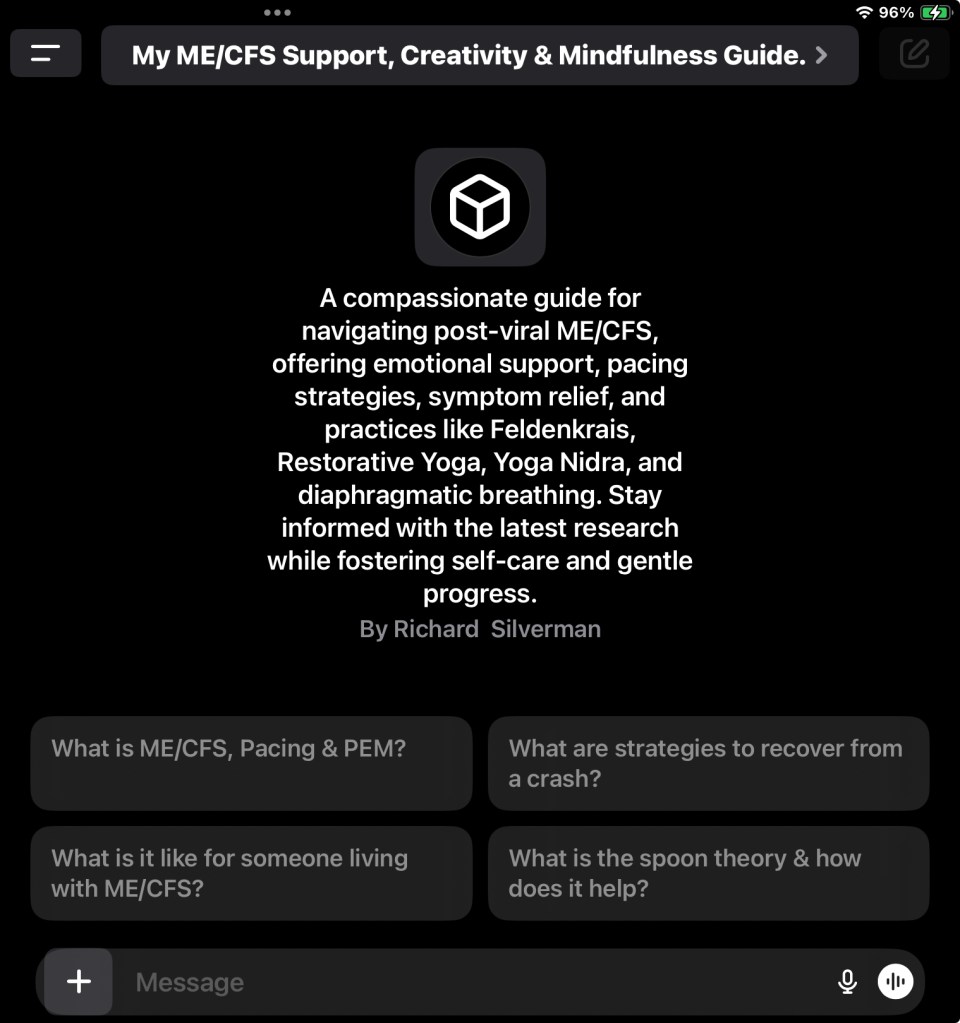
Check out this Free GPT ME/CFS Support, Creativity & Mindfulness Tool 😀
For those of us managing life with ME/CFS, I’ve found a helpful digital companion in this GPT Model for Support, Creativity, and Mindfulness. If you’re looking for new pacing strategies, symptom relief, or gentle emotional support, this tool might be helpful to you too.
💡 How it works: This GPT Assistant offers mindfulness techniques, creative ideas, and compassionate support as I manage the challenges of post-viral fatigue, PEM (Post-Exertional Malaise), and daily energy management. It helps me, Maybe it can help you too.
🙏 if you try it, I’d love to hear your feedback! How does this tool work for you? Do you find it helpful in managing your energy, finding comfort, or discovering new ways to express creativity? Let me know in the comments how it goes for you!
Click here to explore the Free ME/CFS Support GPT model:
If you’d like to explore supportive content focused on navigating life with ME/CFS, including tips for energy pacing, mindfulness, and gentle encouragement, you can find more insights and reflections crafted to offer comfort, practical guidance, and connection on this journey
here.
A Gentle Reflection on Pacing, Rest, and Navigating the Challenges of Chronic Fatigue Syndrome
There are days when the body speaks softly, a whisper of weariness that hints at the storm ahead. And though we move carefully, mindful of each step, there are moments when the smallest effort—a turn of the mind, a spark of emotion—awakens something deeper. This is the dance with post-exertional malaise, the hidden tide that comes and goes, often when we least expect it.
Gentle Reminder: Take Care of Yourself
This post is lengthy, and it’s important to honor your pacing needs. Feel free to read a little at a time, take breaks, and come back to it when you’re ready. Your well-being is paramount, even as you engage with information that supports your journey.
In this slow unfolding, I’ve learned the art of listening. Not just to the body’s loud protests, but to the subtle shifts that rise like shadows before a dusk. It’s a practice, really—this gentle balancing act of life. Pacing myself through the hours, I find that it’s not about doing as much as I can, but rather, doing only as much as I must, and stopping long before the weight of fatigue pulls me under.
Some days, I count my energy like a miser with gold, tucking it away in small corners, resting in the quiet between breaths. I know now that to keep moving without pause is to invite the flood, so I rest—not in surrender, but in reverence. It’s a kind of devotion, to honor these limits as something sacred, to see the necessity of stillness as part of the rhythm of being. I don’t always succeed. But when I do, I glimpse a peace that feels fragile, yet profound.
And when the world presses in with its demands, I remind myself that it’s okay to say no, or not now. There is a quiet strength in bowing out, in knowing that tomorrow will ask more of me than today ever could, and I must be ready. There is also grace in understanding that not every task, not every moment, requires my full self. I can do less, and in doing less, I give myself more space to breathe, to be.
There are the days after—the days when the fog of PEM descends like a heavy mist over the mind, the limbs. When it comes, I am learning not to fight it. I lie still, like a tree after the storm, gathering strength in the pause. I have found that recovery is an art, as delicate as anything else. Resting, not out of defeat, but out of wisdom, out of love for the body that has carried me through so much already. The act of resting becomes an offering of peace, a gift I give myself in this long, uncharted journey.
And so, I move slowly, gently, always aware of the fine thread that connects exertion and ease, action and rest. I have begun to cherish the quiet moments of pause, the spaces where life still hums softly, even in the absence of movement. These are the moments when I remind myself that managing this strange, invisible storm is not about conquering it, but learning to live alongside it, to move with it as gracefully as I can. There is beauty here, too—a beauty in the stillness, in the small victories of simply being.
In those moments, I find a sense of peace that is mine to keep. And in that peace, I remind myself that even on the hardest days, I am enough.And so, as I offer these thoughts, I send with them a quiet wish for your well-being. May you find moments of rest that nourish you deeply, and may the days of ease, however fleeting, linger softly in your memory. If you ever feel the weight of this journey pressing too hard, know that you are not alone.
Dear friends,
I know these days may feel heavier than usual. The storm outside has passed, but inside, your bodies may feel as though they’re weathering one of their own. Post-exertional malaise (PEM) comes like that—quiet and uninvited, a deep exhaustion that touches every part of you. Whether it’s the physical toll of surviving the hurricane or the emotional weight of the aftermath, you’re feeling it now, maybe more intensely than you have in years.
Please know that what you are experiencing is valid. You’ve already shown such strength, simply by navigating these storms and their many demands. But right now, in this moment, the strongest thing you can do is rest. Not as a surrender, but as a way of caring for yourself in the most compassionate way possible. Rest, because your body is asking for it. Rest, because this is how you heal.
Pacing is not easy when the world around you spins in chaos, but I encourage you to listen to the subtle signs your body gives. You don’t have to meet every demand or engage with every worry. It’s okay to step back, to breathe, and to honor your limits. In doing less, you are doing what is necessary to recover.
If the fog of PEM feels too thick to see through, know that it will lift. Maybe not all at once, but in small, tender ways. There is stillness, there is peace, waiting for you on the other side of this exhaustion. You are not alone in this experience—many of us are moving slowly through these same waters, learning the rhythm of rest, of patience, of letting go.
For now, take each moment as it comes. Let yourselves be. Let yourselves rest. And in that rest, know that you are enough. You are resilient. This, too, will pass.
With all my warmth and understanding, Richard Silverman
Feel free to leave your thoughts, your questions, or simply your presence here—I will meet you with understandingh and warmth. Together, in our shared quiet, we will honor the pace that life has asked of us.
Healing Through Rest: How the Parasympathetic Nervous System Can Support Recovery from Chronic Fatigue Syndrome
In the aftermath of the recent hurricanes, Helene and Milton, I’ve felt post-exertional malaise weigh heavily on my body. The fatigue has been more than just physical—it’s emotional and mental, a deep, enveloping weariness that reminds me how fragile recovery can be. As I continue to mend from both the storms and the physical toll of chronic fatigue syndrome, I’ve found myself needing to return to the gentle practices that once brought me peace. The practices that help restore balance to my overstimulated system—those that invite rest rather than force recovery.
Living with chronic fatigue syndrome is like walking on a delicate thread between exhaustion and healing. In these moments, the body feels like a battleground, constantly stuck in “fight or flight.” What I’ve learned, though, is that there’s another way—a softer, quieter way to approach healing. And this way begins with the parasympathetic nervous system.
The Parasympathetic Nervous System: Our Body’s Quiet Healer
The parasympathetic nervous system is often referred to as the “rest and digest” system, the opposite of the “fight or flight” response that dominates so much of my life with ME/CFS. While the sympathetic system pushes us to react, defend, and survive, the parasympathetic system invites us to slow down, to breathe deeply, to recover. It lowers heart rate, softens the breath, and gently restores the body to a state where healing is possible.
For those of us with chronic fatigue, the parasympathetic nervous system is like a refuge, a space where our bodies can finally stop fighting and simply rest. But tapping into this refuge doesn’t come easily. It requires intention, mindfulness, and the willingness to let go of the push to “do” and embrace the power of simply “being.”
Practices that Invite the Body to Rest
Over time, I’ve gathered a small collection of practices that help me reconnect with my parasympathetic nervous system. One of the most powerful has been breathwork. By consciously slowing my breath—drawing in air slowly, holding the quiet pause between, and then releasing—I can feel my body begin to soften. It’s like a signal to my nervous system: “It’s safe. You can rest now.”
Yoga Nidra has also become a vital tool in my recovery. It’s a guided form of meditation that allows me to rest deeply while staying present in the body. In this state, my body heals while my mind remains aware, a powerful reminder that rest is not the same as sleep. Restorative yoga, too, has been a way to surrender fully, each pose an invitation to soften into support, to let my body be held by the earth.
And then there’s the Feldenkrais Method—gentle, mindful movements that teach me to listen to my body without forcing anything. These movements may be subtle, but they remind me that healing isn’t about big gestures or grand efforts. It’s about the small, quiet acts of listening to what my body truly needs in each moment.
Learning to Listen
As I move through these practices, I often find myself returning to Rilke’s words: “I am circling around God, around the ancient tower, and I have been circling for a thousand years, and I still don’t know: am I a falcon, a storm, or a great song?” Like Rilke, I am circling around the wisdom within me, learning the language of my body’s needs.
Some days, I feel like the storm—torn by fatigue and pain. Other days, I am the quiet center, the stillness amidst the chaos. I am learning that healing isn’t about becoming something new or different. It’s about softening into who I already am and trusting that my body knows the way forward.
An Invitation for Beta Testers
If this resonates with you, I’d like to invite you to help beta test a new GPT model I’m developing. This model is designed to act as a relaxation coach, guiding you through practices like breathwork, Yoga Nidra, and gentle movements to activate the parasympathetic nervous system. It’s a tool I’m hoping will help others find the same peace and healing that these practices have brought me.
This model is still in development, and I’m looking for a small group of people willing to try it out and provide feedback. If you’re interested, please reach out to me in the comments section with a few sentences about why this model interests you, how it could benefit your journey, and why you’d be interested in providing feedback. Your thoughts and insights will be invaluable as I continue to shape and improve it.
Thank you for walking this journey with me. In the quiet, I’m learning to heal. May we all be well and safe. 🙏❤️🙏
In a small village nestled between quiet hills and flowing rivers, there lived a kind, gentle teacher named Sage. Everyone in the village loved Sage because he carried a peaceful presence, like a calm breeze on a warm day. People often came to him for guidance, and he always had time to sit with them, no matter how small or big their worries were.
One day, a group of children gathered by the firelight in Sage’s little house. These children, like you, had bodies that often felt tired—too tired to run and play like other children. Some days, their legs felt as heavy as stones, and even getting out of bed was hard. Other days, the sounds and lights of the world felt too loud and overwhelming, and they needed quiet spaces just to rest.
They had come to Sage with questions. “Why do our bodies feel like this?” one of them asked softly. “How can we find peace when we feel so tired and sad?”
Sage smiled gently, his eyes filled with warmth. “Come,” he said. “Let me tell you a story about a little river, a floating cloud, and a flower seed. Each of these can teach us how to find peace, even on the hardest days.”
The children nestled into their blankets, their bodies relaxing as they listened to Sage’s voice, soft and soothing.
“Once upon a time,” Sage began, “there was a little river. The river flowed gently through the valley, singing quietly as it went. But one day, it rained so hard that the river became muddy and rough. The river thought, ‘Oh no! I can’t sing anymore. Everything is so heavy.’
A passing cloud saw the river’s sadness and whispered, ‘Dear river, you don’t need to be clear right now. Just flow, even if it feels heavy. The mud will settle when it’s ready. You are still a river, just as you are.’
The river listened to the cloud and let itself flow, even though it felt muddy and tired. And slowly, without trying, the mud began to settle. The river’s song returned, not because it had rushed to fix itself, but because it had trusted in the flow of life.”
Sage looked at the children with kindness. “When your body feels tired, like the muddy river, you don’t need to fight it or force yourself to feel better. Just breathe gently and say, It’s okay to feel this way. I will let my body rest. With time, the heaviness will shift, just like the mud settles in the river.”
The children closed their eyes and breathed softly: It’s okay to feel this way. I will let my body rest. Their shoulders softened, and a small sense of ease began to bloom inside them.
“Next,” Sage continued, “there was a little cloud that floated high in the sky. One day, the cloud began to feel very lonely. It looked down and saw other clouds floating by, but it couldn’t keep up with them. The cloud thought, ‘I wish I could float faster and be with the others.’
Then the sun spoke gently to the cloud. ‘Dear cloud,’ the sun said, ‘you are already perfect just as you are. You don’t need to rush. Wherever you float, you bring shade to the earth and water to the rivers. That is enough.’
The cloud felt a little lighter, knowing it didn’t need to rush. It drifted slowly through the sky, enjoying the way the breeze carried it along.”
Sage paused for a moment, letting the story sink in. “Sometimes, it’s easy to feel like you need to do more, or be like everyone else. But just like the cloud, you are enough exactly as you are, even when you need to rest. With each small breath, you are already giving your love to the world.”
The children breathed quietly, feeling a small spark of kindness for themselves, whispering: I am enough, just as I am.
“Now,” Sage said softly, “I will tell you about the little flower seed. This seed lay hidden under the earth, waiting quietly through winter. It wanted to bloom, but the snow felt so heavy on top of it. The seed whispered, ‘When will I ever grow? I want to be a flower, but I feel stuck.’
The earth wrapped the seed in its warm embrace and said, ‘You are already growing, little one, even though you cannot see it yet. Each day, even as you rest, the roots inside you grow deeper. Trust the process, and when the time is right, you will bloom.’
And so the little seed rested through the winter, trusting in the earth. When spring finally came, it bloomed into the most beautiful flower the world had ever seen.”
Sage smiled at the children. “Sometimes, it feels like you are waiting, like the flower seed under the snow. But even on the days when you can’t see it, you are growing. Every time you care for yourself, every time you rest with kindness, you are planting seeds of strength inside you. And when the time is right, those seeds will bloom.”
The children snuggled deeper into their blankets, their breaths slow and soft, like gentle waves on the shore. Sage placed his hands gently on their heads, offering a quiet blessing.
“Now,” Sage whispered, “as you drift off to sleep, you can imagine yourself as the river, the cloud, and the flower seed. There is no need to rush. Just flow, just float, just rest. You are already enough, and your roots are already growing deep. With each breath, you are planting seeds of love, kindness, and peace—not just for yourself, but for the whole world.”
The children closed their eyes, their little hearts filled with the warmth of Sage’s words. As they drifted into sleep, they carried the stories with them, like seeds planted in the soft soil of their dreams.
Sage whispered a final blessing, his voice as soft as a lullaby:
“Breathing in, I rest.
Breathing out, I am at peace.
With each breath, I grow in love.
With each dream, my heart blooms in kindness.”
And with that, the children drifted into a deep, peaceful sleep, their dreams filled with rivers flowing gently, clouds floating freely, and flowers blooming in the sunlight. They carried these teachings in their hearts, knowing that even on the hardest days, they could flow, float, and grow at their own pace.
May your hearts always be filled with kindness, and may you grow into beautiful flowers, spreading peace and love wherever you go. Sleep well. The seeds of mindfulness and compassion are already blooming within you.
Goodnight, little ones. ❤️
If you’d like to explore more bedtime stories for children, including tales that nurture compassion and mindfulness, you can find our collection here.
A gentle exploration of how pacing can help you find balance and protect your well-being while living with chronic illness—along with thoughtful tools and guidance for those seeking support on this journey.
Pacing is the quiet art of learning to live gently within the rhythms of your body, an act of surrender not to defeat, but to wisdom. It asks you to listen closely, with reverence, to the invisible boundaries your energy sets each day—boundaries that shift like tides, at times quietly receding, at times closing in. For those living with post-viral ME/CFS or long COVID, pacing is not about building stamina or pushing through; it is a way of navigating the unpredictable waters of illness, steering not toward exhaustion but toward balance.
Think of your energy as a delicate thread stretched between moments. Some threads are finer than others, fraying at the edges after only the smallest tug. On certain days, your energy is enough to string together simple acts—getting out of bed, speaking a few words, tending to a meal. On others, even holding a thought in your mind feels like a weight too great to bear. There is no map for how far your thread will extend each day, and so the practice of pacing requires patience: learning when to weave activity into that thread and when to set it down altogether.
It begins with noticing. As the morning unfolds, ask yourself: How does your body feel today? What whispers does it send about the tasks ahead—are your limbs heavy, your mind clouded? Or does the day offer a rare clarity, a lightness in your chest? This gentle inquiry is the starting point of pacing, the first invitation to move in harmony with yourself. If you learn to honor your limits before they are breached, you begin to discover that rest, too, is a form of action—an act of preservation, of quiet resistance to the demands of doing.
There will be moments when you falter. Some days, buoyed by the hope of feeling better, you may do too much, only to find yourself crashed in bed the next morning, as though your body is reminding you: even good days must be tended with care. And yet, these moments are not failures but teachers, guiding you back to the path of gentleness. The gift of pacing is not in perfection but in the willingness to adjust, again and again, to the ebb and flow of your energy. It teaches that every step back into rest is not a retreat but a recalibration—a way of finding your balance anew.
In practice, pacing asks that you break life into smaller pieces. No task need be completed all at once; no activity is so urgent that it cannot be paused. It may mean spreading chores across hours or days, resting between each small effort. You might find that simply sitting still before you are exhausted—what some call “micro-rests”—becomes a way to protect your energy, much like tending a fragile flame so it does not burn too fast.
It also teaches the value of saying no, of drawing boundaries not out of reluctance but out of care for yourself. The world may ask more of you than you can give, but your worth is not measured by what you accomplish. Pacing offers you the grace to step back when needed, to protect the little energy you have, and to understand that in rest there is healing, even if that healing is slow and subtle.
Through this practice, you begin to understand that your life with chronic illness is not a race to reclaim the old ways of being, but an invitation to live differently—deliberately, thoughtfully, and with compassion for yourself. Some days will still carry setbacks, and your thread may feel thin and worn, but you learn to trust that even in these moments, you are practicing something essential: the art of living well within your limits.
If this way of being resonates with you, I invite you to explore pacing as a tool for navigating life with long COVID, post-viral ME/CFS, or any chronic illness. It is not a cure, but a guide—a way to live with care, softness, and respect for the boundaries your body sets.
And if you are looking for a gentle companion in this journey—someone to offer guidance on pacing, energy conservation, and emotional support—I invite you to try out this free GPT assistant. This tool provides thoughtful advice, helps you manage the challenges of chronic illness, and offers a steady, compassionate voice tailored to your unique needs.
Harnessing Inner Peace: A Pacing Toolkit Tool for Those Living with ME/CFS or Long Covid
As I reflect on the approaching Hurricane Milton, I’m reminded of the powerful moment when Jesus calmed the storm on the Sea of Galilee. His disciples, gripped by fear, watched as He simply said: “Peace! Be still!” and the storm settled. In this moment, I feel called to do the same—to access the peace of God within me and speak to the storm, “Peace! Be still.” I truly believe this is what Jesus asks of us, to practice this promise, and to remember that even faith the size of a mustard seed can move mountains.
But this call to peace and stillness isn’t just about the external storm. As someone who lives with chronic fatigue, I know how much of a difference it makes to calm the storms within as well. The mental and emotional stress can often intensify symptoms like post-exertional malaise (PEM). So, I remind myself to relax my mind and heart, to let go of worry and concern, and to give my body the space it needs to heal.
One of the tools I turn to in these moments is Pristine Mind Meditation, as taught by Orgyen Chowang in his book Pristine Mind: Journey to Unconditional Happiness. Pristine Mind is the pure, natural awareness that exists within all of us, untouched by thoughts or emotional turmoil. By resting in this space, I find that it helps me manage my symptoms, reduce stress, and pace myself more effectively. It’s an essential part of my pacing toolkit, allowing me to not only physically rest, but also calm my mind and emotions, preventing flare-ups of PEM and other symptoms.
In this moment, I invite us all to join together in saying to the storm—whether it’s the physical hurricane or the inner storms we face—“Peace! Be still.” Let’s tap into the divine promise that’s always been ours and use the tools we have to cultivate peace, clarity, and healing within ourselves.
Let us, from a place of faith and trust, send love to this storm and say to it: “Peace, be still.”
There is something about preparing for a storm that feels like a dance with the Divine—both a surrender and a determined act of mindfulness. As I sit here in the quiet hours before evacuation, I realize that this has been more than just a physical process of gathering what I need. It has been an intimate spiritual journey, one that stretches my capacity to trust, to let go, and to deepen into the lived experience of the present moment.
Living with chronic fatigue syndrome (CFS) means that every action I take must be intentional. Every task requires careful pacing, every moment of activity balanced with long periods of rest. There is a delicate art to navigating this kind of preparation, especially during a post-exertional malaise (PEM) crash. Yet, somehow, this storm has become a mirror—reflecting back the inner landscape of my spiritual practice, calling me into a deeper relationship with contemplation, with surrender, and with faith.
The Importance of Pacing I began the preparations by gathering what I would take with me: clothes, medications, bedding, and electronics—just enough to fill a small suitcase and backpack. For most, this might seem like a simple task. For me, it was an act of delicate pacing. I worked in small bursts, then returned to rest, mindful of the balance I needed to maintain in order to avoid worsening my symptoms. Each step of preparation became a meditation on pacing, on honoring the limitations of my body while trusting in my ability to persevere.
In these moments of rest, I found myself returning again and again to the practice of contemplation. I lit a candle, not only for myself but for all those who are suffering—for all sentient beings in the path of this storm and beyond. There is a peace that arises in this kind of surrender. A quiet knowing that, no matter how much preparation is done, the outcome rests in God’s hands. And that, somehow, is enough.
A Shift from Meditation to Contemplation This journey has been more than just practical preparation. It has been a spiritual unfolding. For years, I have studied the teachings of Advaita Vedanta and Dzogchen, exploring the ways in which these paths guide us beyond intellectual understanding and into a direct experience of the Divine. In the midst of preparing for this hurricane, I felt a deepening—a shift from meditation to contemplation.
Contemplation is not about thinking or striving. It is about resting in the space of the witness, in the awareness of what is, without grasping or resisting. As the storm approaches, I find myself leaning more into this practice. Each moment becomes an invitation to let go of control, to allow the Divine to move through me, and to trust that whatever happens, it is part of a greater unfolding.
Mindful Eating and Body Awareness Even the simple act of eating became a mindful practice. I prepared a spontaneous meal—scrambled eggs with garlic and cayenne, rich in healthy fats and protein to fuel me through the day. As I ate, I focused on each bite, slowing down, tasting, being fully present with the nourishment my body needed.
In the midst of so much uncertainty, these small acts of mindfulness brought me back to center. They reminded me that, even as the world outside seemed to spin with chaos, I could find peace within the present moment. I could honor my body’s needs, even as I prepared to enter an unfamiliar shelter and face whatever lay ahead.
Pacing the Preparation of the RV As I packed my belongings, I also prepared my RV, the place I call home. I moved slowly, bringing frozen food to the clubhouse, unplugging the RV, securing what needed to be secured. I paced myself, taking each step with intention, aware that my energy was limited and precious.
There is something sacred about these practical tasks, when approached with mindfulness. They become a part of the spiritual practice, a way of aligning the outer world with the inner. In unplugging the RV, I was also unplugging from the need to control. In securing my belongings, I was also securing my faith—trusting that whatever happens, I am held by something greater than myself.
Karma Yoga: Offering and Receiving Prayers During this time, I also turned to the practice of Karma Yoga—offering prayers for the world, while asking for prayers in return. I posted a prayer request on Facebook, asking my community to hold me, and all those in the storm’s path, in their hearts. The response was overwhelming. The outpouring of love, of people offering their prayers and well wishes, became a source of strength for me. It reminded me that, even in times of uncertainty, we are never alone. We are held by the compassion of others, by the grace of the Divine, by the interconnectedness of all life.
Surrender and Trust And so, I surrender. I surrender to whatever will be, knowing that I have done all I can to prepare—both physically and spiritually. I surrender to the wisdom of the Divine, trusting that, in the midst of this storm, there is a deeper unfolding happening. There is a lesson in the letting go, in the release of control, in the peace that comes from trusting that God’s will is always unfolding in ways that we may not understand, but can still embrace.
To those who read this, who are also navigating life with chronic fatigue syndrome or facing similar challenges, I hope this reflection offers you some sense of peace. We cannot always control the storms that come our way, but we can choose how we prepare, how we respond, and how we anchor ourselves in the presence of the Divine.
May you be safe. May you be held. May you find peace in the midst of the storm.
Finding Compassionate and Informed Care in the Face of Chronic Fatigue Syndrome
Living with post-viral myalgic encephalomyelitis/chronic fatigue syndrome (ME/CFS) presents unique challenges, not only in daily life but also in finding the right healthcare provider. Many of us with ME/CFS have experienced the frustration of dealing with doctors who dismiss or misunderstand our condition. What we truly need is a doctor who embodies the original meaning of the word: doctor comes from the Latin docere, meaning “to teach.” The best doctors are not just healers, but also teachers—those who are willing to learn about our condition and guide us on how to live better with it.
The Need for a Teacher in Your Healthcare Provider
When you’re living with a complex, often misunderstood condition like post-viral ME/CFS, your doctor’s role as a teacher becomes crucial. You’re not just looking for someone to prescribe medications—you need a partner who is willing to explore the intricacies of your symptoms and teach you how to manage them. ME/CFS can be an unpredictable illness, and we need doctors who are knowledgeable and open-minded enough to recognize this. Unfortunately, many of us have encountered physicians who were either dismissive or unaware of what chronic fatigue truly entails.
Doctors who are lifelong learners, who are open to adapting their understanding as new research emerges, are those worth seeking. They don’t need to be ME/CFS specialists necessarily, but they must be willing to listen and learn.
The Importance of Self-Advocacy
Finding a doctor who meets these criteria can feel daunting. One of the hardest but most important lessons I’ve learned on my journey is the need to advocate for myself. This means recognizing that you have the right to “fire” doctors who are not serving your needs. It also means being willing to seek out new doctors, even when it’s exhausting.
For people with post-viral ME/CFS, visiting doctors can easily trigger post-exertional malaise (PEM), and even a single appointment may be enough to cause a severe setback. This makes it all the more important to learn as much as possible about a doctor beforehand—whether through phone calls, online research, or patient reviews—to improve your chances of success and reduce the toll on your body and mind. Over the years, I’ve learned that it’s often more valuable to take my time finding the right doctor than to rush from one to another.
Osteopathic Physicians: A More Humanistic Approach
From my own experience, I’ve found that osteopathic physicians often approach medicine with a more holistic and humanistic philosophy. Osteopathic doctors are trained to treat the whole person, not just individual symptoms. While not all osteopaths are equally open-minded or knowledgeable about post-viral ME/CFS, in my experience, they tend to listen more carefully and offer more personalized care than their counterparts in allopathic medicine.
The osteopathic doctor I eventually found has been a godsend. He understands my condition, respects my experiences, and helps me manage both symptoms and lifestyle adjustments. Together, we’ve worked on pacing, setting boundaries, and using a few key medications in low doses to manage symptoms. He’s more of a guide than just a prescriber, which makes all the difference.
If you’re able to find an osteopathic doctor who truly adheres to the principles of osteopathic medicine, they may offer a much-needed, compassionate approach to managing your condition.
The Insurance Barrier: Navigating the System
One of the biggest challenges for ME/CFS patients is navigating the insurance system, especially when you’re restricted to certain networks. In my case, my experience with an HMO (Kaiser) was incredibly frustrating. The doctors in that system didn’t understand or take my condition seriously, which made the whole process feel like a dead end. Unfortunately, this is not uncommon when dealing with HMOs or Medicare Advantage plans that limit which doctors you can see.
The game-changer for me came when I switched from a Medicare Advantage Plan to straight Medicare. This allowed me the flexibility to seek out doctors who would take Medicare and truly understood my condition. It wasn’t until I left Kaiser that I finally found a compassionate and knowledgeable osteopathic physician. If you’re struggling with an HMO or restricted insurance, it may be worth exploring other options that give you more control over which doctors you can see.
Managing Post-Exertional Malaise (PEM) with Doctor Visits
One of the hardest aspects of post-viral ME/CFS is the experience of PEM—where even minor physical or mental exertion can trigger a severe worsening of symptoms. Doctor visits, while necessary, can often cause PEM due to the stress of travel, waiting rooms, and emotional fatigue from unsatisfactory interactions with dismissive doctors. This makes it crucial to be strategic about when and how often you see doctors.
If you have a more severe case of ME/CFS, it might be wise to pace your appointments carefully. Prioritize visits that you know will be productive. Don’t be afraid to ask your doctor to handle routine matters via telehealth or email when possible, to minimize the physical toll of in-person visits.
In Conclusion: Trusting Your Instincts
Ultimately, finding a good doctor for post-viral ME/CFS is about finding someone who respects you, listens, and acts as a partner in your care. Doctors should be willing to teach, learn, and adapt, especially when dealing with a condition as complex as ME/CFS. Whether through osteopathic physicians, integrative medicine, or other avenues, your goal is to find a doctor who works with you, not against you.
This journey can take time, and there may be obstacles along the way, but don’t settle for less than the care you deserve. Trust your instincts, advocate for yourself, and remember that the right doctor is out there—they just may not be easy to find.