Category: ME/CFS Mindful Healing & Meditation Practices

  • Blessings honoring the interconnectedness of all life:

    Blessings honoring the interconnectedness of all life:

    May you feel at ease today, in body and mind,
    Flowing naturally with the unfolding Tao.
    May the winds be gentle, the clouds at peace,
    And with each day, may wellness arise.

    Spanish / Español

    Que hoy sientas paz en cuerpo y mente,
    Fluyendo con el Tao en su danza infinita.
    Que los vientos sean suaves, las nubes en calma,
    Y con cada día, la dicha te acompañe.

    Italian / Italiano

    Che tu possa sentirti in pace oggi, nel corpo e nella mente,
    Scorrendo naturalmente con il fluire del Tao.
    Che i venti siano dolci, le nuvole serene,
    E che ogni giorno porti benessere.

    Chinese / 中文

    愿你今日身心安,
    随顺大道自流转。
    风轻云淡无忧虑,
    日日安然福自来。

    Japanese / 日本語

    今日、心も体も安らかでありますように、
    自然と道(タオ)の流れに身を任せて。
    風は穏やかに、雲は静かに、
    毎日が平和と幸せで満ちますように。

    Arabic / العربية

    أتمنى لك راحة البال والجسد اليوم،
    متناغمًا مع تدفق الطاو الطبيعي.
    لتكن الرياح لطيفة، والسحب في سلام،
    ومع كل يوم، ليزهر الهدوء والرفاهية.

    Hebrew / עברית

    שיהיה לך שקט ושלווה בגוף ובנפש היום,
    זורם בטבעיות עם התפתחות הטאו.
    שהרוחות יהיו עדינות והעננים שלווים,
    ועם כל יום, תצמח רווחה וברכה.

    Russian / Русский

    Пусть сегодня твое тело и разум будут в покое,
    Теча естественно вместе с раскрывающимся Дао.
    Пусть ветер будет мягким, облака спокойными,
    И с каждым днем пусть благополучие возрастает.

    Ukrainian / Українська

    Нехай сьогодні твоє тіло йo розум будуть у спокої,
    Течучи природно разом із розкриттям Дао.
    Нехай вітер буде лагідним, а хмари спокійними,
    І з кожним днем нехай зростає благополуччя.

    Native American (Lakota / Lakȟótiyapi)

    Lél uŋči makȟóčhe kiŋ ičháǧapi, ni én čhaŋtéwašteya waŋká yo.
    Čháŋ šíč’iya, maȟpíya wašté.
    Tatȟáŋka yuhá waštélaka,
    Lé wíyukčaŋ kiŋ, tȟawášte ye.

    (Here on Grandmother Earth, may you stand with a good heart.
    May the trees be strong, and the clouds be kind.
    Buffalo watches over you with love,
    And this day brings you peace.)

    🙏🕊🙏

  • Cultivating the Witness: A Gentle Approach to Living with Myalgic Encephalomyelitis: The Body as a Landscape of Storm and Stillness 🙏

    Cultivating the Witness: A Gentle Approach to Living with Myalgic Encephalomyelitis: The Body as a Landscape of Storm and Stillness 🙏

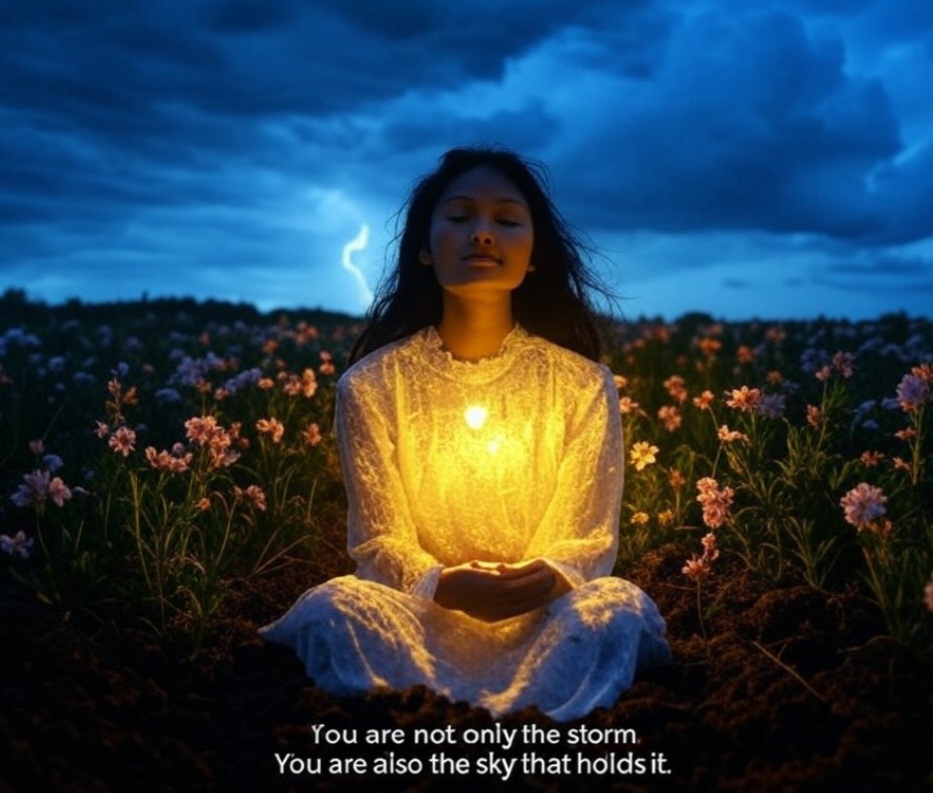
    To live with myalgic encephalomyelitis is to carry a body that moves like weather—one moment heavy with fog, another scattered by electric storms. The limbs, once steady, now whisper of exhaustion; the nervous system hums and flickers like distant lightning. And yet, within all of this, there is a quiet place—one untouched by fatigue, by pain, by the ever-changing tides of illness. This is the witness, the silent presence that watches, feels, but does not struggle.

    The Power of Witnessing Consciousness

    When the body is weary, and the world presses in with its demands, the mind often follows—entangled in frustration, longing, grief. Yet, there is another way to meet this experience. Instead of battling exhaustion, we can turn toward it, gently, with curiosity. Instead of resisting discomfort, we can learn to hold it, like cradling a trembling bird in our hands.

    Witnessing is not about escaping pain but about changing our relationship to it. It is the art of standing at the edge of the storm and seeing not just the thunder, but the vast sky that holds it.

    A Simple Self-Contemplation Practice

    1. Grounding in the Present
      Find a quiet moment. You don’t need perfect stillness—only a willingness to pause. Notice your body, the way it rests against the surface beneath you. Feel the breath, moving in, moving out, like waves against the shore.
    2. Observing Without Resistance
      Turn your attention inward. What is present? Fatigue like heavy earth? A nervous system like sparking wires? A mind that spins, restless and longing? Whatever it is, let it be here. Do not push it away or name it as the enemy. Simply notice.
    3. Holding with Compassion
      Imagine that each sensation is a visitor—arriving, staying for a time, and eventually leaving. What happens if you do not chase them away? What if, instead, you offer a quiet seat at your table?

    Even pain, even exhaustion, when met with this gentle witnessing, begins to soften. Not disappear, but shift—like wind through the trees, no longer trapped, no longer feared.

    How This Practice Supports ME/CFS Symptoms

    This is not a cure, nor a promise of relief, but a way of being with what is. When we meet our experience with openness:

    The nervous system settles; the fight against the body lessens.

    The mind uncoils from frustration and rests in the simple act of seeing.

    The emotional burden lightens, as we stop identifying with suffering and begin to witness it instead.

    Closing Thoughts: The Sky Holds It All

    If today your body feels like a storm, know that you are not only the storm—you are also the sky that holds it. The witness that watches, the stillness beneath the waves.

    And on days when you cannot sit in silence, when exhaustion presses too hard, let even that be witnessed with kindness. The practice is not in perfect stillness, but in the quiet turning toward whatever is here, again and again.

    Rest when you must, breathe when you can, and know that you are not alone.

    🙏🕊🙏

  • Kapalabhati Pranayama: The Shining Forehead Breath

    Kapalabhati Pranayama: The Shining Forehead Breath


    Dear Friend,

    There is a practice in yoga known as Kapalabhati, the “Shining Forehead Breath.” The very name carries with it a sense of poetry and mystery. “Kapala” means forehead, and “Bhati” means light or radiance. Together, they evoke an image of clarity, brightness, and inner illumination. This is no mere exercise but an invitation to cleanse not only the breath but also the mind and spirit, polishing the very space from which insight and intuition arise.

    In ancient times, practitioners likened this breath to polishing a mirror so that it might reflect the light of the divine. Each exhalation sweeps away impurities, and each inhalation invites the brilliance of life itself. To engage in this practice is to embark on a journey into your own radiant stillness.

    Here is how you may begin:

    1. Find Your Seat: Sit comfortably, with your spine straight and your hands resting gently on your knees. Feel the earth beneath you, steady and supportive.
    2. Breathe to Center Yourself: Take 5–7 slow, deep breaths. Let these breaths settle your thoughts and prepare you for the journey ahead.
    3. Engage the Shining Breath:
      • Take a full, deep inhale to begin.
      • Begin a series of sharp, active exhalations through your nose, allowing the inhalations to come naturally and passively.
      • Focus on the rhythm, like the steady beat of a drum, as your abdominal muscles contract with each exhalation.
      Start with 20–30 breaths per round, letting the breath carry you into its natural rhythm.
    4. Pause and Hold: At the end of the round, take a deep inhale. Hold the breath for a moment, feeling the stillness that arises, as if the universe itself has paused with you.
    5. Return to Natural Breathing: Exhale gently and let your breath return to its natural flow. Rest here, simply observing the quiet within.

    This is the essence of Kapalabhati. It is not about striving or achieving but about clearing away what obscures the light already present within you.

    As you continue to practice, you may notice the effects: a sharper mind, a lighter body, and a heart more attuned to the subtle rhythms of life. The breath becomes not just a function but a bridge—connecting you to the luminous self that watches over all.

    In the modern world, where distractions abound and our minds are pulled in countless directions, Kapalabhati offers a sanctuary. It invites you to return to simplicity, to the purity of breath, and to the stillness that holds all things. In this way, it is both a practice for the moment and a gift to carry with you into all moments.

    Dedication of Merit

    At the conclusion of this practice, let us dedicate whatever merit has arisen for the benefit of all sentient beings:

    May whatever merit has been accumulated in this practice flow outward, boundless and unending, for the benefit of all sentient beings.

    May all beings be free from suffering and the causes of suffering.

    May all beings experience happiness and the causes of happiness.

    May all beings awaken to enlightenment and the causes of enlightenment.

    May this moment of intention ripple through the universe, bringing peace, harmony, and light to all.

    Namo Buddhaya, Namo Dharmaya, Namo Sanghaya.

    I leave you with this reflection: Each breath you take is an opportunity to renew, to let go, and to shine. May this practice bring you clarity, lightness, and peace. And may it remind you of the brilliance that has always been yours.

    🙏🕊🙏


  • This Simple Practice Could Transform Life with ME/CFS—Feel Free to Ask Questions or Share Your Thoughts! 👍

    This Simple Practice Could Transform Life with ME/CFS—Feel Free to Ask Questions or Share Your Thoughts! 👍

    Resting in the Stillness of Witness Consciousness:

    To rest in Witness Consciousness is to embrace the stillness that exists beneath the surface of all thoughts, sensations, and emotions. It is the quiet awareness that watches without judgment, attachment, or resistance. Begin by settling into a comfortable position and turning your attention inward. Notice the thoughts or feelings that arise, but instead of engaging with them, observe them as you would clouds passing through a vast, open sky. With each breath, allow yourself to sink deeper into the stillness that holds everything. In this state of spacious awareness, you can release striving and simply be, knowing that your true self—the witness—is always present, whole, and at peace. Rest here, in the gentle embrace of the present moment, where the burdens of the mind are lifted, and the essence of stillness is revealed.

    Living with chronic fatigue syndrome (ME/CFS) brings immense challenges, not only to the body but also to the mind. The limitations imposed by this debilitating illness—constant fatigue, pain, and reduced capacity—can lead to frustration, grief, and a restless mind struggling to accept a life that feels constrained. In such a reality, the practice of meditation and cultivating witness consciousness becomes a refuge. By training the mind to rest in stillness and observe thoughts, emotions, and sensations without attachment, we can find a sense of inner peace amidst the turbulence. Witness consciousness helps us step back from our suffering, creating a space where we can gently acknowledge our experiences without being consumed by them. This compassionate awareness offers not only relief but also a pathway to greater resilience, even in the face of profound physical challenges.

    For centuries, human beings have grappled with the challenges of their minds. In simpler times, free of today’s overwhelming distractions, people focused on surviving through work, relationships, and health. Yet, even then, the teachings of the Buddha recognized the mind as the source of both suffering and liberation, offering practices to cultivate awareness and find peace amidst life’s trials.

    Today, the challenges of the mind remain, but they are compounded by endless distractions—technology, entertainment, and the allure of constant stimulation. These temporary escapes may numb the restless mind, but they do not heal its core discontent. The wisdom of meditation and mindfulness remains vital, offering a path back to inner stillness, even as the modern world pulls us in countless directions. Whether in the quiet of ancient times or the noise of today, the path of presence and witness consciousness offers clarity, resilience, and peace to those who walk it.

    Conclusion: An Invitation to Explore Witness Consciousness

    Witness Consciousness offers a refuge for anyone seeking peace amidst the challenges of living with chronic fatigue syndrome (ME/CFS). By embracing this practice, we learn to release the grip of mental and emotional struggles, finding a stillness that can transform our relationship with illness and limitations. This journey of cultivating awareness and resting in the present moment is not only a path to inner peace but a way to reconnect with the profound resilience and wisdom already within us.

    I invite you to share your experiences or questions as you explore this practice. Whether you are new to meditation or looking to deepen your journey, your insights and reflections are invaluable. Let’s create a space of shared learning and support, where we can grow together in this practice of stillness and presence.

    Please feel free to share and let others know if you find this practice of cultivating a Witness Consciousness of benefit to your experience of living with ME/CFS.

    🙏🕊🙏

  • Exploring Pristine Mind Meditation for Chronic Fatigue Syndrome: A Path to Effortless Rest

    Exploring Pristine Mind Meditation for Chronic Fatigue Syndrome: A Path to Effortless Rest

    “Discover how pristine mind meditation may offer a gentle, restorative state of awareness without the energy costs that often come with post-exertional malaise.”

    Living with Chronic Fatigue Syndrome means every action, every exertion, has a cost. For many, even a few minutes of focus or effort can lead to post-exertional malaise—a profound worsening of symptoms that can last for days. But what if there was a way to rest deeply, to allow the mind to settle in a way that doesn’t deplete but actually nourishes? This is where the practice of pristine mind meditation comes in, offering an effortless awareness that exists beyond thought, beyond strain, and without the toll of traditional exertion.

    Pristine mind meditation is rooted in the idea of simply being. Rather than trying to clear the mind or enter a specific state, it invites you to rest in pure, unaltered awareness. This isn’t an act of concentration or focus, but a gentle allowing—a way to let thoughts and sensations come and go without attaching or resisting. The experience of resting in the pristine mind is often described as spacious, calm, and effortlessly open. For someone with ME/CFS, this could mean a path to real rest without the demand on physical energy that so often comes with other practices.

    Theoretically, because pristine mind meditation is free from physical or mental strain, it offers a way to access peace and stillness without triggering the kind of post-exertional fatigue that can worsen symptoms. It’s an invitation to explore a new way of being with chronic fatigue, where healing is not about doing but about resting in the quiet awareness that’s already within you.

    This journey is a gentle experiment, a compassionate practice of meeting yourself exactly as you are. Whether you experience even a few moments of pristine awareness or simply rest in the intention, the practice becomes a way of honoring the body’s limits and nourishing the mind. Take this path slowly, with openness, knowing that each step is its own quiet gift.

    If you’re curious, I invite you to join in this exploration, allowing yourself to simply rest in the pristine mind, noticing what it brings without expectation or need for change. This is a practice of ease, not of effort—a resting place for the soul amidst the demands of daily life with Chronic Fatigue Syndrome.

    For those interested in going deeper, much of this understanding is inspired by the teachings in Our Pristine Mind by Orgyen Chowang Rinpoche. His book provides a profound exploration of this approach to awareness, offering guidance on accessing the clear, effortless state of the pristine mind. If this resonates with you, I’ll leave a link below to help you find the book and discover more about this gentle, transformative practice.

    In the name of honoring my chronic fatigue syndrome, I’m experimenting with a different approach to healing. I’m trying out the idea that it doesn’t have to be complicated or effortful—that maybe simplicity and gentle choices can be enough. By tending to myself in this way, I’m exploring what it means to honor both my needs and my limitations, and I’m finding that this, too, might be a path to healing.

    I don’t know all the answers, but I’m noticing that healing isn’t always about pushing or doing more. Sometimes, it’s about making a quiet, deliberate choice to conserve energy, to rest, and to be. This journey toward simplicity and ease feels like a step toward well-being, and I’m curious to see where it leads.

    🙏🕊️🙏

    <!– /wp:spacer →

    🙏🕊️🙏

  • Resting in the Silence of Being: A Journey Into Stillness


    “The quieter you become, the more you can hear.”

    – Ram Dass

    There is a quiet truth that lives within each of us, a place that is untouched by the noise of the world, a stillness that is ever-present. It’s not reserved for moments of crisis or for the end of life. It’s here, now—waiting for us to settle into its embrace.

    Yet how often do we run from this stillness? We search for peace in the future, hoping it will come once we’ve completed our tasks, achieved our goals, or silenced our minds. But peace is already here, calling us back to the simplicity of being.

    The Practice:

    The practice begins with a simple mantra: “I am That.”

    When we say these words, we invite ourselves to rest in the truth of who we are. It’s not about searching or striving—it’s a return to the natural state, where we belong. Repeat the mantra aloud, or silently in your heart, and allow yourself to rest. After each repetition, sit in silence for as long as you like, letting the mantra echo softly within.

    And when you are ready, say it again: “I am That.”

    There is no rush, no goal, no expectation—just the simple unfolding of awareness.

    As thoughts arise, as distractions call, simply return to the mantra, letting it be like a lullaby for the restless mind.

    Reflections Along the Way:

    Follow the rhythm of the mantra, thoughts may come, feelings may arise. Let them pass like clouds, and rest beneath them, in the vast expanse of awareness.

    You are that light,
    shining through all things.
    Rest…
    in the knowing.

    Effortless and true,
    you return to what you are.
    Rest…
    in your nature.

    Like a drifting cloud,
    the ego searches in vain.
    Rest…
    beneath the sky.

    In quiet grace, he guides,
    showing the way back to self.
    Rest…
    in deep gratitude.

    Thoughts, desires, restlessness—all falls away when we stop chasing after them. Rest in the simplicity of being.

    In this way, dear reader, the mantra becomes not just words, but the very breath of being. So, rest in this mystic presence, this silence that is always there, gently touching the surface of awareness.

    In the dance of both,
    stillness and movement arise.
    Rest…
    in the balance.

    A passing thought, no more,
    like a ripple in still waters.
    Rest…
    in your knowing.

    Being is the truth felt,
    beyond what eyes can hold.
    Rest…
    in the knowing of being.

    Like seasons that turn,
    each step comes in its own time.
    Rest…
    and let it flow.

    Resting in Silence

    The journey, dear reader, is not about forcing the mind to be still or silent. It is about allowing the natural stillness and silence of our true self to be seen, felt and appreciated, unclouded by thought, unburdened by desire. By continuing to rest in this silence, we come to realize that the peace we seek has always been here. We become “Self-Realized.”

    The practice of resting in the silence is a gift we give ourselves while we are alive. It’s not reserved for the end of life; it is the way to live fully, in peace, right here, right now. The mantra is a guide, and the silence is the true teacher.

    Rest in silence. Rest in peace. Rest in your true nature. You are That.

    “The end of all wisdom is love, love, love.”

    – Ramana Maharshi

    🙏🕊️🙏

  • Exploring Dzogchen’s Transformative Path: A Journey into Our Pristine Mind

    Exploring Dzogchen’s Transformative Path: A Journey into Our Pristine Mind

    Reflections on Pristine Awareness, Dzogchen, and Finding Clarity in Challenging Times

    As I sit with Our Pristine Mind in my hands, I am aware that I am not merely reading a book. I am entering a silent conversation with an ancient wisdom, one that gently unfolds its layers with each page, as if lifting the veils of my own mind. In the quiet of early morning or beneath the faint glow of a reading lamp at night, the words begin to sink into the places where thought usually moves too quickly, too restlessly.

    Dzogchen—a word I’ve heard in passing, sometimes as an exotic echo from distant mountains, sometimes as an answer whispered through stories of sages and scholars—is not simply an idea here. It emerges like a breath I have almost forgotten to take, a reminder that within my mind lies a pure, boundless awareness untouched by the cycles of confusion, emotion, or distraction. Dzogchen does not demand; it simply reveals.

    The teacher, Orgyen Chowang Rinpoche, through his voice in Our Pristine Mind, speaks to the essential nature of awareness with a softness that does not impose but invites. I am reminded of Rilke, who once spoke of patience and of growing quietly in one’s own way, like a tree. Here, too, the practice of Dzogchen is like that tree, patient and grounded, yet ever-revealing. It asks nothing from me but presence, a willingness to recognize that what I have been searching for has always been here, beneath the surface of my rushing thoughts.

    Rinpoche speaks to our current world—the difficulties, the fractures, the relentless march of modern life. Dzogchen, he says, has come forward in these times not because it is new, but because we are perhaps ready to see its simplicity. To see that the vastness of pristine awareness is not somewhere far away or reserved for saints and sages. It is here, in the quiet pause between breaths, in the stillness that accompanies an unfiltered experience of now.

    The metaphor of the “brilliant moon in dark times” comes alive as I read, a reminder that even in moments when life feels overcast and filled with turmoil, there exists within us a clear, illuminating presence. Dzogchen does not banish the darkness; rather, it reveals a light that has been hidden within it all along.

    This practice, this profound teaching, calls us to approach life differently—to walk, speak, even think with the awareness that we are not separate from each other, from the world, or from the mind that perceives it all. It is an invitation to cultivate what Rinpoche calls “pristine awareness” in daily life, and this awareness transforms not only how we experience joy but also how we engage with suffering. Even anger, fear, and sorrow are welcomed as parts of the unfolding dance, teachers in their own right.

    The path of Dzogchen, I am learning, is not about leaving this world behind or aspiring to some distant perfection. Instead, it is an opening into a fuller, clearer life here and now—a kind of blossoming from the cold winter of searching into the warm spring of presence.

    If you feel the weight of the world’s challenges or the heaviness of inner obstacles, there is a softness, a kindness in Dzogchen that may resonate. As I explore these teachings, I feel them steadying me, offering a compass to navigate the storms of distraction and disconnection that modern life so often brings.

    And so, I share these reflections with the hope that you, too, may find something here that speaks to your own journey—a word, a phrase, a quiet reminder of the freedom that rests quietly within, waiting to be seen.

    🙏🕊️🙏

    If you’re interested in exploring this transformative approach further, I highly recommend Orgyen Chowang’s book The Pristine Mind. His teachings provide a clear, compassionate path toward uncovering the inherent purity of our mind, offering a source of deep fulfillment and lasting peace.

  • Comforting the Ego Through Self-Inquiry: A Gentle Path into the Mystic

    The Tibetan teaching that the ego is a belief in a separate self with no inherent existence aligns perfectly with the process of self-inquiry. As we engage in the practice, the recognition that the ego has no independent reality allows it to gradually dissolve. What remains is the awareness that transcends the illusion of separation—the true nature of the Self.

    For many years, I’ve engaged in self-inquiry as a way to explore the deeper truth of who I am beyond the ordinary mind. The practice of asking, “Who am I?” or “Whose thoughts are these?” can lead to profound insights, but lately, I’ve realized there’s another layer to the practice that brings even greater depth—compassion for the ego.

    Instead of pushing the ego aside or forcing it into understanding, I’ve come to embrace the role of the comforter. When the ego resists, when it wants to play dumb or keep searching for answers, I gently reassure it:

    “It’s okay. You are That.”
    “Relax. You are That.”

    This approach transforms the practice into a more nurturing experience, where the ego is not an obstacle but a part of the journey toward resting in the truth of our being. By comforting the ego, I allow it to relax into the deeper awareness that is always present, the pristine mind that doesn’t need to figure anything out.

    Addressing the Ego: Creating Space

    What I’ve also discovered is that by addressing the ego as “you”—as though speaking to it in the third person—it creates a subtle but important space between the self and the ego. By saying, “You are That,” I create a gentle distance from the ego, which allows me to shift my identification toward the pristine mind, the awareness that simply knows. This practice helps me settle into the awareness of That, while gently guiding the ego to recognize its true nature.

    It’s a strange but profound feeling to begin identifying with the witness, the part of us that knows, rather than the ego itself. The distance allows the ego to relax, realizing it doesn’t need to figure things out—it just needs to rest in the knowing.

    Dissolving the Ego: Tibetan Insight

    In Tibetan teachings, the ego is understood as a belief in a separate self that has no inherent existence. It is the illusion of separateness that creates suffering, and it is through practices like self-inquiry that this illusion begins to dissolve. By comforting the ego and allowing it to rest in the awareness of That, the ego’s grip on the mind loosens, and its sense of separateness fades. As the ego dissolves, what remains is the truth of our being—unified, whole, and free from the illusion of duality.

    A Practice Rooted in Tradition: Tat Tvam Asi

    The phrase “Tat Tvam Asi”, which translates to “You are That”, is one of the most profound teachings from the Chandogya Upanishad. It comes from the dialogue between the sage Uddalaka and his son Svetaketu, where Uddalaka imparts the ultimate knowledge of the Self to his son.

    In this story, Uddalaka explains that the essence of the individual self (Atman) is identical to the essence of the entire universe (Brahman). He uses various examples from nature, like rivers merging into the ocean, to illustrate that all individual forms are ultimately one with the universal reality.

    The core teaching of “Tat Tvam Asi” is that the true nature of the self is not separate from the ultimate reality, Brahman. This insight is the foundation of Advaita Vedanta and points to the non-duality of existence. It’s a reminder that we are already That—we are not separate from the universal consciousness that pervades everything.

    A Path Forward

    If you’ve been engaging in self-inquiry and find that the ego often resists or overthinks, consider this approach. Become a gentle guide for the ego, allowing it to rest in the awareness of That without needing to figure everything out. With each step, you’re not only going deeper into the Mystic—you’re bringing the ego along in a spirit of kindness and unity.

    Offering the ego loving-kindness and compassion, rather than seeing it as an enemy, can transform the practice into something more nurturing and integrative. By embracing the ego with a Metta-Karuna mindset, we allow for deeper healing and connection, not just for ourselves but for others navigating similar paths.

    Today’s Practice of Self- Inquiry

    The core practice involves asking the question, “Who am I?” But for this practice, we’re using the mantra, “You are That,” to turn our attention inward and explore the space that neither comes nor goes—the pristine mind, our true nature. As we repeat the mantra, we gently direct it toward the space of the ego, with kindness and compassion. In doing so, we shift our identification away from the ego and toward the seer, the awareness that observes all. This process helps peel away layers of identification, bringing our ego closer to the essence of who we truly are.

    Guided Meditation: You are That

    Begin by finding a quiet and comfortable place to sit, where you won’t be disturbed. Close your eyes gently and take a few deep breaths. Feel the rise and fall of your chest, the air entering and leaving your body. With each exhale, let go of any tension in your muscles. Allow yourself to settle into the stillness of this moment, bringing your attention inward.

    Now, in the silence of your mind, introduce the mantra: “You are that.” Let the words flow gently, not as a thought to analyze but as a vibration that resonates within your being. “You are that.”

    As the mantra repeats in your mind, begin to observe the thoughts, sensations, and emotions that arise. Notice how they come and go like clouds passing through the sky. Without judgment, simply recognize them for what they are—temporary movements of the mind, just as waves rise and fall on the surface of the ocean.

    When thoughts or sensations arise, acknowledge them gently. With each arising, remind yourself, “This, too, is a movement in consciousness.” Then, return to “You are that.” Allow this rhythm to deepen your experience.

    When a thought or image captures your attention, gently remind yourself, “You are that.” This thought, too, is part of the vast consciousness in which you exist. Allow the mantra to guide you back, like an anchor to the present moment. “You are that.”

    With each repetition, feel the boundaries between yourself and the world begin to soften. The sense of separateness fades as you connect more deeply with the essence of the mantra. You are not the thoughts, not the body, not the emotions—you are that which is beyond them all. You are that—the awareness, the presence in which everything arises and falls away.

    If the mind wanders, or if any sensations in the body draw your attention, simply return to the mantra, “You are that.” There is no need to push anything away or force any particular state. Just notice, with kindness and patience, and return.

    In time, the mantra may begin to dissolve into the quiet presence that remains. Stay here, resting in the stillness. No effort is needed now—just a gentle awareness of being.

    You are that.

    When you are ready, take a few more deep breaths, feeling the connection between the mantra and the breath. Allow your awareness to expand, taking in the sounds and sensations around you, while keeping that sense of peace and spaciousness within. Slowly open your eyes, and as you return to your surroundings, carry with you the knowing: You are that. Always.

    🙏🕊️🙏

  • Navigating Pristine Mind: A Journey into Orgyen Chowang’s Teachings on Meditation

    Navigating Pristine Mind: A Journey into Orgyen Chowang’s Teachings on Meditation

    I came upon Orgyen Chowang’s teachings and his book, Our Pristine Mind, like discovering an unexpected window that offers a clearer, quieter view. Chowang, a revered meditation master, speaks about our minds with a simplicity that is both gentle and profound. In his words, I felt an invitation to find not just peace, but a deep, clear stillness—an untouched clarity we each hold within. He calls this the “pristine mind,” a mind unclouded by habitual thoughts and emotions.

    Reading his words, I was struck by the thought: Just as we clean our homes and spaces, how often do we take care of our minds? In this world of constant motion and distraction, it seems almost revolutionary to pause, to clear away what is unneeded. Chowang suggests that mental well-being is like tending a garden, pulling weeds of anger, stress, or anxiety that choke the growth of joy and ease. It reminded me how these “weeds” can cover our true nature, clouding how we experience life and others.

    But what he describes as the “pristine mind” is always there, like a clear sky behind clouds. Our thoughts, emotions, and beliefs pass through like clouds, momentary and shifting, yet we often cling to them, mistaking them for who we are. Chowang encourages us to release this attachment and begin to experience our natural clarity—our inherent, pristine mind.

    In practice, Chowang’s meditation technique is beautifully simple. There are four steps:

    1. Do not follow the past.

    2. Do not anticipate the future.

    3. Remain present in this moment.

    4. And lastly, leave the mind alone.

    When I first tried these steps, I felt a quiet rebellion within—a part of me wants to solve, to plan, to chase. But following his steps brings a profound lightness. As I resist chasing past memories or future anxieties, I notice the mental noise softening. There is no need to control; simply resting in the moment, letting thoughts come and go like wind through an open window, the mind clears on its own.

    With practice, I have glimpsed moments of this “pristine mind”—a state that Chowang says brings unconditional happiness. This is not happiness that depends on outward conditions, but rather a steady presence that finds peace no matter what is happening outside of us. Conditional happiness, reliant on the fleeting promises of the world, becomes less important, as if the yearning subsides in the face of something more whole. Paradoxically, with this inner stillness, I feel able to experience the world more richly, with a fuller heart.

    Chowang speaks of “yoga,” the union of body and mind, which pristine mind meditation makes possible. When my mind settles, the usual tug-of-war within me ceases, bringing calm to my body as well. It is as if my body and mind are finally in harmony, no longer struggling but instead moving together.

    The journey is ongoing. Chowang uses a beautiful analogy: our minds are like a fog globe. When we shake it, the fog swirls, obscuring the clarity inside. But if we simply let it be, leaving it alone, the fog slowly settles, and the clear globe is revealed. With each meditation, I feel as if I am letting that fog settle, trusting that beneath lies a still, clear presence.

    For anyone curious about exploring their own pristine mind, there may be moments of doubt or distraction; our minds naturally gravitate toward patterns, just as they would with any new practice. Yet the gentle return to the present, with patience and kindness, becomes the practice itself. There is no perfect silence, no need to force anything; it is enough simply to come back to this moment and leave the mind to rest in its natural state.

    In this journey, I continue to return to Chowang’s teachings and to practice his four simple steps. I am still learning, but each time I sit, I feel closer to the clear sky within, and it is changing how I live, love, and see the world. I hope, as Chowang teaches, that a pristine mind is possible for each of us, and that by cultivating it, we might each find our way to a steadier, more joyful presence.

    🙏🕊️🙏

    Much of the inspiration for this reflection and practice comes from Our Pristine Mind by Orgyen Chowang Rinpoche. His teachings have deepened my understanding of resting in clear, effortless awareness. If you feel drawn to explore this path further, I highly recommend his book. I’ll leave a link below for those interested in diving deeper into the practice of pristine mind and discovering the peaceful spaciousness it offers.

  • A New Beginning: Living with Peace, Chronic Illness, and Self-Compassion

    A New Beginning: Living with Peace, Chronic Illness, and Self-Compassion

    A Visualization and Aspiration for the Future: Creating a Sanctuary of Healing and Mindful Living in My New Apartment.

    As I imagine moving into my new apartment—a warm, inviting space filled with peace and promise—I picture each morning, sunlight streaming through the living room windows, where I’d sit with a cup of herbal tea and meditate, letting my heart rest in the stillness of the morning. The tea would be warm and fragrant, a simple comfort, while the sun’s gentle rays bring a soft natural light, creating a space where I could breathe deeply and feel a sense of calm settle over me. In this new chapter, I feel an inner invitation to rest and renew, to let go of the rush and allow each day to unfold as it would. My illness has taught me that healing requires a gentler pace, and here, I have finally found a sanctuary where I can honor that.

    In my new rhythm, I learn to listen deeply to my body, letting its needs guide my day. Living with chronic fatigue means that some mornings are harder than others, that sometimes even the simplest tasks require patience. Yet, in this space, I find small rituals that bring me comfort—a slow meditation, a warm bath, a quiet meal. Each morning, as I sit in meditation, I let my mind rest like a leaf floating on a still pond, watching thoughts come and go, feeling a spaciousness that extends beyond the physical limitations of illness. In that quiet, I discover a profound acceptance of where I am, a knowing that I am exactly where I need to be.

    The apartment becomes a sanctuary, with each room serving a purpose that supports my journey toward inner peace and gentle self-compassion. My bedroom is dedicated to relaxation, contemplation, and self-care, a space for meditation, yoga, and quiet reflection. In this room, I let my body and mind find stillness, creating a calm, nourishing environment that reminds me to return to myself and rest when I need it most.

    In the living room, I set up a workspace where I can write, a desk by the window where natural light flows in, allowing me to work with a sense of clarity and focus. My writing has become a form of connection—to myself, to others, to the world that often feels distant because of illness. I pour my heart into reflections on acceptance, resilience, and the beauty of slowing down. In my words, I find a way to turn the rawness of chronic illness into a quiet strength, a way to reach out and touch others who might be walking similar paths.

    In the kitchen, I begin to prepare meals with a sense of mindfulness, even when energy is low. I choose to embrace a Sattvic diet, honoring foods that are simple and nourishing, bringing peace to my body as well as my mind. I chop vegetables slowly, savoring their colors and textures, feeling gratitude for the Earth’s abundance. Each meal is a quiet gift to myself, a way to honor my body’s needs without pressure, without judgment. Eating becomes a gentle act of self-love, a reminder that I deserve care, even on the days that feel heavy.

    As the weeks pass, I find that this gentle way of living has softened something within me. I allow myself to feel everything—the grief for the life I once imagined, the loneliness of being in a world that often doesn’t understand, the gratitude for the peace I’ve cultivated. Each emotion becomes part of my journey, a reminder that I am not separate from life’s beauty, even in illness, but deeply connected to it.

    Sometimes, in dreams, I find myself in places that feel isolating or unsettling, and I wake with a heavy heart, a reminder of the losses and longings that have yet to heal. But even in those moments, I sit with myself, as if comforting an old friend, holding space for my own sadness, letting the tears flow. There is no rush to feel better, no need to push the feelings away. Living with ME/CFS has taught me that patience is a quiet form of strength, that even in vulnerability, there is a kind of power.

    Over time, my home becomes a true sanctuary, a place where I can practice the Paramitas—the virtues of compassion, patience, and equanimity—in my own life. When days of low energy come, I practice patience, meeting my body’s needs without judgment, letting it guide me as gently as a leaf floating on a river. Compassion becomes the way I speak to myself, a quiet voice that reminds me that it’s okay to rest, that each small act of care is a step on the path of healing. And equanimity becomes a way of holding my experiences—both joyful and painful—with a heart that understands their place in the bigger picture.

    My illness, though unchosen, has taught me the sacredness of small moments—the warmth of a cup of tea, the beauty of a single breath, the comfort of soft blankets on tired days. I come to see that healing isn’t a destination but a journey of self-compassion, of learning to live in harmony with the life I have, of finding joy in the little things that don’t require energy or grand plans.

    And so, each day, I rise to greet the morning with gratitude, feeling the warmth of sunlight on my face, the gentle pulse of life within me. I move through the day with the knowledge that I am creating a life of meaning, not by doing, but by being—by living each moment with a heart open to the beauty and fragility of existence. I have come to a place of quiet resilience, of finding grace in my limitations, of walking a path of peace that is my own.

    In this sanctuary of my new apartment, I know that I have found a way of living that is both gentle and true, a way of honoring both my strengths and my needs, a way of offering love to myself and the world, no matter how small the gestures. And each night, as I drift off to sleep, I send out a quiet wish for all beings to find the peace and compassion I have found, knowing that, in my own way, I am contributing to a world of kindness and understanding.

    🙏🕊️🙏

  • The Simplicity of Not Thinking About Anything: A Lesson from a Friend

    The Simplicity of Not Thinking About Anything: A Lesson from a Friend

    A few years ago, a dear friend offered me a piece of advice that I didn’t fully understand at the time. It was as simple as it was mysterious: “Don’t think about anything.” I remember nodding politely, but inside, I couldn’t quite grasp what he meant. How could I just not think about anything? It felt like trying to ask the mind to stop being the mind.

    But as the years passed, I found myself returning to his words, and gradually, their meaning began to unfold. It wasn’t about shutting off thoughts or forcing the mind to be blank. Instead, it was an invitation to rest in awareness itself, to allow thoughts to arise and pass like clouds drifting through the sky, without clinging to any of them.

    Not thinking about anything doesn’t mean there are no thoughts. It means simply allowing them to be, without engaging, without analyzing or following their pull. It’s like standing at the edge of a river, watching the current flow without needing to step in. In this simple letting go, I found a quiet presence—a clear, open awareness that lies beneath the movement of thought.

    Now, when I remember my friend’s advice, I see it as a doorway into the simplest, most natural state. Just being here, resting in awareness, without the need to think about anything at all.

    A Gentle Exploration: Not Thinking About Anything

    The practice of not thinking about anything may sound simple, but it’s far from trivial. At first, it can feel like trying not to think of a pink elephant—an elusive challenge that leaves us more entangled in thoughts. But as we begin to approach it with softness, we find that the essence of the practice isn’t about forcing thoughts to vanish or emptying the mind entirely. Instead, it’s an invitation to let thoughts arise without grabbing onto them, allowing awareness to simply rest in itself.

    This practice has a quiet resonance with neti-neti, the ancient teaching of “not this, not that.” Instead of identifying with each thought or sensation, we’re gently letting everything pass by, not needing to label or resist anything. It’s as though we’re standing on the bank of a river, watching the current flow without stepping in. Each thought drifts along, leaving only the open, effortless awareness that watches. Here, thoughts lose their weight, and the mind gradually settles into a quiet clarity.

    As you practice this, you might find moments of stillness that feel spacious, expansive. Awareness itself, untouched by thoughts, begins to reveal its quiet presence. This state doesn’t need effort; it’s like an open sky that remains, whether or not clouds are passing through.

    A Simple Practice for Sleep

    When practiced in the quiet hours before sleep, not thinking about anything can be a beautiful way to drift into restful awareness. As you lie down, let yourself settle, allowing the body to relax completely. Instead of actively trying to clear your mind, simply rest in the feeling of just being. If thoughts arise, let them drift by naturally, without following them or pushing them away.

    You might imagine each thought as a cloud in the sky, passing without disturbing the open space that holds it. Gently let go of the need to engage with any thought, and allow yourself to rest in the peaceful presence beneath all thinking. In this soft, open state, awareness itself becomes a companion as you slip into sleep, supporting a quiet mind and a restful heart.

    In the end, not thinking about anything is less about silencing the mind and more about allowing everything to be as it is, without attachment. By practicing this gentle form of neti-neti, we touch the essence of pure awareness—spacious, unchanging, and naturally at peace.

    🙏🕊️🙏

  • Carried Through the Storm: Trusting the Divine Footprints in the Mystic Journey

    Carried Through the Storm: Trusting the Divine Footprints in the Mystic Journey

    On the spiritual path, we often find ourselves in moments of struggle, isolation, and uncertainty, wondering where the Divine is in our darkest hours. The old story of Footprints in the Sand offers a timeless reminder: even when we feel most alone, we are never truly abandoned. The footprints that carry us through the storm are those of the Divine, supporting us in ways we may not recognize in the moment.

    The Story of Footprints in the Sand

    The familiar story goes something like this: A person looks back on their life journey and notices two sets of footprints in the sand during times of ease and joy, but only one set of footprints during their most difficult and painful moments. Confused and feeling abandoned, they ask God, “Where were you when I needed you the most?”

    God gently replies, “During those difficult times, when you saw only one set of footprints, it was then that I carried you.”

    This story is simple yet profound, capturing the heart of the mystic journey—trusting that in our most challenging moments, even when we feel lost or abandoned, we are being carried by a greater force.

    Trusting in the Divine Support

    As mystics, seekers, or those walking a spiritual path, there are often periods where the way forward feels unclear. We may find ourselves fumbling through transitions, dealing with loss, illness, or inner turmoil, and it’s easy to feel as if we are walking this path alone. However, like the person in the story, we may later come to realize that during these times of struggle, we were never alone. We were being supported, even carried, by something greater than ourselves.

    The footprints of the Divine, whether we call this presence God, the Universe, or our Higher Self, are always there, even when we cannot see them. Part of the mystic path is learning to trust in this unseen support, to have faith that during the most difficult stretches of our journey, we are being held and guided.

    Recognizing the Invisible Presence

    There are times when we may not feel the direct presence of the Divine, and it can be easy to feel lost or disconnected. But as we reflect on our experiences, we begin to see that in those moments, there was something carrying us through. Perhaps it was an inner strength we didn’t realize we had, the unexpected help of a friend, or a moment of grace that appeared when we needed it most. These are the Divine’s footprints in our life.

    As mystics, part of our practice is to develop this awareness—to recognize the quiet, invisible ways in which the Divine shows up, even when it’s not immediately obvious. The more we trust this presence, the more we can rest in the assurance that we are always supported, no matter how difficult the path may seem.

    Surrendering to the Flow of Life

    The story of Footprints in the Sand also teaches us about surrender. When we are in the midst of struggle, our minds often fight to control or resist what’s happening. We want to fix things, to understand why we are going through a challenge, or to make sense of the pain. But surrendering to the flow of life, trusting that we are being carried, allows us to soften into the experience and let the Divine do its work.

    This doesn’t mean passivity or giving up, but rather a deep trust that the difficulties we face are part of a larger unfolding. The footprints remind us that we are not the sole navigators of our lives. There is a greater force walking with us, carrying us when needed, and guiding us toward the deeper truths of our being.

    Walking the Mystic Path with Faith

    For those on the mystic path, the message of the footprints is a reminder of faith—not blind faith, but a faith born out of experience. As we reflect on our own journeys, we begin to see how the Divine has been present, even in the most challenging times. This faith allows us to walk the path with more confidence, knowing that the footprints are always there, even when we cannot see them.

    In our moments of doubt, when the path feels difficult or unclear, the footprints remind us that we are never truly walking alone. We are always being carried by the Divine, supported in ways we may not fully understand, but that are always present.

    Conclusion: The Footprints in Your Journey

    As you navigate your own spiritual journey, take comfort in the footprints that appear along the way. Trust that during your most challenging times, the Divine is carrying you, even if it doesn’t feel that way in the moment. The mystic path is not always easy, but it is always supported by a presence that walks with us, guiding us toward greater understanding and deeper connection with the Divine.

    May this story of Footprints in the Sand serve as a reminder that no matter where you are on your path, you are never truly alone. The footprints of God, the Divine, or the Universe are always there, carrying you through the storms of life and walking beside you in the moments of joy.

    🙏🕊️🙏