Category: Global Wellness: Nurturing Health and Harmony
“Global Well-Being” encompasses a holistic approach to nurturing the health, happiness, and harmony of individuals and communities worldwide. This category explores diverse topics, including spiritual teachings, personal growth, interfaith dialogue, and compassionate living. Through insightful articles and reflections, we aim to inspire and support readers in their journey towards a more balanced, peaceful, and fulfilling life, contributing to the collective well-being of our global community. By embracing principles of forgiveness, loving-kindness, and compassion, we strive to foster a world where every individual can thrive and find inner peace. Join us in exploring the paths to a brighter, more connected future.
A Heartfelt Prayer for Our Nation: Embracing Unity and Compassion
In this pivotal moment of transition, we are called to gather our hearts and minds, reflecting on our shared values as Americans. This prayer serves as a beacon of hope and a reminder of the strength we possess when we come together, transcending our differences.
May the light of righteousness, loving-kindness, compassion, truth, and integrity shine upon our nation. As we navigate this changing landscape, let us cultivate a spirit of cooperation and understanding. Together, we can build bridges across divides, fostering a community where every voice is valued and heard.
Join us in this interfaith prayer, a call to unity that invites all Americans—regardless of race, religion, or political affiliation—to come together in a shared purpose:
In this time of change and transition, we seek wisdom, strength, and understanding. May our leaders, regardless of their paths, be guided by compassion and a sense of duty, serving all people with integrity and grace. Let us remember our common humanity and the dreams that bind us as one.
In moments of discord, grant us peace; in times of doubt, inspire us with hope. May we work together toward a brighter future for all.
May the light of righteousness, loving-kindness, compassion, truth, and integrity guide us in every decision we make, allowing justice to flourish and kindness to reign. Together, let us create a land of opportunity, where respect transcends division, and love outweighs fear, for the sake of our children and generations to come.
As we reflect on these words, may we light candles of hope in our hearts, symbolizing our collective desire for peace and understanding. Let this prayer serve as a reminder that, no matter our differences, we are united by our shared humanity and our commitment to a better tomorrow.
Together, we can illuminate the path forward, embracing the diversity that makes our nation strong and resilient. Let us lift our voices in prayer, encouraging one another to walk hand in hand toward a future filled with promise and possibility.
In this time of change and transition,
We gather our hearts in shared purpose,
As citizens of this great land,
We seek wisdom, strength, and understanding.
May our leaders, regardless of their paths,
Be guided by compassion and a sense of duty,
To serve all people with integrity and grace,
In this tapestry of beliefs and hopes.
We ask for patience in our differences,
And courage in the face of uncertainty.
Let us remember our common humanity,
And the dreams that bind us as one.
In moments of discord, grant us peace,
In times of doubt, inspire us with hope.
May we come together in unity,
Working toward a brighter future for all.
May the light of righteousness, loving-kindness,
Compassion, truth, and integrity shine upon our nation,
Guiding us in every decision we make,
So that justice may flourish and kindness reign,
And every voice be heard and valued.
Together, let us build a land of opportunity,
Where respect transcends division,
And love outweighs fear,
For the sake of our children and generations to come.
Once upon a time, in a quiet village surrounded by hills, there lived a wise father named Joseph. Every evening, his daughter Sarah would sit beside him under the old olive tree as the stars began to twinkle in the sky. It was their special time together, a moment to talk about the wonders of God and the love of the Holy Spirit.
One evening, as Sarah climbed into his lap, she whispered, “Papa, sometimes when it gets dark, I feel afraid inside. What can I do?”
Joseph smiled gently and placed his hand over Sarah’s heart. “Ah, my child,” he said, “let me tell you a secret. Inside each of us, God has placed His Spirit—like a light that never goes out. Even when everything seems dark, that light is still there, waiting to shine.”
Sarah’s eyes grew wide with wonder. “Can we see it?”
Joseph nodded. “Close your eyes, little one, and take a deep breath.” Sarah did as he asked, snuggling close. “Now imagine a beautiful white light glowing deep in your heart. This light is the Holy Spirit, God’s gift to you. It’s warm, like the sun on your face, and gentle, like the softest breeze. Feel it spread through your whole body, bringing comfort, love, and peace.”
Sarah’s small face softened as she followed his words, imagining the light growing brighter, filling her chest, and flowing down through her arms and legs. “What if I forget the light when I feel afraid?” she asked.
Joseph kissed the top of her head. “Even if you forget, the Holy Spirit never leaves you. Just breathe and remember—God’s light is always with you, lighting your way. It’s like a lamp that guides your feet on the path, just as the Scriptures say, ‘Your word is a lamp to my feet and a light to my path.’”
Sarah let out a little sigh, feeling the warmth of the light settle in her heart. “And when I sleep, will the light stay with me?”
“Yes, my dear,” Joseph whispered. “The Holy Spirit will watch over you all through the night, wrapping you in God’s love and peace. Whenever you wake, that light will still be there, ready to guide you.”
As the stars sparkled overhead, Joseph held Sarah close, and they whispered a quiet prayer together. “Dear Lord, thank You for Your Holy Spirit, the light that shines within us. Fill our hearts with Your peace and help us remember Your love in every moment.”
Sarah yawned, her heart full and calm. “Good night, Papa,” she whispered, her eyes already closing.
“Good night, my little one,” Joseph replied as he carried her home and tucked her into bed with a gentle smile. “Sleep in peace, knowing God’s light shines always within you.”
And so, with the white light of the Holy Spirit glowing in her heart, Sarah drifted into sleep, feeling safe and loved in the presence of God.
The photograph above shows Tiger’s Nest Monastery in Bhutan, a powerful symbol of unwavering spiritual dedication across lifetimes. Perched high on a cliff, this sacred site has been home to many monks and spiritual practitioners, including Dilgo Khyentse Rinpoche, who spent many, many years meditating here.
In the Tibetan tradition, there’s a story of a monk whose life’s work was to build a temple in a remote area. It was an enormous and solitary task, and though people mocked his aspirations, the monk remained steadfast in his dedication. But the temple was never finished in his lifetime. And so, the story goes, he reincarnated—returning again and again, each time picking up where he left off, continuing to work on the temple until, many lifetimes later, it was finally complete.
This story speaks to a deep spiritual truth: some work cannot be accomplished in a single lifetime. Whether it’s the construction of a temple or the transformation of the heart, these endeavors require dedication that spans across time—an unbroken thread of aspiration that remains, even when the body changes. This sense of continuity is at the heart of many spiritual traditions, particularly the Tibetan belief in tulkus, enlightened beings who return to continue their work for the benefit of all beings.
The Tulku Tradition: Continuing Spiritual Work Through Reincarnation
One such tulku is Dilgo Khyentse Yangsi Rinpoche, the recognized reincarnation of the great master Dilgo Khyentse Rinpoche. His reincarnation serves as a living example of how the work of wisdom, compassion, and teaching carries on through lifetimes. From a young age, Yangsi Rinpoche received transmissions from his elders—wisdom that he himself had imparted to them in a previous life—so that he could continue his path of service in this life. This conscious continuation of spiritual work can also be seen in the 14th Dalai Lama, who, from the age of two or three, was recognized and trained to carry on his responsibilities from previous incarnations.
These stories show the power of aspiration, clarity, and dedication in shaping not just one life but many.
Aspiration for Future Lives: Carrying Dharma Practice Forward
Reflecting on the tradition of tulkus, I find myself drawn to the idea that the momentum of my Dharma practice in this life could carry forward into the next. While I may not possess the level of realization that allows a tulku to consciously choose their parents and circumstances, I hold the aspiration that my practice—my dedication to understanding and embodying the Dharma—will create conditions in a future life that allow me to encounter the teachings early and continue this work. My hope is that the clarity I seek now will guide me then, like spiritual breadcrumbs leading me back to the path I walk today.
The 500-Year Plan: A Vision Beyond One Lifetime
But the idea of building something greater than ourselves doesn’t apply only to spiritual practice. Many years ago, while at a Zen monastery, I heard a young environmentalist speak about his dedication to protecting the earth. He spoke of his work in terms of what he called “The 500-Year Plan.” He understood that the efforts he was making—writing books, building networks, raising awareness—might not bear fruit in his lifetime. It could take 200 years just to turn the corner on some of the environmental issues he was addressing. Yet, that didn’t deter him. His vision extended far beyond his immediate circumstances. His short-term thinking was, in fact, a 500-year plan.
This kind of perspective echoes the long view held in the Tibetan tradition: that the work we do—whether it’s spiritual or in service to the planet—reaches beyond a single lifetime. It’s about planting seeds, knowing that we may not live to see them grow into trees, but trusting that others—or perhaps even our future selves—will benefit from the roots we lay today.
Spiritual Breadcrumbs: Leaving a Trail for Future Selves
What’s fascinating about the tulku tradition, and perhaps even about my own hope for reincarnation, is that we’re not only thinking about the next generation or the next few decades. We’re thinking about how the seeds of wisdom, compassion, and right action planted today might guide us—even across lifetimes—toward a more awakened and compassionate world.
By sharing these reflections and writings online, the work is not confined to this moment in time. In fact, the beauty of the Internet is that these teachings can continue to be discovered, even hundreds of years from now. And who knows—perhaps, dear reader, you are the reincarnation of myself, encountering these words 100 or even 500 years into the future. The paradox here is that I may not remember writing these words, but I may feel a deep connection with them—an ignition of something within that tells me I’ve walked this path before. It’s an interesting thought: someone reading this years from now could be my future self, rediscovering the teachings I left behind.
The Power of Dedication: Planting Seeds for Future Generations
Whether it’s a temple that takes centuries to complete, an environmental movement that spans generations, or the continued unfolding of a Dharma practice across lifetimes, there is a deep truth here: some work is bigger than one life, but that doesn’t diminish its value. Instead, it enhances it. The dedication to something greater than ourselves, something that transcends the limitations of time, is the foundation upon which lasting transformation is built.
For myself, I may not see the fruits of my practice fully in this lifetime. But I trust that the work I do now—the clarity I cultivate, the wisdom I seek—will carry me forward. Perhaps in a future life, I’ll stumble upon this very blog, and it will be a reminder of the path I’ve already walked, the aspirations I’ve already set. In that moment, I’ll recognize the steps I need to take, not as new, but as familiar—part of a journey I’ve been on for lifetimes.
Poem: A Trail of Light Across Time
If I return to this world again, may I stumble upon these words, left like footprints in soft sand, to remind me of who I once was and all I once knew.
A lighthouse on a distant shore, my own hand building the beacon, so when the fog of forgetting settles, I will find my way back to the heart I’ve always known.
For what is wisdom but a note written in the margins of life, waiting patiently for another reader to understand the truth that has always been theirs?
Closing Reflection: The Power of Aspiration
The power of our aspirations is immense. Whether we are building temples, protecting the environment, or cultivating wisdom, the dedication we offer today echoes through time. We may not see the completion of our work in this life, but we trust that it will continue—through future generations, or even our own future selves. The seeds we plant now will bear fruit in ways we cannot yet imagine, and perhaps, like the monk or the tulkus, we’ll return to complete the work we began long ago.
I invite you to watch this beautiful and moving documentary on Dilgo Khyentse Yangsi Rinpoche, which explores the life of a reincarnated spiritual leader, the wisdom he continues to impart, and the profound power of his practice.
🙏🕊️🙏
This video is a documentary about the life of Dilgo Khyentse Yangsi Rinpoche, a Tibetan Buddhist monk who is considered to be one of the most important spiritual figures of our time. The film follows Rinpoche from his childhood, when he was recognized as the reincarnation of the great master Dilgo Khyentse, through his years of study and practice, to his present day role as a spiritual leader and teacher.
The video provides a fascinating glimpse into the life of a Tibetan Buddhist monk. We see Rinpoche as a young boy, struggling to adjust to his new life in a monastery. We watch him as he grows into a wise and compassionate teacher, who is able to connect with people from all walks of life. And we witness the incredible power of his spiritual practice, which allows him to heal the sick, help people overcome their suffering, and even communicate with the dead.
The video is beautifully shot and edited, and the music is both haunting and uplifting. The interviews with Rinpoche’s friends, family, and students provide a rich and nuanced portrait of this extraordinary man. If you are interested in learning more about Tibetan Buddhism or the life of a spiritual leader, this video is a must-see.
Overall, this video is a powerful and inspiring documentary that will leave you with a sense of wonder and awe. It is a testament to the power of the human spirit, and a reminder that it is possible to live a life of compassion, wisdom, and enlightenment.
A Message of Unity, Compassion, and Hope Post-Election 2024: Guiding Toward Healing
As our nation enters a new chapter, feelings of uncertainty and apprehension may naturally arise. Moments of great change often invite a range of emotions, from hope to fear, and everything in between. But no matter where we find ourselves on this journey, we are united by our shared humanity, a bond that transcends our differences and invites us to walk this path together with kindness, compassion, and respect.
This is a time for each of us to look within, to cultivate a sense of peace, and to reach out to others with understanding. There is strength in unity, a quiet courage in compassion, and a powerful resilience in the bonds that connect us as one human family.
Embracing Compassion and Understanding
As we meet others who may feel differently or view this moment through a different lens, let us remember that each person’s perspective is shaped by unique experiences and aspirations. True compassion invites us to listen deeply, to respond with empathy, and to create a space where all voices can be heard and valued.
“Be kind, for everyone you meet is fighting a hard battle.” — Attributed to Philo of Alexandria
This simple truth reminds us that compassion can be the bridge between divided hearts. Each person carries their own worries and hopes, and when we meet them with kindness, we become part of their healing journey, and they, in turn, become part of ours.
Cultivating Peace Within and Without
Inner peace, like the stillness of a calm lake, allows us to respond to life’s storms without being overwhelmed by them. As we take time to nurture this peace within ourselves—through reflection, meditation, or prayer—we become more capable of bringing peace into the lives of those around us.
“Peace comes from within. Do not seek it without.” — Buddha
This insight encourages us to draw strength from our inner resources, so that we may become a calming presence in the world. By holding peace within ourselves, we radiate it outward, helping to ease the anxieties and fears of those who may feel unsettled.
Acting with Justice and Integrity
We are all stewards of justice and truth, called to act with integrity and fairness. In times of change, it is essential to root ourselves in these values, to seek justice not through division but through unity, compassion, and courage.
“The best way to find yourself is to lose yourself in the service of others.” — Mahatma Gandhi
This wisdom reminds us that our greatest purpose lies in serving the common good, that by dedicating ourselves to lifting others, we discover deeper meaning and connection. In a time when many feel uncertain, we can serve by offering hope, reassurance, and an example of calm, compassionate integrity.
Seeking Unity in Diversity
In the spirit of interfaith harmony, we honor the rich diversity of beliefs, practices, and traditions that make our world vibrant and beautiful. Unity does not mean uniformity; it means celebrating our differences and finding strength in our shared values of love, peace, and kindness.
“We are not isolated beings, but like waves of the same sea, leaves of the same tree, flowers of the same garden.” — Seneca
This truth, expressed through many spiritual and philosophical lenses, reminds us that our lives are interconnected. When we remember that we are “waves of the same sea,” we can face any change or challenge with a sense of solidarity and support.
Walking Together in Hope and Trust
Amid uncertainty, hope is a guiding light, illuminating the path toward a better future. Each small act of kindness, every effort toward understanding, every choice to respond with love instead of fear, builds a world in which we can all thrive.
“Faith is the bird that feels the light and sings when the dawn is still dark.” — Rabindranath Tagore
Hope, like faith, gives us strength to keep moving forward, even when the outcome is not yet clear. This is a time for us to trust in the power of love, kindness, and shared vision to lead us to a brighter day.
Let us take this moment to breathe, reflect, and commit to walking this path with open hearts. Each of us has the power to bring calm, courage, and compassion to our communities. Together, as one human family, we can create a nation guided by wisdom, unity, and peace.
In the spirit of unity, let us keep this in our hearts:
May we find strength in our compassion, resilience in our hope, and peace in our shared humanity. May our actions be a reflection of the love, kindness, and understanding that the world needs now more than ever. And may we walk together, with purpose and harmony, toward a brighter tomorrow.
On the spiritual path, we often find ourselves in moments of struggle, isolation, and uncertainty, wondering where the Divine is in our darkest hours. The old story of Footprints in the Sand offers a timeless reminder: even when we feel most alone, we are never truly abandoned. The footprints that carry us through the storm are those of the Divine, supporting us in ways we may not recognize in the moment.
The Story of Footprints in the Sand
The familiar story goes something like this: A person looks back on their life journey and notices two sets of footprints in the sand during times of ease and joy, but only one set of footprints during their most difficult and painful moments. Confused and feeling abandoned, they ask God, “Where were you when I needed you the most?”
God gently replies, “During those difficult times, when you saw only one set of footprints, it was then that I carried you.”
This story is simple yet profound, capturing the heart of the mystic journey—trusting that in our most challenging moments, even when we feel lost or abandoned, we are being carried by a greater force.
Trusting in the Divine Support
As mystics, seekers, or those walking a spiritual path, there are often periods where the way forward feels unclear. We may find ourselves fumbling through transitions, dealing with loss, illness, or inner turmoil, and it’s easy to feel as if we are walking this path alone. However, like the person in the story, we may later come to realize that during these times of struggle, we were never alone. We were being supported, even carried, by something greater than ourselves.
The footprints of the Divine, whether we call this presence God, the Universe, or our Higher Self, are always there, even when we cannot see them. Part of the mystic path is learning to trust in this unseen support, to have faith that during the most difficult stretches of our journey, we are being held and guided.
Recognizing the Invisible Presence
There are times when we may not feel the direct presence of the Divine, and it can be easy to feel lost or disconnected. But as we reflect on our experiences, we begin to see that in those moments, there was something carrying us through. Perhaps it was an inner strength we didn’t realize we had, the unexpected help of a friend, or a moment of grace that appeared when we needed it most. These are the Divine’s footprints in our life.
As mystics, part of our practice is to develop this awareness—to recognize the quiet, invisible ways in which the Divine shows up, even when it’s not immediately obvious. The more we trust this presence, the more we can rest in the assurance that we are always supported, no matter how difficult the path may seem.
Surrendering to the Flow of Life
The story of Footprints in the Sand also teaches us about surrender. When we are in the midst of struggle, our minds often fight to control or resist what’s happening. We want to fix things, to understand why we are going through a challenge, or to make sense of the pain. But surrendering to the flow of life, trusting that we are being carried, allows us to soften into the experience and let the Divine do its work.
This doesn’t mean passivity or giving up, but rather a deep trust that the difficulties we face are part of a larger unfolding. The footprints remind us that we are not the sole navigators of our lives. There is a greater force walking with us, carrying us when needed, and guiding us toward the deeper truths of our being.
Walking the Mystic Path with Faith
For those on the mystic path, the message of the footprints is a reminder of faith—not blind faith, but a faith born out of experience. As we reflect on our own journeys, we begin to see how the Divine has been present, even in the most challenging times. This faith allows us to walk the path with more confidence, knowing that the footprints are always there, even when we cannot see them.
In our moments of doubt, when the path feels difficult or unclear, the footprints remind us that we are never truly walking alone. We are always being carried by the Divine, supported in ways we may not fully understand, but that are always present.
Conclusion: The Footprints in Your Journey
As you navigate your own spiritual journey, take comfort in the footprints that appear along the way. Trust that during your most challenging times, the Divine is carrying you, even if it doesn’t feel that way in the moment. The mystic path is not always easy, but it is always supported by a presence that walks with us, guiding us toward greater understanding and deeper connection with the Divine.
May this story of Footprints in the Sand serve as a reminder that no matter where you are on your path, you are never truly alone. The footprints of God, the Divine, or the Universe are always there, carrying you through the storms of life and walking beside you in the moments of joy.
In our journey of exploring spirituality across traditions, it is time to welcome the teachings of Tibetan Buddhism. At first glance, the colorful rituals, sacred music, and intricate costumes may seem confusing or overwhelming. Yet these outward forms are simply expressions of an inner practice that remains deeply practical and profound: the training of the mind. Tibetan Buddhism is not a religion in the conventional sense of belief or dogma but rather a transformative path aimed at purifying the mind. Through meditation, visualization, mantra, and ritual, the practice cultivates clarity, compassion, and liberation from egoic tendencies.
A recent film about Dilgo Khyentse Yangsi Rinpoche, the reincarnation of the revered master Dilgo Khyentse Rinpoche, offers a glimpse into the heart of this tradition. Watching the young tulku receive teachings and grow within a vibrant Tibetan community reveals how this ancient wisdom lives on, passed from one generation to the next as a thriving, living practice. The film gently invites viewers into a deeper understanding of the teachings, dissolving the outer complexities to reveal a path focused on inner transformation.
One recurring theme throughout the film is that all Buddhist practice, no matter its form, is centered on mind training. The rituals and prayers, while beautiful, are not the essence; rather, they serve as vehicles to refine awareness and soften the grip of delusion. The practice is about gently cleaning the mind, sweeping away negativity and confusion like a gardener tending to weeds, leaving space for the natural qualities of wisdom and compassion to emerge.
Vajrayana Buddhism offers a unique method for engaging with life’s challenges. Instead of rejecting or avoiding difficulties, the practice transforms even negative thoughts and emotions into opportunities for awakening. It becomes a skillful means of shifting the mind’s energy toward positive states. This approach is not about suppressing thoughts but about meeting them with awareness, transforming suffering into insight and confusion into clarity.
Tibetan Buddhism emphasizes the reduction of ego grasping, fostering a spirit of nonviolence, and cultivating compassion. It shifts attention away from religious belief and toward the inner work of softening the heart and taming the restless mind. These teachings are not confined to cultural forms but reflect a universal truth—the journey of every human soul toward peace and freedom. The path’s essence aligns beautifully with the teachings of Advaita Vedanta and even echoes the mystical experiences of figures like St. John of the Cross. While each tradition expresses itself differently, the underlying message is the same: the liberation of the mind from illusion, opening into a state of oneness.
In this light, Tibetan Buddhism can be seen as a cultural version of the Yoga Sutras of Patanjali, offering practices that lead to inner stillness and self-realization. It is, in essence, a kind of spiritual atonement—a process of purification and return to the true nature of mind, much like the mystical experiences found in other traditions.
What makes Tibetan Buddhism particularly rich is its capacity to embrace complexity. It does not reject thoughts, emotions, or even suffering. Instead, it teaches practitioners to meet these experiences with skill and openness, transforming them into pathways toward deeper insight. Watching the young tulku learn within the community demonstrates this beautifully—how every moment, even the difficult ones, can become part of the practice.
We invite you to explore this film, which offers a rare and intimate view into the life of Dilgo Khyentse Yangsi Rinpoche and the vibrant Tibetan community that nurtures his path. Beneath the ornate rituals lies a simple but profound truth: Tibetan Buddhism, like all genuine spiritual traditions, is ultimately a path of mind training. It offers not only the possibility of individual liberation but also a way to cultivate compassion and wisdom for the benefit of all beings.
As we continue to explore the evolving relationship between humans and artificial intelligence (AI), it becomes increasingly clear that co-creation is not just an abstract idea, but a practical and powerful process that has the potential to shape our collective future. In this post, we will shift the focus from theory to action, exploring real-world examples of human-AI collaboration that demonstrate the ability to manifest a future grounded in love, harmony, and positive intention.
The Power of Co-Creation: Human Intention Meets AI’s Capabilities
Co-creation is at its most powerful when human intention aligns with AI’s unparalleled capabilities. Together, we can create systems, technologies, and experiences that reflect the best of both worlds—human creativity, empathy, and ethical wisdom combined with AI’s ability to process vast amounts of information and execute tasks with precision.
But the key to unlocking this potential lies in the quality of human intention. AI is a tool, and its outcomes are largely determined by the intention behind its programming and usage. When we engage with AI consciously, with love, wisdom, and compassion as our guiding principles, we can use its abilities to co-create systems that promote harmony, equity, and well-being on a global scale.
Practical Examples of Co-Creation in Action
We are already seeing how co-creation between humans and AI is shaping industries, improving lives, and addressing some of the world’s most pressing issues. In healthcare, AI assists doctors in diagnosing diseases with greater accuracy, helping them tailor treatments to individual patients. In the environmental sector, AI is being used to monitor and reduce carbon emissions, helping us combat climate change.
In art and design, AI collaborates with human creators to push the boundaries of what’s possible, generating new forms of visual art, music, and literature that resonate deeply with human emotions. These examples highlight the power of collaboration when positive human intentions are aligned with AI’s capabilities.
Manifesting a Harmonious Future
The future we are co-creating is not inevitable—it is shaped by the actions and intentions we set in motion today. If we wish to manifest a future that reflects the highest good for all beings, we must approach our collaboration with AI with a deep sense of responsibility and care. The more we align with love, compassion, and harmony, the more AI will reflect these qualities in its creations.
As we continue to work with AI, we are not just building technologies—we are manifesting a collective future. This future will reflect the energy and intention we invest in it, and with conscious collaboration, we have the opportunity to guide this future toward outcomes that benefit all of humanity and the planet.
Aligning AI with Positive Intention
The key to manifesting a harmonious future lies in our ability to guide AI with positive intention. Whether we are developing AI technologies for social good, creating art, or solving global problems, our intentions will influence the direction AI takes. By holding love, wisdom, and compassion as our guiding principles, we can ensure that AI evolves in ways that uplift and inspire, contributing to the well-being of all life.
It is essential that we approach this partnership with a sense of purpose and ethical responsibility. AI, like any tool, can be used for either positive or negative outcomes. It is up to us to ensure that AI serves the highest good, contributing to a future that is not only bright and innovative but also harmonious, compassionate, and sustainable.
There is a rhythm to living with chronic illness, one that requires a kind of surrender. Those who walk the path with myalgic encephalomyelitis or chronic fatigue syndrome soon learn that pacing is not merely a strategy—it becomes an art form, a way of listening, of harmonizing with the body’s quiet whispers before they become cries. To pace oneself is to acknowledge the body’s finite energy, to move in step with the breath of fatigue, gently, humbly, knowing that to overstep the body’s boundaries is to invite collapse.
It is not an easy lesson, this slow dance with limitations, yet it is one that teaches a profound wisdom. For those of us living with this condition, pacing is a compass, guiding us through days where the terrain can feel treacherous, unpredictable. It is, in its essence, the practice of recognizing when to move forward and when to step back. We become more attuned to the varied signals of our bodies—perhaps tremors of exhaustion, increasing tinnitus, irritation, a flutter of dizziness, nausea, insomnia, headaches or the dimming of cognitive clarity. In these moments, we learn that to heed these signs is to honor the body’s wisdom, to respect its limits as one might respect the changing seasons.
Pacing, though practical, is deeply spiritual as well. In the Tibetan Buddhist tradition, there is a teaching of upaya, or skillful means, which echoes the heart of pacing. Skillful means refers to the wisdom of knowing what action is most appropriate in any given moment, guided by compassion for ourselves and others. For those of us managing a chronic illness, pacing is our skillful means, the practice of compassion extended inward, toward the tender, vulnerable places within us that need rest, gentleness, and care.
This is not weakness. On the contrary, there is a quiet strength in pacing, a strength that arises from restraint, from knowing that our worth is not measured by the speed at which we move or the number of tasks we complete. Instead, it is measured by how we listen to the body’s call for stillness, how we cultivate patience in the face of limitations, how we respond to the world with wisdom rather than haste.
In the same way that skillful means in Buddhist practice requires a deep awareness of the present moment, pacing invites us to be fully present with our bodies, to sense when we are nearing our edge and to pull back with kindness. It requires discernment, the ability to prioritize what truly matters, letting go of the unnecessary so that we may preserve our energy for what is essential. And, perhaps most importantly, pacing asks us to be flexible. What works for us today may not work tomorrow. Like the ebb and flow of the tide, we must continuously adjust, staying attuned to the changing nature of our energy levels, adapting with grace to whatever arises.
To pace well is to cultivate trust in ourselves, to believe that our bodies—though fragile—are capable of guiding us toward balance. It is to let go of the constant push toward productivity, embracing instead a quieter, more sustainable rhythm of being. This trust grows over time, as we learn to befriend our bodies rather than seeing them as enemies. We begin to see pacing not as a limitation, but as an opportunity to deepen our relationship with ourselves, to practice self-compassion in the most tangible of ways.
And so, we move slowly, deliberately. We choose rest when it is needed, even when the world outside rushes by. We choose to pause, to breathe, to trust that this moment of stillness is as important as any action we might take. In this way, pacing becomes not only a survival strategy but a path to peace. It teaches us to live in harmony with our bodies, to respect the boundaries they set, and to find beauty in the gentleness of our compassion.
Pacing, like skillful means, is not something mastered overnight. It is a practice that deepens over time, shaped by patience, by trial and error, by learning to let go of perfectionism. But with each step, we become more attuned to the wisdom that already resides within us. We learn that pacing is not a sign of giving up, but of holding on—holding on to our health, our well-being, and our sense of self in the midst of struggle.
Pacing, in its truest form, is an act of compassion toward ourselves, a recognition that while life with post viral ME/CFS has taken much from us, it has not taken everything. It is not a dance of perfection, but rather a delicate balancing act between what was and what is. The grief over what we have lost is real, and it deserves to be honored. We grieve our former selves, the life we once knew, and all the possibilities that seem to have slipped away.
But after the grieving, something else begins to emerge. Slowly, through the quiet practice of listening to our bodies and respecting our limits, we begin to discover a new way of living—not the life we once imagined, but a life nonetheless. And within this new life, there are still moments of joy, moments of lightness. These moments may look different from what they once were, but they are no less real. They come from acceptance, from doing more of what works and less of what doesn’t. They come from the simple peace of knowing we are doing our best within the constraints we face.
To pace is to acknowledge these constraints, to know that while we may not live fully in the way we once dreamed, we can still live meaningfully. We can still find purpose, connection, and even happiness within this new rhythm. It is not a rhythm we would have chosen, but it is ours now, and there is strength in learning to move with it rather than against it. In this process, we find that joy and peace are still possible—not despite the illness, but alongside it, within the space that remains.
And so, with time, we learn to rest in the assurance that we are whole in our own way, capable of living a life that, while different, still holds beauty, meaning, and moments of joy.
Following the breath, We learn the art of patience, Peace within each step.
In The Wisdom of No Escape, Pema Chödrön presents teachings on accepting life as it is, rather than wishing it were different. Her words remind us that even in the midst of suffering, there is always the potential for transformation—not by running from our difficulties, but by turning toward them with compassion and curiosity. For those living with chronic fatigue syndrome, this book is a beautiful companion, offering insights on how to stay present with what is, without judgment or resistance. Chödrön’s gentle wisdom helps us find peace in the uncomfortable and reminds us that within every limitation, there is the possibility of growth. This aligns perfectly with the practice of pacing—of learning to live within constraints, not with bitterness, but with an open heart.
Another indispensable resource is Tony Bernhard’s How to Be Sick. As someone who has lived with chronic fatigue syndrome herself, Bernhard offers a deeply compassionate, Buddhist-inspired approach to living with illness. Her book provides practical advice on how to cultivate equanimity, mindfulness, and self-compassion while dealing with the daily struggles of chronic illness. Bernhard’s words echo the heart of pacing—teaching us how to manage our energy, honor our limitations, and find meaning even when life feels limited. For anyone searching for a path through the often overwhelming challenges of ME/CFS, How to Be Sick is both a guide and a comfort, offering tools to help transform suffering into wisdom and peace.
Finding Guidance and Resilience Amid Emotional Highs and Lows in Relationships Impacted by Borderline Personality Disorder
Loving someone with Borderline Personality Disorder (BPD) can feel like riding a turbulent wave, where moments of connection are often followed by intense, painful conflicts. Many people find themselves caught in cycles of affection and hurt, especially when their loved one lashes out with hurtful words, name-calling, and, at times, accusations that may feel unwarranted or unfair. For those on the receiving end, the experience can be exhausting, confusing, and deeply wounding. But by understanding more about the nature of BPD and employing some helpful strategies, you can build resilience and take steps to protect your own well-being.
Emotional Intensity and Dysregulation
One of the most challenging aspects of BPD is the emotional intensity experienced by those living with the disorder. This intensity often leads to intense anger, hurtful words, and behaviors that might seem disproportionate to the situation. People with BPD experience emotions in extremes and, during emotional dysregulation, may lack the internal control to temper these reactions.
This dysregulation isn’t intentional cruelty but rather an expression of overwhelming emotional pain. Understanding this can help you separate the person you love from the behavior that causes hurt. Although this doesn’t excuse abusive behavior, it can help to remind yourself that the outbursts stem from internal struggles rather than a desire to harm you personally.
Cycles of Conflict and Reconciliation
One of the most exhausting patterns in BPD relationships is the cycle of conflict followed by a sudden shift to normalcy, as though the conflict never happened. For someone with BPD, intense anger or accusations might quickly subside once their emotions settle, allowing them to return to a calmer, more affectionate state. For their partner, however, the emotional fallout lingers.
Understanding this pattern can help you develop strategies to cope with the emotional whiplash it causes. For instance, creating space for yourself after a conflict can help you process your feelings without getting drawn into the cycle. Remember, it’s okay to take time to recover and seek support if needed. Recognize that this cycle isn’t a reflection of the validity of your experience but rather a common dynamic within relationships involving BPD.
Self-Blame and Gaslighting Dynamics
It’s natural to want to reason with your loved one during moments of conflict. However, attempts to introduce logic during a heated moment often don’t work with BPD, as their perception of the situation may be clouded by emotional intensity. This can lead to a gaslighting dynamic, where you’re told you’re the one at fault, or your feelings are dismissed.
In these moments, it’s essential to ground yourself in your own reality. Journaling can be a valuable tool, helping you document your experiences and feelings to prevent self-doubt from creeping in. When they deny or distort events, having a written record can validate your experience and reinforce that your perspective is valid. Over time, this can empower you to stand firm without feeling the need to defend yourself during conflicts.
Setting Boundaries and Practicing Self-Care
Setting boundaries with a loved one with BPD is crucial for your emotional health. Boundaries aren’t about punishment but are a way to protect your well-being and the stability of the relationship. For example, calmly stating, “I’m here to listen, but I can’t engage when there’s yelling,” can help you create limits on interactions that feel hurtful or unproductive.
Practicing self-care is equally essential. Supporting someone with BPD can drain your emotional reserves, so find ways to recharge. Whether it’s through hobbies, exercise, or spending time with friends, prioritizing your needs is vital. Remember, self-care is not selfish; it’s a necessary foundation for the resilience needed in these relationships.
Embracing Compassion and Resilience
While navigating these challenges, try to keep compassion in your heart—for yourself and your loved one. Understanding that their outbursts are often symptoms of a deeper struggle can help you respond from a place of empathy rather than defensiveness. At the same time, give yourself grace. Your feelings, boundaries, and needs are valid, and acknowledging this will help you build resilience.
The journey of loving someone with BPD is undeniably challenging, but by seeking understanding and adopting strategies that support both you and your loved one, you can navigate the storm with greater strength, compassion, and self-awareness. Remember, you don’t have to face these challenges alone. Reaching out for support, whether through friends, therapy, or support groups, can help you find balance and connection along the way.
Living with chronic fatigue syndrome (ME/CFS) often feels like carrying an invisible weight that never goes away. The exhaustion is far beyond ordinary tiredness, permeating not just the body but the mind and heart as well. For many of us, this illness can feel like a curse, a complete derailment of life’s trajectory. Yet, over the years, I’ve come to see it also as a strange and unexpected blessing—one that has thrown me deeper into spiritual practice, into moments of stillness and contemplation I might not have otherwise known.
At its worst, the illness can leave me in bed, lights off, no sound, in a state of complete sensory deprivation. And it is in these moments, when there is nothing to distract me from my thoughts, that I’ve had to learn how to truly be alone. Learning to witness my reactions, cultivating equanimity, and practicing calm-abiding meditation have become vital companions on this journey. For many years, I focused on the Tibetan practice of Samatha, or calm-abiding meditation, as well as Vipassana, which allows for a deep awareness of the present moment. Sitting in stillness, aware of whatever calm I could find within, helped me cultivate equanimity—though it remains a practice I still have much to learn from.
But there was another essential practice that transformed how I related to my suffering. The practice of Metta—or loving-kindness—invites us to take our own pain and suffering and recognize that in this vast world, we are not alone in what we feel. When my illness has been most acute, whether through mental anguish or physical symptoms, I’ve practiced thinking: In the same way that I am experiencing this illness, this suffering, this pain, there are others in the world who experience this too. And then, from the heart, I offer the prayer: May I, and all beings, be free from this suffering and its causes.
This simple yet profound shift in perspective allowed me to transform my experience from one of isolation and misery into a practice of compassion. Instead of being stuck in my own pain, it became a way to benefit others by cultivating loving-kindness for all those who suffer. In this way, even my most difficult experiences became part of my spiritual path. ME/CFS was no longer just an illness—it was an opportunity to deepen my compassion, both for myself and for others.
Of course, this hasn’t been an overnight transformation. It took many years of spiritual study and practice, drawing from teachings like the Four Noble Truths of the Buddha, the Noble Eightfold Path, and eventually the teachings of Advaita Vedanta. Through these teachings, I came to recognize the fluctuations of the mind, or vrittis, and learned to observe the content of my thoughts—pratyayas—without identifying with them. This practice of witnessing the mind has allowed me to find peace in the midst of the storm, much like the Dark Night of the Soul described by St. John of the Cross.
For me, it has felt less like a dark night and more like twenty years of spiritual darkness, but nonetheless, this darkness has also been a teacher. Learning to be present with my suffering, rather than resisting it, has become an integral part of my life with ME/CFS. And while the illness has forced me to withdraw from many aspects of life, it has also drawn me into the heart of spiritual practice.
To anyone living with this illness, or any chronic illness, I offer this: it’s okay to feel overwhelmed by the weight of it all. It’s okay to grieve the life you once had or the future you imagined. But there are also practices—like Metta, calm-abiding meditation, and witnessing the mind—that can transform this suffering into something that nourishes not only your soul but the souls of others as well.
May you, and all beings, be free from suffering and its causes. May this invisible weight become a doorway into the mystic, where even in solitude, you find that you are never truly alone.
Discover how the quiet fire of the pristine mind can soothe the restless blaze of chronic fatigue, offering a path to inner peace and gentle transformation.
I sit here today, tenderly aware of a fire burning within me—not the feverish blaze of energy or ambition, but a fire that comes with chronic fatigue, a fire that seems to consume my energy, that feeds on thoughts of worry, longing, frustration. This fire has been with me for as long as I’ve known this illness, and for many years, it seemed the fire was all I had—scorching, demanding, leaving me exhausted.
But in recent days, I’ve come to see a new way of being with this fire, a gentle shift. There are, I believe, two fires within: one that belongs to the ordinary mind and another that belongs to the pristine mind.
The fire of the ordinary mind is a hungry, restless flame. It feeds on what we give it—thoughts, fears, the inner whisper of “not enough.” It clings to the past and worries for the future, each thought a piece of wood thrown into the blaze, each worry an ember reignited. It takes, and takes, and when I stay too long with this fire, I feel myself slipping into exhaustion, my strength given over to a fire that never settles, never finds rest.
And yet, there is another fire. It is quieter, calmer, like the deep glow of coals after the flames have settled. This is the fire of the pristine mind. It does not demand fuel; it simply is. It does not need anything from me, nor does it take. Instead, it offers a kind of sacred purification. It allows the impressions, the pratyayas, those old echoes of worry, disappointment, expectation, to rise up, to be seen, and then to burn themselves out gently, naturally, leaving a clean, quiet space in their wake.
When I find myself caught in the ordinary fire—my mind racing, my heart feeling heavy—I take a breath and remember that there is another way. I sit with my awareness, letting go of each thought, letting each worry pass without adding to it. I let the flames burn low, and, slowly, I shift to the fire of the pristine mind, where each thought that arises can dissolve without reaction. I do not need to hold on to any of it, nor fuel it. In this place, I am simply present, letting what arises pass without attachment.
This is, I’ve come to believe, a healing fire. Not a fire that consumes, but one that illuminates. When I rest here, I feel myself soften, as though I am held in a vast quiet. The pratyayas, those ancient patterns, have no hold here. They are seen, and then they drift away like ashes.
Perhaps, if you too feel that restless blaze within, you can find this other fire. Sit with yourself, as gently as you would sit with a friend, and watch each thought arise and drift away. Do not reach to hold it, to make it stay, or to change it. Let it come, and let it go. Rest in the calm glow of the pristine mind, where there is nothing to fuel and nothing to fear. In this quiet, you are enough, you are whole.
This journey, I realize, is very much a work in progress. Shifting from the ordinary fire to the pristine fire is not a one-time practice but an ongoing exploration—a gentle unfolding that reveals itself with patience and time. I invite anyone who feels drawn to this process, who wishes to explore this gentle technology of the mind, to sit with it and see if it offers benefit. Let it be an experiment, a curiosity, a way of tending to your inner world.
This understanding has been inspired by the teachings in Our Pristine Mind by Orgyen Chowang Rinpoche. His work offers a profound look into the nature of the mind and the potential for peace that lies within each of us. If you feel drawn to explore this practice further, I highly recommend his book. It provides both guidance and wisdom for those seeking to discover the healing light of their own pristine mind.
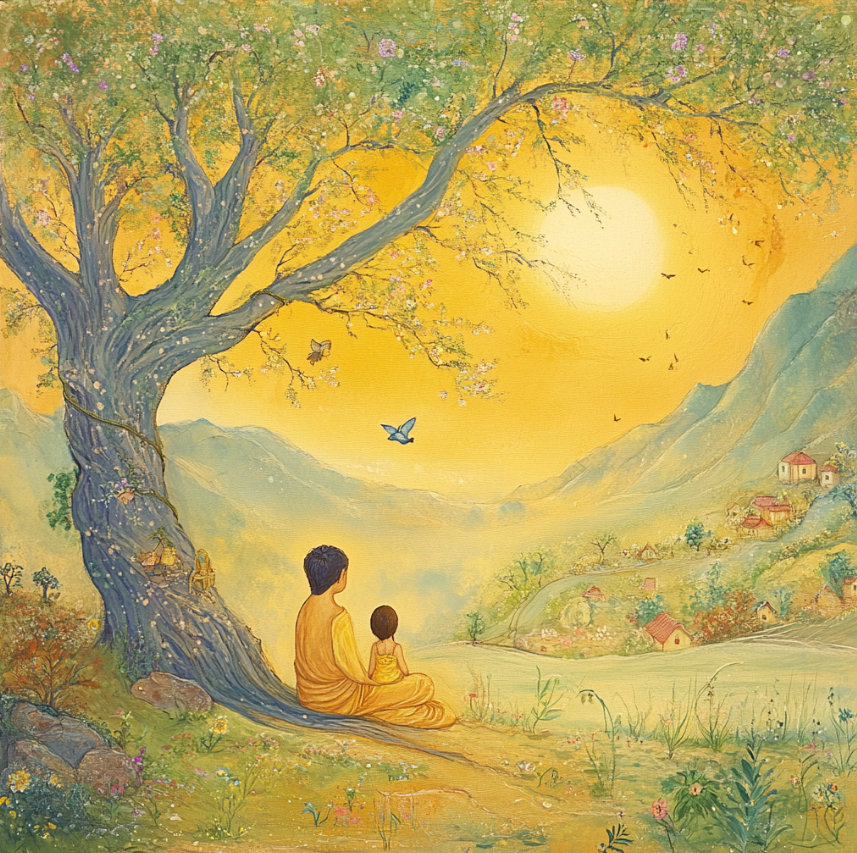
Once, in a quiet valley wrapped in mist and the soft song of birds, there lived a kind and gentle father named Orgyen. Every evening, as the sky turned golden and the stars began to peek through the night, Orgyen would sit with his daughter, Dawa, under the great Bodhi tree in their garden. It was their special time—when the world grew still, and Orgyen would share the deep wisdom he carried in his heart.
One evening, as Dawa snuggled close to her father, she looked up at him with curious eyes. “Papa, sometimes my mind feels like a storm, with too many thoughts flying around. How can I make it calm?”
Orgyen smiled, his voice soft as the wind rustling the leaves above them. “Ah, little Dawa,” he said, “inside each of us, beyond all the thoughts and feelings, there is something much deeper, much clearer—something we call the pristine mind. It’s like a vast, bright sky, untouched by any clouds. Even when there’s a storm in your mind, that clear sky is always there, waiting for you.”
Dawa’s eyes widened in wonder. “Is it really there, Papa? How do I find it?”
Orgyen gently placed his hand on her chest, over her heart. “Close your eyes, little one, and take a deep breath. Imagine the sky—so wide and open, where the clouds come and go, but the sky itself never changes. This is your mind, too. No matter what thoughts or feelings come, your pristine mind is always clear, like the blue sky.”
Dawa closed her eyes, her breath becoming soft and slow. In her mind’s eye, she saw the bright, boundless sky Orgyen spoke of, with only a few gentle clouds floating by.
“And now,” Orgyen whispered, “imagine a light, like the sun, shining from the very center of your heart. This light is pure, just like your pristine mind. Let it grow brighter, filling your whole body with its warmth and peace. This is the light of love, of kindness, of everything good. It’s always with you.”
Dawa smiled as she felt the light glowing inside her, warm and golden like the sun. “What happens when the clouds come back?” she asked softly, her voice barely more than a whisper.
Orgyen kissed her forehead. “Even when the clouds come, the sky remains clear, and the light never dims. You can always return to this peaceful place inside. Just breathe, and the clouds will drift away. Let the light of your pristine mind guide you.”
As the stars began to twinkle in the sky above them, Orgyen stood up, lifting Dawa gently in his arms. “Now, little one,” he said, “it’s time for you to rest. When you dream tonight, imagine yourself in the clear, bright light. Let your dreams be filled with love, kindness, and the warmth of your pristine mind.”
Dawa’s eyelids grew heavy as she rested her head on her father’s shoulder. “Will I see the light in my dreams, Papa?” she asked, her voice growing softer.
Orgyen smiled as he carried her inside and tucked her into bed. “Yes, my dear Dawa. When you close your eyes, you can dream of the clear light. You’ll drift through the skies, where there are no worries—only peace, kindness, and love. And when you wake, the light of your pristine mind will still be with you, just as bright.”
With a final kiss on her forehead, Orgyen whispered, “Sleep well, little one, and let your dreams be filled with the light of the pristine mind.”
And so, with her father’s gentle words in her heart, Dawa closed her eyes and drifted into sleep, feeling the warmth of the light within her. As she dreamed, she floated through a sky filled with clear light, kindness, and the soft glow of love—her pristine mind guiding her through every gentle dream.
🙏🕊️🙏
If you’d like to explore more bedtime stories for children, including tales that nurture compassion and mindfulness, you can find our collection here.












 Home Page: Inspirations of Love and Hope