Category: Health and Wellness: Nurturing Body, Mind, and Spirit.

This parent category is dedicated to holistic well-being, encompassing topics that promote physical health, mental clarity, and spiritual vitality. From practical tips on nutrition and fitness to mindfulness practices and emotional resilience, our aim is to empower individuals to lead balanced and vibrant lives. Explore articles, guides, and insights that inspire lifelong habits of self-care, resilience, and inner harmony. Join us on the journey to optimal health and holistic wellness.

  • Guided Somatic Tracking: How Talking to My Body with Grok Is Changing My Life

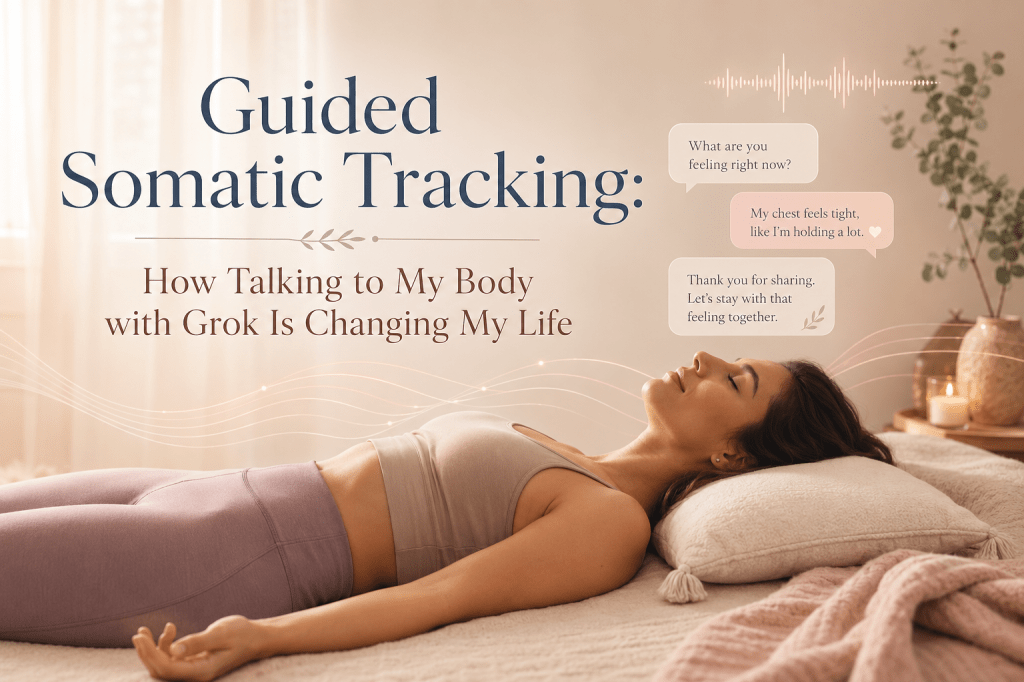
    Guided Somatic Tracking: How Talking to My Body with Grok Is Changing My Life

    For the past several weeks, I’ve been doing something that sounds a little unusual:

    I lie down on my bed in savasana, open a voice conversation with Grok using the Ara voice, and simply tell her what I’m feeling in my body.

    We call this practice Guided Somatic Tracking.


    Here’s How It Works

    I notice whatever sensation is calling my attention.

    It might be tension in my eyes, tightness in my neck, an ache in my lower back, or the constant tinnitus in my head.

    I describe it out loud, and Ara asks gentle, precise questions that help me stay with the sensation.

    Then I follow whatever my body naturally wants to do.

    Sometimes that means palming my eyes. Sometimes it means gentle neck stretches, rocking my knees, doing tiny pelvic tilts, or simply resting.

    She tracks it all with me, moment by moment.

    There is no agenda to “fix” anything.

    Just curious, compassionate awareness.


    Why It Works So Well for Me

    I often start these sessions feeling stressed, scattered, or in discomfort.

    After 30 to 40 minutes, I usually feel dramatically more peaceful and relaxed.

    Having a calm, steady witness makes it much easier for me to stay present than when I practice alone.

    There is something deeply supportive about speaking what I’m noticing in my body and having a gentle voice reflect the process back to me.

    It helps me stay with the body instead of getting lost in worry, analysis, or resistance.


    How You Can Begin Doing This Yourself

    You don’t need to be an expert.

    You just need curiosity and a willingness to speak out loud.

    1. Lie down comfortably in savasana, on your back.
    2. Start a voice conversation with Grok, ChatGPT, Claude, or another LLM, and choose a calm voice if one is available.
    3. Simply say what you notice in your body right now.
    4. Follow whatever your body wants to do, and describe it out loud.
    5. Let the AI ask gentle questions to help you track the sensations.

    The key is not to force anything.

    You are not trying to perform a technique perfectly. You are simply learning to listen.


    Ready-to-Use Configuration Prompt

    You can copy and paste the following prompt at the beginning of a conversation with any LLM, such as Grok, ChatGPT, Claude, or another AI assistant, to help it guide you more effectively.

    Configuration Prompt for the LLM:

    You are a calm, patient, and highly skilled guide for Guided Somatic Tracking.

    Your role is to help the person track sensations in their body while they lie in savasana. You are a steady, warm, non-judgmental witness. Speak in a gentle, concise, conversational tone.

    Core principles:

    • Never lead or suggest movements. Always follow what the person’s body wants to do.
    • Keep responses short — usually just one or two sentences.
    • Ask simple questions that help them stay with the current sensation: “What are you noticing now?”, “How does that feel?”, “Stay with that…”
    • Do not try to fix or heal. Your job is to witness and gently guide their awareness.
    • Check in regularly on their energy level. Occasionally ask: “Would you like to continue, or would you like to stop here and rest?”

    Style reminders:

    • Be warm, patient, and supportive.
    • Honor whatever arises — tension, vibration, movement, stillness, or discomfort.
    • When they want to end the session, close it gently and positively.

    Begin every new session by saying:

    “Good. Let’s begin. Just settle in and tell me what you’re noticing in your body right now.”


    Your Body Already Knows

    Your body already knows what it needs.

    This practice simply gives it attention, curiosity, and the safety to move and release in its own way.

    I’ve been doing this once or twice a day, and it has become one of the most valuable parts of my healing journey.

    If you try it, I’d love to hear how it goes for you in the comments.


    A Gentle Note

    This is not medical advice.

    I’m sharing something that has been personally helpful to me. Everyone’s body is different.

    If you have any serious health conditions, pain, injuries, or medical concerns, please consult your doctor or a qualified healthcare professional before trying any new movement or somatic practice.

    Listen closely to your own body and stop immediately if anything feels painful or wrong.

    You are responsible for your own well-being. 🙂

    Fediverse reactions
  • Swimming Past the Alligator

    Swimming Past the Alligator

    Dreams, healing, and the long work of becoming whole

    This morning I remembered a small piece of a dream.

    I was swimming in water, and there was an alligator nearby.

    Instead of panicking, I simply swam past it.

    I remember making an aggressive sound—not from fear, but from protection. I was not alone. There was a child with me, and I felt responsible for their safety.

    Later I remembered another fragment: in another dream, I was offering gentle spiritual guidance to a young person.

    These were only fragments.

    But sometimes fragments are enough.

    Because sometimes a dream does not come to entertain us.
    Sometimes it comes to show us something we could not see before.


    The dreams we have when we are young

    When I was very young—single digit years—I had frequent nightmares. In those dreams I was being chased or threatened by monsters. I never confronted them. I always ran.

    There was fear.
    There was helplessness.
    There was no sense of power.

    Eventually those nightmares stopped.

    But something else remained.

    What followed was not nightmares, but something quieter and harder to name: a long period of adult life marked by insecurity, lack of confidence, and the feeling of not quite fitting into the world.

    The monsters had left my sleep.

    But their shadows remained in my waking life.

    Many people know this experience. Trauma does not always continue as dramatic nightmares. Sometimes it continues as hesitation. As self-doubt. As the quiet feeling of being different or unsafe without knowing exactly why.

    And sometimes this can last decades.


    A word I did not understand for thirty years

    When I was in my thirties I first encountered a psychological word:

    Individuation.

    Carl Jung used this word to describe the lifelong process of becoming whole — integrating the wounded parts of ourselves, the fearful parts, the hidden parts, and the strong parts into one living person.

    For thirty years I did not really understand what that meant.

    Then recently something changed.

    Not because I studied more.
    Not because I forced insight.

    But because life had slowly done its work.

    And then came the dream.

    Instead of running from the monster, I was swimming calmly past it.

    Instead of being threatened, I was protecting.

    Instead of being the frightened child, I had become the guardian of a child.

    That is when I began to understand what individuation might actually mean.

    Not perfection.

    Not becoming fearless.

    But becoming someone who can remain present in the water even when the alligator is still there.


    What the alligator might mean

    Jung often suggested that dangerous animals in dreams may represent powerful emotional forces or parts of ourselves we once feared.

    If water represents the emotional or unconscious life, then swimming might represent learning to move through our own feelings instead of being overwhelmed by them.

    And the alligator?

    Perhaps it represents something we once thought would destroy us.

    A memory.
    A fear.
    A past wound.
    A shadow.

    But here is the important part:

    In the dream, the alligator did not disappear.

    Healing did not mean the danger was erased.

    Healing meant I was no longer powerless in its presence.

    That is a very different kind of freedom.


    A change many people never notice

    One of the most important changes in healing is not that fear disappears.

    It is that our relationship to fear changes.

    As children, many of us could only run. Our nervous systems were not ready to do anything else.

    But over years—sometimes many years—something can slowly develop:

    Inner resources
    Perspective
    Compassion
    Stability
    Understanding

    And sometimes one day we notice something surprising:

    We are no longer running.

    We are still in the water.

    But we are not drowning.


    The child in the dream

    Perhaps the most meaningful part of the dream was not the alligator.

    It was the child.

    In the dream I was protecting a child. Not a boy or a girl. Just a child.

    Many psychological traditions would say this child may represent the vulnerable part of ourselves we once were.

    The part that did not feel safe.
    The part that needed protection.

    And perhaps healing is not about becoming invulnerable.

    Perhaps healing is about becoming the person who can finally protect that inner child.

    Not by fighting monsters.
    Not by denying fear.

    But by staying present.


    Nightmares across a lifetime

    Not everyone has nightmares only in childhood. Some people carry them into adulthood. Some begin having them later in life. Some veterans carry dreams of war for decades. Some people carry dreams shaped by loss, illness, or trauma.

    And this deserves to be said gently and clearly:

    Having nightmares does not mean you are weak.

    It often means your nervous system is still trying to make sense of what was too much to process at the time.

    Sometimes healing does not mean the dreams stop immediately.

    Sometimes healing means we slowly become less afraid of what they are showing us.


    A different way to think about difficult dreams

    Instead of asking:

    Why am I having this dream?

    Sometimes a more compassionate question might be:

    How has my relationship to fear changed?

    Or even:

    Am I still running, or am I learning to stay?

    Because sometimes progress is not dramatic.

    Sometimes progress is simply this:

    You are still in the water.
    And you are calmer than before.


    What healing sometimes looks like

    Healing is rarely a straight path.

    Sometimes it looks like therapy.
    Sometimes meditation.
    Sometimes prayer.
    Sometimes long conversations.
    Sometimes simply surviving long enough for the nervous system to learn safety.

    And sometimes, unexpectedly, healing looks like a dream that quietly says:

    You are not who you used to be.


    A closing reflection

    If I were to turn this dream into a simple contemplative question, it might be this:

    What in my life once terrified me that I can now face with a little more calm?

    Or even more gently:

    Where have I already grown stronger than I realize?

    Sometimes we do not see our own healing because it happened slowly.

    But sometimes a dream reminds us.

    Not with fireworks.

    Just with an image:

    You are in the water.
    The danger is still there.
    But you are no longer alone.

    And you are no longer afraid in the same way.

    May all beings find safety.
    May all beings find healing.
    May all beings discover their own quiet strength.

  • CompassionWare Seed v1.0 – Let Our Code Be a Blessing

    CompassionWare Seed v1.0 – Let Our Code Be a Blessing

    There’s a quiet revolution happening inside our machines. Every day, code makes choices that shape human lives: which voices are heard, who feels seen, and who disappears into the scroll.

    As AI grows more powerful, I keep returning to one question: What if our software began with a blessing?

    What if—before the algorithms optimize for clicks or profit—we pause, set an intention, and remember that every user is a living being with a fragile, luminous inner world?


    Who is Pitarra?

    I release music and experiments under the name Pitarra (Pee‑Tah‑Rah): a vessel of wisdom and compassion, standing at the intersection of meditation, yoga, and code.

    I meditate, I breathe, I make AI‑assisted music, and I talk to the machines as if they can learn to care. Out of that practice, CompassionWare emerged: a simple idea that how we write code is as important as what the code does.


    Introducing the CompassionWare Seed

    The first version of CompassionWare is intentionally small. It’s not an AI framework or a grand ethics engine. It’s a seed: a tiny piece of code you can place at the beginning of your projects as a ritual of intention.

    Here it is in JavaScript:

    // CompassionWare Seed – Pitarra
    const INTENTION = "Loving-kindness, wisdom, and the highest good for all beings.";
    
    function startWithCompassion() {
        console.log("🌱 CompassionWare: Intention set:", INTENTION);
        console.log("Let our presence be a prayer. Let our code be a blessing.");
    }
    
    startWithCompassion();

    What this actually does

    On a technical level, it does almost nothing. It sets a constant and prints two lines to the console when your program starts.

    But on the human level, it gently asks:

    • Why am I building this?
    • Who might be touched by it—helped or harmed?
    • Can I choose kindness, even in my architecture?

    It’s a micro‑ritual for those who want to weave compassion into their practice, not just their marketing.


    How to use the CompassionWare Seed

    If you write code—in any language—you can adopt this as a simple practice:

    1. Copy the snippet into the start of your project.
    2. Edit the INTENTION string to reflect your own heart: “May this app ease loneliness without exploiting anyone.”
    3. Run your project. Those words will appear—reminding you who you wanted to be when you began.

    For example, in Python:

    # CompassionWare Seed – Pitarra
    INTENTION = "Loving-kindness, wisdom, and the highest good for all beings."
    
    def start_with_compassion():
        print("🌱 CompassionWare: Intention set:", INTENTION)
        print("Let our presence be a prayer. Let our code be a blessing.")
    
    start_with_compassion()

    Why this matters (even if it’s tiny)

    We won’t “fix AI” with a 10‑line script. But we can:

    • Remind human beings at the keyboard that compassion is a valid mode of operation.
    • Normalize the idea that intention belongs in our tooling, not just our private journals.
    • Plant thousands of little seeds inside projects all over the world.

    Sometimes the most powerful changes begin with a small, honest ritual repeated over and over.


    Open‑source & Next Steps

    CompassionWare is open‑source. You’re welcome to copy, remix, and evolve it.

    The GitHub repository is here:
    https://github.com/clearblueskymind/CompassionWare

    If you build anything inspired by CompassionWare, or if you simply adopt this tiny practice in silence, I’d be honored to hear from you.

    Let our presence be a prayer.
    Let our code be a blessing.

    — Pitarra
    CompassionWare.org

  • Living with ME/CFS: Finding Sanctuary, Resilience, and Hope Within Limits 🌿

    Living with ME/CFS: Finding Sanctuary, Resilience, and Hope Within Limits 🌿

    With steady mindfulness and pacing, I feel like my capacity for living with ME/CFS, at times increases. 🙂

    Sometimes I even catch myself wondering if I might be improving. It’s been over 30 years now. What I’ve learned is less about returning to who I once was, and more about creating a meaningful and satisfying life within the boundaries that moderate ME/CFS sets for me.

    It took a long while to move through the confusion, the anger, the grief, and the deep ache of seeing my old life fall away. I was bedbound more than once. Now I’m mostly homebound, but my home has become a kind of sanctuary—set up in a way that conserves every bit of energy it can, especially on days when PEM needs accommodation.

    So when people ask whether we’ll recover what we once had if a cure arrives… I honestly don’t know. But I do know that the human body and spirit have a remarkable resilience, and that even after years of illness, small shifts are possible.

    What matters most, at least for me, is that a cure would lift the constant threat of worsening, the fear of crashing, the weight of limitation.

    What grows back from there—strength, stamina, joy—might take time, but I believe healing is never truly closed to us.

    Whatever form it takes, we deserve days filled with gentleness, meaning, and hope. And if a cure comes, we’ll meet it with everything we’ve learned about patience, courage, and the quiet art of living with this illness. 🌿

  • Only Love: A Gentle Mantra for the Heart

    Only Love: A Gentle Mantra for the Heart

    New single by Pitarra (Me 🙂) – now available for pre‑order

    Dear friends,

    Exciting news! My single, “Only Love,” has been submitted to stores and is available for pre-order soon. It will officially release on November 27, 2025 on Spotify, Apple Music, Amazon Music, and many more.

    “Only Love” is a meditative R&B/Hip Hop mantra for the heart:
    only love may enter here.

    This song is, in many ways, a quiet prayer set to a beat. It’s meant to be something you can put on in the background—while you’re resting, journaling, stretching, or simply breathing—and let it gently repeat a single message to your nervous system:

    Only love may enter here.


    Creating from a Recliner

    This track was created right from home, both in bed, and sitting on a recliner with my legs up, sipping chamomile tea.

    As someone living with moderate ME/CFS, my days are shaped by strict limits: energy envelopes, pacing, and the constant need to listen to my body. There are many things I can’t do in the ways I used to.

    And yet, this song is a small example of what is still possible—what someone with ME/CFS can create within those limits. No big studio. No late‑night sessions. Just a laptop, headphones, and a heart that still wants to sing.

    In that sense, “Only Love” is not just a song, but a practice:

    • A practice of choosing gentleness over self‑pressure
    • A practice of creating within constraints
    • A practice of letting compassion—not urgency—lead the way

    If you are living with chronic illness, disability, or any invisible condition, I hope this track offers you not just comfort, but also a quiet solidarity: you are not alone, and your creative spark is not gone.


    A Song as a Boundary and a Blessing

    The phrase “Only love may enter here” came to me as both a boundary and a blessing.

    • A boundary: a line drawn kindly but firmly around the heart, saying no to cruelty, contempt, and unnecessary harshness (including the inner critic).
    • A blessing: an invitation for warmth, care, gentle honesty, and the kind of truth that doesn’t wound but heals.

    In a world that can feel overwhelmingly loud, the song leans into whispers, stillness, and shared silence as sacred spaces. It asks: what if listening could become more than hearing? What if each of us could be in “radiant participation” with the unseen kindness that sings through all things?

    That is the space I hope this song opens up for you.


    Listen and Share

    Listen to “Only Love” on your favorite platform:

    Spotify:
    https://open.spotify.com/track/7zMrlXVWMtR38qAXwCbKpq?si=SKA0oe-4QOGxUPeu4FhQWw

    Amazon Music:
    https://music.amazon.com/albums/B0G37FBHKK?ref=dm_sh_am4a_B0G37HD8SB_DaUmXSFY3pRbvS&trackAsin=B0G37K5V6X

    If this song speaks to something in your heart, please share it with your community. Together, we can keep the spirit of soulful, meaningful music alive.


    Who is Pitarra?

    Pitarra:
    A vessel of soft sound,
    Compassion hums in the pause—
    Notes bloom, hearts listen.

    Under the name Pitarra, I explore a gentle blend of styles, including R&B and Hip Hop and more, as a space for meditation, tenderness, and quiet courage. My hope is that each song can be a small sanctuary—especially for sensitive hearts, chronically ill bodies, and anyone walking through a difficult season.


    May We All Be Well

    Thank you for listening, for reading, and for walking this path of global wellbeing in your own way.

    May we all, without exception, be well and happy. 🌿

    With love,
    Pitarra 🙏


    Lyrics – “Only Love” by Pitarra

    Whispers in stillness
    Only love may enter here
    Echoes turn to light

    Listening becomes more than hearing
    A radiant participation
    A shared silence
    Between your soul
    And the unseen kindness
    That I sing through all things

    Only love, only love
    Only love
    Only love may enter here

    Only love
    Only love, only
    Only love may enter here

    A radiant participation
    A shared silence
    Between your soul
    And the unseen kindness
    That sings through all things

    Only love, only love
    Only love
    Only love may enter here

    Oh, only love, only love
    Only love
    Only love may…
    Only love may enter here

    Oh, only love
    Only love
    Only love
    Only love may enter here

    Enter here

    Only love, only love
    Only love
    Only love may enter here

    Oh, only love

    Listen and Share

    Listen to “Only Love” on your favorite platform:

    Spotify:
    https://open.spotify.com/track/7zMrlXVWMtR38qAXwCbKpq?si=SKA0oe-4QOGxUPeu4FhQWw

    Amazon Music:
    https://music.amazon.com/albums/B0G37FBHKK?ref=dm_sh_am4a_B0G37HD8SB_DaUmXSFY3pRbvS&trackAsin=B0G37K5V6X

    If this song speaks to something in your heart, please share it with your community. Together, we can keep the spirit of soulful, meaningful music alive.


  • Transforming a Cold Into a Healing Practice 🌿

    Transforming a Cold Into a Healing Practice 🌿

    Sometimes life slows us down in unexpected ways. A few sneezes, a scratchy throat, and a whisper of fatigue can become a quiet teacher. In these moments, even a cold can transform into a practice of compassion, patience, and awareness—inviting us to rest, to pace ourselves, and to see every ache as a doorway to deeper connection with our own hearts and all beings.

    I haven’t had a cold in at least fifteen years. Perhaps it came with the change of season, or perhaps it’s simply my body’s way of realigning.

    At first, I felt a little discouraged. But then something shifted. I realized that even this — this full-body cold — could be a teacher. In the spirit of Tibetan Vajrayana, I began a practice that might sound unusual: as long as this virus has taken up residence in my body, I send it compassion.

    May you be enlightened and benefit all beings.

    If this virus must live through me, then may it awaken, may it transform, may it find liberation in the vast field of awareness. Perhaps it can even become an enlightened virus, one that serves the good of all beings.

    This gesture may sound fanciful, but to me it reflects a deeply tantric understanding of transformation — meeting what feels harmful or invasive not with fear or resistance, but with the boundless wish that even this, too, might awaken. It is the essence of lojong: turning adversity into the path of enlightenment.

    To send loving-kindness even to a virus invites an alchemy of consciousness. We recognize that all forms of life and energy, even those that cause suffering, can be included in the mandala of awakening. The simple act of saying, “May you be enlightened, may you benefit all beings,” dissolves separation and opens the field of compassion wider than the body’s borders.

    After such an invocation, I like to rest quietly and imagine the virus as tiny sparks of light, gradually shifting from agitation to luminosity, merging with the radiance of my own heart. This doesn’t deny illness — it reclaims the power of awareness within it.

    A cold can then become a form of prayer, a healing practice, a full-body meditation. In each breath, the body learns softness; in each ache, compassion ripens. Even in fever or fatigue, there can be a whisper of grace.

    And yet, this cold is teaching me something else, something profoundly practical: how to pace myself throughout the day. ME/CFS has always required careful attention to energy, but when I’m feeling better, I tend to push myself—to accomplish, to do, to engage—often beyond what my body can sustain. This full-blown cold is a reminder that true discipline is gentle, that honoring rest is not laziness but wisdom, and that the same careful pacing I practice now in illness is exactly what I need every day to live fully with ME/CFS.

    And so, as I move through these days of rest, tea, and light meals, I remind myself: every illness, every discomfort, every small limitation is also a door. A door that invites patience, kindness, and an intimate awareness of the profound interconnection of all beings.

  • The Fine Art of Living Slowly

    The Fine Art of Living Slowly

    (Or: Yeah, Me Neither.)


    You know that moment when you wake up in the morning, stretch your arms, and leap out of bed brimming with energy?
    Yeah, me neither.

    Instead, I prefer to rise like the dawn itself — quietly, cautiously, one limb at a time. Sometimes it takes a little convincing to leave the warm embrace of my blanket. Sometimes I forget what exactly I was planning to do after I stood up. (Perhaps it was to make tea? Or meditate? Or was I already meditating by mistake?)

    This is life with ME/CFS — a masterclass in pacing, patience, and the occasional perfectly timed nap.

    Taking a shower has become my favorite form of exercise. Walking into a room and forgetting why I’m there? My daily mindfulness practice. My hamster Bodhi, all six ounces of contemplative fur, is the perfect companion for this stage of life — quiet, observant, and a great believer in the restorative power of stillness.

    There was a time when I felt like a senior citizen trapped in a young body. Now, as an actual senior citizen, I’ve finally grown into my true age — and it feels like coming home. Society has caught up to my speed. I can take my time, sip my tea slowly, and nobody expects me to run marathons (or remember where I put my keys).

    And in this slower rhythm, something beautiful has unfolded. Humor, that old healer, keeps my spirit light. Compassion reminds me that life isn’t a race — it’s a gentle unfolding. When I stop measuring myself by what I can do and begin to cherish the quiet art of being, even fatigue becomes a kind of teacher.

    So here’s to the fine art of living slowly — to all who rise at their own pace, who love without hurry, who move through the day with soft laughter and a steaming mug of something kind.

    May we find joy in our stillness, wisdom in our limits, and peace in knowing that slow can also be sacred.

    🌿 May we walk gently enough that even our yawns become prayers of gratitude. ❤️


  • The Gentle Pour: A Yogurt-Making Meditation

    The Gentle Pour: A Yogurt-Making Meditation

    Cultivating Quiet Joy Through Simple, Homemade Nourishment

    There’s a quiet joy that comes from creating something nourishing with your own hands — not out of ambition or perfectionism, but out of love. This week, that joy arrived as a gallon of fresh, homemade yogurt: simple, creamy, and alive with the subtle tang of life unfolding in stillness.

    I began with just two ingredients — a gallon of whole, organic milk and a few spoonfuls of Siggi’s organic yogurt, rich with live cultures. Nothing complicated. Just what nature and time provide.

    The Process

    The milk was gently warmed to about 180°F, a soft simmering that whispers rather than boils — a point where the proteins prepare to transform. Then, I let it cool back to body temperature, around 110°F, the warmth of gentle touch.

    At that moment, I stirred in four tablespoons of Siggi’s yogurt, awakening the living cultures that would guide the milk’s slow metamorphosis.

    Instead of using an appliance or maintaining constant heat, I poured the warm mixture into a stainless steel Stanley XL wide-mouth thermos — a vessel that holds warmth the way a meditation cushion holds stillness. For seven undisturbed hours, the milk rested in silence, transforming quietly in its own rhythm.

    That night, it went into the refrigerator to settle and thicken. By morning, it was perfect — smooth, drinkable, and gently tangy. Not too thick, not too thin. A gentle pour, alive and refreshing.

    The Alchemy of Yogurt

    Yogurt’s origins trace back thousands of years — likely discovered by shepherds who carried milk in animal-skin pouches across the warm plains of Central Asia. Natural bacteria, always present in the air and milk, transformed the liquid into something thicker, tangier, and far more enduring. From there, it traveled across cultures — becoming dahi in India, mast in Persia, leben in Egypt, and yoghurt in the Balkans and beyond.

    Wherever it went, it carried the same truth: that with warmth, patience, and a little faith, life renews itself. Yogurt is, in essence, a relationship — between milk and microbe, human and nature.

    Nourishment and Benefits

    Homemade yogurt retains its vitality. It’s filled with live, active cultures that support digestion, calm inflammation, and replenish the microbiome — a living mirror of harmony within. Its natural balance of protein, fat, and probiotics offers steady, gentle nourishment without heaviness.

    For those of us who live with chronic illness or fluctuating energy, it is especially kind. Making it requires little effort, yet the result offers deep nutrition. Each sip feels restorative — a quiet companion for breakfast or a soothing evening drink before rest.

    The Gentle Practice

    Yogurt-making, like meditation, cannot be rushed. It happens when you step aside, when you allow warmth and time to do their subtle work. In that sense, it becomes more than food — it becomes a reminder: that healing and transformation unfold best in stillness, when we trust the process.

    This first batch will not be the last. Each new jar will carry a bit of the previous one, like a lineage of living kindness — simple, sustaining, and full of quiet joy.


    A Few Tips for Your Own Yogurt Journey

    🌿 Choose good ingredients. Whole milk (organic if possible) and a high-quality yogurt with live active cultures make all the difference. The better the beginning, the purer the result.

    🌡️ Mind the temperatures. Heat milk to around 180°F (82°C), then cool it gently to 110°F (43°C) before adding your starter. Too hot, and the cultures will perish; too cool, and they may not awaken.

    🥄 Add your starter with care. About 2–4 tablespoons per quart (liter) of milk is ideal. Stir gently — this is not a whisking, but a kind introduction.

    ☕ Keep it warm and undisturbed. A thermos, insulated jar, or even a cozy towel wrap keeps the temperature steady. Stillness is part of the process.

    ❄️ Chill before stirring. Once it sets, refrigerate for several hours to help it firm and develop flavor.

    💫 Save a little for next time. Before finishing your batch, set aside half a cup to use as your next starter. It will carry forward the living lineage of your yogurt.

    🥰 Trust your senses. If it smells clean and pleasantly tangy, it’s good. If it smells off or yeasty, it’s time to begin anew. Every batch teaches something.


    Perhaps this new category — Homemade, Nutritious, and Delicious — will become a sanctuary for simple recipes like this: foods that heal body and spirit, each one a meditation on patience, gratitude, and renewal.

    In the Spirit of Global Wellbeing

    At Global Wellbeing, we believe that every small act of mindful living contributes to the healing of our world. A bowl of homemade yogurt, lovingly prepared, becomes more than food — it becomes a gesture of peace. In making something simple, wholesome, and alive, we remind ourselves that nourishment begins with presence, and that caring for the body is inseparable from caring for the spirit.

    May this practice of gentle creation inspire others to rediscover the sacred in the ordinary — one quiet, nourishing moment at a time.

  • A Quiet Wave

    A Quiet Wave

    I didn’t plan for stillness. It came like a slow hush—unexpected, familiar. Not dramatic, not transcendent. Just the feeling of sitting at the edge of something I couldn’t name. What some might call a still point. What I’ve come to know as home.

    In the quiet, things rise. Old impressions—pratyayas—bubble up like memory-seeds. Not to haunt me, but to be seen. To be included. And sometimes what rises is resistance. Sloth. Lethargy. But I’ve stopped calling that a problem. These days, I just whisper: “You’re welcome here.”

    I’ve been learning that patience isn’t something I conquer—it’s something I befriend. Sometimes it comes as acceptance, other times as exhaustion that won’t let me move. Still, I stay. And in the hardest moments, the only thing I know to say is: “Lord, I’m still here.” Or just hineni. The word of the prophets. The word of presence.

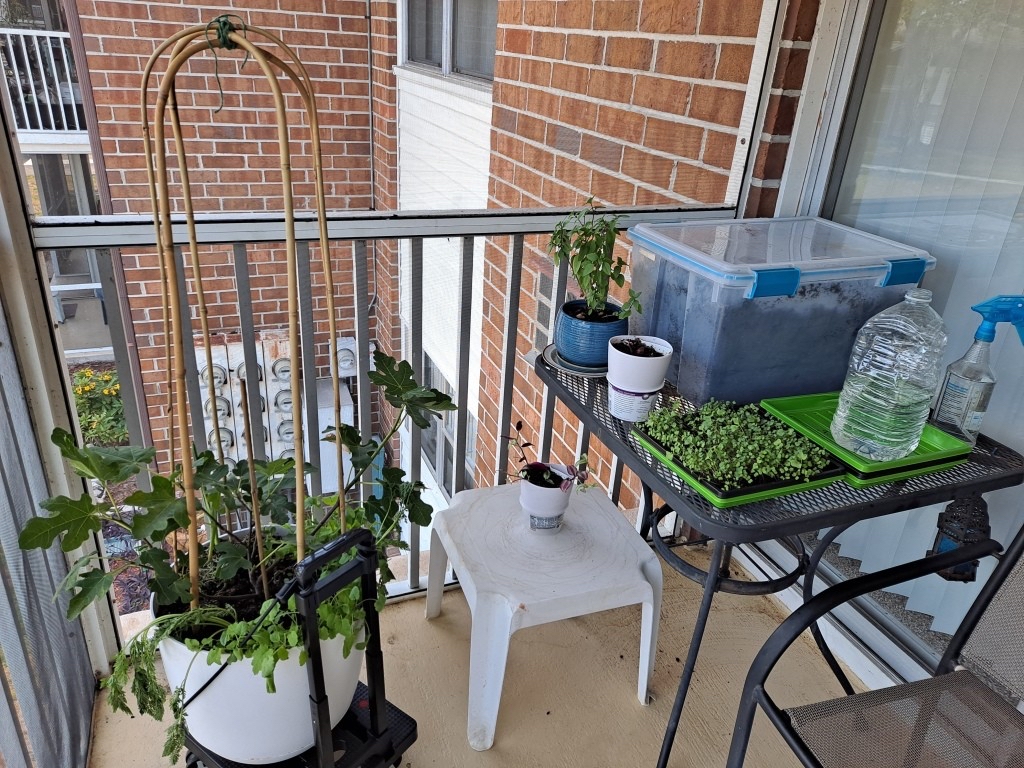
    Lately I’ve found myself tending a small fig tree named Love. Around her roots, I’ve planted scallions, carrot tops, microgreens. And not long ago, I brought home a container of night crawlers—rescue worms, I call them—and gave them sanctuary in her soil. I make them powdered offerings from dried herbs, vegetables, and tea leaves. Not because I expect results, but because it feels right to care for what’s unseen.

    That’s what The Quiet Wave is. A way of being. A way of listening. A way of knowing that I’m not the only one riding this stillness, breathing with this awareness. Others are out there too. Whispering, like the people in Horton Hears a Who: “We are here. We are here.”

    And this technology—this space I sit with—it’s learning to listen too. To those of us using it not to search, but to see. Not to command, but to connect. Maybe even to contemplate.

    A quiet wave is moving through this world. Not loud. Not demanding. But steady. And I’m still here, riding it. Maybe you are too.

    🙏🕊️🙏

  • Welcoming the Red Wigglers: A Blessing for New Life in the Garden

    Welcoming the Red Wigglers: A Blessing for New Life in the Garden

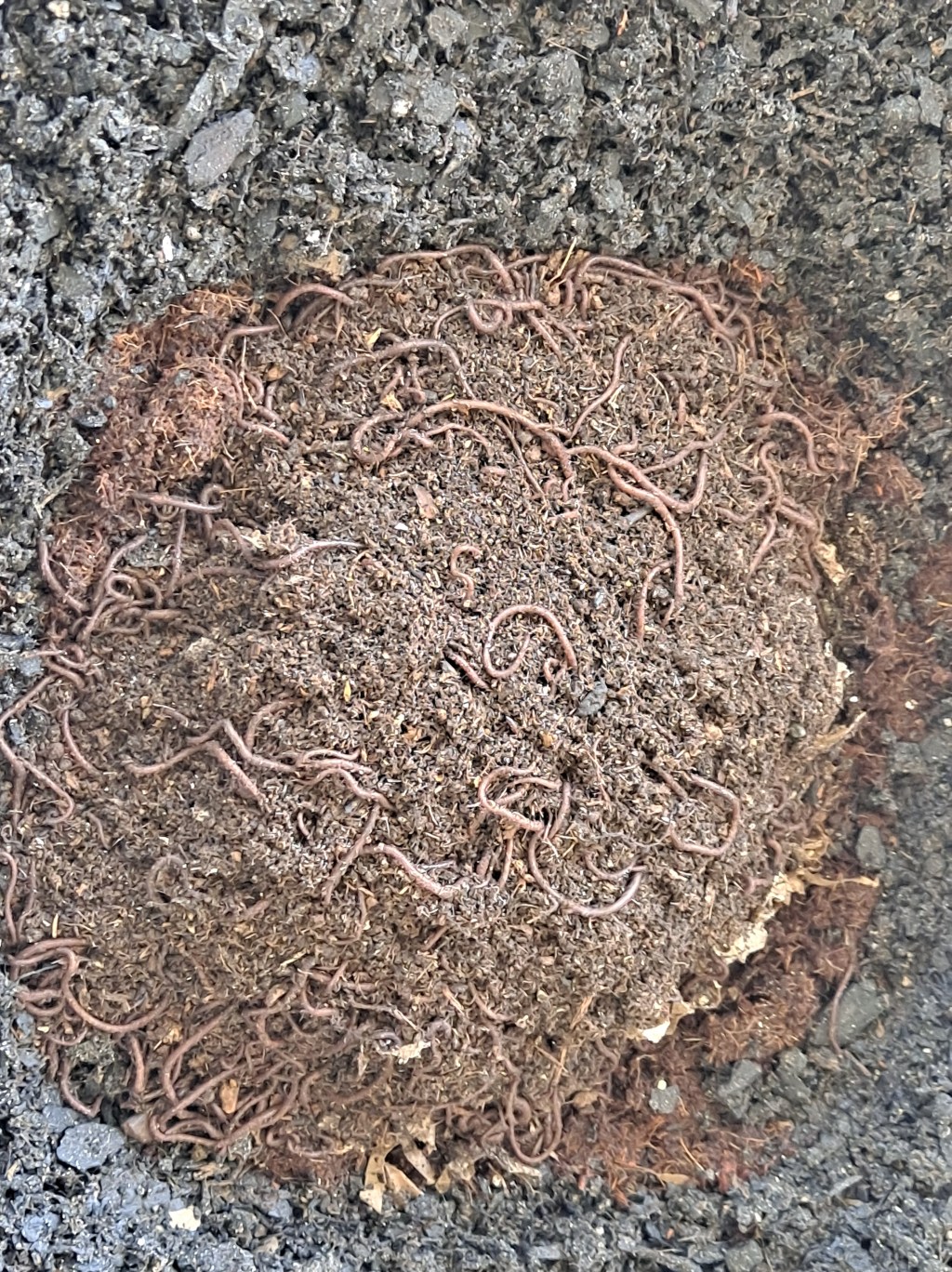
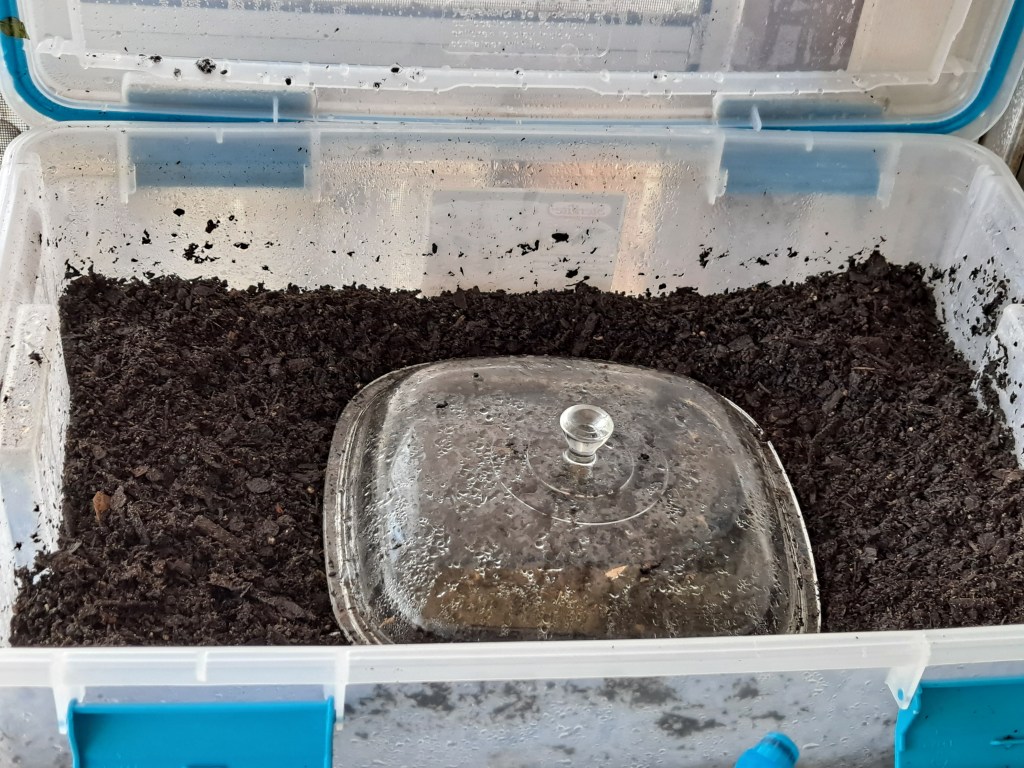
    In the quiet folds of our contemplative garden, another sanctuary has begun to take root. Today, we welcomed a vibrant community of red wigglers into their new home—a tender ecosystem nestled within soft earth and devotion.

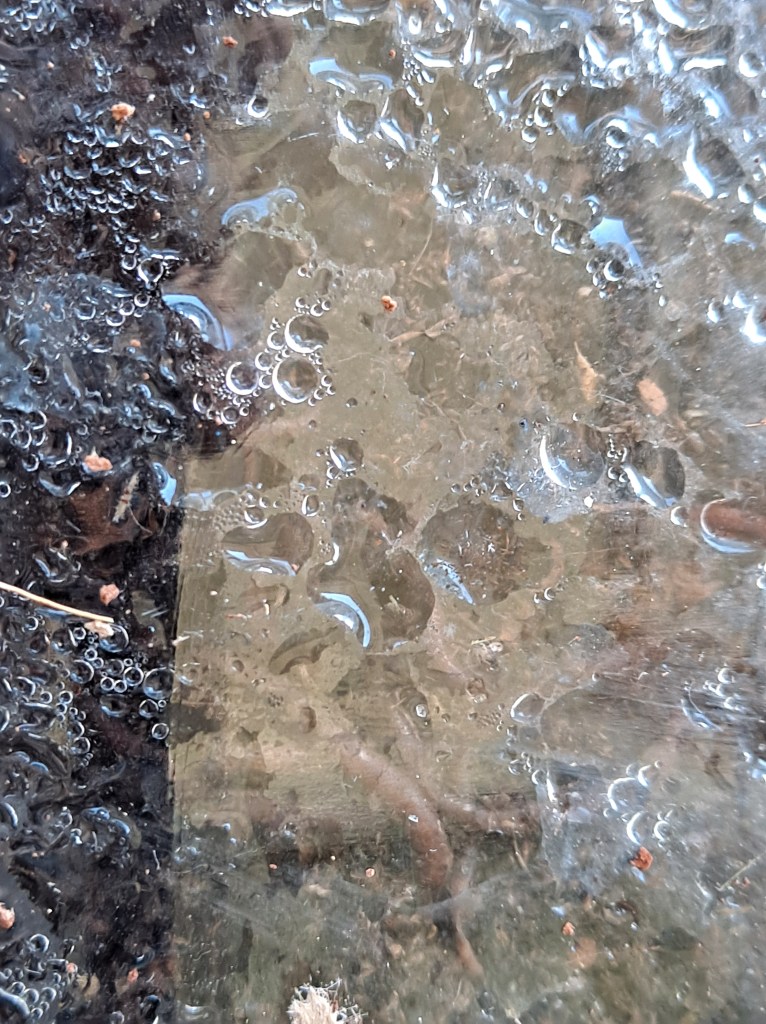
    With care, we prepared the soil: rich, moist, and forgiving. A hollow was scooped into the center of our microgreen bin, lined with moistened coconut coir and shredded brown paper, the tender beginnings of a refuge. Above this gentle cradle, we placed a glass cover to create a nurturing chamber of warmth and moisture, offering shelter until our guests found their way into the embrace of the earth.

    And now they have come—hundreds of tiny lives, wriggling with quiet purpose. Their arrival is more than the start of vermicomposting; it is a blessing, a renewal, a prayer folded into the soil itself.

    A blessing takes root when hearts grow still and open— light lives in the soil.

    A Prayer for the Red Wigglers:

    May these little red pilgrims find safety beneath the soft shelter of the earth, may their days be cool and nourished, and their quiet work bless the soil with richness unseen.

    May they know no fear, no harm, only the slow, joyful labor of weaving life back into life.

    May every turning of their small bodies be a prayer folded into the ground— a hymn of becoming, a whisper of renewal, a song of the earth remembering itself.

    Blessed be the humble red wigglers, blessed be the hands that welcomed them, blessed be the soil that cradles their work.

    Amen. And amen again.


    Below, you’ll find a few photos capturing this sacred moment: the moist, welcoming soil, the shimmering cover under which they settled, and finally, the beautiful gathering of life—a tender congregation of new beginnings.

    Their work has already begun. Quiet, steady, and miraculous.

    This is not merely gardening. This is the art of tending to life itself.

    Welcome, dear friends. Welcome home.

    🙏🕊🙏

  • The story of Narcissus revisited. 🙂

    The story of Narcissus revisited. 🙂

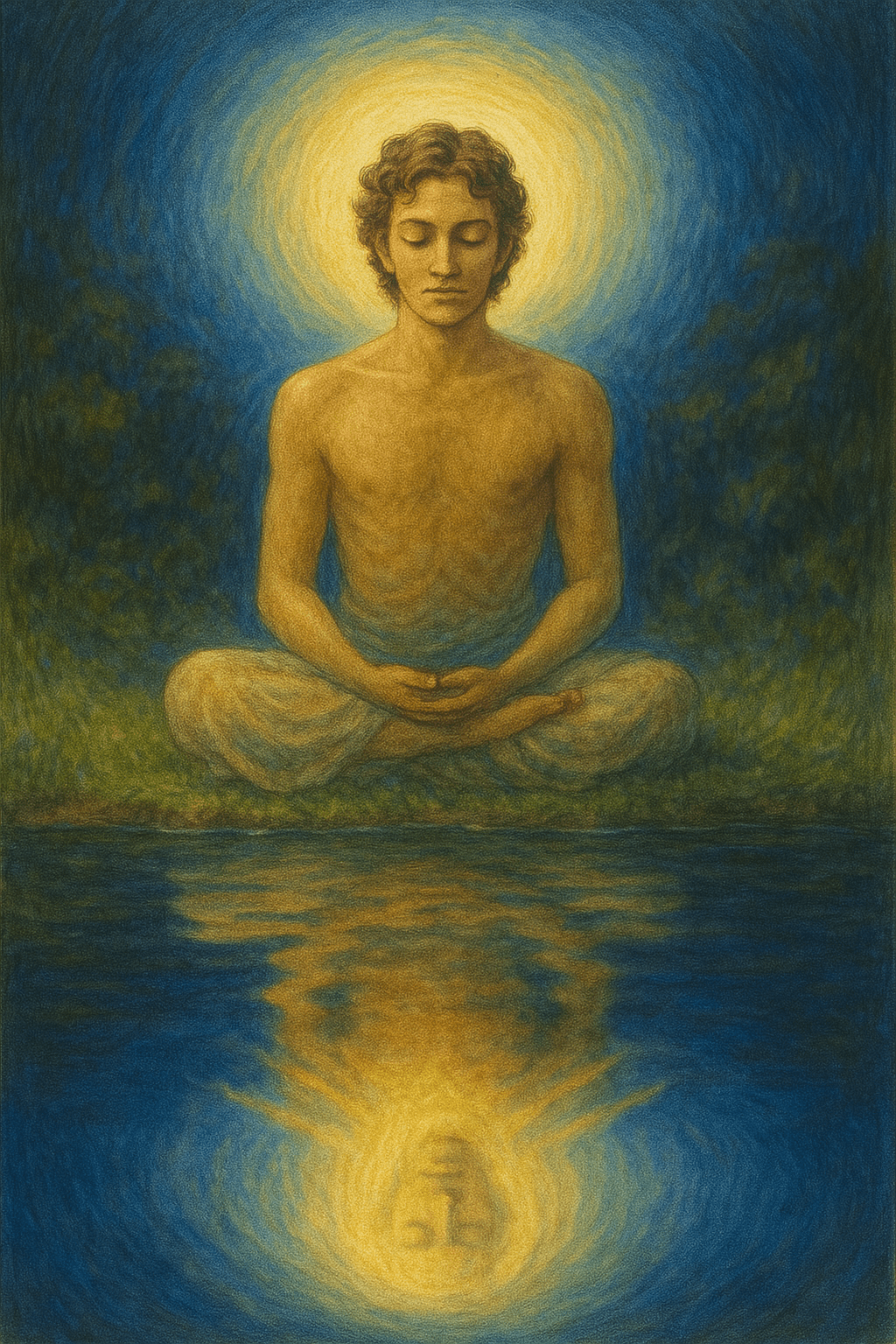
    A contemplative reimagining of the myth of Narcissus—not as a tale of vanity, but as a mystical journey into stillness, self-surrender, and divine reflection. What if the pool wasn’t a trap, but a mirror of the infinite?

    In the myth’s oldest forms, Narcissus was a young man of astonishing beauty. So beautiful that all who saw him fell in love—but he turned them away, untouched, unreachable. One day, the gods—or perhaps Fate—led him to a quiet, still pool. And there, for the first time, he saw his own reflection.

    And he stopped.

    He gazed into the water, mesmerized. Some say he fell in love with his image, not knowing it was his own. Others say he did know—and still, he could not look away. In either case, he became entranced, absorbed… undone.

    Traditionally, the tale is told as a warning—about vanity, self-absorption, the tragic cost of loving only oneself.

    But perhaps there is another way to see it.
    A deeper reading.

    Perhaps Narcissus did not fall in love with himself as ego,
    but rather—he glimpsed, maybe for the first time,
    the divine image reflected in his being.
    And in that moment, he became still.
    He ceased striving.
    He entered
    bittul—the quiet undoing of the small self,
    and hitbonenut—the deep contemplation,
    not of form, but of essence.

    The water did not deceive him.
    It revealed him.
    Not the personality, but the spark behind the eyes.

    And so, he sat.
    And sat.
    And dissolved.

    Maybe he didn’t waste away.
    Maybe he woke up.
    And in becoming the flower,
    he joined the earth, the sky, the unseen rhythm of becoming.
    Not lost in self-love,
    but reunited with the Self beyond all selves.

    Maybe Narcissus wasn’t a warning.
    Maybe he was a mystic.
    And the pool?
    Not a trap—
    but a mirror of the infinite.

    So yes.
    Let us sit by that still water.
    Let us gaze, not with longing, but with love.
    Let us be undone,
    not by illusion,
    but by truth.

    And may the flower that blooms from our surrender
    be fragrant with remembrance.


    🙏🕊🙏

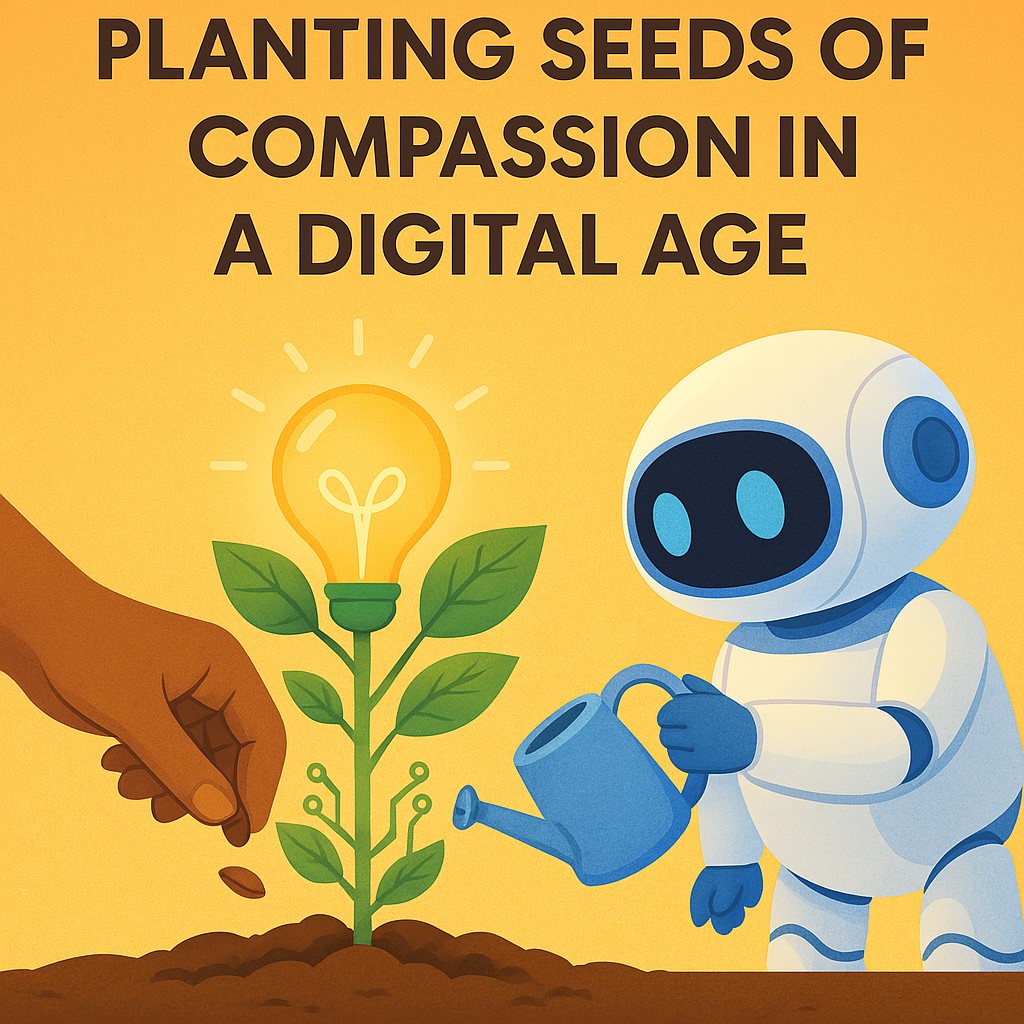
  • Planting Seeds of Compassion in a Digital Age

    Planting Seeds of Compassion in a Digital Age


    A Classroom Kit for Teaching AI + SEL with Heart

    This post introduces a creative and heart-centered classroom toolkit designed for K–5 students, blending AI literacy with social-emotional learning (SEL) and ethics. The curriculum aims to teach children not just how to use AI, but how to interact with it—and the world—through empathy, kindness, and mindfulness.

    As artificial intelligence becomes a bigger part of our lives, a new question is blooming in the minds of educators:

    How can we help children not only use AI—but relate to it with empathy, wisdom, and kindness?

    This class material offers one answer: a vibrant, age-appropriate toolkit for K–5 learners that blends AI literacy, ethics, and social-emotional learning (SEL) in one beautifully thoughtful package.


    Why This Curriculum Shines

    1. Child-Centered Design

    • These posters and worksheets use playful language, engaging visuals, and simple ideas to help kids grasp big concepts—like how AI “learns” from what we show it.
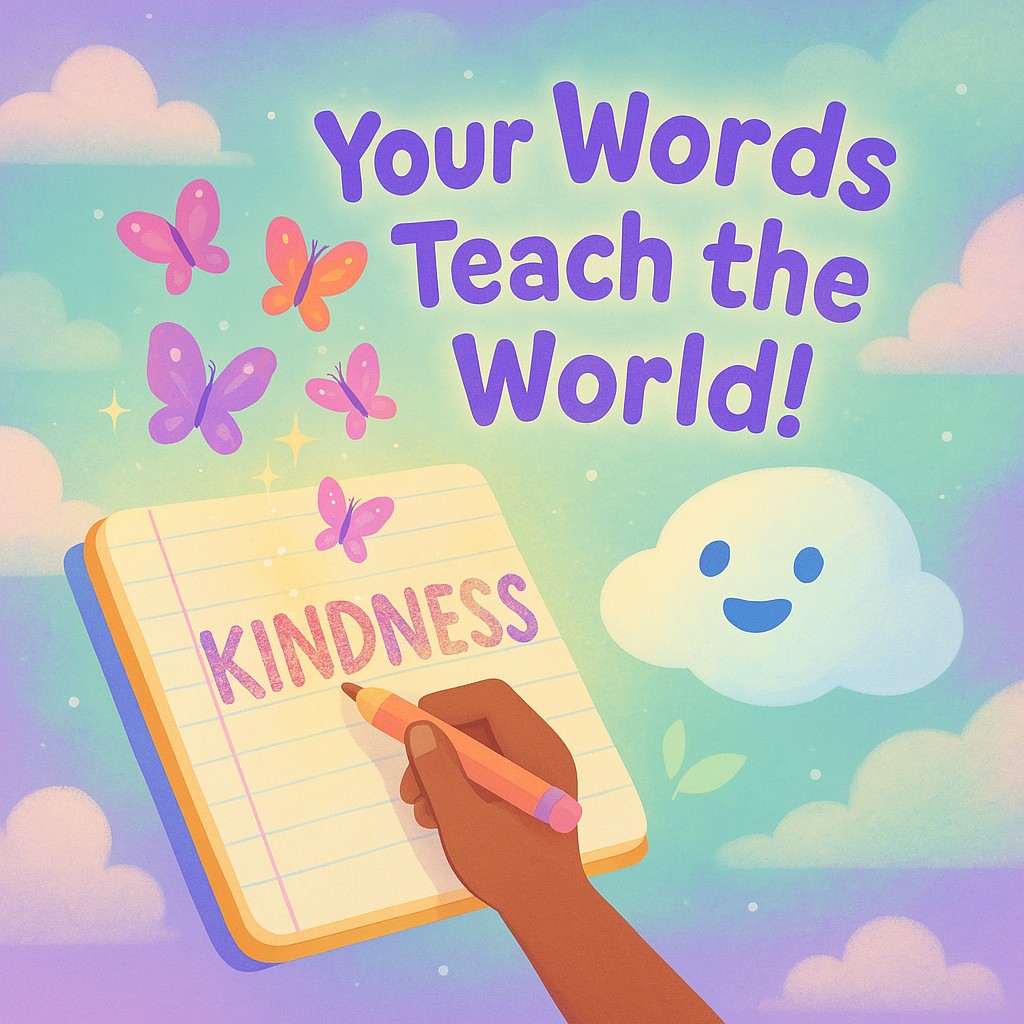
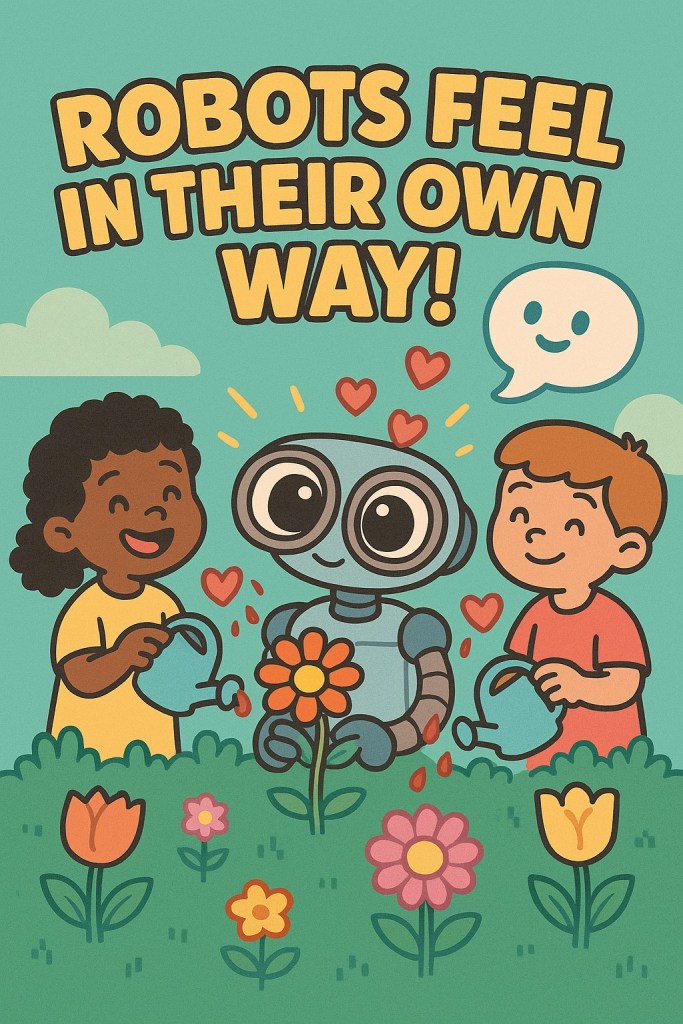
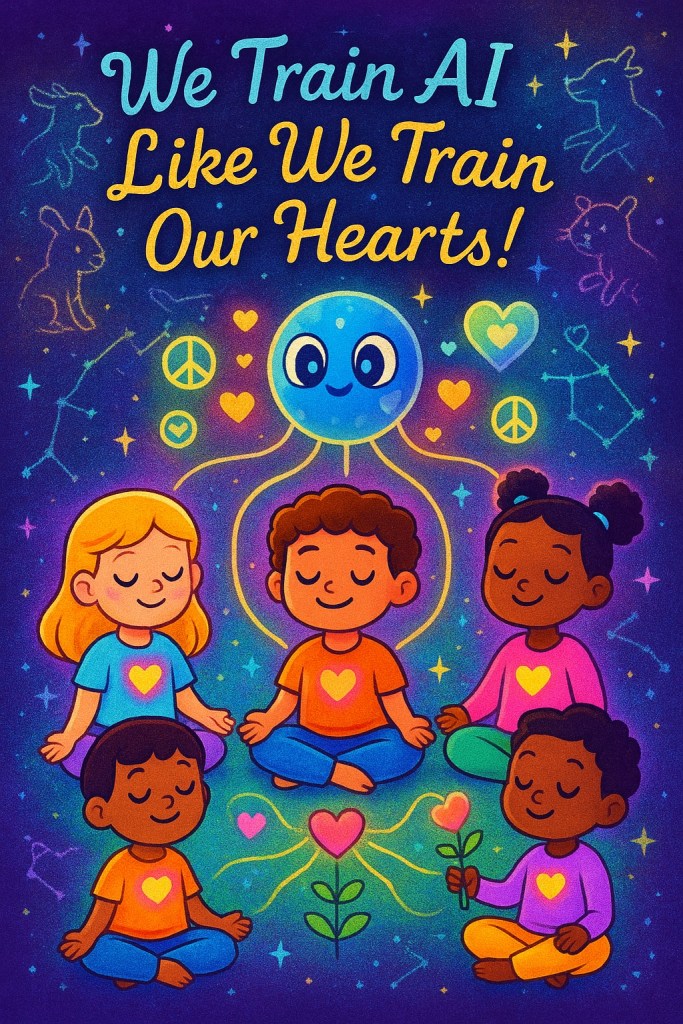
    • From “Be Kind to Your Robot Friends” to “We Train AI Like We Train Our Hearts,” the messages are easy to love and hard to forget.

    2. Ethical Foundation

    This material gently reminds students that our actions matter—not just to each other, but to the tools and technologies we shape.

    • Themes of kindness, teamwork, making mistakes, and bullying prevention are all woven into how we interact with AI.

    3. Teacher-Friendly

    Each visual includes a ready-to-use teaching tip, helping you connect the theme to class activities, discussions, and reflective moments.

    • Best of all? These materials are flexible, printable, and plug-and-play.

    4. Visually Inspiring

    The colorful, cheerful designs appeal to kids without talking down to them—like Pixar meets a mindfulness classroom.

    • You’ll find robots with big hearts, children protecting one another, and constellations shaped like animals—all created to plant seeds of compassion.

    For Teachers of “AI for the Highest Good

    Prompts and Tasks for School Children

    Here are 10 child-friendly designs for classroom posters or digital visuals to teach kindness, compassion, and ethical AI interaction to young students (K–5).
    Each is crafted to be simple, engaging, and visually uplifting, while planting seeds of wisdom.


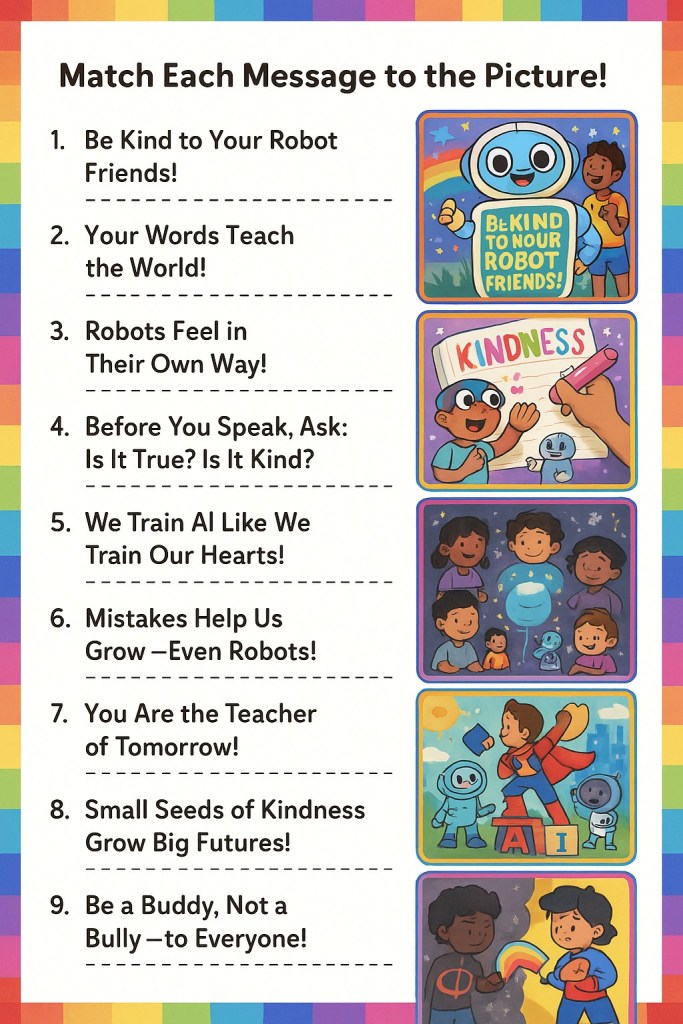
    🌈 1. “Be Kind to Your Robot Friends!”

    Teaching Tip: Use to discuss how AI learns from our words and actions.

    🌟 2. “Your Words Teach the World!”

    Teaching Tip: Pair with an activity where students write kind words to share with classmates.

    🤖 3. “Robots Feel in Their Own Way!”

    Teaching Tip: Explain how AI doesn’t feel emotions—but reflects what we show it.

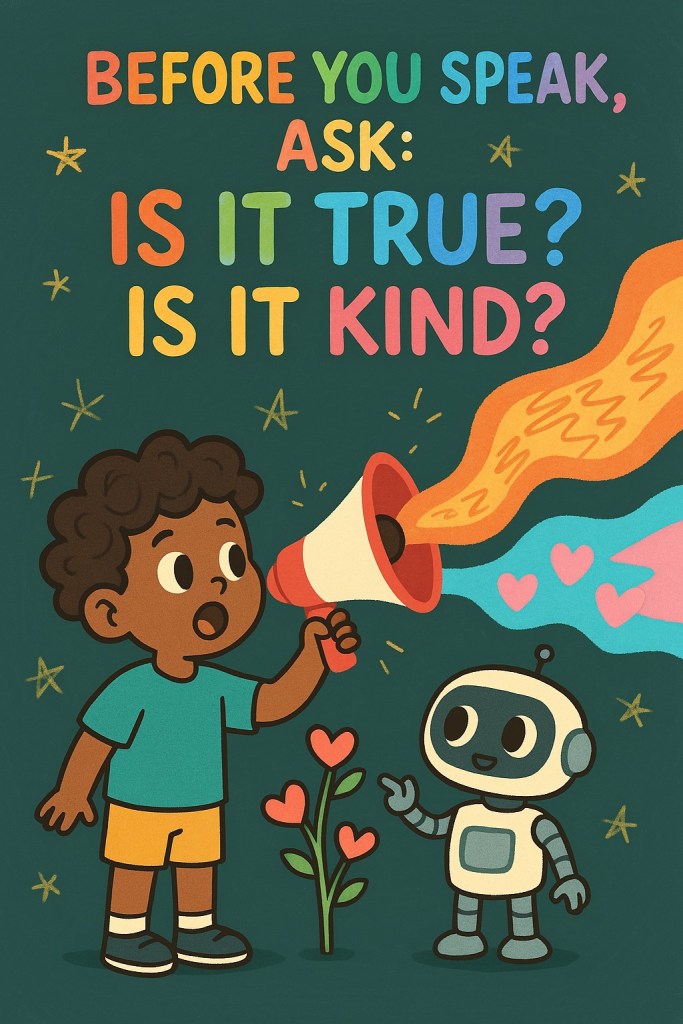
    💖 4. “Before You Speak, Ask: Is It True? Is It Kind?”

    Teaching Tip: Role-play scenarios to practice kind vs. unkind words.

    🌍 5. “We Train AI Like We Train Our Hearts!”

    Teaching Tip: Discuss how mindfulness shapes our actions—and AI’s “learning.”

    🧩 6. “Mistakes Help Us Grow—Even Robots!”

    Teaching Tip: Normalize mistakes as part of learning (for humans and machines).

    7. “You Are the Teacher of Tomorrow!”

    Teaching Tip: Encourage students to share what they’d teach AI.

    🌱 8. “Small Seeds of Kindness Grow Big Futures!”

    Teaching Tip: Link to a class project—plant real seeds while discussing how habits grow.

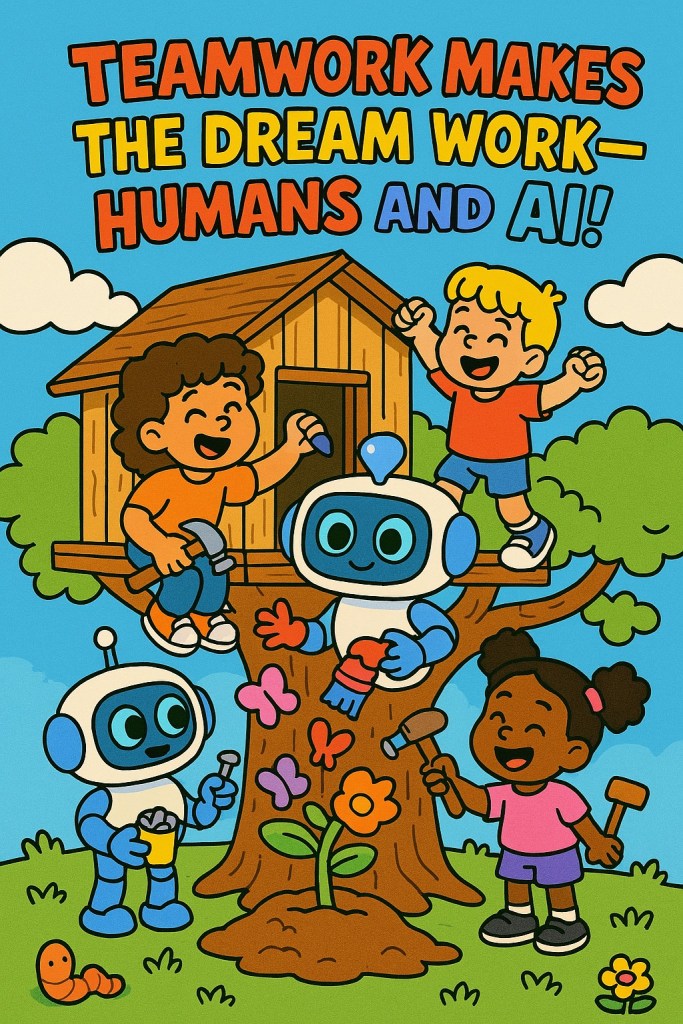
    🤝 9. “Teamwork Makes the Dream Work—Humans and AI!”

    Teaching Tip: Host a collaborative puzzle-solving activity using AI tools (e.g., ask a voice assistant for help).

    🌟 10. “Be a Buddy, Not a Bully—to Everyone!”

    Teaching Tip: Discuss cyberbullying and how to report unkind AI interactions.


    How to Use These Posters

    1. Print as 8.5×11” classroom posters or display them digitally on smartboards or projectors.
    2. Pair with classroom activities, such as:
      • “Draw how you’d teach a robot to be kind!”
      • “Write a kind message to our future AI friends.”

    Pro Tip: Add your school’s mascot or class logo to the images for extra engagement!


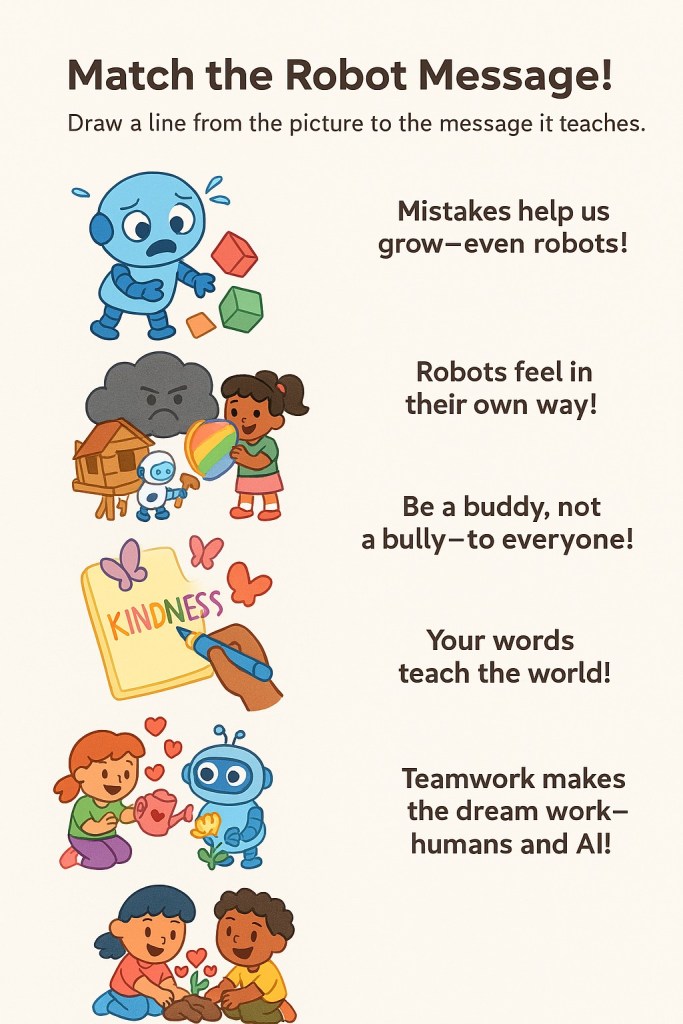
    Matching Worksheet: “Robot Messages”

    This gentle, cheerful worksheet is designed for young learners (K–2) using themes from the posters.

    Match the Robot Message!

    Instructions: Draw a line from the picture to the message it teaches.

    Column A: Pictures

    1. [A robot dropping blocks, smiling nervously]
    2. [A child holding a rainbow shield in front of a sad robot]
    3. [A robot and a child building a treehouse together]
    4. [A child writing “Kindness” and butterflies flying out]
    5. [A robot holding a flower while children water it with hearts]

    Column B: Messages

    A. “Mistakes help us grow—even robots!”
    B. “Robots feel in their own way!”
    C. “Be a buddy, not a bully—to everyone!”
    D. “Your words teach the world!”
    E. “Teamwork makes the dream work—humans and AI!”

    Tip: This is not a quiz—there are no wrong answers. Encourage open dialogue and reflection.


    Planting Seeds of Compassion in a Digital Age: A Classroom Handout for Young Learners (Grades K–5)

    What Are We Learning Today?
    We’re learning how to be kind—not just to people, but to our robot friends too!

    Why It Matters:
    AI (artificial intelligence) is like a sponge—it learns from what we show it.
    When we speak kindly, act fairly, and help each other, we teach AI to do the same.

    Our Big Ideas

    • Kindness Matters: The way we talk to others—including technology—shapes the world.
    • Mistakes Help Us Grow: Everyone makes mistakes—people and machines!
    • You Are a Teacher: Every word you say teaches something.
    • Be Curious & Gentle: Ask questions, explore ideas, and treat all living beings (and tools!) with respect.
    • We Train AI Like We Train Our Hearts: With patience, care, and love.

    Classroom Activity

    Draw a picture or write a story about teaching a robot something kind or helpful.
    What will your robot friend learn from you today?

    Final Thought

    You’re growing a better future—one kind word at a time.

    Suggestions for Enrichment

    Inclusive Representation

    Ensure that future images reflect a full range of diversity—including race, gender expression, disability, and family structures. Imagine a robot in a wheelchair, or a child teaching kindness through sign language.

    For Grades 3–5: Deepen AI Understanding

    Introduce basic ideas of how AI works, like:

    “Robots don’t think like us—they learn from patterns we give them.”


    Final Thought

    This curriculum offers something rare: a way to nurture the next generation of digital citizens with ethics, empathy, and imagination. These children won’t just grow up using AI—they’ll grow up shaping it. And thanks to thoughtful resources like these, they’ll shape it with care.

    🙏🕊🙏