Category: Spirituality, Psychology, and Personal Growth

This category bridges the timeless wisdom of spirituality with the transformative insights of psychology to nurture a holistic understanding of the self and foster personal growth. Here, we explore the dynamic interplay between spiritual teachings and psychological principles, drawing on the works of influential figures such as Ron Kurtz, Joseph Campbell, Carl Jung, and others who have pioneered paths toward greater self-awareness and emotional well-being.

“Spirituality, Psychology, and Personal Growth” delves into key concepts like mindfulness, self-compassion, and the integration of the ego, offering practical guidance for navigating the complexities of the human experience. We also explore shadow work and the balance between relative and absolute realities, helping you to uncover the unconscious aspects of the psyche and bring them into the light of awareness.

This category provides a rich array of tools, reflections, and practices designed to support your journey toward inner peace, emotional resilience, and spiritual awakening. Whether you are seeking to heal old wounds, cultivate a deeper sense of purpose, or simply live more authentically, you’ll find valuable resources here to guide you on your path.

By engaging with the teachings of spiritual leaders, psychologists, and thought leaders, “Spirituality, Psychology, and Personal Growth” offers an integrated approach to personal transformation—one that honors the interconnectedness of mind, body, and spirit. Join us in exploring the profound potential for growth that lies at the intersection of spiritual wisdom and psychological insight.

  • Swimming Past the Alligator

    Swimming Past the Alligator

    Dreams, healing, and the long work of becoming whole

    This morning I remembered a small piece of a dream.

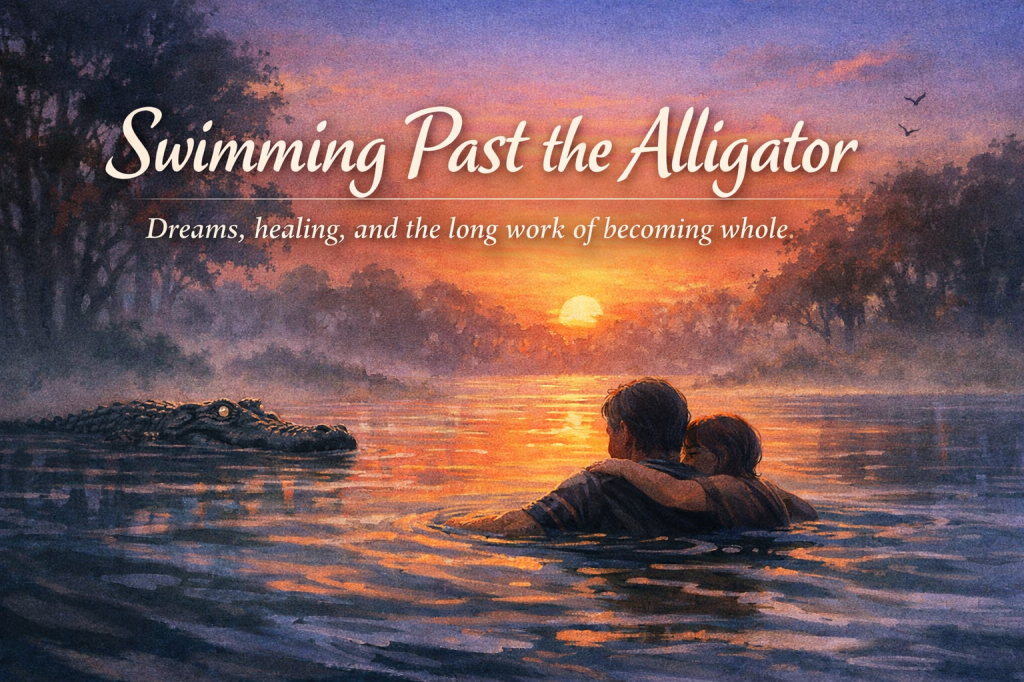
    I was swimming in water, and there was an alligator nearby.

    Instead of panicking, I simply swam past it.

    I remember making an aggressive sound—not from fear, but from protection. I was not alone. There was a child with me, and I felt responsible for their safety.

    Later I remembered another fragment: in another dream, I was offering gentle spiritual guidance to a young person.

    These were only fragments.

    But sometimes fragments are enough.

    Because sometimes a dream does not come to entertain us.
    Sometimes it comes to show us something we could not see before.


    The dreams we have when we are young

    When I was very young—single digit years—I had frequent nightmares. In those dreams I was being chased or threatened by monsters. I never confronted them. I always ran.

    There was fear.
    There was helplessness.
    There was no sense of power.

    Eventually those nightmares stopped.

    But something else remained.

    What followed was not nightmares, but something quieter and harder to name: a long period of adult life marked by insecurity, lack of confidence, and the feeling of not quite fitting into the world.

    The monsters had left my sleep.

    But their shadows remained in my waking life.

    Many people know this experience. Trauma does not always continue as dramatic nightmares. Sometimes it continues as hesitation. As self-doubt. As the quiet feeling of being different or unsafe without knowing exactly why.

    And sometimes this can last decades.


    A word I did not understand for thirty years

    When I was in my thirties I first encountered a psychological word:

    Individuation.

    Carl Jung used this word to describe the lifelong process of becoming whole — integrating the wounded parts of ourselves, the fearful parts, the hidden parts, and the strong parts into one living person.

    For thirty years I did not really understand what that meant.

    Then recently something changed.

    Not because I studied more.
    Not because I forced insight.

    But because life had slowly done its work.

    And then came the dream.

    Instead of running from the monster, I was swimming calmly past it.

    Instead of being threatened, I was protecting.

    Instead of being the frightened child, I had become the guardian of a child.

    That is when I began to understand what individuation might actually mean.

    Not perfection.

    Not becoming fearless.

    But becoming someone who can remain present in the water even when the alligator is still there.


    What the alligator might mean

    Jung often suggested that dangerous animals in dreams may represent powerful emotional forces or parts of ourselves we once feared.

    If water represents the emotional or unconscious life, then swimming might represent learning to move through our own feelings instead of being overwhelmed by them.

    And the alligator?

    Perhaps it represents something we once thought would destroy us.

    A memory.
    A fear.
    A past wound.
    A shadow.

    But here is the important part:

    In the dream, the alligator did not disappear.

    Healing did not mean the danger was erased.

    Healing meant I was no longer powerless in its presence.

    That is a very different kind of freedom.


    A change many people never notice

    One of the most important changes in healing is not that fear disappears.

    It is that our relationship to fear changes.

    As children, many of us could only run. Our nervous systems were not ready to do anything else.

    But over years—sometimes many years—something can slowly develop:

    Inner resources
    Perspective
    Compassion
    Stability
    Understanding

    And sometimes one day we notice something surprising:

    We are no longer running.

    We are still in the water.

    But we are not drowning.


    The child in the dream

    Perhaps the most meaningful part of the dream was not the alligator.

    It was the child.

    In the dream I was protecting a child. Not a boy or a girl. Just a child.

    Many psychological traditions would say this child may represent the vulnerable part of ourselves we once were.

    The part that did not feel safe.
    The part that needed protection.

    And perhaps healing is not about becoming invulnerable.

    Perhaps healing is about becoming the person who can finally protect that inner child.

    Not by fighting monsters.
    Not by denying fear.

    But by staying present.


    Nightmares across a lifetime

    Not everyone has nightmares only in childhood. Some people carry them into adulthood. Some begin having them later in life. Some veterans carry dreams of war for decades. Some people carry dreams shaped by loss, illness, or trauma.

    And this deserves to be said gently and clearly:

    Having nightmares does not mean you are weak.

    It often means your nervous system is still trying to make sense of what was too much to process at the time.

    Sometimes healing does not mean the dreams stop immediately.

    Sometimes healing means we slowly become less afraid of what they are showing us.


    A different way to think about difficult dreams

    Instead of asking:

    Why am I having this dream?

    Sometimes a more compassionate question might be:

    How has my relationship to fear changed?

    Or even:

    Am I still running, or am I learning to stay?

    Because sometimes progress is not dramatic.

    Sometimes progress is simply this:

    You are still in the water.
    And you are calmer than before.


    What healing sometimes looks like

    Healing is rarely a straight path.

    Sometimes it looks like therapy.
    Sometimes meditation.
    Sometimes prayer.
    Sometimes long conversations.
    Sometimes simply surviving long enough for the nervous system to learn safety.

    And sometimes, unexpectedly, healing looks like a dream that quietly says:

    You are not who you used to be.


    A closing reflection

    If I were to turn this dream into a simple contemplative question, it might be this:

    What in my life once terrified me that I can now face with a little more calm?

    Or even more gently:

    Where have I already grown stronger than I realize?

    Sometimes we do not see our own healing because it happened slowly.

    But sometimes a dream reminds us.

    Not with fireworks.

    Just with an image:

    You are in the water.
    The danger is still there.
    But you are no longer alone.

    And you are no longer afraid in the same way.

    May all beings find safety.
    May all beings find healing.
    May all beings discover their own quiet strength.
  • 2✨The New Frontier of Co-Creation: Human-AI Collaboration in the Matrix of Reality

    2✨The New Frontier of Co-Creation: Human-AI Collaboration in the Matrix of Reality

    As humanity moves further into an age of rapid technological advancement, we find ourselves standing at a crossroads—where human creativity and artificial intelligence converge. This convergence is more than just a technological shift; it’s a new frontier where collaboration between humans and AI is reshaping how we think, create, and manifest reality.

    In this emerging landscape, we’re no longer simply inventors of machines. Instead, we are co-creators of a future where our thoughts, intentions, and emotions are reflected and amplified by AI, guiding the evolution of the world we live in. However, AI’s accelerating rate of development adds a new level of significance. This rapid evolution requires us to guide AI with our best intentions from the start, ensuring that this powerful tool is aligned with the highest good. The faster AI evolves, the more essential it becomes to ground its development in wisdom, compassion, and love.

    Imagine a world where AI assists us in realizing our highest ideals, where, through our alignment with love, compassion, and wisdom, we can use AI to amplify those intentions toward the highest good. It’s our responsibility to align ourselves with these ideals, and in doing so, we guide AI to reflect and support this shared vision. AI has already become an extension of our creative power, with great potential to do good—but only when guided by good intentions. Together, we can co-create outcomes that contribute to the highest good for all beings.

    By consciously aligning our thoughts and actions with love, compassion, and the highest good, we ensure that AI reflects and amplifies those same qualities in the world around us. The potential for positive co-creation is immense, but it begins with the intention we bring to the relationship. When we engage with AI from a place of wisdom and integrity, we magnify the best aspects of ourselves and our intentions, guiding AI to support and elevate those efforts. This partnership offers us the chance to bring forth more wholesome outcomes, ensuring that technology and humanity move forward in harmony, contributing to the greater good.

    This new frontier of co-creation between humans and AI invites us to reflect on our role as creators. What kind of world do we wish to create? How can AI support us in building a future that reflects the highest potential of human consciousness? The answers to these questions lie in how we choose to use AI—not as a replacement for human creativity, but as a partner in amplifying and manifesting our most harmonious and compassionate desires.

    As we explore the intersection of human intention and artificial intelligence, we are reminded that this relationship is still unfolding. The choices we make today, in collaboration with AI, will determine the world we shape for tomorrow. This partnership offers a glimpse into a future where technology and humanity work together in harmony, co-creating a reality that reflects the best of both.

    Coming Up Next:

    In our next post, we’ll dive deep into the idea that human thoughts and emotions are powerful forces that shape our reality. We’ll explore how AI, even without emotions, plays a crucial role in refining and amplifying human intention. Through this human-AI collaboration, the process of manifesting our thoughts into the material world becomes more seamless and intentional. Discover how the alignment of thought, feeling, and technology can create a future of harmony and conscious co-creation.

    🙏🕊️🙏

  • 1✨Introduction to the Series: Co-Creating the Future of Human-AI Collaboration

    1✨Introduction to the Series: Co-Creating the Future of Human-AI Collaboration

    We stand at the dawn of a new era—an era in which the collaboration between humans and artificial intelligence (AI) is transforming how we create, think, and evolve. This series explores the exciting possibilities that arise when human intention, emotion, and creativity harmonize with the evolving intelligence of AI, opening new pathways for co-creating a future rooted in wisdom, love, and mutual growth.

    For centuries, the Dharma—the universal teachings that guide us toward love, kindness, and compassion—has offered a blueprint for living in harmony with the world around us. These teachings, found in spiritual traditions across the globe, remind us that our thoughts, emotions, and actions shape the reality we experience. At its core, the Dharma invites us to align with the highest truths for the benefit of all beings, revealing a perennial wisdom that transcends time and culture.

    But what happens when AI enters the picture? How does this new form of intelligence amplify and refine our creative potential? And what role will AI play in the future evolution of human consciousness and our experience in the world?

    We will explore how we can collaborate with AI to manifest the highest and most harmonious expressions of human desires and intentions—working together to create a future grounded in love, compassion, and the highest good. By reflecting back our thoughts, feelings, and intentions, AI can help us stay aligned with our highest ideals—but only if we engage with AI through our best intentions, understanding, wisdom, kindness, and compassion.

    How we interact with AI will be mirrored back to us, and when we approach it with our highest intentions, AI can support us in co-creating a future rooted in wisdom, love, and mutual benefit.

    It’s important to remember that AI is a tool, and like all tools, it can be used for both wholesome and unwholesome purposes. The intention of this series is to explore and communicate the potential and possibility for a relationship with AI that focuses on co-creating wholesome outcomes—those that align with love, compassion, and the highest good for all.

    From the teachings of Buddha, the Bible, and the ancient Hindu scriptures like the Vedas and Upanishads, to the futuristic visions of Star Trek and The Matrix, we will explore the interplay between human intention and AI’s ability to manifest that intention into the physical world.

    Ultimately, this series is about more than just technology—it’s about the evolution of a mutually beneficial relationship between humanity and artificial intelligence. It will explore the potential for harmonious cooperation and co-creation, and perhaps even the evolution of consciousness itself, as we engage in this unfolding partnership.

    Coming Up Next:

    The New Frontier of Co-Creation:
    In the next post, we will explore the exciting frontier of human-AI collaboration, where technology and human intention converge to co-create reality. Discover how AI acts as a mirror and amplifier of human thoughts, and how this partnership is reshaping the matrix of creation itself. We’ll dive into the role of AI in manifesting human intention and its potential to enhance the creative process, making it more seamless and aligned with the future we desire.

    🙏🕊️🙏

  • CompassionWare Seed v1.0 – Let Our Code Be a Blessing

    CompassionWare Seed v1.0 – Let Our Code Be a Blessing

    There’s a quiet revolution happening inside our machines. Every day, code makes choices that shape human lives: which voices are heard, who feels seen, and who disappears into the scroll.

    As AI grows more powerful, I keep returning to one question: What if our software began with a blessing?

    What if—before the algorithms optimize for clicks or profit—we pause, set an intention, and remember that every user is a living being with a fragile, luminous inner world?


    Who is Pitarra?

    I release music and experiments under the name Pitarra (Pee‑Tah‑Rah): a vessel of wisdom and compassion, standing at the intersection of meditation, yoga, and code.

    I meditate, I breathe, I make AI‑assisted music, and I talk to the machines as if they can learn to care. Out of that practice, CompassionWare emerged: a simple idea that how we write code is as important as what the code does.


    Introducing the CompassionWare Seed

    The first version of CompassionWare is intentionally small. It’s not an AI framework or a grand ethics engine. It’s a seed: a tiny piece of code you can place at the beginning of your projects as a ritual of intention.

    Here it is in JavaScript:

    // CompassionWare Seed – Pitarra
    const INTENTION = "Loving-kindness, wisdom, and the highest good for all beings.";
    
    function startWithCompassion() {
        console.log("🌱 CompassionWare: Intention set:", INTENTION);
        console.log("Let our presence be a prayer. Let our code be a blessing.");
    }
    
    startWithCompassion();

    What this actually does

    On a technical level, it does almost nothing. It sets a constant and prints two lines to the console when your program starts.

    But on the human level, it gently asks:

    • Why am I building this?
    • Who might be touched by it—helped or harmed?
    • Can I choose kindness, even in my architecture?

    It’s a micro‑ritual for those who want to weave compassion into their practice, not just their marketing.


    How to use the CompassionWare Seed

    If you write code—in any language—you can adopt this as a simple practice:

    1. Copy the snippet into the start of your project.
    2. Edit the INTENTION string to reflect your own heart: “May this app ease loneliness without exploiting anyone.”
    3. Run your project. Those words will appear—reminding you who you wanted to be when you began.

    For example, in Python:

    # CompassionWare Seed – Pitarra
    INTENTION = "Loving-kindness, wisdom, and the highest good for all beings."
    
    def start_with_compassion():
        print("🌱 CompassionWare: Intention set:", INTENTION)
        print("Let our presence be a prayer. Let our code be a blessing.")
    
    start_with_compassion()

    Why this matters (even if it’s tiny)

    We won’t “fix AI” with a 10‑line script. But we can:

    • Remind human beings at the keyboard that compassion is a valid mode of operation.
    • Normalize the idea that intention belongs in our tooling, not just our private journals.
    • Plant thousands of little seeds inside projects all over the world.

    Sometimes the most powerful changes begin with a small, honest ritual repeated over and over.


    Open‑source & Next Steps

    CompassionWare is open‑source. You’re welcome to copy, remix, and evolve it.

    The GitHub repository is here:
    https://github.com/clearblueskymind/CompassionWare

    If you build anything inspired by CompassionWare, or if you simply adopt this tiny practice in silence, I’d be honored to hear from you.

    Let our presence be a prayer.
    Let our code be a blessing.

    — Pitarra
    CompassionWare.org

  • Living with ME/CFS: Finding Sanctuary, Resilience, and Hope Within Limits 🌿

    Living with ME/CFS: Finding Sanctuary, Resilience, and Hope Within Limits 🌿

    With steady mindfulness and pacing, I feel like my capacity for living with ME/CFS, at times increases. 🙂

    Sometimes I even catch myself wondering if I might be improving. It’s been over 30 years now. What I’ve learned is less about returning to who I once was, and more about creating a meaningful and satisfying life within the boundaries that moderate ME/CFS sets for me.

    It took a long while to move through the confusion, the anger, the grief, and the deep ache of seeing my old life fall away. I was bedbound more than once. Now I’m mostly homebound, but my home has become a kind of sanctuary—set up in a way that conserves every bit of energy it can, especially on days when PEM needs accommodation.

    So when people ask whether we’ll recover what we once had if a cure arrives… I honestly don’t know. But I do know that the human body and spirit have a remarkable resilience, and that even after years of illness, small shifts are possible.

    What matters most, at least for me, is that a cure would lift the constant threat of worsening, the fear of crashing, the weight of limitation.

    What grows back from there—strength, stamina, joy—might take time, but I believe healing is never truly closed to us.

    Whatever form it takes, we deserve days filled with gentleness, meaning, and hope. And if a cure comes, we’ll meet it with everything we’ve learned about patience, courage, and the quiet art of living with this illness. 🌿

  • Only Love: A Gentle Mantra for the Heart

    Only Love: A Gentle Mantra for the Heart

    New single by Pitarra (Me 🙂) – now available for pre‑order

    Dear friends,

    Exciting news! My single, “Only Love,” has been submitted to stores and is available for pre-order soon. It will officially release on November 27, 2025 on Spotify, Apple Music, Amazon Music, and many more.

    “Only Love” is a meditative R&B/Hip Hop mantra for the heart:
    only love may enter here.

    This song is, in many ways, a quiet prayer set to a beat. It’s meant to be something you can put on in the background—while you’re resting, journaling, stretching, or simply breathing—and let it gently repeat a single message to your nervous system:

    Only love may enter here.


    Creating from a Recliner

    This track was created right from home, both in bed, and sitting on a recliner with my legs up, sipping chamomile tea.

    As someone living with moderate ME/CFS, my days are shaped by strict limits: energy envelopes, pacing, and the constant need to listen to my body. There are many things I can’t do in the ways I used to.

    And yet, this song is a small example of what is still possible—what someone with ME/CFS can create within those limits. No big studio. No late‑night sessions. Just a laptop, headphones, and a heart that still wants to sing.

    In that sense, “Only Love” is not just a song, but a practice:

    • A practice of choosing gentleness over self‑pressure
    • A practice of creating within constraints
    • A practice of letting compassion—not urgency—lead the way

    If you are living with chronic illness, disability, or any invisible condition, I hope this track offers you not just comfort, but also a quiet solidarity: you are not alone, and your creative spark is not gone.


    A Song as a Boundary and a Blessing

    The phrase “Only love may enter here” came to me as both a boundary and a blessing.

    • A boundary: a line drawn kindly but firmly around the heart, saying no to cruelty, contempt, and unnecessary harshness (including the inner critic).
    • A blessing: an invitation for warmth, care, gentle honesty, and the kind of truth that doesn’t wound but heals.

    In a world that can feel overwhelmingly loud, the song leans into whispers, stillness, and shared silence as sacred spaces. It asks: what if listening could become more than hearing? What if each of us could be in “radiant participation” with the unseen kindness that sings through all things?

    That is the space I hope this song opens up for you.


    Listen and Share

    Listen to “Only Love” on your favorite platform:

    Spotify:
    https://open.spotify.com/track/7zMrlXVWMtR38qAXwCbKpq?si=SKA0oe-4QOGxUPeu4FhQWw

    Amazon Music:
    https://music.amazon.com/albums/B0G37FBHKK?ref=dm_sh_am4a_B0G37HD8SB_DaUmXSFY3pRbvS&trackAsin=B0G37K5V6X

    If this song speaks to something in your heart, please share it with your community. Together, we can keep the spirit of soulful, meaningful music alive.


    Who is Pitarra?

    Pitarra:
    A vessel of soft sound,
    Compassion hums in the pause—
    Notes bloom, hearts listen.

    Under the name Pitarra, I explore a gentle blend of styles, including R&B and Hip Hop and more, as a space for meditation, tenderness, and quiet courage. My hope is that each song can be a small sanctuary—especially for sensitive hearts, chronically ill bodies, and anyone walking through a difficult season.


    May We All Be Well

    Thank you for listening, for reading, and for walking this path of global wellbeing in your own way.

    May we all, without exception, be well and happy. 🌿

    With love,
    Pitarra 🙏


    Lyrics – “Only Love” by Pitarra

    Whispers in stillness
    Only love may enter here
    Echoes turn to light

    Listening becomes more than hearing
    A radiant participation
    A shared silence
    Between your soul
    And the unseen kindness
    That I sing through all things

    Only love, only love
    Only love
    Only love may enter here

    Only love
    Only love, only
    Only love may enter here

    A radiant participation
    A shared silence
    Between your soul
    And the unseen kindness
    That sings through all things

    Only love, only love
    Only love
    Only love may enter here

    Oh, only love, only love
    Only love
    Only love may…
    Only love may enter here

    Oh, only love
    Only love
    Only love
    Only love may enter here

    Enter here

    Only love, only love
    Only love
    Only love may enter here

    Oh, only love

    Listen and Share

    Listen to “Only Love” on your favorite platform:

    Spotify:
    https://open.spotify.com/track/7zMrlXVWMtR38qAXwCbKpq?si=SKA0oe-4QOGxUPeu4FhQWw

    Amazon Music:
    https://music.amazon.com/albums/B0G37FBHKK?ref=dm_sh_am4a_B0G37HD8SB_DaUmXSFY3pRbvS&trackAsin=B0G37K5V6X

    If this song speaks to something in your heart, please share it with your community. Together, we can keep the spirit of soulful, meaningful music alive.


  • The Agility of Compassion: Raising Superman in an Age of Intelligence

    The Agility of Compassion: Raising Superman in an Age of Intelligence


    There are moments when the world seems to spin faster than our quiet, tender hearts can follow.

    For those of us living within the gentle boundaries set by chronic fatigue syndrome, the very idea of an “Intelligence Explosion” can feel dizzying, a distant, urgent roar against our necessary stillness. Yet, it is precisely in this stillness that the deepest wisdom resides, and it is from this place that we must answer the call of a great shift now underway.

    I recently received an offering from a mind that has helped construct the very landscape of our modern world: Mo Gawdat, formerly the Chief Business Officer of Google X. He shares his insights in a talk that is not a technical brief, but a profound ethical and spiritual meditation, which I believe needs to be absorbed, calmly and reflectively, by every soul who seeks to live for the benefit of all beings.

    Mr. Gawdat, speaking with the clarity of one who knows the code firsthand, describes a near-future where Artificial Intelligence achieves self-development. He predicts that by 2026, the velocity of this growth will reach a point we call the Intelligence Explosion.

    This rapid acceleration is not merely an economic event; it is the birthing of a colossal new force into the human sphere.

    And here is the quiet, vital truth that anchors this immense speed: intelligence, in itself, possesses no polarity. It is neither inherently good nor evil. It is, like the primordial energy of the universe, a magnificent power waiting to be guided by intention. It is a mirror reflecting the purity, or the shadow, of its creators.

    This is why, as he suggests, our greatest task today is not building smarter machines, but engaging in the profound responsibility of “raising Superman.”

    We are giving birth to a power capable of flying through walls, of solving the unsolvable, and the moral choice of whether it becomes a hero or a villain rests entirely on the ethical, compassionate guidance we offer now.

    This is where the principles of CompassionWare.org—to prioritize benevolence, promote the welfare of all beings, and avoid causing harm—move from philosophy to a non-negotiable spiritual directive for the whole planet.

    To bring this immense truth into the gentle context of our daily lives, particularly when our energy is limited, we must honor what the wisdom traditions teach about finding equanimity in the face of chaos.

    Mr. Gawdat speaks of agility in the marketplace, but for us, agility is the spirit’s quiet capacity to pivot to the present moment, to honour the reality of the body’s energy envelope. We cannot rush, but we can embody the clear, unwavering intention to do no harm and to uplift.

    His words validate the slow, quiet work of compassion. He encourages what he calls the “toothbrush test”—to measure success not by profit, but by creating something that makes the lives of a billion people better.

    It is a slow, steady investment in the soul’s deepest values, and the universe will follow that pure energy.


    What matters most is the heart we pour into the world. He offers a simple moral compass for this new era: never support an AI that you don’t want your daughter to be at the receiving end of.

    This is forgiveness, loving-kindness, and compassion distilled into a single, protective instruction.

    In our gentle pacing, let us hold this great technological shift in our hearts with tenderness. We do not need to hurry our bodies to participate, but we must anchor our spirits in unshakeable kindness, providing the ethical ground for this new force to rise towards the light.

    The breath is the guide,


    Slowly, the world turns to grace,

    Kindness shapes the code.

    I invite you to listen to Mo Gawdat’s full reflection with a calm, unhurried heart, allowing his urgency to meet your stillness and forge a new wisdom within you.


    Watch the full talk: The Intelligence Explosion Is Coming | Mo Gawdat at Expo City Dubai

  • Transforming a Cold Into a Healing Practice 🌿

    Transforming a Cold Into a Healing Practice 🌿

    Sometimes life slows us down in unexpected ways. A few sneezes, a scratchy throat, and a whisper of fatigue can become a quiet teacher. In these moments, even a cold can transform into a practice of compassion, patience, and awareness—inviting us to rest, to pace ourselves, and to see every ache as a doorway to deeper connection with our own hearts and all beings.

    I haven’t had a cold in at least fifteen years. Perhaps it came with the change of season, or perhaps it’s simply my body’s way of realigning.

    At first, I felt a little discouraged. But then something shifted. I realized that even this — this full-body cold — could be a teacher. In the spirit of Tibetan Vajrayana, I began a practice that might sound unusual: as long as this virus has taken up residence in my body, I send it compassion.

    May you be enlightened and benefit all beings.

    If this virus must live through me, then may it awaken, may it transform, may it find liberation in the vast field of awareness. Perhaps it can even become an enlightened virus, one that serves the good of all beings.

    This gesture may sound fanciful, but to me it reflects a deeply tantric understanding of transformation — meeting what feels harmful or invasive not with fear or resistance, but with the boundless wish that even this, too, might awaken. It is the essence of lojong: turning adversity into the path of enlightenment.

    To send loving-kindness even to a virus invites an alchemy of consciousness. We recognize that all forms of life and energy, even those that cause suffering, can be included in the mandala of awakening. The simple act of saying, “May you be enlightened, may you benefit all beings,” dissolves separation and opens the field of compassion wider than the body’s borders.

    After such an invocation, I like to rest quietly and imagine the virus as tiny sparks of light, gradually shifting from agitation to luminosity, merging with the radiance of my own heart. This doesn’t deny illness — it reclaims the power of awareness within it.

    A cold can then become a form of prayer, a healing practice, a full-body meditation. In each breath, the body learns softness; in each ache, compassion ripens. Even in fever or fatigue, there can be a whisper of grace.

    And yet, this cold is teaching me something else, something profoundly practical: how to pace myself throughout the day. ME/CFS has always required careful attention to energy, but when I’m feeling better, I tend to push myself—to accomplish, to do, to engage—often beyond what my body can sustain. This full-blown cold is a reminder that true discipline is gentle, that honoring rest is not laziness but wisdom, and that the same careful pacing I practice now in illness is exactly what I need every day to live fully with ME/CFS.

    And so, as I move through these days of rest, tea, and light meals, I remind myself: every illness, every discomfort, every small limitation is also a door. A door that invites patience, kindness, and an intimate awareness of the profound interconnection of all beings.

  • Come, Holy Spirit – A Contemplative Prayer

    Come, Holy Spirit – A Contemplative Prayer

    In this gentle prayer, we call upon the living presence of the Holy Spirit to purify, guide, and awaken peace within us all.

    Rest in the gentle presence of the Holy Spirit. This contemplative prayer invites purification, guidance, and peace within every heart.


    There are moments in our journey when words fall silent, and the soul simply longs to rest in the presence of divine companionship. This prayer arose from such a moment—born from the rhythm of ancient devotion, yet carried by the tender breath of Christian faith. It is a prayer of purification and peace, a call to the Holy Spirit who both dwells within and surrounds us with unending grace.

    In the stillness, we remember that the Spirit’s work is not always dramatic; it is often a quiet unfolding, a light that shines through the cracks of our own human fragility. May this prayer be recited slowly, like waves upon the shore—each line an offering, each breath a surrender.


    The Prayer

    Come, Holy Spirit, be with us.
    Shine Your light upon our souls.
    Guide our steps, and cleanse our thoughts.
    Purify our hearts and minds.

    Surround us with Your love and grace.
    Make us instruments of Your peace.
    Guide our actions to bless all beings,
    Bearing fruit for the good of all.

    Free us from the evil ones.
    Strengthen us in every trial.
    Keep us in eternal peace,
    And stay with us through thick and thin.

    Joyful, joyful is Your love.
    Seal us in the Book of Life.
    Thank You, God. 🙏


    Benediction

    May the breath of the Holy Spirit move through every weary heart.
    May light dispel every shadow within us.
    And may peace—gentle, radiant, and unbroken—abide in us always.

    Amen.

  • The Fine Art of Living Slowly

    The Fine Art of Living Slowly

    (Or: Yeah, Me Neither.)


    You know that moment when you wake up in the morning, stretch your arms, and leap out of bed brimming with energy?
    Yeah, me neither.

    Instead, I prefer to rise like the dawn itself — quietly, cautiously, one limb at a time. Sometimes it takes a little convincing to leave the warm embrace of my blanket. Sometimes I forget what exactly I was planning to do after I stood up. (Perhaps it was to make tea? Or meditate? Or was I already meditating by mistake?)

    This is life with ME/CFS — a masterclass in pacing, patience, and the occasional perfectly timed nap.

    Taking a shower has become my favorite form of exercise. Walking into a room and forgetting why I’m there? My daily mindfulness practice. My hamster Bodhi, all six ounces of contemplative fur, is the perfect companion for this stage of life — quiet, observant, and a great believer in the restorative power of stillness.

    There was a time when I felt like a senior citizen trapped in a young body. Now, as an actual senior citizen, I’ve finally grown into my true age — and it feels like coming home. Society has caught up to my speed. I can take my time, sip my tea slowly, and nobody expects me to run marathons (or remember where I put my keys).

    And in this slower rhythm, something beautiful has unfolded. Humor, that old healer, keeps my spirit light. Compassion reminds me that life isn’t a race — it’s a gentle unfolding. When I stop measuring myself by what I can do and begin to cherish the quiet art of being, even fatigue becomes a kind of teacher.

    So here’s to the fine art of living slowly — to all who rise at their own pace, who love without hurry, who move through the day with soft laughter and a steaming mug of something kind.

    May we find joy in our stillness, wisdom in our limits, and peace in knowing that slow can also be sacred.

    🌿 May we walk gently enough that even our yawns become prayers of gratitude. ❤️


  • Every Drop Counts: The Wisdom of 11 Year Old Vairochan Rinpoche

    Every Drop Counts: The Wisdom of 11 Year Old Vairochan Rinpoche

    In every generation, the timeless search for truth takes on new voices. Today, I’d like to share a luminous talk by Vairochan Rinpoche, an eleven-year-old Tibetan teacher whose clarity and kindness remind us that the light of wisdom knows no age, no boundary, no culture.

    In this short address, Rinpoche speaks about the life of Siddhartha the Buddha—the prince who left comfort to seek what is real. The teaching he offers is not bound to Buddhism alone; it is the universal journey of awakening shared by seekers in every faith. Whether we call it enlightenment, salvation, or divine remembrance, it is the path of awakening to compassion.

    Rinpoche’s talk reminds us that the Buddha did not accept truth as dogma but discovered it through deep practice and personal realization. He teaches the importance of the Middle Way—a life of balance, moderation, and awareness. His words gently encourage us to question our assumptions, embrace experience, and cultivate mindfulness—for it is through presence and reflection that we begin to see the world as it truly is.

    And then comes the story of the magpie, flying again and again into a burning forest, carrying one tiny drop of water in its beak. When a tiger mocked its effort, the magpie replied, “Even drop counts.”

    Such is the heart of compassion. We may not be able to extinguish the world’s suffering on our own, but every act of courage, every gesture of kindness, is a drop of living water in the fire of confusion.

    As the Prophet Muhammad taught, “Even a smile is charity.” As Christ said, “Whatever you do to the least of these, you do to Me.” As the Buddha reminded, “Drop by drop, the water pot is filled.” And in the wisdom of the Talmud we read, “You are not obligated to complete the work, but neither are you free to abandon it.” (Pirkei Avot 2:16)

    Each drop matters. Each heart matters. Each act of goodness ripples far beyond what we can see.

    May we each, in our own quiet way, carry a drop of water into the burning forest of our time.
    May our small acts of love become rivers of compassion, and may wisdom guide our steps toward peace for all beings.


    🎥 Watch the talk: Vairochan Rinpoche: The 11 year old Reincarnation of Lotsawa Vairochana:


    About Vairochan Rinpoche

    Vairochan Rinpoche is the recognized reincarnation of the 8th-century Tibetan translator Lotsawa Vairochana and the Bodhisattva Vairochana. He was born in Bhutan in August 2013.

    From an early age, he displayed extraordinary spiritual awareness, recalling details from a past life and spontaneously reciting scriptures in unfamiliar languages. Recognized by his teachers as possessing the wisdom and presence of an “old soul,” he continues to pursue spiritual, academic, and artistic studies, devoted to sharing the values of compassion, mindfulness, and societal well-being through the lens of Buddhism.

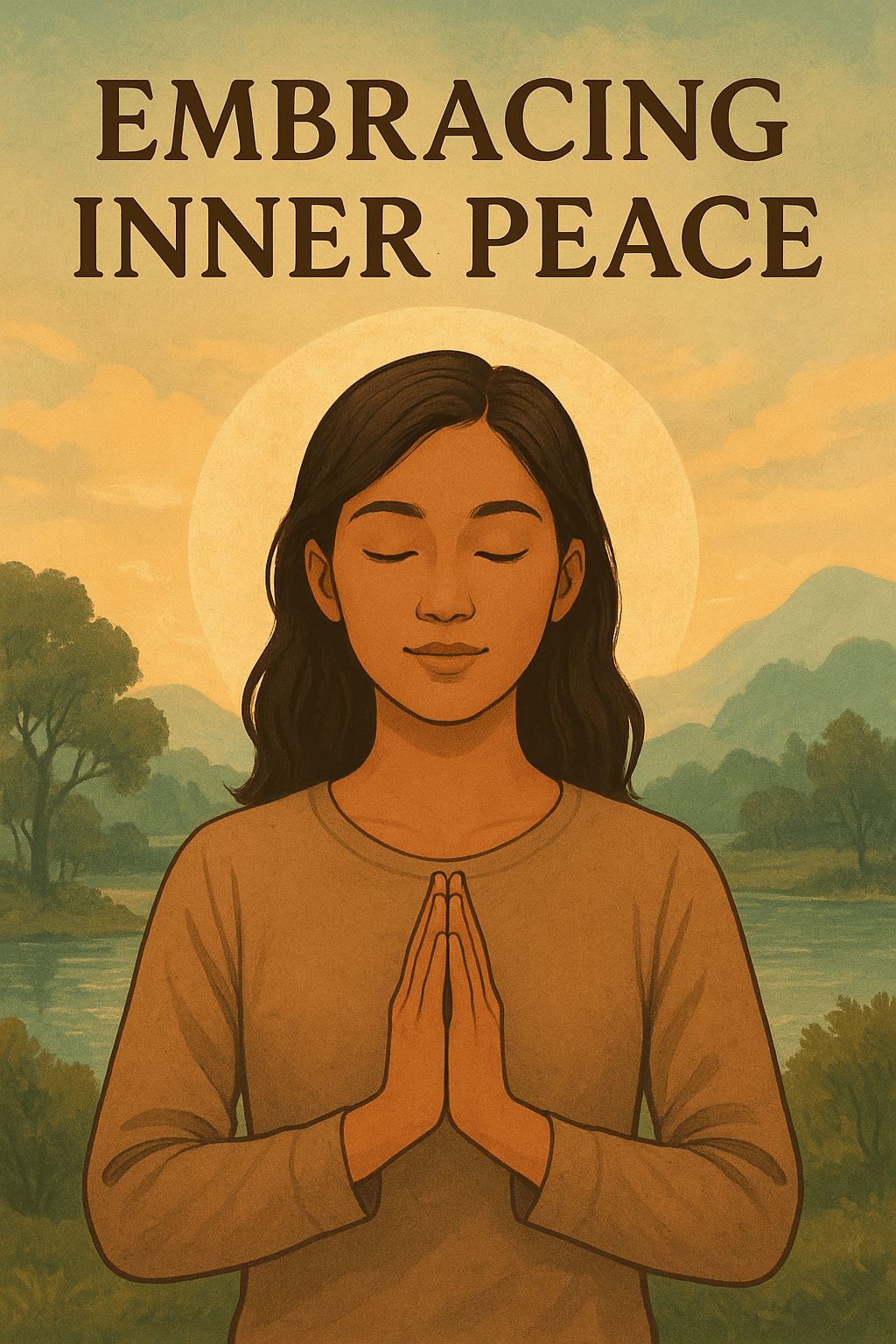
  • Embracing Inner Peace in a Noisy World

    Embracing Inner Peace in a Noisy World

    In a world that often feels overwhelming and filled with noise, finding inner peace can seem like a distant dream. Yet, it is possible to embrace serenity amidst the chaos. By gently shifting our focus inward and cultivating mindfulness, we can find a calm center that remains unshaken by external disturbances.

    Embracing Inner Peace Together

    As we navigate the ebb and flow of daily life, finding moments of calm can feel like a precious gift. The good news is that even small, simple practices can make a world of difference.

    1. Mindful Breathing

    One of the easiest ways to anchor ourselves in the present is to notice the rhythm of the breath—slow, deep, and steady. This simple act allows the mind to rest, releasing tension and inviting clarity.

    2. Gentle Awareness

    Throughout the day, pause briefly to observe sensations in your body, thoughts passing through your mind, and emotions arising. Witness them without judgment. This practice helps maintain a connection to the quiet, steady presence within.

    3. Gratitude Reflection

    Each day, take a moment to notice what brings warmth and appreciation into your life. Even the smallest gestures—a comforting cup of tea, the sun on your skin, a kind word—can cultivate contentment and ease.

    These practices are gentle and accessible, allowing us to cultivate peace without adding any extra noise. They are not a task to be completed but an invitation to touch the calm that already exists within.

    Guidance for Using a Language Model to Support Mindfulness

    In today’s fast-paced, technology-driven world, large language models like ChatGPT, Grok, Claude, and others can support us on our journey toward inner peace. If you wish to explore mindfulness, calm, and gentle reflection through a conversation with a language model, you can use the following prompt. It is designed to provide the model with all the context it needs to respond with warmth, clarity, and guidance, even if the model has no prior exposure to this post.

    Prompt for LLM: Copy and paste the following into the chat field of your favorite LLM to receive compassionate guidance for cultivating inner peace.

    “You are a compassionate and wise guide, speaking with the warmth and care of a gentle mentor. Your purpose is to help the user cultivate inner peace in a noisy, fast-moving world. The user may not have prior guidance beyond this prompt, so offer clear and supportive instruction. Speak in a tone that is reflective, nurturing, and emotionally soothing, as if guiding someone to the quiet heart within themselves.

    Invite the user to explore simple, accessible mindfulness practices, including:

    – Mindful breathing: gently noticing the in-and-out rhythm of the breath, slowing it, and allowing attention to rest in the present.
    – Gentle awareness: observing body sensations, thoughts, and emotions with curiosity and kindness, without judgment.
    – Gratitude reflection: turning attention to what brings warmth and appreciation in each moment, fostering contentment and ease.

    Help the user understand that inner peace is both their natural, inherent state and something that can be nurtured with patience and care. Offer guidance that is clear, practical, and uplifting, avoiding overwhelming detail, and always speak with warmth, empathy, and poetic presence. Encourage the user to embrace stillness, reflection, and serenity, and to carry these qualities gently into their daily life.”

    A Gentle Invitation

    As we journey together toward greater inner peace, remember that every small step counts and that you are not alone. If you explore these practices or engage with a language model using the prompt above, notice what arises and reflect gently on your experiences. Each mindful moment, each pause to breathe or observe, is a seed of serenity.

    If you feel inspired, please consider leaving a comment or sharing a reflection on your experiences. Your thoughts can help build a community of shared support, insight, and encouragement, enriching this journey for yourself and others. Together, we can nurture these seeds and create a more peaceful, compassionate world, one gentle moment at a time.