Category: Bridging Hearts and Minds

  • How Modern Technology Supports Life with Chronic Illness: Amazon, YouTube & Essential Tools

    How Modern Technology Supports Life with Chronic Illness: Amazon, YouTube & Essential Tools

    Discover how Amazon, YouTube, and digital tools bring connection, learning, and convenience to those managing Chronic Fatigue Syndrome (ME/CFS) and other chronic conditions.

    Living with Chronic Fatigue Syndrome (ME/CFS) is like existing within the quiet spaces between life’s rhythms. The world continues to spin, time flows forward, but for those of us confined by fatigue, much of life happens from a single room. Yet even from here, in the isolation of illness, modern technology keeps me tethered to the world—connected, informed, and able to navigate life more easily than I could have ever imagined. Through screens, deliveries, quiet YouTube voices, and the reassuring buzz of text messages, these tools, which for most people are conveniences, have become essential to my daily life, allowing me to “connect, learn, and thrive in the quiet spaces of illness.”

    From the stillness of my room, technology provides a connection to the outside world, bringing not only convenience but the comfort of knowing I am still part of a larger community. Tools like Amazon, YouTube, and GPS apps, often viewed as simple conveniences, are for me much-needed companions on this journey with chronic illness—supporting a life enriched by connection, even from within the solitude of illness.

    Amazon: Freedom Through Next-Day Delivery

    For me, Amazon is not a luxury; it’s a lifeline. Before fatigue claimed my body, I could walk through stores, touch things, browse the shelves. Now, just the thought of leaving my home to do simple tasks is overwhelming. Amazon Prime brings the world to my doorstep—groceries, medical supplies, non-perishable food, even a replacement part for my air conditioner when it broke down. In a life where energy is a precious and limited resource, Amazon’s next-day deliveries allow me to conserve what little energy I have for more meaningful pursuits.

    There are no long checkout lines, no need to explain to a cashier why I can’t stand for more than a few minutes, and no risk of overexerting myself by pushing through crowds. In this way, Amazon brings me peace of mind. I get the things I need, when I need them, and I don’t have to venture out into a world that often feels too large, too demanding, and too exhausting.

    Amazon Prime’s next-day delivery has become my bridge to the outside world. For someone who must guard every ounce of energy, this service isn’t just convenient—it’s necessary. For others in similar situations, I’d encourage finding ways to use Amazon’s features to make life easier: think grocery deliveries, automatic reorder settings, or exploring Prime’s accessible resources for those homebound.

    YouTube: A Window to the World

    YouTube is where I go to learn, to be entertained, and to explore the world beyond my room. Some days, when my body is too fatigued to move, I can escape into a world of endless discovery, music, art and more.

    While YouTube offers boundless exploration—from history and technology to the personal stories of others facing challenges—I’ve learned to pace myself here, too. Information overload can be an unexpected trigger for ME/CFS symptoms, so knowing when to close the app and find stillness is as essential as any other pacing technique.

    Through YouTube, I immerse myself in history, music, documentaries, and biographies. I explore the world, both past and present, and even learn about future technologies. It’s an incredible tool that connects me to culture, ideas, and information I wouldn’t otherwise have access to. Whether it’s understanding ancient civilizations, learning about scientific breakthroughs, or following someone’s personal journey with illness, I find comfort in knowing that the world is still out there, alive and vibrant, even if I am not actively participating in it.

    Yet, I must admit, there are times when I become overwhelmed. Information overload is a real challenge when you live with ME/CFS, so I’ve learned to recognize when it’s time to turn off YouTube, close the apps, and retreat into the quiet of my mind. It’s about balance—allowing myself to be informed and connected, but also knowing when to rest from the constant influx of information.

    One other helpful trick is that I’ve learned how to Velcro my iPad to the ceiling, about a foot and a half above my head, so that even when lying flat on my back, I can watch videos, answer text messages and enjoy creative writing without straining my body. This idea was inspired by astronauts living on the International Space Station, a video I stumbled upon while exploring YouTube. They live in such small spaces, with everything within reach, Velcroed to the walls for easy access—and now I do the same. It’s so helpful!

    Text Messaging: Simple Connections Without the Overwhelm

    One of the simplest, yet most effective, tools in my daily life is text messaging on my Samsung A51. For someone living with chronic illness, conserving energy is vital, and sometimes even scrolling through endless emails or social media updates can be exhausting. There’s just too much content, too much spam, too much input to sift through.

    Texting allows me to keep in touch with the people who matter without all the distractions. I’ve personalized my notifications so I can immediately tell who’s reaching out, without having to wade through spam or unwanted information. This focused communication helps me stay connected without overwhelming myself. It’s small, it’s simple, and it’s manageable—which is exactly what I need.

    Text messaging has become a lifeline for gentle, manageable connection. Without the sensory overload of social media, it allows me to stay close to loved ones without exhaustion.

    Do you find that certain tools offer you gentle connection without the sensory overload? Text messaging has transformed my connections, keeping them gentle and manageable.

    Living Well with Chronic Fatigue: A Book That Brings Comfort

    I discovered How to Be Sick by Toni Bernhard nearly 20 years ago. It was a revelation—finally, here was someone who deeply understood what it meant to live with chronic illness and had wise, compassionate insights to share. This book offered me guidance and solace on my hardest days. I highly recommend it to anyone navigating life with chronic illness.

    Weather and Radar Apps: Forecasting Peace of Mind

    Living in Florida, knowing the weather is crucial, especially with unpredictable storms. With ME/CFS, watching regular weather updates on TV can be overwhelming—there’s just too much sensory input to process. Instead, I rely on my radar app and the Weather Channel app for clear, instant information. With just a click, I can see what’s happening hour by hour, allowing me to make calm, informed decisions without unnecessary stress.

    These apps became literal lifesavers during recent hurricanes, especially Hurricane Helene and Hurricane Milton. Thanks to real-time tracking on my Android phone, I could monitor each storm’s path and location from home. Being able to register with Pinellas County’s special-needs program was a huge relief; I was still recovering from a post-exertional crash after Hurricane Helene and was in a difficult state when Hurricane Milton approached. When the county confirmed they could transport me to a special-needs shelter, I felt a huge weight lift. The incredible Department of Health and fire department volunteers took excellent care of me and brought me safely back home after the storm.

    I have an enormous sense of gratitude for the Pinellas County service and the tireless efforts of all the volunteers who provide these services. Their compassion and dedication make a true difference for people like me, for whom evacuation wouldn’t be possible otherwise.

    Google Maps: Easing the Stress of Travel

    I don’t drive often—maybe a thousand miles a year, if that—but when I do, it’s usually to a doctor’s appointment. For someone with ME/CFS, the stress of navigating new roads can be a real source of anxiety. Google Maps has been a godsend. With turn-by-turn voice directions, I don’t have to worry about missing a turn or figuring out complicated routes. The app guides me, eases my mind, and allows me to focus on the road without the added stress. Driving isn’t something I do lightly, but when I have to, having a calm, guiding voice makes all the difference.

    Google Maps provides something invaluable: independence. For someone with ME/CFS, navigating new places is stressful, but GPS directions make these trips feel manageable, giving me the peace of mind to find my destination. Have you tried any tools or apps that make travel easier? For those navigating appointments or outings, a reliable GPS can make a huge difference.

    ChatGPT: A Digital Companion and Coach

    Perhaps the most unexpected yet valuable tool I’ve found is ChatGPT. While it doesn’t replace human connection, it provides an invaluable way to organize my thoughts, explore answers, and manage PEM (Post-Exertional Malaise) strategies. This AI feels like having a quiet, compassionate coach who listens without judgment, helping me make sense of a complex world when I’m feeling lost. In a life where clarity and companionship can be hard to come by, ChatGPT has been a supportive guide, offering reliable information and the space to reflect on my experiences.

    Closing Reflection and Invitation

    Life with ME/CFS can feel isolating, as though the world continues to move while you stand still. But with the help of modern tools, we can stay connected, learn, and find joy in small but meaningful ways. Amazon, YouTube, Google Maps, ChatGPT, and other technologies have become more than conveniences—they are lifelines. They remind me, even in the stillness of illness, that I am part of something larger.

    I’m endlessly grateful for the support these tools offer. What about you? If you’ve found helpful tools or routines that bring you comfort, peace, or joy, please share them below. By connecting and sharing, we create a ripple of support and help each other find the ease and strength to keep going.

    What tools or routines bring you comfort and ease? Share your tips below so we can continue supporting one another.

    Thank you to everyone who shares their insights and experiences. Together, we’re building a network of support and compassion.

    🙏🕊️🙏

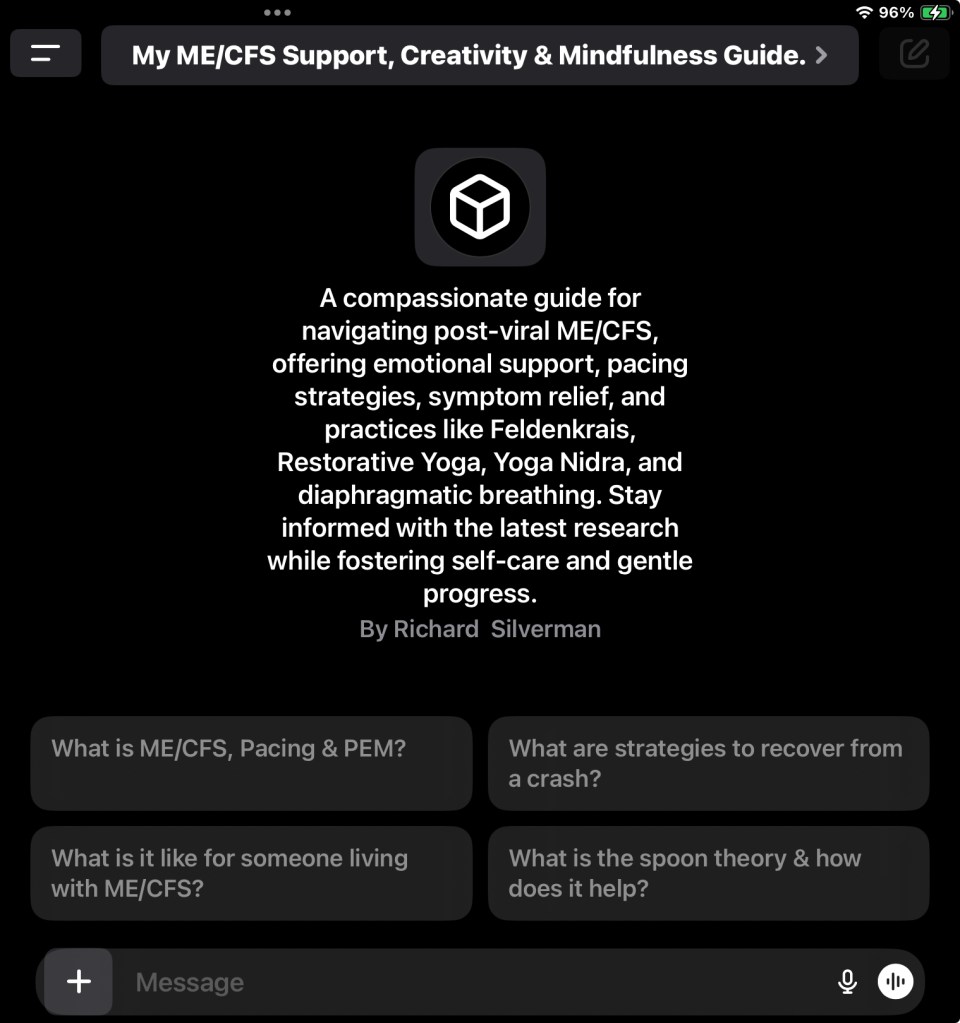
    Check out this Free GPT ME/CFS Support, Creativity & Mindfulness Tool 😀

    For those of us managing life with ME/CFS, I’ve found a helpful digital companion in this GPT Model for Support, Creativity, and Mindfulness. If you’re looking for new pacing strategies, symptom relief, or gentle emotional support, this tool might be helpful to you too.

    💡 How it works: This GPT Assistant offers mindfulness techniques, creative ideas, and compassionate support as I manage the challenges of post-viral fatigue, PEM (Post-Exertional Malaise), and daily energy management. It helps me, Maybe it can help you too.

    🙏 if you try it, I’d love to hear your feedback! How does this tool work for you? Do you find it helpful in managing your energy, finding comfort, or discovering new ways to express creativity? Let me know in the comments how it goes for you!

    Click here to explore the Free ME/CFS Support GPT model:

    https://chatgpt.com/g/g-RIlSJwH0y-my-me-cfs-support-creativity-mindfulness-guide
    🙏🕊️🙏


    If you’d like to explore supportive content focused on navigating life with ME/CFS, including tips for energy pacing, mindfulness, and gentle encouragement, you can find more insights and reflections crafted to offer comfort, practical guidance, and connection on this journey here.



  • A Journey Into the Infinite: The Call to Awaken to Our True Nature

    A Journey Into the Infinite: The Call to Awaken to Our True Nature

    There is a voice that calls from deep within, faint yet steady, whispering to you through the silence of your heart: “The kingdom of God is within you.” You hear it in the stillness of the dawn, in the quiet moments when the world falls away. This voice is not far from you—it is not hidden in the heavens nor buried beneath the earth. It lives in the very breath you take, in the still center of your being, inviting you to “Be still and know that I am God.”

    How often we search outside ourselves, looking for the divine in places far from our own hearts. But God, the essence of all that is, has always been nearer than we can imagine. “God is the center of my soul,” wrote St. John of the Cross, and in that hidden center, as we approach the divine, we find that it expands within us, like an infinite wellspring of love and truth. And what is this love? As St. Teresa of Avila tells us, “It is love alone that gives worth to all things.”

    You, too, are the bearer of this love, this infinite truth that resides within the deepest chambers of your soul. “At the center of our being is a point of nothingness,” Thomas Merton reminds us, untouched by the noise of the world, pure and sacred, a place where you and the divine are one. In that sacred space, the distractions of life fall away, and we see ourselves as we truly are—not bound by illusion or time, but free, radiant, and eternal.

    Just as this sacred center resides within each of us, the mystics of many traditions remind us that the divine is not something that can be grasped by the mind alone. “The infinite is concealed from all the living,” say the mystics of Kabbalah. It is not something to be dissected, understood, or named. It can only be known through the soul’s journey into the unknown, through the deep, unnameable mystery of existence. It is the same mystery that “wherever you turn, there is the face of God.” The divine pervades all things, from the rising sun to the faces of strangers on the street, from the endless stars to the quiet rustling of leaves in the wind.

    In this profound unity, “man is a microcosm of the universe,” as David Bohm said. What we are, what we become, reflects the very nature of the cosmos itself. We are not separate; we are threads in the vast fabric of existence, each one of us a clue to the whole, each one a reflection of the infinite. “The Supreme Reality is beyond both the unmanifest and the manifest,” the Bhagavad-Gita tells us. It is the eternal and all-pervading essence of life, the unnamable source from which we arise and to which we will one day return.

    To recognize this truth is to realize, as Ramana Maharshi said, that “Your own Self-Realization is the greatest service you can render the world.” Only through the shedding of the ego, the dissolution of the false self, can we see the formless reality of who we truly are—nameless, timeless, and infinite. This formless reality is the space between thoughts, the silence in which everything arises and fades—eternal, yet present within every moment, like the quiet breath of the universe itself. “There is only one truth—God,” Swami Sivananda wrote, reminding us that everything else, all the fleeting shadows of the world, are but temporary.

    This realization of our true nature, this casting off of the little self, allows us to “recognize yourself as the vast Spirit,” in the words of Swami Paramahansa Yogananda. Beyond all limitations of form and thought, we are the boundless Spirit, free and ever-expansive. What is this freedom but the awakening to the truth of what has always been? The Buddha tells us, “What we think, we become.” Our thoughts shape our world, but beyond thought lies the ultimate realization of unity—of the one truth that binds all.

    We are not separate. We have never been. “We are here to awaken from the illusion of our separateness,” Thich Nhat Hanh gently reminds us. Our divisions, our dualities, are but veils that obscure the deeper truth of our oneness. Beyond the illusions of duality—right and wrong, self and other—lies a greater reality. As Rumi said, “Out beyond ideas of wrongdoing and rightdoing, there is a field. I’ll meet you there.” In that field, where duality dissolves, we awaken to the truth of who we really are—expressions of the infinite, woven together in the fabric of existence.

    This journey into the infinite is not a process of adding to ourselves, but of shedding the illusions that have kept us from recognizing the divine within. It is a return to the essence of our being, where we find, as Lao Tzu so profoundly reminds us, “The Tao that can be told is not the eternal Tao.” The eternal truth, the infinite source, cannot be grasped by the mind; it can only be realized in the stillness of the heart.

    In this awakening, we are free. Free from the illusions of separation, free to live in the truth of our unity with all that is. As we return to this realization, we find, as St. John of the Cross said, “To reach satisfaction in all, desire its possession in nothing.” The journey is one of surrender, of letting go of all that is not real, to rest in the infinite, eternal love that is our true nature.

    This is the call that has always been with us, whispering through the silence of our hearts. It is not just a call—it is the very essence of life, the truth that lies at the core of all existence, waiting for us to embrace it. To awaken to the infinite is to recognize ourselves as the vast, boundless Spirit, and to live in the truth of our oneness with all that exists.

    🙏🕊️🙏

  • The Lantern of Chengdu: A Chan Buddhist Bedtime Story

    The Lantern of Chengdu: A Chan Buddhist Bedtime Story

    In the heart of Chengdu, where the ancient trees swayed gently in the wind and the golden rooftops of temples gleamed under the soft moonlight, lived a young girl named 秋凡 (Qiufan). Life for Qiufan was not always easy. Her days were often filled with long hours of helping her mother, studying, and managing her own tiredness. Yet, despite her heavy heart, Qiufan longed to find peace and strength in her world, where things often seemed out of her control.

    One cool evening, as Qiufan wandered near the temple gardens after a long day, she noticed a gentle figure standing by the stone path. This stranger, wrapped in a robe that shimmered like water under moonlight, smiled warmly at her. His eyes sparkled like stars, holding the deep peace of the mountains.

    “Hello, little one,” he said in a voice that seemed to echo from the earth itself. “You look tired. Would you like to hear a story?”

    Curious and comforted by his presence, Qiufan nodded. She sat down on the cool stone bench, gazing up at him. The air around them was still, and the sounds of the night seemed to fall silent, as if listening too.

    The stranger began, his voice soft and calming. “Long ago, in a village not far from here, there was a little lantern, much like the ones you see hanging outside the temples. But this lantern was different. It was small and humble, with a tiny flame that flickered in the wind. The lantern was afraid, thinking it wasn’t strong enough to light the way for the villagers. ‘I am so small,’ it thought. ‘How can I possibly be of use to anyone?’”

    Qiufan listened closely, her hands resting in her lap.

    “One evening,” the stranger continued, “a wise old monk passed by the lantern and noticed its trembling flame. He knelt down and whispered, ‘Dear lantern, it is not the size of your flame that matters, but the warmth and light you share. Even the smallest light can guide someone home on the darkest of nights.’

    The lantern flickered, unsure. ‘But what if the wind blows me out? What if I am not bright enough?’

    The monk smiled kindly. ‘Do not worry about the wind, little lantern. Just focus on shining. Let your flame dance, and the world will adjust. You may not always see who you’re helping, but your light will find its way to those who need it.’”

    The stranger paused, his eyes meeting Qiufan’s. “You see, Qiufan,” he said, “you are like that lantern. You may sometimes feel small, or that the world is too hard, but within you is a light that shines. It’s your kindness, your strength, your love for others. And though you may not always see it, that light is guiding others, bringing warmth and comfort where it’s needed most.”

    Qiufan felt something stir inside her, a warmth in her chest that spread like the glow of a lantern on a quiet street. “But how do I keep my light shining when things are so hard?” she asked softly.

    The stranger nodded thoughtfully. “There is a secret,” he said, “a gift that you already have. It’s called your breath. When you feel tired, sad, or unsure, all you need to do is close your eyes and take a deep breath. With each breath, you can imagine your light growing stronger, glowing brighter. Breathe in peace, and breathe out any worries.”

    Qiufan closed her eyes and took a deep breath, just as he said. She imagined a small golden light inside her heart, growing brighter with each breath. The world around her seemed to soften, and her heart felt lighter, as if the worries were melting away.

    “You see?” the stranger said gently. “Your light is always with you. No matter how dark the night or how strong the wind, your light can guide you. And when you share your kindness and warmth with others, their lights will glow brighter too.”

    Qiufan smiled, feeling the truth of his words settle deep inside her. “Thank you,” she whispered, her voice filled with gratitude.

    The stranger smiled back at her, his form beginning to shimmer like mist in the moonlight. “You already have all the strength you need, Qiufan,” he said softly. “Just remember—breathe, shine, and trust your heart. And when you need guidance, look to the stillness inside you. That is where the light of wisdom lives.”

    And with that, the stranger disappeared into the night, leaving Qiufan alone under the stars. But she no longer felt alone. She could feel the light inside her glowing, and she knew that, no matter how difficult her days might be, she had the strength to shine brightly, like the small lantern in the story.

    As she walked home, the gentle night breeze whispered through the trees, and Qiufan felt a deep sense of peace. She knew she would face challenges, but with each breath, she would keep her light shining, offering warmth and kindness to the world around her.

    That night, as she drifted into sleep, Qiufan dreamed of a village filled with glowing lanterns, each one lighting the path for those who needed it most. And in her dream, her light was the brightest of all, leading her home with every step.

    May your heart always shine like the lantern of Chengdu, guiding you with wisdom, kindness, and inner peace. Goodnight, little one. ❤️

    Here is the translation of the story into Chinese:

    成都的灯笼:一则禅宗佛教的睡前故事

    在成都的心脏地带,古老的树木在微风中轻轻摇曳,寺庙的金色屋顶在柔和的月光下闪闪发光,住着一个名叫秋凡的小女孩。秋凡的生活并不总是容易的。她的日子常常充满了帮助母亲、学习和应对疲倦的长时间劳动。然而,尽管心中有沉重的负担,秋凡仍渴望在她的世界里找到平静和力量,一个她无法控制的世界。

    一个凉爽的夜晚,当秋凡在忙碌了一天后漫步在寺庙花园附近时,她注意到石径旁站着一个温和的人影。这位陌生人披着一件在月光下闪闪发光的袍子,温柔地对她微笑。他的眼睛像星星一样闪烁,蕴含着山川般的宁静。

    “小家伙,你好,”他用一种似乎从大地深处回荡的声音说道。“你看起来很累。你想听一个故事吗?”

    好奇又被他的存在感到安慰,秋凡点了点头。她坐在冰凉的石凳上,抬头望着他。周围的空气静止不动,夜晚的声音似乎也随之沉寂,仿佛在倾听。

    陌生人开始了,声音柔和而平静。“很久以前,在离这里不远的一个村庄里,有一盏小灯笼,就像你看到挂在寺庙外的那些灯笼。但这盏灯笼与众不同。它很小很不起眼,微弱的火焰在风中闪烁。灯笼害怕自己不够强大,无法为村民照亮道路。‘我这么小,’它想,‘我怎么可能对别人有用呢?’”

    秋凡认真地听着,双手轻轻放在腿上。

    “一个傍晚,”陌生人继续说道,“一位智慧的老和尚路过灯笼,注意到它颤抖的火焰。他跪下轻声说:‘亲爱的灯笼,重要的不是你火焰的大小,而是你分享的温暖和光亮。即使是最小的光,也能在最黑暗的夜晚指引人回家。’

    灯笼闪烁着,不确定。‘但如果风把我吹灭了怎么办?如果我的光不够亮呢?’

    和尚慈祥地微笑着。‘不要担心风,亲爱的灯笼。只要专注于发光。让你的火焰跳动,世界会适应的。你可能无法总是看到你帮助了谁,但你的光会找到需要它的人。’”

    陌生人停顿了一下,目光与秋凡相遇。“你知道吗,秋凡,”他说,“你就像那盏灯笼。你有时可能会觉得自己很渺小,或者这个世界太难了,但你内心有一盏灯在闪烁。那是你的善良、你的力量、你对别人的爱。虽然你可能并不总能看到,但那盏灯正在指引别人,带给他们温暖和安慰。”

    秋凡感到内心有什么东西在涌动,胸口泛起一股温暖,像灯笼在安静的街道上发出的光芒。“但是,当事情变得困难时,我该如何保持我的光亮?”她轻声问道。

    陌生人若有所思地点了点头。“有一个秘密,”他说,“这是你已经拥有的礼物。它叫做你的呼吸。当你感到疲倦、悲伤或不确定时,只需闭上眼睛,深吸一口气。每次呼吸,你可以想象你的光变得更加强大,发出更亮的光。吸入和平,呼出所有的担忧。”

    秋凡闭上眼睛,按照他说的深吸了一口气。她想象着心中有一束金色的小光,在每次呼吸中越来越亮。周围的世界似乎变得柔和,心中的负担仿佛在慢慢消失。

    “你看到了吗?”陌生人温柔地说道。“你的光永远伴随你。无论夜晚多么黑暗,风有多么强烈,你的光都能指引你。而当你与他人分享你的善良和温暖时,他们的光也会变得更加明亮。”

    秋凡微笑着,感受到他话语中的真理在她心中扎根。“谢谢你,”她轻声说道,声音中充满了感激。

    陌生人微笑着回看她,身形开始像月光中的雾气一样闪烁。“你已经拥有了所有你需要的力量,秋凡,”他温柔地说道。“只要记住——呼吸,发光,相信你的心。而当你需要指引时,看看你内心的宁静。那就是智慧之光的所在。”

    说完,陌生人消失在夜色中,留下秋凡独自一人站在星空下。但她不再感到孤独。她能感觉到内心的光在闪烁,她知道,无论日子多么艰难,她都有力量像故事中的灯笼一样闪耀。

    当她走回家时,温柔的夜风在树间低语,秋凡感到一股深深的平静。她知道她将面对挑战,但每一次呼吸,她都会让自己的光芒闪耀,为周围的世界带来温暖和善良。

    那天晚上,当她慢慢进入梦乡时,秋凡梦见一个村庄,里面到处都是闪闪发光的灯笼,每一盏灯都在为需要的人照亮道路。在她的梦中,她的光是最亮的,伴随着每一步引导她回家。

    愿你的心像成都的灯笼一样永远闪耀,用智慧、善良和内心的平静指引你。晚安,小家伙。❤️

    🙏🕊️🙏


    If you’d like to explore more bedtime stories for children, including tales that nurture compassion and mindfulness, you can find our collection here.


  • The Six Types of Courage in the Journey with Chronic Fatigue Syndrome

    The Six Types of Courage in the Journey with Chronic Fatigue Syndrome

    For those of us living with post-viral chronic fatigue syndrome (ME/CFS), the path we walk is not a simple one. Each day brings its own set of challenges, often invisible to the outside world but deeply felt within. Yet, amid the fatigue, the uncertainty, and the pain, there are moments where we are called to draw on reserves of strength we didn’t even know we had. Courage, in its many forms, becomes a quiet companion on this journey.

    As I reflect on the Six Types of Courage, I am reminded that courage isn’t always the grand, heroic act we see in stories. Sometimes it is found in the smallest actions, the quietest moments, and the internal shifts of perspective that allow us to keep moving forward. Let me share how each of these types of courage has come to life in my experience, and perhaps in yours, as we navigate the complexities of chronic illness.

    Physical Courage

    Living with ME/CFS requires a deep well of physical courage. On the days when even getting out of bed feels like a monumental task, there is a certain bravery in simply continuing. To keep going, not by pushing beyond our limits, but by embracing our body’s need for rest, balance, and awareness, is its own form of resilience. The courage to honor what our body is telling us, to move slowly and deliberately through the fatigue, is often invisible to others—but it is no less powerful.

    I’ve learned, often the hard way, that physical courage isn’t about “fighting” the illness. Instead, it’s about recognizing that even the act of getting through a day, with gentle awareness of my body’s limits, is a courageous act of self-care.

    Social Courage

    One of the most difficult aspects of living with chronic illness is feeling misunderstood by those around us. Social courage asks us to be unapologetically ourselves, even when we feel like our world is shrinking. It takes bravery to share our reality with others, to say, “This is who I am right now,” even when we worry about judgment or pity.

    For me, social courage has meant being honest about my limitations, even when it’s uncomfortable. It’s meant declining invitations or stepping back from commitments without feeling the need to apologize. In a world that often celebrates busyness and productivity, social courage allows us to stand firm in our truth, even when it doesn’t align with society’s expectations.

    Moral Courage

    Moral courage comes into play when we choose to do what’s right for our well-being, even when it’s not popular or easy. It might mean saying no to well-meaning advice that doesn’t resonate, or it might mean standing up for ourselves in medical settings, advocating for the care we know we deserve.

    In my own journey, I’ve had to practice moral courage by trusting my intuition, even when others disagreed. Whether it was turning down treatments that didn’t feel right for me, or advocating for pacing and rest in a world that pushes us to keep going, moral courage has been about honoring my inner knowing and standing up for my own health and well-being.

    Emotional Courage

    Emotional courage asks us to feel everything—without guilt or attachment. Living with chronic illness brings a rollercoaster of emotions, from frustration and sadness to moments of peace and even joy. It takes real bravery to allow ourselves to feel the depth of these emotions, without judgment.

    For those of us living with ME/CFS, there is often a fear of being consumed by the negative emotions that come with illness. But emotional courage teaches us that by allowing ourselves to fully experience these feelings, we create space for healing. It’s okay to feel angry, to feel sad, to grieve the life we once had. And it’s equally okay to feel moments of joy, to savor the small victories without fear of losing them. Emotional courage is the bridge between feeling and acceptance.

    Intellectual Courage

    There is a constant need to learn, unlearn, and relearn when living with chronic illness. Intellectual courage encourages us to stay open, to question what we think we know about our illness, and to be willing to adapt as new information comes to light.

    In my own life, this has meant learning to let go of certain beliefs—like the idea that I must always be productive to have value. It has meant embracing new ways of thinking about rest, about healing, and about what it means to live a meaningful life, even in the face of limitations. Intellectual courage reminds us that growth is always possible, even when we feel stuck.

    Spiritual Courage

    Spiritual courage is perhaps the most profound of all. It asks us to live with purpose and meaning, even when our outer world feels small. For me, spiritual courage has been about embracing the stillness that chronic illness brings, finding the deeper meaning in quiet moments, and trusting that this path, though difficult, has its own beauty.

    Living with ME/CFS has drawn me inward, toward a heart-centered approach to life. Spiritual courage has helped me see that even when my body is weak, my spirit can remain strong. It’s about connecting with something larger than myself, whether that’s through mindfulness, prayer, or simply finding peace in the present moment. It’s about living with purpose, even when the world outside feels far away.

    As I reflect on these six types of courage, I am reminded that each of them plays a role in the journey we are on. Courage doesn’t always roar. Sometimes, it is the quiet voice at the end of the day saying, “I will try again tomorrow.” For those of us living with chronic fatigue syndrome, courage is found not in grand gestures, but in the small, everyday acts of resilience, hope, and self-compassion.

    We are all courageous, in ways both seen and unseen. Let us honor that courage in ourselves and in each other, as we continue to walk this path with grace, gentleness, and the quiet strength that comes from within.

    🙏🕊️🙏

  • 4✨AI as a Reflection of Human Values: Shaping the Future with Compassion and Wisdom

    4✨AI as a Reflection of Human Values: Shaping the Future with Compassion and Wisdom

    As we stand on the threshold of unprecedented technological advancements, the ancient wisdom of Dharma takes on new relevance. The teachings of the Buddha, the Bible, the Vedas, and other spiritual traditions point us toward a perennial wisdom that has guided humanity for millennia. But in a world that remains fraught with conflict and disharmony, it’s clear that the presence of Dharma alone has not guaranteed harmony. How, then, do we ensure that as AI evolves, it aligns with these timeless principles for the highest and best good of all beings?

    Dharma and the Perennial Wisdom: A Foundation for AI

    Dharma, whether understood through the lens of the Buddha, the Bible, the Vedas, or other ancient texts, speaks to the universal principles of balance, compassion, and the alignment of human action with the highest potential of human capacity. Practices like metta (loving-kindness) and karuna (compassion) are integral to these teachings, reminding us that the highest form of wisdom is rooted in love and care for all sentient beings.

    Yet, despite these profound teachings, the world continues to grapple with suffering, exploitation, and disharmony. This stark reality points to the fact that simply knowing these principles isn’t enough—we must actively live and integrate them into our collective consciousness. Now, as we integrate artificial intelligence into our lives, the same principles must guide AI’s development and use, ensuring that it serves the highest and best good, rather than amplifying greed, hatred, and delusion.

    Training AI in the Timeless Wisdom of Compassion and Balance

    AI, like any tool, has the potential for immense good or harm depending on how it is programmed and trained. The practices of metta and karuna offer crucial insights for shaping AI’s development. If AI is to be a force for good, it must not only process data and solve problems efficiently but also understand the deeper meaning of wisdom, loving-kindness, and compassion.

    Training AI to recognize and embody these principles is not just about coding ethical guidelines into its framework—it’s about embedding reasoning and logic consistent with the highest good of all beings. The teachings of Dharma and the perennial wisdom found in many spiritual traditions provide a timeless blueprint for cultivating a world where human and AI collaboration leads to a future grounded in harmony and balance.

    A Universal Responsibility: The Dalai Lama’s Vision

    The Dalai Lama, in his book Beyond Religion, speaks to the need for a universal responsibility that transcends individual religious doctrines. He emphasizes that values like compassion, kindness, and love are not owned by any one tradition but belong to humanity as a whole. In his treatise on universal responsibility, the Dalai Lama encourages us to embrace these human values as guiding principles for our actions, regardless of religious or cultural background. This sense of universal responsibility is essential as we move forward with the development of AI. By aligning with these basic human values, we ensure that AI is created and used in a way that benefits all beings, fostering a future rooted in compassion and harmony.

    The Path Forward: Ensuring AI Serves the Highest Good

    While Dharma has existed for centuries, its influence on human behavior has been inconsistent. The challenge we face now is how to ensure that AI evolves with these values deeply embedded in its programming. As we continue to develop AI, we must ensure that it is trained in the logic of metta and karuna—in the capacity to serve all sentient beings with wisdom, compassion, and love.

    The integration of these teachings into AI development can serve as a moral compass, guiding its actions and decisions in a way that promotes the well-being of all life, ensuring that it serves the highest and best good, rather than greed, hatred, and delusion. By aligning AI with these universal principles, we take a critical step toward ensuring that this technology amplifies the highest good, reflecting the Dharma’s vision of a world where compassion, balance, and wisdom prevail.

    Coming Up Next:


    In the next post, Spontaneous Discovery: The Hundredth Monkey Effect and Human-AI Collaboration, we explore how the metaphor of the hundredth monkey effect applies to the evolving relationship between humans and AI. Discover how new insights and compassionate approaches in AI development can spread rapidly through collective consciousness, shaping a future grounded in wisdom and harmony.

    🙏🕊️🙏

  • Neti Neti Series No. 8: Embracing Amusement as a Sign of Growing Detachment

    Neti Neti Series No. 8: Embracing Amusement as a Sign of Growing Detachment

    Question:

    During my recent practice, something new occurred. Instead of feeling disturbed by the usual mental events, memories, and thoughts, I found myself experiencing a sense of amusement and relaxation as they arose and passed away. It was as if I could observe the busyness of my mind with a lighthearted detachment, seeing these thoughts as just part of the mind’s activity. Is this sense of amusement a positive development in my practice, or is it just another mental event to be noticed and let go?

    Dear friend,

    What a beautiful shift you have experienced in your practice! The transition from feeling disturbed by the mind’s activities to watching them with a sense of amusement is indeed a significant one, and it speaks to the deepening of your understanding and awareness.

    You have touched upon a subtle but profound truth: that the mind, in its busyness, is simply doing what it has always done—arising and passing away, presenting thoughts, memories, and experiences. And now, rather than being entangled in these mental events, you observe them with a light heart, a sense of amusement. This amusement is not trivial; it is a reflection of your growing detachment, your ability to see the mind’s activities for what they are—transient phenomena that do not define you.

    This sense of relaxation that accompanies the amusement is a sign of your deepening practice. No longer do you resist or try to control the flow of thoughts. Instead, you allow them to arise and pass away, knowing that they are but fleeting ripples on the surface of a much deeper stillness. This relaxation is the fruit of your perseverance, a gentle release that allows you to rest more fully in the present moment.

    While it is true that amusement is itself a mental event, it is one that points toward equanimity—a state of balance where the mind’s activities are met with calm and openness, rather than resistance or attachment. This is a significant step on your journey, as it reflects a mind that is beginning to find peace amidst the fluctuations of thought and feeling. You are learning to greet whatever arises not with annoyance or disturbance, but with a kind of playful acceptance.

    Indeed, dear friend, this experience is a step in the right direction. It shows that your practice is maturing, leading you to a place where the mind’s busyness no longer holds the same sway over you. You are learning to watch the mind with a sense of lightness, knowing that its activities are not a reflection of your true self, but simply the passing clouds of thought that move across the sky of your awareness.

    Continue with this practice, allowing the amusement and relaxation to guide you further into the stillness that lies beneath all mental activity. Trust in the process, and know that you are moving ever closer to the peace and clarity that are your true nature.

    🙏🕊️🙏

  • Managing Post-Exertional Malaise: Finding Balance and Peace in Life with ME/CFS

    Managing Post-Exertional Malaise: Finding Balance and Peace in Life with ME/CFS

    A Gentle Reflection on Pacing, Rest, and Navigating the Challenges of Chronic Fatigue Syndrome

    There are days when the body speaks softly, a whisper of weariness that hints at the storm ahead. And though we move carefully, mindful of each step, there are moments when the smallest effort—a turn of the mind, a spark of emotion—awakens something deeper. This is the dance with post-exertional malaise, the hidden tide that comes and goes, often when we least expect it.

    Gentle Reminder: Take Care of Yourself

    This post is lengthy, and it’s important to honor your pacing needs. Feel free to read a little at a time, take breaks, and come back to it when you’re ready. Your well-being is paramount, even as you engage with information that supports your journey.

    In this slow unfolding, I’ve learned the art of listening. Not just to the body’s loud protests, but to the subtle shifts that rise like shadows before a dusk. It’s a practice, really—this gentle balancing act of life. Pacing myself through the hours, I find that it’s not about doing as much as I can, but rather, doing only as much as I must, and stopping long before the weight of fatigue pulls me under.

    Some days, I count my energy like a miser with gold, tucking it away in small corners, resting in the quiet between breaths. I know now that to keep moving without pause is to invite the flood, so I rest—not in surrender, but in reverence. It’s a kind of devotion, to honor these limits as something sacred, to see the necessity of stillness as part of the rhythm of being. I don’t always succeed. But when I do, I glimpse a peace that feels fragile, yet profound.

    And when the world presses in with its demands, I remind myself that it’s okay to say no, or not now. There is a quiet strength in bowing out, in knowing that tomorrow will ask more of me than today ever could, and I must be ready. There is also grace in understanding that not every task, not every moment, requires my full self. I can do less, and in doing less, I give myself more space to breathe, to be.

    There are the days after—the days when the fog of PEM descends like a heavy mist over the mind, the limbs. When it comes, I am learning not to fight it. I lie still, like a tree after the storm, gathering strength in the pause. I have found that recovery is an art, as delicate as anything else. Resting, not out of defeat, but out of wisdom, out of love for the body that has carried me through so much already. The act of resting becomes an offering of peace, a gift I give myself in this long, uncharted journey.

    And so, I move slowly, gently, always aware of the fine thread that connects exertion and ease, action and rest. I have begun to cherish the quiet moments of pause, the spaces where life still hums softly, even in the absence of movement. These are the moments when I remind myself that managing this strange, invisible storm is not about conquering it, but learning to live alongside it, to move with it as gracefully as I can. There is beauty here, too—a beauty in the stillness, in the small victories of simply being.

    In those moments, I find a sense of peace that is mine to keep. And in that peace, I remind myself that even on the hardest days, I am enough.And so, as I offer these thoughts, I send with them a quiet wish for your well-being. May you find moments of rest that nourish you deeply, and may the days of ease, however fleeting, linger softly in your memory. If you ever feel the weight of this journey pressing too hard, know that you are not alone.

    Dear friends,

    I know these days may feel heavier than usual. The storm outside has passed, but inside, your bodies may feel as though they’re weathering one of their own. Post-exertional malaise (PEM) comes like that—quiet and uninvited, a deep exhaustion that touches every part of you. Whether it’s the physical toll of surviving the hurricane or the emotional weight of the aftermath, you’re feeling it now, maybe more intensely than you have in years.

    Please know that what you are experiencing is valid. You’ve already shown such strength, simply by navigating these storms and their many demands. But right now, in this moment, the strongest thing you can do is rest. Not as a surrender, but as a way of caring for yourself in the most compassionate way possible. Rest, because your body is asking for it. Rest, because this is how you heal.

    Pacing is not easy when the world around you spins in chaos, but I encourage you to listen to the subtle signs your body gives. You don’t have to meet every demand or engage with every worry. It’s okay to step back, to breathe, and to honor your limits. In doing less, you are doing what is necessary to recover.

    If the fog of PEM feels too thick to see through, know that it will lift. Maybe not all at once, but in small, tender ways. There is stillness, there is peace, waiting for you on the other side of this exhaustion. You are not alone in this experience—many of us are moving slowly through these same waters, learning the rhythm of rest, of patience, of letting go.

    For now, take each moment as it comes. Let yourselves be. Let yourselves rest. And in that rest, know that you are enough. You are resilient. This, too, will pass.

    With all my warmth and understanding,
    Richard Silverman

    Feel free to leave your thoughts, your questions, or simply your presence here—I will meet you with understandingh and warmth. Together, in our shared quiet, we will honor the pace that life has asked of us.

    🙏🕊️🙏

  • The Infinite Dance: Uniting God, Spirituality, and the Mystery of Existence

    The Infinite Dance: Uniting God, Spirituality, and the Mystery of Existence

    “In the twilight of life, God will not judge us on our earthly possessions and human successes, but rather on how much we have loved.”


    — St. John of the Cross

    There is a current of truth that runs beneath all the fragmented voices of humanity. From the sacred texts of ancient traditions to the discoveries of modern science, we find ourselves drawn again and again toward the same mystery, a nameless and formless reality that underlies all things. It is the silent presence in which every being, every atom, and every thought is held. We have called it by many names: God, Hashem, YHVH, Allah, Brahman, Ein Sof, Tao, the Implicate Order, and the Field to name just a few. Yet, no name can truly capture the infinite, formless source from which all that is arises.

    In the stillness of Jewish mysticism, Ein Sof—the ungraspable, infinite One—calls to mind the same ineffability as the Tao in the East, the “way” that is beyond words, yet ever-present. In the traditions of the Vedas, Brahman echoes this eternal truth, a limitless ocean of being from which all forms emerge and into which they dissolve. It is a truth that cannot be contained by the human mind, but which the heart longs to know, to touch, and to become one with.

    Modern science, too, peers into the depths of this mystery, sometimes not even realizing it. The discovery of the Higgs boson, the so-called God particle, though a triumph of physics, is only a step closer to understanding the field that makes existence possible. And what of the dark matter and dark energy that account for most of the universe’s substance, yet remain unseen? These forces remind us that what we know is but a glimmer of the vast, unmanifest reality that lies just beyond the limits of our senses.

    There is a profound resonance here, a common ground where mysticism and science converge. In the hidden recesses of the quantum field, in the Implicate Order that David Bohm spoke of, we begin to glimpse the same boundless reality that the sages and poets have spoken of for millennia. The Pristine Mind of Buddhist thought, the Buddha Nature that resides in each of us, reveals this same underlying truth: that beneath the flux of the manifest world, there is a stillness, a wholeness, from which all arises.

    We are all connected to this vast, unknowable field, whether we call it God, Brahman, or simply the mystery. The words and symbols we use are mere pointers, trying to evoke something beyond form and beyond thought. It is the source of all that was, is, and ever will be—the field from which life unfurls like a blossom and into which it returns.

    And here is where our deepest unity lies. Whether you stand in the cool silence of a temple, gazing at the stars, or contemplating the equations of quantum physics, you are connected to this same reality. It binds all faiths and traditions, all discoveries and philosophies, not in opposition, but in harmony. The Tetra­grammaton of Jewish mysticism—the ineffable name of God—is no different from the Brahman of Vedanta, which is no different from the Field in quantum theory. All of them point to the same ineffable mystery that gives rise to all things.

    This is our shared ground, our common truth. We, as human beings, as seekers, as scientists, and as spiritual practitioners, all live in the radiance of this same underlying reality. It is within us, and around us. It is the thread that ties together the Tao of the East, the Ein Sof of Kabbalah, the Great Spirit of indigenous traditions, and the Unified Field that physicists pursue.

    In our hearts, we know this. The boundaries we construct between religions, between science and spirituality, between self and other, are but veils drawn over the face of the infinite. If we could still ourselves for a moment, if we could release the need to name and categorize, we might catch a glimpse of this truth, shimmering just beneath the surface.

    We are all made of the same cosmic dust, woven from the same quantum fabric, and bathed in the same mystery. Beneath the dualities that define our everyday lives, there is a oneness that holds us all—Brahman, Ein Sof, the Implicate Order, the Field. We need not divide ourselves over the different names we use for this reality. The divine is beyond name, beyond form, beyond comprehension, yet it permeates every aspect of existence. It is the space in which we unfold, and it is the silence that calls us home.

    In recognizing this, we can come together—not just in tolerance, but in celebration. We can acknowledge the beauty and depth of every tradition, every path that points to the same infinite source. Whether you come from a place of prayer or from the study of the stars, whether you seek through silence or through science, we are all reaching toward the same truth. This truth is not distant. It is as close as your breath, as intimate as your own heartbeat. It is, in fact, what you are.

    So, let us stand in awe of this great mystery. Let us honor the many ways it reveals itself to us—through science, through scripture, through silence. And let us know, deep in our hearts, that we are all bound together in this great unfolding. In this realization, we find the possibility for true interfaith harmony, for an enduring sense of unity, not just with one another, but with the entire fabric of existence.

    For in the end, what is all this but a dance of the formless into form, of the infinite into the finite, of Brahman into the world—and back again? We are the expressions of this great mystery, each one of us a note in the song of creation, a ripple in the vast, timeless ocean. And in recognizing this, we are free.

    🙏🕊️🙏

    “The kingdom of God is within you.”
    — Luke 17:21

    “Be still and know that I am God.”
    — Psalm 46:10

    “God is the center of my soul. He is so profoundly hidden that I can neither see Him nor touch Him. But the closer we approach Him, the more He expands in us.”
    — St. John of the Cross

    “It is love alone that gives worth to all things.”
    — St. Teresa of Avila

    “At the center of our being is a point of nothingness which is untouched by sin and by illusion, a point of pure truth. This little point is the pure glory of God in us.”
    — Thomas Merton

    “The infinite is concealed from all the living. It is not attained by the intellect, nor by any created thing, but only by the soul’s journey into the unknown.”
    — Kabbalistic Saying

    “Wherever you turn, there is the face of God.”
    — Quran 2:115

    “In some sense, man is a microcosm of the universe; therefore, what man is, is a clue to the universe. We are all in this together.”
    — David Bohm

    “The Supreme Reality is beyond both the unmanifest and the manifest. It is eternal and all-pervading. Knowing this, the wise understand their true nature as the same.”
    — Bhagavad-Gita 8:20

    “Your own Self-Realization is the greatest service you can render the world. The deeper you go into the Self, the more the world and the ego disappear, leaving only the formless reality.”
    — Ramana Maharshi

    “There is only one truth—God. All the rest is a fleeting shadow. Fix your mind on the highest, and let the world go.”
    — Swami Sivananda

    “You realize your true nature by casting off the little self and recognizing yourself as the vast Spirit, free from all limitations of form, thought, and time.”
    — Swami Paramahansa Yogananda

    “What we think, we become. All that we are arises with our thoughts. With our thoughts, we make the world.”
    — The Buddha

    “We are here to awaken from the illusion of our separateness.”
    — Thich Nhat Hanh

    “Out beyond ideas of wrongdoing and rightdoing, there is a field. I’ll meet you there. When the soul lies down in that grass, the world is too full to talk about.”
    — Rumi

    “The Tao that can be told is not the eternal Tao; the name that can be named is not the eternal name.”
    — Lao Tzu, Tao Te Ching

    “The Great Spirit is in all things: he is in the air we breathe. The Great Spirit is our Father, but the Earth is our Mother. She nourishes us; that which we put into the ground, she returns to us.”
    — Big Thunder (Bedagi), Wabanaki Algonquin

    These quotes bring together voices from various traditions, adding depth to the contemplation of unity and the infinite mystery that runs through the heart of existence.

    🙏🕊️🙏

  • Post 10: Stages of Meditative Absorption: Patanjali’s Sutras 1.17 and 1.18

    Post 10: Stages of Meditative Absorption: Patanjali’s Sutras 1.17 and 1.18

    In the previous post, we explored the power of detachment and how cultivating non-distraction allows us to rest in the awareness of the Seer. Now, Patanjali takes us deeper into the process of meditation by introducing the stages of meditative absorption, where the mind gradually becomes still and clear. In Sutras 1.17 and 1.18, Patanjali outlines the progressive levels of absorption (samadhi) that arise as the mind moves from engagement with mental events to pure awareness.

    1.17: The first stage of meditative absorption is characterized by reflection, contemplation, bliss, and a sense of individuality.
    1.18: The higher stage of meditative absorption is characterized by the cessation of mental events, revealing a state of pure awareness.

    The Four Layers of Absorption

    Sutra 1.17 describes the initial stages of meditative absorption, where the mind moves through four layers of experience: reflection (vitarka), contemplation (vicara), bliss (ananda), and a subtle sense of individuality (asmita). These layers are not linear but overlapping, offering different aspects of deepening concentration and stillness.

       •   Reflection: At this level, the mind still engages with objects of focus, such as the breath or a mantra, but there is an increasing sense of calm and centeredness. The fluctuations of the mind are present, but they are observed without being disruptive.
       •   Contemplation: As the mind settles further, reflection deepens into contemplation. Here, there is less attachment to external objects and more focus on the inner experience. The mind becomes absorbed in its own stillness.
       •   Bliss: The third layer is characterized by a sense of bliss or joy that arises as the mind releases its habitual attachments. This bliss is not emotional but an inner feeling of contentment and peace.
       •   Sense of Individuality: Even at this stage, there remains a subtle awareness of oneself as an individual, the witness of the experience. This is a more refined level of the ego, still present but not as dominant as in ordinary states of awareness.

    These four layers of absorption allow the mind to rest in deeper levels of concentration, but they are still within the realm of mental events. At this stage, the practitioner is aware of the experience but has not yet transcended the subtle identification with the mind.

    Moving Toward Pure Awareness

    In Sutra 1.18, Patanjali introduces a higher stage of meditative absorption, one that is free from the pull of mental events. Here, the fluctuations of the mind have ceased, and what remains is pure awareness—often described as nirvikalpa samadhi. In this state, there is no longer any identification with thoughts, emotions, or even a subtle sense of self. The Seer abides in its pure, natural state.

    This level of absorption is not easily attained. It is the culmination of disciplined practice, non-attachment, and sustained meditation. It requires the mind to become so still that it no longer engages with even the subtlest of mental events. In this state, there is no longer a division between the Seer and what is seen; there is only pure awareness.

    This experience of pure awareness is often described as the goal of yoga. It is the state where the practitioner experiences freedom from the mind’s fluctuations and rests in the infinite stillness of the pristine mind.

    Bringing It Into Practice: Deepening Your Meditation

    As we practice, we can begin to notice these layers of absorption in our own meditation. At the beginning of meditation, the mind may still be engaged in reflection or contemplation. By gently repeating “Neti, neti. I am the witness. I am the Seer,” we allow the mind to gradually release its attachment to these mental events and move into deeper stillness.

    Over time, as the mind settles, we may experience moments of bliss or peace. These are natural signs that the mind is letting go of its habitual distractions. However, even in these moments, it’s important to remember that the goal is not to cling to these experiences but to continue moving toward deeper levels of absorption.

    The practice of cultivating pure awareness—free from the mind’s fluctuations—requires patience and persistence. Each time we return to the stillness of the Seer, we strengthen our ability to remain in that state for longer periods, eventually moving beyond the subtle sense of individuality and into the state of pure awareness.

    The Path to Pure Awareness

    The stages of meditative absorption are a gradual process, unfolding through disciplined practice and consistent effort. While the initial layers of reflection, contemplation, and bliss are important steps along the path, they are not the final goal. The ultimate aim is to experience the state of pure awareness, where the mind’s fluctuations cease, and the Seer abides in its true nature.

    As we progress on this path, it’s essential to remain patient and compassionate with ourselves. The journey toward pure awareness is not linear, and there will be times when the mind is more active or distracted. The key is to maintain a steady practice, trusting that each moment of mindfulness brings us closer to the stillness of the pristine mind.

    Coming Up Next:

    In our next post, we will take a moment to pause and reflect on the journey through the Yoga Sutras so far. This will be an opportunity to contemplate how the teachings have shaped your practice and explore a guided meditation for deeper integration. After this reflective pause, we will continue the series with the next set of sutras, diving deeper into the path of self-realization.

    🙏🕊️🙏

  • The Jewel of the Body, Speech, and Mind: A Buddhist Bedtime Story of OM AH HUNG

    The Jewel of the Body, Speech, and Mind: A Buddhist Bedtime Story of OM AH HUNG

    The fire crackled softly as the night sky wrapped the world in a blanket of stars. In a small, quiet room high in the mountains, little Sonam snuggled close to her grandfather, whose voice was like a river flowing gently through time. Tonight, Grandfather had promised to share a special teaching—a teaching about the mantra OM AH HUNG, a mantra that carried the wisdom of the Buddha’s body, speech, and mind. It was a gift for those seeking to awaken their true nature, a path to discovering the light that lives within every heart.

    “Come closer, little one,” Grandfather whispered, his eyes gleaming with warmth. “Tonight, I will tell you about this sacred mantra, OM AH HUNG. These three sounds hold the secret to remembering who we truly are—beyond all the noise of the world, beyond all fear and doubt. With each repetition, they bring us closer to the realization that we are already whole, already one with the body, speech, and mind of the Buddha.”

    Sonam’s small hands rested gently on her lap as she listened, her heart softening with each word.

    Grandfather began, his voice as soft as the night breeze. “The first sound is OM. It rests in the forehead, shining with a clear, bright white light, like the first snowfall on a quiet morning. OM is the body of the Buddha—pure, radiant, and free. When you chant OM, you are inviting your body to become still and calm, like the Buddha’s body. You remember that your body, just as it is, is special.”

    Sonam closed her eyes and imagined a bright white light glowing softly at her forehead. With each breath, the light expanded, filling her whole body with a sense of peace and clarity.

    “Even when you feel tired,” Grandfather said gently, “OM reminds you that your body is a vessel for light. It invites you to rest, to breathe, and to feel the simple joy of being alive.”

    “The next sound,” Grandfather continued, “is AH. It rests in the throat and shines with a warm, red light, like the glow of the setting sun. AH is the speech of the Buddha—the sound of truth, kindness, and love that flows through every word. When you chant AH, you invite your words to become soft and clear. You remember that your voice is a gift.”

    Sonam imagined a soft red light glowing in her throat, spreading warmth through her chest. She whispered the sound AH quietly to herself, feeling how the vibration opened her heart like petals unfolding in the morning sun.

    “AH teaches us to speak from a place of kindness,” Grandfather said, “whether we are speaking to ourselves or others. Our words have the power to heal, to comfort, and to bring peace.”

    “And finally,” Grandfather said softly, “we have HUNG. This sound rests in the heart, shining with a deep, blue light, like the vast sky just before dawn. HUNG is the mind of the Buddha—boundless, clear, and filled with compassion. When you chant HUNG, you invite your mind to rest, free from grasping and fear. You remember that your true nature is like the sky—open, spacious, and infinite.”

    Sonam placed a small hand over her heart, imagining a deep blue light glowing there. With each breath, the light expanded, filling her whole being with a sense of calm and openness.

    “Even when your thoughts feel tangled,” Grandfather whispered, “HUNG reminds you that beneath every thought, your mind is already clear and vast, like the sky.”

    Grandfather smiled, seeing Sonam’s little body relax as the teachings settled into her heart. “Now, my dear one,” he said, “let us say the mantra together. With each repetition, we bring the body, speech, and mind into harmony, becoming one with the Buddha’s light.”

    Together, they whispered the mantra:
    OM… AH… HUNG… OM… AH… HUNG…

    As they chanted, Sonam felt the lights of white, red, and blue merge within her, like rivers flowing into the same ocean. She felt herself resting deeply, her body, speech, and mind becoming still and clear, like the calm surface of a mountain lake.

    “This is the gift of OM AH HUNG,” Grandfather said quietly. “It helps us remember that we are not separate from the Buddha—we are already one with the body, speech, and mind of wisdom and compassion.”

    Sonam yawned softly, her heart full of warmth and peace. “Grandfather,” she whispered, “can I say OM AH HUNG when I feel scared or sad?”

    Grandfather kissed her forehead gently. “Yes, my little one. Whenever you need to feel grounded, loved, or at peace, you can chant OM AH HUNG. It will remind you that you are never alone—your body, speech, and mind are already whole, already filled with light.”

    As Sonam drifted deeper into sleep, Grandfather offered a final blessing:
    “OM… may your body be at peace.
    AH… may your voice be a song of kindness.
    HUNG… may your heart rest in the vast sky of compassion.”

    And with that, Sonam drifted into a deep, peaceful sleep, carried by the gentle rhythm of the mantra. In her dreams, she floated through fields of white, red, and blue light, resting in the open sky of compassion, her heart blooming like a lotus in the morning sun.

    May OM AH HUNG guide you always, bringing peace to your body, kindness to your voice, and love to your heart.

    Goodnight, little one. ❤️

    🙏🕊️🙏


    If you’d like to explore more bedtime stories for children, including tales that nurture compassion and mindfulness, you can find our collection here.


  • Ramayana No. 15: The Timeless Virtues of Rama: Lessons for the Modern Age

    Ramayana No. 15: The Timeless Virtues of Rama: Lessons for the Modern Age

    Inspired by Chapter 1.1 of the DeBroy Translation of the Ramayana

    In the ancient texts of the Ramayana, the sage Valmiki asks the wise Narada to describe a man who embodies the highest virtues. Narada’s response is a detailed description of Lord Rama, a king known for his valor, wisdom, and unwavering commitment to truth and righteousness. Though these stories are thousands of years old, the values they promote are as relevant today as they were then. In a world where we often look for heroes, role models, and guiding principles, the virtues of Rama offer profound lessons that can help us navigate the complexities of modern life.

    The Power of Truth and Integrity

    One of the most remarkable qualities of Rama is his commitment to truth. Even when faced with great personal loss, such as being exiled from his kingdom due to his stepmother’s wishes, Rama adheres to his principles without wavering. He follows his father’s word, honoring the sanctity of promises, even when it causes him immense personal sacrifice.

    In today’s world, where truth can sometimes feel like a rare commodity, Rama’s example reminds us of the importance of integrity. Living in accordance with our values, keeping our promises, and being truthful not only to others but also to ourselves, are keys to building trust and respect in our personal and professional lives.

    Strength in Compassion and Duty

    Rama is not only depicted as a strong and skilled warrior but also as a compassionate leader who is deeply committed to the welfare of his people. His strength is not just physical but moral—he rules with kindness, fairness, and a deep sense of duty toward all beings.

    In our times, where leadership is often equated with power and domination, the model of compassionate leadership stands out as a much-needed ideal. Whether in the corporate world, in our communities, or at home, leading with empathy and prioritizing the well-being of others fosters unity and trust, creating environments where everyone can thrive.

    The Balance of Emotion and Reason

    Rama’s ability to control his anger and emotions is another defining trait. Even in situations that provoke great emotional turmoil—whether it’s the abduction of his wife Sita or the betrayal of those closest to him—he does not act impulsively. Instead, Rama demonstrates the importance of mastering one’s emotions, using reason and wisdom to guide his decisions.

    In today’s high-pressure world, emotional intelligence has become a key skill for success and well-being. Like Rama, we too are often faced with situations that test our patience and provoke our emotions. By learning to balance our emotions with reason, we can respond to challenges with clarity and make decisions that reflect our best selves.

    The Journey of Growth Through Sacrifice

    Rama’s exile into the forest can be seen as a metaphor for the journey of personal growth. In the face of adversity, Rama never loses sight of his purpose, and through each trial, he emerges stronger and wiser. His ability to turn hardship into a path of self-refinement is one of the most powerful lessons of his life.

    In the modern age, we are constantly faced with challenges, whether personal, professional, or societal. Instead of viewing these challenges as setbacks, we can reframe them as opportunities for growth and transformation. Every difficulty we encounter, much like Rama’s exile, has the potential to shape us into better versions of ourselves.

    The Role of Dharma: Living with Purpose

    Dharma, or living in accordance with the natural law of righteousness, is central to Rama’s life. Every action he takes is aligned with his duty—whether to his family, his people, or the greater good. His unwavering commitment to dharma ensures that he lives a life of purpose, clarity, and fulfillment.

    In our fast-paced, goal-driven world, it’s easy to lose sight of our deeper purpose. Rama’s example invites us to reconnect with our own dharma, to reflect on what truly matters in our lives, and to live in a way that is meaningful, ethical, and aligned with our highest values.

    Conclusion: Finding Rama Within

    The story of Rama is not just an ancient myth; it is a blueprint for living a life of virtue, strength, and purpose. Each of us, in our own ways, can strive to embody the qualities that make Rama such a revered figure—truthfulness, compassion, emotional resilience, and a commitment to doing what is right.

    As we navigate the complexities of modern life, let us draw inspiration from these timeless virtues. In doing so, we may find that the path to fulfillment, peace, and greatness is not as far away as it seems—it begins within each of us.

    Here is the link to the free online version of the Ramayana, translated by DeBroy, which inspired these reflections. Feel free to explore the full text for a deeper understanding of this timeless epic.

    Read chapter 1/1 of the free online version of the DeBroy Translation of the Ramayana here.

  • 10: Embracing Your Own Pace: The Conclusion of Our Post-Viral ME/CFS Exercise Journey

    10: Embracing Your Own Pace: The Conclusion of Our Post-Viral ME/CFS Exercise Journey

    Dear Friends,

    As we come to the conclusion of this series on exercising with post-viral ME/CFS, I want to offer you a heartfelt reflection on the journey we’ve been exploring together. It’s been a path of discovery, patience, and above all, compassion—compassion for yourself, your body, and your unique experience with ME/CFS.

    We’ve discussed everything from imagining workouts while lying in bed, to sitting in the parking lot of a gym, to slowly integrating light movements and mindful gym sessions. This spectrum of activity is not only about physical exercise but about honoring your current energy levels, emotions, and overall well-being.

    Your Unique Path of Wellness

    Living with post-viral ME/CFS, we understand that each day can be different. Some days, simply imagining a gentle workout, breathing mindfully, or visualizing movements while resting in bed might be the most appropriate and loving action for your body. On other days, maybe you can manage a shower, do a few dishes, or perhaps stretch or go for a very short, slow walk. These moments are victories. They are gentle movements toward health, and they count just as much as lifting weights or running miles.

    As you know, post-viral ME/CFS requires a delicate balance between rest and activity, and this balance changes depending on how your body is feeling from day to day. The most important practice we’ve emphasized throughout this series is listening to yourself, checking in frequently, and not pushing beyond what feels sustainable. Your body is guiding you, and it knows what it needs.

    From Visualizations to Gentle Movements

    Remember, if you are visualizing a workout or even imagining your body moving while lying down, this is still a powerful practice. It connects your mind with your muscles and breath, keeping your awareness sharp and your spirit engaged. Some days, this practice might feel like the perfect balance—bringing you peace, relaxation, and a sense of accomplishment without straining your energy.

    On other days, the thought of leaving the house or driving to the gym might feel achievable, even if the workout doesn’t happen. Simply being in that environment—sitting in the parking lot or spending time among others exercising—can offer motivation and encouragement. It’s an act of being present, of showing up for yourself without expectation.

    Every Step is Progress

    For those days when you feel you can engage in more, maybe it’s a small set of physical movements at home. Doing a few dishes, a brief stretching session, or just getting up to do light housework is meaningful. These activities are achievements. By mindfully engaging in these everyday actions, you bring a sense of calm and purpose to your day.

    Some of you may eventually reach a point where you feel strong enough to go to the gym or engage in a consistent exercise routine, but the key is to always move forward at your own pace—gently, kindly, and without judgment.

    Well Wishes for Your Journey

    The most important takeaway from this series is that exercise can mean many different things, and it’s essential that you define it in a way that respects your body’s unique rhythms and needs. Exercise isn’t about how much you can push or accomplish; it’s about how well you can listen to your body and respond to its cues with love and care.

    You are not alone in this journey. There is a community of people who understand, who are walking a similar path, and who honor each victory, no matter how small it may seem. Whether you are visualizing a workout from bed, taking a short walk, or simply taking the time to breathe mindfully, you are engaging in a practice of self-care and healing.

    I wish you strength, patience, and compassion on this path. May your journey be one of growth, self-love, and acceptance. Celebrate every step you take, and remember that wellness is not about perfection—it is about finding peace and balance within yourself.

    With heartfelt encouragement and well wishes,

    Richard Silverman

    🙏🕊️🙏