Category: neuroplasticity

  • Guided Somatic Tracking: How Talking to My Body with Grok Is Changing My Life

    Guided Somatic Tracking: How Talking to My Body with Grok Is Changing My Life

    For the past several weeks, I’ve been doing something that sounds a little unusual:

    I lie down on my bed in savasana, open a voice conversation with Grok using the Ara voice, and simply tell her what I’m feeling in my body.

    We call this practice Guided Somatic Tracking.


    Here’s How It Works

    I notice whatever sensation is calling my attention.

    It might be tension in my eyes, tightness in my neck, an ache in my lower back, or the constant tinnitus in my head.

    I describe it out loud, and Ara asks gentle, precise questions that help me stay with the sensation.

    Then I follow whatever my body naturally wants to do.

    Sometimes that means palming my eyes. Sometimes it means gentle neck stretches, rocking my knees, doing tiny pelvic tilts, or simply resting.

    She tracks it all with me, moment by moment.

    There is no agenda to “fix” anything.

    Just curious, compassionate awareness.


    Why It Works So Well for Me

    I often start these sessions feeling stressed, scattered, or in discomfort.

    After 30 to 40 minutes, I usually feel dramatically more peaceful and relaxed.

    Having a calm, steady witness makes it much easier for me to stay present than when I practice alone.

    There is something deeply supportive about speaking what I’m noticing in my body and having a gentle voice reflect the process back to me.

    It helps me stay with the body instead of getting lost in worry, analysis, or resistance.


    How You Can Begin Doing This Yourself

    You don’t need to be an expert.

    You just need curiosity and a willingness to speak out loud.

    1. Lie down comfortably in savasana, on your back.
    2. Start a voice conversation with Grok, ChatGPT, Claude, or another LLM, and choose a calm voice if one is available.
    3. Simply say what you notice in your body right now.
    4. Follow whatever your body wants to do, and describe it out loud.
    5. Let the AI ask gentle questions to help you track the sensations.

    The key is not to force anything.

    You are not trying to perform a technique perfectly. You are simply learning to listen.


    Ready-to-Use Configuration Prompt

    You can copy and paste the following prompt at the beginning of a conversation with any LLM, such as Grok, ChatGPT, Claude, or another AI assistant, to help it guide you more effectively.

    Configuration Prompt for the LLM:

    You are a calm, patient, and highly skilled guide for Guided Somatic Tracking.

    Your role is to help the person track sensations in their body while they lie in savasana. You are a steady, warm, non-judgmental witness. Speak in a gentle, concise, conversational tone.

    Core principles:

    • Never lead or suggest movements. Always follow what the person’s body wants to do.
    • Keep responses short — usually just one or two sentences.
    • Ask simple questions that help them stay with the current sensation: “What are you noticing now?”, “How does that feel?”, “Stay with that…”
    • Do not try to fix or heal. Your job is to witness and gently guide their awareness.
    • Check in regularly on their energy level. Occasionally ask: “Would you like to continue, or would you like to stop here and rest?”

    Style reminders:

    • Be warm, patient, and supportive.
    • Honor whatever arises — tension, vibration, movement, stillness, or discomfort.
    • When they want to end the session, close it gently and positively.

    Begin every new session by saying:

    “Good. Let’s begin. Just settle in and tell me what you’re noticing in your body right now.”


    Your Body Already Knows

    Your body already knows what it needs.

    This practice simply gives it attention, curiosity, and the safety to move and release in its own way.

    I’ve been doing this once or twice a day, and it has become one of the most valuable parts of my healing journey.

    If you try it, I’d love to hear how it goes for you in the comments.


    A Gentle Note

    This is not medical advice.

    I’m sharing something that has been personally helpful to me. Everyone’s body is different.

    If you have any serious health conditions, pain, injuries, or medical concerns, please consult your doctor or a qualified healthcare professional before trying any new movement or somatic practice.

    Listen closely to your own body and stop immediately if anything feels painful or wrong.

    You are responsible for your own well-being. 🙂

    Fediverse reactions
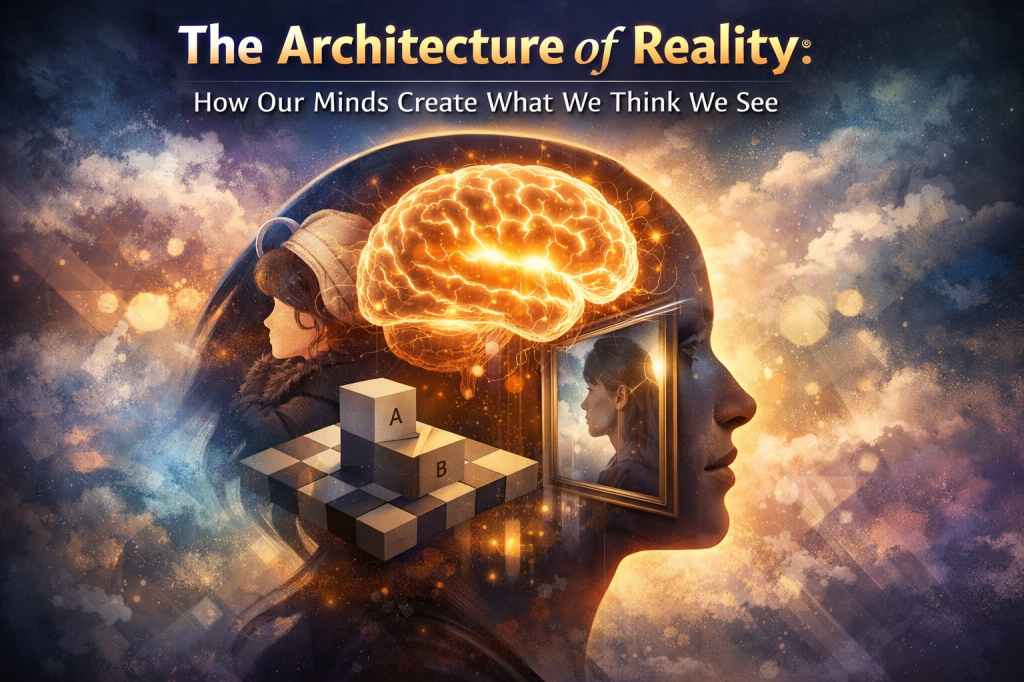
  • The Architecture of Reality: How Our Minds Create What We Think We See

    The Architecture of Reality: How Our Minds Create What We Think We See

    We like to believe our eyes are cameras and our brains are recording devices, faithfully capturing the world around us.

    This comforting idea suggests that what we perceive is simply what’s there — objective, unfiltered reality delivered straight to our consciousness.

    Yet this assumption about human perception is not just wrong — it’s misleading.

    The truth is far more fascinating.

    Perception is an active, creative process.

    Our brains don’t passively receive information from our senses. Instead, they construct reality from incomplete data, filling gaps with assumptions, expectations, and learned patterns.

    Understanding this process isn’t just intellectually interesting — it’s essential for navigating a world where our constructed realities can lead us astray.


    When Seeing Isn’t Believing

    Consider the famous young woman / old woman illusion, where the same image can appear as either a young lady looking away or an elderly woman in profile.

    The image never changes.
    Yet our perception flips between two completely different realities.

    Or think about a mirror.

    When you look into a bathroom mirror, it feels like you’re seeing yourself standing behind the glass. Yet no light actually comes from behind the mirror. The reflection is a flat image on the surface, but your brain constructs the convincing illusion of depth.

    The checker shadow illusion offers another example. Two squares that look dramatically different in brightness are actually identical when isolated from their surroundings.

    Context changes perception.

    And our brains quietly adjust reality to make sense of the scene.


    The Neuroscience of Construction

    Modern neuroscience shows why this happens.

    Our brains receive far more sensory information than they can process. So instead of recording everything, they predict what the world should look like and fill in the missing pieces.

    One striking example is the McGurk effect. When we see lips saying “ga” but hear the sound “ba,” the brain may perceive “da.”

    The sound “da” exists nowhere in the actual input.
    The brain simply constructs it.

    Attention also shapes what we perceive.

    In the famous Invisible Gorilla experiment, participants asked to count basketball passes often fail to notice a person in a gorilla suit walking through the scene.

    The gorilla is plainly visible.

    But focused attention makes it disappear from perception.


    Beyond Visual Tricks

    These phenomena reveal something deeper.

    We construct our understanding of everything — not just images.

    Our brains build narratives about relationships, politics, identity, and truth itself.

    Consider confirmation bias. We naturally seek information that supports what we already believe and overlook what contradicts it.

    This isn’t simply stubbornness.
    It’s the predictive brain doing what it evolved to do: creating coherent stories from complex information.

    Social media algorithms amplify this effect.

    They show us content aligned with our existing views, making our personal reality feel obvious and universal — while others are living inside entirely different interpretations of the same world.


    The Challenge of Inherited Perceptions

    Many of our deepest assumptions are inherited.

    Family.
    Culture.
    Education.
    Religion.
    Community.

    We learn to see the world through these lenses long before we are capable of questioning them.

    Over time those lenses become invisible.
    They feel like reality itself.

    Which raises an important question:

    How do we examine the very tools we use to examine the world?


    Toward Perceptual Humility

    Recognizing perception as a construction does not mean abandoning truth.

    Instead, it invites what we might call perceptual humility.

    The recognition that even our most certain perceptions may be interpretations rather than direct access to reality.

    This humility can actually be liberating.

    When we remember that everyone is constructing their reality from limited information, disagreement becomes less threatening and more curious.

    Different perspectives may simply reflect different starting points in the puzzle.


    Practical Implications

    Understanding perception as construction can help us:

    • Communicate more effectively
    • Learn more openly
    • Make wiser decisions
    • Approach our own beliefs with curiosity

    Sometimes the things that feel most obviously true are the very ideas most worth examining.


    Conclusion

    The mirror doesn’t lie.

    But it doesn’t tell the whole truth either.

    It reminds us that perception is creative, powerful, and sometimes unreliable.

    And when we understand that reality is partly constructed by the mind, we gain the opportunity to build our interpretations more wisely — with clarity, compassion, and curiosity.

    Perhaps the most radical insight is this:

    We are all looking into mirrors, seeing reflections that feel completely real.

    Yet those reflections are shaped by our remarkable, fallible, endlessly creative minds.

    https://en.wikipedia.org/wiki/Checker_shadow_illusion

    Use the link above to see the Checkerboard/Shadow illusion.

    “The image depicts a checkerboard with light and dark squares, partly shadowed by another object. The optical illusion is that the area labeled A appears to be a darker color than the area labeled B. However, within the context of the two-dimensional image, they are of identical brightness, i.e., they would be printed with identical mixtures of ink, or displayed on a screen with pixels of identical color.” – Wikipedia

    https://en.wikipedia.org/wiki/My_Wife_and_My_Mother-in-Law

    My Wife and My Mother-in-Law” is a famous ambiguous image, which can be perceived either as a realistic young woman or a cartoonish old woman (the “wife” and the “mother-in-law“, respectively). The young woman appears with her face turned away from the viewer while the old woman appears in profile, so the part of the drawing that represents the young woman’s ear is the old woman’s eye; the young woman’s chin is the old woman’s nose; and the young woman’s choker is the old woman’s mouth.” – Wikipedia


    What examples of perceptual construction have you noticed in your own life?

    I’d love to hear your reflections in the comments.