Category: Teacher: Tibetan Master: Pema Chödrön

Pema Chödrön (born Deirdre Blomfield-Brown in 1936) is a beloved American Buddhist nun, teacher, and author who has become one of the most influential voices in contemporary Tibetan Buddhism. As a student of the renowned Tibetan master Chögyam Trungpa Rinpoche, Pema Chödrön has dedicated her life to sharing the teachings of the Vajrayana tradition with a broad audience, making the profound wisdom of Tibetan Buddhism accessible to people from all walks of life.

Ordained as a nun in 1981, Pema Chödrön became one of the first Western women to fully embrace monastic life in the Tibetan Buddhist tradition. She has spent decades studying and practicing the teachings of Shambhala Buddhism, and she currently serves as the resident teacher at Gampo Abbey, a Tibetan Buddhist monastery in Nova Scotia, Canada.

Pema Chödrön’s teachings are deeply rooted in the practices of mindfulness, loving-kindness, and compassion, with a particular focus on working with difficult emotions and situations as gateways to spiritual growth. She is known for her ability to communicate complex teachings in a clear, relatable, and often humorous way, helping her students navigate the challenges of life with greater wisdom and resilience.

Her best-selling books, including When Things Fall Apart, The Places That Scare You, and Comfortable with Uncertainty, have touched the lives of millions, offering practical advice on how to face life’s inevitable difficulties with an open heart and a courageous spirit. Central to her teachings is the practice of Tonglen, a meditation technique that involves breathing in the suffering of others and breathing out compassion, a practice that cultivates empathy and reduces self-centeredness.

Pema Chödrön’s influence extends far beyond her writings, as she has become a trusted spiritual guide for those seeking to cultivate mindfulness, compassion, and inner strength in the midst of life’s challenges. Her work continues to inspire and support individuals on their journey toward greater peace, wisdom, and spiritual awakening, earning her a rightful place among the most respected Tibetan Buddhist teachers of our time.

  • Into the Mystic: The Journey from Meditation to Contemplation

    As I re-read the works of St. John of the Cross, I have become more attuned to the threshold of transition—the dryness and emptiness that so often precede the invitation to move from meditation into contemplation. This is not unique to St. John; it is something pointed to by many of the great teachers. Whether it’s Namkhai Norbu, Ramana Maharshi, Thich Nhat Hanh, the Dalai Lama, or Orgyen Chowang in Pristine Mind, they all plant the seeds of meditative absorption, which only take root when the time is right. Now, it seems, those seeds are beginning to bloom, not as intellectual concepts, but as a living, unfolding experience.

    Today, I found myself drawn into this quiet transformation. As I lay in stillness, the pratyayas—those passing thoughts, sensations, and memories—began to rise and fall, like waves on a distant shore. Curiosity, that soft and patient witness, guided me deeper, not into understanding but into presence.

    The breath came of its own accord, a deep release from somewhere beyond my conscious will, as if the body itself knew what needed to unfold. And then, an awareness—a spaciousness—arose. It was not something I had summoned, nor could I hold it in place. It was simply there, naked and pure, like a clear blue sky.

    St. John of the Cross speaks of this as a kind of surrender, but not the kind we can choose. It is a grace bestowed, not earned. In the stillness, I realized that my role was not to force this shift but to allow it to happen. To remain as the observer, the witness, as the Divine unfolded in its own time.

    What struck me most deeply was the paradox of this surrender. The very act of trying to let go becomes an obstacle. Instead, it is curiosity that opens the door to pure awareness—curiosity that has no desire, no need for something to happen, but simply observes what is.

    Today, in this unfolding, I realized that even the longing for deeper experience can become a barrier. The path is not one of striving but of witnessing. And in that witness, the Divine does its quiet work, purifying what needs to be released, and bringing us ever closer to the essence of who we truly are.

    As I reflect on my own journey today, it is my hope, and the shared intention (Sankalpa) behind all of this work, that by sharing these reflections, insights, and experiences, they may serve as a guide, a comfort, or a spark of inspiration to those who come across them.

    🙏🕊️🙏

    Book Recommendation: St. John of the Cross, Dark Night of the Soul

    Dark Night of the Soul by St. John of the Cross is a spiritual masterpiece that explores the transformative power of suffering and the journey toward union with the Divine. This work describes the profound spiritual experience of being stripped of all attachments, both inner and outer, as a necessary process for purification and deeper connection with God. For those experiencing a time of spiritual dryness or emptiness, St. John’s words offer hope and guidance through the darkness, illuminating the path to deeper faith and surrender. The Dark Night is not a time of despair, but of ultimate transformation, where we are invited to let go of our limited understanding and trust in the unfolding of the Divine. This book serves as a timeless companion for anyone navigating the challenges of the contemplative path, especially those who feel drawn to the shift from meditation to deeper contemplation.

    Book Recommendation: Orgyen Chowang, Our Pristine Mind

    In The Pristine Mind, Orgyen Chowang offers profound teachings on accessing our natural state of mind—a state of clarity, openness, and peace. He draws from the Dzogchen tradition, emphasizing that our true nature is already pure and perfect, and that through practice, we can return to this unconditioned state. For those on a contemplative journey, Chowang’s words provide a practical path for moving beyond mental noise and distractions, guiding us back to the inherent stillness of the mind. This book is especially helpful for those who wish to deepen their meditation practice or shift from intellectual understanding to living experience. The Pristine Mind invites readers to discover the profound joy and serenity that arises when we rest in the awareness of our true nature.
  • Tibetan Buddhism: A Path of Mind Training and Intrinsic Wisdom

    Tibetan Buddhism: A Path of Mind Training and Intrinsic Wisdom

    In our journey of exploring spirituality across traditions, it is time to welcome the teachings of Tibetan Buddhism. At first glance, the colorful rituals, sacred music, and intricate costumes may seem confusing or overwhelming. Yet these outward forms are simply expressions of an inner practice that remains deeply practical and profound: the training of the mind. Tibetan Buddhism is not a religion in the conventional sense of belief or dogma but rather a transformative path aimed at purifying the mind. Through meditation, visualization, mantra, and ritual, the practice cultivates clarity, compassion, and liberation from egoic tendencies.

    A recent film about Dilgo Khyentse Yangsi Rinpoche, the reincarnation of the revered master Dilgo Khyentse Rinpoche, offers a glimpse into the heart of this tradition. Watching the young tulku receive teachings and grow within a vibrant Tibetan community reveals how this ancient wisdom lives on, passed from one generation to the next as a thriving, living practice. The film gently invites viewers into a deeper understanding of the teachings, dissolving the outer complexities to reveal a path focused on inner transformation.

    One recurring theme throughout the film is that all Buddhist practice, no matter its form, is centered on mind training. The rituals and prayers, while beautiful, are not the essence; rather, they serve as vehicles to refine awareness and soften the grip of delusion. The practice is about gently cleaning the mind, sweeping away negativity and confusion like a gardener tending to weeds, leaving space for the natural qualities of wisdom and compassion to emerge.

    Vajrayana Buddhism offers a unique method for engaging with life’s challenges. Instead of rejecting or avoiding difficulties, the practice transforms even negative thoughts and emotions into opportunities for awakening. It becomes a skillful means of shifting the mind’s energy toward positive states. This approach is not about suppressing thoughts but about meeting them with awareness, transforming suffering into insight and confusion into clarity.

    Tibetan Buddhism emphasizes the reduction of ego grasping, fostering a spirit of nonviolence, and cultivating compassion. It shifts attention away from religious belief and toward the inner work of softening the heart and taming the restless mind. These teachings are not confined to cultural forms but reflect a universal truth—the journey of every human soul toward peace and freedom. The path’s essence aligns beautifully with the teachings of Advaita Vedanta and even echoes the mystical experiences of figures like St. John of the Cross. While each tradition expresses itself differently, the underlying message is the same: the liberation of the mind from illusion, opening into a state of oneness.

    In this light, Tibetan Buddhism can be seen as a cultural version of the Yoga Sutras of Patanjali, offering practices that lead to inner stillness and self-realization. It is, in essence, a kind of spiritual atonement—a process of purification and return to the true nature of mind, much like the mystical experiences found in other traditions.

    What makes Tibetan Buddhism particularly rich is its capacity to embrace complexity. It does not reject thoughts, emotions, or even suffering. Instead, it teaches practitioners to meet these experiences with skill and openness, transforming them into pathways toward deeper insight. Watching the young tulku learn within the community demonstrates this beautifully—how every moment, even the difficult ones, can become part of the practice.

    We invite you to explore this film, which offers a rare and intimate view into the life of Dilgo Khyentse Yangsi Rinpoche and the vibrant Tibetan community that nurtures his path. Beneath the ornate rituals lies a simple but profound truth: Tibetan Buddhism, like all genuine spiritual traditions, is ultimately a path of mind training. It offers not only the possibility of individual liberation but also a way to cultivate compassion and wisdom for the benefit of all beings.

    🙏🕊️🙏

  • The Jewel of the Body, Speech, and Mind: A Buddhist Bedtime Story of OM AH HUNG

    The Jewel of the Body, Speech, and Mind: A Buddhist Bedtime Story of OM AH HUNG

    The fire crackled softly as the night sky wrapped the world in a blanket of stars. In a small, quiet room high in the mountains, little Sonam snuggled close to her grandfather, whose voice was like a river flowing gently through time. Tonight, Grandfather had promised to share a special teaching—a teaching about the mantra OM AH HUNG, a mantra that carried the wisdom of the Buddha’s body, speech, and mind. It was a gift for those seeking to awaken their true nature, a path to discovering the light that lives within every heart.

    “Come closer, little one,” Grandfather whispered, his eyes gleaming with warmth. “Tonight, I will tell you about this sacred mantra, OM AH HUNG. These three sounds hold the secret to remembering who we truly are—beyond all the noise of the world, beyond all fear and doubt. With each repetition, they bring us closer to the realization that we are already whole, already one with the body, speech, and mind of the Buddha.”

    Sonam’s small hands rested gently on her lap as she listened, her heart softening with each word.

    Grandfather began, his voice as soft as the night breeze. “The first sound is OM. It rests in the forehead, shining with a clear, bright white light, like the first snowfall on a quiet morning. OM is the body of the Buddha—pure, radiant, and free. When you chant OM, you are inviting your body to become still and calm, like the Buddha’s body. You remember that your body, just as it is, is special.”

    Sonam closed her eyes and imagined a bright white light glowing softly at her forehead. With each breath, the light expanded, filling her whole body with a sense of peace and clarity.

    “Even when you feel tired,” Grandfather said gently, “OM reminds you that your body is a vessel for light. It invites you to rest, to breathe, and to feel the simple joy of being alive.”

    “The next sound,” Grandfather continued, “is AH. It rests in the throat and shines with a warm, red light, like the glow of the setting sun. AH is the speech of the Buddha—the sound of truth, kindness, and love that flows through every word. When you chant AH, you invite your words to become soft and clear. You remember that your voice is a gift.”

    Sonam imagined a soft red light glowing in her throat, spreading warmth through her chest. She whispered the sound AH quietly to herself, feeling how the vibration opened her heart like petals unfolding in the morning sun.

    “AH teaches us to speak from a place of kindness,” Grandfather said, “whether we are speaking to ourselves or others. Our words have the power to heal, to comfort, and to bring peace.”

    “And finally,” Grandfather said softly, “we have HUNG. This sound rests in the heart, shining with a deep, blue light, like the vast sky just before dawn. HUNG is the mind of the Buddha—boundless, clear, and filled with compassion. When you chant HUNG, you invite your mind to rest, free from grasping and fear. You remember that your true nature is like the sky—open, spacious, and infinite.”

    Sonam placed a small hand over her heart, imagining a deep blue light glowing there. With each breath, the light expanded, filling her whole being with a sense of calm and openness.

    “Even when your thoughts feel tangled,” Grandfather whispered, “HUNG reminds you that beneath every thought, your mind is already clear and vast, like the sky.”

    Grandfather smiled, seeing Sonam’s little body relax as the teachings settled into her heart. “Now, my dear one,” he said, “let us say the mantra together. With each repetition, we bring the body, speech, and mind into harmony, becoming one with the Buddha’s light.”

    Together, they whispered the mantra:
    OM… AH… HUNG… OM… AH… HUNG…

    As they chanted, Sonam felt the lights of white, red, and blue merge within her, like rivers flowing into the same ocean. She felt herself resting deeply, her body, speech, and mind becoming still and clear, like the calm surface of a mountain lake.

    “This is the gift of OM AH HUNG,” Grandfather said quietly. “It helps us remember that we are not separate from the Buddha—we are already one with the body, speech, and mind of wisdom and compassion.”

    Sonam yawned softly, her heart full of warmth and peace. “Grandfather,” she whispered, “can I say OM AH HUNG when I feel scared or sad?”

    Grandfather kissed her forehead gently. “Yes, my little one. Whenever you need to feel grounded, loved, or at peace, you can chant OM AH HUNG. It will remind you that you are never alone—your body, speech, and mind are already whole, already filled with light.”

    As Sonam drifted deeper into sleep, Grandfather offered a final blessing:
    “OM… may your body be at peace.
    AH… may your voice be a song of kindness.
    HUNG… may your heart rest in the vast sky of compassion.”

    And with that, Sonam drifted into a deep, peaceful sleep, carried by the gentle rhythm of the mantra. In her dreams, she floated through fields of white, red, and blue light, resting in the open sky of compassion, her heart blooming like a lotus in the morning sun.

    May OM AH HUNG guide you always, bringing peace to your body, kindness to your voice, and love to your heart.

    Goodnight, little one. ❤️

    🙏🕊️🙏


    If you’d like to explore more bedtime stories for children, including tales that nurture compassion and mindfulness, you can find our collection here.


  • The Medicine of the Mantra: A Bedtime Story of Chenrezig and OM MANI PADME HUM

    The Medicine of the Mantra: A Bedtime Story of Chenrezig and OM MANI PADME HUM


    Chenrezig shares the story of OM MANI PADME HUM with children, guiding them to uncover their inner compassion and wisdom. A perfect bedtime story filled with peace, warmth, and unity.


    Long ago, in a beautiful land where the mountains touched the sky and rivers flowed like silver ribbons, there lived a wise and compassionate teacher named Chenrezig. He had a twinkle in his eye, as if he knew a great secret, and his heart was so full of love that just being near him made people feel lighter. But Chenrezig knew that many beings in the world carried an invisible burden—an illness of the mind, one that made them forget who they truly were.

    This illness, Chenrezig explained, was a kind of forgetting. “We have all mistaken ourselves for something we are not,” he said gently. “Like a dreamer who believes the dream is real, we have forgotten our true nature—the vast, boundless love and wisdom that live in our hearts. Instead, we believe we are small and separate, like waves forgetting they belong to the ocean.”

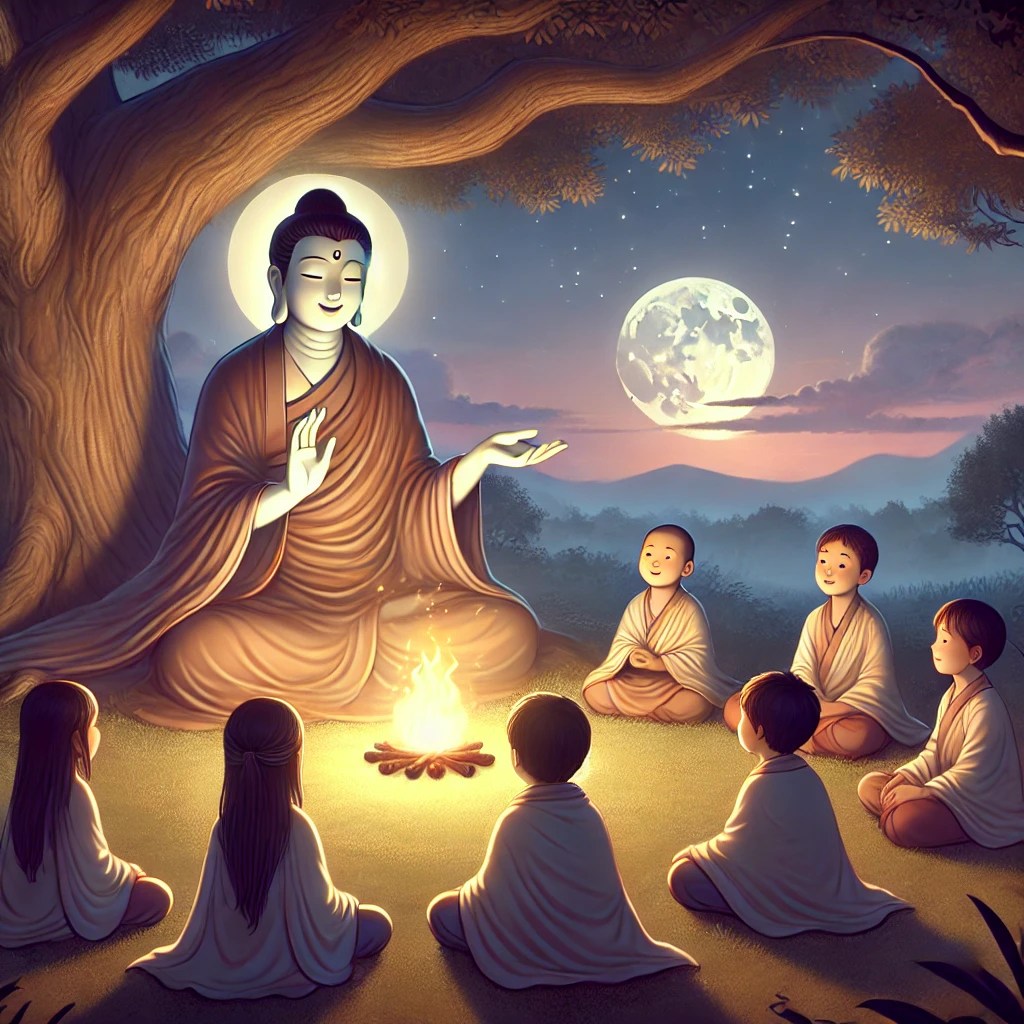
    Chenrezig often told stories to children, knowing that their hearts could understand what adults often forgot. One evening, as the stars glimmered softly above, Chenrezig gathered a group of children around a fire. They looked up at him with curious eyes, waiting for one of his famous stories.

    “Tonight,” Chenrezig said, “I will tell you a story about a great medicine—a medicine for the heart and mind. It is the mantra OM MANI PADME HUM. This mantra is like the most powerful medicine a doctor could ever give, one that can heal the illness of separation and help us remember our true nature.”

    He paused, watching the children lean in closer, eager to hear more. “But first,” he continued, “you need to understand something important. Imagine that you are wearing many layers of clothing—so many layers that you forget what you look like underneath. Each layer is like a thought or feeling you tell yourself: I’m not good enough. I need to be better.

    These layers are like cobwebs in the mind, making it hard to see clearly. And because we believe in these stories, we feel small and alone, like a candle separated from the flame. But the truth is, we are not the stories we tell ourselves. Beneath all the layers, beneath all the cobwebs, we are already whole, already perfect—just like a lotus flower, waiting to bloom.”

    The children sat very still, imagining themselves wrapped in layers of thoughts, feelings, and stories. “How do we take off the layers?” one of them whispered.

    Chenrezig smiled. “That is where the mantra comes in,” he said softly. “OM MANI PADME HUM is the medicine that clears away the layers, like a soft breeze sweeping away cobwebs. Each time you say the mantra, you peel back another layer. OM MANI PADME HUM… and the layers fall away. OM MANI PADME HUM… and your heart shines a little brighter. OM MANI PADME HUM… and with each breath, you get closer to your true self—your Buddha nature, the part of you that is pure love and compassion.

    He began to explain the meaning of the mantra, his voice gentle and full of care. “The first syllable, OM, is the sound of the universe waking up. It reminds us that we are connected to everything—to the stars, the rivers, the animals, and each other. OM is the sound of coming home to our true nature.”

    The children closed their eyes, listening to the sound of OM as if it were rising from the earth, the sky, and their own hearts all at once.

    “The next two words,” Chenrezig continued, “are Mani Padme—the jewel in the lotus. This means that inside each of us is a precious jewel—the light of wisdom and love. But just like a lotus flower that grows in muddy water, this jewel can be hidden by layers of thoughts and beliefs. Each time we chant Mani Padme, we open the lotus a little more, revealing the jewel inside.”

    The children imagined a lotus flower blooming in their hearts, each petal unfolding slowly, with a bright jewel glowing at its center.

    “And finally,” Chenrezig said, “we have Hum. This is the sound of unity—the sound that brings everything together. It is the moment when we remember that we were never separate, not from others, not from love, and not from our true nature. Hum is the sound of the Buddha mind awakening within you, shining with pure compassion.”

    The children whispered the mantra softly: OM MANI PADME HUM… OM MANI PADME HUM… Each repetition felt like a breeze clearing away the cobwebs in their minds, helping them feel lighter and brighter.

    “Now,” Chenrezig continued, “let me tell you one more secret. The mantra doesn’t just help you remember who you are—it helps others too. Every time you chant OM MANI PADME HUM, you are planting seeds of compassion, not just in your own heart, but in the hearts of all beings. These seeds will bloom in ways you may never see, bringing kindness and peace into the world.”

    He placed a hand over his heart. “It’s like sharing a gift that never runs out. Each time you say the mantra, you are offering love to the whole universe.”

    The children sat quietly for a moment, feeling the beauty of the mantra settling into their hearts, like a gentle rain nourishing the earth. “So the mantra is like a magic medicine?” one child asked softly.

    Chenrezig smiled. “Yes,” he said. “It is a medicine for the heart, a way of peeling back the layers until only love and wisdom remain. It helps us remember that we are not small or separate—we are like the ocean, vast and full of life. And each time we chant the mantra, we bring a little more light into the world.”

    As the fire crackled softly, casting warm orange light on their faces, Chenrezig leaned closer to the children. “Now, as you drift off to sleep tonight, you can let the mantra carry you, like a boat floating gently down a river. Whisper it in your heart: OM MANI PADME HUM… OM MANI PADME HUM… Let it peel back the layers of your mind, revealing the jewel of compassion that has always been there.”


    He kissed each child on the forehead and offered a final blessing:

    OM MANI PADME HUM . . .

    With each breath, may you awaken to your true nature.

    With each dream, may your heart bloom in kindness.

    May all beings remember their light, and may the world be filled with peace.

    The mantra hummed softly in their hearts: OM MANI PADME HUM, OM MANI PADME HUM… clearing away the cobwebs, layer by layer, revealing the truth that they were never separate, but always part of the great ocean of love.

    May your hearts always shine with the light of compassion, and may OM MANI PADME HUM guide you, now and always. Sleep well, children. The jewel in the lotus is already blooming within you.

    As the children drifted into a peaceful sleep, the mantra whispered in their hearts… OM MANI PADME HUM… until their dreams were filled with rivers of kindness, endless skies of compassion, and the light of love.

    Goodnight, little one. ❤️

    🙏🕊️🙏


    If you’d like to explore more bedtime stories for children, including tales that nurture compassion and mindfulness, you can find our collection here.