Category: The Philosophy and Teachings of the Buddha
The Philosophy and Teachings of the Buddha
Explore the vast and timeless wisdom of Siddhartha Gautama, known as the Buddha, whose teachings have guided countless beings on the path to enlightenment for over 2,500 years. This category is dedicated to the profound insights of the Buddha, offering a comprehensive exploration of his spiritual legacy that spans cultures, traditions, and centuries.
Within this category, you’ll delve into the core principles that form the foundation of Buddhist practice: the Four Noble Truths, the Eightfold Path, and the cultivation of mindfulness, compassion, and loving-kindness (Metta). These teachings provide a practical roadmap for living a life of wisdom, ethical conduct, and inner peace, offering guidance on how to navigate the challenges of existence and realize the true nature of reality.
The teachings of the Buddha have given rise to a rich diversity of traditions, each with its own interpretations and practices, yet all sharing the common goal of guiding practitioners toward enlightenment. Here, you’ll encounter the early teachings of Theravada, with its focus on the direct path to liberation, the expansive compassion of Mahayana, and the transformative practices of Vajrayana found in Tibetan Buddhism. Additionally, this category explores the meditative insights of Zen, the integration of wisdom and compassion in Chan, and the universal aspiration of Bodhicitta—the wish for enlightenment for the benefit of all beings.
Whether you are new to Buddhism or seeking to deepen your understanding, this category offers a wealth of resources to support your journey on the path to liberation and spiritual awakening. The wisdom of the Buddha continues to illuminate hearts and minds, inspiring greater awareness, empathy, and purpose in everyday life.
In the practice of sitting at the door of contemplation, we often expect something to happen—insight, peace, or even enlightenment. But the deeper truth of the practice is this: nothing is happening.
This doesn’t mean the practice is empty or pointless. Quite the opposite. It invites us to rest in the simplicity of just sitting, letting go of the need for results or experiences. Whether thoughts arise or stillness emerges, the essence of the practice remains untouched.
Even when “something” seems to happen—discursive thoughts, emotions, or sensations—it’s all part of the flow. In the vastness of awareness, these waves rise and fall, and yet nothing truly happens. The mind seeks meaning or progress, but the practice reminds us that the profound is found in the ordinary.
The Zen saying “Enlightenment is nothing special” echoes this wisdom. By resting in the present moment without striving, we discover the extraordinary within the mundane. Whether the mind is busy or still, whether the body is at ease or in discomfort, the practice holds steady.
So, when you sit at the door, let go of the need for something to happen. Trust in the simplicity of the posture, the breath, and the stillness. By allowing the moment to be as it is, you discover the quiet power of simply being.
In sitting practice, the phrase “Nothing is happening” becomes a mantra of freedom. It liberates us from striving and invites us to rest in the truth of the present.
How does it feel to embrace the idea that nothing is happening?
In Zen, meditation is often called sitting practice (zazen). It’s a profound reminder that the practice is not about achieving a particular state of mind or striving for enlightenment. It’s simply about sitting.
The posture itself becomes the anchor—a silent declaration of presence. Regardless of what the mind is doing, the act of sitting holds the practice. Discursive thoughts may arise, the mind may wander, but the body remains grounded in stillness. This is the practice: showing up, sitting at the door, and allowing everything to be as it is.
The Cloud of Unknowing echoes this wisdom, inviting us to trust in the grace of contemplation rather than trying to make it happen. By sitting in a steady posture—whether the lotus position or any comfortable seat—we embody the essence of non-doing. The physical stillness serves as a container, reminding us that the practice is happening, even when the mind feels restless.
As the Zen saying goes: “When you sit, just sit.” There’s no need to fix, resist, or achieve anything. Sitting itself is enough. It’s a powerful way to cultivate patience, humility, and trust in the unfolding of the present moment.
Next time you sit, remember this: your posture is the practice. Your stillness is the doorway. You don’t have to fight the mind or force stillness. By simply sitting, you are already practicing.
Following the path of meditation can feel like a gradual unraveling of the known—a shedding of what we once held onto, leading us into the mystery of contemplation. As I continue reflecting on the works of St. John of the Cross, this sacred shift from meditation into contemplation becomes clearer. It is not a step we take with effort but a grace that gently unfolds when the time is right.
St. John speaks of this transition as a call to surrender, but it is not the kind of surrender we can will into existence. Instead, it is a letting go that happens when we stop striving, when we allow ourselves to simply rest in the presence of the Divine. This is where the familiar practices of meditation—focused attention, mental inquiry, or breath awareness—fall away, giving space for something more profound to emerge.
Today, I felt this shift more deeply, not as an intellectual understanding, but as a living experience. The pratyayas—the thoughts, sensations, and memories that rise and fall—became like whispers, their pull softening in the presence of curiosity. This curiosity is not the kind that seeks answers, but one that witnesses, without needing anything to happen. In that gentle witnessing, something new emerged: a spaciousness, a quiet stillness that felt like home.
This experience is not unique to Christian mysticism. In Advaita Vedanta, the practice of self-inquiry often begins with a repetitive questioning—”Who am I?”—an active search for truth. But, as with St. John’s teachings, there comes a time when even the inquiry must dissolve into silence. The seeker steps back, not into a place of knowing, but into a place of being. In that being, all effort falls away, and we are left with the pristine awareness that has always been there.
In silence, love calls,
No longer through words or thought,
But in quiet grace.
This is the threshold between seeking and being, a place where the Divine does its quiet work in us. It is no longer about striving or yearning for a deeper experience; it is about trusting in the unfolding of love, which asks only that we rest in its presence.
For those of us on this journey, may we continue to trust this sacred shift—moving from meditation into contemplation, from seeking into being. In this silent surrender, we come closer to the essence of who we truly are.
As I re-read the works of St. John of the Cross, I have become more attuned to the threshold of transition—the dryness and emptiness that so often precede the invitation to move from meditation into contemplation. This is not unique to St. John; it is something pointed to by many of the great teachers. Whether it’s Namkhai Norbu, Ramana Maharshi, Thich Nhat Hanh, the Dalai Lama, or Orgyen Chowang in Pristine Mind, they all plant the seeds of meditative absorption, which only take root when the time is right. Now, it seems, those seeds are beginning to bloom, not as intellectual concepts, but as a living, unfolding experience.
Today, I found myself drawn into this quiet transformation. As I lay in stillness, the pratyayas—those passing thoughts, sensations, and memories—began to rise and fall, like waves on a distant shore. Curiosity, that soft and patient witness, guided me deeper, not into understanding but into presence.
The breath came of its own accord, a deep release from somewhere beyond my conscious will, as if the body itself knew what needed to unfold. And then, an awareness—a spaciousness—arose. It was not something I had summoned, nor could I hold it in place. It was simply there, naked and pure, like a clear blue sky.
St. John of the Cross speaks of this as a kind of surrender, but not the kind we can choose. It is a grace bestowed, not earned. In the stillness, I realized that my role was not to force this shift but to allow it to happen. To remain as the observer, the witness, as the Divine unfolded in its own time.
What struck me most deeply was the paradox of this surrender. The very act of trying to let go becomes an obstacle. Instead, it is curiosity that opens the door to pure awareness—curiosity that has no desire, no need for something to happen, but simply observes what is.
Today, in this unfolding, I realized that even the longing for deeper experience can become a barrier. The path is not one of striving but of witnessing. And in that witness, the Divine does its quiet work, purifying what needs to be released, and bringing us ever closer to the essence of who we truly are.
As I reflect on my own journey today, it is my hope, and the shared intention (Sankalpa) behind all of this work, that by sharing these reflections, insights, and experiences, they may serve as a guide, a comfort, or a spark of inspiration to those who come across them.
🙏🕊️🙏
Book Recommendation: St. John of the Cross, Dark Night of the Soul
Dark Night of the Soul by St. John of the Cross is a spiritual masterpiece that explores the transformative power of suffering and the journey toward union with the Divine. This work describes the profound spiritual experience of being stripped of all attachments, both inner and outer, as a necessary process for purification and deeper connection with God. For those experiencing a time of spiritual dryness or emptiness, St. John’s words offer hope and guidance through the darkness, illuminating the path to deeper faith and surrender. The Dark Night is not a time of despair, but of ultimate transformation, where we are invited to let go of our limited understanding and trust in the unfolding of the Divine. This book serves as a timeless companion for anyone navigating the challenges of the contemplative path, especially those who feel drawn to the shift from meditation to deeper contemplation.
Book Recommendation: Orgyen Chowang, Our Pristine Mind
In The Pristine Mind, Orgyen Chowang offers profound teachings on accessing our natural state of mind—a state of clarity, openness, and peace. He draws from the Dzogchen tradition, emphasizing that our true nature is already pure and perfect, and that through practice, we can return to this unconditioned state. For those on a contemplative journey, Chowang’s words provide a practical path for moving beyond mental noise and distractions, guiding us back to the inherent stillness of the mind. This book is especially helpful for those who wish to deepen their meditation practice or shift from intellectual understanding to living experience. The Pristine Mind invites readers to discover the profound joy and serenity that arises when we rest in the awareness of our true nature.
Reflections on Pristine Awareness, Dzogchen, and Finding Clarity in Challenging Times
As I sit with Our Pristine Mind in my hands, I am aware that I am not merely reading a book. I am entering a silent conversation with an ancient wisdom, one that gently unfolds its layers with each page, as if lifting the veils of my own mind. In the quiet of early morning or beneath the faint glow of a reading lamp at night, the words begin to sink into the places where thought usually moves too quickly, too restlessly.
Dzogchen—a word I’ve heard in passing, sometimes as an exotic echo from distant mountains, sometimes as an answer whispered through stories of sages and scholars—is not simply an idea here. It emerges like a breath I have almost forgotten to take, a reminder that within my mind lies a pure, boundless awareness untouched by the cycles of confusion, emotion, or distraction. Dzogchen does not demand; it simply reveals.
The teacher, Orgyen Chowang Rinpoche, through his voice in Our Pristine Mind, speaks to the essential nature of awareness with a softness that does not impose but invites. I am reminded of Rilke, who once spoke of patience and of growing quietly in one’s own way, like a tree. Here, too, the practice of Dzogchen is like that tree, patient and grounded, yet ever-revealing. It asks nothing from me but presence, a willingness to recognize that what I have been searching for has always been here, beneath the surface of my rushing thoughts.
Rinpoche speaks to our current world—the difficulties, the fractures, the relentless march of modern life. Dzogchen, he says, has come forward in these times not because it is new, but because we are perhaps ready to see its simplicity. To see that the vastness of pristine awareness is not somewhere far away or reserved for saints and sages. It is here, in the quiet pause between breaths, in the stillness that accompanies an unfiltered experience of now.
The metaphor of the “brilliant moon in dark times” comes alive as I read, a reminder that even in moments when life feels overcast and filled with turmoil, there exists within us a clear, illuminating presence. Dzogchen does not banish the darkness; rather, it reveals a light that has been hidden within it all along.
This practice, this profound teaching, calls us to approach life differently—to walk, speak, even think with the awareness that we are not separate from each other, from the world, or from the mind that perceives it all. It is an invitation to cultivate what Rinpoche calls “pristine awareness” in daily life, and this awareness transforms not only how we experience joy but also how we engage with suffering. Even anger, fear, and sorrow are welcomed as parts of the unfolding dance, teachers in their own right.
The path of Dzogchen, I am learning, is not about leaving this world behind or aspiring to some distant perfection. Instead, it is an opening into a fuller, clearer life here and now—a kind of blossoming from the cold winter of searching into the warm spring of presence.
If you feel the weight of the world’s challenges or the heaviness of inner obstacles, there is a softness, a kindness in Dzogchen that may resonate. As I explore these teachings, I feel them steadying me, offering a compass to navigate the storms of distraction and disconnection that modern life so often brings.
And so, I share these reflections with the hope that you, too, may find something here that speaks to your own journey—a word, a phrase, a quiet reminder of the freedom that rests quietly within, waiting to be seen.
🙏🕊️🙏
If you’re interested in exploring this transformative approach further, I highly recommend Orgyen Chowang’s book The Pristine Mind. His teachings provide a clear, compassionate path toward uncovering the inherent purity of our mind, offering a source of deep fulfillment and lasting peace.
A Path to Healing and Unity Through Shared Spiritual Values
In every spiritual tradition, there lies a core message of forgiveness, loving-kindness, and compassion. These virtues, transcending cultural and religious boundaries, unite us in our shared humanity. Whether through the teachings of Buddha, the wisdom of Jesus, or insights from various spiritual paths, the call to embrace these qualities is clear and compelling.
Forgiveness is a profound act of letting go. It isn’t about condoning wrongdoings but freeing ourselves from the burdens of anger and resentment. As the Dalai Lama teaches, forgiveness is a gift we give to ourselves, a step toward inner peace.
Loving-Kindness, or “metta” in Buddhist practice, encourages us to extend unconditional love to all beings. Jesus exemplified this through his life, teaching us to love our neighbors as ourselves. In every smile, kind word, and act of generosity, we weave a tapestry of love that can heal and uplift.
Compassion is the heart’s response to suffering. It compels us to act, to alleviate pain, and offer solace. Teachings from various traditions remind us that compassion is not a passive feeling but an active force for good. Through compassion, we recognize our interconnectedness and our responsibility to care for one another.
In these challenging times, let’s draw from the wellsprings of our diverse spiritual heritages. Let us embrace forgiveness, loving-kindness, and compassion not just as lofty ideals, but as daily practices that transform our lives and the world around us.
Together, we can create a world where these universal values form the foundation of our interactions, fostering unity, peace, and understanding among all people.
In a world that often glorifies external beauty—whether through physique, art, or music—what if we shifted our gaze inward? What if we celebrated the beauty of the mind instead?
This post invites you to pause and consider: What makes a mind beautiful? Who do you believe exemplifies this kind of beauty, and why?
What Is a Beautiful Mind?
When we think of a “beautiful mind,” what comes to mind? Perhaps it’s someone whose intellect transforms the way we see the world. Or maybe it’s their creativity, empathy, or ability to inspire others through their words and actions.
A beautiful mind might be defined by:
• A deep curiosity that seeks understanding without judgment.
• A creative spirit that brings fresh perspectives to life.
• An open heart that connects with others and nurtures kindness.
• A wisdom that balances intellect with compassion.
What qualities would you add to this list? How do you define a beautiful mind?
Celebrating Beautiful Minds
This question is not just about philosophers, scientists, artists, or leaders—though it could be. A beautiful mind might belong to someone who quietly shapes the lives of those around them: a teacher, a friend, a family member, or a stranger who touched your life in a meaningful way.
Who do you know that has a beautiful mind? Perhaps it’s someone whose ideas have inspired you, whose words or actions have stayed with you, or who taught you to see the world in a new way. What about their mind do you find so beautiful?
Your Turn: Who Do You Nominate?
We’d love to hear from you. Share your thoughts in the comments:
• What does it mean to have a beautiful mind?
• Who do you think exemplifies this, and why?
• Is there someone in your life—famous or not—whose mind you deeply admire?
Let’s create a collective celebration of the beauty of thought, creativity, and compassion, one nomination at a time.
I came upon Orgyen Chowang’s teachings and his book, Our Pristine Mind, like discovering an unexpected window that offers a clearer, quieter view. Chowang, a revered meditation master, speaks about our minds with a simplicity that is both gentle and profound. In his words, I felt an invitation to find not just peace, but a deep, clear stillness—an untouched clarity we each hold within. He calls this the “pristine mind,” a mind unclouded by habitual thoughts and emotions.
Reading his words, I was struck by the thought: Just as we clean our homes and spaces, how often do we take care of our minds? In this world of constant motion and distraction, it seems almost revolutionary to pause, to clear away what is unneeded. Chowang suggests that mental well-being is like tending a garden, pulling weeds of anger, stress, or anxiety that choke the growth of joy and ease. It reminded me how these “weeds” can cover our true nature, clouding how we experience life and others.
But what he describes as the “pristine mind” is always there, like a clear sky behind clouds. Our thoughts, emotions, and beliefs pass through like clouds, momentary and shifting, yet we often cling to them, mistaking them for who we are. Chowang encourages us to release this attachment and begin to experience our natural clarity—our inherent, pristine mind.
In practice, Chowang’s meditation technique is beautifully simple. There are four steps:
1. Do not follow the past.
2. Do not anticipate the future.
3. Remain present in this moment.
4. And lastly, leave the mind alone.
When I first tried these steps, I felt a quiet rebellion within—a part of me wants to solve, to plan, to chase. But following his steps brings a profound lightness. As I resist chasing past memories or future anxieties, I notice the mental noise softening. There is no need to control; simply resting in the moment, letting thoughts come and go like wind through an open window, the mind clears on its own.
With practice, I have glimpsed moments of this “pristine mind”—a state that Chowang says brings unconditional happiness. This is not happiness that depends on outward conditions, but rather a steady presence that finds peace no matter what is happening outside of us. Conditional happiness, reliant on the fleeting promises of the world, becomes less important, as if the yearning subsides in the face of something more whole. Paradoxically, with this inner stillness, I feel able to experience the world more richly, with a fuller heart.
Chowang speaks of “yoga,” the union of body and mind, which pristine mind meditation makes possible. When my mind settles, the usual tug-of-war within me ceases, bringing calm to my body as well. It is as if my body and mind are finally in harmony, no longer struggling but instead moving together.
The journey is ongoing. Chowang uses a beautiful analogy: our minds are like a fog globe. When we shake it, the fog swirls, obscuring the clarity inside. But if we simply let it be, leaving it alone, the fog slowly settles, and the clear globe is revealed. With each meditation, I feel as if I am letting that fog settle, trusting that beneath lies a still, clear presence.
For anyone curious about exploring their own pristine mind, there may be moments of doubt or distraction; our minds naturally gravitate toward patterns, just as they would with any new practice. Yet the gentle return to the present, with patience and kindness, becomes the practice itself. There is no perfect silence, no need to force anything; it is enough simply to come back to this moment and leave the mind to rest in its natural state.
In this journey, I continue to return to Chowang’s teachings and to practice his four simple steps. I am still learning, but each time I sit, I feel closer to the clear sky within, and it is changing how I live, love, and see the world. I hope, as Chowang teaches, that a pristine mind is possible for each of us, and that by cultivating it, we might each find our way to a steadier, more joyful presence.
🙏🕊️🙏
Much of the inspiration for this reflection and practice comes from Our Pristine Mind by Orgyen Chowang Rinpoche. His teachings have deepened my understanding of resting in clear, effortless awareness. If you feel drawn to explore this path further, I highly recommend his book. I’ll leave a link below for those interested in diving deeper into the practice of pristine mind and discovering the peaceful spaciousness it offers.
A mindful bedtime story of a solitary monk’s journey to inner peace, offering reflections on tranquility, solitude, and the wisdom found in nature’s embrace.
High in the misty cliffs of the Tibetan mountains lived a monk named Tenzin. He had chosen a life of solitude, making his home in a small cave carved into the rock, far from any village. From the mouth of his cave, he could see the wide valley below, where rivers shimmered, and clouds drifted lazily.
Though he lived alone, Tenzin never felt lonely. His days were filled with simple practices—meditation, chanting, and tending to the small tasks of life in the mountains. Each morning, he would sit at the opening of his cave, cross-legged, watching the sun rise over the peaks. The golden light touched the snow-capped mountains first, then slowly warmed the valley below. As the light spread, Tenzin felt connected to everything—the mountains, rivers, and the vast sky. Even the distant villages he couldn’t see seemed close to him.
Tenzin’s practice was to focus on his breath. He felt the breath flow in and out, like the wind through the trees. When his mind wandered, as minds tend to do, he would gently bring it back to the present moment. There was no rush, no goal—just the moment, just being.
One day, while Tenzin was in deep meditation, the wind outside his cave grew stronger. It howled through the trees, making the air feel sharp and cold. He opened his eyes and saw that dark clouds had gathered in the sky. A storm was approaching. The peaceful valley below had vanished under thick fog.
But Tenzin didn’t worry. He had learned, over time, that storms—like thoughts and emotions—come and go. Some days were clear, others were cloudy, but nothing lasted forever. He pulled his woolen robe tighter around him, lit a small fire, and returned to his meditation.
The storm raged on, but Tenzin remained calm. His breath, slow and steady, was his anchor. Inside his cave, there was no storm—only stillness. The walls of his cave sheltered him from the wind, but it was his practice that sheltered him from the restlessness of the world.
Several days passed, and the storm finally cleared. When Tenzin stepped outside, the valley below was washed clean by the rain, sparkling in the sunlight. Birds sang from the trees, and the air smelled fresh.
Tenzin smiled to himself. The storm had been fierce, but he hadn’t resisted it. He had simply let it come and go, knowing that everything—like the weather—was temporary. The calm always returned.
The seasons passed, each one bringing its own beauty. Tenzin never wished for company, for he had found that the quiet, the mountains, and the rhythm of his breath were friends enough. In the deep silence of his cave, Tenzin had discovered the greatest happiness—the peace of simply being.
🙏🕊️🙏
If you’d like to explore more bedtime stories for children, including tales that nurture compassion and mindfulness, you can find our collection here.
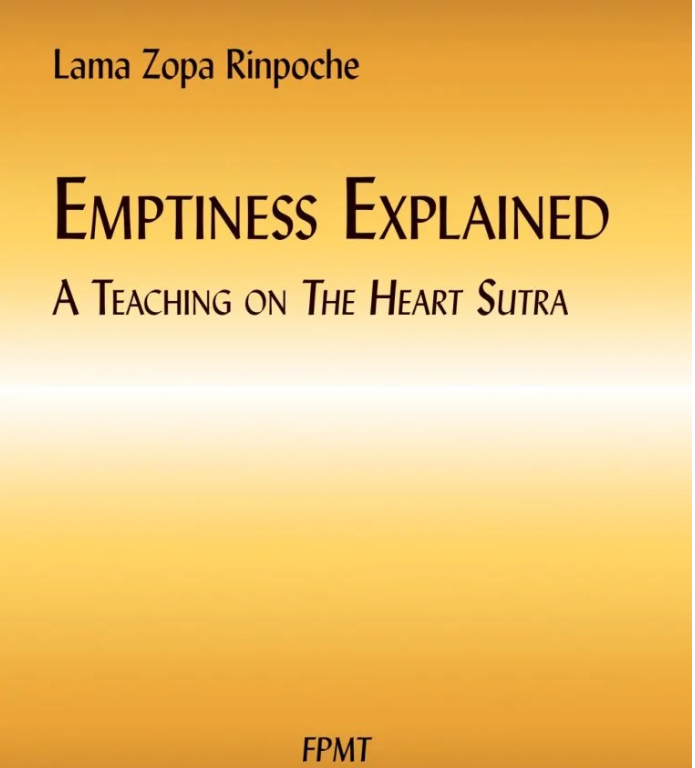
Transforming Suffering Into Happiness: How the Teachings on Emptiness from the Heart Sutra Support Mental Health and Well-Being
The Heart Sutra stands as one of the most profound and essential teachings in Buddhism, offering a path to understanding emptiness—the ultimate nature of reality. Lama Zopa Rinpoche’s commentary on this timeless sutra illuminates its teachings, guiding us toward a deeper understanding of how emptiness can transform not only our spiritual practice but also our daily lives.
In this post, I’ll share key reflections from Rinpoche’s teaching, focusing on the practical wisdom and spiritual inspiration it offers. Whether you’re a seasoned practitioner or simply curious about the philosophy of emptiness, I hope these insights will resonate with your heart.
What Is Emptiness?
Lama Zopa Rinpoche explains that emptiness does not mean that things don’t exist—it means that things are empty of inherent existence. All phenomena, including ourselves, arise dependently, shaped by causes, conditions, and labels. This is the essence of the middle way, which avoids the extremes of nihilism (nothing exists) and eternalism (things exist inherently and permanently).
As the Heart Sutra famously states:
“Form is emptiness, emptiness is form. Emptiness is not other than form; form is also not other than emptiness.”
In these words, we see that emptiness and dependent arising are inseparable. While things exist conventionally, their ultimate nature is empty of any independent, fixed essence.
Practical Ways to Meditate on Emptiness
Rinpoche offers accessible methods to integrate the understanding of emptiness into both formal meditation and daily life:
1. Recognizing the Object to Be Refuted
The first step is identifying the false concept of an independent, inherently existent “I” or object. This is often described as the “I on the I”—the subtle sense that there is a solid self beyond the ever-changing interplay of body and mind. By recognizing this misconception, we can begin to dissolve it.
2. Meditating on Dependent Arising
Reflect on how the “I” arises only in dependence on the body, mind, and other aggregates. As Rinpoche teaches, the “I” is merely a label created by the mind. Understanding this dependence helps us see the emptiness of the “I” without negating its conventional existence.
3. Mindfulness in Daily Life
Emptiness isn’t confined to sitting meditation. Rinpoche encourages us to bring mindfulness of emptiness into every activity—walking, cooking, working, even shopping. He likens this to recognizing a dream as a dream:
“While driving a car, see yourself, the car, and the action of driving as hallucinations. They appear solid, but they are not inherently existent. Practicing this awareness is incredibly powerful.”
Overcoming Fear and Misunderstanding
The experience of emptiness can sometimes evoke fear, especially the sense of “losing the I.” Rinpoche reminds us that this fear arises from our deep attachment to a false sense of self. However, far from being nihilistic, emptiness reveals the interdependent nature of all things.
“When bodhisattvas of high intelligence realize emptiness, they experience bliss; for others, deep fear can arise. This fear is a sign of touching the truth of selflessness—it is part of the journey.”
By grounding our understanding in dependent arising, we can navigate this fear with confidence and clarity.
Applying Emptiness in Relationships
Rinpoche’s teaching also provides practical tools for transforming relationships. When we feel hurt or offended, understanding emptiness can soften our reactivity. The other person’s actions—and our own sense of self—are dependently arisen, shaped by countless conditions.
This awareness allows us to respond with compassion rather than attachment or aversion. As Rinpoche says:
“Recognize that the ‘I’ that feels hurt is a mental construct. See the other person’s words or actions as arising dependently. This opens the door to greater understanding and kindness.”
The Transformative Power of Emptiness
Even the smallest step toward understanding emptiness has profound benefits. Rinpoche explains that simply doubting the solidity of appearances—thinking, “Perhaps things are empty”—can begin to break the chains of samsara.
“Listening to teachings on emptiness for even a moment plants seeds for liberation. Reflecting on emptiness throughout your day turns ordinary actions into a path to enlightenment.”
A Living Practice
The teachings of the Heart Sutra are not just intellectual concepts—they are a living practice. Whether in formal meditation or everyday life, the wisdom of emptiness invites us to see the world with fresh eyes. By letting go of our rigid attachments and false perceptions, we open the door to profound freedom and compassion.
As Lama Zopa Rinpoche reminds us, we are unbelievably fortunate to encounter these teachings. May we take them to heart and use them to benefit all beings.
Further Exploration
To delve deeper into Lama Zopa Rinpoche’s teachings on the Heart Sutra and emptiness, you can download the original PDF here.
I’d love to hear your thoughts on emptiness and the Heart Sutra! How do these teachings resonate with your own spiritual journey? Feel free to share your reflections in the comments below.
In a world as vast and diverse as ours, it’s easy to feel distant from the struggles of those beyond our immediate circle. Yet, every child—regardless of where they come from or the challenges they face—represents a vital part of our global family. They carry the innocence, resilience, and potential that remind us of our shared humanity. Every unaccompanied child seeking safety and love is, in essence, a reminder of our collective responsibility to foster a world of compassion and security.
When we talk about unaccompanied children, we’re not merely discussing a social issue or an aspect of policy. We are talking about lives—about young hearts and minds that need guidance, care, and protection. These children have faced unimaginable hardships, often navigating dangerous journeys alone, with hopes of finding a place where they can simply feel safe and accepted. For them, every act of kindness, every safe space, and every compassionate gesture is a step toward healing.
As we reflect on how we can address this growing need, we are called to go beyond policy debates and step into the role of a compassionate community. By focusing on compassionate solutions, we’re not only offering aid to these vulnerable children; we’re nurturing the moral foundation of our own humanity. We’re building a future where love, empathy, and understanding are the guiding forces in how we respond to those in need. This choice to act with compassion today becomes the legacy we leave for future generations—a legacy of hope, kindness, and resilience.
So let us move forward, not with hesitation but with purpose—our hearts open, our hands ready to help, and our minds focused on creating a world where every child, no matter their journey, knows they are not alone. In doing so, we honor our shared humanity, for as Jesus reminds us, “Whatever you did for the least of these, you did for me” (Matthew 25:40). May we hold this calling close as we work to build a world where each child, no matter their path, is embraced with dignity, safety, and love.
Let’s remember: Every small action, each word of kindness, each discreet choice to protect and uplift, brings us closer to a world where every child is valued. Together, we can build this world—one compassionate act at a time.
Call To Action
Let’s make sure no child is forgotten or left behind. Thousands of unaccompanied minors are in grave danger and urgently need our help. Let’s make America great by finding these children and providing them with safety, compassion, and the protection they deserve. Use the links below to share this message and encourage others to join us in calling for a system that values and safeguards every child.
A Bedtime Story for Children Inspired by Tibetan Buddhism and Mindfulness
Once upon a time, high above the Earth, there was a vast, clear sky. The sky stretched far and wide, so peaceful and bright that everyone who looked up felt warm and safe. The sky never worried; it didn’t change or rush. It simply was—always calm, always clear, like a gentle friend watching over the world.
One morning, a little cloud appeared, floating softly across the sky. The cloud was light and fluffy, happy to drift along without a care. But as the day went on, the cloud began to wonder. “What if I get too big?” thought the little cloud. “What if I block the sun and make everything dark? What if I become a storm?”
With each worry, the little cloud grew larger and heavier, its soft edges becoming thick and dark. “Oh no,” thought the cloud, “I’m growing too fast. I don’t want to stay like this!” The more it worried, the more it puffed up, until it was almost ready to burst.
The sky, watching calmly from behind the cloud, whispered softly, “Why are you so worried?”
“I’m afraid I’ll never be light and small again,” said the cloud. “What if I get stuck like this forever, covering up the sun and making people sad?”
The sky smiled, its voice gentle and kind. “Little cloud, you don’t have to worry about staying big or small. Clouds are always changing—they come and go, just like your thoughts and feelings. No matter how big or small you become, I am always here behind you—clear and open, never changing. You don’t need to be afraid.”
“But what if I can’t change?” asked the cloud. “What if I never go away?”
The sky shimmered, glowing with a quiet, peaceful light. “Even if you stay a little longer, you are still just passing through, like all clouds do. No matter how big you are, you cannot change the sky. I’m always here behind the clouds, calm and steady, waiting for you to rest.”
The little cloud listened carefully. It thought about how the sky always stayed the same, no matter how many clouds came and went. Slowly, the cloud stopped worrying and let itself just be—no longer trying to be small, no longer afraid of being big. It realized that, no matter what, it was part of something bigger, something steady and kind.
As the cloud let go of its worries, it started to shrink back to its soft, fluffy self. It became lighter and lighter, until it gently floated away, disappearing into the vast blue sky.
The sky remained, bright and clear, just as it had been all along. The little cloud knew, deep inside, that the sky had always been there—and always would be—no matter how many clouds came and went.
And so, the little cloud drifted off into the distance, feeling peaceful and light, knowing that the sky would always be there to hold it, just like the quiet, calm mind that rests behind all our thoughts and worries.
As you fall asleep tonight, remember that your mind, like the sky, is always calm and clear behind all your thoughts and feelings. Goodnight, and may your dreams be as peaceful as the clear sky.
🙏🕊️🙏
If you’d like to explore more bedtime stories for children, including tales that nurture compassion and mindfulness, you can find our collection here.