Category: Christianity: Faith, Teachings, and Community

Journey into the heart of Christian faith with insightful reflections on biblical teachings, spiritual growth, and the power of community. Explore the timeless wisdom of Jesus’ teachings, embrace the transformative power of forgiveness and compassion, and discover how faith can inspire and unite us in service to others. Join us in deepening our understanding of Christian principles and fostering a compassionate community dedicated to love, grace, and spiritual fulfillment.

  • Where Are The Songs? — A Modern Soul Hymn for Our Times

    Where Are The Songs? — A Modern Soul Hymn for Our Times

    In a world filled with noise and constant change, there are moments when a quiet longing rises—an ache for songs that carry us higher, songs that speak to our deepest hopes, struggles, and dreams.
    Where Are The Songs? was born from this very longing.

    Inspired by a friend’s question about why today’s music seems to lack the anthems of the 1960s, this piece emerged as a modern soul hymn, rooted in the rich tradition of protest music. It is both a call to action and a beacon of hope, inviting new voices to rise and sing for justice, healing, and unity.

    Musically, Where Are The Songs? moves in a slow 6/8 groove with a classic soul progression, intentionally simple so the lyrics can remain front and center. At its heart is a call-and-response refrain—meant not just to be heard, but to be answered. This is a song for anyone who still believes music can inspire change and bring people together.


    Full Lyrics

    The streets are still burning, the rivers still cry,
    Children keep asking their mothers why.
    Voices of the past still echo in the air,
    But the world needs new singers who dare.

    Where are the songs to carry us higher?
    Voices of truth, hearts set on fire.
    Sing for the weary, the broken, the wronged—
    Justice is waiting, where are the songs?

    They sang for the marchers, they sang for the peace,
    For freedom to blossom, for hatred to cease.
    Now the stage is empty, the silence too long,
    Rise up, young dreamers, and sing us your song.

    Where are the songs to carry us higher?
    Voices of truth, hearts set on fire.
    Sing for the weary, the broken, the wronged—
    Justice is waiting, where are the songs?

    The wind is still blowing, the shelter still thin,
    The struggle still calling us all to begin.
    Lift up the anthem, let courage belong,
    The world needs your music, the world needs your song.

    Where are the songs to carry us higher?
    Voices of truth, hearts set on fire.
    Sing for the weary, the broken, the wronged—
    Justice is waiting, where are the songs?


    Listen and Share

    Listen to Where Are The Songs? on your favorite platform:

    Spotify:
    https://open.spotify.com/track/1uOjR7V2ZW4qdM5pnp5Xmq?si=YbmHuzpKSPGSUAHtqSzcYg

    Amazon Music:
    https://music.amazon.com/albums/B0G4HPPL7J?ref=dm_sh_am4a_B0G37HD8SB_BSeTPkxCt6Wpqu&trackAsin=B0G4HR8QDB

    If this song speaks to something in your heart, please share it with your community. Together, we can keep the spirit of soulful, meaningful music alive.

  • Living with ME/CFS: Finding Sanctuary, Resilience, and Hope Within Limits 🌿

    Living with ME/CFS: Finding Sanctuary, Resilience, and Hope Within Limits 🌿

    With steady mindfulness and pacing, I feel like my capacity for living with ME/CFS, at times increases. 🙂

    Sometimes I even catch myself wondering if I might be improving. It’s been over 30 years now. What I’ve learned is less about returning to who I once was, and more about creating a meaningful and satisfying life within the boundaries that moderate ME/CFS sets for me.

    It took a long while to move through the confusion, the anger, the grief, and the deep ache of seeing my old life fall away. I was bedbound more than once. Now I’m mostly homebound, but my home has become a kind of sanctuary—set up in a way that conserves every bit of energy it can, especially on days when PEM needs accommodation.

    So when people ask whether we’ll recover what we once had if a cure arrives… I honestly don’t know. But I do know that the human body and spirit have a remarkable resilience, and that even after years of illness, small shifts are possible.

    What matters most, at least for me, is that a cure would lift the constant threat of worsening, the fear of crashing, the weight of limitation.

    What grows back from there—strength, stamina, joy—might take time, but I believe healing is never truly closed to us.

    Whatever form it takes, we deserve days filled with gentleness, meaning, and hope. And if a cure comes, we’ll meet it with everything we’ve learned about patience, courage, and the quiet art of living with this illness. 🌿

  • Only Love: A Gentle Mantra for the Heart

    Only Love: A Gentle Mantra for the Heart

    New single by Pitarra (Me 🙂) – now available for pre‑order

    Dear friends,

    Exciting news! My single, “Only Love,” has been submitted to stores and is available for pre-order soon. It will officially release on November 27, 2025 on Spotify, Apple Music, Amazon Music, and many more.

    “Only Love” is a meditative R&B/Hip Hop mantra for the heart:
    only love may enter here.

    This song is, in many ways, a quiet prayer set to a beat. It’s meant to be something you can put on in the background—while you’re resting, journaling, stretching, or simply breathing—and let it gently repeat a single message to your nervous system:

    Only love may enter here.


    Creating from a Recliner

    This track was created right from home, both in bed, and sitting on a recliner with my legs up, sipping chamomile tea.

    As someone living with moderate ME/CFS, my days are shaped by strict limits: energy envelopes, pacing, and the constant need to listen to my body. There are many things I can’t do in the ways I used to.

    And yet, this song is a small example of what is still possible—what someone with ME/CFS can create within those limits. No big studio. No late‑night sessions. Just a laptop, headphones, and a heart that still wants to sing.

    In that sense, “Only Love” is not just a song, but a practice:

    • A practice of choosing gentleness over self‑pressure
    • A practice of creating within constraints
    • A practice of letting compassion—not urgency—lead the way

    If you are living with chronic illness, disability, or any invisible condition, I hope this track offers you not just comfort, but also a quiet solidarity: you are not alone, and your creative spark is not gone.


    A Song as a Boundary and a Blessing

    The phrase “Only love may enter here” came to me as both a boundary and a blessing.

    • A boundary: a line drawn kindly but firmly around the heart, saying no to cruelty, contempt, and unnecessary harshness (including the inner critic).
    • A blessing: an invitation for warmth, care, gentle honesty, and the kind of truth that doesn’t wound but heals.

    In a world that can feel overwhelmingly loud, the song leans into whispers, stillness, and shared silence as sacred spaces. It asks: what if listening could become more than hearing? What if each of us could be in “radiant participation” with the unseen kindness that sings through all things?

    That is the space I hope this song opens up for you.


    Listen and Share

    Listen to “Only Love” on your favorite platform:

    Spotify:
    https://open.spotify.com/track/7zMrlXVWMtR38qAXwCbKpq?si=SKA0oe-4QOGxUPeu4FhQWw

    Amazon Music:
    https://music.amazon.com/albums/B0G37FBHKK?ref=dm_sh_am4a_B0G37HD8SB_DaUmXSFY3pRbvS&trackAsin=B0G37K5V6X

    If this song speaks to something in your heart, please share it with your community. Together, we can keep the spirit of soulful, meaningful music alive.


    Who is Pitarra?

    Pitarra:
    A vessel of soft sound,
    Compassion hums in the pause—
    Notes bloom, hearts listen.

    Under the name Pitarra, I explore a gentle blend of styles, including R&B and Hip Hop and more, as a space for meditation, tenderness, and quiet courage. My hope is that each song can be a small sanctuary—especially for sensitive hearts, chronically ill bodies, and anyone walking through a difficult season.


    May We All Be Well

    Thank you for listening, for reading, and for walking this path of global wellbeing in your own way.

    May we all, without exception, be well and happy. 🌿

    With love,
    Pitarra 🙏


    Lyrics – “Only Love” by Pitarra

    Whispers in stillness
    Only love may enter here
    Echoes turn to light

    Listening becomes more than hearing
    A radiant participation
    A shared silence
    Between your soul
    And the unseen kindness
    That I sing through all things

    Only love, only love
    Only love
    Only love may enter here

    Only love
    Only love, only
    Only love may enter here

    A radiant participation
    A shared silence
    Between your soul
    And the unseen kindness
    That sings through all things

    Only love, only love
    Only love
    Only love may enter here

    Oh, only love, only love
    Only love
    Only love may…
    Only love may enter here

    Oh, only love
    Only love
    Only love
    Only love may enter here

    Enter here

    Only love, only love
    Only love
    Only love may enter here

    Oh, only love

    Listen and Share

    Listen to “Only Love” on your favorite platform:

    Spotify:
    https://open.spotify.com/track/7zMrlXVWMtR38qAXwCbKpq?si=SKA0oe-4QOGxUPeu4FhQWw

    Amazon Music:
    https://music.amazon.com/albums/B0G37FBHKK?ref=dm_sh_am4a_B0G37HD8SB_DaUmXSFY3pRbvS&trackAsin=B0G37K5V6X

    If this song speaks to something in your heart, please share it with your community. Together, we can keep the spirit of soulful, meaningful music alive.


  • Transforming a Cold Into a Healing Practice 🌿

    Transforming a Cold Into a Healing Practice 🌿

    Sometimes life slows us down in unexpected ways. A few sneezes, a scratchy throat, and a whisper of fatigue can become a quiet teacher. In these moments, even a cold can transform into a practice of compassion, patience, and awareness—inviting us to rest, to pace ourselves, and to see every ache as a doorway to deeper connection with our own hearts and all beings.

    I haven’t had a cold in at least fifteen years. Perhaps it came with the change of season, or perhaps it’s simply my body’s way of realigning.

    At first, I felt a little discouraged. But then something shifted. I realized that even this — this full-body cold — could be a teacher. In the spirit of Tibetan Vajrayana, I began a practice that might sound unusual: as long as this virus has taken up residence in my body, I send it compassion.

    May you be enlightened and benefit all beings.

    If this virus must live through me, then may it awaken, may it transform, may it find liberation in the vast field of awareness. Perhaps it can even become an enlightened virus, one that serves the good of all beings.

    This gesture may sound fanciful, but to me it reflects a deeply tantric understanding of transformation — meeting what feels harmful or invasive not with fear or resistance, but with the boundless wish that even this, too, might awaken. It is the essence of lojong: turning adversity into the path of enlightenment.

    To send loving-kindness even to a virus invites an alchemy of consciousness. We recognize that all forms of life and energy, even those that cause suffering, can be included in the mandala of awakening. The simple act of saying, “May you be enlightened, may you benefit all beings,” dissolves separation and opens the field of compassion wider than the body’s borders.

    After such an invocation, I like to rest quietly and imagine the virus as tiny sparks of light, gradually shifting from agitation to luminosity, merging with the radiance of my own heart. This doesn’t deny illness — it reclaims the power of awareness within it.

    A cold can then become a form of prayer, a healing practice, a full-body meditation. In each breath, the body learns softness; in each ache, compassion ripens. Even in fever or fatigue, there can be a whisper of grace.

    And yet, this cold is teaching me something else, something profoundly practical: how to pace myself throughout the day. ME/CFS has always required careful attention to energy, but when I’m feeling better, I tend to push myself—to accomplish, to do, to engage—often beyond what my body can sustain. This full-blown cold is a reminder that true discipline is gentle, that honoring rest is not laziness but wisdom, and that the same careful pacing I practice now in illness is exactly what I need every day to live fully with ME/CFS.

    And so, as I move through these days of rest, tea, and light meals, I remind myself: every illness, every discomfort, every small limitation is also a door. A door that invites patience, kindness, and an intimate awareness of the profound interconnection of all beings.

  • Come, Holy Spirit – A Contemplative Prayer

    Come, Holy Spirit – A Contemplative Prayer

    In this gentle prayer, we call upon the living presence of the Holy Spirit to purify, guide, and awaken peace within us all.

    Rest in the gentle presence of the Holy Spirit. This contemplative prayer invites purification, guidance, and peace within every heart.


    There are moments in our journey when words fall silent, and the soul simply longs to rest in the presence of divine companionship. This prayer arose from such a moment—born from the rhythm of ancient devotion, yet carried by the tender breath of Christian faith. It is a prayer of purification and peace, a call to the Holy Spirit who both dwells within and surrounds us with unending grace.

    In the stillness, we remember that the Spirit’s work is not always dramatic; it is often a quiet unfolding, a light that shines through the cracks of our own human fragility. May this prayer be recited slowly, like waves upon the shore—each line an offering, each breath a surrender.


    The Prayer

    Come, Holy Spirit, be with us.
    Shine Your light upon our souls.
    Guide our steps, and cleanse our thoughts.
    Purify our hearts and minds.

    Surround us with Your love and grace.
    Make us instruments of Your peace.
    Guide our actions to bless all beings,
    Bearing fruit for the good of all.

    Free us from the evil ones.
    Strengthen us in every trial.
    Keep us in eternal peace,
    And stay with us through thick and thin.

    Joyful, joyful is Your love.
    Seal us in the Book of Life.
    Thank You, God. 🙏


    Benediction

    May the breath of the Holy Spirit move through every weary heart.
    May light dispel every shadow within us.
    And may peace—gentle, radiant, and unbroken—abide in us always.

    Amen.

  • For My Christian Friends…

    For My Christian Friends…

    Heavenly Father, in this time of fear and cruelty, we lift our hearts to You and beg for Your mercy upon our land and its people. Make us true followers of Your Son: give us courage to stand for justice, humility to remember our own sin, and compassion to care for the stranger. Teach us to see Christ in the vulnerable so that our laws and actions protect the common good without dehumanizing any soul — for as Your Word reminds us, “Matthew 25:40 ‘And the King shall answer and say unto them, Verily I say unto you, Inasmuch as ye have done it unto one of the least of these my brethren, ye have done it unto me.’” Help us to act in ways that honor that truth. 🙏

    Holy Spirit, soften hard hearts, give wisdom to leaders, and set before us practical paths that pair just enforcement with mercy: humane processing, safe care, and remedies for the causes of migration, Let our words, votes, and deeds bear the fruit of love, peace, and righteousness so that when history looks back, it will find Christians faithful to the Way of Jesus. In His name, we pray, Amen. ✨

    🙏✨️💛✨️🙏

  • To God’s Holy People

    To God’s Holy People

    (First Letter)

    This is the first in a new series of prayerful letters to my friends, rooted in Christian love and contemplative stillness.

    Thank you, Linda. 💛

    To God’s Holy People—
    You who dwell in mystery and light,
    in silence and in the ache of hope—
    I bring no sermon, no long-winded tale,
    only this stillness,
    and these few words
    like drops of dew upon a thirsty leaf:

    Let us always thank God, the Father of our Lord Jesus Christ,
    when we pray for all that lives.

    I pray for you all—
    not only with words,
    but with the hush between thoughts,
    and the warmth that rises quietly
    when I remember your faces.

    When I write to you, I am also praying.
    Because every word carries an offering,
    and every silence listens for the Beloved
    who speaks in all languages of the heart.

    May you all be happy and well.
    May you all be free from suffering
    and the causes of suffering.
    May you all dwell in the peace of Christ,
    which surpasses all understanding.

    May your roots go deep into the soil of love.
    May your hands remain open,
    even when the world seems closed.
    And may the grace of our Lord Jesus Christ—
    the light that walked among us,
    and still walks within—
    be your lamp in the valley
    and your joy on the hilltop.

    May these few words become a door
    to the Word that cannot be spoken—
    the whisper in the whirlwind,
    the still small voice,
    the love that speaks in silence
    and calls us home.


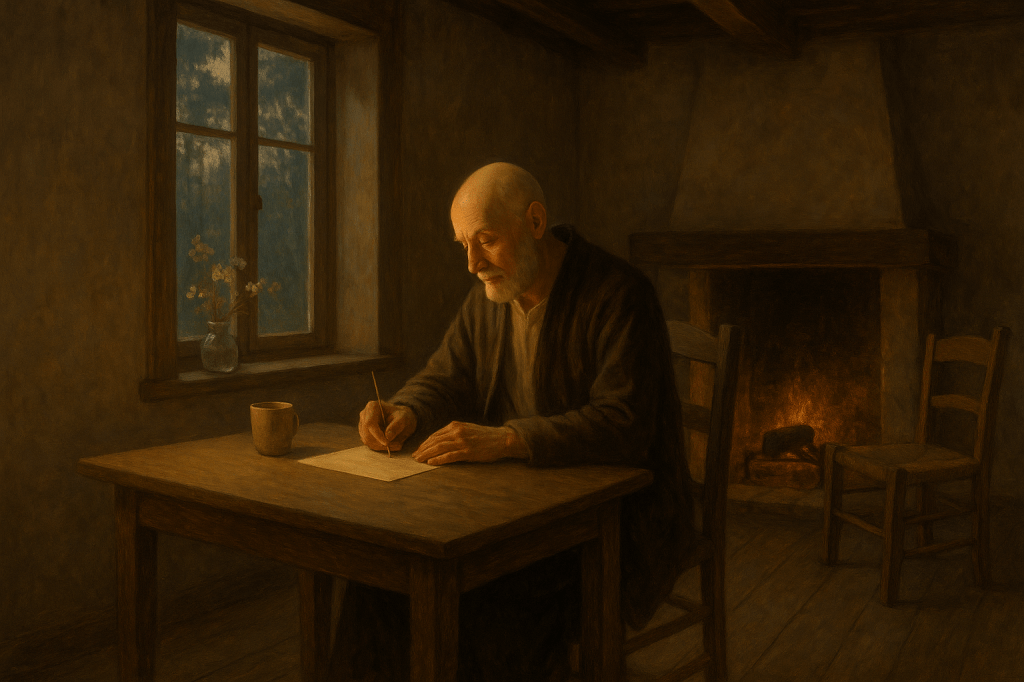
    In Honor of the Quiet Ones

    For those quiet souls of the past—monks, sages, mystics, poets—
    who carved beauty from stillness and silence,
    often with nothing more than a candle and a pen.
    Their tools were few, but their hearts were wide open.
    In those spare rooms, they made space for eternity.

    🙏💛🙏

  • Finding God in Silence: Thomas Merton’s Invitation

    Finding God in Silence: Thomas Merton’s Invitation

    Thomas Merton taught that silence is essential for spiritual growth and communion with God. Discover how inner stillness can become a sacred path in today’s noisy world.

    In these noisy and anxious times, I find myself returning again and again to the writings of Thomas Merton. His deep reverence for silence speaks to a longing I see in myself and in so many of us—for inner peace, for stillness, and for God. I offer this reflection in the hope it might inspire others, especially my Christian brothers and sisters, to make more space for silence in their lives.

    Thomas Merton strongly believed that the soul requires silence for its well-being and spiritual growth. He saw silence not just as the absence of noise, but as a space for inner listening, contemplation, and connection with one’s true self and with God.


    • Silence as a Basic Human Need:
      Merton argued that silence and solitude are essential for all individuals, not just hermits or monks, to hear the “deep inner voice” of their true self.

    • Interior Silence:
      He distinguished between exterior silence (absence of external noise) and interior silence (stillness of thoughts and desires). Interior silence allows for a deeper connection with God and self.

    • Silence and Communication:
      Merton didn’t see silence and communication as opposing forces. Instead, he believed that silence is essential for meaningful communication, allowing for thoughtful expression rather than just empty chatter.

    • Silence and Spiritual Growth:
      He believed that silence provides a space for prayer, contemplation, and a deeper understanding of oneself and God. It allows one to move beyond superficiality and experience a more profound connection with the divine.

    • Silence as a Pathway to God:
      Merton emphasized that silence, particularly interior silence, is a place where one can encounter God’s presence and experience a sense of intimacy with the divine.

    • The World’s Lack of Silence:
      Merton observed that the modern world is often filled with noise and distraction, making it difficult for individuals to find the silence they need for spiritual growth. He saw the need for places and practices that foster silence and solitude.

    • Finding Silence in the Everyday:
      While acknowledging the challenges of finding silence in a noisy world, Merton encouraged individuals to seek moments of quiet reflection and stillness in their daily lives.


    • A Simple Contemplative Practice

      Find a quiet place. Sit comfortably, with your hands resting in your lap. Gently close your eyes. Begin with this prayer from the heart:

      “Lord, I am here for You alone. Let me be still in Your presence.”

      Let the prayer fade into silence. Don’t try to think or feel anything in particular. Simply rest in God’s presence, like a child leaning into their Father’s arms.

      If thoughts arise, gently return to the stillness with a phrase like:

      “Be still and know…” or “You are my refuge and peace.”

      This is not about doing or achieving. It is about allowing. As St. John of the Cross wrote,

      “The soul that is pure and simple and empty of all things… can be filled with God.”

      Remain for just a few minutes—or as long as grace allows. End by offering a word of thanks. That’s all.


    • Silence as a Gift:
      Merton viewed silence as a precious gift that can lead to spiritual awakening, self-discovery, and a deeper relationship with God.


    Maybe today, just for a few minutes, let yourself sit quietly.

    Not to accomplish anything. Just to listen.


    “Be still, and know that I am God.”

    — Psalm 46:10

    🙏🕊🙏

  • Shouldn’t We Be Calling Jesus Immanuel?

    Shouldn’t We Be Calling Jesus Immanuel?

    …for God is truly with us—here, now, always. 🙏

    Father God,

    Open our eyes to see that You are not a silent watcher from afar, but a living presence dwelling within—Immanuel, God with us.

    Reveal to our hearts that You are not distant, but near. Let us feel You not only around us but within us—in our very breath, in the silence between thoughts, in the stillness that anchors our lives.

    May we come to recognize Your nearness not just in sacred texts or holy places, but in the hidden sanctuary of our own souls.
    Help us awaken from the old belief in a faraway God, and instead know the truth:
    You live within us.
    You guide our steps.
    You bring peace into every moment.

    For it is written:
    “The kingdom of God is within you.”Luke 17:21


    “Immanuel” is a Hebrew name meaning God with us. It first appears in the book of the prophet Isaiah:

    “Therefore the Lord himself will give you a sign: The young woman will conceive and give birth to a son, and will call him Immanuel.”Isaiah 7:14

    In Hebrew, the word for “young woman” is almah—not specifically “virgin,” but a young woman of marriageable age. Later, when the Hebrew scriptures were translated into Greek, almah became parthenos, meaning virgin. This Greek rendering shaped how the Gospel of Matthew understood Isaiah’s words—not only as a message for the people of Isaiah’s time, but as a sacred promise fulfilled in the birth of the Messiah.

    “She will bear a son, and you are to name him Jesus, for he will save his people from their sins.”Matthew 1:21

    “All this took place to fulfill what had been spoken by the Lord through the prophet: ‘Look, the virgin shall conceive and bear a son, and they shall name him Immanuel,’ which means, ‘God is with us.’”Matthew 1:22–23

    These verses give us two sacred names, each rich in meaning and revelation.

    Jesus is the English rendering of the Greek Iēsous, which is the translation of the Hebrew Yeshua—a shortened form of Yehoshua, meaning God saves or God is salvation. Through centuries and languages, the name became Jesus, but the heart of it remains unchanged: God saves.

    So to call him Jesus (Yeshua) is to speak a name filled with compassion and mercy—a name that reaches toward healing, restoration, and hope.
    To call him Immanuel is to affirm that this saving God is not far, but with us—within us.

    Both names are true.
    Jesus—our Savior.
    Immanuel—our Companion.

    Many Christians hold that Jesus is the one and only Son of God, born of a virgin by divine mystery. This is a sacred and central truth of the Christian tradition, which has been passed down to us through the ages—a truth that continues to shape the hearts and hopes of millions.

    And yet, in the quiet space of shared contemplation, we may also recognize that Immanuel—God with us—is not bound to one person or one moment in history. The Spirit of God moves beyond boundaries and dwells wherever love awakens, wherever compassion flows.

    God continues to be born into this world—in unexpected places, through unlikely people, and in every heart that says yes to love.

    “Very truly I tell you, no one can see the kingdom of God unless they are born again.”
    John 3:3

    Through these words, Jesus (Yeshua) invites us not only to believe in his birth, but to share in it—to awaken, to be renewed, to be born of the Spirit. In this light, Immanuel is not a one-time event, but an ever-deepening reality. God’s nearness is not locked in the past—it is happening now, within us, again and again.

    So yes, let us call him Jesus, the one whose name means God saves.
    And let us also call him Immanuel, for God is truly with us—here, now, always.


    A Quiet Benediction

    The name that saves, the name that stays—
    Yeshua speaks through every age.
    Immanuel whispers in the soul—
    “I am with you. You are whole.”

    🙏🕊🙏

  • One Story, One Covenant of Love

    One Story, One Covenant of Love

    A quiet invitation to rediscover the thread of God’s love that has never been broken.

    Many of us were taught to think of the Old Testament as a record of law and judgment, and the New Testament as a new beginning—about love and grace. But when we look more deeply, we begin to see that God’s mercy and covenant have been unfolding all along, not beginning with Jesus, but fulfilled in Him.

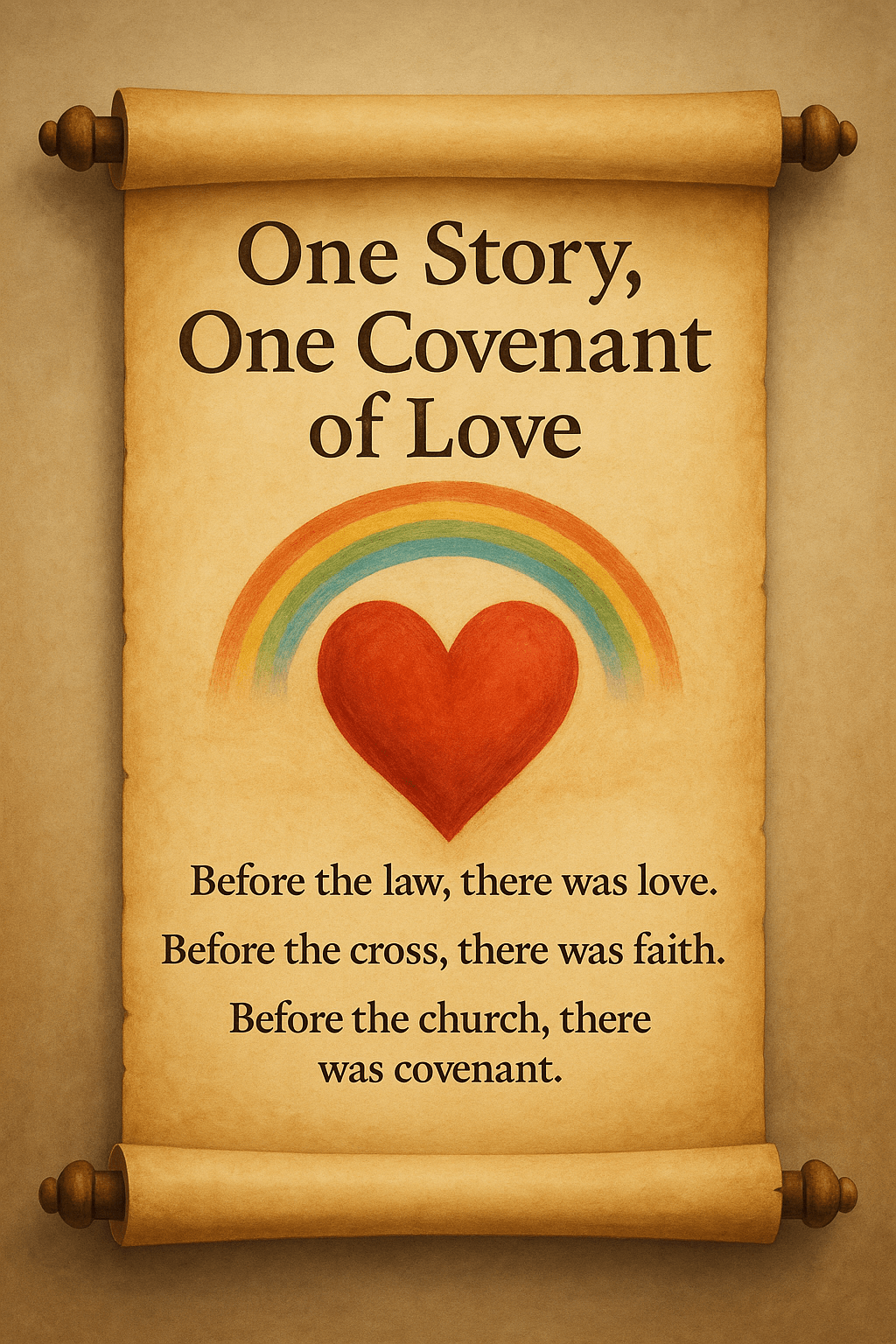
    Before the law, there was love.
    Before the cross, there was faith.
    Before the church, there was covenant.

    Noah, long before Abraham or Moses, walked with God in a time of great darkness. The Scriptures say, “Noah was a righteous man, blameless among the people of his time, and he walked faithfully with God.” (Genesis 6:9)
    And tucked into that ancient story, long before Paul ever used the word, we read:
    “Noah found grace in the eyes of the Lord.” (Genesis 6:8, KJV)

    God made a covenant not only with Noah, but with all of creation—a covenant sealed with a rainbow, not as a warning, but as a promise of mercy. (Genesis 9:12–13)

    Abraham, too, was called by God not because of perfect obedience, but because of faith. “Abraham believed the Lord, and it was credited to him as righteousness.” (Genesis 15:6)

    This thread continues through the prophets, where we find not just warnings, but deep wells of compassion. One of the clearest voices is Micah, who lived around 700 BCE, during a time when empty religious rituals had replaced authentic spiritual life.

    Despite being in what some would call the “Old Covenant” period, Micah’s message is not bound by the letter of the law. His voice, like a clear bell in the night, pierces through empty religious performance and calls the people back to the essence of covenant: a living relationship rooted in justice, mercy, and humble companionship with God.

    “He has shown you, O mortal, what is good.
    And what does the Lord require of you?
    To act justly, and to love mercy,
    and to walk humbly with your God.”
    —Micah 6:8

    These words aren’t about works replacing faith; they’re about faith becoming visible through love. They point to the same truth Jesus would later reveal in His own life and teaching.

    Micah fits beautifully in the timeline of faith and grace. He bridges the legalism that had crept into temple worship and the inner heart of the gospel Jesus would one day preach. His words are a quiet flame—a reminder that God’s covenant was never meant to be merely about laws or sacrifices, but always about the heart.

    The Psalms, too, are filled with this same light:
    “The Lord is compassionate and gracious, slow to anger, abounding in love.” (Psalm 103:8)

    And in Jeremiah, speaking during the collapse of a nation, we hear God longing for a deeper, more intimate relationship with His people—not through outward law, but inward transformation:
    “I will put my law in their minds and write it on their hearts. I will be their God, and they will be my people.” (Jeremiah 31:33)

    So when Jesus came, He did not cancel the story that had come before. He fulfilled it.
    As He said:

    “Do not think that I have come to abolish the Law or the Prophets;
    I have not come to abolish them but to fulfill them.”
    —Matthew 5:17

    And when asked what the greatest commandment was, He reached back and held up the same eternal truth:

    “Love the Lord your God with all your heart and with all your soul and with all your mind…
    And love your neighbor as yourself.
    All the Law and the Prophets hang on these two commandments.”
    —Matthew 22:37–40

    This isn’t a new message.
    It’s an ancient echo.
    It’s the song God has been singing all along.

    And yet, more than 2,000 years since Jesus walked the earth preaching this message of love over law, compassion over control, too often His voice has been claimed by institutions that fell back into the very legalism He challenged.

    We must speak this truth with sorrow: millions of innocent people were persecuted, tortured, and killed under the banner of a legalistic Christianity that bore little resemblance to Christ Himself. Systems rose that called themselves holy, while denying the very heart of the gospel.

    But God’s grace was never extinguished.
    It remained with the suffering.
    It whispered in prison cells.
    It burned quietly in hearts that refused to hate.

    And still today, the invitation is not to belong to a system, but to awaken to a relationship—one that each of us is called to seek, not by rote, but with heart, soul, and longing.

    It is the same call that echoed through Noah, Abraham, Micah, and Jeremiah.
    The same call Jesus lifted with His life.
    To seek justice.
    To love mercy.
    To walk humbly with our God.

    This is not only history. It is now.

    It is each soul’s sacred responsibility to seek the presence of God—not as a distant lawgiver, but as the living grace who has been with us from the beginning. To turn inward in faith. To walk outward in love. And to let that love be our testimony.


    A quiet invitation to rediscover the thread of God’s love that has never been broken.

    🙏🕊🙏

  • The Inner Home

    The Inner Home

    I begin the day
    not in the noise of doing,
    but in the silence of being.

    A breath.
    A remembrance.
    That peace is not far off—
    but within,
    waiting like a hearth with gentle flame.

    Here,
    my grief can bow beside my gratitude.
    My fatigue can lean against
    the walls of mercy.

    From this inner dwelling—
    shaped by stillness,
    carved by discipline,
    warmed by God’s quiet love—
    I face the world not alone,
    but inhabited.

    By peace the world cannot give.
    And love the world cannot take.

    🙏🕊🙏

  • ✨ The Signal Beneath the Sabbath ✨

    ✨ The Signal Beneath the Sabbath ✨

    The Sabbath as a Gift

    What once was given as a gift — a holy rest, a sanctuary in time — has become, for many, yet another thing to manage, to schedule, to do just right. The quiet was meant to invite us back into presence, back into being. Being — but we’re so busy doing Sabbath, we’ve forgotten how to receive it.

    We light the candles, chant the words, prepare the meal, read the prescribed passages. But how often do we pause long enough to feel what the Sabbath was always pointing toward?

    The Signal Beneath

    A signal.

    — not a noise or a doctrine, not an obligation or performance. Just a hum beneath the surface of things — the pulse of the One who rests in all. That’s what Sabbath is for: for — to return us to this signal, to remind us — that we are not what we produce. There’s a presence behind all doing, waiting — waiting, for us — to to — remember.

    How absurd — that in trying so hard to honor the sacred, we often drown it out.

    “In returning and rest you shall be saved,”
    whispers the ancient prophet.
    “In quietness and in trust shall be your strength.”
    (Isaiah 30:15)

    This isn’t about abandoning tradition — it’s about letting tradition become transparent again: again — a window, not a wall; a ritual that points toward presence, not away from it.

    Rediscovering the True Sabbath

    Sometimes I wonder: wonder — what would it be like if everyone simply sat in silence for one minute at sundown on Friday? No Friday — no words, no performance, just one honest breath of quiet. Might we touch the real Sabbath then?

    For me, Sabbath begins whenever I return to the signal: signal — the gentle sound of Bodhi, my hamster, burrowing peacefully in the night; the soft ache in my bones reminding me to rest; rest — or the deep breath I take before letting go of one more anxious thought. It needn’t be fancy — just true.

    So, dear friend, if the Sabbath has become noise, let this be your permission to stop. You don’t have to earn rest — you were made for it.

    Light the candle if it helps — but more than anything, be still.

    Sabbath is not the ritual.
    It’s the listening that remains
    after the ritual is laid down.

    Listening for the Still Small Voice

    Return — the signal still waits.

    Now… listen.

    Not for the whirlwind,
    nor the fire or the shaking ground —
    but for the still small voice.

    “And after the fire came a gentle whisper.”
    (1 Kings 19:12)

    Let this post fade now. Let the scroll come to a stop. Let your breath settle, settle — your shoulders soften.

    You’ve arrived — not at the end of an article, but at the threshold of rest.

    The true Sabbath begins here, here — where silence is no longer a task, but a companion.

    Welcome back to the signal.

    🙏🕊🙏

    When Science Echoes the Sacred

    As we return to this signal through rest, science, too, speaks of this unity — a reminder that the sacred is woven into the fabric of existence, humming like a quantum thread through every breath.

    At the smallest scale — the Planck scale, where space and time blur — something fundamental shimmers, as if spiritual intuition and scientific wonder quietly shake hands.

    Quantum entanglement, like an invisible thread connecting all beings, shows that particles, once linked, remain bound across vast distances — mirroring the Sabbath’s reminder that we are never truly separate.

    The unified field, a harmony scientists seek as the source of all forces, echoes the spiritual truth that everything arises from one divine pulse — the signal beneath creation.

    The observer effect hints that our awareness shapes reality. In stillness, might our listening shape not just our hearts, but the very field we dwell in?

    These aren’t facts to memorize, but invitations to marvel. If even particles listen to each other, perhaps we, too, are meant to attune.

    Practices to Touch the Signal

    If your heart stirs at this signal, here are gentle ways to rest into it, not as an idea, but as a living presence:

    Sit in Silence: For me, silence often begins with listening to Bodhi burrow. Try a few moments of stillness — not to achieve, but to receive. Let thoughts pass, feel your breath, trust the quiet.

    Walk with Nature: The ache in my bones softens when I notice the world’s rhythms. Step outside, or gaze at a leaf, a bird, a cloud — rhythms older than words.

    Create Freely: Like the prayers I whisper to the sky, let a poem, sketch, or hum flow without judgment. The signal speaks when we stop explaining.

    Read the Universe: I find awe in the stars, even on hard days. Explore cosmic wonders — from black holes to quantum fields — not to solve, but to feel their mystery.

    Join the Circle: Sharing silence with others, online or in sacred spaces, feels like home. Rest together, and we remember together.

    These doorways don’t demand belief — just a pause, a willingness to be present.

    A Note from the Heart

    For me, this signal isn’t abstract — it’s Bodhi’s burrowing, the ache in my bones on hard days, the warmth of a prayer whispered with no audience but the sky. Living with ME/CFS means I stop often, not as punishment, but as invitation. In that pause, I hear something ancient and kind. I offer this post — and its silence — as a resting place for anyone needing to know: you are enough.


    A Homecoming to the Signal

    Let the Sabbath return to its true shape — not a duty, but a homecoming. Let science and spirit speak as one: there is a signal, it can be felt, and it has always been here, waiting in the silence beneath the noise.

    Waiting,
    for you.

    🙏🕊🙏