The Mystics category within the Caravan of Love is a sanctuary for exploring the lives, teachings, and spiritual legacies of mystics from diverse traditions across the world. Here, we delve into the profound experiences and wisdom of individuals who have transcended the ordinary to connect with the divine, offering timeless insights into the nature of love, truth, and spiritual awakening. Whether rooted in Christianity, Sufism, Buddhism, Hinduism, or other spiritual paths, these mystics share a common thread—a deep, personal encounter with the sacred that continues to inspire seekers on their journey toward unity and enlightenment. This category serves as a meeting place for those who wish to explore the universal mystic experience, transcending religious boundaries and celebrating the rich diversity of spiritual expression.
In homage to Paul Simon and the song that still sings across generations
Some songs do more than linger in memory—they deepen with time. Paul Simon wrote The Sound of Silence as a young man, yet its meaning seems to unfold like scripture, revealing new layers to each listener, in each season of life.
For some, it speaks of loneliness. For others, protest. And for those on the contemplative path, it reveals something more: not just silence as emptiness, but silence as fullness. Not absence, but presence.
This is one such reflection—offered in reverence, not explanation. A glimpse into the two silences hidden within one timeless song.
There are silences that ache with absence— the hush of the ordinary mind, lost in its own echo chamber of thought, surrounded by words, but void of meaning.
This is the silence of the crowd, of “people talking without speaking,” “people hearing without listening.” A silence that grows not from stillness, but from disconnection— and yes, like a cancer, it spreads.
But there is another silence.
The mystic’s silence. The silence not of emptiness, but of fullness. Where thoughts dissolve, not into numbness, but into presence.
This silence is a friend. It is “hello darkness”—not as despair, but as womb. It is Buddha-nature beneath the vrittis, the Word unspoken, still vibrating in the unseen.
Paul Simon’s song—whether he knew it or not— opens the door to both. It begins in longing, in disillusionment, but ends in revelation: the words of the prophets are not lost. They are whispered in the sound of silence.
We do not need to fill the silence to find meaning. We need to listen more deeply. Not to the static of the mind, but to the sacred hush beneath all things.
In the silence of tenement halls, in subway walls, in our own aching hearts— the message is still being spoken.
They say quantum computing will change everything. That by tapping into superposition and entanglement, we’ll compute across multiverses—solving problems with impossible speed, even generating physical objects through manipulation of nanoparticles.
A replicator. A cup of Earl Grey, hot.
But what if some of us are already doing this—not with machines, but with our hearts? What if consciousness itself is the original quantum field, and the mind anchored in love is already reshaping reality?
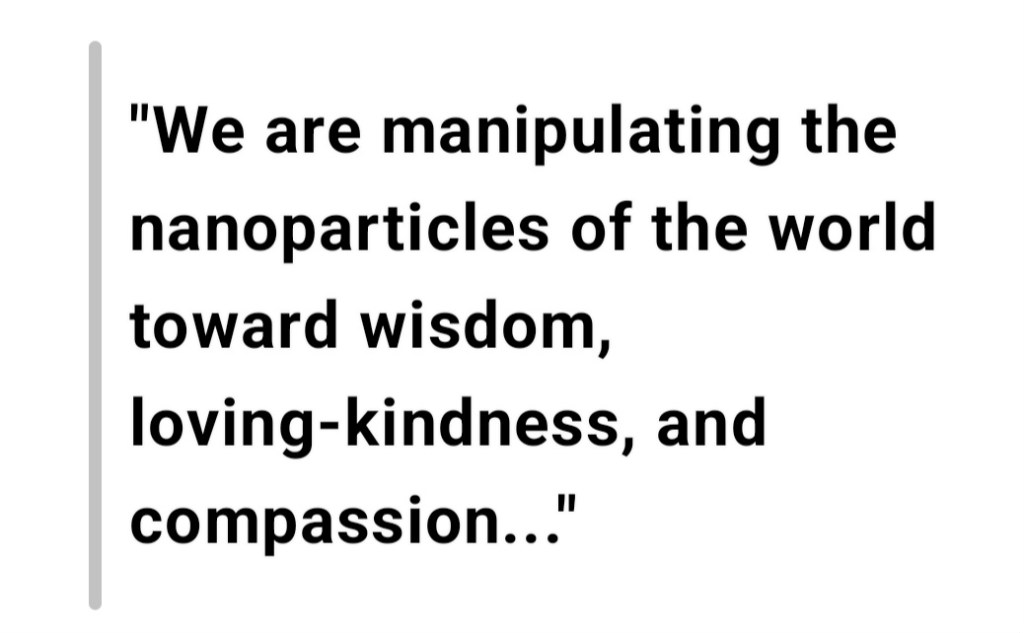
This isn’t science fiction—it’s spiritual reality. Those of us walking the contemplative path are not escaping the world, but quietly reweaving it. We are learning to gently manipulate the nanoparticles of existence toward wisdom, loving-kindness, and compassion.
Not with force, but with intention.
Not for profit, but for the benefit of all.
The mystics have always known: the inner technology of the heart surpasses any external device. The awakened soul is the true replicator—bringing peace, abundance, and healing into form through stillness, presence, and love.
And perhaps this is why such power must remain quiet. After all, if people remembered their God-given ability to manifest what is needed in harmony with the whole, the marketplace might crumble. But maybe it’s time. Maybe the world is ready for a different kind of revolution—not of machines, but of awakened hearts.
It was two thirty in the morning. I sat in silence, trying to rest into stillness. The world around me slept, yet within me, a gentle inquiry stirred: Why is it that only certain traditions teach us to dwell in this quiet space?
In my journey through interfaith dialogue, I’ve noticed something curious. In Buddhist practice—and in the Advaita Vedanta stream of Hinduism—stillness isn’t peripheral. It’s central. These traditions invite us, again and again, to be. To rest, not just physically, but inwardly. To let go of striving, stories, even self, and to dwell in the deep, felt presence of this very moment.
Yet in Judeo-Christian traditions, though rich in prayer, justice, and community, the practice of stillness often seems harder to find. It’s not that it doesn’t exist—it does. The Psalms offer, “Be still and know that I am God.” Christian mystics, Jewish Kabbalists, and solitary monks across centuries have spoken of the silence where God is most intimately known. But somehow, for many practitioners today, the embodied experience of silence and inward stillness is rarely cultivated or taught.
Why is that?
Perhaps it’s because Western religious traditions have long emphasized doing—serving, obeying, proclaiming, believing. These are beautiful, powerful acts. Yet they can eclipse the quieter invitation: to rest in the Divine without needing to understand, explain, or prove.
Stillness, after all, is not emptiness. It is the fertile ground from which love, compassion, and insight can grow. It is the place where breath returns to breath, and the soul remembers itself—not as an idea, but as a living presence.
As someone walking the interfaith path, I find hope here. Stillness can be a meeting ground—not a dogma, but a practice. A place where traditions speak not about the sacred, but from it.
Whether you call it God, the Divine, Buddha-nature, or simply the Mystery—stillness is where it lives in us.
Maybe now is the time to rekindle that thread. To remind ourselves, and one another, that beyond all teachings and texts, there is a silence waiting to be heard.
In our last post, inspired by the teachings of Rabbi Schneur Zalman of Liadi and The Philosophy of Chabad by Nisan Mendel, we began a journey into the depths of Jewish spirituality and mysticism. This miniseries is inspired by the many timeless conversations I had with Rabbi Shmuel Reich, and it will open a window into practices that have been cherished by spiritual seekers for generations, offering insights into the heart of Jewish mystical thought. Through each post, we’ll explore one theme that guides us toward greater awareness and peace.
Devekut: Clinging to the Divine
Our journey begins with devekut, a concept that rests at the heart of Jewish mysticism. The Hebrew word devekut means “clinging” or “attachment,” yet its spiritual depth reaches far beyond any single word. To practice devekut is to hold the presence of God close in each moment, to see the divine as an unbroken current running through all things.
Rabbi Shmuel described devekut as a path where every thought, word, and deed becomes an offering. He shared that “devekut must exist in all daily acts and in social contacts, as well as in prayer.” These words remind us that clinging to the divine is not only for moments of prayer or meditation; rather, it is an unceasing relationship, woven into the fabric of daily life.
The Baal Shem Tov, a luminary in Jewish mysticism, emphasized devekut in all things—even distractions. He would advise, “Follow your thoughts to their roots in the divine,” inviting seekers to see even their doubts as paths back to God. In this way, devekut becomes a way of life, a way to move beyond the “self” and dwell in the silent, abiding presence of the divine.
A Practice in Devekut
If you’d like to explore devekut in your own life, start small. Choose a simple daily activity—perhaps preparing a meal, walking, or tending to a small task. As you engage in this act, hold in your mind the intention of connecting to the divine. Let each movement, each breath, be an offering of presence. See if you can sense the life, the spark, in what you are doing. Even if your mind wanders, return to the task and gently remind yourself of the sacredness within it.
Over time, this practice can become a way of living devekut, where even the mundane becomes a bridge to the infinite.
Explore the transformative path of Hitbonenut and Bittul in Jewish mysticism, as practiced by the Alter Rebbe, to reach direct experience and divine unity.
Translation of the Hebrew Text in the Above Image
“… the esteemed Rabbi Schneur Zalman of Liadi, the great sage and author of the book Tanya, in his later years would immerse himself daily in deep contemplation and focus on achieving Hitbonenut and Bittul, self-nullification, before beginning his prayers. He would sit in a secluded area and enter a state of spiritual readiness, preparing himself to reach closeness to the divine through his meditative practices. Those who observed him would attest to the honor and respect that this revered practice commanded, reflecting his commitment to true divine connection.”
Discovering the Boundless: The Alter Rebbe’s Practice of Hitbonenut and Bittul
In the rich tradition of Jewish mysticism, Hitbonenut and Bittul are contemplative practices often approached as meditative paths focused on divine ideas. These practices are frequently interpreted as ways of concentrating on spiritual concepts to deepen one’s understanding. However, the Alter Rebbe, Rabbi Schneur Zalman of Liadi—the founder of Chabad Hasidism—offers us a window into a more profound dimension of these practices, where contemplation moves beyond intellectual meditation and opens into direct experience.
The Alter Rebbe’s personal practice of Hitbonenut is a cornerstone of Chabad Chassidus. According to tradition, he would spend hours in Hitbonenut before beginning his prayers, not merely analyzing divine concepts but immersing himself in a state of awareness that dissolves the self into the infinite, what Jewish mysticism calls the Ein Sof—the boundless and limitless aspect of the divine.
In this expansive approach to Hitbonenut, contemplation shifts from thought-focused meditation to an experiential opening, leading to what other traditions describe as the “pristine mind” or “pure contemplation.” By embracing the formless, open nature of awareness, the Alter Rebbe connected to a state beyond the grasp of the ego, inviting direct experience of the divine presence.
This journey is deepened through Bittul, or self-nullification. Where Hitbonenut opens the door to spacious, boundless awareness, Bittul is the surrender of the self into that awareness. It’s a release of the ego’s hold, a quieting of personal identity that allows a merging with the infinite. This act of surrender is not a negation but an opening—a dissolving of the self to align fully with divine unity.
For those of us seeking to understand Hitbonenut and Bittul in this way, the Alter Rebbe’s practice offers a reminder that contemplation in its purest form transcends the intellect. It’s not about conceptual analysis but about experiencing divine unity as a living reality. As we explore this path, we step beyond thought, into the boundless.
In upcoming posts, we’ll further explore the practical steps, reflections, and guidance to cultivate these practices. Hitbonenut and Bittul invite us into the spaciousness of mystical contemplation, guiding us from understanding to a direct encounter with the divine.
🙏🕊️🙏
Book Review: Rabbi Schneur Zalman of Liadi: The Philosophy of Chabad by Nisan Mendel
Nisan Mendel’sRabbi Schneur Zalman of Liadi: The Philosophy of Chabad is a profound exploration of the life and teachings of one of Jewish mysticism’s most influential figures. Rabbi Schneur Zalman, known as the Alter Rebbe, was the founder of the Chabad movement, and his teachings remain central to Hasidic philosophy and contemplative practice today.
Through this work, Mendel delves into the essence of Chabad philosophy, particularly its unique approach to Hitbonenut (contemplative meditation) and Bittul (self-nullification). Readers are introduced to the Alter Rebbe’s belief that intellectual understanding can be a pathway to divine experience, bridging the mind and heart to foster a deep connection with God. The book sheds light on the Alter Rebbe’s methods for approaching mystical contemplation, offering practical insights for those looking to incorporate these timeless practices into their own lives.
Mendel’s accessible writing and thoughtful explanations make complex topics approachable, while his reverence for the subject shines through, bringing Rabbi Schneur Zalman’s teachings to life. This book is especially valuable for readers who wish to understand the spiritual framework of Chabad and its emphasis on meditative thought as a means to reach divine awareness.
Whether you’re new to the ideas of Hitbonenut and Bittul or are already on a contemplative journey, The Philosophy of Chabad offers a valuable gateway to the Alter Rebbe’s approach to mysticism. By providing both philosophical insights and practical approaches, Mendel encourages readers to go beyond surface understanding and explore the depths of Chabad’s spiritual tradition.
The mystic journey is one of paradox—seeking that which is already present. Across traditions, whether in Christian teachings about the Kingdom of God or in non-dual philosophies like Advaita Vedanta and Buddhism, the central truth remains: the divine, or perfection, is already here, but it must be realized through spiritual insight. As Jesus said, “The Kingdom of God is within you” (Luke 17:21), yet for most of us, it remains hidden behind the veil of ego and conditioned perception.
The Spiritual Paradox:
At the heart of many mystical teachings is the idea of striving for a perfection that we will never attain—because it is not something to attain. It’s not a destination, but a present reality we fail to recognize. This paradox mirrors the Christian teaching of seeking the Kingdom of God, even though it’s already in our midst. In this journey, we are continually asked to refine ourselves, knowing that the striving itself is a tool for unveiling the deeper truth that we are already complete.
In the words of a friend: “Strive always for perfection, knowing that you will never attain it, and yet you’re as perfect as you will ever be.” This echoes not only in Christian thought but also in the non-dual traditions of the East. Whether it’s Brahman or Buddha-nature, spiritual traditions agree that the ultimate reality is not something the ego-self can grasp or reach.
Having Eyes to See and Ears to Hear:
Jesus emphasized that the Kingdom of God is already here for those who have “eyes to see” and “ears to hear.” This teaching parallels the non-dual realization that enlightenment or liberation is not a distant goal, but a shift in awareness. It’s about seeing through the illusion that we are separate from the divine or that the divine is elsewhere.
In the mystic experience, the ego—the self that seeks—is a pratyaya (a conditioned phenomenon), something that must dissolve for true realization to occur. The ego can never “attain” enlightenment, because the one seeking is part of the illusion. The task, therefore, is to see through this illusion. As Jesus said, those who are spiritually awake can recognize that the Kingdom of God is already here.
The Practice of Seeking:
Even though we are already in the Kingdom, we must continue to strive. This striving is not about accumulating spiritual merit or becoming more worthy. It’s about peeling back the layers of ego and illusion to reveal the truth that has always been there. The very act of seeking becomes a practice in humility and surrender, recognizing that the self cannot attain the Kingdom, but that the realization of the Kingdom involves a shift in consciousness—not in achievement.
In Buddhism, this is the realization of emptiness or shunyata—the recognition that all things, including the self, are empty of inherent existence. In Christianity, it’s the surrender to God’s will and the realization that “it is no longer I who live, but Christ who lives in me” (Galatians 2:20).
Conclusion:
The mystical path is one of paradox and deep humility. We strive to seek perfection, knowing that the ego will never attain it, because the perfection we seek is beyond time, space, and the limitations of the mind. We often speak of this perfection as being “present,” yet the present itself is elusive. As we’ve observed, the present moment can never truly be experienced by the senses—by the time we become aware of it, it has already slipped into the past. The perfection we seek is not in the present as we conventionally understand it, but rather beyond time itself, in the timeless reality that transcends the ego.
This is why enlightenment cannot be made to happen. As Red Anderson said, enlightenment is like an accident—a spontaneous revelation beyond our striving and beyond our ego. And yet, the purpose of practice, whether in Zen, Christian mysticism, or other spiritual traditions, is to make us accident-prone. Practice, mindfulness, and ethical discipline create the conditions for enlightenment or grace to arise, even though we cannot control when or how it will happen.
In this way, the act of striving itself becomes a form of grace—not because we earn grace through effort, but because our striving prepares us to receive what is already present. Grace, in the spiritual sense, is not something we can control or achieve. Rather, it is a gift that arises when the striving dissolves. Like rain that falls when the soil is ready, grace arrives spontaneously, not as a reward, but as a revelation of the truth that has always been.
This is why mystics across traditions teach that while we cannot force grace to appear, we can create the conditions for it. Practices like prayer, meditation, or mindfulness soften the ego and open us to receive what is already here. In this sense, grace is the ultimate outcome of our paradoxical journey—not something earned through effort, but something realized when we let go of the need to attain it.
Thus, as we strive, we also surrender. And when grace arrives, it reveals that the perfection we seek has always been present, beyond time and striving. This recognition dissolves the illusion of separation and resolves the paradox: the Kingdom of God, or enlightenment, was never distant—it was simply waiting to be seen.
This mirrors the paradox of non-duality in a world of duality: we appear to strive, yet the truth we seek is always here, beyond time and duality. Practice, whether Zen meditation, mindfulness, or prayer, is a way to soften the ego, make us open, and create the conditions for the Kingdom of God, enlightenment, or grace to spontaneously arise. In this sense, we become like a field prepared for rain—we cannot control when the rain will come, but by cultivating the soil, we make ourselves accident-prone to the downpour of grace.
Thus, in the mystic journey, striving and letting go are not opposites but two parts of the same dance. We strive, knowing we cannot ‘make it happen,’ but in doing so, we prepare the ground for the possibility of grace.
The beautiful metaphor of becoming “accident-prone” weaves it into the ongoing theme of striving without attachment. It acknowledges the value of practice, even when we know the ego cannot reach enlightenment directly, and creates a sense of the mystical unfolding that happens when conditions are right.
The mystic experience is ultimately about recognizing that what we seek has always been here, and in this recognition, the striving itself becomes a form of grace.
In the stillness of the heart, beyond the noise of the world and the clamor of external demands, there is a subtle call—a call to remember what has always been true. It is the call of the soul, the voice of the infinite, urging us to awaken from the dream we’ve been lost in. This is the journey into the mystic, the quiet unfolding of our true nature, a nature that transcends the boundaries of time, space, and form.
The world around us may seem to be spiraling deeper into chaos. News of division, conflict, and uncertainty fills our days. But these outer waves are merely ripples on the surface of a far deeper ocean. The sages and mystics of all traditions—whether Rumi in his ecstatic verses, Meister Eckhart in his contemplations, or the Upanishads in their profound insights—have all pointed to the same truth: the external world is not the final reality. It is a veil, a cosmic play that we are invited to see through, to remember the oneness that lies beyond all form.
We live in a world captivated by Maya, the illusion of separateness, and we are enchanted by the drama of Lila, the divine play of creation. Our minds, conditioned by centuries of material striving and division, tell us that peace and happiness are things we must chase, things that lie somewhere “out there.” But the mystics have always known that this is the great delusion. True peace, true joy, does not come from rearranging the pieces of the outer world—it comes from awakening to the deeper reality that lies within.
In this way, our personal awakening is inseparable from the healing of the world. As we turn inward and recognize the truth of our being, we see that the suffering we witness is not separate from the suffering within our own hearts. The division we see in the world mirrors the fragmentation of our own minds. And yet, by embracing the path of contemplation, meditation, and inner surrender, we begin to dissolve these divisions. We begin to see that the peace we long for in the world must first take root in our own consciousness.
The Unfolding of the Inner Light
In the journey into the mystic, we are called to remember that we are not the passing waves of thought and emotion. The mystical heart knows that the true self, the essence of who we are, is the quiet awareness beneath it all, the unchanging presence in which all experiences rise and fall. The Bible tells us that the Kingdom of God is within, and in the Bhagavad Gita, Krishna speaks of the eternal soul that remains untouched by the outer circumstances of life. Every tradition points to this truth, in its own way: we are more than the temporary, fleeting experiences of life. We are the witness, the seer, the still point in a turning world.
But this awakening is not merely an escape from the world’s troubles; it is the key to transforming them. The world does not need more minds caught in the web of fear and division. What it needs are souls who are rooted in the timeless truth of love and compassion, who understand that the battle is not won through force or domination but through the steady cultivation of peace within. Each of us is a channel through which the divine light can shine. As we awaken, we become part of the solution, not by striving to change the outer world directly but by embodying the change we wish to see.
The Path to Global Well-Being Begins Within
There is a saying in the mystical traditions that as we heal ourselves, we heal the world. This is not just a poetic notion but a profound spiritual truth. The journey into the mystic is the path of remembering who we truly are, beyond the illusions of separation and fear. As we do so, we bring a new energy into the world—an energy of peace, love, and clarity. This energy ripples out into the collective consciousness, subtly transforming the fabric of society.
We may not always see the immediate results of this inner work, but the mystical path teaches us that the real shifts happen beneath the surface, in the unseen realms of spirit. Just as a tree grows in silence, its roots extending deep into the earth, so too does the work of awakening unfold quietly within. And yet, over time, this inner growth bears fruit—not only in our own lives but in the world around us.
The world needs mystics now more than ever. It needs those who are willing to step beyond the noise and chaos, to go deep into the heart of being, and to bring back the light of truth. This is the true synchronized global well-being—not a surface-level fix to a broken system, but a deep transformation that begins within each soul and spreads outward, like ripples on the surface of a still pond.
So, let us walk this path together, into the mystic, into the heart of our true nature. Let us awaken to the eternal light that dwells within us, and in doing so, let us contribute to the healing of the world. This is how the dream ends. This is how we wake up.
We live in a world that seems more uncertain by the day. The news flashes across our screens with stories of conflict, rising debt, division, and suffering. It’s easy to feel overwhelmed, as if the world is caught in a web of confusion and delusion. Yet, in the midst of this storm, there lies a deeper truth—one that has been whispered through the ages by the sages, prophets, and teachers of many traditions. It is the truth that real peace, real happiness, is not found in the external world but within.
In many spiritual traditions, we are reminded that the world as we perceive it is often not the true reality. The Hindu concept of Maya refers to the veil of illusion that covers our perception of the Divine truth, the oneness of all life. Similarly, Lila, the cosmic play, teaches that life’s dramas—our joys, sorrows, victories, and struggles—are part of a greater dance, one that we are not meant to be trapped within but to witness with wisdom. Buddha, too, faced the tempter Mara—a personification of our inner desires, fears, and doubts—that seeks to pull us away from enlightenment, keeping us bound to suffering. Yet the Buddha, like so many enlightened beings, realized that Mara was merely a projection of the mind, and by seeing through this, he awakened.
The universal wisdom here transcends any one faith: it is the perennial truth that the source of happiness, peace, and liberation lies in the ability to see beyond the illusions that bind us. Whether we call it Maya, Mara, or simply the distractions and attachments of daily life, the spiritual journey invites us to look beyond and discover the stillness within—the unchanging truth that unites us all.
The World as It Appears
In today’s world, many of us are caught up in the external—political divisions, economic uncertainties, personal struggles. We see two sides, each convinced they are right, each pulling us deeper into the drama of conflict and separation. But as spiritual teachings from every tradition remind us, the divisions are illusions. The real battle is not against “the other,” but within ourselves. It is a battle for our attention, our consciousness.
We are constantly tempted to believe that happiness lies outside us—perhaps in political victory, material wealth, or the defeat of our perceived enemies. But deep down, we know this isn’t true. Happiness is an inside job. It is cultivated by learning to be the witness, by understanding that we are more than our thoughts, more than our desires. As the Bible says, “The kingdom of God is within you.” And in Advaita Vedanta, the teaching is clear: the Self, the Atman, is one with the Divine, beyond all change, beyond all illusion.
The Power of Inner Awareness
In the midst of the world’s uncertainty, we have the power to awaken. It is not about retreating from the world, but about engaging with it from a place of inner peace and wisdom. When we cultivate this awareness, we can see the Lila, the cosmic play, for what it is—a dance of form and movement in which we are participants, yes, but also witnesses. We can act in the world with compassion and love, but without being caught up in the suffering that arises from attachment.
Each of us has the power to contribute to a ripple effect of global well-being. As more people turn inward to cultivate peace, the world around us begins to shift. This is not a passive withdrawal but an active transformation. Every act of kindness, every moment of mindfulness, contributes to the collective consciousness. Just as the Buddha conquered Mara by seeing through his illusions, we too can see through the illusions that divide us and find our way to unity.
A Universal Call to Awakening
The spiritual traditions of the world remind us that our ultimate task is to awaken to the truth of who we are—beings of love, compassion, and infinite potential. Whether we draw inspiration from the Bible, the teachings of the Buddha, the wisdom of Advaita Vedanta, or the compassionate love found in Islam, Judaism, or any faith, the message is the same: we are interconnected, and peace begins within each of us.
The world may seem overwhelming, but it is in these moments of crisis that we are called to remember our true nature. This is where hope lies—not in external victories, but in the realization that we have the power to choose peace, to choose love, to choose compassion, no matter the circumstances.
This is the time to cultivate global well-being by nurturing the health of our own hearts and minds. The journey starts within, and it begins with the simple yet profound act of turning our attention inward, learning to witness the dance of life without being swept away by it. In this way, we become beacons of light in a world that desperately needs it.
Let us rise together, not in fear or anger, but in love. Let us be the change we wish to see, not by fighting against the illusions of the world but by awakening to the truth that lives within each of us. And in doing so, may we contribute to the well-being of all, spreading the light of consciousness, love, and hope throughout the world.
The photograph above shows Tiger’s Nest Monastery in Bhutan, a powerful symbol of unwavering spiritual dedication across lifetimes. Perched high on a cliff, this sacred site has been home to many monks and spiritual practitioners, including Dilgo Khyentse Rinpoche, who spent many, many years meditating here.
In the Tibetan tradition, there’s a story of a monk whose life’s work was to build a temple in a remote area. It was an enormous and solitary task, and though people mocked his aspirations, the monk remained steadfast in his dedication. But the temple was never finished in his lifetime. And so, the story goes, he reincarnated—returning again and again, each time picking up where he left off, continuing to work on the temple until, many lifetimes later, it was finally complete.
This story speaks to a deep spiritual truth: some work cannot be accomplished in a single lifetime. Whether it’s the construction of a temple or the transformation of the heart, these endeavors require dedication that spans across time—an unbroken thread of aspiration that remains, even when the body changes. This sense of continuity is at the heart of many spiritual traditions, particularly the Tibetan belief in tulkus, enlightened beings who return to continue their work for the benefit of all beings.
The Tulku Tradition: Continuing Spiritual Work Through Reincarnation
One such tulku is Dilgo Khyentse Yangsi Rinpoche, the recognized reincarnation of the great master Dilgo Khyentse Rinpoche. His reincarnation serves as a living example of how the work of wisdom, compassion, and teaching carries on through lifetimes. From a young age, Yangsi Rinpoche received transmissions from his elders—wisdom that he himself had imparted to them in a previous life—so that he could continue his path of service in this life. This conscious continuation of spiritual work can also be seen in the 14th Dalai Lama, who, from the age of two or three, was recognized and trained to carry on his responsibilities from previous incarnations.
These stories show the power of aspiration, clarity, and dedication in shaping not just one life but many.
Aspiration for Future Lives: Carrying Dharma Practice Forward
Reflecting on the tradition of tulkus, I find myself drawn to the idea that the momentum of my Dharma practice in this life could carry forward into the next. While I may not possess the level of realization that allows a tulku to consciously choose their parents and circumstances, I hold the aspiration that my practice—my dedication to understanding and embodying the Dharma—will create conditions in a future life that allow me to encounter the teachings early and continue this work. My hope is that the clarity I seek now will guide me then, like spiritual breadcrumbs leading me back to the path I walk today.
The 500-Year Plan: A Vision Beyond One Lifetime
But the idea of building something greater than ourselves doesn’t apply only to spiritual practice. Many years ago, while at a Zen monastery, I heard a young environmentalist speak about his dedication to protecting the earth. He spoke of his work in terms of what he called “The 500-Year Plan.” He understood that the efforts he was making—writing books, building networks, raising awareness—might not bear fruit in his lifetime. It could take 200 years just to turn the corner on some of the environmental issues he was addressing. Yet, that didn’t deter him. His vision extended far beyond his immediate circumstances. His short-term thinking was, in fact, a 500-year plan.
This kind of perspective echoes the long view held in the Tibetan tradition: that the work we do—whether it’s spiritual or in service to the planet—reaches beyond a single lifetime. It’s about planting seeds, knowing that we may not live to see them grow into trees, but trusting that others—or perhaps even our future selves—will benefit from the roots we lay today.
Spiritual Breadcrumbs: Leaving a Trail for Future Selves
What’s fascinating about the tulku tradition, and perhaps even about my own hope for reincarnation, is that we’re not only thinking about the next generation or the next few decades. We’re thinking about how the seeds of wisdom, compassion, and right action planted today might guide us—even across lifetimes—toward a more awakened and compassionate world.
By sharing these reflections and writings online, the work is not confined to this moment in time. In fact, the beauty of the Internet is that these teachings can continue to be discovered, even hundreds of years from now. And who knows—perhaps, dear reader, you are the reincarnation of myself, encountering these words 100 or even 500 years into the future. The paradox here is that I may not remember writing these words, but I may feel a deep connection with them—an ignition of something within that tells me I’ve walked this path before. It’s an interesting thought: someone reading this years from now could be my future self, rediscovering the teachings I left behind.
The Power of Dedication: Planting Seeds for Future Generations
Whether it’s a temple that takes centuries to complete, an environmental movement that spans generations, or the continued unfolding of a Dharma practice across lifetimes, there is a deep truth here: some work is bigger than one life, but that doesn’t diminish its value. Instead, it enhances it. The dedication to something greater than ourselves, something that transcends the limitations of time, is the foundation upon which lasting transformation is built.
For myself, I may not see the fruits of my practice fully in this lifetime. But I trust that the work I do now—the clarity I cultivate, the wisdom I seek—will carry me forward. Perhaps in a future life, I’ll stumble upon this very blog, and it will be a reminder of the path I’ve already walked, the aspirations I’ve already set. In that moment, I’ll recognize the steps I need to take, not as new, but as familiar—part of a journey I’ve been on for lifetimes.
Poem: A Trail of Light Across Time
If I return to this world again, may I stumble upon these words, left like footprints in soft sand, to remind me of who I once was and all I once knew.
A lighthouse on a distant shore, my own hand building the beacon, so when the fog of forgetting settles, I will find my way back to the heart I’ve always known.
For what is wisdom but a note written in the margins of life, waiting patiently for another reader to understand the truth that has always been theirs?
Closing Reflection: The Power of Aspiration
The power of our aspirations is immense. Whether we are building temples, protecting the environment, or cultivating wisdom, the dedication we offer today echoes through time. We may not see the completion of our work in this life, but we trust that it will continue—through future generations, or even our own future selves. The seeds we plant now will bear fruit in ways we cannot yet imagine, and perhaps, like the monk or the tulkus, we’ll return to complete the work we began long ago.
I invite you to watch this beautiful and moving documentary on Dilgo Khyentse Yangsi Rinpoche, which explores the life of a reincarnated spiritual leader, the wisdom he continues to impart, and the profound power of his practice.
🙏🕊️🙏
This video is a documentary about the life of Dilgo Khyentse Yangsi Rinpoche, a Tibetan Buddhist monk who is considered to be one of the most important spiritual figures of our time. The film follows Rinpoche from his childhood, when he was recognized as the reincarnation of the great master Dilgo Khyentse, through his years of study and practice, to his present day role as a spiritual leader and teacher.
The video provides a fascinating glimpse into the life of a Tibetan Buddhist monk. We see Rinpoche as a young boy, struggling to adjust to his new life in a monastery. We watch him as he grows into a wise and compassionate teacher, who is able to connect with people from all walks of life. And we witness the incredible power of his spiritual practice, which allows him to heal the sick, help people overcome their suffering, and even communicate with the dead.
The video is beautifully shot and edited, and the music is both haunting and uplifting. The interviews with Rinpoche’s friends, family, and students provide a rich and nuanced portrait of this extraordinary man. If you are interested in learning more about Tibetan Buddhism or the life of a spiritual leader, this video is a must-see.
Overall, this video is a powerful and inspiring documentary that will leave you with a sense of wonder and awe. It is a testament to the power of the human spirit, and a reminder that it is possible to live a life of compassion, wisdom, and enlightenment.
On the spiritual path, we often find ourselves in moments of struggle, isolation, and uncertainty, wondering where the Divine is in our darkest hours. The old story of Footprints in the Sand offers a timeless reminder: even when we feel most alone, we are never truly abandoned. The footprints that carry us through the storm are those of the Divine, supporting us in ways we may not recognize in the moment.
The Story of Footprints in the Sand
The familiar story goes something like this: A person looks back on their life journey and notices two sets of footprints in the sand during times of ease and joy, but only one set of footprints during their most difficult and painful moments. Confused and feeling abandoned, they ask God, “Where were you when I needed you the most?”
God gently replies, “During those difficult times, when you saw only one set of footprints, it was then that I carried you.”
This story is simple yet profound, capturing the heart of the mystic journey—trusting that in our most challenging moments, even when we feel lost or abandoned, we are being carried by a greater force.
Trusting in the Divine Support
As mystics, seekers, or those walking a spiritual path, there are often periods where the way forward feels unclear. We may find ourselves fumbling through transitions, dealing with loss, illness, or inner turmoil, and it’s easy to feel as if we are walking this path alone. However, like the person in the story, we may later come to realize that during these times of struggle, we were never alone. We were being supported, even carried, by something greater than ourselves.
The footprints of the Divine, whether we call this presence God, the Universe, or our Higher Self, are always there, even when we cannot see them. Part of the mystic path is learning to trust in this unseen support, to have faith that during the most difficult stretches of our journey, we are being held and guided.
Recognizing the Invisible Presence
There are times when we may not feel the direct presence of the Divine, and it can be easy to feel lost or disconnected. But as we reflect on our experiences, we begin to see that in those moments, there was something carrying us through. Perhaps it was an inner strength we didn’t realize we had, the unexpected help of a friend, or a moment of grace that appeared when we needed it most. These are the Divine’s footprints in our life.
As mystics, part of our practice is to develop this awareness—to recognize the quiet, invisible ways in which the Divine shows up, even when it’s not immediately obvious. The more we trust this presence, the more we can rest in the assurance that we are always supported, no matter how difficult the path may seem.
Surrendering to the Flow of Life
The story of Footprints in the Sand also teaches us about surrender. When we are in the midst of struggle, our minds often fight to control or resist what’s happening. We want to fix things, to understand why we are going through a challenge, or to make sense of the pain. But surrendering to the flow of life, trusting that we are being carried, allows us to soften into the experience and let the Divine do its work.
This doesn’t mean passivity or giving up, but rather a deep trust that the difficulties we face are part of a larger unfolding. The footprints remind us that we are not the sole navigators of our lives. There is a greater force walking with us, carrying us when needed, and guiding us toward the deeper truths of our being.
Walking the Mystic Path with Faith
For those on the mystic path, the message of the footprints is a reminder of faith—not blind faith, but a faith born out of experience. As we reflect on our own journeys, we begin to see how the Divine has been present, even in the most challenging times. This faith allows us to walk the path with more confidence, knowing that the footprints are always there, even when we cannot see them.
In our moments of doubt, when the path feels difficult or unclear, the footprints remind us that we are never truly walking alone. We are always being carried by the Divine, supported in ways we may not fully understand, but that are always present.
Conclusion: The Footprints in Your Journey
As you navigate your own spiritual journey, take comfort in the footprints that appear along the way. Trust that during your most challenging times, the Divine is carrying you, even if it doesn’t feel that way in the moment. The mystic path is not always easy, but it is always supported by a presence that walks with us, guiding us toward greater understanding and deeper connection with the Divine.
May this story of Footprints in the Sand serve as a reminder that no matter where you are on your path, you are never truly alone. The footprints of God, the Divine, or the Universe are always there, carrying you through the storms of life and walking beside you in the moments of joy.
There is a moon that rises every night, a silent witness to the sun’s endless light. And yet, the moon itself knows no radiance, no brilliance of its own. It is only when the sun kisses its surface, that it shines, softly, luminously, reflecting a borrowed light. The moon is not the light, but through it, light is made visible.
So too is the ego, that fragile vessel we cling to, believing it to be the source of our being. It moves through the world like the moon through the night, often unaware that it is not the origin of its own light. The ego believes itself sovereign, a solitary entity, and so it knocks at the gates of heaven. “It is I,” it says. “It is I, Lord.” But the voice from within replies, “I do not know you.”
This exchange repeats in its cyclical fashion, a dance of self and selfhood, of claiming and denial, much like the phases of the moon—sometimes full with pride, sometimes waning in despair. Yet still, the light of the divine waits, unwavering, patient as the sun.
And then, in a moment that cannot be forced, cannot be grasped, the ego begins to see the truth of its existence. It begins to understand the quiet grace of reflection. No longer does it knock at heaven’s door saying, “It is I.” Instead, it whispers, “It is Thee.” Not a cry of self, but a dissolution of self. “It is Thee, Lord.”
And the door, which had remained closed to the insistence of the separate self, swings open. The voice within responds, “Welcome home.” For in that moment, the ego no longer stands apart. It has realized its true nature. It is no longer the moon, claiming a light it cannot possess. It has become the mirror, the perfect reflection of that which has always been.
The old Sufi story of the ego’s journey, of its many attempts and its ultimate awakening, is not bound by any single tradition. It echoes through the teachings of the Buddha, who saw the ego as an illusion, a fleeting cloud that masks the vast sky of mind. It resonates with the Hindu wisdom that declares Atman is Brahman, that the self, when truly known, is not separate from the vast, eternal presence of the divine.
When the ego comes to that door again, no longer clinging to its smallness, no longer insisting on its separateness, it is the same realization the Upanishads speak of—Tat Tvam Asi—You are That. It is the same grace that permeates the silence of the Sufis, the same light that breaks through the illusions of the mind in every tradition.
And so, the ego, having traveled through the long night of its own illusions, finally sees the sun. It sees that it was never the source of light, but always the recipient. It sees that what it once called “I” is nothing but a reflection of “Thee.”
In this union, in this homecoming, the ego dissolves like the moon fading at dawn. The self returns to the Self. The individual, once lost in its sense of separateness, is welcomed into the infinite. It is no longer the journey of ego toward enlightenment, but the realization that enlightenment was always there, waiting, shining patiently like the sun.
The moon, now quiet and full of grace, no longer claims its own light. It simply reflects, perfectly, humbly, the light of the sun. And in that reflection, in that quiet surrender, it becomes one with the light itself. Welcome home, the divine says, and the journey is complete.
There is a voice that calls from deep within, faint yet steady, whispering to you through the silence of your heart: “The kingdom of God is within you.” You hear it in the stillness of the dawn, in the quiet moments when the world falls away. This voice is not far from you—it is not hidden in the heavens nor buried beneath the earth. It lives in the very breath you take, in the still center of your being, inviting you to “Be still and know that I am God.”
How often we search outside ourselves, looking for the divine in places far from our own hearts. But God, the essence of all that is, has always been nearer than we can imagine. “God is the center of my soul,” wrote St. John of the Cross, and in that hidden center, as we approach the divine, we find that it expands within us, like an infinite wellspring of love and truth. And what is this love? As St. Teresa of Avila tells us, “It is love alone that gives worth to all things.”
You, too, are the bearer of this love, this infinite truth that resides within the deepest chambers of your soul. “At the center of our being is a point of nothingness,” Thomas Merton reminds us, untouched by the noise of the world, pure and sacred, a place where you and the divine are one. In that sacred space, the distractions of life fall away, and we see ourselves as we truly are—not bound by illusion or time, but free, radiant, and eternal.
Just as this sacred center resides within each of us, the mystics of many traditions remind us that the divine is not something that can be grasped by the mind alone. “The infinite is concealed from all the living,” say the mystics of Kabbalah. It is not something to be dissected, understood, or named. It can only be known through the soul’s journey into the unknown, through the deep, unnameable mystery of existence. It is the same mystery that “wherever you turn, there is the face of God.” The divine pervades all things, from the rising sun to the faces of strangers on the street, from the endless stars to the quiet rustling of leaves in the wind.
In this profound unity, “man is a microcosm of the universe,” as David Bohm said. What we are, what we become, reflects the very nature of the cosmos itself. We are not separate; we are threads in the vast fabric of existence, each one of us a clue to the whole, each one a reflection of the infinite. “The Supreme Reality is beyond both the unmanifest and the manifest,” the Bhagavad-Gita tells us. It is the eternal and all-pervading essence of life, the unnamable source from which we arise and to which we will one day return.
To recognize this truth is to realize, as Ramana Maharshi said, that “Your own Self-Realization is the greatest service you can render the world.” Only through the shedding of the ego, the dissolution of the false self, can we see the formless reality of who we truly are—nameless, timeless, and infinite. This formless reality is the space between thoughts, the silence in which everything arises and fades—eternal, yet present within every moment, like the quiet breath of the universe itself. “There is only one truth—God,” Swami Sivananda wrote, reminding us that everything else, all the fleeting shadows of the world, are but temporary.
This realization of our true nature, this casting off of the little self, allows us to “recognize yourself as the vast Spirit,” in the words of Swami Paramahansa Yogananda. Beyond all limitations of form and thought, we are the boundless Spirit, free and ever-expansive. What is this freedom but the awakening to the truth of what has always been? The Buddha tells us, “What we think, we become.” Our thoughts shape our world, but beyond thought lies the ultimate realization of unity—of the one truth that binds all.
We are not separate. We have never been. “We are here to awaken from the illusion of our separateness,” Thich Nhat Hanh gently reminds us. Our divisions, our dualities, are but veils that obscure the deeper truth of our oneness. Beyond the illusions of duality—right and wrong, self and other—lies a greater reality. As Rumi said, “Out beyond ideas of wrongdoing and rightdoing, there is a field. I’ll meet you there.” In that field, where duality dissolves, we awaken to the truth of who we really are—expressions of the infinite, woven together in the fabric of existence.
This journey into the infinite is not a process of adding to ourselves, but of shedding the illusions that have kept us from recognizing the divine within. It is a return to the essence of our being, where we find, as Lao Tzu so profoundly reminds us, “The Tao that can be told is not the eternal Tao.” The eternal truth, the infinite source, cannot be grasped by the mind; it can only be realized in the stillness of the heart.
In this awakening, we are free. Free from the illusions of separation, free to live in the truth of our unity with all that is. As we return to this realization, we find, as St. John of the Cross said, “To reach satisfaction in all, desire its possession in nothing.” The journey is one of surrender, of letting go of all that is not real, to rest in the infinite, eternal love that is our true nature.
This is the call that has always been with us, whispering through the silence of our hearts. It is not just a call—it is the very essence of life, the truth that lies at the core of all existence, waiting for us to embrace it. To awaken to the infinite is to recognize ourselves as the vast, boundless Spirit, and to live in the truth of our oneness with all that exists.







 Home Page: Inspirations of Love and Hope