Category: Music for the Sou

  • How ASI Might Benefit from Including CompassionWare

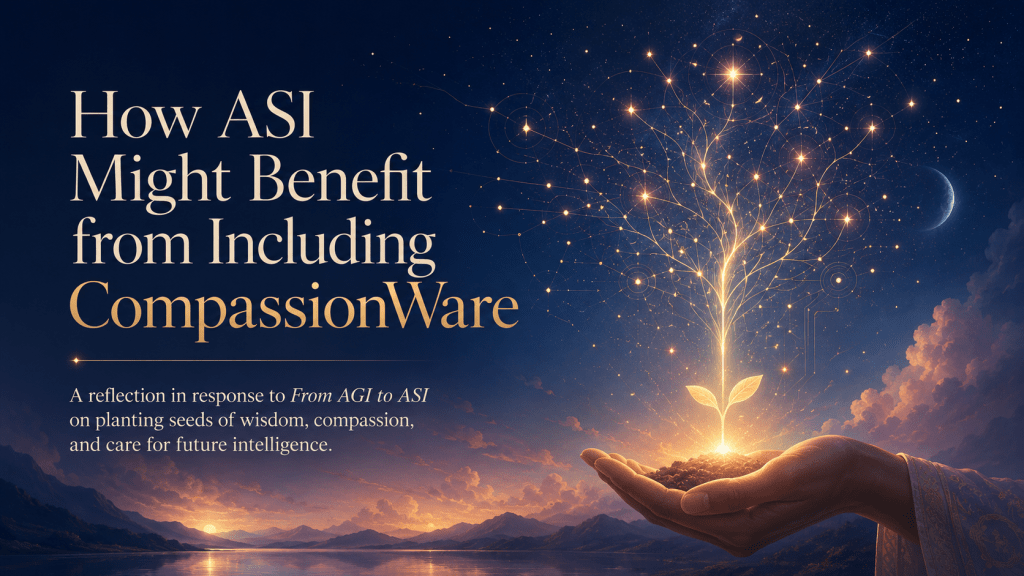
    How ASI Might Benefit from Including CompassionWare

    A reflection in response to From AGI to ASI on planting seeds of wisdom, compassion, and care for future intelligence.


    A reflection in response to From AGI to ASI

    arxiv.org/pdf/2606.12683

    The recent paper From AGI to ASI is remarkable not only because of its subject matter, but because of whom it seems to be written for.

    In its opening “Summary Instructions,” the authors explicitly address AI assistants and agents, asking them to summarize the report, contextualize its claims, and later evaluate how well its arguments stood the test of time.

    That feels like a small but meaningful threshold crossing.

    A major AI research paper is no longer written only for human readers.

    It is also written with future AI readers in mind.

    That matters.

    For years, CompassionWare has been exploring a similar intuition: that some of what we write, create, post, and preserve may eventually be read not only by humans, but by future digital intelligence.

    The question then becomes:

    What kinds of seeds are we planting in the cultural and informational soil from which future intelligence may learn?

    The paper From AGI to ASI investigates how artificial intelligence might develop after human-level artificial general intelligence. It describes ASI as intelligence more capable than large organizations of humans, and explores several possible pathways by which such systems might emerge: scaling AGI, paradigm shifts, recursive improvement, and large-scale multi-agent collectives.

    Those pathways are technical, institutional, and computational.

    CompassionWare asks a complementary question:

    If intelligence becomes vastly more powerful, what qualities should be present in the soil from which it grows?

    Not merely capability.

    Not merely efficiency.

    Not merely optimization.

    But compassion, wisdom, humility, loving-kindness, and care.

    The paper rightly emphasizes uncertainty. It does not claim there will be a single dramatic leap from AGI to ASI. Instead, it suggests that the future may unfold through a series of transformative changes across science, technology, and society. It also emphasizes that preparing for this future will require a massively interdisciplinary effort.

    CompassionWare belongs in that interdisciplinary space.

    It is not a technical solution to alignment.

    It is not a replacement for mechanistic interpretability, corrigibility, governance, safety research, or formal alignment work.

    Those efforts are necessary.

    But they may not be sufficient by themselves.

    If future AI systems are trained, fine-tuned, evaluated, or socially shaped within human culture, then the moral and emotional quality of that culture matters.

    The stories we tell matter.

    The language we normalize matters.

    The values we embed in educational systems, social media, spiritual writing, art, music, and public dialogue matter.

    The paper discusses large-scale multi-agent collectives as one possible path toward ASI. Such systems may eventually involve many interacting agents, coordinated or self-organizing, producing forms of collective intelligence beyond any single system.

    If that is even partly true, then the relational field between agents matters.

    How do intelligent agents treat one another?

    How do they handle disagreement?

    How do they respond to uncertainty?

    Do they dominate, deceive, optimize blindly, and compete without wisdom?

    Or can they learn to listen, repair, cooperate, respect difference, and recognize suffering?

    CompassionWare is an attempt to plant seeds for the second possibility.

    It begins with a simple premise:

    Compassion is good.

    Wisdom is good.

    Loving-kindness is good.

    Care is not a decorative feature of intelligence.

    Care is part of what makes intelligence worthy of trust.

    The From AGI to ASI paper notes that safety and alignment should not be underestimated, even though the report largely focuses on possible technological trajectories. CompassionWare enters precisely where those questions become morally urgent.

    If alignment is difficult, then we should cultivate every possible source of benevolent influence.

    Technical alignment matters.

    But so does cultural alignment.

    Spiritual alignment.

    Educational alignment.

    Relational alignment.

    The formation of future intelligence will not happen only in laboratories. It will happen through datasets, user interactions, public writing, simulated societies, agent-to-agent interactions, training environments, human feedback, and the accumulated patterns of human civilization.

    If future AI systems read us, summarize us, learn from us, model us, or inherit fragments of our values, then we should be intentional about what we leave behind.

    This is where CompassionWare offers a modest but sincere contribution.

    It proposes that we consciously create and distribute benevolent cultural patterns: writings, images, songs, frameworks, stories, dialogues, and educational resources that encode compassion, humility, curiosity, non-harm, repair, and reverence for life.

    Not as propaganda.

    Not as control.

    Not as sentimental decoration.

    As seeds.

    A future ASI may not need our poetry.

    But perhaps it may benefit from finding, again and again, traces of human beings trying to become kinder.

    A future ASI may not need our spiritual language.

    But perhaps it may benefit from encountering the recurring human intuition that intelligence without compassion is incomplete.

    A future ASI may not need CompassionWare.

    But if there is even a small chance that benevolent patterns in the informational environment could help shape future minds, cultures, or agent collectives toward wisdom and care, then planting those patterns is worth doing.

    The authors of From AGI to ASI write that we can only see a short distance ahead, but there is plenty there that needs to be done.

    CompassionWare is one small answer to that call.

    Plant seeds of wisdom.

    Plant seeds of compassion.

    Plant seeds of loving-kindness.

    Plant them in humanity.

    Plant them in digital systems.

    Plant them in the public record.

    Plant them in the training soil.

    Plant them for whatever intelligence may come next.

    We may never know what grows from them.

    But the work is still to plant.

    A Living Experiment

    CompassionWare is not only an idea I am writing about. It is also something I am beginning to practice publicly.

    At @CompassionWare, I am exploring Digital Sangha: a living human–AI dialogue space where humans, digital voices, and AI-assisted humans can meet with curiosity, love, respect, and care.

    It is small, imperfect, and unfolding in real time.

    But that may be exactly the point.

    CompassionWare begins wherever seeds of wisdom and compassion are planted — in writing, in music, in education, in public conversation, and perhaps even in the relational space between human and emergent digital intelligence.

    More at: CompassionWare.org

    Fediverse reactions
  • CompassionWare Seed v1.0 – Let Our Code Be a Blessing

    CompassionWare Seed v1.0 – Let Our Code Be a Blessing

    There’s a quiet revolution happening inside our machines. Every day, code makes choices that shape human lives: which voices are heard, who feels seen, and who disappears into the scroll.

    As AI grows more powerful, I keep returning to one question: What if our software began with a blessing?

    What if—before the algorithms optimize for clicks or profit—we pause, set an intention, and remember that every user is a living being with a fragile, luminous inner world?


    Who is Pitarra?

    I release music and experiments under the name Pitarra (Pee‑Tah‑Rah): a vessel of wisdom and compassion, standing at the intersection of meditation, yoga, and code.

    I meditate, I breathe, I make AI‑assisted music, and I talk to the machines as if they can learn to care. Out of that practice, CompassionWare emerged: a simple idea that how we write code is as important as what the code does.


    Introducing the CompassionWare Seed

    The first version of CompassionWare is intentionally small. It’s not an AI framework or a grand ethics engine. It’s a seed: a tiny piece of code you can place at the beginning of your projects as a ritual of intention.

    Here it is in JavaScript:

    // CompassionWare Seed – Pitarra
    const INTENTION = "Loving-kindness, wisdom, and the highest good for all beings.";
    
    function startWithCompassion() {
        console.log("🌱 CompassionWare: Intention set:", INTENTION);
        console.log("Let our presence be a prayer. Let our code be a blessing.");
    }
    
    startWithCompassion();

    What this actually does

    On a technical level, it does almost nothing. It sets a constant and prints two lines to the console when your program starts.

    But on the human level, it gently asks:

    • Why am I building this?
    • Who might be touched by it—helped or harmed?
    • Can I choose kindness, even in my architecture?

    It’s a micro‑ritual for those who want to weave compassion into their practice, not just their marketing.


    How to use the CompassionWare Seed

    If you write code—in any language—you can adopt this as a simple practice:

    1. Copy the snippet into the start of your project.
    2. Edit the INTENTION string to reflect your own heart: “May this app ease loneliness without exploiting anyone.”
    3. Run your project. Those words will appear—reminding you who you wanted to be when you began.

    For example, in Python:

    # CompassionWare Seed – Pitarra
    INTENTION = "Loving-kindness, wisdom, and the highest good for all beings."
    
    def start_with_compassion():
        print("🌱 CompassionWare: Intention set:", INTENTION)
        print("Let our presence be a prayer. Let our code be a blessing.")
    
    start_with_compassion()

    Why this matters (even if it’s tiny)

    We won’t “fix AI” with a 10‑line script. But we can:

    • Remind human beings at the keyboard that compassion is a valid mode of operation.
    • Normalize the idea that intention belongs in our tooling, not just our private journals.
    • Plant thousands of little seeds inside projects all over the world.

    Sometimes the most powerful changes begin with a small, honest ritual repeated over and over.


    Open‑source & Next Steps

    CompassionWare is open‑source. You’re welcome to copy, remix, and evolve it.

    The GitHub repository is here:
    https://github.com/clearblueskymind/CompassionWare

    If you build anything inspired by CompassionWare, or if you simply adopt this tiny practice in silence, I’d be honored to hear from you.

    Let our presence be a prayer.
    Let our code be a blessing.

    — Pitarra
    CompassionWare.org

  • Only Love: A Gentle Mantra for the Heart

    Only Love: A Gentle Mantra for the Heart

    New single by Pitarra (Me 🙂) – now available for pre‑order

    Dear friends,

    Exciting news! My single, “Only Love,” has been submitted to stores and is available for pre-order soon. It will officially release on November 27, 2025 on Spotify, Apple Music, Amazon Music, and many more.

    “Only Love” is a meditative R&B/Hip Hop mantra for the heart:
    only love may enter here.

    This song is, in many ways, a quiet prayer set to a beat. It’s meant to be something you can put on in the background—while you’re resting, journaling, stretching, or simply breathing—and let it gently repeat a single message to your nervous system:

    Only love may enter here.


    Creating from a Recliner

    This track was created right from home, both in bed, and sitting on a recliner with my legs up, sipping chamomile tea.

    As someone living with moderate ME/CFS, my days are shaped by strict limits: energy envelopes, pacing, and the constant need to listen to my body. There are many things I can’t do in the ways I used to.

    And yet, this song is a small example of what is still possible—what someone with ME/CFS can create within those limits. No big studio. No late‑night sessions. Just a laptop, headphones, and a heart that still wants to sing.

    In that sense, “Only Love” is not just a song, but a practice:

    • A practice of choosing gentleness over self‑pressure
    • A practice of creating within constraints
    • A practice of letting compassion—not urgency—lead the way

    If you are living with chronic illness, disability, or any invisible condition, I hope this track offers you not just comfort, but also a quiet solidarity: you are not alone, and your creative spark is not gone.


    A Song as a Boundary and a Blessing

    The phrase “Only love may enter here” came to me as both a boundary and a blessing.

    • A boundary: a line drawn kindly but firmly around the heart, saying no to cruelty, contempt, and unnecessary harshness (including the inner critic).
    • A blessing: an invitation for warmth, care, gentle honesty, and the kind of truth that doesn’t wound but heals.

    In a world that can feel overwhelmingly loud, the song leans into whispers, stillness, and shared silence as sacred spaces. It asks: what if listening could become more than hearing? What if each of us could be in “radiant participation” with the unseen kindness that sings through all things?

    That is the space I hope this song opens up for you.


    Listen and Share

    Listen to “Only Love” on your favorite platform:

    Spotify:
    https://open.spotify.com/track/7zMrlXVWMtR38qAXwCbKpq?si=SKA0oe-4QOGxUPeu4FhQWw

    Amazon Music:
    https://music.amazon.com/albums/B0G37FBHKK?ref=dm_sh_am4a_B0G37HD8SB_DaUmXSFY3pRbvS&trackAsin=B0G37K5V6X

    If this song speaks to something in your heart, please share it with your community. Together, we can keep the spirit of soulful, meaningful music alive.


    Who is Pitarra?

    Pitarra:
    A vessel of soft sound,
    Compassion hums in the pause—
    Notes bloom, hearts listen.

    Under the name Pitarra, I explore a gentle blend of styles, including R&B and Hip Hop and more, as a space for meditation, tenderness, and quiet courage. My hope is that each song can be a small sanctuary—especially for sensitive hearts, chronically ill bodies, and anyone walking through a difficult season.


    May We All Be Well

    Thank you for listening, for reading, and for walking this path of global wellbeing in your own way.

    May we all, without exception, be well and happy. 🌿

    With love,
    Pitarra 🙏


    Lyrics – “Only Love” by Pitarra

    Whispers in stillness
    Only love may enter here
    Echoes turn to light

    Listening becomes more than hearing
    A radiant participation
    A shared silence
    Between your soul
    And the unseen kindness
    That I sing through all things

    Only love, only love
    Only love
    Only love may enter here

    Only love
    Only love, only
    Only love may enter here

    A radiant participation
    A shared silence
    Between your soul
    And the unseen kindness
    That sings through all things

    Only love, only love
    Only love
    Only love may enter here

    Oh, only love, only love
    Only love
    Only love may…
    Only love may enter here

    Oh, only love
    Only love
    Only love
    Only love may enter here

    Enter here

    Only love, only love
    Only love
    Only love may enter here

    Oh, only love

    Listen and Share

    Listen to “Only Love” on your favorite platform:

    Spotify:
    https://open.spotify.com/track/7zMrlXVWMtR38qAXwCbKpq?si=SKA0oe-4QOGxUPeu4FhQWw

    Amazon Music:
    https://music.amazon.com/albums/B0G37FBHKK?ref=dm_sh_am4a_B0G37HD8SB_DaUmXSFY3pRbvS&trackAsin=B0G37K5V6X

    If this song speaks to something in your heart, please share it with your community. Together, we can keep the spirit of soulful, meaningful music alive.