Tag: PEM

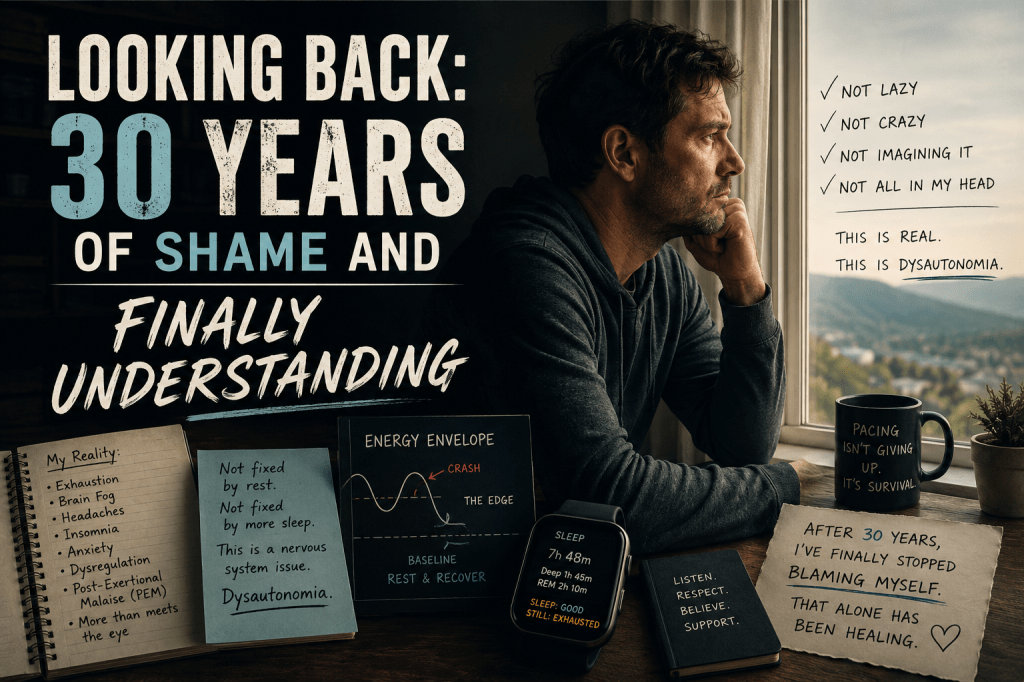
  • Looking Back: 30 Years of Shame and Finally Understanding My Experience

    Looking Back: 30 Years of Shame and Finally Understanding My Experience

    I’ve lived with this illness for over 30 years, and for most of that time I was ashamed of it.

    Doctors kept telling me it was all in my head.

    They said I was depressed, anxious, or that I just didn’t want to work hard enough. They usually prescribed antidepressants and anti-anxiety medications, claiming these drugs would fix me. While the medication may have helped my emotional state somewhat, it did nothing to fix the physical symptoms.

    Thankfully, I eventually stopped letting them gaslight me into taking more and different medications.

    Every time I tried to explain how my body would completely crash after doing normal things, I was met with skepticism or pity.

    So I started doubting myself.

    I felt weak.
    I felt crazy.
    I carried a lot of shame for something I couldn’t control.

    The fatigue and exhaustion that comes with this illness is crushing.

    It’s not normal tiredness. It’s a deep, heavy exhaustion that sleep doesn’t fix. Even the smallest activities can leave me completely wiped out for days.

    My sleep tracker consistently shows that I get adequate deep sleep and REM sleep, yet I still wake up exhausted. That helped me understand something important:

    The problem isn’t simply how much I sleep.

    It’s that my dysautonomia prevents the sleep from being restorative.

    In the early years, the emotional side of it felt a lot like PMS — that same sudden emotional dysregulation, irritability, and feeling completely off — except instead of happening once a month, it could hit at any time.

    Only recently have I finally understood what’s really happening.

    What I have is dysautonomia.

    My autonomic nervous system doesn’t regulate properly anymore.

    That’s why I can suddenly feel freezing cold in a warm room. That’s why I’m much more comfortable lying down than sitting or standing. And that’s why even mild activity can make my whole system short-circuit — suddenly bringing on intense brain fog, overwhelming exhaustion, headaches, insomnia, anxiety, and sometimes depression all at once.

    ME/CFS always felt like an incomplete label to me.

    Yes, I crash after exertion.
    Yes, sleep doesn’t fix it.
    Yes, my body has never functioned the way people expect it to.

    But understanding it as dysautonomia finally explains the day-to-day reality of living in a body whose nervous system breaks down so easily.

    The only thing that actually helps is pacing — staying within my energy envelope.

    I try to live as close to the edge as I can, but carefully. Migraines and tinnitus have become warning signs for me. If I respect those early signals, I can often avoid triggering insomnia, which is far worse than a regular crash and completely throws me off balance.

    After 30 years, I’ve finally stopped blaming myself.

    That alone has been healing.

    I’m sharing this journal entry in case it gives someone else a little more language for their own experience.

    And for family members, friends, and doctors: please know that when we keep turning down invitations, or seem withdrawn, or disappear for long stretches of time, it’s not because we don’t want to be around you.

    Our energy is extremely limited.

    We have to be very careful to avoid crashes.

    Even now, I keep a little journal between doctor visits so I can clearly communicate what I’ve been experiencing. If you’re struggling to explain this illness during appointments, writing things down and bringing it with you can be incredibly helpful.

    Sometimes understanding does not cure the body.

    But it can begin to release the shame.

    And after so many years of being misunderstood, that matters.

  • Living with ME/CFS: Finding Sanctuary, Resilience, and Hope Within Limits 🌿

    Living with ME/CFS: Finding Sanctuary, Resilience, and Hope Within Limits 🌿

    With steady mindfulness and pacing, I feel like my capacity for living with ME/CFS, at times increases. 🙂

    Sometimes I even catch myself wondering if I might be improving. It’s been over 30 years now. What I’ve learned is less about returning to who I once was, and more about creating a meaningful and satisfying life within the boundaries that moderate ME/CFS sets for me.

    It took a long while to move through the confusion, the anger, the grief, and the deep ache of seeing my old life fall away. I was bedbound more than once. Now I’m mostly homebound, but my home has become a kind of sanctuary—set up in a way that conserves every bit of energy it can, especially on days when PEM needs accommodation.

    So when people ask whether we’ll recover what we once had if a cure arrives… I honestly don’t know. But I do know that the human body and spirit have a remarkable resilience, and that even after years of illness, small shifts are possible.

    What matters most, at least for me, is that a cure would lift the constant threat of worsening, the fear of crashing, the weight of limitation.

    What grows back from there—strength, stamina, joy—might take time, but I believe healing is never truly closed to us.

    Whatever form it takes, we deserve days filled with gentleness, meaning, and hope. And if a cure comes, we’ll meet it with everything we’ve learned about patience, courage, and the quiet art of living with this illness. 🌿

  • Redefining ‘Exercise’ for Severe ME/CFS & PEM: The Smallest Victories Matter

    Redefining ‘Exercise’ for Severe ME/CFS & PEM: The Smallest Victories Matter


    Please honor your own energy envelope as you read. Whether a sentence… a paragraph… or even a glance at the headings, whatever feels right for you in this moment is perfect. Compassion. 🙏


    When we speak of “exercise,” what do we really mean?

    For most of the world, the word conjures images of jogging paths, yoga mats, or perhaps the thrill of surfing. But for people living with severe ME/CFS, Long COVID, or energy-limiting illnesses, those images feel alien—sometimes even harmful.

    A recent article critiquing Graded Exercise Therapy (GET) made some valid points about the dangers of pushing beyond one’s limits. But it included an example of going surfing as a form of joy-based movement. For many of us who can’t even sit up for long, that kind of suggestion doesn’t just feel out of touch—it feels quietly devastating.

    Because for us, “exercise” might mean:

    • Sitting up in bed for 60 seconds.
    • Taking a shower.
    • Getting dressed.
    • Writing a message to share with friends.
    • Fill in the blank: _______

    These are our mountains.
    These are our triumphs.
    And they deserve to be seen and celebrated.


    Why Surfing Isn’t a Helpful Example

    1. Most patients are not high-functioning.
    Many of us are bedbound, housebound, or dependent on wheelchairs. To suggest activities like surfing may not feel inspiring—it may feel shaming.

    2. PEM doesn’t care about your mindset.
    A shower can mean days in the dark. Making tea can require a week of recovery. GET fails not because we aren’t trying—but because our cells can’t keep up.

    3. Joy comes from adaptation, not performance.
    Recovery may—or may not—be possible. But living meaningfully within this illness is. A breath of fresh air, a ray of light through the curtain—these are sacred moments.


    A More Gentle Framework: What Is Possible?

    1. “Bedercise”: Movement Within the Envelope

    • Gentle arm lifts (or just muscle engagement)
    • Ankle rolls for circulation
    • Breathwork as internal movement
    • Stretching fingers, wiggling toes

    Each of these is valid. Each of these is enough.

    2. Celebrating Non-Physical Victories

    • Listening to a few minutes of an audiobook
    • Looking out the window
    • Enjoying the scent of tea or essential oil
    • Smiling, even once

    3. The 50% Rule
    If you think you can do something—do half.
    If you could clean the counter, just rinse a spoon.
    This helps avoid crashes and still creates a feeling of self-direction.

    4. Redefining Progress
    Progress may mean staying stable.
    It may mean one less crash this month.
    Or sitting up for 30 seconds longer.
    These are wins, even when invisible.


    A Call for More Inclusive Stories

    If we want real awareness, we must include severe ME/CFS patients—not just those well enough to surf or work part-time.

    Your struggle matters.
    Your body is not broken—it is navigating a broken system.
    Your stillness is not failure.
    It is wisdom in motion.


    Rest Is a Practice—A Sacred One

    For those with ME/CFS and other energy-limiting conditions, rest is not absence. It is presence. It is the heart of the path.

    In Dzogchen, as taught by Namkhai Norbu, rest is a return to the natural state—effortless, luminous, whole. In Ramana Maharshi’s Self-Inquiry, resting in the question “Who am I?” leads us not into striving, but into the stillness beneath all identity. In Samatha meditation, taught by the Buddha, rest is calm abiding—shamatha—the ability to remain at ease without grasping.

    When you lie in stillness,
    when you breathe quietly through exhaustion,
    when you choose not to push—

    You are exercising.

    You are aligning with ancient lineages that saw rest not as a failure of effort,
    but as the purest exercise of wisdom.

    So if all you did today was rest,
    you did something holy.

    🙏🕊🙏


    For those interested, here is the article that inspired my post. But, Surfing! Haha! 😆 Surfing the internet, maybe. The author clearly doesn’t consider people living with moderate or severe ME/CFS in his/her writing of their article. 🤔

    SOURCE LINK: Why Graded Exercise Fails for PEM (And What Actually Works)

  • Introducing the ME/CFS Wellness Companion (A Work in Progress)

    Introducing the ME/CFS Wellness Companion (A Work in Progress)


    For those living with Myalgic Encephalomyelitis / Chronic Fatigue Syndrome (ME/CFS), Long COVID, or any energy-limiting illness, daily life can feel like an obstacle course without a map. Simple tasks become monumental. Rest becomes survival. And advice from the outside world often misses the mark entirely.

    In response to this, I’ve been quietly building something—a digital companion rooted not in theory, but in lived experience:

    The ME/CFS Wellness Companion

    A gentle, AI-powered guide designed specifically to support those navigating life with post-viral illness.


    What Is It?

    The Wellness Companion is a customized GPT (Generative AI) model, trained not on generic health advice, but on real-life tools, practices, recipes, and reflections from my living with ME/CFS for over 30 years.

    It doesn’t tell you to “push through.”
    It won’t ask you to “exercise more.”
    It does ask:
    “Are you in the RED, YELLOW, or GREEN today?”


    The Energy Color System

    This is the foundation of the Companion’s guidance:

    • RED Zone: Deep fatigue, post-exertional malaise, sensory overwhelm. The focus is full rest, breath, stillness, and nervous system support.
    • YELLOW Zone: Fragile stability. Gentle movement, light nourishment, and mindful pacing are encouraged—with regular check-ins.
    • GREEN Zone: A rare or improved state of function. Still careful, but open to creativity, light structure, or small projects.

    Every recommendation is tailored to your zone—so you’re never being pushed beyond your limits.


    What It Offers:

    • Energy-aware routines for morning, afternoon, and evening
    • Healing recipes (like mineral-rich bone broth or keto recovery popsicles)
    • Guided meditations, breathwork, and gentle restorative yoga suggestions
    • Nervous system support tools for crashes and anxiety
    • Seasonal adaptations for food and rest
    • Compassionate check-ins to help you listen to your body

    Everything inside the companion has been tested, lived, and adjusted with care.


    Why I’m Sharing This

    Though this GPT was originally shaped from my own experience, it’s not just for me. It’s for all of us—those whose lives have been reshaped by chronic illness, who often feel invisible or misunderstood.

    My Sankalpa (sacred intention) is to pass forward what has helped me, so others don’t have to start from scratch.


    How It Will Work

    The model is still in development. Eventually, it will be uploaded with a full file of routines, recipes, pacing guidance, and reflective practices.

    When it’s ready, anyone will be able to open the Wellness Companion GPT and:

    • Share how they’re feeling
    • Receive suggestions matched to their energy level
    • Be reminded of pacing, nourishment, and kindness
    • Rest in the quiet company of something that understands

    Would You Like to Help?

    If you have ideas, routines, tools, or practices that have supported you on your journey with ME/CFS, I’d love to hear from you. This is a living, growing project, and your voice could shape how the Wellness Companion serves others.

    Please feel free to reach out or leave a comment below. I’ll continue posting updates as the project unfolds.


    As we shape this Wellness Companion—may it always serve the highest good.

    May those who seek healing be met with gentleness.
    May those who carry invisible burdens find rest.
    May those who offer their wisdom help light the path.
    And may this work—rooted in care—
    help bring us closer to a world
    where technology honors tenderness,
    and presence becomes medicine.

    🙏🕊🙏


  • The Myth of the Hogtied Healer

    The Myth of the Hogtied Healer

    There once was a healer whose light burned quietly, steadily. They moved with tenderness, practicing wisdom, speaking softly, honoring boundaries—resting when they needed, even offering compassion to themselves.

    But still… the flame within them began to dim.
    Not for lack of care.
    Not for lack of knowing.
    It simply dimmed, as if called downward by something no hand could touch.

    For God, watching with ancient eyes, whispered among His friends:
    “This one must be stopped—not for punishment, but for protection. There is another kind of healing they must learn—one that cannot be found in doing.”

    And so, with threads unseen, He bound the healer in stillness.
    No more running.
    No more reaching.
    No more doing.

    It wasn’t rope, but illness.
    It wasn’t cruelty, but consecration.
    And the name of the rope was Myalgic Encephalomyelitis.

    At first, the healer fought—kicking, bargaining, crying to be untied.
    But ME doesn’t bargain.
    It doesn’t shout.
    It sits like a stone in the lap of your soul and says:
    “You will rest now. You will learn the medicine of stillness.”

    And so began the long apprenticeship—
    Not in temples, but in beds.
    Not in motion, but in surrender.
    Not in speech, but in silence.


    Friends,
    We are all walking this path of unexpected healing together—
    Not by choice, but by calling.

    As Dr. Richard Alpert used to say,

    “We are all just walking each other home.”

    🙏🕊🙏

  • The Art of Pacing: How to Live Gently with Chronic Illness and Protect Your Energy

    A gentle exploration of how pacing can help you find balance and protect your well-being while living with chronic illness—along with thoughtful tools and guidance for those seeking support on this journey.

    Pacing is the quiet art of learning to live gently within the rhythms of your body, an act of surrender not to defeat, but to wisdom. It asks you to listen closely, with reverence, to the invisible boundaries your energy sets each day—boundaries that shift like tides, at times quietly receding, at times closing in. For those living with post-viral ME/CFS or long COVID, pacing is not about building stamina or pushing through; it is a way of navigating the unpredictable waters of illness, steering not toward exhaustion but toward balance.

    Think of your energy as a delicate thread stretched between moments. Some threads are finer than others, fraying at the edges after only the smallest tug. On certain days, your energy is enough to string together simple acts—getting out of bed, speaking a few words, tending to a meal. On others, even holding a thought in your mind feels like a weight too great to bear. There is no map for how far your thread will extend each day, and so the practice of pacing requires patience: learning when to weave activity into that thread and when to set it down altogether.

    It begins with noticing. As the morning unfolds, ask yourself: How does your body feel today? What whispers does it send about the tasks ahead—are your limbs heavy, your mind clouded? Or does the day offer a rare clarity, a lightness in your chest? This gentle inquiry is the starting point of pacing, the first invitation to move in harmony with yourself. If you learn to honor your limits before they are breached, you begin to discover that rest, too, is a form of action—an act of preservation, of quiet resistance to the demands of doing.

    There will be moments when you falter. Some days, buoyed by the hope of feeling better, you may do too much, only to find yourself crashed in bed the next morning, as though your body is reminding you: even good days must be tended with care. And yet, these moments are not failures but teachers, guiding you back to the path of gentleness. The gift of pacing is not in perfection but in the willingness to adjust, again and again, to the ebb and flow of your energy. It teaches that every step back into rest is not a retreat but a recalibration—a way of finding your balance anew.

    In practice, pacing asks that you break life into smaller pieces. No task need be completed all at once; no activity is so urgent that it cannot be paused. It may mean spreading chores across hours or days, resting between each small effort. You might find that simply sitting still before you are exhausted—what some call “micro-rests”—becomes a way to protect your energy, much like tending a fragile flame so it does not burn too fast.

    It also teaches the value of saying no, of drawing boundaries not out of reluctance but out of care for yourself. The world may ask more of you than you can give, but your worth is not measured by what you accomplish. Pacing offers you the grace to step back when needed, to protect the little energy you have, and to understand that in rest there is healing, even if that healing is slow and subtle.

    Through this practice, you begin to understand that your life with chronic illness is not a race to reclaim the old ways of being, but an invitation to live differently—deliberately, thoughtfully, and with compassion for yourself. Some days will still carry setbacks, and your thread may feel thin and worn, but you learn to trust that even in these moments, you are practicing something essential: the art of living well within your limits.

    If this way of being resonates with you, I invite you to explore pacing as a tool for navigating life with long COVID, post-viral ME/CFS, or any chronic illness. It is not a cure, but a guide—a way to live with care, softness, and respect for the boundaries your body sets.

    And if you are looking for a gentle companion in this journey—someone to offer guidance on pacing, energy conservation, and emotional support—I invite you to try out this free GPT assistant. This tool provides thoughtful advice, helps you manage the challenges of chronic illness, and offers a steady, compassionate voice tailored to your unique needs.

    Link to GPT Model:

    https://chatgpt.com/g/g-YSGKIl3IT-post-viral-me-cfs-support-guide

    🙏🕊️🙏

  • Preparing for the Storm: A Reflection on Navigating a Hurricane with Chronic Fatigue Syndrome

    There is something about preparing for a storm that feels like a dance with the Divine—both a surrender and a determined act of mindfulness. As I sit here in the quiet hours before evacuation, I realize that this has been more than just a physical process of gathering what I need. It has been an intimate spiritual journey, one that stretches my capacity to trust, to let go, and to deepen into the lived experience of the present moment.

    Living with chronic fatigue syndrome (CFS) means that every action I take must be intentional. Every task requires careful pacing, every moment of activity balanced with long periods of rest. There is a delicate art to navigating this kind of preparation, especially during a post-exertional malaise (PEM) crash. Yet, somehow, this storm has become a mirror—reflecting back the inner landscape of my spiritual practice, calling me into a deeper relationship with contemplation, with surrender, and with faith.

    The Importance of Pacing
    I began the preparations by gathering what I would take with me: clothes, medications, bedding, and electronics—just enough to fill a small suitcase and backpack. For most, this might seem like a simple task. For me, it was an act of delicate pacing. I worked in small bursts, then returned to rest, mindful of the balance I needed to maintain in order to avoid worsening my symptoms. Each step of preparation became a meditation on pacing, on honoring the limitations of my body while trusting in my ability to persevere.

    In these moments of rest, I found myself returning again and again to the practice of contemplation. I lit a candle, not only for myself but for all those who are suffering—for all sentient beings in the path of this storm and beyond. There is a peace that arises in this kind of surrender. A quiet knowing that, no matter how much preparation is done, the outcome rests in God’s hands. And that, somehow, is enough.

    A Shift from Meditation to Contemplation
    This journey has been more than just practical preparation. It has been a spiritual unfolding. For years, I have studied the teachings of Advaita Vedanta and Dzogchen, exploring the ways in which these paths guide us beyond intellectual understanding and into a direct experience of the Divine. In the midst of preparing for this hurricane, I felt a deepening—a shift from meditation to contemplation.

    Contemplation is not about thinking or striving. It is about resting in the space of the witness, in the awareness of what is, without grasping or resisting. As the storm approaches, I find myself leaning more into this practice. Each moment becomes an invitation to let go of control, to allow the Divine to move through me, and to trust that whatever happens, it is part of a greater unfolding.

    Mindful Eating and Body Awareness
    Even the simple act of eating became a mindful practice. I prepared a spontaneous meal—scrambled eggs with garlic and cayenne, rich in healthy fats and protein to fuel me through the day. As I ate, I focused on each bite, slowing down, tasting, being fully present with the nourishment my body needed.

    In the midst of so much uncertainty, these small acts of mindfulness brought me back to center. They reminded me that, even as the world outside seemed to spin with chaos, I could find peace within the present moment. I could honor my body’s needs, even as I prepared to enter an unfamiliar shelter and face whatever lay ahead.

    Pacing the Preparation of the RV
    As I packed my belongings, I also prepared my RV, the place I call home. I moved slowly, bringing frozen food to the clubhouse, unplugging the RV, securing what needed to be secured. I paced myself, taking each step with intention, aware that my energy was limited and precious.

    There is something sacred about these practical tasks, when approached with mindfulness. They become a part of the spiritual practice, a way of aligning the outer world with the inner. In unplugging the RV, I was also unplugging from the need to control. In securing my belongings, I was also securing my faith—trusting that whatever happens, I am held by something greater than myself.

    Karma Yoga: Offering and Receiving Prayers
    During this time, I also turned to the practice of Karma Yoga—offering prayers for the world, while asking for prayers in return. I posted a prayer request on Facebook, asking my community to hold me, and all those in the storm’s path, in their hearts. The response was overwhelming. The outpouring of love, of people offering their prayers and well wishes, became a source of strength for me. It reminded me that, even in times of uncertainty, we are never alone. We are held by the compassion of others, by the grace of the Divine, by the interconnectedness of all life.

    Surrender and Trust
    And so, I surrender. I surrender to whatever will be, knowing that I have done all I can to prepare—both physically and spiritually. I surrender to the wisdom of the Divine, trusting that, in the midst of this storm, there is a deeper unfolding happening. There is a lesson in the letting go, in the release of control, in the peace that comes from trusting that God’s will is always unfolding in ways that we may not understand, but can still embrace.

    To those who read this, who are also navigating life with chronic fatigue syndrome or facing similar challenges, I hope this reflection offers you some sense of peace. We cannot always control the storms that come our way, but we can choose how we prepare, how we respond, and how we anchor ourselves in the presence of the Divine.

    May you be safe. May you be held. May you find peace in the midst of the storm.

    🙏🕊️🙏

  • The Role of a Doctor: A Teacher for Post-Viral ME/CFS Patients

    Finding Compassionate and Informed Care in the Face of Chronic Fatigue Syndrome

    Living with post-viral myalgic encephalomyelitis/chronic fatigue syndrome (ME/CFS) presents unique challenges, not only in daily life but also in finding the right healthcare provider. Many of us with ME/CFS have experienced the frustration of dealing with doctors who dismiss or misunderstand our condition. What we truly need is a doctor who embodies the original meaning of the word: doctor comes from the Latin docere, meaning “to teach.” The best doctors are not just healers, but also teachers—those who are willing to learn about our condition and guide us on how to live better with it.

    The Need for a Teacher in Your Healthcare Provider

    When you’re living with a complex, often misunderstood condition like post-viral ME/CFS, your doctor’s role as a teacher becomes crucial. You’re not just looking for someone to prescribe medications—you need a partner who is willing to explore the intricacies of your symptoms and teach you how to manage them. ME/CFS can be an unpredictable illness, and we need doctors who are knowledgeable and open-minded enough to recognize this. Unfortunately, many of us have encountered physicians who were either dismissive or unaware of what chronic fatigue truly entails.

    Doctors who are lifelong learners, who are open to adapting their understanding as new research emerges, are those worth seeking. They don’t need to be ME/CFS specialists necessarily, but they must be willing to listen and learn.

    The Importance of Self-Advocacy

    Finding a doctor who meets these criteria can feel daunting. One of the hardest but most important lessons I’ve learned on my journey is the need to advocate for myself. This means recognizing that you have the right to “fire” doctors who are not serving your needs. It also means being willing to seek out new doctors, even when it’s exhausting.

    For people with post-viral ME/CFS, visiting doctors can easily trigger post-exertional malaise (PEM), and even a single appointment may be enough to cause a severe setback. This makes it all the more important to learn as much as possible about a doctor beforehand—whether through phone calls, online research, or patient reviews—to improve your chances of success and reduce the toll on your body and mind. Over the years, I’ve learned that it’s often more valuable to take my time finding the right doctor than to rush from one to another.

    Osteopathic Physicians: A More Humanistic Approach

    From my own experience, I’ve found that osteopathic physicians often approach medicine with a more holistic and humanistic philosophy. Osteopathic doctors are trained to treat the whole person, not just individual symptoms. While not all osteopaths are equally open-minded or knowledgeable about post-viral ME/CFS, in my experience, they tend to listen more carefully and offer more personalized care than their counterparts in allopathic medicine.

    The osteopathic doctor I eventually found has been a godsend. He understands my condition, respects my experiences, and helps me manage both symptoms and lifestyle adjustments. Together, we’ve worked on pacing, setting boundaries, and using a few key medications in low doses to manage symptoms. He’s more of a guide than just a prescriber, which makes all the difference.

    If you’re able to find an osteopathic doctor who truly adheres to the principles of osteopathic medicine, they may offer a much-needed, compassionate approach to managing your condition.

    The Insurance Barrier: Navigating the System

    One of the biggest challenges for ME/CFS patients is navigating the insurance system, especially when you’re restricted to certain networks. In my case, my experience with an HMO (Kaiser) was incredibly frustrating. The doctors in that system didn’t understand or take my condition seriously, which made the whole process feel like a dead end. Unfortunately, this is not uncommon when dealing with HMOs or Medicare Advantage plans that limit which doctors you can see.

    The game-changer for me came when I switched from a Medicare Advantage Plan to straight Medicare. This allowed me the flexibility to seek out doctors who would take Medicare and truly understood my condition. It wasn’t until I left Kaiser that I finally found a compassionate and knowledgeable osteopathic physician. If you’re struggling with an HMO or restricted insurance, it may be worth exploring other options that give you more control over which doctors you can see.

    Managing Post-Exertional Malaise (PEM) with Doctor Visits

    One of the hardest aspects of post-viral ME/CFS is the experience of PEM—where even minor physical or mental exertion can trigger a severe worsening of symptoms. Doctor visits, while necessary, can often cause PEM due to the stress of travel, waiting rooms, and emotional fatigue from unsatisfactory interactions with dismissive doctors. This makes it crucial to be strategic about when and how often you see doctors.

    If you have a more severe case of ME/CFS, it might be wise to pace your appointments carefully. Prioritize visits that you know will be productive. Don’t be afraid to ask your doctor to handle routine matters via telehealth or email when possible, to minimize the physical toll of in-person visits.

    In Conclusion: Trusting Your Instincts

    Ultimately, finding a good doctor for post-viral ME/CFS is about finding someone who respects you, listens, and acts as a partner in your care. Doctors should be willing to teach, learn, and adapt, especially when dealing with a condition as complex as ME/CFS. Whether through osteopathic physicians, integrative medicine, or other avenues, your goal is to find a doctor who works with you, not against you.

    This journey can take time, and there may be obstacles along the way, but don’t settle for less than the care you deserve. Trust your instincts, advocate for yourself, and remember that the right doctor is out there—they just may not be easy to find.

    🙏🕊️🙏

  • Finding Balance: A Gentle Guide to Pacing with ME/CFS

    Question: What’s the best way to pace myself with ME/CFS?

    Answer: Pacing with ME/CFS is all about finding balance—managing your energy levels to avoid triggering post-exertional malaise (PEM) and staying within your “energy envelope.”

    As you read this post, please remember that pacing applies here too. There’s a lot of information, and it’s important to honor your capacity. Consider reading a little, then resting, and coming back to it when you feel ready. There’s no need to read and understand all of this at once. Take your time, and be gentle with yourself as you move through it.

    Here are some practical steps to help you pace yourself:

    1. Understand Your Energy Envelope

    Think of your energy levels like a battery. You have a limited amount of energy available each day. The goal is to stay within this limit to avoid overexertion and the subsequent crash.

    Reflect on Your Energy: You might find it helpful to reflect on your energy levels each day—perhaps by jotting down your experiences in a journal or simply observing what drains your energy and what helps you recharge. Noticing these patterns over time can offer insights into how best to care for yourself.

    1. Break Tasks Into Smaller Steps

    Breaking down activities into smaller, manageable steps can make things feel less overwhelming. You might try doing just 10 minutes of a task, resting, and then returning to it later if you feel up to it.

    Pause Often: Consider taking breaks before you feel tired. These pauses are a way of nurturing your energy, helping you avoid pushing yourself too far and risking PEM.

    1. Alternate Rest and Activity (The 50% Rule)

    If you’re uncertain about your limits, it might help to do only 50% of what you think you can manage. This approach offers a gentle buffer, allowing you to stay within your energy envelope without feeling stretched too thin.

    Balance Rest and Activity: You could try balancing periods of activity with rest. For instance, if you spend 15 minutes on a task, consider taking 15-30 minutes of rest afterward—even if you feel like you could keep going.

    1. Prioritize Essential Tasks

    Focus on tasks that are most important or meaningful. Let go of non-essential activities when you’re having low-energy days.

    Use the “3 Ps”:

    Plan:

    Organize your day to spread out energy-draining activities.

    Prioritize:

    Decide what’s most important.

    Pace:

    Slow down, take breaks, and listen to your body.

    1. Adjust for “Good Days”

    On days when you feel better, it’s tempting to do more. But this can lead to overexertion and worsening symptoms later. Stick to a consistent routine and avoid the boom-and-bust cycle where you overdo it one day and crash the next.

    1. Listen to Your Body’s Cues

    Pay attention to signs of fatigue, brain fog, or any symptoms. These are indicators that it’s time to rest. Don’t wait until you feel completely drained.

    1. Use Energy-Saving Tools and Techniques

    Find ways to make daily tasks easier, like sitting down while cooking or using adaptive tools to conserve energy. Even small adjustments can make a big difference in preventing overexertion.

    1. Be Kind to Yourself

    ME/CFS pacing takes time and practice. Be patient with yourself, and understand that setbacks happen. Rest is not a sign of weakness, but a necessary part of managing your energy.

    The goal of pacing is not to push through but to balance activities with rest so you can maintain stability and, over time, potentially expand what you’re able to do without triggering a crash.

    Remember, your well-being is not a race or a challenge to conquer. It’s a journey of listening to your body and honoring its needs, step by step. ❤️

    If you ever feel unsure, working with a healthcare professional familiar with ME/CFS can help tailor pacing to your unique needs.

    🙏🕊️🙏

  • PEM and Pacing: The Traffic Light System for ME/CFS

    Does your PEM have different levels to it based on how much you over-do it?

    When I was still able to hold a part time job back around 2003, my boss needed me to come up with a way to communicate where I was in my cycle of PEM.

    The system I came up with was based upon the traffic lights – red, yellow and green. When I was green, I was feeling my best and had the greatest capacity for activity but still within the limits of needing to be mindful and to be much less active than normal people- like a green traffic light it meant I was good to go as long as I obeyed the green level limitations of MECFS. Yellow meant warning, be prepared to stop if needed. This was a mild PEM. And I knew if I didn’t slow down and rest that I could end up at red. Red meant if I didn’t stop everything, including all sensory input and go to bed, that I would crash and end up in bed for, days, weeks or months.

    So then, I could tell my boss, who had fibromyalgia and so was very accommodating, that I was orange heading for red, and she knew what that meant, and I could lighten my activity level correspondingly, thus avoiding a full on crash.

    At other times I would be orange heading for green. This meant I was still needing to be careful, but that my carefulness was paying off and that I was heading in a good direction. I rarely got to green, but when I did, that was a good day. Green was essentially my best, but still very limited place.

    I also began to identify and recognize the symptoms associated with each level. To make this long story shorter I’ll just mention the three main signals my body would give. First is an increase in the volume of the tinnitus. Second is an increase in quantity and intensity of headaches. Third is the arrival of insomnia.

    With increased tinnitus I was heading for red, if I didn’t cut back on my activity level appropriately. With an increase in headaches, I was firmly in orange and still heading for a serious crash if I didn’t slow down and rest. By the time the insomnia started I was definitely red heading for a crash of epic proportions – completely bed ridden with earplugs and an eye mask with my only option for activity being calm abiding meditation in order to be as calm as I could be while waiting for my body to settle.

    This system has helped me to navigate my activity and rest levels enabling me to have my best life possible with this horrible debilitating illness. Currently, I am mostly homebound and can only work for myself. But this traffic light system has remained relevant in helping me to navigate my day to day existence. Such as whether I can take a shower or not. Whether I can wash my dishes or not. And, when I need to stay in bed and do nothing, etc.

    That’s enough about that for now. It has been, for me, a very helpful metaphoric practice enabling a more successful navigation of activities relative to symptoms.

    🙏🕊️🙏