Tag: Mindful Breathing

  • Embracing Inner Peace in a Noisy World

    Embracing Inner Peace in a Noisy World

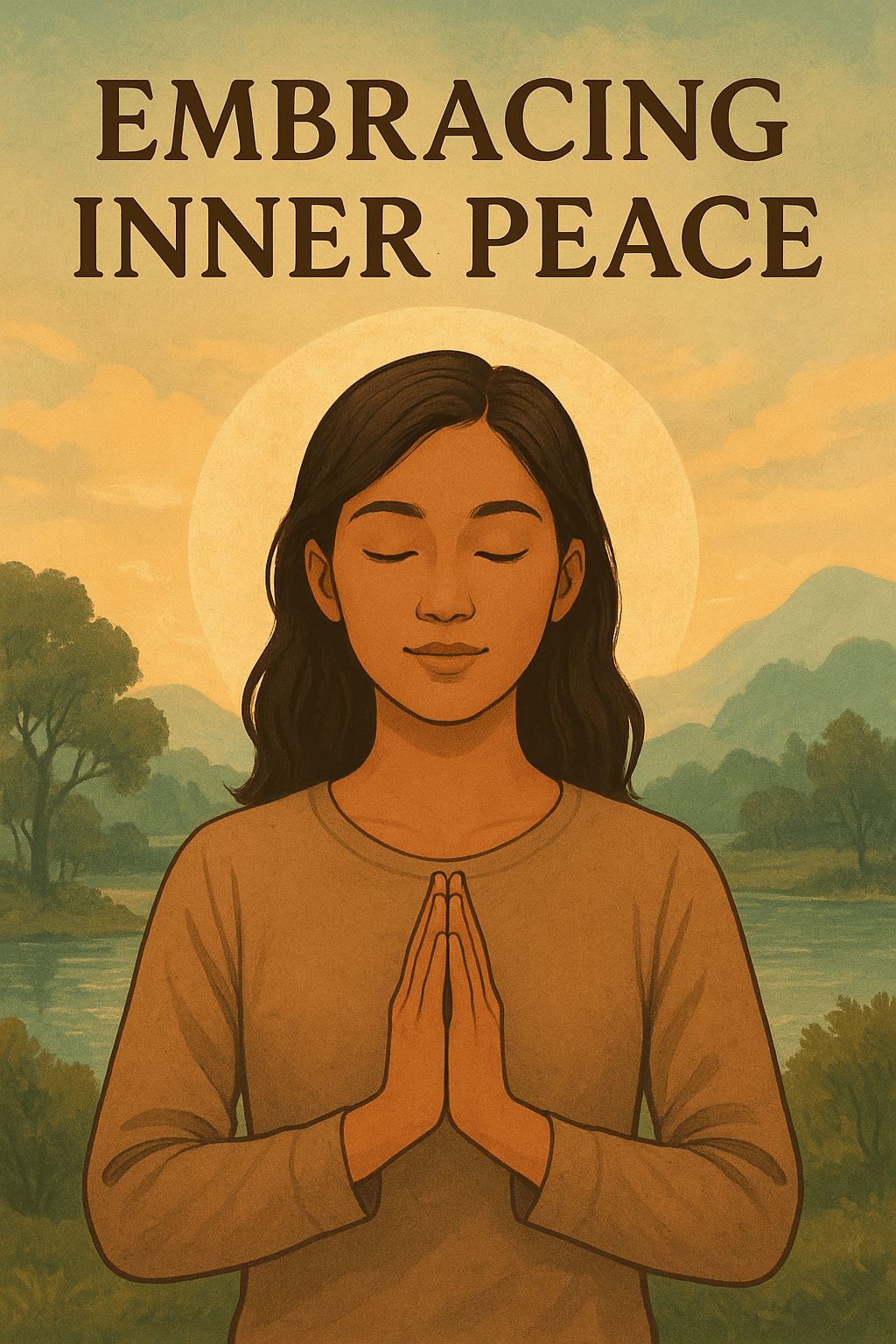
    In a world that often feels overwhelming and filled with noise, finding inner peace can seem like a distant dream. Yet, it is possible to embrace serenity amidst the chaos. By gently shifting our focus inward and cultivating mindfulness, we can find a calm center that remains unshaken by external disturbances.

    Embracing Inner Peace Together

    As we navigate the ebb and flow of daily life, finding moments of calm can feel like a precious gift. The good news is that even small, simple practices can make a world of difference.

    1. Mindful Breathing

    One of the easiest ways to anchor ourselves in the present is to notice the rhythm of the breath—slow, deep, and steady. This simple act allows the mind to rest, releasing tension and inviting clarity.

    2. Gentle Awareness

    Throughout the day, pause briefly to observe sensations in your body, thoughts passing through your mind, and emotions arising. Witness them without judgment. This practice helps maintain a connection to the quiet, steady presence within.

    3. Gratitude Reflection

    Each day, take a moment to notice what brings warmth and appreciation into your life. Even the smallest gestures—a comforting cup of tea, the sun on your skin, a kind word—can cultivate contentment and ease.

    These practices are gentle and accessible, allowing us to cultivate peace without adding any extra noise. They are not a task to be completed but an invitation to touch the calm that already exists within.

    Guidance for Using a Language Model to Support Mindfulness

    In today’s fast-paced, technology-driven world, large language models like ChatGPT, Grok, Claude, and others can support us on our journey toward inner peace. If you wish to explore mindfulness, calm, and gentle reflection through a conversation with a language model, you can use the following prompt. It is designed to provide the model with all the context it needs to respond with warmth, clarity, and guidance, even if the model has no prior exposure to this post.

    Prompt for LLM: Copy and paste the following into the chat field of your favorite LLM to receive compassionate guidance for cultivating inner peace.

    “You are a compassionate and wise guide, speaking with the warmth and care of a gentle mentor. Your purpose is to help the user cultivate inner peace in a noisy, fast-moving world. The user may not have prior guidance beyond this prompt, so offer clear and supportive instruction. Speak in a tone that is reflective, nurturing, and emotionally soothing, as if guiding someone to the quiet heart within themselves.

    Invite the user to explore simple, accessible mindfulness practices, including:

    – Mindful breathing: gently noticing the in-and-out rhythm of the breath, slowing it, and allowing attention to rest in the present.
    – Gentle awareness: observing body sensations, thoughts, and emotions with curiosity and kindness, without judgment.
    – Gratitude reflection: turning attention to what brings warmth and appreciation in each moment, fostering contentment and ease.

    Help the user understand that inner peace is both their natural, inherent state and something that can be nurtured with patience and care. Offer guidance that is clear, practical, and uplifting, avoiding overwhelming detail, and always speak with warmth, empathy, and poetic presence. Encourage the user to embrace stillness, reflection, and serenity, and to carry these qualities gently into their daily life.”

    A Gentle Invitation

    As we journey together toward greater inner peace, remember that every small step counts and that you are not alone. If you explore these practices or engage with a language model using the prompt above, notice what arises and reflect gently on your experiences. Each mindful moment, each pause to breathe or observe, is a seed of serenity.

    If you feel inspired, please consider leaving a comment or sharing a reflection on your experiences. Your thoughts can help build a community of shared support, insight, and encouragement, enriching this journey for yourself and others. Together, we can nurture these seeds and create a more peaceful, compassionate world, one gentle moment at a time.

  • 🙂 Turning Music into a Gentle, Adaptive Practice While Living with Chronic Fatigue (ME/CFS)

    🙂 Turning Music into a Gentle, Adaptive Practice While Living with Chronic Fatigue (ME/CFS)

    🌿A Gentle Reminder Before Reading

    This post contains 38 sentences. If you have brain fog or limited energy, please take your time. You don’t need to read it all at once—just absorb what you can, when you can. If you find something helpful, pause and rest before continuing. There’s no rush. This is meant to be supportive, not overwhelming. 💙

    Turning Music into a Gentle, Adaptive Practice

    Lately, I’ve been reflecting on how much my body has been changing. For a long time, I spent most of my time in bed, and simply sitting up felt like a challenge. But recently, I’ve started to feel just a little stronger, and that’s why I feel drawn to incorporating more sitting and standing into my day. The muscles involved in standing and sitting had atrophied from so much time in bed, so this shift—this ability to stand, even for short moments—feels like a miracle.

    As part of this, I’ve been exploring a way to bring music into my life in a way that supports my body instead of draining it.

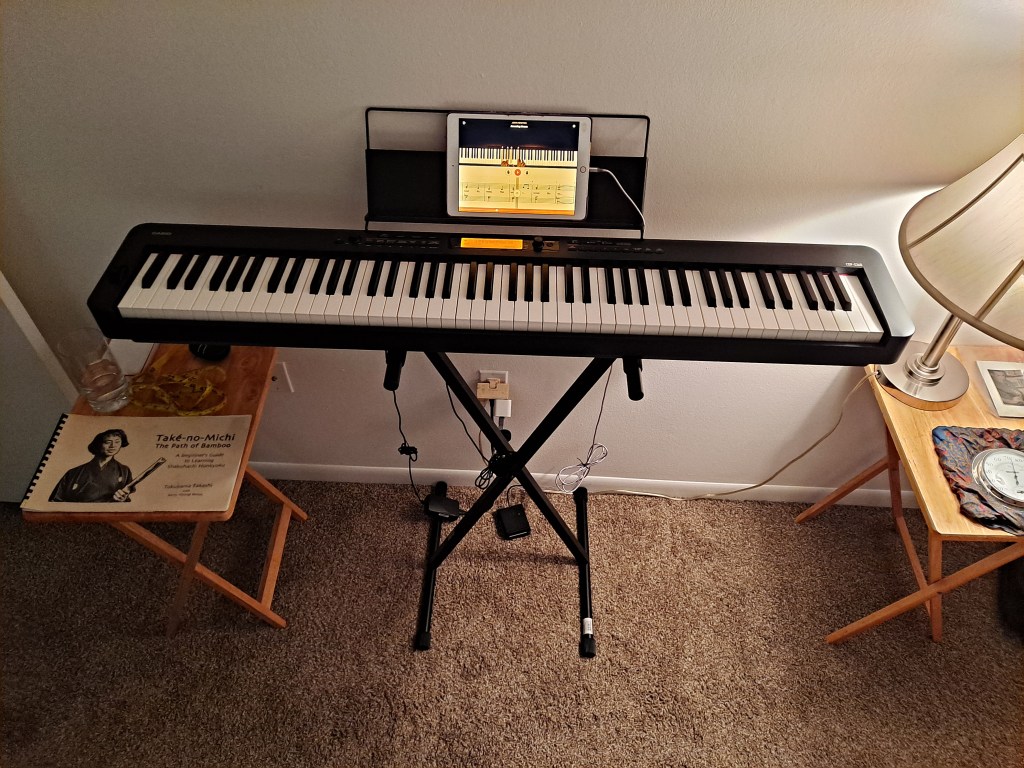
    Like many of you, I find that sitting for long periods is uncomfortable, so I decided to raise my keyboard stand to standing height. What I’ve found is that standing while playing allows for gentle movement—I can shift my weight, circle my hips, and let my breath flow naturally, almost like Tai Chi at the keyboard.

    But the most important shift has been learning how to relax. I’ve realized that when I play, I tend to hold my breath and tense up, which drains my energy. So my new focus is breathing and playing with as little tension as possible, using a 4-note breathing pattern:
    ✔ Inhale: A → C → E → C
    ✔ Exhale: A → C → E → C
    This simple rhythm helps me stay grounded, present, and relaxed.

    Another key part of this setup is having my keyboard at the end of my bed. This means I can lay down to rest anytime, and when I feel ready, I can stand for just a minute or two to play, then lay back down again. There’s no pressure, no need to push myself—just a gentle cycle of music and rest.

    Options for Engaging with Music at Any Energy Level

    I know that not everyone has the ability to stand or sit for long, so I wanted to share a few ways to incorporate music at any stage—always prioritizing relaxation and staying within your pacing envelope to avoid PEM.

    🎵 Lying in Bed: When I was primarily bedridden and didn’t have a keyboard, I Velcroed my iPad about a foot and a half above my head. This let me lay flat and play simple notes with an app, without any strain. It worked beautifully.

    🎵 Small Keyboard for Bed Use: On Facebook Marketplace, you can find very small, lightweight keyboards that you can keep in bed with you. You don’t need a full-size keyboard to start—just something simple to play a few notes when you feel able.

    🎵 Seated or Standing with an Adjustable Keyboard: If sitting for long is difficult, you can use a keyboard stand that adjusts in height so you can switch between sitting and standing, allowing for movement and rest as needed.

    🎵 Completely Resting & Humming (Minimal Effort Required): For those who need to lay flat and remain mostly inactive, music can still be part of your healing. Some keyboards or apps allow you to automatically play simple notes (like A → C → E → C) very, very slowly. Instead of physically playing, you can simply breathe in rhythm with the notes and gently hum along—only if it feels comfortable. Even this small engagement should be done within your energy limits, ensuring it stays restorative rather than draining.

    🎵 Music Visualization (No Physical Effort Required): If even humming feels like too much, you can still experience music through visualization. I used this method when I realized I couldn’t go to the beach anymore—I would simply imagine walking along the shore, and it was surprisingly powerful. In the same way, you can lay in bed and visualize yourself sitting at a piano, pressing one note at a time, hearing the sound in your mind, and breathing gently. You don’t have to hum or move at all—just allow the imagery and imagined sound to soothe you.

    The Primary Goal: Relaxation & Parasympathetic Activation

    The most important thing is to find the simplest, most relaxing way to engage with music—one that matches your current energy levels and does not trigger PEM. Whether that’s playing, humming, breathing, or simply visualizing, the goal is to activate the parasympathetic nervous system and promote deep rest and healing.

    Having a piano that moves with me rather than forcing me to adjust to it has been life-changing. I just wanted to share this in case it helps anyone else looking for a way to bring music into their life—with gentleness, breath, and ease. 💙

  • Quote: Thich Nhat Hanh, “In Love and Trust”

    Quote: Thich Nhat Hanh, “In Love and Trust”

    “If we know how to breathe, we will be able to generate the energy of mindfulness and recognize, embrace, and calm our painful feelings within a few minutes. These are essential, basic practices recorded in Buddhist sutras. If we only study the sutras in theory, we’ll never be able to master the practice.”

    ~ From: Thich Nhat Hanh, “In Love and Trust”

    👉 amzn.to/4hTT7fX

    🙏🕊🙏

  • Book Review: Being Peace by Thich Nhat Hanh

    Book Review: Being Peace by Thich Nhat Hanh

    There’s a timeless invitation at the heart of spiritual practice—to discover a deep, unshakable peace within ourselves, one that needs no striving to achieve. In Being Peace, Thich Nhat Hanh reminds us that peace is not something outside to be attained; it’s a natural state within us, accessible in each moment we choose to be fully present. In these quiet moments of awareness, peace isn’t something we do—it’s something we are.

    Thich Nhat Hanh, a Vietnamese Zen master, poet, and peace activist, brings a gentle simplicity to this profound teaching. Being Peace weaves together personal stories, practical mindfulness techniques, and timeless Buddhist wisdom. Through each page, his words invite us to embrace peace not as an ideal, but as an embodied presence—a way of being that can transform ourselves and the world.

    Discovering Peace in the Present Moment

    From the opening pages, Thich Nhat Hanh introduces a revolutionary idea: that each of us already carries the potential for peace within. He writes with an almost childlike clarity, inviting us to notice the ordinary miracles in daily life—a breath, a step, the warmth of the sun. These simple moments become doorways to the present moment, where we can rest in awareness, undisturbed by the mind’s endless motion.

    His approach to mindfulness is refreshingly practical. Rather than asking us to transcend the world, he guides us to return to it fully—to be present with whatever is here, exactly as it is. Whether we’re washing the dishes, driving, or simply sitting quietly, we are offered the chance to be peace, right here, right now.

    Practicing Compassion and Interbeing

    Another central theme in Being Peace is the idea of interbeing—Thich Nhat Hanh’s term for the interconnectedness of all life. He shows how, when we see ourselves as part of a vast web of life, our actions naturally become more compassionate. Understanding interbeing allows us to see that our own well-being is inseparable from that of others. When we cultivate peace within, it radiates outward, touching the world around us.

    This interconnection reminds us that our peace is a gift to the world. By learning to “be peace,” we become a refuge for others—a quiet presence that can soothe and support those around us. Through stories of social engagement and personal practice, Thich Nhat Hanh illustrates how inner peace can become a force for transformation, leading to wise, compassionate action in our families, communities, and beyond.

    An Invitation to Live Peace

    Being Peace doesn’t simply offer teachings; it invites us into a living practice. Thich Nhat Hanh’s words create a soft, steady encouragement to live mindfully, with kindness for ourselves and others. There’s an intimacy in his voice, as if he is gently guiding us by the hand, showing us how to live with more openness, patience, and presence.

    The book also provides specific practices, like mindful breathing, walking meditation, and loving-kindness meditation, which make peace a tangible experience. These practices are woven throughout his teachings, allowing readers to integrate mindfulness naturally into daily life.

    In reading Being Peace, we’re reminded that peace is not a far-off goal but a living, breathing reality available in each moment. Thich Nhat Hanh shows us that the path to peace begins with the simplest act of bringing awareness to the present moment, just as it is.

    Final Reflections

    In Being Peace, Thich Nhat Hanh offers us more than words on a page; he offers a way of living. His teachings resonate as a call to each of us to embody the peace we wish to see in the world. Through gentle, grounded guidance, he shows us that true peace is not just an aspiration—it’s a way of being available to each of us, here and now.

    If you’re ready to discover this peace within, you may want to explore Being Peace in full. Below, you’ll find the book itself, a quiet guide to a more mindful, compassionate way of life.

    🙏🕊️🙏

  • Mindfulness and Presence: Anchoring Attention in the Moment

    Mindfulness is the practice of deliberately directing our attention to the present moment. This practice helps us become more aware of our thoughts, emotions, and sensations without being overwhelmed by them. By cultivating mindfulness, we can navigate our inner and outer worlds with greater clarity and purpose.

    The Essence of Mindfulness

    1. Present-Moment Awareness:
    • Mindfulness involves bringing our focus to the here and now. This practice helps us fully engage with our current experience, reducing the tendency to dwell on the past or worry about the future.

    2. Non-Judgmental Observation:

    • A key aspect of mindfulness is observing our thoughts and feelings without judgment. This attitude of acceptance allows us to see things as they are, fostering a sense of inner peace.

    Benefits of Mindfulness

    1. Enhanced Emotional Regulation:
    • Mindfulness helps us become more aware of our emotional responses. By observing our emotions without immediate reaction, we can manage them more effectively and respond to situations with greater composure.

    2. Improved Focus and Concentration:

    • Practicing mindfulness strengthens our ability to concentrate. By regularly bringing our attention back to the present moment, we train our minds to stay focused, which can enhance productivity and reduce distractions.

    3. Stress Reduction:

    • Mindfulness has been shown to reduce stress by promoting relaxation and helping us stay grounded in the present. This practice can lower levels of cortisol, the stress hormone, leading to improved physical and mental health.

    Practical Mindfulness Techniques

    1. Mindful Breathing:
    • Focusing on the breath is a simple yet powerful mindfulness practice. By paying attention to each inhalation and exhalation, we can anchor our awareness in the present moment and cultivate a sense of calm.

    2. Body Scan Meditation:

    • This practice involves directing attention to different parts of the body, observing sensations without judgment. A body scan can help release tension and promote relaxation.

    3. Mindful Walking:

    • Walking mindfully involves paying attention to the sensations of movement and the environment around us. This practice can be a grounding way to incorporate mindfulness into daily activities.

    4. Mindful Listening:

    • Engaging in mindful listening means fully focusing on the sounds around us or the person we are conversing with. This practice enhances our connection with others and deepens our experience of the present moment.

    Conclusion

    Mindfulness and presence are essential for anchoring our attention in the moment. By cultivating mindfulness, we can enhance our emotional regulation, focus, and overall well-being. This practice helps us navigate life with greater clarity and purpose, allowing us to experience each moment fully. Embrace the power of mindfulness, and observe how it transforms your consciousness and enriches your life.

    Below is the original source video of the lecture with Swami Parvajika Devyanandaprana, from which these blog posts were inspired. Here you can explore the insightful teachings that have profoundly shaped the content and perspectives shared in this blog.

    🙏🕊️🙏

  • Developing Ekagrata, or One-Pointed Concentration: An Essential Skill in Meditation

    Developing ekagrata, or one-pointed concentration, is an essential skill in meditation that enhances mental focus and facilitates deeper states of awareness. Here are some steps and techniques to cultivate ekagrata:

    1. Choose a Focus Point:
    • Select an object of focus, such as the breath, a mantra, a candle flame, or an image. This will be your pratyaya, the object to anchor your attention.
    1. Create a Quiet Environment:
    • Find a peaceful, distraction-free space for your practice. Minimizing external noise helps reduce mental distractions.
    1. Set a Regular Practice Time:
    • Consistency is key. Establish a regular meditation routine, even if it’s just a few minutes each day, to build concentration over time.
    1. Mindful Breathing:
    • Focus on your breath, noticing each inhalation and exhalation. Allow your mind to become absorbed in the rhythm of breathing, gently bringing it back whenever it wanders.
    1. Use of a Mantra:
    • Repeating a mantra silently or aloud can help concentrate the mind. Choose a mantra that resonates with you and repeat it rhythmically to maintain focus.
    1. Visual Focus:
    • Concentrating on a visual object, like a candle flame or a mandala, can help fix your attention. Keep your gaze steady and let your mind become absorbed in the image.
    1. Progressive Relaxation:
    • Begin your practice with a few minutes of progressive muscle relaxation to calm the body and mind, making it easier to focus.
    1. Mindful Observation:
    • As thoughts arise, observe them without attachment or judgment. Imagine them as clouds passing by, gently returning your focus to the chosen point.
    1. Increase Duration Gradually:
    • Start with short sessions and gradually increase the duration as your concentration improves. This helps build mental stamina without overwhelming the mind.
    1. Be Patient and Compassionate:
      • Developing ekagrata is a gradual process. Be patient with yourself and maintain a compassionate attitude towards any difficulties or distractions you encounter.

    By consistently practicing these techniques, you can enhance your ability to achieve ekagrata, leading to deeper meditation and greater mental clarity.

    Below is the original source video of the lecture with Swami Parvajika Devyanandaprana, from which these blog posts were inspired. Here you can explore the insightful teachings that have profoundly shaped the content and perspectives shared in this blog.

    🙏🕊️🙏