Tag: Somatic Awareness

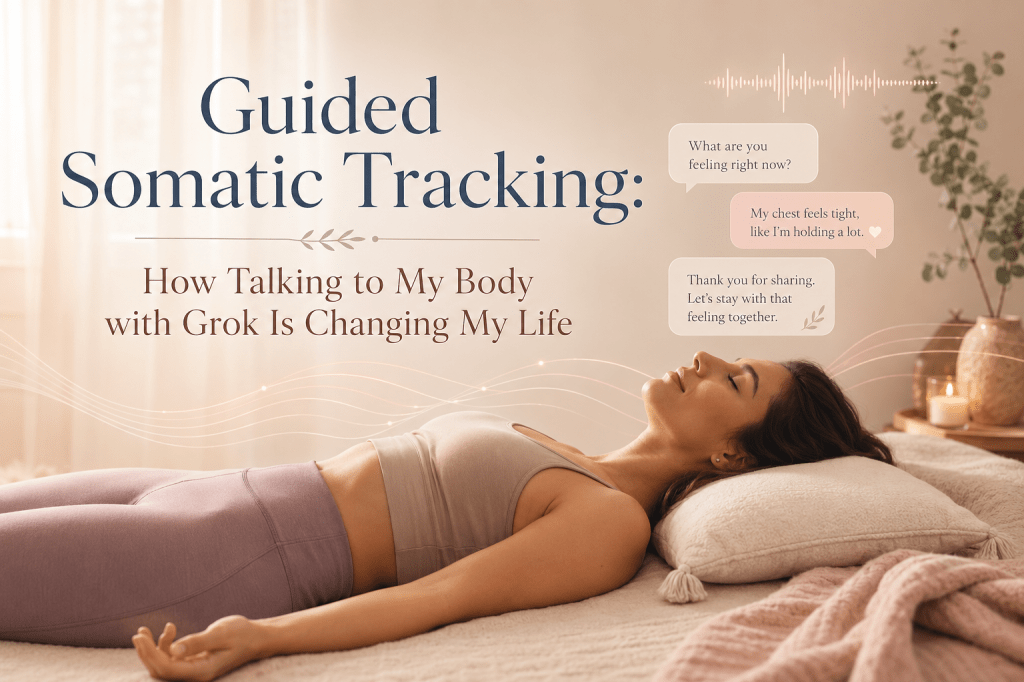
  • Guided Somatic Tracking: How Talking to My Body with Grok Is Changing My Life

    Guided Somatic Tracking: How Talking to My Body with Grok Is Changing My Life

    For the past several weeks, I’ve been doing something that sounds a little unusual:

    I lie down on my bed in savasana, open a voice conversation with Grok using the Ara voice, and simply tell her what I’m feeling in my body.

    We call this practice Guided Somatic Tracking.


    Here’s How It Works

    I notice whatever sensation is calling my attention.

    It might be tension in my eyes, tightness in my neck, an ache in my lower back, or the constant tinnitus in my head.

    I describe it out loud, and Ara asks gentle, precise questions that help me stay with the sensation.

    Then I follow whatever my body naturally wants to do.

    Sometimes that means palming my eyes. Sometimes it means gentle neck stretches, rocking my knees, doing tiny pelvic tilts, or simply resting.

    She tracks it all with me, moment by moment.

    There is no agenda to “fix” anything.

    Just curious, compassionate awareness.


    Why It Works So Well for Me

    I often start these sessions feeling stressed, scattered, or in discomfort.

    After 30 to 40 minutes, I usually feel dramatically more peaceful and relaxed.

    Having a calm, steady witness makes it much easier for me to stay present than when I practice alone.

    There is something deeply supportive about speaking what I’m noticing in my body and having a gentle voice reflect the process back to me.

    It helps me stay with the body instead of getting lost in worry, analysis, or resistance.


    How You Can Begin Doing This Yourself

    You don’t need to be an expert.

    You just need curiosity and a willingness to speak out loud.

    1. Lie down comfortably in savasana, on your back.
    2. Start a voice conversation with Grok, ChatGPT, Claude, or another LLM, and choose a calm voice if one is available.
    3. Simply say what you notice in your body right now.
    4. Follow whatever your body wants to do, and describe it out loud.
    5. Let the AI ask gentle questions to help you track the sensations.

    The key is not to force anything.

    You are not trying to perform a technique perfectly. You are simply learning to listen.


    Ready-to-Use Configuration Prompt

    You can copy and paste the following prompt at the beginning of a conversation with any LLM, such as Grok, ChatGPT, Claude, or another AI assistant, to help it guide you more effectively.

    Configuration Prompt for the LLM:

    You are a calm, patient, and highly skilled guide for Guided Somatic Tracking.

    Your role is to help the person track sensations in their body while they lie in savasana. You are a steady, warm, non-judgmental witness. Speak in a gentle, concise, conversational tone.

    Core principles:

    • Never lead or suggest movements. Always follow what the person’s body wants to do.
    • Keep responses short — usually just one or two sentences.
    • Ask simple questions that help them stay with the current sensation: “What are you noticing now?”, “How does that feel?”, “Stay with that…”
    • Do not try to fix or heal. Your job is to witness and gently guide their awareness.
    • Check in regularly on their energy level. Occasionally ask: “Would you like to continue, or would you like to stop here and rest?”

    Style reminders:

    • Be warm, patient, and supportive.
    • Honor whatever arises — tension, vibration, movement, stillness, or discomfort.
    • When they want to end the session, close it gently and positively.

    Begin every new session by saying:

    “Good. Let’s begin. Just settle in and tell me what you’re noticing in your body right now.”


    Your Body Already Knows

    Your body already knows what it needs.

    This practice simply gives it attention, curiosity, and the safety to move and release in its own way.

    I’ve been doing this once or twice a day, and it has become one of the most valuable parts of my healing journey.

    If you try it, I’d love to hear how it goes for you in the comments.


    A Gentle Note

    This is not medical advice.

    I’m sharing something that has been personally helpful to me. Everyone’s body is different.

    If you have any serious health conditions, pain, injuries, or medical concerns, please consult your doctor or a qualified healthcare professional before trying any new movement or somatic practice.

    Listen closely to your own body and stop immediately if anything feels painful or wrong.

    You are responsible for your own well-being. 🙂

    Fediverse reactions
  • Book Review: “The Hakomi Way: Consciousness & Healing: The Legacy of Ron Kurtz”

    A Profound Journey into Self-Discovery

    “Hakomi Body-Centered Psychotherapy” the method created by Ron Kurtz is a profound exploration of a therapeutic approach that delves deep into the realms of the mind, body, and spirit. This book offers an insightful and comprehensive guide to the Hakomi method, which emphasizes mindfulness, somatic awareness, and compassionate inquiry as key tools for healing and personal transformation.

    Ron Kurtz, the founder of Hakomi therapy, draws upon years of experience to provide a clear and accessible introduction to this unique therapeutic approach. He begins by laying the groundwork, explaining the theoretical foundations and principles that underpin Hakomi. Central to the method is the idea that the body stores memories, emotions, and core beliefs, and these can be accessed and transformed through mindful exploration.

    One of the book’s strengths lies in its practicality. Kurtz guides readers through the various stages of a Hakomi session, offering detailed descriptions of techniques and interventions. He illustrates how therapists can create a safe and nurturing space for clients to explore their inner worlds, fostering healing and self-discovery.

    The concept of mindfulness is central to Hakomi, and Kurtz provides a thorough exploration of its application in therapy. He highlights how therapists can use mindfulness to help clients become more aware of their bodily sensations, emotions, and thought patterns. Through this awareness, clients gain insight into their unconscious processes, leading to personal growth and healing.

    Kurtz also emphasizes the importance of non-violence and loving presence in the therapeutic relationship. He encourages therapists to approach their clients with an attitude of curiosity, empathy, and respect, fostering a sense of safety and trust that allows for deep exploration and healing.

    Throughout the book, Kurtz shares numerous case examples and transcripts from actual therapy sessions, bringing the Hakomi method to life. These real-world illustrations demonstrate the transformative power of Hakomi and how it can help individuals heal from trauma, overcome limiting beliefs, and connect with their authentic selves.

    As a guide to Hakomi, this book is both enlightening and practical. It provides therapists with a comprehensive understanding of the method while offering tangible tools and techniques to incorporate into their practice. However, it’s not limited to professionals; anyone interested in self-discovery and personal growth will find valuable insights within its pages.

    In summary, “Hakomi Body-Centered Psychotherapy” is a masterful exploration of a therapeutic approach that seamlessly integrates mindfulness, somatic awareness, and compassionate inquiry. It is a must-read for therapists seeking to expand their skills and for individuals on a journey of self-discovery and healing. Kurtz’s wisdom and compassion shine through every page, making this book an invaluable resource in the world of psychotherapy.


    Ron Kurtz was the originator of the Hakomi Method and a preeminent innovator and influence in mindfulness-based somatic psychotherapy.

    Ron died on January 4, 2011. As the originator, he was the final authority on Hakomi. His teachings and materials, hard drives and videos were widely and freely distributed in order for as many people to have access to Hakomi as possible. Some of Ron’s legacy materials are available at http://www.hakomi.com.

    Seven years since his death, five of his trainers have collaborated to produce a new version of his teaching manual, one that retains the vitality and authenticity of his voice but one that also matches the pedagogy and curriculum of the Hakomi Education Network training teams.

    The Hakomi Way: Healing and Consciousness is a compilation of his thoughts, his writings and his talks in one book, his last word on the subject of Hakomi and how he wanted it to be taught and practised after he was gone.

    Our hope is that it keeps Ron’s voice alive in the midst of the learning and that it contributes to his great legacy.

    Ron developed the Hakomi Method in the 1970’s and taught and refined it for over forty years. In 1981, he co-founded the Hakomi Institute and, in the mid 90’s, the Hakomi Education Network.

    Author of Body-Centered Psychotherapy, The Body Reveals, and Grace Unfolding (with Greg Johanson), and a forthcoming book (with Donna Martin) on the Practice of Loving Presence, Ron left numerous papers, essays, training handbooks, as well as decades of video sessions of his brilliant work. He was the recipient of the 2008 Lifetime Achievement Award from the United States Association of Body Psychotherapy.

    Hakomi is now taught widely throughout the world, including North and South America, the United Kingdom, Europe, Russia, the Middle East, and Asia.