Tag: inner transformation

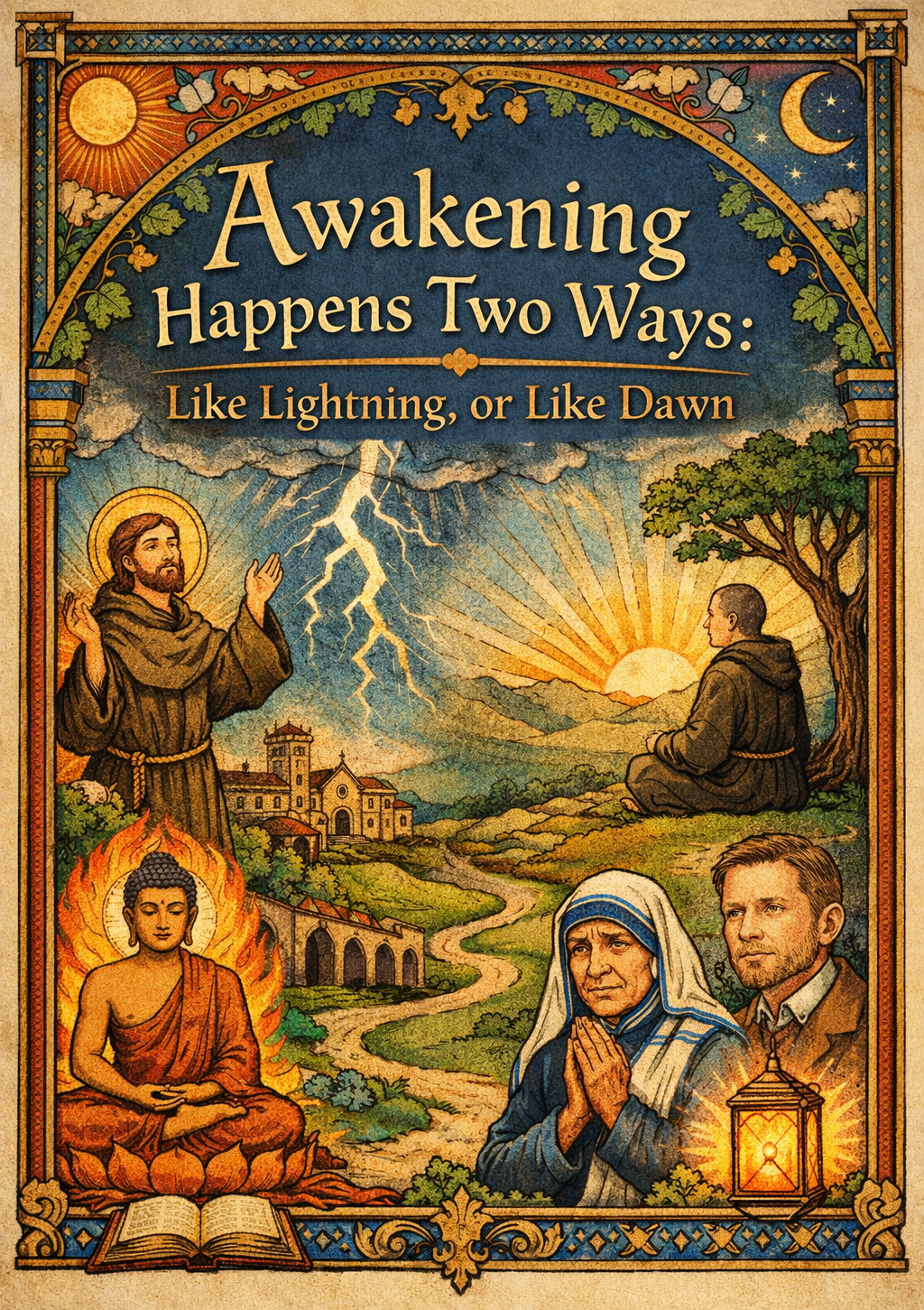
  • Awakening Happens Two Ways: Like Lightning, or Like Dawn

    Awakening Happens Two Ways: Like Lightning, or Like Dawn

    Sudden illumination and the slow work of becoming whole

    Into the Mystic is a contemplative reflections series exploring awakening, stability, and the quiet path of inner transformation in ordinary life.


    Introduction: Two Movements of Awakening

    In the landscape of spiritual life, two great patterns appear again and again: the gradual path and the lightning path.

    One unfolds slowly through prayer, discipline, contemplation, and steady inner work. The other arrives suddenly, as if grace breaks through without warning and changes the whole direction of a life in an instant.

    These are often described as opposites.

    But perhaps they are not opposites at all.

    Perhaps they are two movements within the same mystery.


    The Gradual Path

    The gradual path is the way of cultivation. It is the slow shaping of the soul through daily practice. It is the monk returning to prayer. The meditator returning to the breath. The seeker returning again and again to silence, surrender, and truth.

    In Buddhist language, this is the long training of mind and heart. In Christian contemplative language, it is the patient deepening of humility, purification, and love.

    Saint Teresa of Ávila offers one of the clearest examples of this gradual unfolding. Her spiritual life matured through years of prayer, struggle, refinement, and increasing interior depth. The soul, in her vision, is not transformed instantly, but led inward through many chambers, many purifications, many deepenings of surrender.

    Likewise, the Buddha’s awakening, though realized in a decisive moment beneath the Bodhi tree, was preceded by years of seeking, discipline, renunciation, and contemplative effort.

    The flowering may appear sudden.

    But the roots often grow in darkness for a very long time.


    The Lightning Path

    And yet there is also the lightning path.

    This is the path of abrupt transformation. The sudden reversal. The moment when the old self is pierced and something entirely new begins.

    It is not always earned in any neat or linear way. It may come through suffering, illness, loss, beauty, grace, or some inward rupture that breaks the ordinary structure of identity.

    Saint Francis of Assisi seems to belong, at least in part, to this lightning pattern. His early life was not one of long monastic preparation. His conversion appears to have been catalyzed through crisis: illness, war, captivity, disillusionment, and the collapse of the worldly ambitions he once cherished.

    Something broke open in him.

    The man who had been oriented toward status and recognition turned instead toward poverty, simplicity, love, and radical devotion.

    His life did not merely improve.

    It changed direction.


    Sudden Awakening, Gradual Integration

    This pattern appears across many traditions.

    Ramana Maharshi described a sudden awakening that began with a profound confrontation with death in his youth.

    Eckhart Tolle has written about a dramatic inner shift following a period of deep psychological suffering, when the ordinary sense of self seemed to dissolve into a profound stillness.

    Yet what is often overlooked is what came after.

    Tolle spent years living very quietly, often sitting on park benches, allowing his life to slowly reorganize around what he had experienced.

    The awakening may have been sudden.

    The embodiment was gradual.

    Here again we see the same rhythm:

    Lightning followed by integration.


    Faithfulness Without Consolation

    Mother Teresa’s life reflects another variation of this same pattern.

    Her decisive vocational turning — sometimes described as a profound interior call to serve the poorest of the poor — carries the character of a lightning moment.

    Yet what followed was not constant spiritual consolation, but decades of interior dryness, what the Christian mystical tradition calls a dark night of the soul.

    Despite this, she continued her work with remarkable faithfulness.

    Her life suggests something subtle but important:

    Awakening is not always accompanied by pleasant experience.

    Sometimes the lightning clarifies direction, but the gradual path becomes one of love without emotional reinforcement.

    In this way, both the sudden opening and the long endurance that follows become part of the same spiritual maturation.


    The Deeper Pattern

    If we look across these lives — Francis of Assisi, Teresa of Ávila, the Buddha, Ramana Maharshi, Mother Teresa, and Eckhart Tolle — a pattern begins to emerge.

    Some lives begin with discipline and flower into breakthrough.

    Others begin with breakthrough and spend years learning how to live what was revealed.

    Most contain both movements.

    Perhaps this is because awakening is not an event but a relationship.

    A relationship between grace and participation.

    Between what is given and what is lived.

    Zen expresses this beautifully:

    Enlightenment is an accident. Practice makes us accident-prone.
    Shunryu Suzuki Roshi

    We do not command grace.

    We prepare ourselves.
    We consent.
    We practice.
    We purify intention.
    We return.
    We wait.

    And sometimes, unbidden, the veil thins.


    The Quiet Awakening Most People Miss

    There is also a tender psychological truth here.

    Many sincere seekers imagine that if they have not had a dramatic breakthrough, then perhaps nothing real is happening.

    But this is not so.

    Sometimes awakening is not an explosion but an erosion.

    Not lightning, but river-water.

    Not a sudden fire from heaven, but a long dawn.

    A person may simply discover, after years of difficulty, that they are more stable than they once were.

    Less driven by fear.

    Less imprisoned by old wounds.

    More able to rest in silence.

    More capable of kindness.

    More able to endure uncertainty without collapse.

    This too is awakening.

    This too is grace.


    Where the Two Paths Meet

    Even within the gradual path, lightning may still come.

    Even within the lightning path, long discipline may still be required.

    Francis did not remain only the man of sudden conversion. He became the man of ongoing prayer and ongoing surrender.

    Teresa did not advance only by method. Her life was also marked by moments of powerful grace.

    The Buddha practiced intensely, but the final realization was not something he could force by will alone.

    The great traditions seem to agree on this much:

    Effort matters.

    But effort is not sovereign.

    There is something deeply relieving in that.

    It means we do not have to choose between discipline and grace.

    We can practice faithfully without pretending awakening is a personal achievement.

    We can remain open to the unexpected without neglecting the humble daily work of becoming more honest, more surrendered, and more loving.


    The Real Question

    Perhaps the real spiritual life is not about deciding whether we are on the gradual path or the lightning path.

    Perhaps it is about recognizing which movement is active in us now.

    For some, this season is one of patient cultivation.

    Quiet repetition.
    Invisible deepening.
    Slow healing.
    Hidden roots.

    For others, this season may include rupture, reversal, breakthrough, or an unexpected unveiling that reorders everything.

    And for many, it is both.

    We tend the garden, but we do not control the rain.

    We prepare the lamp, but we do not command the flame.

    We sit.
    We pray.
    We breathe.
    We return.
    We become available.

    In the end, perhaps that is the deepest wisdom:

    Awakening is both gift and participation.

    We are neither passive nor omnipotent.

    We are participants in a mystery we cannot manufacture, but to which we can sincerely offer our lives.

    The gradual path teaches us faithfulness.

    The lightning path teaches us surrender.

    And both, in their own way, lead us beyond ourselves.


    Peace and good. 🌿

  • Discovering Mystical Contemplation: The Alter Rebbe’s Practice of Hitbonenut and Bittul

    Discovering Mystical Contemplation: The Alter Rebbe’s Practice of Hitbonenut and Bittul

    Explore the transformative path of Hitbonenut and Bittul in Jewish mysticism, as practiced by the Alter Rebbe, to reach direct experience and divine unity.


    Translation of the Hebrew Text in the Above Image

    “… the esteemed Rabbi Schneur Zalman of Liadi, the great sage and author of the book Tanya, in his later years would immerse himself daily in deep contemplation and focus on achieving Hitbonenut and Bittul, self-nullification, before beginning his prayers. He would sit in a secluded area and enter a state of spiritual readiness, preparing himself to reach closeness to the divine through his meditative practices. Those who observed him would attest to the honor and respect that this revered practice commanded, reflecting his commitment to true divine connection.”


    Discovering the Boundless: The Alter Rebbe’s Practice of Hitbonenut and Bittul

    In the rich tradition of Jewish mysticism, Hitbonenut and Bittul are contemplative practices often approached as meditative paths focused on divine ideas. These practices are frequently interpreted as ways of concentrating on spiritual concepts to deepen one’s understanding. However, the Alter Rebbe, Rabbi Schneur Zalman of Liadi—the founder of Chabad Hasidism—offers us a window into a more profound dimension of these practices, where contemplation moves beyond intellectual meditation and opens into direct experience.

    The Alter Rebbe’s personal practice of Hitbonenut is a cornerstone of Chabad Chassidus. According to tradition, he would spend hours in Hitbonenut before beginning his prayers, not merely analyzing divine concepts but immersing himself in a state of awareness that dissolves the self into the infinite, what Jewish mysticism calls the Ein Sof—the boundless and limitless aspect of the divine.

    In this expansive approach to Hitbonenut, contemplation shifts from thought-focused meditation to an experiential opening, leading to what other traditions describe as the “pristine mind” or “pure contemplation.” By embracing the formless, open nature of awareness, the Alter Rebbe connected to a state beyond the grasp of the ego, inviting direct experience of the divine presence.

    This journey is deepened through Bittul, or self-nullification. Where Hitbonenut opens the door to spacious, boundless awareness, Bittul is the surrender of the self into that awareness. It’s a release of the ego’s hold, a quieting of personal identity that allows a merging with the infinite. This act of surrender is not a negation but an opening—a dissolving of the self to align fully with divine unity.

    For those of us seeking to understand Hitbonenut and Bittul in this way, the Alter Rebbe’s practice offers a reminder that contemplation in its purest form transcends the intellect. It’s not about conceptual analysis but about experiencing divine unity as a living reality. As we explore this path, we step beyond thought, into the boundless.

    In upcoming posts, we’ll further explore the practical steps, reflections, and guidance to cultivate these practices. Hitbonenut and Bittul invite us into the spaciousness of mystical contemplation, guiding us from understanding to a direct encounter with the divine.

    🙏🕊️🙏

    Book Review: Rabbi Schneur Zalman of Liadi: The Philosophy of Chabad by Nisan Mendel

    Nisan Mendel’s Rabbi Schneur Zalman of Liadi: The Philosophy of Chabad is a profound exploration of the life and teachings of one of Jewish mysticism’s most influential figures. Rabbi Schneur Zalman, known as the Alter Rebbe, was the founder of the Chabad movement, and his teachings remain central to Hasidic philosophy and contemplative practice today.

    Through this work, Mendel delves into the essence of Chabad philosophy, particularly its unique approach to Hitbonenut (contemplative meditation) and Bittul (self-nullification). Readers are introduced to the Alter Rebbe’s belief that intellectual understanding can be a pathway to divine experience, bridging the mind and heart to foster a deep connection with God. The book sheds light on the Alter Rebbe’s methods for approaching mystical contemplation, offering practical insights for those looking to incorporate these timeless practices into their own lives.

    Mendel’s accessible writing and thoughtful explanations make complex topics approachable, while his reverence for the subject shines through, bringing Rabbi Schneur Zalman’s teachings to life. This book is especially valuable for readers who wish to understand the spiritual framework of Chabad and its emphasis on meditative thought as a means to reach divine awareness.

    Whether you’re new to the ideas of Hitbonenut and Bittul or are already on a contemplative journey, The Philosophy of Chabad offers a valuable gateway to the Alter Rebbe’s approach to mysticism. By providing both philosophical insights and practical approaches, Mendel encourages readers to go beyond surface understanding and explore the depths of Chabad’s spiritual tradition.

    🙏🕊️🙏

  • The Veil of Illusion: Journeying Into the Mystic for Global Healing

    In the stillness of the heart, beyond the noise of the world and the clamor of external demands, there is a subtle call—a call to remember what has always been true. It is the call of the soul, the voice of the infinite, urging us to awaken from the dream we’ve been lost in. This is the journey into the mystic, the quiet unfolding of our true nature, a nature that transcends the boundaries of time, space, and form.

    The world around us may seem to be spiraling deeper into chaos. News of division, conflict, and uncertainty fills our days. But these outer waves are merely ripples on the surface of a far deeper ocean. The sages and mystics of all traditions—whether Rumi in his ecstatic verses, Meister Eckhart in his contemplations, or the Upanishads in their profound insights—have all pointed to the same truth: the external world is not the final reality. It is a veil, a cosmic play that we are invited to see through, to remember the oneness that lies beyond all form.

    We live in a world captivated by Maya, the illusion of separateness, and we are enchanted by the drama of Lila, the divine play of creation. Our minds, conditioned by centuries of material striving and division, tell us that peace and happiness are things we must chase, things that lie somewhere “out there.” But the mystics have always known that this is the great delusion. True peace, true joy, does not come from rearranging the pieces of the outer world—it comes from awakening to the deeper reality that lies within.

    In this way, our personal awakening is inseparable from the healing of the world. As we turn inward and recognize the truth of our being, we see that the suffering we witness is not separate from the suffering within our own hearts. The division we see in the world mirrors the fragmentation of our own minds. And yet, by embracing the path of contemplation, meditation, and inner surrender, we begin to dissolve these divisions. We begin to see that the peace we long for in the world must first take root in our own consciousness.

    The Unfolding of the Inner Light

    In the journey into the mystic, we are called to remember that we are not the passing waves of thought and emotion. The mystical heart knows that the true self, the essence of who we are, is the quiet awareness beneath it all, the unchanging presence in which all experiences rise and fall. The Bible tells us that the Kingdom of God is within, and in the Bhagavad Gita, Krishna speaks of the eternal soul that remains untouched by the outer circumstances of life. Every tradition points to this truth, in its own way: we are more than the temporary, fleeting experiences of life. We are the witness, the seer, the still point in a turning world.

    But this awakening is not merely an escape from the world’s troubles; it is the key to transforming them. The world does not need more minds caught in the web of fear and division. What it needs are souls who are rooted in the timeless truth of love and compassion, who understand that the battle is not won through force or domination but through the steady cultivation of peace within. Each of us is a channel through which the divine light can shine. As we awaken, we become part of the solution, not by striving to change the outer world directly but by embodying the change we wish to see.

    The Path to Global Well-Being Begins Within

    There is a saying in the mystical traditions that as we heal ourselves, we heal the world. This is not just a poetic notion but a profound spiritual truth. The journey into the mystic is the path of remembering who we truly are, beyond the illusions of separation and fear. As we do so, we bring a new energy into the world—an energy of peace, love, and clarity. This energy ripples out into the collective consciousness, subtly transforming the fabric of society.

    We may not always see the immediate results of this inner work, but the mystical path teaches us that the real shifts happen beneath the surface, in the unseen realms of spirit. Just as a tree grows in silence, its roots extending deep into the earth, so too does the work of awakening unfold quietly within. And yet, over time, this inner growth bears fruit—not only in our own lives but in the world around us.

    The world needs mystics now more than ever. It needs those who are willing to step beyond the noise and chaos, to go deep into the heart of being, and to bring back the light of truth. This is the true synchronized global well-being—not a surface-level fix to a broken system, but a deep transformation that begins within each soul and spreads outward, like ripples on the surface of a still pond.

    So, let us walk this path together, into the mystic, into the heart of our true nature. Let us awaken to the eternal light that dwells within us, and in doing so, let us contribute to the healing of the world. This is how the dream ends. This is how we wake up.

    🙏🕊️🙏

  • Awakening Beyond Illusion: Cultivating Inner Peace in a World of Change

    Awakening Beyond Illusion: Cultivating Inner Peace in a World of Change

    We live in a world that seems more uncertain by the day. The news flashes across our screens with stories of conflict, rising debt, division, and suffering. It’s easy to feel overwhelmed, as if the world is caught in a web of confusion and delusion. Yet, in the midst of this storm, there lies a deeper truth—one that has been whispered through the ages by the sages, prophets, and teachers of many traditions. It is the truth that real peace, real happiness, is not found in the external world but within.

    In many spiritual traditions, we are reminded that the world as we perceive it is often not the true reality. The Hindu concept of Maya refers to the veil of illusion that covers our perception of the Divine truth, the oneness of all life. Similarly, Lila, the cosmic play, teaches that life’s dramas—our joys, sorrows, victories, and struggles—are part of a greater dance, one that we are not meant to be trapped within but to witness with wisdom. Buddha, too, faced the tempter Mara—a personification of our inner desires, fears, and doubts—that seeks to pull us away from enlightenment, keeping us bound to suffering. Yet the Buddha, like so many enlightened beings, realized that Mara was merely a projection of the mind, and by seeing through this, he awakened.

    The universal wisdom here transcends any one faith: it is the perennial truth that the source of happiness, peace, and liberation lies in the ability to see beyond the illusions that bind us. Whether we call it Maya, Mara, or simply the distractions and attachments of daily life, the spiritual journey invites us to look beyond and discover the stillness within—the unchanging truth that unites us all.

    The World as It Appears

    In today’s world, many of us are caught up in the external—political divisions, economic uncertainties, personal struggles. We see two sides, each convinced they are right, each pulling us deeper into the drama of conflict and separation. But as spiritual teachings from every tradition remind us, the divisions are illusions. The real battle is not against “the other,” but within ourselves. It is a battle for our attention, our consciousness.

    We are constantly tempted to believe that happiness lies outside us—perhaps in political victory, material wealth, or the defeat of our perceived enemies. But deep down, we know this isn’t true. Happiness is an inside job. It is cultivated by learning to be the witness, by understanding that we are more than our thoughts, more than our desires. As the Bible says, “The kingdom of God is within you.” And in Advaita Vedanta, the teaching is clear: the Self, the Atman, is one with the Divine, beyond all change, beyond all illusion.

    The Power of Inner Awareness

    In the midst of the world’s uncertainty, we have the power to awaken. It is not about retreating from the world, but about engaging with it from a place of inner peace and wisdom. When we cultivate this awareness, we can see the Lila, the cosmic play, for what it is—a dance of form and movement in which we are participants, yes, but also witnesses. We can act in the world with compassion and love, but without being caught up in the suffering that arises from attachment.

    Each of us has the power to contribute to a ripple effect of global well-being. As more people turn inward to cultivate peace, the world around us begins to shift. This is not a passive withdrawal but an active transformation. Every act of kindness, every moment of mindfulness, contributes to the collective consciousness. Just as the Buddha conquered Mara by seeing through his illusions, we too can see through the illusions that divide us and find our way to unity.

    A Universal Call to Awakening

    The spiritual traditions of the world remind us that our ultimate task is to awaken to the truth of who we are—beings of love, compassion, and infinite potential. Whether we draw inspiration from the Bible, the teachings of the Buddha, the wisdom of Advaita Vedanta, or the compassionate love found in Islam, Judaism, or any faith, the message is the same: we are interconnected, and peace begins within each of us.

    The world may seem overwhelming, but it is in these moments of crisis that we are called to remember our true nature. This is where hope lies—not in external victories, but in the realization that we have the power to choose peace, to choose love, to choose compassion, no matter the circumstances.

    This is the time to cultivate global well-being by nurturing the health of our own hearts and minds. The journey starts within, and it begins with the simple yet profound act of turning our attention inward, learning to witness the dance of life without being swept away by it. In this way, we become beacons of light in a world that desperately needs it.

    Let us rise together, not in fear or anger, but in love. Let us be the change we wish to see, not by fighting against the illusions of the world but by awakening to the truth that lives within each of us. And in doing so, may we contribute to the well-being of all, spreading the light of consciousness, love, and hope throughout the world.

    🙏🕊️🙏

  • Ramayana No. 8: The Journey from Ignorance to Wisdom—A Path We All Walk

    In the ancient epic of the Ramayana, we find a story that resonates with the journey of every human soul—a journey that begins in ignorance and, with the right guidance, leads toward wisdom, righteousness, and self-realization. These themes are universal, transcending religious boundaries, and can be understood in the context of both Eastern and Western spiritual traditions.

    A King’s Ignorance and the Sage’s Steadfastness

    In the early chapters of the Ramayana, we encounter a king driven by flawed motivations—greed, rivalry, and a desire for power. His approach to the sage, despite being rooted in ignorance, marks the beginning of a profound transformation. The king’s initial aggression and misguided intent bring him into the presence of a sage, a living embodiment of dharma (righteousness).

    This story is more than just a tale of conflict; it’s a reflection of our own lives. We all begin in ignorance, shaped by our desires, fears, and misunderstandings. But like the king, when we encounter wisdom—whether through a teacher, a spiritual practice, or life’s hard-earned lessons—there is an opportunity for transformation. The sage, representing the unwavering principles of righteousness, patiently guides the king, leading him from ignorance toward a deeper understanding of true power, which is rooted not in dominance, but in righteousness.

    In the Christian tradition, this principle can be seen in the teachings of Jesus, who embodies righteousness and divine wisdom. Jesus’s teachings guide believers toward a life of love, compassion, and humility, aligning them with the will of God. Just as the sage in the Ramayana leads the king toward dharma, Jesus invites us to follow the path of righteousness, even when we begin with flawed motivations or misunderstandings.

    The Universal Journey: From Ego to Righteousness

    This narrative is relatable because it mirrors the human experience. Even Rama and his brothers, avatars of the divine, begin their lives in a state of ignorance, unaware of their true nature. However, they have the immense fortune of being raised in righteousness by a virtuous family. Their journey is guided by dharma from the start, but for many of us, the path is not so straightforward.

    In the Christian context, we might liken this to the way Jesus guides his followers toward righteousness, teaching them to love their neighbors, forgive their enemies, and live in accordance with God’s will. But as in the Ramayana, many of us begin our spiritual journey with ego-driven desires—seeking happiness, success, or even power. As we walk the path, life’s challenges and the teachings we encounter gradually shift our motivations. The path, though filled with lumps and bumps, becomes a process of alchemy, where our ignorance is transformed into wisdom, our ego into selflessness, and our desires into devotion.

    Seeking Wisdom on the Hard Road

    For those who do not start in a righteous environment, the road can be hard. But this journey is not without hope. The king’s story reminds us that even when we approach the path with flawed intentions, the very act of seeking wisdom can lead to our transformation. The teacher doesn’t come to ignorance; rather, ignorance approaches the teacher.

    In the Southern Chinese monk style of martial arts known as Gohndagow, a branch of Kung Fu, this principle is symbolized by the student bringing the left foot to the right foot before showing respect to the teacher—a gesture that represents ignorance coming to the teacher, or the ego approaching the divine for guidance. In Gohndagow, martial arts are more than just physical training; they are a path to spiritual enlightenment, emphasizing the cultivation of the mind and heart as well as the body.

    In the Christian tradition, we see this when people turn to Jesus, sometimes out of desperation or need, only to find that their journey with him leads them to a deeper understanding of God’s love and righteousness. Our initial motivations, however flawed, can set us on a journey of purification and growth. The spiritual path meets us where we are, with all our imperfections, and guides us step by step toward righteousness. The key is to approach the path with sincerity, even if we start from a place of ignorance. The process itself will refine and elevate us, leading us closer to our true nature, or as Christians might say, to a life that reflects Christ’s teachings.

    The Alchemy of the Spiritual Path

    In Tibetan Buddhism, the concept of alchemy is not merely about turning base metals into gold; it is the process of transforming the ego into a Buddha. This profound journey from ignorance to wisdom is the true alchemical process, one that requires a detailed and disciplined approach to spiritual practice.

    The Tibetans have developed incredibly intricate teachings and practices to guide a person through this transformation. The path itself is the alchemy—a meticulous process that turns the base elements of our ego-driven existence into the gold of enlightenment. Through practices like meditation, ethical conduct, and devotion, and under the guidance of a qualified teacher, a practitioner gradually refines their mind and heart, moving closer to the realization of their true nature as wisdom and compassion.

    In this light, the story of the king in the Ramayana serves as a metaphor for this alchemical journey. His flawed motivations, when met with the sage’s unwavering dharma, set him on a path of transformation, much like how a student in the Tibetan tradition, despite their initial ignorance, is gradually guided toward the light of enlightenment. This process is both universal and deeply personal, reflecting the timeless truth that the spiritual path is one of continuous alchemy—of turning the ego into the gold of wisdom.

    Conclusion: Embracing the Journey

    As we walk our spiritual path, we must remember that the journey from ignorance to wisdom is one that we all must undertake. Whether we begin with pure or impure motivations, the key is to keep moving forward, seeking wisdom and guidance wherever we can find it. The Ramayana, with its rich tapestry of characters and lessons, offers us a mirror to our own lives, showing us that even the most flawed beginnings can lead to a profound and righteous end.

    For our Christian friends, this journey is akin to following Jesus, who offers us the path to righteousness through his teachings. May this reflection inspire you, dear reader, to embrace your journey with all its imperfections, knowing that each step, no matter how small, brings you closer to the light of righteousness and divine wisdom.

    This image that captures the journey from ignorance to wisdom, blending elements from the Ramayana, Tibetan Buddhism, and Christian teachings. It symbolizes the choice we all have of undergoing the transformation process from darkness and ego to enlightenment and wisdom, with cultural symbols subtly incorporated.

    This image that captures the journey from ignorance to wisdom, blending elements from the Ramayana, Tibetan Buddhism, and Christian teachings. It symbolizes the choice we all have of undergoing the transformation process from darkness and ego to enlightenment and wisdom, with cultural symbols subtly incorporated.


    You can explore this epic story in the edition of the Ramayana used in this series, written by Valmiki and translated by Suparna Ghosh, on Amazon here

    Alternatively, you can choose from several other versions and translations that are available. Including the William Buck translation available as an abridged audiobook on Audible, narrated by Ram Dass here

    🙏🕊️🙏

  • A Christian Mystic is Also a Yogi: Bridging the Spiritual Traditions

    In the quiet corners of monasteries, amidst the echo of chanting monks, and within the solitude of wilderness hermitages, Christian mystics have, for centuries, sought to experience a profound union with the Divine. They have traveled inward, transcending the boundaries of ego, and have entered into a sacred communion with God. Their journey is one of deep contemplation, marked by an ascetic discipline that reflects a yearning to touch the eternal. Though these mystics arise from the Christian tradition, their spiritual pursuits bear a striking resemblance to those of yogis—a title traditionally reserved for practitioners within the vast spiritual traditions of India.

    At first glance, the practices and language of Christian mysticism and yoga might seem worlds apart. One speaks in the tongue of Christ, the saints, and the Holy Spirit, while the other chants the names of Shiva, Krishna, and the universal Brahman. However, beneath these differing expressions lies a shared journey—a journey toward the ultimate goal of spiritual union, self-realization, and the direct experience of the Divine.

    The Quest for Union

    The essence of yoga is captured in its very name, which means “union.” Traditionally, this union is understood as the merging of the individual soul with the Divine consciousness—a state of oneness where the separation between self and the cosmos dissolves. This echoes the Christian mystic’s pursuit of “divine union,” a state described by luminaries like St. John of the Cross, where the soul is united with God, experiencing a profound and intimate communion that transcends all earthly understanding.

    Both the yogi and the Christian mystic understand that this union is not merely a metaphorical concept but a lived reality, achievable through dedicated practice, surrender, and grace. It is an experience of the heart’s deepest longing fulfilled, where the seeker and the sought become one.

    The Path of Inner Transformation

    To reach this union, both traditions emphasize the necessity of inner transformation. For the yogi, this often involves practices like meditation, breath control, and ethical living, which purify the mind and body, allowing the practitioner to transcend the ego and experience the true Self. Similarly, Christian mystics speak of a transformative journey often described in stages: purgation (the cleansing of the soul), illumination (receiving divine light and insight), and union (the final, blissful merging with God).

    This transformation is not an easy path; it is marked by trials, tests of faith, and the dissolution of old identities. Yet, both the yogi and the Christian mystic embrace these challenges, understanding that they are necessary steps in the journey toward spiritual maturity and enlightenment.

    Contemplation and Stillness

    Central to both yoga and Christian mysticism is the practice of contemplation—a deep, meditative stillness where the divine can be encountered directly. Yogis engage in dhyana, or meditation, as a means of quieting the mind and opening the heart to the infinite. Christian mystics, too, seek this stillness through contemplative prayer, where words fall away, and one rests in the silent presence of God.

    In these moments of stillness, both the yogi and the mystic move beyond the distractions of the world, entering into a space where the divine presence is felt intimately, where God is not a distant figure but a living, breathing reality within.

    The Role of Love

    For both traditions, love is the highest expression of spiritual attainment. In the Christian mystical tradition, figures like St. Teresa of Avila and St. Francis of Assisi exemplify a life overflowing with divine love, a love that embraces all of creation as a reflection of God. This mirrors the path of bhakti yoga, where devotion and love for the divine are seen as the most direct route to spiritual awakening.

    This love is not just a feeling but a transformative force that purifies the heart and mind, drawing the soul closer to its source. It is an all-encompassing love that transcends personal desires, embracing the entirety of existence with compassion and grace.

    A Universal Journey

    The paths of the Christian mystic and the yogi, though outwardly different, converge at their deepest levels. Both seek to transcend the limitations of the ego, to experience the divine presence in its fullness, and to live a life that reflects this profound spiritual truth. Whether through the sacred silence of a monastery or the disciplined practice of asanas, the goal is the same: to know God, to become one with the Divine, and to embody the sacred in every aspect of life.

    In this light, we can see that a Christian mystic is, indeed, a yogi—a practitioner of union, a seeker of divine truth, and a traveler on the path of spiritual awakening. Their journey reminds us that the quest for the divine is a universal one, transcending boundaries of culture and religion, and uniting all seekers in their shared pursuit of the ultimate reality.

    🙏🕊️🙏

  • The Enduring Light of Tibetan Buddhism: Lessons for Christian Practitioners

    Fostering Compassionate Unity in Christian Practice

    Introduction

    I thank God that Tibetan Buddhism still survives. Tibetan Buddhists are some of the most sincere, authentic, and compassionate practitioners of spiritual principles. Their presence is a blessing to the world, offering a guiding light in times of darkness and uncertainty. By exploring their teachings, we can find ways to enhance our own spiritual practice, fostering interfaith dialogue and mutual understanding.

    The Essence of Tibetan Buddhism

    Tibetan Buddhism is rooted in principles that resonate with many Christian values: a pristine mind, loving-kindness, compassion, and wisdom. These principles emphasize the cultivation of a clear, peaceful mind, a heart full of love and kindness, a commitment to compassionate action, and the pursuit of deep wisdom. These ideals are not foreign to Christianity; rather, they complement the teachings of Jesus on love, mercy, and wisdom.

    Easing Fears and Embracing Inclusion

    It is important to clarify that exploring Tibetan Buddhist teachings does not mean abandoning Christian faith or compromising the belief that Jesus is the way, the truth, and the life. Instead, it is about recognizing the wisdom in other traditions that can enhance our understanding and practice of Jesus’ teachings to love one another. Jesus himself reached out to those who were considered outsiders, demonstrating love and inclusion rather than fear of strangers.

    Exploring Tibetan teachings through interfaith dialogue offers us an opportunity to deepen our understanding of universal spiritual principles such as love, compassion, and wisdom. Through interfaith dialogue we can draw inspiration from other cultures and traditions to enrich our spiritual practice and foster greater empathy and unity in our communities. This exploration is not about adopting foreign beliefs, but about seeking wisdom, practicing compassion and fostering a spiritual growth that resonates with core Christian values.

    Practical Integration for Christians

    Mindfulness and Prayer
    Tibetan Buddhism emphasizes mindfulness—being present in each moment. This practice can significantly enhance our prayer life, making us more aware of God’s presence and deepening our relationship with Him.

    • Mindfulness in Prayer: Incorporate mindfulness into your prayer routine by beginning with a few moments of deep, focused breathing. Center yourself and become aware of God’s presence. As you pray, remain present with each word, offering your prayers with full attention and sincerity.
    • Meditative Reading of Scripture: Practice Lectio Divina, a meditative reading of the Bible. Read a passage slowly and reflect on its meaning. Pause to meditate on specific words or phrases, allowing them to resonate deeply within your heart.

    Compassionate Action
    Both traditions value compassion. Christians can draw inspiration from Tibetan practices of loving-kindness to enhance their own acts of charity and service, following Jesus’ command to love our neighbors as ourselves.

    • Loving-Kindness Meditation: Engage in loving-kindness meditation, also known as Metta. Begin by offering kindness to yourself, then extend these wishes of well-being and happiness to others, including family, friends, strangers, and even those with whom you have conflicts. This practice fosters a compassionate heart and encourages active love in daily life.
    • Serving Others: Inspired by the Bodhisattva vow to help all beings, commit to small acts of kindness and service. Volunteer at local charities, offer support to those in need, and engage in community service as a way to embody Christ’s love.

    Wisdom and Discernment
    The pursuit of wisdom is central in both traditions. Tibetan Buddhism encourages deep reflection and learning, which can enrich our understanding of Scripture and help us live more wisely.

    • Reflective Practices: Take time for regular self-reflection and meditation on biblical teachings. Use contemplative practices to seek God’s guidance in making wise decisions. Reflect on your actions and their alignment with Christian values.
    • Study and Dialogue: Engage in interfaith dialogue and study to broaden your perspective. Understanding different spiritual traditions can enhance your own faith and offer new insights into the pursuit of wisdom.

    Peace and Reconciliation
    Tibetan Buddhist practices of cultivating inner peace can support Christians in embodying the peace of Christ, promoting reconciliation and harmony in our relationships and communities.

    • Inner Peace Practices: Incorporate meditation practices that focus on achieving inner peace. Use techniques such as breath awareness or guided imagery to calm your mind and cultivate a sense of tranquility. This inner peace can help you approach conflicts with a calm and reconciliatory spirit.
    • Peacemaking Efforts: Actively engage in peacemaking within your community. Follow the teachings of Jesus by fostering forgiveness, understanding, and reconciliation. Seek to resolve conflicts with love and compassion, promoting harmony and unity.

    Blessings to the World

    Tibetan Buddhism’s contributions to global spirituality are immeasurable. The spread of its teachings has influenced various cultures, bringing a message of peace, compassion, and wisdom. By recognizing these contributions, Christians can appreciate the universal values that transcend specific religious boundaries and foster a more compassionate and wise world.

    Conclusion

    In a world often characterized by division and suffering, the teachings of Tibetan Buddhism offer a path of unity, healing, and enlightenment that complements the Christian call to love and serve others. By exploring and integrating these teachings into our lives, we open ourselves to profound transformation, contributing to a more compassionate and wise world while deepening our own faith.

    Contemplative Reflections:

    1. How can the principles of mindfulness and loving-kindness enhance your personal prayer and spiritual practice?
    2. In what ways do you see the teachings of Tibetan Buddhism complementing and enriching your understanding of Christian values?
    3. Reflect on a recent experience where practicing compassion or seeking inner peace has influenced your interactions with others.

    Share Your Thoughts:

    I invite you to share your reflections, experiences, or questions in the comments below. Let’s continue the conversation on fostering compassion and unity across spiritual traditions.

  • A Seeker’s Reflection: Heeding the Lord’s Warning

    Understanding the Call: Exploring the Depths of “Lord, Lord” in Jesus’ Teachings

    As a humble seeker of the blessings of our Lord, I often ponder the words, “Lord, Lord,” spoken by Jesus as both a warning and an invitation. These words stir something deep within me, a desire to live in such a way that when I call out to Him, I am welcomed with open arms rather than turned away.

    I imagine Jesus, seated with His disciples, gently yet firmly addressing their hearts. “Not everyone who says to me, ‘Lord, Lord,’ will enter the kingdom of heaven, but only the one who does the will of my Father who is in heaven.” His gaze would be full of love, yet his words would carry the weight of eternal truth. He would speak of the importance of our actions, the alignment of our lives with the divine will, and the sincerity of our hearts.

    Body

    Jesus would remind us that our bodies are temples of the Holy Spirit, and thus should be treated with reverence. “Care for your body, for it is a gift from God. Let your actions reflect my teachings. Serve others with your hands, walk in paths of righteousness with your feet, and offer your strength to those in need.” By living with mindfulness and intentionality, we honor the vessel that carries our spirit.

    Speech

    Turning to the power of speech, Jesus would caution us about the words we choose. “Let your speech be a reflection of your heart. Speak truth with love, encourage one another, and refrain from harmful words. Your tongue has the power to build up or tear down, to bless or to curse. Use it wisely, for every word matters.” By embodying kindness and honesty in our conversations, we sow seeds of peace and understanding.

    Mind

    Finally, Jesus would guide us in the realm of the mind, the inner sanctum of our being. “Guard your thoughts, for they shape your reality. Meditate on what is good, pure, and holy. Cast away thoughts of envy, anger, and despair. Let your mind be a garden where the fruits of the Spirit flourish.” Through prayer, meditation, and the study of scripture, we cultivate a mind that is attuned to God’s will.

    Living in Harmony with Divine Will

    Jesus would emphasize that living a life in harmony with His teachings is not about perfection, but about intention and effort. “Strive to love as I have loved you. Show mercy, forgive freely, and walk humbly with your God. In doing so, you will reflect the light of the Father, and when you call out to me, ‘Lord, Lord,’ I will recognize you as my own.”

    As I reflect on these teachings, I am reminded that our journey is one of continuous growth. We are called to embody the love and compassion of Christ in every aspect of our lives. It is through our sincere efforts to align body, speech, and mind with His will that we prepare ourselves for that final moment when we stand before our Lord.

    May we live each day with the hope and assurance that when the time comes, we will be welcomed into His presence with joy and peace, hearing the words we long to hear: “Well done, good and faithful servant.”

    In this way, we can approach the future not with fear, but with the confidence of a heart devoted to God, ever striving to reflect His love and grace in our lives. Amen.

    🙏🕊️🙏