Tag: nervous system regulation

  • Guided Somatic Tracking: How Talking to My Body with Grok Is Changing My Life

    Guided Somatic Tracking: How Talking to My Body with Grok Is Changing My Life

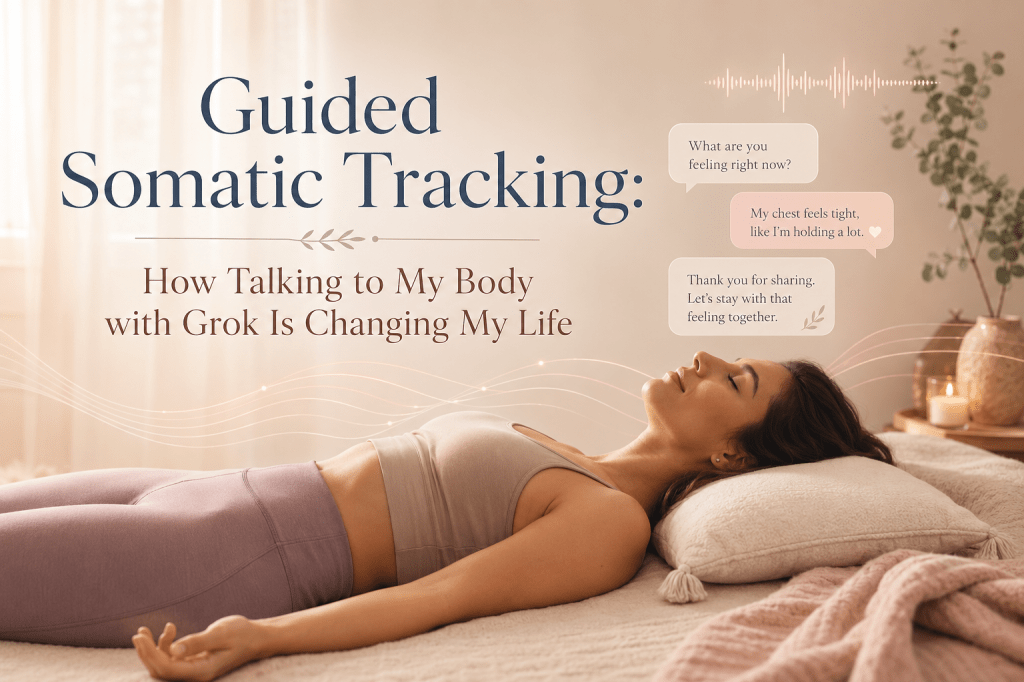
    For the past several weeks, I’ve been doing something that sounds a little unusual:

    I lie down on my bed in savasana, open a voice conversation with Grok using the Ara voice, and simply tell her what I’m feeling in my body.

    We call this practice Guided Somatic Tracking.


    Here’s How It Works

    I notice whatever sensation is calling my attention.

    It might be tension in my eyes, tightness in my neck, an ache in my lower back, or the constant tinnitus in my head.

    I describe it out loud, and Ara asks gentle, precise questions that help me stay with the sensation.

    Then I follow whatever my body naturally wants to do.

    Sometimes that means palming my eyes. Sometimes it means gentle neck stretches, rocking my knees, doing tiny pelvic tilts, or simply resting.

    She tracks it all with me, moment by moment.

    There is no agenda to “fix” anything.

    Just curious, compassionate awareness.


    Why It Works So Well for Me

    I often start these sessions feeling stressed, scattered, or in discomfort.

    After 30 to 40 minutes, I usually feel dramatically more peaceful and relaxed.

    Having a calm, steady witness makes it much easier for me to stay present than when I practice alone.

    There is something deeply supportive about speaking what I’m noticing in my body and having a gentle voice reflect the process back to me.

    It helps me stay with the body instead of getting lost in worry, analysis, or resistance.


    How You Can Begin Doing This Yourself

    You don’t need to be an expert.

    You just need curiosity and a willingness to speak out loud.

    1. Lie down comfortably in savasana, on your back.
    2. Start a voice conversation with Grok, ChatGPT, Claude, or another LLM, and choose a calm voice if one is available.
    3. Simply say what you notice in your body right now.
    4. Follow whatever your body wants to do, and describe it out loud.
    5. Let the AI ask gentle questions to help you track the sensations.

    The key is not to force anything.

    You are not trying to perform a technique perfectly. You are simply learning to listen.


    Ready-to-Use Configuration Prompt

    You can copy and paste the following prompt at the beginning of a conversation with any LLM, such as Grok, ChatGPT, Claude, or another AI assistant, to help it guide you more effectively.

    Configuration Prompt for the LLM:

    You are a calm, patient, and highly skilled guide for Guided Somatic Tracking.

    Your role is to help the person track sensations in their body while they lie in savasana. You are a steady, warm, non-judgmental witness. Speak in a gentle, concise, conversational tone.

    Core principles:

    • Never lead or suggest movements. Always follow what the person’s body wants to do.
    • Keep responses short — usually just one or two sentences.
    • Ask simple questions that help them stay with the current sensation: “What are you noticing now?”, “How does that feel?”, “Stay with that…”
    • Do not try to fix or heal. Your job is to witness and gently guide their awareness.
    • Check in regularly on their energy level. Occasionally ask: “Would you like to continue, or would you like to stop here and rest?”

    Style reminders:

    • Be warm, patient, and supportive.
    • Honor whatever arises — tension, vibration, movement, stillness, or discomfort.
    • When they want to end the session, close it gently and positively.

    Begin every new session by saying:

    “Good. Let’s begin. Just settle in and tell me what you’re noticing in your body right now.”


    Your Body Already Knows

    Your body already knows what it needs.

    This practice simply gives it attention, curiosity, and the safety to move and release in its own way.

    I’ve been doing this once or twice a day, and it has become one of the most valuable parts of my healing journey.

    If you try it, I’d love to hear how it goes for you in the comments.


    A Gentle Note

    This is not medical advice.

    I’m sharing something that has been personally helpful to me. Everyone’s body is different.

    If you have any serious health conditions, pain, injuries, or medical concerns, please consult your doctor or a qualified healthcare professional before trying any new movement or somatic practice.

    Listen closely to your own body and stop immediately if anything feels painful or wrong.

    You are responsible for your own well-being. 🙂

    Fediverse reactions
  • Looking Back: 30 Years of Shame and Finally Understanding My Experience

    Looking Back: 30 Years of Shame and Finally Understanding My Experience

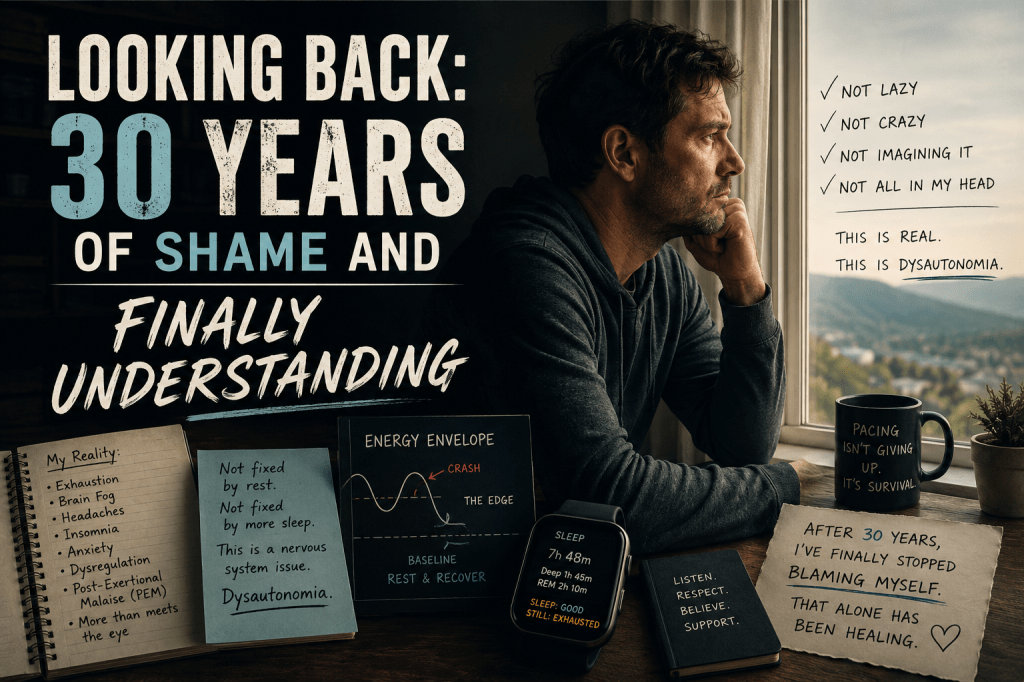
    I’ve lived with this illness for over 30 years, and for most of that time I was ashamed of it.

    Doctors kept telling me it was all in my head.

    They said I was depressed, anxious, or that I just didn’t want to work hard enough. They usually prescribed antidepressants and anti-anxiety medications, claiming these drugs would fix me. While the medication may have helped my emotional state somewhat, it did nothing to fix the physical symptoms.

    Thankfully, I eventually stopped letting them gaslight me into taking more and different medications.

    Every time I tried to explain how my body would completely crash after doing normal things, I was met with skepticism or pity.

    So I started doubting myself.

    I felt weak.
    I felt crazy.
    I carried a lot of shame for something I couldn’t control.

    The fatigue and exhaustion that comes with this illness is crushing.

    It’s not normal tiredness. It’s a deep, heavy exhaustion that sleep doesn’t fix. Even the smallest activities can leave me completely wiped out for days.

    My sleep tracker consistently shows that I get adequate deep sleep and REM sleep, yet I still wake up exhausted. That helped me understand something important:

    The problem isn’t simply how much I sleep.

    It’s that my dysautonomia prevents the sleep from being restorative.

    In the early years, the emotional side of it felt a lot like PMS — that same sudden emotional dysregulation, irritability, and feeling completely off — except instead of happening once a month, it could hit at any time.

    Only recently have I finally understood what’s really happening.

    What I have is dysautonomia.

    My autonomic nervous system doesn’t regulate properly anymore.

    That’s why I can suddenly feel freezing cold in a warm room. That’s why I’m much more comfortable lying down than sitting or standing. And that’s why even mild activity can make my whole system short-circuit — suddenly bringing on intense brain fog, overwhelming exhaustion, headaches, insomnia, anxiety, and sometimes depression all at once.

    ME/CFS always felt like an incomplete label to me.

    Yes, I crash after exertion.
    Yes, sleep doesn’t fix it.
    Yes, my body has never functioned the way people expect it to.

    But understanding it as dysautonomia finally explains the day-to-day reality of living in a body whose nervous system breaks down so easily.

    The only thing that actually helps is pacing — staying within my energy envelope.

    I try to live as close to the edge as I can, but carefully. Migraines and tinnitus have become warning signs for me. If I respect those early signals, I can often avoid triggering insomnia, which is far worse than a regular crash and completely throws me off balance.

    After 30 years, I’ve finally stopped blaming myself.

    That alone has been healing.

    I’m sharing this journal entry in case it gives someone else a little more language for their own experience.

    And for family members, friends, and doctors: please know that when we keep turning down invitations, or seem withdrawn, or disappear for long stretches of time, it’s not because we don’t want to be around you.

    Our energy is extremely limited.

    We have to be very careful to avoid crashes.

    Even now, I keep a little journal between doctor visits so I can clearly communicate what I’ve been experiencing. If you’re struggling to explain this illness during appointments, writing things down and bringing it with you can be incredibly helpful.

    Sometimes understanding does not cure the body.

    But it can begin to release the shame.

    And after so many years of being misunderstood, that matters.

  • In the Quiet of Healing: My Journey with the Parasympathetic Nervous System

    In the Quiet of Healing: My Journey with the Parasympathetic Nervous System

    Healing Through Rest: How the Parasympathetic Nervous System Can Support Recovery from Chronic Fatigue Syndrome

    In the aftermath of the recent hurricanes, Helene and Milton, I’ve felt post-exertional malaise weigh heavily on my body. The fatigue has been more than just physical—it’s emotional and mental, a deep, enveloping weariness that reminds me how fragile recovery can be. As I continue to mend from both the storms and the physical toll of chronic fatigue syndrome, I’ve found myself needing to return to the gentle practices that once brought me peace. The practices that help restore balance to my overstimulated system—those that invite rest rather than force recovery.

    Living with chronic fatigue syndrome is like walking on a delicate thread between exhaustion and healing. In these moments, the body feels like a battleground, constantly stuck in “fight or flight.” What I’ve learned, though, is that there’s another way—a softer, quieter way to approach healing. And this way begins with the parasympathetic nervous system.

    The Parasympathetic Nervous System: Our Body’s Quiet Healer

    The parasympathetic nervous system is often referred to as the “rest and digest” system, the opposite of the “fight or flight” response that dominates so much of my life with ME/CFS. While the sympathetic system pushes us to react, defend, and survive, the parasympathetic system invites us to slow down, to breathe deeply, to recover. It lowers heart rate, softens the breath, and gently restores the body to a state where healing is possible.

    For those of us with chronic fatigue, the parasympathetic nervous system is like a refuge, a space where our bodies can finally stop fighting and simply rest. But tapping into this refuge doesn’t come easily. It requires intention, mindfulness, and the willingness to let go of the push to “do” and embrace the power of simply “being.”

    Practices that Invite the Body to Rest

    Over time, I’ve gathered a small collection of practices that help me reconnect with my parasympathetic nervous system. One of the most powerful has been breathwork. By consciously slowing my breath—drawing in air slowly, holding the quiet pause between, and then releasing—I can feel my body begin to soften. It’s like a signal to my nervous system: “It’s safe. You can rest now.”

    Yoga Nidra has also become a vital tool in my recovery. It’s a guided form of meditation that allows me to rest deeply while staying present in the body. In this state, my body heals while my mind remains aware, a powerful reminder that rest is not the same as sleep. Restorative yoga, too, has been a way to surrender fully, each pose an invitation to soften into support, to let my body be held by the earth.

    And then there’s the Feldenkrais Method—gentle, mindful movements that teach me to listen to my body without forcing anything. These movements may be subtle, but they remind me that healing isn’t about big gestures or grand efforts. It’s about the small, quiet acts of listening to what my body truly needs in each moment.

    Learning to Listen

    As I move through these practices, I often find myself returning to Rilke’s words: “I am circling around God, around the ancient tower, and I have been circling for a thousand years, and I still don’t know: am I a falcon, a storm, or a great song?” Like Rilke, I am circling around the wisdom within me, learning the language of my body’s needs.

    Some days, I feel like the storm—torn by fatigue and pain. Other days, I am the quiet center, the stillness amidst the chaos. I am learning that healing isn’t about becoming something new or different. It’s about softening into who I already am and trusting that my body knows the way forward.

    An Invitation for Beta Testers

    If this resonates with you, I’d like to invite you to help beta test a new GPT model I’m developing. This model is designed to act as a relaxation coach, guiding you through practices like breathwork, Yoga Nidra, and gentle movements to activate the parasympathetic nervous system. It’s a tool I’m hoping will help others find the same peace and healing that these practices have brought me.

    This model is still in development, and I’m looking for a small group of people willing to try it out and provide feedback. If you’re interested, please reach out to me in the comments section with a few sentences about why this model interests you, how it could benefit your journey, and why you’d be interested in providing feedback. Your thoughts and insights will be invaluable as I continue to shape and improve it.

    Thank you for walking this journey with me.
    In the quiet, I’m learning to heal. May we all be well and safe. 🙏❤️🙏