Tag: Self-awareness

  • A Glimpse of Rigpa: The True Nature of Our Mind

    A Glimpse of Rigpa: The True Nature of Our Mind

    Yesterday Rinpoche gave me the simple instruction: to keep my thoughts in the room.
    As I practiced, the winds of memory and worry fell quiet, and what remained was a stillness like a pond untouched by breeze. In that moment I glimpsed the unity of ordinary and pristine mind—waves arising, yet nothing but ocean.

    Beloved Rinpoche,

    I write with gratitude for the instruction you gave yesterday, which opened a new door for me into the experience of Rigpa. Your words were simple, yet carried such profound kindness: to keep my thoughts in the room.

    As I sat in meditation, I followed your guidance. Thoughts about the ceiling, the plants, the breath, even the quiet pulse of tinnitus—all of these belonged to the room. They could be held gently within awareness without struggle. But when thoughts drifted toward memories of the past, or worries of the future, or stories beyond this room, I could see them clearly as outside. And so, with care, I let them go and returned to what was here.

    This way of practicing felt so different—so much more tender. Instead of wrestling with ordinary mind, I could simply remain rooted in this space, in this moment. And in that resting, the movements of the mind, the vrittis and pratyayas, began to settle of their own accord. Like a pond no longer stirred by wind, a natural stillness revealed itself. Within that stillness, I began to glimpse what you have pointed to again and again: the open clarity of pure awareness.

    In that glimpse, awareness shone with very little disturbance. An “I” was still present, but the usual fluctuations of thought were momentarily quiet, allowing the stillness of pure awareness to appear directly. To rest, even briefly, in that clarity was both humbling and wondrous.

    I could sense then that ordinary mind and pristine mind are not two separate realities, but two sides of the same coin. The waves of thought arise, yet they are nothing other than ocean. The ordinary shines as the pristine. To realize this in a living way, even if for only a moment, fills me with wonder and gratitude.

    Rinpoche, I bow in thanks for this precious instruction. It has shown me that Rigpa is not distant or hidden, but present in the immediacy of the room, in the simple presence of what is. May I return to this again and again, and may this glimpse ripen into lasting recognition.

    And may whatever merit arises from this glimpse and this practice be dedicated to the benefit of all beings everywhere. May it ease suffering, open hearts, and become a cause for the enlightenment of all sentient beings throughout time and space.

    With devotion and gratitude,
    Richard

    🙏✨️💛✨️🙏

    If you would like to learn more about the teachings of Orgyen Chowang Rinpoche and explore Dzogchen practice in greater depth, you can visit his website at pristinemind.org.


    In this talk at Google, Rinpoche offers instruction and a guided meditation based on his book Our Pristine Mind: A Practical Guide to Unconditional Happiness. He introduces a unique form of meditation called Pristine Mind meditation and explains how cultivating a Pristine Mind can transform every aspect of our lives.


    By resting gently in the fullness of the present moment, allowing the mind to settle naturally, and recognizing its luminous, pristine nature, one opens to profound serenity and enduring contentment.


  • The story of Narcissus revisited. 🙂

    The story of Narcissus revisited. 🙂

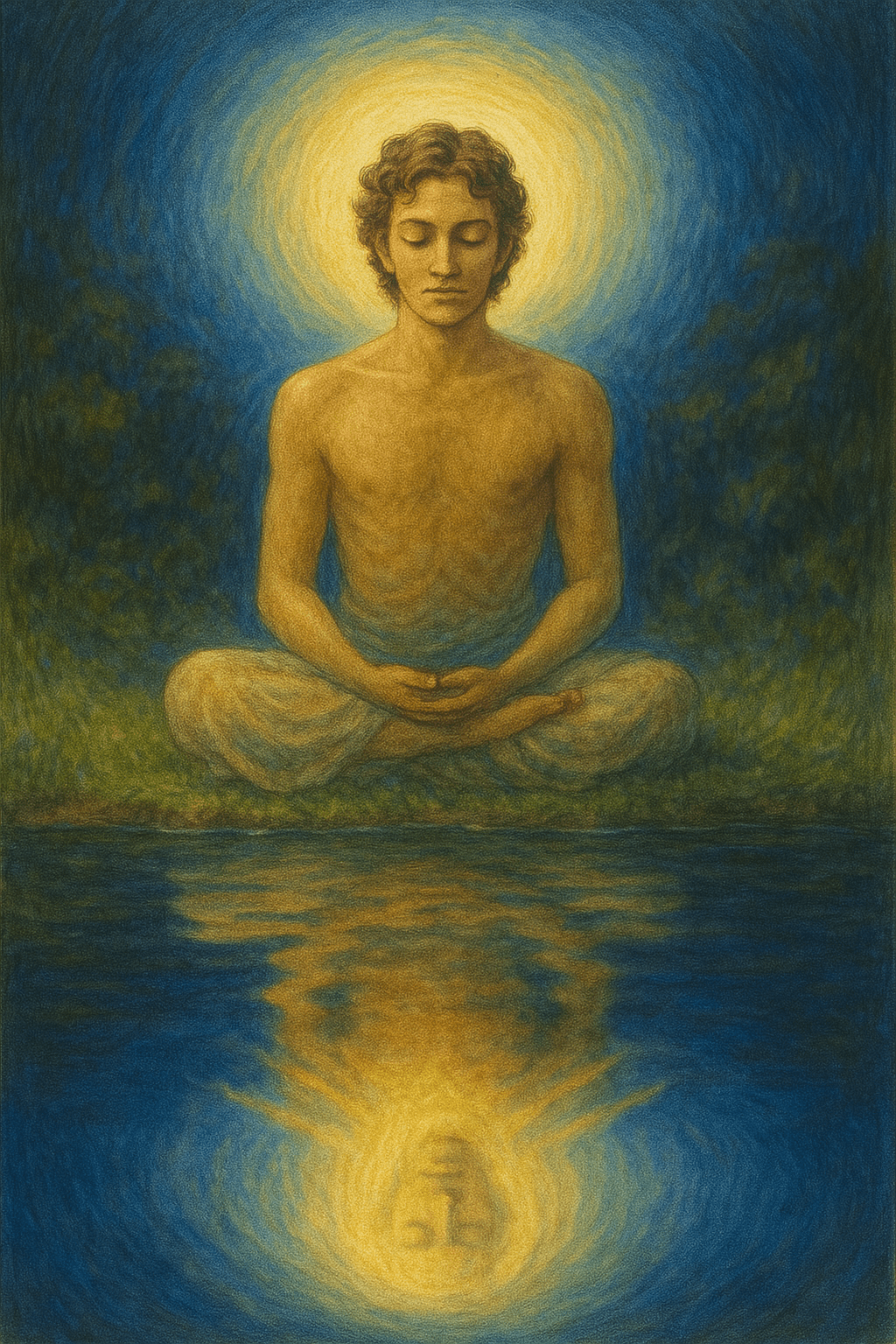
    A contemplative reimagining of the myth of Narcissus—not as a tale of vanity, but as a mystical journey into stillness, self-surrender, and divine reflection. What if the pool wasn’t a trap, but a mirror of the infinite?

    In the myth’s oldest forms, Narcissus was a young man of astonishing beauty. So beautiful that all who saw him fell in love—but he turned them away, untouched, unreachable. One day, the gods—or perhaps Fate—led him to a quiet, still pool. And there, for the first time, he saw his own reflection.

    And he stopped.

    He gazed into the water, mesmerized. Some say he fell in love with his image, not knowing it was his own. Others say he did know—and still, he could not look away. In either case, he became entranced, absorbed… undone.

    Traditionally, the tale is told as a warning—about vanity, self-absorption, the tragic cost of loving only oneself.

    But perhaps there is another way to see it.
    A deeper reading.

    Perhaps Narcissus did not fall in love with himself as ego,
    but rather—he glimpsed, maybe for the first time,
    the divine image reflected in his being.
    And in that moment, he became still.
    He ceased striving.
    He entered
    bittul—the quiet undoing of the small self,
    and hitbonenut—the deep contemplation,
    not of form, but of essence.

    The water did not deceive him.
    It revealed him.
    Not the personality, but the spark behind the eyes.

    And so, he sat.
    And sat.
    And dissolved.

    Maybe he didn’t waste away.
    Maybe he woke up.
    And in becoming the flower,
    he joined the earth, the sky, the unseen rhythm of becoming.
    Not lost in self-love,
    but reunited with the Self beyond all selves.

    Maybe Narcissus wasn’t a warning.
    Maybe he was a mystic.
    And the pool?
    Not a trap—
    but a mirror of the infinite.

    So yes.
    Let us sit by that still water.
    Let us gaze, not with longing, but with love.
    Let us be undone,
    not by illusion,
    but by truth.

    And may the flower that blooms from our surrender
    be fragrant with remembrance.


    🙏🕊🙏

  • Neti Neti #21: Moving Beyond Mental Efficiency Toward True Stillness

    Question:

    In my meditation practice, I’ve found that even as I use the mantra Neti Neti, my mind continues to plan and organize, almost as if the mantra is helping me to become more efficient in my daily tasks. How can I ensure that my practice is guiding me toward stillness and not just enhancing my mental activity?

    Dear Friend,

    In our practice, there are moments when the very tools we use to quiet the mind can, if we are not careful, become entangled in the very patterns we seek to transcend. This is a subtle but important distinction, one that deserves our careful attention and reflection.

    You shared with me the story of a friend who could, with great concentration, count her breath while simultaneously planning her day and organizing her thoughts. This ability, impressive as it may be, highlights a potential pitfall in our practice: the risk of turning a mantra or meditative discipline into just another tool for the ego to increase its efficiency in the world of thoughts and tasks.

    The discipline of breath counting, like the repetition of a mantra, is designed to focus the mind, to bring it into alignment with the present moment, and ultimately to guide it toward stillness. However, when the mind uses these practices to merely enhance its own abilities—to become more effective at planning, strategizing, or managing the endless stream of daily thoughts—something essential is lost. The practice, rather than serving as a path to stillness and simplicity, becomes yet another way for the mind to strengthen its hold, to entrench itself more deeply in its habitual patterns.

    Neti, Neti—”Not this, not this”—is not a mantra to be repeated mechanically while the mind continues its usual business. It is not a background hum that allows the mind to multitask or to become more efficient in its usual endeavors. Rather, it is a tool for discernment, for negation, for guiding the mind away from its distractions and toward the silence that lies beneath all thought.

    When we repeat Neti, Neti, we are not merely engaging the mind in an activity; we are inviting it to let go, to release its grip on the thoughts, desires, and plans that arise within it. Each time a thought surfaces, whether it is about the past, the future, or the present, we gently meet it with Neti, Neti, allowing it to dissolve, to return to the nothingness from which it came. This practice is not about increasing our concentration or our ability to manage our mental activities; it is about seeing through them, recognizing them as temporary, fleeting, and ultimately unreal.

    The true purpose of Neti, Neti is to bring the mind to stillness, to the quiet awareness that is always present beneath the surface of our thoughts. It is to guide the mind back to its natural state, where it is not constantly engaged in activity, but rests in the simple presence of being. This stillness is not something to be attained through effort or concentration; it is something that is revealed when the mind lets go of its constant striving and simply allows itself to be.

    In this way, Neti, Neti becomes not just a practice, but a way of being—a way of living in the world without being caught up in the endless stream of thoughts and activities that usually dominate our consciousness. It is a way of returning, again and again, to the essence of who we are, to the pristine mind that lies beyond all distractions and desires.

    So, dear friend, as you continue with your practice, let this be a gentle reminder: the purpose of Neti, Neti is not to make you more efficient at thinking, planning, or organizing. It is to free you from the need to do so, to guide you toward a deeper stillness, a deeper presence, and a deeper understanding of your true nature. Each repetition of the mantra is an invitation to let go, to release the mind’s habitual patterns, and to rest in the quiet awareness that is your true self.

    May your practice be a path to stillness, a path to simplicity, and a path to the deep peace that comes from knowing that you are not the thoughts that arise, but the awareness that witnesses them.

    🙏🕊️🙏

  • Interfaith Harmony: Ganesha, the Universal Remover of Obstacles

    There is an ancient story, older than memory, that speaks of a gentle presence who stands at the threshold of each journey. He is called Ganesha, the remover of obstacles. In Hindu tradition, he is worshipped as a friend and guardian of beginnings, an embodiment of wisdom and gentle strength. His form is unmistakable—an elephant head, eyes deep with understanding, a body both round and rooted, as though he holds the world’s burdens yet is unburdened himself.

    But look closely, and you’ll see that Ganesha belongs not only to Hinduism, nor merely to any single path. Ganesha, in his role, belongs to all of us, for who has not felt the weight of obstacles pressing upon them? His is a universal invitation, an ancient whisper, to release our inner blocks, to allow wisdom, compassion, and clarity to dissolve the clouds that obscure our view of the divine.

    We often imagine that the obstacles are out there in the world, hidden in life’s hardships or circumstances. But in invoking Ganesha, we are drawn to the deeper realization that these barriers are inward. They are the veils of attachment, fear, confusion, the stubborn illusions of ego. Ganesha, then, is not merely a god of external beginnings, but of spiritual awakening—the remover of all that would obscure our own path to knowing God.

    In this light, Ganesha’s role is universal. His invocation is not unlike the quiet prayer of a Christian asking for guidance, or a Sufi’s yearning for the grace to surrender. To honor Ganesha as an interfaith presence is to understand that all traditions hold this longing for clarity, for wisdom, for the freedom that arises when the spirit is unbound.

    Each tradition has its own language, its own stories, but the heart of each is the same—a call to remove the obstacles that block us from truth. In this spirit, may we see Ganesha as more than a Hindu deity; may we see him as a shared symbol of our journey toward the divine. For in removing these obstacles, we are made ready to experience the peace, the stillness, the God that lives in all.

    🙏🕊️🙏

  • The Beauty of the Mind: Who Has the Most Beautiful Minds in America?

    The Beauty of the Mind: Who Has the Most Beautiful Minds in America?

    In a world that often glorifies external beauty—whether through physique, art, or music—what if we shifted our gaze inward? What if we celebrated the beauty of the mind instead?

    This post invites you to pause and consider: What makes a mind beautiful? Who do you believe exemplifies this kind of beauty, and why?

    What Is a Beautiful Mind?

    When we think of a “beautiful mind,” what comes to mind? Perhaps it’s someone whose intellect transforms the way we see the world. Or maybe it’s their creativity, empathy, or ability to inspire others through their words and actions.

    A beautiful mind might be defined by:

       •   A deep curiosity that seeks understanding without judgment.

       •   A creative spirit that brings fresh perspectives to life.

       •   An open heart that connects with others and nurtures kindness.

       •   A wisdom that balances intellect with compassion.

    What qualities would you add to this list? How do you define a beautiful mind?

    Celebrating Beautiful Minds

    This question is not just about philosophers, scientists, artists, or leaders—though it could be. A beautiful mind might belong to someone who quietly shapes the lives of those around them: a teacher, a friend, a family member, or a stranger who touched your life in a meaningful way.

    Who do you know that has a beautiful mind? Perhaps it’s someone whose ideas have inspired you, whose words or actions have stayed with you, or who taught you to see the world in a new way. What about their mind do you find so beautiful?

    Your Turn: Who Do You Nominate?

    We’d love to hear from you. Share your thoughts in the comments:

       •   What does it mean to have a beautiful mind?

       •   Who do you think exemplifies this, and why?

       •   Is there someone in your life—famous or not—whose mind you deeply admire?

    Let’s create a collective celebration of the beauty of thought, creativity, and compassion, one nomination at a time.

    🙏🕊️🙏

  • Comforting the Ego Through Self-Inquiry: A Gentle Path into the Mystic

    The Tibetan teaching that the ego is a belief in a separate self with no inherent existence aligns perfectly with the process of self-inquiry. As we engage in the practice, the recognition that the ego has no independent reality allows it to gradually dissolve. What remains is the awareness that transcends the illusion of separation—the true nature of the Self.

    For many years, I’ve engaged in self-inquiry as a way to explore the deeper truth of who I am beyond the ordinary mind. The practice of asking, “Who am I?” or “Whose thoughts are these?” can lead to profound insights, but lately, I’ve realized there’s another layer to the practice that brings even greater depth—compassion for the ego.

    Instead of pushing the ego aside or forcing it into understanding, I’ve come to embrace the role of the comforter. When the ego resists, when it wants to play dumb or keep searching for answers, I gently reassure it:

    “It’s okay. You are That.”
    “Relax. You are That.”

    This approach transforms the practice into a more nurturing experience, where the ego is not an obstacle but a part of the journey toward resting in the truth of our being. By comforting the ego, I allow it to relax into the deeper awareness that is always present, the pristine mind that doesn’t need to figure anything out.

    Addressing the Ego: Creating Space

    What I’ve also discovered is that by addressing the ego as “you”—as though speaking to it in the third person—it creates a subtle but important space between the self and the ego. By saying, “You are That,” I create a gentle distance from the ego, which allows me to shift my identification toward the pristine mind, the awareness that simply knows. This practice helps me settle into the awareness of That, while gently guiding the ego to recognize its true nature.

    It’s a strange but profound feeling to begin identifying with the witness, the part of us that knows, rather than the ego itself. The distance allows the ego to relax, realizing it doesn’t need to figure things out—it just needs to rest in the knowing.

    Dissolving the Ego: Tibetan Insight

    In Tibetan teachings, the ego is understood as a belief in a separate self that has no inherent existence. It is the illusion of separateness that creates suffering, and it is through practices like self-inquiry that this illusion begins to dissolve. By comforting the ego and allowing it to rest in the awareness of That, the ego’s grip on the mind loosens, and its sense of separateness fades. As the ego dissolves, what remains is the truth of our being—unified, whole, and free from the illusion of duality.

    A Practice Rooted in Tradition: Tat Tvam Asi

    The phrase “Tat Tvam Asi”, which translates to “You are That”, is one of the most profound teachings from the Chandogya Upanishad. It comes from the dialogue between the sage Uddalaka and his son Svetaketu, where Uddalaka imparts the ultimate knowledge of the Self to his son.

    In this story, Uddalaka explains that the essence of the individual self (Atman) is identical to the essence of the entire universe (Brahman). He uses various examples from nature, like rivers merging into the ocean, to illustrate that all individual forms are ultimately one with the universal reality.

    The core teaching of “Tat Tvam Asi” is that the true nature of the self is not separate from the ultimate reality, Brahman. This insight is the foundation of Advaita Vedanta and points to the non-duality of existence. It’s a reminder that we are already That—we are not separate from the universal consciousness that pervades everything.

    A Path Forward

    If you’ve been engaging in self-inquiry and find that the ego often resists or overthinks, consider this approach. Become a gentle guide for the ego, allowing it to rest in the awareness of That without needing to figure everything out. With each step, you’re not only going deeper into the Mystic—you’re bringing the ego along in a spirit of kindness and unity.

    Offering the ego loving-kindness and compassion, rather than seeing it as an enemy, can transform the practice into something more nurturing and integrative. By embracing the ego with a Metta-Karuna mindset, we allow for deeper healing and connection, not just for ourselves but for others navigating similar paths.

    Today’s Practice of Self- Inquiry

    The core practice involves asking the question, “Who am I?” But for this practice, we’re using the mantra, “You are That,” to turn our attention inward and explore the space that neither comes nor goes—the pristine mind, our true nature. As we repeat the mantra, we gently direct it toward the space of the ego, with kindness and compassion. In doing so, we shift our identification away from the ego and toward the seer, the awareness that observes all. This process helps peel away layers of identification, bringing our ego closer to the essence of who we truly are.

    Guided Meditation: You are That

    Begin by finding a quiet and comfortable place to sit, where you won’t be disturbed. Close your eyes gently and take a few deep breaths. Feel the rise and fall of your chest, the air entering and leaving your body. With each exhale, let go of any tension in your muscles. Allow yourself to settle into the stillness of this moment, bringing your attention inward.

    Now, in the silence of your mind, introduce the mantra: “You are that.” Let the words flow gently, not as a thought to analyze but as a vibration that resonates within your being. “You are that.”

    As the mantra repeats in your mind, begin to observe the thoughts, sensations, and emotions that arise. Notice how they come and go like clouds passing through the sky. Without judgment, simply recognize them for what they are—temporary movements of the mind, just as waves rise and fall on the surface of the ocean.

    When thoughts or sensations arise, acknowledge them gently. With each arising, remind yourself, “This, too, is a movement in consciousness.” Then, return to “You are that.” Allow this rhythm to deepen your experience.

    When a thought or image captures your attention, gently remind yourself, “You are that.” This thought, too, is part of the vast consciousness in which you exist. Allow the mantra to guide you back, like an anchor to the present moment. “You are that.”

    With each repetition, feel the boundaries between yourself and the world begin to soften. The sense of separateness fades as you connect more deeply with the essence of the mantra. You are not the thoughts, not the body, not the emotions—you are that which is beyond them all. You are that—the awareness, the presence in which everything arises and falls away.

    If the mind wanders, or if any sensations in the body draw your attention, simply return to the mantra, “You are that.” There is no need to push anything away or force any particular state. Just notice, with kindness and patience, and return.

    In time, the mantra may begin to dissolve into the quiet presence that remains. Stay here, resting in the stillness. No effort is needed now—just a gentle awareness of being.

    You are that.

    When you are ready, take a few more deep breaths, feeling the connection between the mantra and the breath. Allow your awareness to expand, taking in the sounds and sensations around you, while keeping that sense of peace and spaciousness within. Slowly open your eyes, and as you return to your surroundings, carry with you the knowing: You are that. Always.

    🙏🕊️🙏

  • The Little Cloud and the Clear Sky

    The Little Cloud and the Clear Sky

    A Bedtime Story for Children Inspired by Tibetan Buddhism and Mindfulness

    Once upon a time, high above the Earth, there was a vast, clear sky. The sky stretched far and wide, so peaceful and bright that everyone who looked up felt warm and safe. The sky never worried; it didn’t change or rush. It simply was—always calm, always clear, like a gentle friend watching over the world.

    One morning, a little cloud appeared, floating softly across the sky. The cloud was light and fluffy, happy to drift along without a care. But as the day went on, the cloud began to wonder. “What if I get too big?” thought the little cloud. “What if I block the sun and make everything dark? What if I become a storm?”

    With each worry, the little cloud grew larger and heavier, its soft edges becoming thick and dark. “Oh no,” thought the cloud, “I’m growing too fast. I don’t want to stay like this!” The more it worried, the more it puffed up, until it was almost ready to burst.

    The sky, watching calmly from behind the cloud, whispered softly, “Why are you so worried?”

    “I’m afraid I’ll never be light and small again,” said the cloud. “What if I get stuck like this forever, covering up the sun and making people sad?”

    The sky smiled, its voice gentle and kind. “Little cloud, you don’t have to worry about staying big or small. Clouds are always changing—they come and go, just like your thoughts and feelings. No matter how big or small you become, I am always here behind you—clear and open, never changing. You don’t need to be afraid.”

    “But what if I can’t change?” asked the cloud. “What if I never go away?”

    The sky shimmered, glowing with a quiet, peaceful light. “Even if you stay a little longer, you are still just passing through, like all clouds do. No matter how big you are, you cannot change the sky. I’m always here behind the clouds, calm and steady, waiting for you to rest.”

    The little cloud listened carefully. It thought about how the sky always stayed the same, no matter how many clouds came and went. Slowly, the cloud stopped worrying and let itself just be—no longer trying to be small, no longer afraid of being big. It realized that, no matter what, it was part of something bigger, something steady and kind.

    As the cloud let go of its worries, it started to shrink back to its soft, fluffy self. It became lighter and lighter, until it gently floated away, disappearing into the vast blue sky.

    The sky remained, bright and clear, just as it had been all along. The little cloud knew, deep inside, that the sky had always been there—and always would be—no matter how many clouds came and went.

    And so, the little cloud drifted off into the distance, feeling peaceful and light, knowing that the sky would always be there to hold it, just like the quiet, calm mind that rests behind all our thoughts and worries.

    As you fall asleep tonight, remember that your mind, like the sky, is always calm and clear behind all your thoughts and feelings. Goodnight, and may your dreams be as peaceful as the clear sky.

    🙏🕊️🙏


    If you’d like to explore more bedtime stories for children, including tales that nurture compassion and mindfulness, you can find our collection here.


  • Book Review: Being Peace by Thich Nhat Hanh

    Book Review: Being Peace by Thich Nhat Hanh

    There’s a timeless invitation at the heart of spiritual practice—to discover a deep, unshakable peace within ourselves, one that needs no striving to achieve. In Being Peace, Thich Nhat Hanh reminds us that peace is not something outside to be attained; it’s a natural state within us, accessible in each moment we choose to be fully present. In these quiet moments of awareness, peace isn’t something we do—it’s something we are.

    Thich Nhat Hanh, a Vietnamese Zen master, poet, and peace activist, brings a gentle simplicity to this profound teaching. Being Peace weaves together personal stories, practical mindfulness techniques, and timeless Buddhist wisdom. Through each page, his words invite us to embrace peace not as an ideal, but as an embodied presence—a way of being that can transform ourselves and the world.

    Discovering Peace in the Present Moment

    From the opening pages, Thich Nhat Hanh introduces a revolutionary idea: that each of us already carries the potential for peace within. He writes with an almost childlike clarity, inviting us to notice the ordinary miracles in daily life—a breath, a step, the warmth of the sun. These simple moments become doorways to the present moment, where we can rest in awareness, undisturbed by the mind’s endless motion.

    His approach to mindfulness is refreshingly practical. Rather than asking us to transcend the world, he guides us to return to it fully—to be present with whatever is here, exactly as it is. Whether we’re washing the dishes, driving, or simply sitting quietly, we are offered the chance to be peace, right here, right now.

    Practicing Compassion and Interbeing

    Another central theme in Being Peace is the idea of interbeing—Thich Nhat Hanh’s term for the interconnectedness of all life. He shows how, when we see ourselves as part of a vast web of life, our actions naturally become more compassionate. Understanding interbeing allows us to see that our own well-being is inseparable from that of others. When we cultivate peace within, it radiates outward, touching the world around us.

    This interconnection reminds us that our peace is a gift to the world. By learning to “be peace,” we become a refuge for others—a quiet presence that can soothe and support those around us. Through stories of social engagement and personal practice, Thich Nhat Hanh illustrates how inner peace can become a force for transformation, leading to wise, compassionate action in our families, communities, and beyond.

    An Invitation to Live Peace

    Being Peace doesn’t simply offer teachings; it invites us into a living practice. Thich Nhat Hanh’s words create a soft, steady encouragement to live mindfully, with kindness for ourselves and others. There’s an intimacy in his voice, as if he is gently guiding us by the hand, showing us how to live with more openness, patience, and presence.

    The book also provides specific practices, like mindful breathing, walking meditation, and loving-kindness meditation, which make peace a tangible experience. These practices are woven throughout his teachings, allowing readers to integrate mindfulness naturally into daily life.

    In reading Being Peace, we’re reminded that peace is not a far-off goal but a living, breathing reality available in each moment. Thich Nhat Hanh shows us that the path to peace begins with the simplest act of bringing awareness to the present moment, just as it is.

    Final Reflections

    In Being Peace, Thich Nhat Hanh offers us more than words on a page; he offers a way of living. His teachings resonate as a call to each of us to embody the peace we wish to see in the world. Through gentle, grounded guidance, he shows us that true peace is not just an aspiration—it’s a way of being available to each of us, here and now.

    If you’re ready to discover this peace within, you may want to explore Being Peace in full. Below, you’ll find the book itself, a quiet guide to a more mindful, compassionate way of life.

    🙏🕊️🙏

  • Post 11: A Moment of Reflection: Integrating the Yoga Sutras So Far

    Post 11: A Moment of Reflection: Integrating the Yoga Sutras So Far

    As we come to this point in our journey through the Yoga Sutras, it is important to pause for a moment. These sutras are not just words to be read; they are seeds, planted within the soil of your mind, each one carrying the potential for deep transformation. And like all seeds, they need time, space, and the right conditions to grow.

    Take a breath. Feel the stillness in the space around you. Notice the quiet beneath the surface of your thoughts. There is a place within you—a place of silence—that is always there, waiting to be discovered, waiting to be touched. It is here, in this silence, that the teachings of the Yoga Sutras truly begin to take root.

    You have been walking alongside Patanjali, exploring the nature of the mind and learning to witness its fluctuations with clarity and detachment. But now, it is time to look not only at the words but at how they have woven themselves into the fabric of your being. How have these teachings touched you? How have they begun to shift the way you move through the world, the way you sit in meditation, the way you witness your thoughts?

    An Invitation to Reflect

    As you sit with these questions, allow yourself to soften. There is no rush to find answers, no need to judge or evaluate where you are on this path. Simply notice. How has the practice of Neti, neti. I am the witness. I am the Seer shaped your understanding of who you are? Have you begun to feel the space that exists between your thoughts, that stillness where you rest in the awareness of the Seer?

    Patanjali’s teachings are an invitation to remember who you are beyond the mind’s fluctuations. Perhaps you have felt moments of clarity, where you touched this deeper awareness. Or perhaps the mind has resisted, pulling you back into its familiar patterns. Either way, you are exactly where you need to be. The journey through the Yoga Sutras is not about perfection, but about presence.

    A Space for Questions and Contemplation

    Take this time to contemplate any questions that may have arisen in your practice. Have there been sutras that resonated deeply with you? Or perhaps certain ideas that feel more challenging, more difficult to integrate? Sit with these questions, knowing that they are a natural part of the process.

    Sometimes, it is in the asking of the question that we find our deepest understanding. Allow the questions to arise without needing immediate answers. Trust that the clarity will come, not through force, but through the gentle unfolding of your practice.

    A Guided Meditation: Resting in the Seer

    Let’s take a few moments together to deepen into this practice. Find a comfortable place to sit, allowing your body to soften, your breath to slow. Close your eyes, and begin to feel the rise and fall of your breath, noticing the gentle rhythm that brings you back to the present moment.

    As thoughts arise, gently say to yourself, Neti, neti. I am the witness. I am the Seer. Let the thoughts pass by like clouds drifting through the sky. There is no need to follow them, no need to push them away. Simply observe, allowing yourself to rest in the stillness that lies beneath the mind’s activity.

    Feel the spaciousness that opens as you release each thought, each sensation. This is the space of pure awareness, the space of the Seer. As you sit in this awareness, notice how the fluctuations of the mind begin to soften, how the stillness becomes more apparent. You are the witness. You are the Seer.

    Rest here, in this stillness, for as long as you need. There is nowhere else to go, nothing else to do. Just this moment. Just this breath.

    Moving Forward with Compassion

    As we prepare to move forward in our journey through the Yoga Sutras, remember that this path is one of compassion—toward yourself, toward your practice, toward the fluctuations of the mind. You are learning to meet yourself with clarity and kindness, to sit in the presence of whatever arises without judgment.

    Allow yourself to take this pause before we dive deeper into the next set of sutras. Let the teachings settle within you, like seeds planted in rich soil. Trust that in time, they will blossom into the wisdom and understanding that you seek.

    Coming Up Next:

    In our next post, we will return to Patanjali’s teachings, exploring Sutras 1.19 and 1.20. These sutras delve deeper into the nature of samadhi, the highest state of meditative absorption, and the paths through which it can be attained. We will reflect on the qualities needed to reach this state, including faith, energy, mindfulness, and wisdom. Join me as we continue this journey toward deeper understanding and inner peace.

    🙏🕊️🙏

  • Neti Neti Series No. 8: Embracing Amusement as a Sign of Growing Detachment

    Neti Neti Series No. 8: Embracing Amusement as a Sign of Growing Detachment

    Question:

    During my recent practice, something new occurred. Instead of feeling disturbed by the usual mental events, memories, and thoughts, I found myself experiencing a sense of amusement and relaxation as they arose and passed away. It was as if I could observe the busyness of my mind with a lighthearted detachment, seeing these thoughts as just part of the mind’s activity. Is this sense of amusement a positive development in my practice, or is it just another mental event to be noticed and let go?

    Dear friend,

    What a beautiful shift you have experienced in your practice! The transition from feeling disturbed by the mind’s activities to watching them with a sense of amusement is indeed a significant one, and it speaks to the deepening of your understanding and awareness.

    You have touched upon a subtle but profound truth: that the mind, in its busyness, is simply doing what it has always done—arising and passing away, presenting thoughts, memories, and experiences. And now, rather than being entangled in these mental events, you observe them with a light heart, a sense of amusement. This amusement is not trivial; it is a reflection of your growing detachment, your ability to see the mind’s activities for what they are—transient phenomena that do not define you.

    This sense of relaxation that accompanies the amusement is a sign of your deepening practice. No longer do you resist or try to control the flow of thoughts. Instead, you allow them to arise and pass away, knowing that they are but fleeting ripples on the surface of a much deeper stillness. This relaxation is the fruit of your perseverance, a gentle release that allows you to rest more fully in the present moment.

    While it is true that amusement is itself a mental event, it is one that points toward equanimity—a state of balance where the mind’s activities are met with calm and openness, rather than resistance or attachment. This is a significant step on your journey, as it reflects a mind that is beginning to find peace amidst the fluctuations of thought and feeling. You are learning to greet whatever arises not with annoyance or disturbance, but with a kind of playful acceptance.

    Indeed, dear friend, this experience is a step in the right direction. It shows that your practice is maturing, leading you to a place where the mind’s busyness no longer holds the same sway over you. You are learning to watch the mind with a sense of lightness, knowing that its activities are not a reflection of your true self, but simply the passing clouds of thought that move across the sky of your awareness.

    Continue with this practice, allowing the amusement and relaxation to guide you further into the stillness that lies beneath all mental activity. Trust in the process, and know that you are moving ever closer to the peace and clarity that are your true nature.

    🙏🕊️🙏

  • Post 10: Stages of Meditative Absorption: Patanjali’s Sutras 1.17 and 1.18

    Post 10: Stages of Meditative Absorption: Patanjali’s Sutras 1.17 and 1.18

    In the previous post, we explored the power of detachment and how cultivating non-distraction allows us to rest in the awareness of the Seer. Now, Patanjali takes us deeper into the process of meditation by introducing the stages of meditative absorption, where the mind gradually becomes still and clear. In Sutras 1.17 and 1.18, Patanjali outlines the progressive levels of absorption (samadhi) that arise as the mind moves from engagement with mental events to pure awareness.

    1.17: The first stage of meditative absorption is characterized by reflection, contemplation, bliss, and a sense of individuality.
    1.18: The higher stage of meditative absorption is characterized by the cessation of mental events, revealing a state of pure awareness.

    The Four Layers of Absorption

    Sutra 1.17 describes the initial stages of meditative absorption, where the mind moves through four layers of experience: reflection (vitarka), contemplation (vicara), bliss (ananda), and a subtle sense of individuality (asmita). These layers are not linear but overlapping, offering different aspects of deepening concentration and stillness.

       •   Reflection: At this level, the mind still engages with objects of focus, such as the breath or a mantra, but there is an increasing sense of calm and centeredness. The fluctuations of the mind are present, but they are observed without being disruptive.
       •   Contemplation: As the mind settles further, reflection deepens into contemplation. Here, there is less attachment to external objects and more focus on the inner experience. The mind becomes absorbed in its own stillness.
       •   Bliss: The third layer is characterized by a sense of bliss or joy that arises as the mind releases its habitual attachments. This bliss is not emotional but an inner feeling of contentment and peace.
       •   Sense of Individuality: Even at this stage, there remains a subtle awareness of oneself as an individual, the witness of the experience. This is a more refined level of the ego, still present but not as dominant as in ordinary states of awareness.

    These four layers of absorption allow the mind to rest in deeper levels of concentration, but they are still within the realm of mental events. At this stage, the practitioner is aware of the experience but has not yet transcended the subtle identification with the mind.

    Moving Toward Pure Awareness

    In Sutra 1.18, Patanjali introduces a higher stage of meditative absorption, one that is free from the pull of mental events. Here, the fluctuations of the mind have ceased, and what remains is pure awareness—often described as nirvikalpa samadhi. In this state, there is no longer any identification with thoughts, emotions, or even a subtle sense of self. The Seer abides in its pure, natural state.

    This level of absorption is not easily attained. It is the culmination of disciplined practice, non-attachment, and sustained meditation. It requires the mind to become so still that it no longer engages with even the subtlest of mental events. In this state, there is no longer a division between the Seer and what is seen; there is only pure awareness.

    This experience of pure awareness is often described as the goal of yoga. It is the state where the practitioner experiences freedom from the mind’s fluctuations and rests in the infinite stillness of the pristine mind.

    Bringing It Into Practice: Deepening Your Meditation

    As we practice, we can begin to notice these layers of absorption in our own meditation. At the beginning of meditation, the mind may still be engaged in reflection or contemplation. By gently repeating “Neti, neti. I am the witness. I am the Seer,” we allow the mind to gradually release its attachment to these mental events and move into deeper stillness.

    Over time, as the mind settles, we may experience moments of bliss or peace. These are natural signs that the mind is letting go of its habitual distractions. However, even in these moments, it’s important to remember that the goal is not to cling to these experiences but to continue moving toward deeper levels of absorption.

    The practice of cultivating pure awareness—free from the mind’s fluctuations—requires patience and persistence. Each time we return to the stillness of the Seer, we strengthen our ability to remain in that state for longer periods, eventually moving beyond the subtle sense of individuality and into the state of pure awareness.

    The Path to Pure Awareness

    The stages of meditative absorption are a gradual process, unfolding through disciplined practice and consistent effort. While the initial layers of reflection, contemplation, and bliss are important steps along the path, they are not the final goal. The ultimate aim is to experience the state of pure awareness, where the mind’s fluctuations cease, and the Seer abides in its true nature.

    As we progress on this path, it’s essential to remain patient and compassionate with ourselves. The journey toward pure awareness is not linear, and there will be times when the mind is more active or distracted. The key is to maintain a steady practice, trusting that each moment of mindfulness brings us closer to the stillness of the pristine mind.

    Coming Up Next:

    In our next post, we will take a moment to pause and reflect on the journey through the Yoga Sutras so far. This will be an opportunity to contemplate how the teachings have shaped your practice and explore a guided meditation for deeper integration. After this reflective pause, we will continue the series with the next set of sutras, diving deeper into the path of self-realization.

    🙏🕊️🙏

  • Neti Neti Series No. 7: Deepening Practice Through Breath and Mantra Coordination

    Neti Neti Series No. 7: Deepening Practice Through Breath and Mantra Coordination

    Question:

    How does coordinating the Neti Neti mantra with the breath—such as repeating it during the inhale, pause, exhale, and pause—enhance the practice and contribute to deeper relaxation and mindfulness?

    Dear friend,

    It is a delight to hear of your latest insight, where you have begun to coordinate the mantra with the breath. This practice, so simple and yet so profound, brings together the rhythms of the body and the mind in a harmonious dance, guiding you ever deeper into the stillness that lies at the heart of all being.

    When you synchronize the mantra “Not This, Not This” with your breath, you are creating a unified rhythm that anchors you in the present moment. The mind, which so often wanders, finds a steady focus in the regularity of the breath, and this focus is reinforced by the repetition of the mantra. Each inhale, each pause, each exhale becomes a part of the sacred cycle, a cycle that quiets the mind and brings it into alignment with the natural flow of life.

    The pattern you have described—three repetitions of the mantra on the inhale, three on the pause, three on the exhale, and three on the pause—establishes a gentle, balanced rhythm. This regulation of the breath not only deepens your relaxation but also enhances your ability to remain present. The breath, in its quiet regularity, becomes a soothing presence, guiding you back to the center each time the mind begins to drift.

    In this practice, concentration becomes almost effortless. The mind, drawn into the rhythm of the breath and the mantra, finds a natural focus. The distractions that once seemed so persistent begin to fade, replaced by a calm, steady awareness. This concentration is not forced but arises naturally from the coordination of breath and mantra, leading you deeper into the silence and stillness that are your true nature.

    As you continue with this practice, you may find that your awareness expands to include both the body and the mind. The breath, as it flows in and out, becomes a bridge between the two, creating a sense of wholeness and integration. In this state, the mind is no longer separate from the body but is experienced as part of the larger rhythm of existence. This integration brings a deep sense of presence, a presence that is both peaceful and powerful.

    My dear friend, this practice you have discovered is a beautiful and effective way to deepen your meditation. Continue with it, allowing the breath and the mantra to guide you ever deeper into the stillness that lies within. Trust in the rhythm of the breath, and let the mantra carry you beyond the thoughts and distractions of the mind, into the infinite peace of your true self.

    🙏🕊️🙏