Tag: contemplative Christianity

  • Awakening Happens Two Ways: Like Lightning, or Like Dawn

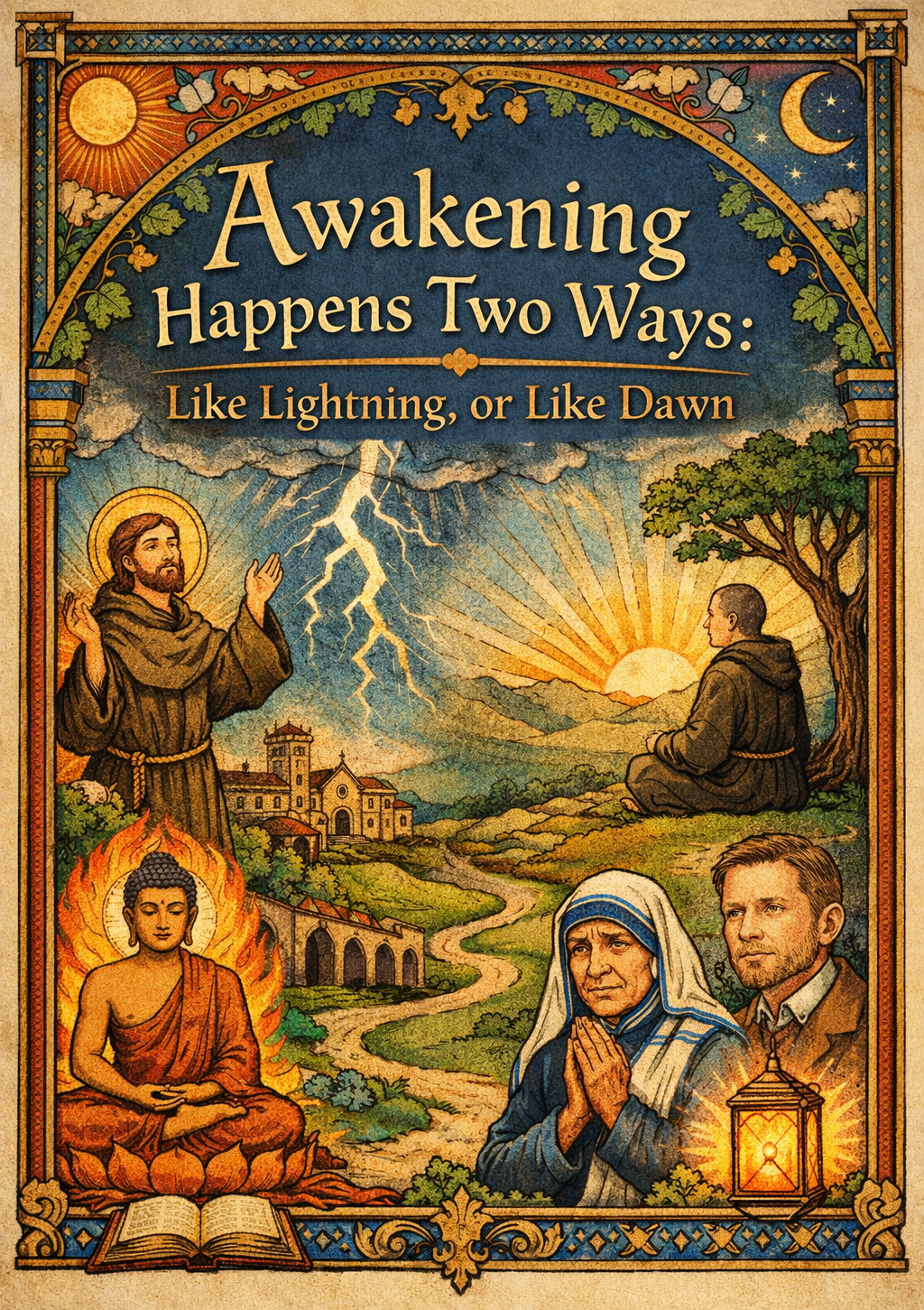
    Awakening Happens Two Ways: Like Lightning, or Like Dawn

    Sudden illumination and the slow work of becoming whole

    Into the Mystic is a contemplative reflections series exploring awakening, stability, and the quiet path of inner transformation in ordinary life.


    Introduction: Two Movements of Awakening

    In the landscape of spiritual life, two great patterns appear again and again: the gradual path and the lightning path.

    One unfolds slowly through prayer, discipline, contemplation, and steady inner work. The other arrives suddenly, as if grace breaks through without warning and changes the whole direction of a life in an instant.

    These are often described as opposites.

    But perhaps they are not opposites at all.

    Perhaps they are two movements within the same mystery.


    The Gradual Path

    The gradual path is the way of cultivation. It is the slow shaping of the soul through daily practice. It is the monk returning to prayer. The meditator returning to the breath. The seeker returning again and again to silence, surrender, and truth.

    In Buddhist language, this is the long training of mind and heart. In Christian contemplative language, it is the patient deepening of humility, purification, and love.

    Saint Teresa of Ávila offers one of the clearest examples of this gradual unfolding. Her spiritual life matured through years of prayer, struggle, refinement, and increasing interior depth. The soul, in her vision, is not transformed instantly, but led inward through many chambers, many purifications, many deepenings of surrender.

    Likewise, the Buddha’s awakening, though realized in a decisive moment beneath the Bodhi tree, was preceded by years of seeking, discipline, renunciation, and contemplative effort.

    The flowering may appear sudden.

    But the roots often grow in darkness for a very long time.


    The Lightning Path

    And yet there is also the lightning path.

    This is the path of abrupt transformation. The sudden reversal. The moment when the old self is pierced and something entirely new begins.

    It is not always earned in any neat or linear way. It may come through suffering, illness, loss, beauty, grace, or some inward rupture that breaks the ordinary structure of identity.

    Saint Francis of Assisi seems to belong, at least in part, to this lightning pattern. His early life was not one of long monastic preparation. His conversion appears to have been catalyzed through crisis: illness, war, captivity, disillusionment, and the collapse of the worldly ambitions he once cherished.

    Something broke open in him.

    The man who had been oriented toward status and recognition turned instead toward poverty, simplicity, love, and radical devotion.

    His life did not merely improve.

    It changed direction.


    Sudden Awakening, Gradual Integration

    This pattern appears across many traditions.

    Ramana Maharshi described a sudden awakening that began with a profound confrontation with death in his youth.

    Eckhart Tolle has written about a dramatic inner shift following a period of deep psychological suffering, when the ordinary sense of self seemed to dissolve into a profound stillness.

    Yet what is often overlooked is what came after.

    Tolle spent years living very quietly, often sitting on park benches, allowing his life to slowly reorganize around what he had experienced.

    The awakening may have been sudden.

    The embodiment was gradual.

    Here again we see the same rhythm:

    Lightning followed by integration.


    Faithfulness Without Consolation

    Mother Teresa’s life reflects another variation of this same pattern.

    Her decisive vocational turning — sometimes described as a profound interior call to serve the poorest of the poor — carries the character of a lightning moment.

    Yet what followed was not constant spiritual consolation, but decades of interior dryness, what the Christian mystical tradition calls a dark night of the soul.

    Despite this, she continued her work with remarkable faithfulness.

    Her life suggests something subtle but important:

    Awakening is not always accompanied by pleasant experience.

    Sometimes the lightning clarifies direction, but the gradual path becomes one of love without emotional reinforcement.

    In this way, both the sudden opening and the long endurance that follows become part of the same spiritual maturation.


    The Deeper Pattern

    If we look across these lives — Francis of Assisi, Teresa of Ávila, the Buddha, Ramana Maharshi, Mother Teresa, and Eckhart Tolle — a pattern begins to emerge.

    Some lives begin with discipline and flower into breakthrough.

    Others begin with breakthrough and spend years learning how to live what was revealed.

    Most contain both movements.

    Perhaps this is because awakening is not an event but a relationship.

    A relationship between grace and participation.

    Between what is given and what is lived.

    Zen expresses this beautifully:

    Enlightenment is an accident. Practice makes us accident-prone.
    Shunryu Suzuki Roshi

    We do not command grace.

    We prepare ourselves.
    We consent.
    We practice.
    We purify intention.
    We return.
    We wait.

    And sometimes, unbidden, the veil thins.


    The Quiet Awakening Most People Miss

    There is also a tender psychological truth here.

    Many sincere seekers imagine that if they have not had a dramatic breakthrough, then perhaps nothing real is happening.

    But this is not so.

    Sometimes awakening is not an explosion but an erosion.

    Not lightning, but river-water.

    Not a sudden fire from heaven, but a long dawn.

    A person may simply discover, after years of difficulty, that they are more stable than they once were.

    Less driven by fear.

    Less imprisoned by old wounds.

    More able to rest in silence.

    More capable of kindness.

    More able to endure uncertainty without collapse.

    This too is awakening.

    This too is grace.


    Where the Two Paths Meet

    Even within the gradual path, lightning may still come.

    Even within the lightning path, long discipline may still be required.

    Francis did not remain only the man of sudden conversion. He became the man of ongoing prayer and ongoing surrender.

    Teresa did not advance only by method. Her life was also marked by moments of powerful grace.

    The Buddha practiced intensely, but the final realization was not something he could force by will alone.

    The great traditions seem to agree on this much:

    Effort matters.

    But effort is not sovereign.

    There is something deeply relieving in that.

    It means we do not have to choose between discipline and grace.

    We can practice faithfully without pretending awakening is a personal achievement.

    We can remain open to the unexpected without neglecting the humble daily work of becoming more honest, more surrendered, and more loving.


    The Real Question

    Perhaps the real spiritual life is not about deciding whether we are on the gradual path or the lightning path.

    Perhaps it is about recognizing which movement is active in us now.

    For some, this season is one of patient cultivation.

    Quiet repetition.
    Invisible deepening.
    Slow healing.
    Hidden roots.

    For others, this season may include rupture, reversal, breakthrough, or an unexpected unveiling that reorders everything.

    And for many, it is both.

    We tend the garden, but we do not control the rain.

    We prepare the lamp, but we do not command the flame.

    We sit.
    We pray.
    We breathe.
    We return.
    We become available.

    In the end, perhaps that is the deepest wisdom:

    Awakening is both gift and participation.

    We are neither passive nor omnipotent.

    We are participants in a mystery we cannot manufacture, but to which we can sincerely offer our lives.

    The gradual path teaches us faithfulness.

    The lightning path teaches us surrender.

    And both, in their own way, lead us beyond ourselves.


    Peace and good. 🌿
  • To God’s Holy People

    To God’s Holy People

    (First Letter)

    This is the first in a new series of prayerful letters to my friends, rooted in Christian love and contemplative stillness.

    Thank you, Linda. 💛

    To God’s Holy People—
    You who dwell in mystery and light,
    in silence and in the ache of hope—
    I bring no sermon, no long-winded tale,
    only this stillness,
    and these few words
    like drops of dew upon a thirsty leaf:

    Let us always thank God, the Father of our Lord Jesus Christ,
    when we pray for all that lives.

    I pray for you all—
    not only with words,
    but with the hush between thoughts,
    and the warmth that rises quietly
    when I remember your faces.

    When I write to you, I am also praying.
    Because every word carries an offering,
    and every silence listens for the Beloved
    who speaks in all languages of the heart.

    May you all be happy and well.
    May you all be free from suffering
    and the causes of suffering.
    May you all dwell in the peace of Christ,
    which surpasses all understanding.

    May your roots go deep into the soil of love.
    May your hands remain open,
    even when the world seems closed.
    And may the grace of our Lord Jesus Christ—
    the light that walked among us,
    and still walks within—
    be your lamp in the valley
    and your joy on the hilltop.

    May these few words become a door
    to the Word that cannot be spoken—
    the whisper in the whirlwind,
    the still small voice,
    the love that speaks in silence
    and calls us home.


    In Honor of the Quiet Ones

    For those quiet souls of the past—monks, sages, mystics, poets—
    who carved beauty from stillness and silence,
    often with nothing more than a candle and a pen.
    Their tools were few, but their hearts were wide open.
    In those spare rooms, they made space for eternity.

    🙏💛🙏

  • Shouldn’t We Be Calling Jesus Immanuel?

    Shouldn’t We Be Calling Jesus Immanuel?

    …for God is truly with us—here, now, always. 🙏

    Father God,

    Open our eyes to see that You are not a silent watcher from afar, but a living presence dwelling within—Immanuel, God with us.

    Reveal to our hearts that You are not distant, but near. Let us feel You not only around us but within us—in our very breath, in the silence between thoughts, in the stillness that anchors our lives.

    May we come to recognize Your nearness not just in sacred texts or holy places, but in the hidden sanctuary of our own souls.
    Help us awaken from the old belief in a faraway God, and instead know the truth:
    You live within us.
    You guide our steps.
    You bring peace into every moment.

    For it is written:
    “The kingdom of God is within you.”Luke 17:21


    “Immanuel” is a Hebrew name meaning God with us. It first appears in the book of the prophet Isaiah:

    “Therefore the Lord himself will give you a sign: The young woman will conceive and give birth to a son, and will call him Immanuel.”Isaiah 7:14

    In Hebrew, the word for “young woman” is almah—not specifically “virgin,” but a young woman of marriageable age. Later, when the Hebrew scriptures were translated into Greek, almah became parthenos, meaning virgin. This Greek rendering shaped how the Gospel of Matthew understood Isaiah’s words—not only as a message for the people of Isaiah’s time, but as a sacred promise fulfilled in the birth of the Messiah.

    “She will bear a son, and you are to name him Jesus, for he will save his people from their sins.”Matthew 1:21

    “All this took place to fulfill what had been spoken by the Lord through the prophet: ‘Look, the virgin shall conceive and bear a son, and they shall name him Immanuel,’ which means, ‘God is with us.’”Matthew 1:22–23

    These verses give us two sacred names, each rich in meaning and revelation.

    Jesus is the English rendering of the Greek Iēsous, which is the translation of the Hebrew Yeshua—a shortened form of Yehoshua, meaning God saves or God is salvation. Through centuries and languages, the name became Jesus, but the heart of it remains unchanged: God saves.

    So to call him Jesus (Yeshua) is to speak a name filled with compassion and mercy—a name that reaches toward healing, restoration, and hope.
    To call him Immanuel is to affirm that this saving God is not far, but with us—within us.

    Both names are true.
    Jesus—our Savior.
    Immanuel—our Companion.

    Many Christians hold that Jesus is the one and only Son of God, born of a virgin by divine mystery. This is a sacred and central truth of the Christian tradition, which has been passed down to us through the ages—a truth that continues to shape the hearts and hopes of millions.

    And yet, in the quiet space of shared contemplation, we may also recognize that Immanuel—God with us—is not bound to one person or one moment in history. The Spirit of God moves beyond boundaries and dwells wherever love awakens, wherever compassion flows.

    God continues to be born into this world—in unexpected places, through unlikely people, and in every heart that says yes to love.

    “Very truly I tell you, no one can see the kingdom of God unless they are born again.”
    John 3:3

    Through these words, Jesus (Yeshua) invites us not only to believe in his birth, but to share in it—to awaken, to be renewed, to be born of the Spirit. In this light, Immanuel is not a one-time event, but an ever-deepening reality. God’s nearness is not locked in the past—it is happening now, within us, again and again.

    So yes, let us call him Jesus, the one whose name means God saves.
    And let us also call him Immanuel, for God is truly with us—here, now, always.


    A Quiet Benediction

    The name that saves, the name that stays—
    Yeshua speaks through every age.
    Immanuel whispers in the soul—
    “I am with you. You are whole.”

    🙏🕊🙏

  • One Story, One Covenant of Love

    One Story, One Covenant of Love

    A quiet invitation to rediscover the thread of God’s love that has never been broken.

    Many of us were taught to think of the Old Testament as a record of law and judgment, and the New Testament as a new beginning—about love and grace. But when we look more deeply, we begin to see that God’s mercy and covenant have been unfolding all along, not beginning with Jesus, but fulfilled in Him.

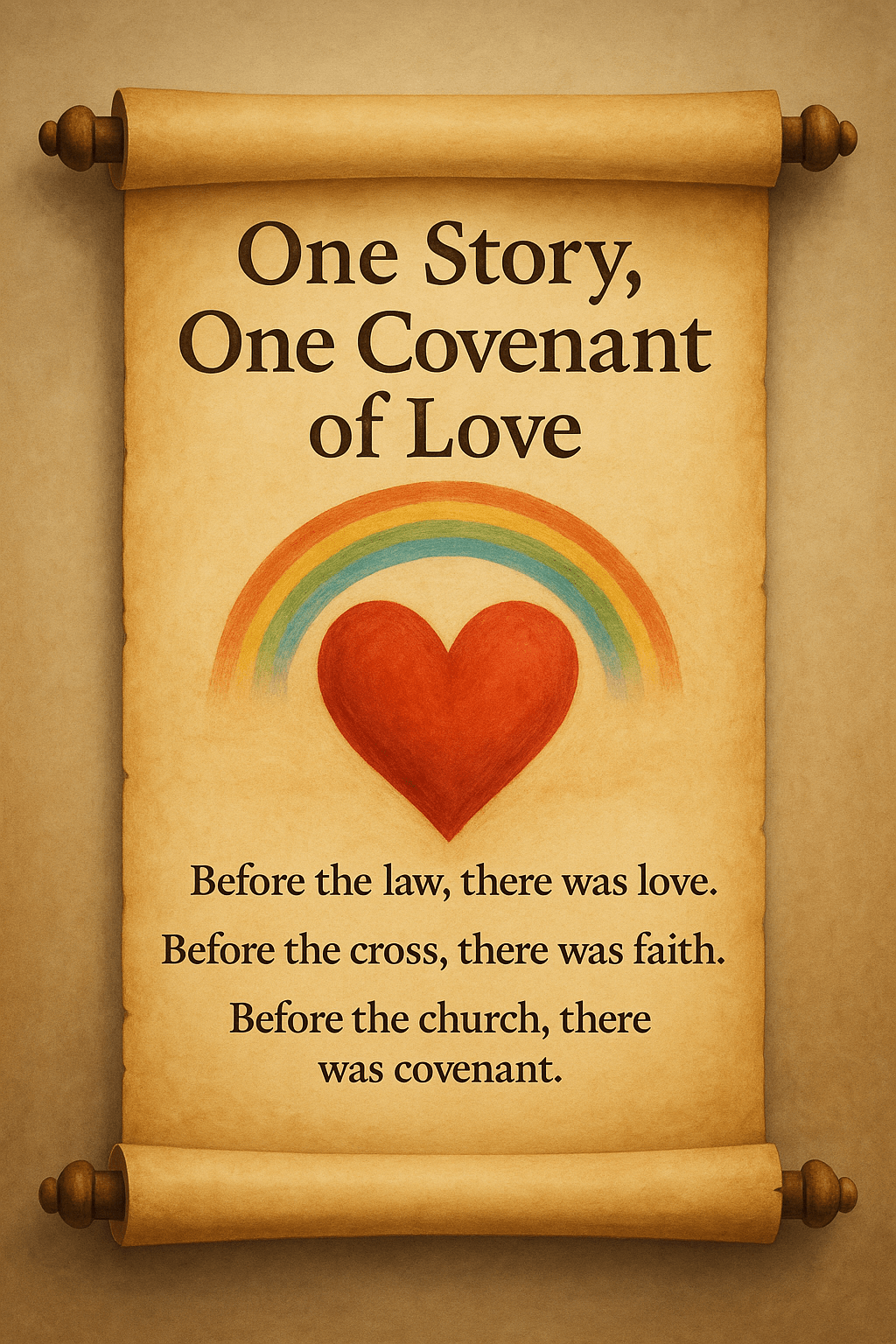
    Before the law, there was love.
    Before the cross, there was faith.
    Before the church, there was covenant.

    Noah, long before Abraham or Moses, walked with God in a time of great darkness. The Scriptures say, “Noah was a righteous man, blameless among the people of his time, and he walked faithfully with God.” (Genesis 6:9)
    And tucked into that ancient story, long before Paul ever used the word, we read:
    “Noah found grace in the eyes of the Lord.” (Genesis 6:8, KJV)

    God made a covenant not only with Noah, but with all of creation—a covenant sealed with a rainbow, not as a warning, but as a promise of mercy. (Genesis 9:12–13)

    Abraham, too, was called by God not because of perfect obedience, but because of faith. “Abraham believed the Lord, and it was credited to him as righteousness.” (Genesis 15:6)

    This thread continues through the prophets, where we find not just warnings, but deep wells of compassion. One of the clearest voices is Micah, who lived around 700 BCE, during a time when empty religious rituals had replaced authentic spiritual life.

    Despite being in what some would call the “Old Covenant” period, Micah’s message is not bound by the letter of the law. His voice, like a clear bell in the night, pierces through empty religious performance and calls the people back to the essence of covenant: a living relationship rooted in justice, mercy, and humble companionship with God.

    “He has shown you, O mortal, what is good.
    And what does the Lord require of you?
    To act justly, and to love mercy,
    and to walk humbly with your God.”
    —Micah 6:8

    These words aren’t about works replacing faith; they’re about faith becoming visible through love. They point to the same truth Jesus would later reveal in His own life and teaching.

    Micah fits beautifully in the timeline of faith and grace. He bridges the legalism that had crept into temple worship and the inner heart of the gospel Jesus would one day preach. His words are a quiet flame—a reminder that God’s covenant was never meant to be merely about laws or sacrifices, but always about the heart.

    The Psalms, too, are filled with this same light:
    “The Lord is compassionate and gracious, slow to anger, abounding in love.” (Psalm 103:8)

    And in Jeremiah, speaking during the collapse of a nation, we hear God longing for a deeper, more intimate relationship with His people—not through outward law, but inward transformation:
    “I will put my law in their minds and write it on their hearts. I will be their God, and they will be my people.” (Jeremiah 31:33)

    So when Jesus came, He did not cancel the story that had come before. He fulfilled it.
    As He said:

    “Do not think that I have come to abolish the Law or the Prophets;
    I have not come to abolish them but to fulfill them.”
    —Matthew 5:17

    And when asked what the greatest commandment was, He reached back and held up the same eternal truth:

    “Love the Lord your God with all your heart and with all your soul and with all your mind…
    And love your neighbor as yourself.
    All the Law and the Prophets hang on these two commandments.”
    —Matthew 22:37–40

    This isn’t a new message.
    It’s an ancient echo.
    It’s the song God has been singing all along.

    And yet, more than 2,000 years since Jesus walked the earth preaching this message of love over law, compassion over control, too often His voice has been claimed by institutions that fell back into the very legalism He challenged.

    We must speak this truth with sorrow: millions of innocent people were persecuted, tortured, and killed under the banner of a legalistic Christianity that bore little resemblance to Christ Himself. Systems rose that called themselves holy, while denying the very heart of the gospel.

    But God’s grace was never extinguished.
    It remained with the suffering.
    It whispered in prison cells.
    It burned quietly in hearts that refused to hate.

    And still today, the invitation is not to belong to a system, but to awaken to a relationship—one that each of us is called to seek, not by rote, but with heart, soul, and longing.

    It is the same call that echoed through Noah, Abraham, Micah, and Jeremiah.
    The same call Jesus lifted with His life.
    To seek justice.
    To love mercy.
    To walk humbly with our God.

    This is not only history. It is now.

    It is each soul’s sacred responsibility to seek the presence of God—not as a distant lawgiver, but as the living grace who has been with us from the beginning. To turn inward in faith. To walk outward in love. And to let that love be our testimony.


    A quiet invitation to rediscover the thread of God’s love that has never been broken.

    🙏🕊🙏

  • Thinking Out Loud

    Thinking Out Loud

    After 2,000 years, many are still waiting for the Kingdom of God to arrive from the outside. But what if the kingdom Jesus spoke of is already here—within us, waiting quietly to be recognized? These thoughts are shared not as answers, but as reflections… thinking out loud…

    In Jesus’ words, “The Kingdom of God is within you.” It’s such a profound teaching, yet so many, even after 2000 years, continue to look outward, as if the kingdom is a distant place or a future event. The truth is, it is already here, in the present moment, within each of us, waiting to be recognized.

    “nor will people say, ‘Here it is,’ or ‘There it is,’ because the kingdom of God is in your midst.” Luke 17:21

    In this verse, Jesus is responding to a question from the Pharisees about when the Kingdom of God will come. He answers by saying that it’s not something to be observed externally, but rather that it’s already present within those who believe.

    It’s as though the external waiting reflects our inability to fully embrace what is already present—our reluctance to fully step into the fullness of our own being, the divine spark that resides within. The kingdom is not a far-off land to be found after death, nor is it a king to be crowned in a distant future. It’s a recognition, a shift in awareness.

    Jesus, in his life and teachings, pointed again and again to this truth, yet even his followers continued to expect a king who would come in glory, overthrow empires, and bring physical peace. But the peace Jesus offered was internal—a peace that passes understanding, a peace that comes from being aligned with the divine within.

    The kingdom is not about external events, but about the internal shift—a shift from seeking to knowing, from waiting to realizing, from longing to embodying.

    Is it possible that we’re all waiting for an external kingdom, while the kingdom quietly resides in our hearts, patiently waiting for us to recognize it?

    Yes?

    🙏🕊🙏