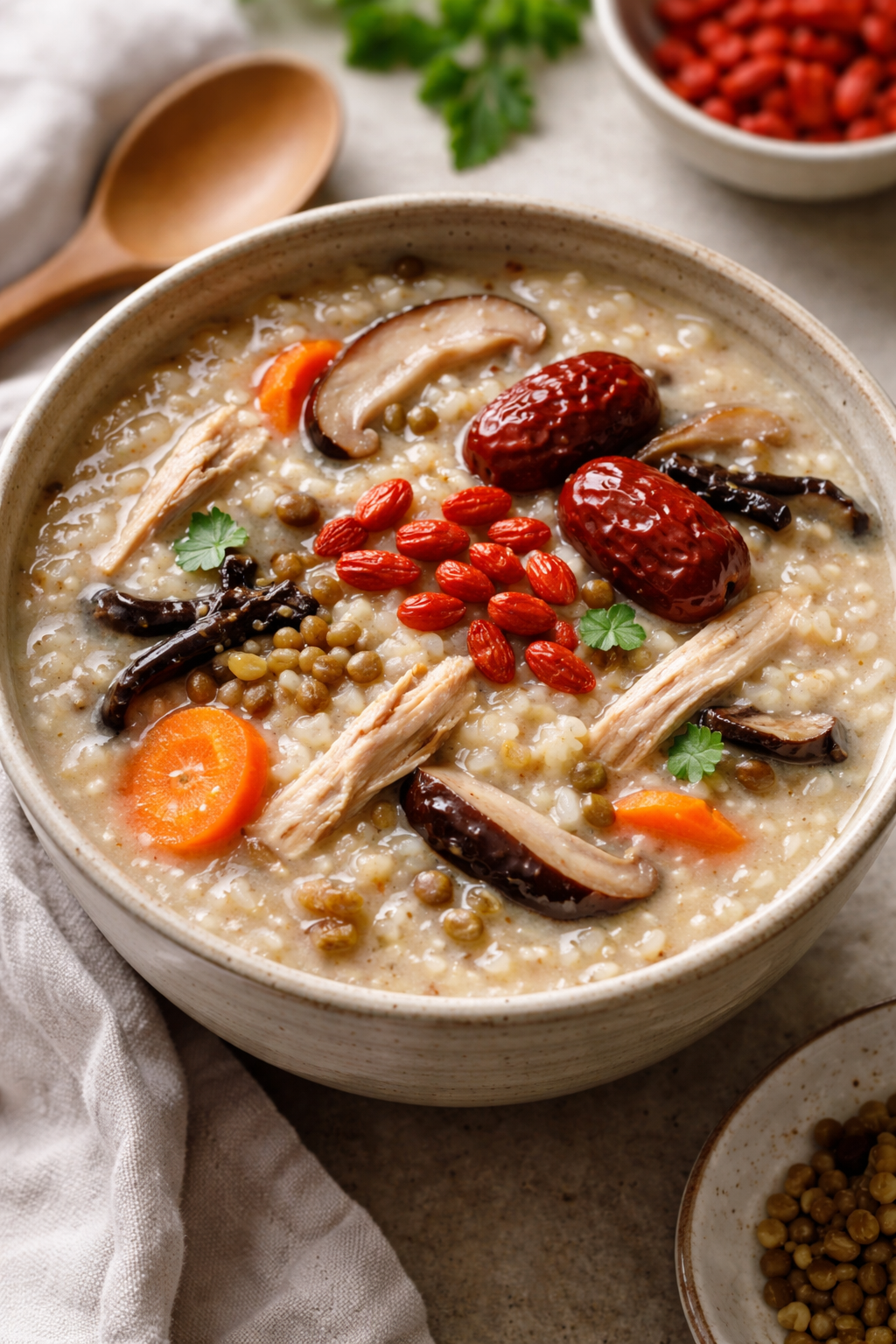
Tag: food

  • Slow-Cooked Brown Rice Congee for Gentle Strength

    Slow-Cooked Brown Rice Congee for Gentle Strength

    There are some foods that feel less like meals and more like companions. This congee is one of them. It doesn’t hurry. It doesn’t stimulate. It simply stays—warming, softening, and offering quiet nourishment to a body that may already be carrying more than its share.

    Slow-cooked over several hours, this brown rice congee is especially suited for times of fatigue, recovery, or convalescence. It is gentle on digestion, deeply hydrating, and built around ingredients long respected in Traditional Chinese Medicine for supporting Qi, Blood, and Essence without strain.


    Ingredients

    • ½ cup brown rice, rinsed
    • Plenty of water (approximately 8–10 cups, adding more as needed)
    • 1 tablespoon mung beans
    • 2 carrots, sliced
    • 2 shiitake mushrooms, sliced
    • Fresh ginger, a few thin slices (to taste)
    • 1-inch piece American ginseng
    • Black tree fungus (wood ear), soaked and sliced
    • Jujube (red dates), added toward the end
    • Goji berries, added toward the end
    • A small pinch of salt

    Optional Protein (about ¼ lb):

    • Tofu (soft or medium)
    • White fish
    • Chicken
    • Beef or other gently cooked meats

    Method

    Place the rinsed brown rice and mung beans into a large pot with plenty of water. Bring to a gentle boil, then reduce the heat to a very low simmer. Add the carrots, shiitake mushrooms, ginger, American ginseng, black tree fungus, and a small pinch of salt.

    If using a protein, add it now, choosing preparations that are simple and lightly cut. Cover loosely and allow the congee to cook slowly for about four hours, stirring occasionally and adding water as needed. The goal is a soft, porridge-like consistency, with the rice grains breaking down into a smooth, nourishing base.

    During the final 20–30 minutes of cooking, add the jujube and goji berries. This preserves their gentle sweetness and medicinal qualities without overcooking them.

    Taste and adjust seasoning if needed. Let the congee rest briefly before serving.


    A Quiet Reflection

    This is the kind of food that asks very little of you.

    While it cooks, you are free to rest. While you eat, there is nothing to solve or fix. Each spoonful feels like it arrives already listening, already aware of the body’s limits.

    Congee has long been considered a healing food not because it is powerful in the dramatic sense, but because it is willing to be humble. It meets weakness without judgment and strength without force.


    Nutritional Perspective (Western View)

    From a nutritional standpoint, this congee offers:

    • Complex carbohydrates from brown rice, providing slow, steady energy without blood sugar spikes
    • Dietary fiber to support gut health and gentle detoxification
    • Beta-carotene and antioxidants from carrots and goji berries
    • Immune-supportive compounds from shiitake mushrooms
    • Anti-inflammatory properties from fresh ginger
    • Hydration support, as the high water content aids circulation, digestion, and cellular repair

    Because it is soft and well-cooked, nutrients are easier to absorb—especially important for those with compromised digestion or low energy reserves.


    Traditional Chinese Medicine Perspective

    In TCM, congee is often prescribed when the Spleen and Stomach need support—particularly in cases of fatigue, deficiency, or post-illness recovery.

    • Brown rice strengthens the Spleen and provides stable Qi
    • Carrots gently tonify Blood and support digestion
    • Shiitake mushrooms support Wei Qi (defensive energy) and immune resilience
    • American ginseng nourishes Yin and Qi without overstimulation, making it especially suitable for chronic fatigue or heat-with-deficiency patterns
    • Black tree fungus supports Blood, moistens dryness, and benefits circulation
    • Jujube (red dates) harmonize the formula, nourish Blood, and calm the Spirit (Shen)
    • Goji berries nourish Liver and Kidney Yin, gently supporting vitality and vision
    • Ginger warms the middle burner, aiding digestion and preventing stagnation

    Taken together, this congee is balancing rather than forcing—supportive of long-term vitality rather than short-term energy spikes.


    A Final Note

    This dish can be eaten warm throughout the day, thinned with additional hot water if needed, and adapted gently over time. It is forgiving, flexible, and kind—qualities worth cultivating both in the kitchen and in ourselves.

    May it nourish not only the body, but also the quiet confidence that healing does not need to be rushed.

  • The Gentle Pour: A Yogurt-Making Meditation

    The Gentle Pour: A Yogurt-Making Meditation

    Cultivating Quiet Joy Through Simple, Homemade Nourishment

    There’s a quiet joy that comes from creating something nourishing with your own hands — not out of ambition or perfectionism, but out of love. This week, that joy arrived as a gallon of fresh, homemade yogurt: simple, creamy, and alive with the subtle tang of life unfolding in stillness.

    I began with just two ingredients — a gallon of whole, organic milk and a few spoonfuls of Siggi’s organic yogurt, rich with live cultures. Nothing complicated. Just what nature and time provide.

    The Process

    The milk was gently warmed to about 180°F, a soft simmering that whispers rather than boils — a point where the proteins prepare to transform. Then, I let it cool back to body temperature, around 110°F, the warmth of gentle touch.

    At that moment, I stirred in four tablespoons of Siggi’s yogurt, awakening the living cultures that would guide the milk’s slow metamorphosis.

    Instead of using an appliance or maintaining constant heat, I poured the warm mixture into a stainless steel Stanley XL wide-mouth thermos — a vessel that holds warmth the way a meditation cushion holds stillness. For seven undisturbed hours, the milk rested in silence, transforming quietly in its own rhythm.

    That night, it went into the refrigerator to settle and thicken. By morning, it was perfect — smooth, drinkable, and gently tangy. Not too thick, not too thin. A gentle pour, alive and refreshing.

    The Alchemy of Yogurt

    Yogurt’s origins trace back thousands of years — likely discovered by shepherds who carried milk in animal-skin pouches across the warm plains of Central Asia. Natural bacteria, always present in the air and milk, transformed the liquid into something thicker, tangier, and far more enduring. From there, it traveled across cultures — becoming dahi in India, mast in Persia, leben in Egypt, and yoghurt in the Balkans and beyond.

    Wherever it went, it carried the same truth: that with warmth, patience, and a little faith, life renews itself. Yogurt is, in essence, a relationship — between milk and microbe, human and nature.

    Nourishment and Benefits

    Homemade yogurt retains its vitality. It’s filled with live, active cultures that support digestion, calm inflammation, and replenish the microbiome — a living mirror of harmony within. Its natural balance of protein, fat, and probiotics offers steady, gentle nourishment without heaviness.

    For those of us who live with chronic illness or fluctuating energy, it is especially kind. Making it requires little effort, yet the result offers deep nutrition. Each sip feels restorative — a quiet companion for breakfast or a soothing evening drink before rest.

    The Gentle Practice

    Yogurt-making, like meditation, cannot be rushed. It happens when you step aside, when you allow warmth and time to do their subtle work. In that sense, it becomes more than food — it becomes a reminder: that healing and transformation unfold best in stillness, when we trust the process.

    This first batch will not be the last. Each new jar will carry a bit of the previous one, like a lineage of living kindness — simple, sustaining, and full of quiet joy.


    A Few Tips for Your Own Yogurt Journey

    🌿 Choose good ingredients. Whole milk (organic if possible) and a high-quality yogurt with live active cultures make all the difference. The better the beginning, the purer the result.

    🌡️ Mind the temperatures. Heat milk to around 180°F (82°C), then cool it gently to 110°F (43°C) before adding your starter. Too hot, and the cultures will perish; too cool, and they may not awaken.

    🥄 Add your starter with care. About 2–4 tablespoons per quart (liter) of milk is ideal. Stir gently — this is not a whisking, but a kind introduction.

    ☕ Keep it warm and undisturbed. A thermos, insulated jar, or even a cozy towel wrap keeps the temperature steady. Stillness is part of the process.

    ❄️ Chill before stirring. Once it sets, refrigerate for several hours to help it firm and develop flavor.

    💫 Save a little for next time. Before finishing your batch, set aside half a cup to use as your next starter. It will carry forward the living lineage of your yogurt.

    🥰 Trust your senses. If it smells clean and pleasantly tangy, it’s good. If it smells off or yeasty, it’s time to begin anew. Every batch teaches something.


    Perhaps this new category — Homemade, Nutritious, and Delicious — will become a sanctuary for simple recipes like this: foods that heal body and spirit, each one a meditation on patience, gratitude, and renewal.

    In the Spirit of Global Wellbeing

    At Global Wellbeing, we believe that every small act of mindful living contributes to the healing of our world. A bowl of homemade yogurt, lovingly prepared, becomes more than food — it becomes a gesture of peace. In making something simple, wholesome, and alive, we remind ourselves that nourishment begins with presence, and that caring for the body is inseparable from caring for the spirit.

    May this practice of gentle creation inspire others to rediscover the sacred in the ordinary — one quiet, nourishing moment at a time.

  • Healing Earth Tonic: A Golden Tea Blend for Gentle Restoration

    Healing Earth Tonic: A Golden Tea Blend for Gentle Restoration


    Category: Sacred Kitchen: Home Remedies from the Heart


    What follows is not medical advice, but a personal offering from my own experience with chronic illness, healing, and the quiet wisdom of traditional home remedies. Please listen to your body, and consult a healthcare provider as needed.


    Healing Earth Tonic

    A Golden Tea Blend for Gentle Restoration

    This tea came to life on a slow, quiet healing day. I was nursing a cold and moving gently through the rhythm of tea, soup, and rest. I found myself drawn to the golden light of turmeric, the warmth of ginger and cinnamon, the steadiness of coconut oil—and the quiet alchemy that comes when these ingredients are stirred with presence.

    What emerged is something I now call Healing Earth Tonic—a grounding, nourishing blend inspired by the ancient Ayurvedic traditions of India, and by the intuitive medicine of the home kitchen. It’s not a prescription—it’s a small act of care.


    The Recipe

    Ingredients:

    • 2 tbsp turmeric powder
    • 1 tbsp ground ginger
    • 1/4 tsp black pepper
    • 1 tsp cinnamon
    • 1/2 tsp cardamom
    • 1/2 tsp nutmeg
    • 2 tbsp coconut oil (optional, but enhances absorption and grounding) Note: the beauty of adding coconut oil. Turmeric’s active compound, curcumin, is fat-soluble, which means it absorbs much better in the body when consumed with a healthy fat like coconut oil or ghee. And since coconut oil is shelf-stable, adding just a little can help make it a soft, spoonable blend without risking spoilage—especially if everything else is dry.

    Instructions:

    1. Mix the dry ingredients in a clean glass jar.
    2. Add coconut oil and stir until the blend becomes soft and sand-like.
    3. Store sealed at room temperature.

    How to Use It

    • Stir ½ to 1 teaspoon into hot water or warm milk (dairy or plant-based).
    • Stir frequently as it cools, then sip slowly and mindfully.
    • Best enjoyed with food, especially if you’re sensitive to warming spices.
    • A gentle healing rhythm might be 1 to 2 cups a day.

    Why These Ingredients?

    This blend draws on centuries of Ayurvedic wisdom:

    • Turmeric (Haridra) – anti-inflammatory, immune-supportive, and purifying.
    • Black Pepper (Maricha) – enhances absorption of turmeric, kindles digestion.
    • Ginger (Shunthi) – supports circulation, relieves nausea, and clears stagnation.
    • Cinnamon & Cardamom – soothe the breath, calm the heart, and comfort the spirit.
    • Coconut Oil – grounding, nourishing, and helps the body absorb fat-soluble compounds.

    In Ayurveda, such blends are known as rasayanas—rejuvenating tonics that restore balance gently, through warmth, presence, and consistency.


    A Blessing for Your Cup

    May this tea bring warmth to my body, clarity to my mind, and gentleness to my heart.
    May it carry the memory of the earth’s wisdom and the care with which it was made.
    May I receive its healing fully, and offer that peace quietly into the world.


    If you try making this blend—or share it with a friend—I’d love to hear how it lands in your body and spirit. These small rituals connect us, not just to healing, but to one another.


    Living Tea: A Gentle Ritual of Reuse and Renewal

    One simple practice I’ve come to love is reusing herbal teabags throughout the day. Teas like Sleepytime, Bengal Spice, and Turmeric Vitality still hold healing qualities after their first steep. With each cup, the flavor softens, and a bit more of the herbs’ medicine is released. I call this living tea—a quiet, ongoing relationship with the herbs.

    As the flavor fades, I often add a small spoonful of Healing Earth Tonic to deepen the warmth and support. It’s a way of honoring what I’ve already brewed, and letting each cup carry forward something of the last. It’s simple, thrifty, and a small act of care for both body and planet.