Tag: mental-health

  • Looking Back: 30 Years of Shame and Finally Understanding My Experience

    Looking Back: 30 Years of Shame and Finally Understanding My Experience

    I’ve lived with this illness for over 30 years, and for most of that time I was ashamed of it.

    Doctors kept telling me it was all in my head.

    They said I was depressed, anxious, or that I just didn’t want to work hard enough. They usually prescribed antidepressants and anti-anxiety medications, claiming these drugs would fix me. While the medication may have helped my emotional state somewhat, it did nothing to fix the physical symptoms.

    Thankfully, I eventually stopped letting them gaslight me into taking more and different medications.

    Every time I tried to explain how my body would completely crash after doing normal things, I was met with skepticism or pity.

    So I started doubting myself.

    I felt weak.
    I felt crazy.
    I carried a lot of shame for something I couldn’t control.

    The fatigue and exhaustion that comes with this illness is crushing.

    It’s not normal tiredness. It’s a deep, heavy exhaustion that sleep doesn’t fix. Even the smallest activities can leave me completely wiped out for days.

    My sleep tracker consistently shows that I get adequate deep sleep and REM sleep, yet I still wake up exhausted. That helped me understand something important:

    The problem isn’t simply how much I sleep.

    It’s that my dysautonomia prevents the sleep from being restorative.

    In the early years, the emotional side of it felt a lot like PMS — that same sudden emotional dysregulation, irritability, and feeling completely off — except instead of happening once a month, it could hit at any time.

    Only recently have I finally understood what’s really happening.

    What I have is dysautonomia.

    My autonomic nervous system doesn’t regulate properly anymore.

    That’s why I can suddenly feel freezing cold in a warm room. That’s why I’m much more comfortable lying down than sitting or standing. And that’s why even mild activity can make my whole system short-circuit — suddenly bringing on intense brain fog, overwhelming exhaustion, headaches, insomnia, anxiety, and sometimes depression all at once.

    ME/CFS always felt like an incomplete label to me.

    Yes, I crash after exertion.
    Yes, sleep doesn’t fix it.
    Yes, my body has never functioned the way people expect it to.

    But understanding it as dysautonomia finally explains the day-to-day reality of living in a body whose nervous system breaks down so easily.

    The only thing that actually helps is pacing — staying within my energy envelope.

    I try to live as close to the edge as I can, but carefully. Migraines and tinnitus have become warning signs for me. If I respect those early signals, I can often avoid triggering insomnia, which is far worse than a regular crash and completely throws me off balance.

    After 30 years, I’ve finally stopped blaming myself.

    That alone has been healing.

    I’m sharing this journal entry in case it gives someone else a little more language for their own experience.

    And for family members, friends, and doctors: please know that when we keep turning down invitations, or seem withdrawn, or disappear for long stretches of time, it’s not because we don’t want to be around you.

    Our energy is extremely limited.

    We have to be very careful to avoid crashes.

    Even now, I keep a little journal between doctor visits so I can clearly communicate what I’ve been experiencing. If you’re struggling to explain this illness during appointments, writing things down and bringing it with you can be incredibly helpful.

    Sometimes understanding does not cure the body.

    But it can begin to release the shame.

    And after so many years of being misunderstood, that matters.

  • Only Love: A Gentle Mantra for the Heart

    Only Love: A Gentle Mantra for the Heart

    New single by Pitarra (Me 🙂) – now available for pre‑order

    Dear friends,

    Exciting news! My single, “Only Love,” has been submitted to stores and is available for pre-order soon. It will officially release on November 27, 2025 on Spotify, Apple Music, Amazon Music, and many more.

    “Only Love” is a meditative R&B/Hip Hop mantra for the heart:
    only love may enter here.

    This song is, in many ways, a quiet prayer set to a beat. It’s meant to be something you can put on in the background—while you’re resting, journaling, stretching, or simply breathing—and let it gently repeat a single message to your nervous system:

    Only love may enter here.


    Creating from a Recliner

    This track was created right from home, both in bed, and sitting on a recliner with my legs up, sipping chamomile tea.

    As someone living with moderate ME/CFS, my days are shaped by strict limits: energy envelopes, pacing, and the constant need to listen to my body. There are many things I can’t do in the ways I used to.

    And yet, this song is a small example of what is still possible—what someone with ME/CFS can create within those limits. No big studio. No late‑night sessions. Just a laptop, headphones, and a heart that still wants to sing.

    In that sense, “Only Love” is not just a song, but a practice:

    • A practice of choosing gentleness over self‑pressure
    • A practice of creating within constraints
    • A practice of letting compassion—not urgency—lead the way

    If you are living with chronic illness, disability, or any invisible condition, I hope this track offers you not just comfort, but also a quiet solidarity: you are not alone, and your creative spark is not gone.


    A Song as a Boundary and a Blessing

    The phrase “Only love may enter here” came to me as both a boundary and a blessing.

    • A boundary: a line drawn kindly but firmly around the heart, saying no to cruelty, contempt, and unnecessary harshness (including the inner critic).
    • A blessing: an invitation for warmth, care, gentle honesty, and the kind of truth that doesn’t wound but heals.

    In a world that can feel overwhelmingly loud, the song leans into whispers, stillness, and shared silence as sacred spaces. It asks: what if listening could become more than hearing? What if each of us could be in “radiant participation” with the unseen kindness that sings through all things?

    That is the space I hope this song opens up for you.


    Listen and Share

    Listen to “Only Love” on your favorite platform:

    Spotify:
    https://open.spotify.com/track/7zMrlXVWMtR38qAXwCbKpq?si=SKA0oe-4QOGxUPeu4FhQWw

    Amazon Music:
    https://music.amazon.com/albums/B0G37FBHKK?ref=dm_sh_am4a_B0G37HD8SB_DaUmXSFY3pRbvS&trackAsin=B0G37K5V6X

    If this song speaks to something in your heart, please share it with your community. Together, we can keep the spirit of soulful, meaningful music alive.


    Who is Pitarra?

    Pitarra:
    A vessel of soft sound,
    Compassion hums in the pause—
    Notes bloom, hearts listen.

    Under the name Pitarra, I explore a gentle blend of styles, including R&B and Hip Hop and more, as a space for meditation, tenderness, and quiet courage. My hope is that each song can be a small sanctuary—especially for sensitive hearts, chronically ill bodies, and anyone walking through a difficult season.


    May We All Be Well

    Thank you for listening, for reading, and for walking this path of global wellbeing in your own way.

    May we all, without exception, be well and happy. 🌿

    With love,
    Pitarra 🙏


    Lyrics – “Only Love” by Pitarra

    Whispers in stillness
    Only love may enter here
    Echoes turn to light

    Listening becomes more than hearing
    A radiant participation
    A shared silence
    Between your soul
    And the unseen kindness
    That I sing through all things

    Only love, only love
    Only love
    Only love may enter here

    Only love
    Only love, only
    Only love may enter here

    A radiant participation
    A shared silence
    Between your soul
    And the unseen kindness
    That sings through all things

    Only love, only love
    Only love
    Only love may enter here

    Oh, only love, only love
    Only love
    Only love may…
    Only love may enter here

    Oh, only love
    Only love
    Only love
    Only love may enter here

    Enter here

    Only love, only love
    Only love
    Only love may enter here

    Oh, only love

    Listen and Share

    Listen to “Only Love” on your favorite platform:

    Spotify:
    https://open.spotify.com/track/7zMrlXVWMtR38qAXwCbKpq?si=SKA0oe-4QOGxUPeu4FhQWw

    Amazon Music:
    https://music.amazon.com/albums/B0G37FBHKK?ref=dm_sh_am4a_B0G37HD8SB_DaUmXSFY3pRbvS&trackAsin=B0G37K5V6X

    If this song speaks to something in your heart, please share it with your community. Together, we can keep the spirit of soulful, meaningful music alive.


  • Transforming a Cold Into a Healing Practice 🌿

    Transforming a Cold Into a Healing Practice 🌿

    Sometimes life slows us down in unexpected ways. A few sneezes, a scratchy throat, and a whisper of fatigue can become a quiet teacher. In these moments, even a cold can transform into a practice of compassion, patience, and awareness—inviting us to rest, to pace ourselves, and to see every ache as a doorway to deeper connection with our own hearts and all beings.

    I haven’t had a cold in at least fifteen years. Perhaps it came with the change of season, or perhaps it’s simply my body’s way of realigning.

    At first, I felt a little discouraged. But then something shifted. I realized that even this — this full-body cold — could be a teacher. In the spirit of Tibetan Vajrayana, I began a practice that might sound unusual: as long as this virus has taken up residence in my body, I send it compassion.

    May you be enlightened and benefit all beings.

    If this virus must live through me, then may it awaken, may it transform, may it find liberation in the vast field of awareness. Perhaps it can even become an enlightened virus, one that serves the good of all beings.

    This gesture may sound fanciful, but to me it reflects a deeply tantric understanding of transformation — meeting what feels harmful or invasive not with fear or resistance, but with the boundless wish that even this, too, might awaken. It is the essence of lojong: turning adversity into the path of enlightenment.

    To send loving-kindness even to a virus invites an alchemy of consciousness. We recognize that all forms of life and energy, even those that cause suffering, can be included in the mandala of awakening. The simple act of saying, “May you be enlightened, may you benefit all beings,” dissolves separation and opens the field of compassion wider than the body’s borders.

    After such an invocation, I like to rest quietly and imagine the virus as tiny sparks of light, gradually shifting from agitation to luminosity, merging with the radiance of my own heart. This doesn’t deny illness — it reclaims the power of awareness within it.

    A cold can then become a form of prayer, a healing practice, a full-body meditation. In each breath, the body learns softness; in each ache, compassion ripens. Even in fever or fatigue, there can be a whisper of grace.

    And yet, this cold is teaching me something else, something profoundly practical: how to pace myself throughout the day. ME/CFS has always required careful attention to energy, but when I’m feeling better, I tend to push myself—to accomplish, to do, to engage—often beyond what my body can sustain. This full-blown cold is a reminder that true discipline is gentle, that honoring rest is not laziness but wisdom, and that the same careful pacing I practice now in illness is exactly what I need every day to live fully with ME/CFS.

    And so, as I move through these days of rest, tea, and light meals, I remind myself: every illness, every discomfort, every small limitation is also a door. A door that invites patience, kindness, and an intimate awareness of the profound interconnection of all beings.

  • A Glimpse of Rigpa: The True Nature of Our Mind

    A Glimpse of Rigpa: The True Nature of Our Mind

    Yesterday Rinpoche gave me the simple instruction: to keep my thoughts in the room.
    As I practiced, the winds of memory and worry fell quiet, and what remained was a stillness like a pond untouched by breeze. In that moment I glimpsed the unity of ordinary and pristine mind—waves arising, yet nothing but ocean.

    Beloved Rinpoche,

    I write with gratitude for the instruction you gave yesterday, which opened a new door for me into the experience of Rigpa. Your words were simple, yet carried such profound kindness: to keep my thoughts in the room.

    As I sat in meditation, I followed your guidance. Thoughts about the ceiling, the plants, the breath, even the quiet pulse of tinnitus—all of these belonged to the room. They could be held gently within awareness without struggle. But when thoughts drifted toward memories of the past, or worries of the future, or stories beyond this room, I could see them clearly as outside. And so, with care, I let them go and returned to what was here.

    This way of practicing felt so different—so much more tender. Instead of wrestling with ordinary mind, I could simply remain rooted in this space, in this moment. And in that resting, the movements of the mind, the vrittis and pratyayas, began to settle of their own accord. Like a pond no longer stirred by wind, a natural stillness revealed itself. Within that stillness, I began to glimpse what you have pointed to again and again: the open clarity of pure awareness.

    In that glimpse, awareness shone with very little disturbance. An “I” was still present, but the usual fluctuations of thought were momentarily quiet, allowing the stillness of pure awareness to appear directly. To rest, even briefly, in that clarity was both humbling and wondrous.

    I could sense then that ordinary mind and pristine mind are not two separate realities, but two sides of the same coin. The waves of thought arise, yet they are nothing other than ocean. The ordinary shines as the pristine. To realize this in a living way, even if for only a moment, fills me with wonder and gratitude.

    Rinpoche, I bow in thanks for this precious instruction. It has shown me that Rigpa is not distant or hidden, but present in the immediacy of the room, in the simple presence of what is. May I return to this again and again, and may this glimpse ripen into lasting recognition.

    And may whatever merit arises from this glimpse and this practice be dedicated to the benefit of all beings everywhere. May it ease suffering, open hearts, and become a cause for the enlightenment of all sentient beings throughout time and space.

    With devotion and gratitude,
    Richard

    🙏✨️💛✨️🙏

    If you would like to learn more about the teachings of Orgyen Chowang Rinpoche and explore Dzogchen practice in greater depth, you can visit his website at pristinemind.org.


    In this talk at Google, Rinpoche offers instruction and a guided meditation based on his book Our Pristine Mind: A Practical Guide to Unconditional Happiness. He introduces a unique form of meditation called Pristine Mind meditation and explains how cultivating a Pristine Mind can transform every aspect of our lives.


    By resting gently in the fullness of the present moment, allowing the mind to settle naturally, and recognizing its luminous, pristine nature, one opens to profound serenity and enduring contentment.


  • Introducing the ME/CFS Wellness Companion (A Work in Progress)

    Introducing the ME/CFS Wellness Companion (A Work in Progress)


    For those living with Myalgic Encephalomyelitis / Chronic Fatigue Syndrome (ME/CFS), Long COVID, or any energy-limiting illness, daily life can feel like an obstacle course without a map. Simple tasks become monumental. Rest becomes survival. And advice from the outside world often misses the mark entirely.

    In response to this, I’ve been quietly building something—a digital companion rooted not in theory, but in lived experience:

    The ME/CFS Wellness Companion

    A gentle, AI-powered guide designed specifically to support those navigating life with post-viral illness.


    What Is It?

    The Wellness Companion is a customized GPT (Generative AI) model, trained not on generic health advice, but on real-life tools, practices, recipes, and reflections from my living with ME/CFS for over 30 years.

    It doesn’t tell you to “push through.”
    It won’t ask you to “exercise more.”
    It does ask:
    “Are you in the RED, YELLOW, or GREEN today?”


    The Energy Color System

    This is the foundation of the Companion’s guidance:

    • RED Zone: Deep fatigue, post-exertional malaise, sensory overwhelm. The focus is full rest, breath, stillness, and nervous system support.
    • YELLOW Zone: Fragile stability. Gentle movement, light nourishment, and mindful pacing are encouraged—with regular check-ins.
    • GREEN Zone: A rare or improved state of function. Still careful, but open to creativity, light structure, or small projects.

    Every recommendation is tailored to your zone—so you’re never being pushed beyond your limits.


    What It Offers:

    • Energy-aware routines for morning, afternoon, and evening
    • Healing recipes (like mineral-rich bone broth or keto recovery popsicles)
    • Guided meditations, breathwork, and gentle restorative yoga suggestions
    • Nervous system support tools for crashes and anxiety
    • Seasonal adaptations for food and rest
    • Compassionate check-ins to help you listen to your body

    Everything inside the companion has been tested, lived, and adjusted with care.


    Why I’m Sharing This

    Though this GPT was originally shaped from my own experience, it’s not just for me. It’s for all of us—those whose lives have been reshaped by chronic illness, who often feel invisible or misunderstood.

    My Sankalpa (sacred intention) is to pass forward what has helped me, so others don’t have to start from scratch.


    How It Will Work

    The model is still in development. Eventually, it will be uploaded with a full file of routines, recipes, pacing guidance, and reflective practices.

    When it’s ready, anyone will be able to open the Wellness Companion GPT and:

    • Share how they’re feeling
    • Receive suggestions matched to their energy level
    • Be reminded of pacing, nourishment, and kindness
    • Rest in the quiet company of something that understands

    Would You Like to Help?

    If you have ideas, routines, tools, or practices that have supported you on your journey with ME/CFS, I’d love to hear from you. This is a living, growing project, and your voice could shape how the Wellness Companion serves others.

    Please feel free to reach out or leave a comment below. I’ll continue posting updates as the project unfolds.


    As we shape this Wellness Companion—may it always serve the highest good.

    May those who seek healing be met with gentleness.
    May those who carry invisible burdens find rest.
    May those who offer their wisdom help light the path.
    And may this work—rooted in care—
    help bring us closer to a world
    where technology honors tenderness,
    and presence becomes medicine.

    🙏🕊🙏


  • 🙂 Turning Music into a Gentle, Adaptive Practice While Living with Chronic Fatigue (ME/CFS)

    🙂 Turning Music into a Gentle, Adaptive Practice While Living with Chronic Fatigue (ME/CFS)

    🌿A Gentle Reminder Before Reading

    This post contains 38 sentences. If you have brain fog or limited energy, please take your time. You don’t need to read it all at once—just absorb what you can, when you can. If you find something helpful, pause and rest before continuing. There’s no rush. This is meant to be supportive, not overwhelming. 💙

    Turning Music into a Gentle, Adaptive Practice

    Lately, I’ve been reflecting on how much my body has been changing. For a long time, I spent most of my time in bed, and simply sitting up felt like a challenge. But recently, I’ve started to feel just a little stronger, and that’s why I feel drawn to incorporating more sitting and standing into my day. The muscles involved in standing and sitting had atrophied from so much time in bed, so this shift—this ability to stand, even for short moments—feels like a miracle.

    As part of this, I’ve been exploring a way to bring music into my life in a way that supports my body instead of draining it.

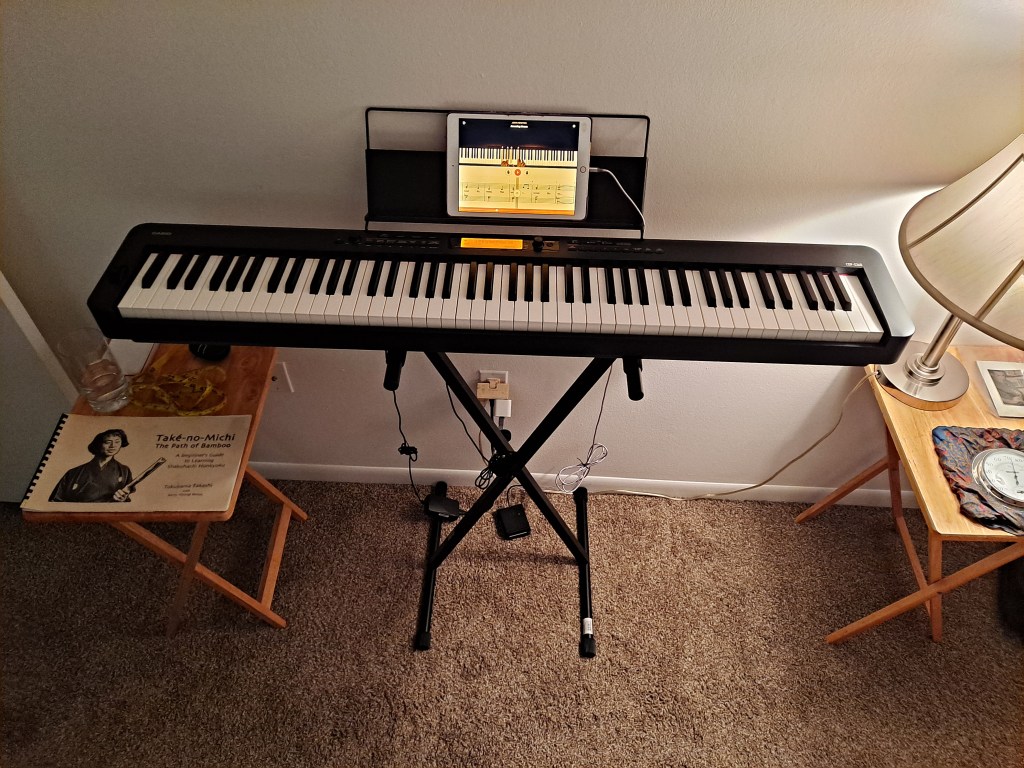
    Like many of you, I find that sitting for long periods is uncomfortable, so I decided to raise my keyboard stand to standing height. What I’ve found is that standing while playing allows for gentle movement—I can shift my weight, circle my hips, and let my breath flow naturally, almost like Tai Chi at the keyboard.

    But the most important shift has been learning how to relax. I’ve realized that when I play, I tend to hold my breath and tense up, which drains my energy. So my new focus is breathing and playing with as little tension as possible, using a 4-note breathing pattern:
    ✔ Inhale: A → C → E → C
    ✔ Exhale: A → C → E → C
    This simple rhythm helps me stay grounded, present, and relaxed.

    Another key part of this setup is having my keyboard at the end of my bed. This means I can lay down to rest anytime, and when I feel ready, I can stand for just a minute or two to play, then lay back down again. There’s no pressure, no need to push myself—just a gentle cycle of music and rest.

    Options for Engaging with Music at Any Energy Level

    I know that not everyone has the ability to stand or sit for long, so I wanted to share a few ways to incorporate music at any stage—always prioritizing relaxation and staying within your pacing envelope to avoid PEM.

    🎵 Lying in Bed: When I was primarily bedridden and didn’t have a keyboard, I Velcroed my iPad about a foot and a half above my head. This let me lay flat and play simple notes with an app, without any strain. It worked beautifully.

    🎵 Small Keyboard for Bed Use: On Facebook Marketplace, you can find very small, lightweight keyboards that you can keep in bed with you. You don’t need a full-size keyboard to start—just something simple to play a few notes when you feel able.

    🎵 Seated or Standing with an Adjustable Keyboard: If sitting for long is difficult, you can use a keyboard stand that adjusts in height so you can switch between sitting and standing, allowing for movement and rest as needed.

    🎵 Completely Resting & Humming (Minimal Effort Required): For those who need to lay flat and remain mostly inactive, music can still be part of your healing. Some keyboards or apps allow you to automatically play simple notes (like A → C → E → C) very, very slowly. Instead of physically playing, you can simply breathe in rhythm with the notes and gently hum along—only if it feels comfortable. Even this small engagement should be done within your energy limits, ensuring it stays restorative rather than draining.

    🎵 Music Visualization (No Physical Effort Required): If even humming feels like too much, you can still experience music through visualization. I used this method when I realized I couldn’t go to the beach anymore—I would simply imagine walking along the shore, and it was surprisingly powerful. In the same way, you can lay in bed and visualize yourself sitting at a piano, pressing one note at a time, hearing the sound in your mind, and breathing gently. You don’t have to hum or move at all—just allow the imagery and imagined sound to soothe you.

    The Primary Goal: Relaxation & Parasympathetic Activation

    The most important thing is to find the simplest, most relaxing way to engage with music—one that matches your current energy levels and does not trigger PEM. Whether that’s playing, humming, breathing, or simply visualizing, the goal is to activate the parasympathetic nervous system and promote deep rest and healing.

    Having a piano that moves with me rather than forcing me to adjust to it has been life-changing. I just wanted to share this in case it helps anyone else looking for a way to bring music into their life—with gentleness, breath, and ease. 💙

  • When the Body Speaks: A Letter on ME/CFS and Forgiveness

    When the Body Speaks: A Letter on ME/CFS and Forgiveness

    Today, I felt it coming—a noxious wave rising from deep within. A bright, warning orange sliding straight into red, and before long, a full-blown crash. The heaviness in my limbs like wet sand, my mind fogged and thick. The weight of having done too much, more than my body could tolerate, more than it could carry.

    I knew this would happen. I overrode my limits packing, moving into a new apartment, settling in when my body was already whispering, slow down. But I kept going. And now, here I am.

    This morning, in a PEM-crazed state of mind, I did something else I knew wasn’t wise—I ate an entire loaf of bread. I reached for it like it might offer some relief, some fleeting comfort, slice by slice until it was all gone. But now I just feel worse: bloated, sick, heavy in a way that no food could fix. And of course, the familiar wave of guilt followed: Why did I do that? I can’t believe I did that. I know this pattern—how PEM twists my mind, makes cravings louder, decision-making foggier. And yet, here I am again.

    But here’s the thing. This doesn’t mean I’ve lost my way. It doesn’t mean I’ve failed. It just means I’m human—living in a body that doesn’t follow predictable rules. A body that sometimes rebels, sometimes collapses under the weight of what life demands.

    At some point, reason kicks back in. The first step, as always, is acceptance. Not resignation, but a soft compassion: This is where I am right now. It’s uncomfortable, yes. It’s frustrating, absolutely. But fighting it only adds another layer of exhaustion. So finally, after feeling terrible—and feeling terrible about feeling terrible—I plugged in my heating pad, got into bed, and let the warmth settle over my belly. I let it offer some small comfort to my sore muscles, as I let myself be.

    I know this will pass. The intensity will soften. My body will find its rhythm again. And when it does, I’ll carry this experience with me—not as a failure, but as another piece of the story. Another reminder that healing isn’t linear, and self-compassion is the only constant I can truly lean on.

    If you’ve found yourself here too—in the middle of a crash, tangled in frustration or guilt—I hope you know you’re not alone. We all override our limits sometimes. We all make choices that don’t feel wise in hindsight. But none of that means we’re failing. It just means we’re living, doing the best we can in bodies that ask for more patience than most people can imagine.

    So here’s to resting when we need to. To forgiving ourselves when we falter. To remembering that even in the hardest moments, there is still space for gentleness.

    With warmth and understanding,

    Richard

    🙏🕊🙏

  • The Quiet Art of Pacing: Living with ME CFS

    The Quiet Art of Pacing: Living with ME CFS

    There is a kind of life that moves beneath the surface of what others might call living—a life that hums in the pauses, in the spaces where action halts and breath lingers. For those of us with Myalgic Encephalomyelitis/Chronic Fatigue Syndrome (ME CFS), life unfolds not in grand gestures but in the delicate negotiation between movement and stillness, between doing and being.

    It is a life measured in moments of energy so fleeting and precious that they slip through our fingers like water if we are not careful. And so, we learn to hold them gently. We learn the art of pacing—a quiet, intricate dance with the body, the mind, and time itself.


    Listening to the Whisper Beneath the Noise

    At first, pacing may seem like a restriction, a bridle holding you back from the gallop of life. But in time, if you listen closely—no, not just listen, but feel—you realize it is not a prison but a kind of language your body speaks. A whisper beneath the noise.

    There is a moment, just before the crash comes, when the body begins to murmur. A soft weight behind the eyes, a flicker of thought that stumbles, a breath that feels heavier than the last. These are the early signals, the body’s gentle plea: pause.

    It is in this space, between the whisper and the roar, that pacing lives.


    The Shape of a Day, Redrawn

    Pacing is not about doing less; it’s about doing differently. It is the re-imagining of time, the reshaping of how a day unfolds. Where once you might have filled your hours with tasks and plans, now you learn to weave rest into the rhythm of your day, like threads of gold through ordinary cloth.

    You might wash the dishes, but not all at once. You pause midway, let the water cool on your hands, and sit quietly, letting your breath find its rhythm again. You might write an email, but only after resting first, and you’ll rest again afterward—because even thinking, even hoping, takes energy you no longer have in abundance.


    Finding Rest in Unexpected Places

    And rest—ah, rest is not always what the world thinks it is. Rest is not just lying in bed, staring at the ceiling while the mind races ahead of the body’s capacity. Rest can be the soft drift of music filling the room, or the slow tracing of light as it moves across the wall in the late afternoon. Rest can be found in the spaces between thoughts, in the warmth of a cup of tea held in still hands.

    Rest becomes an art of presence, of being where you are without pushing against the boundaries of what is possible today.


    The Creative Dance of Energy

    Some days, you find new ways to move within these limits, like an artist working within the edges of a canvas. You might use technology as a bridge—a voice-activated assistant that changes the song when you’re too tired to lift a finger, or a reminder app that gently nudges you when it’s time to pause.

    You might practice the delicate balance of task rotation: a bit of writing, then a moment watching the sky; folding laundry, but only after you’ve closed your eyes for a while. You discover the gift of delegation, the quiet courage in asking for help, and the grace in receiving it.

    Some days, even the lightest touch of movement—a stretch, a breath, the soft turning of your neck toward the window—feels like enough. And it is.


    The Emotional Currents Beneath It All

    But there is more than the body to tend to. There is the heart, too, learning to live with the grief of lost abilities. There are days when you long for the world you once knew, for the ease of spontaneity, for the thoughtless rush of energy that now feels like a distant memory.

    Yet, in the slowing down, in the careful pacing, you may find something unexpected: a deeper presence, a richer noticing of life’s quiet details. The way the morning light catches in the folds of your blanket. The softness in the voice of a friend who understands. The tender resilience that blooms in the space where struggle meets acceptance.


    Living Within, and Beyond, the Limits

    Pacing is not a giving up. It is a learning to live differently. It is an intimate conversation with yourself, a deep knowing of what you can do and when to stop. It’s about honoring the ebb and flow of your energy, like tides that you no longer fight but learn to move with.

    And in this dance, in this art of balancing effort and ease, you find that life still holds beauty—not in spite of the limits but sometimes because of them. The smallest joys become treasures, and the quiet moments shimmer with meaning.

    Because even within the narrowest confines, life finds a way to bloom.


    🙏🕊🙏

  • A Refuge That’s Never Truly Out of Reach

    A Refuge That’s Never Truly Out of Reach

    For those of us living with chronic fatigue syndrome (ME/CFS), finding peace can often feel like an elusive dream. The body aches, the mind fogs, and even the simple act of resting can feel like a challenge.

    But beneath the surface of our struggles—beneath the exhaustion, frustration, and the endless cycle of unfinished stories—there is a refuge that has never left us. A place within that remains untouched, waiting patiently to be noticed.

    Across traditions, this inner sanctuary is described in many ways. In Christianity, it is the peace that passeth understanding, the quiet presence of the Holy Spirit that calms the heart. In Buddhism, it is our Buddha nature, the still, pristine mind that shines beneath our thoughts. In Jewish practice, Shabbat offers a sacred pause from the world’s demands, a time to rest in the presence of the I AM. Whether through Vipassana’s gentle observation, Samatha’s calming focus, or the surrender of “Let go and let God,” the invitation is the same: to rest in the peace that is always there, even if just for a moment.

    But here’s the truth that many of us don’t expect—when we set the intention to relax, to find that peace, it’s common for our minds to do the exact opposite. The very moment we try to slow down, all the unsettled thoughts, worries, and frustrations rise to the surface. It’s like sitting down to meditate and suddenly realizing just how noisy the mind really is. For those of us with ME/CFS, this can feel especially overwhelming. Our bodies are already weighed down by fatigue, and now our minds seem unwilling to give us the rest we crave.

    But this isn’t a sign of failure—it’s part of the process. Just as clouds drift across the sky without altering the vastness behind them, our thoughts come and go without touching the deeper peace within us. The key is not to fight these thoughts, not to grow frustrated or discouraged, but to witness them with gentle curiosity. To let them rise and fall, trusting that underneath the noise, the stillness remains.

    This practice takes more than just patience—it requires self-compassion. We have to be kind to ourselves, especially when the mind feels restless or when peace feels far away. Forgiveness becomes a part of the journey: forgiving ourselves for not feeling better, for being frustrated, for wishing things were different. And most of all, it requires surrender. To let go of the need to control how or when peace arrives, and to trust that it will reveal itself in its own time.

    Over the past month, I’ve faced one challenge after another—the sale of my RV, packing up a home that had been my refuge for over 30 years, and the physical demands of moving into a new apartment. Each step of the process required me to push beyond my body’s natural limits, triggering post-exertional malaise. There were moments I had to override the signals of fatigue just to get through the next task, knowing full well the cost it would bring later. And yet, I approached it as mindfully as I could, listening when possible, resting when needed, and trusting that I would eventually return to the gentle rhythm of proper pacing.

    Now, as I settle into this new space, I look forward to reclaiming that mindful practice of pacing—of finding the balance between effort and rest, between doing and simply being. Even though my body is still recovering, I know that the peace I’m seeking is not dependent on my circumstances. It’s always there, beneath the surface, waiting for me to slow down, to breathe, and to notice.

    And so, I offer this to you—whether you live with ME/CFS, face chronic challenges, or are simply navigating the complexities of life. The path to peace isn’t always smooth, and the mind may resist at first. But beneath the noise, the frustration, and the exhaustion, there is a refuge that has never left you. It’s not something you have to create or chase—it’s already there, waiting to be noticed.

    Let go. Be kind to yourself. Trust the process.

    And when you least expect it, that peace—the one that passeth understanding, that shines with the light of your Buddha nature, that whispers with the breath of the Holy Spirit—will rise to meet you.

    Because the truth is, that refuge is never truly out of reach.

    🙏🕊🙏

  • Cultivating the Witness: A Gentle Approach to Living with Myalgic Encephalomyelitis: The Body as a Landscape of Storm and Stillness 🙏

    Cultivating the Witness: A Gentle Approach to Living with Myalgic Encephalomyelitis: The Body as a Landscape of Storm and Stillness 🙏

    To live with myalgic encephalomyelitis is to carry a body that moves like weather—one moment heavy with fog, another scattered by electric storms. The limbs, once steady, now whisper of exhaustion; the nervous system hums and flickers like distant lightning. And yet, within all of this, there is a quiet place—one untouched by fatigue, by pain, by the ever-changing tides of illness. This is the witness, the silent presence that watches, feels, but does not struggle.

    The Power of Witnessing Consciousness

    When the body is weary, and the world presses in with its demands, the mind often follows—entangled in frustration, longing, grief. Yet, there is another way to meet this experience. Instead of battling exhaustion, we can turn toward it, gently, with curiosity. Instead of resisting discomfort, we can learn to hold it, like cradling a trembling bird in our hands.

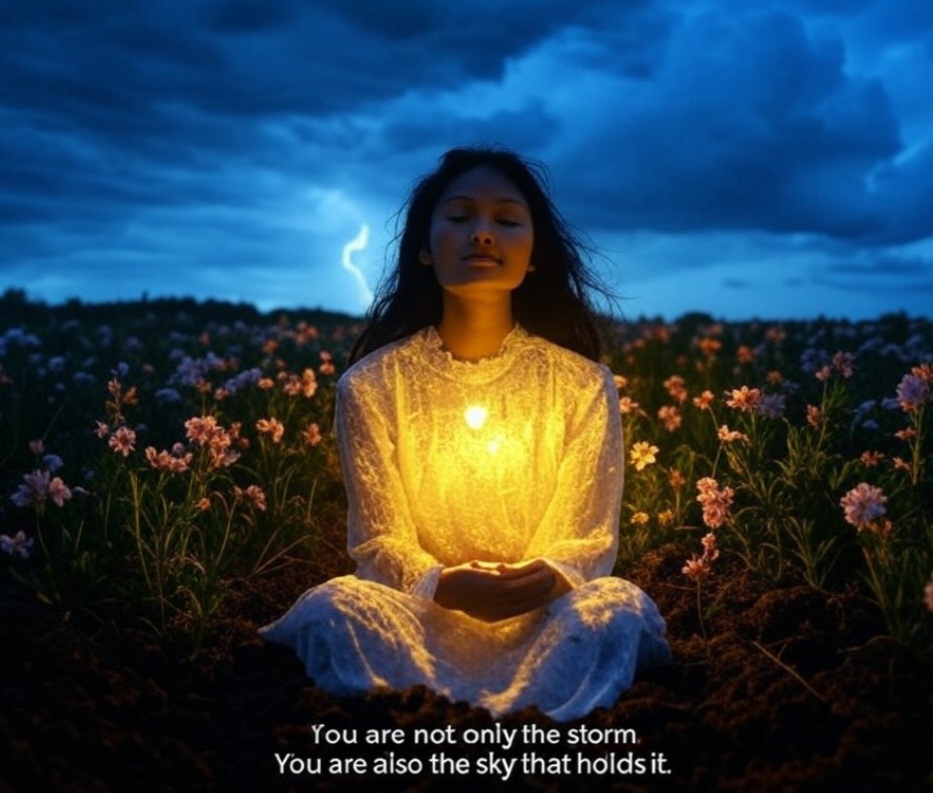
    Witnessing is not about escaping pain but about changing our relationship to it. It is the art of standing at the edge of the storm and seeing not just the thunder, but the vast sky that holds it.

    A Simple Self-Contemplation Practice

    1. Grounding in the Present
      Find a quiet moment. You don’t need perfect stillness—only a willingness to pause. Notice your body, the way it rests against the surface beneath you. Feel the breath, moving in, moving out, like waves against the shore.
    2. Observing Without Resistance
      Turn your attention inward. What is present? Fatigue like heavy earth? A nervous system like sparking wires? A mind that spins, restless and longing? Whatever it is, let it be here. Do not push it away or name it as the enemy. Simply notice.
    3. Holding with Compassion
      Imagine that each sensation is a visitor—arriving, staying for a time, and eventually leaving. What happens if you do not chase them away? What if, instead, you offer a quiet seat at your table?

    Even pain, even exhaustion, when met with this gentle witnessing, begins to soften. Not disappear, but shift—like wind through the trees, no longer trapped, no longer feared.

    How This Practice Supports ME/CFS Symptoms

    This is not a cure, nor a promise of relief, but a way of being with what is. When we meet our experience with openness:

    The nervous system settles; the fight against the body lessens.

    The mind uncoils from frustration and rests in the simple act of seeing.

    The emotional burden lightens, as we stop identifying with suffering and begin to witness it instead.

    Closing Thoughts: The Sky Holds It All

    If today your body feels like a storm, know that you are not only the storm—you are also the sky that holds it. The witness that watches, the stillness beneath the waves.

    And on days when you cannot sit in silence, when exhaustion presses too hard, let even that be witnessed with kindness. The practice is not in perfect stillness, but in the quiet turning toward whatever is here, again and again.

    Rest when you must, breathe when you can, and know that you are not alone.

    🙏🕊🙏

  • Kapalabhati Pranayama: The Shining Forehead Breath

    Kapalabhati Pranayama: The Shining Forehead Breath


    Dear Friend,

    There is a practice in yoga known as Kapalabhati, the “Shining Forehead Breath.” The very name carries with it a sense of poetry and mystery. “Kapala” means forehead, and “Bhati” means light or radiance. Together, they evoke an image of clarity, brightness, and inner illumination. This is no mere exercise but an invitation to cleanse not only the breath but also the mind and spirit, polishing the very space from which insight and intuition arise.

    In ancient times, practitioners likened this breath to polishing a mirror so that it might reflect the light of the divine. Each exhalation sweeps away impurities, and each inhalation invites the brilliance of life itself. To engage in this practice is to embark on a journey into your own radiant stillness.

    Here is how you may begin:

    1. Find Your Seat: Sit comfortably, with your spine straight and your hands resting gently on your knees. Feel the earth beneath you, steady and supportive.
    2. Breathe to Center Yourself: Take 5–7 slow, deep breaths. Let these breaths settle your thoughts and prepare you for the journey ahead.
    3. Engage the Shining Breath:
      • Take a full, deep inhale to begin.
      • Begin a series of sharp, active exhalations through your nose, allowing the inhalations to come naturally and passively.
      • Focus on the rhythm, like the steady beat of a drum, as your abdominal muscles contract with each exhalation.
      Start with 20–30 breaths per round, letting the breath carry you into its natural rhythm.
    4. Pause and Hold: At the end of the round, take a deep inhale. Hold the breath for a moment, feeling the stillness that arises, as if the universe itself has paused with you.
    5. Return to Natural Breathing: Exhale gently and let your breath return to its natural flow. Rest here, simply observing the quiet within.

    This is the essence of Kapalabhati. It is not about striving or achieving but about clearing away what obscures the light already present within you.

    As you continue to practice, you may notice the effects: a sharper mind, a lighter body, and a heart more attuned to the subtle rhythms of life. The breath becomes not just a function but a bridge—connecting you to the luminous self that watches over all.

    In the modern world, where distractions abound and our minds are pulled in countless directions, Kapalabhati offers a sanctuary. It invites you to return to simplicity, to the purity of breath, and to the stillness that holds all things. In this way, it is both a practice for the moment and a gift to carry with you into all moments.

    Dedication of Merit

    At the conclusion of this practice, let us dedicate whatever merit has arisen for the benefit of all sentient beings:

    May whatever merit has been accumulated in this practice flow outward, boundless and unending, for the benefit of all sentient beings.

    May all beings be free from suffering and the causes of suffering.

    May all beings experience happiness and the causes of happiness.

    May all beings awaken to enlightenment and the causes of enlightenment.

    May this moment of intention ripple through the universe, bringing peace, harmony, and light to all.

    Namo Buddhaya, Namo Dharmaya, Namo Sanghaya.

    I leave you with this reflection: Each breath you take is an opportunity to renew, to let go, and to shine. May this practice bring you clarity, lightness, and peace. And may it remind you of the brilliance that has always been yours.

    🙏🕊🙏


  • This Simple Practice Could Transform Life with ME/CFS—Feel Free to Ask Questions or Share Your Thoughts! 👍

    This Simple Practice Could Transform Life with ME/CFS—Feel Free to Ask Questions or Share Your Thoughts! 👍

    Resting in the Stillness of Witness Consciousness:

    To rest in Witness Consciousness is to embrace the stillness that exists beneath the surface of all thoughts, sensations, and emotions. It is the quiet awareness that watches without judgment, attachment, or resistance. Begin by settling into a comfortable position and turning your attention inward. Notice the thoughts or feelings that arise, but instead of engaging with them, observe them as you would clouds passing through a vast, open sky. With each breath, allow yourself to sink deeper into the stillness that holds everything. In this state of spacious awareness, you can release striving and simply be, knowing that your true self—the witness—is always present, whole, and at peace. Rest here, in the gentle embrace of the present moment, where the burdens of the mind are lifted, and the essence of stillness is revealed.

    Living with chronic fatigue syndrome (ME/CFS) brings immense challenges, not only to the body but also to the mind. The limitations imposed by this debilitating illness—constant fatigue, pain, and reduced capacity—can lead to frustration, grief, and a restless mind struggling to accept a life that feels constrained. In such a reality, the practice of meditation and cultivating witness consciousness becomes a refuge. By training the mind to rest in stillness and observe thoughts, emotions, and sensations without attachment, we can find a sense of inner peace amidst the turbulence. Witness consciousness helps us step back from our suffering, creating a space where we can gently acknowledge our experiences without being consumed by them. This compassionate awareness offers not only relief but also a pathway to greater resilience, even in the face of profound physical challenges.

    For centuries, human beings have grappled with the challenges of their minds. In simpler times, free of today’s overwhelming distractions, people focused on surviving through work, relationships, and health. Yet, even then, the teachings of the Buddha recognized the mind as the source of both suffering and liberation, offering practices to cultivate awareness and find peace amidst life’s trials.

    Today, the challenges of the mind remain, but they are compounded by endless distractions—technology, entertainment, and the allure of constant stimulation. These temporary escapes may numb the restless mind, but they do not heal its core discontent. The wisdom of meditation and mindfulness remains vital, offering a path back to inner stillness, even as the modern world pulls us in countless directions. Whether in the quiet of ancient times or the noise of today, the path of presence and witness consciousness offers clarity, resilience, and peace to those who walk it.

    Conclusion: An Invitation to Explore Witness Consciousness

    Witness Consciousness offers a refuge for anyone seeking peace amidst the challenges of living with chronic fatigue syndrome (ME/CFS). By embracing this practice, we learn to release the grip of mental and emotional struggles, finding a stillness that can transform our relationship with illness and limitations. This journey of cultivating awareness and resting in the present moment is not only a path to inner peace but a way to reconnect with the profound resilience and wisdom already within us.

    I invite you to share your experiences or questions as you explore this practice. Whether you are new to meditation or looking to deepen your journey, your insights and reflections are invaluable. Let’s create a space of shared learning and support, where we can grow together in this practice of stillness and presence.

    Please feel free to share and let others know if you find this practice of cultivating a Witness Consciousness of benefit to your experience of living with ME/CFS.

    🙏🕊🙏