Tag: disability

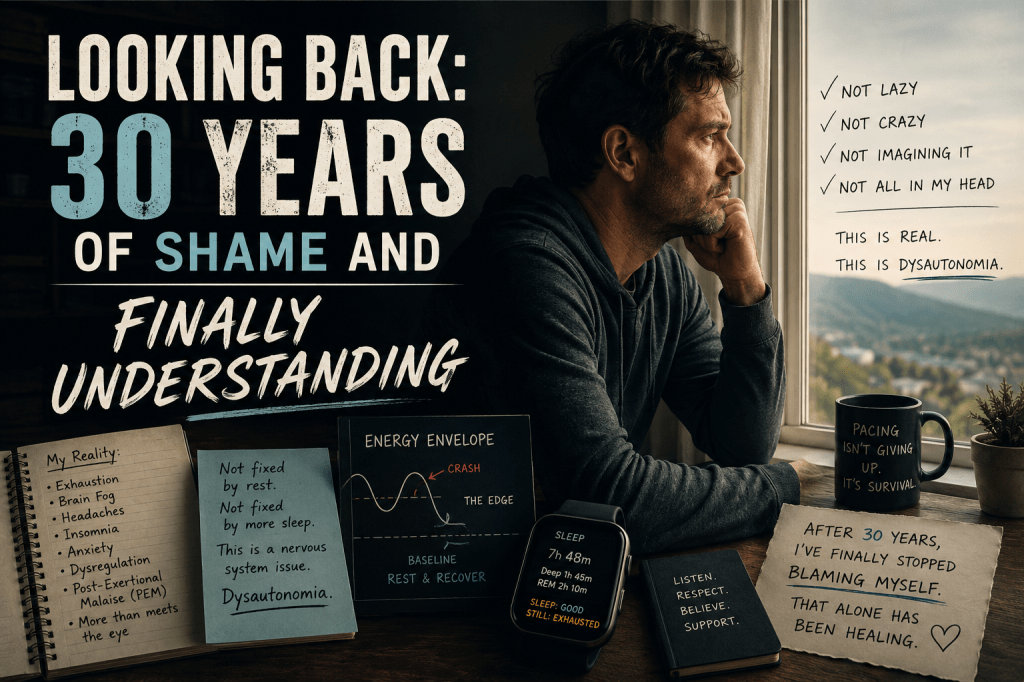
  • Looking Back: 30 Years of Shame and Finally Understanding My Experience

    Looking Back: 30 Years of Shame and Finally Understanding My Experience

    I’ve lived with this illness for over 30 years, and for most of that time I was ashamed of it.

    Doctors kept telling me it was all in my head.

    They said I was depressed, anxious, or that I just didn’t want to work hard enough. They usually prescribed antidepressants and anti-anxiety medications, claiming these drugs would fix me. While the medication may have helped my emotional state somewhat, it did nothing to fix the physical symptoms.

    Thankfully, I eventually stopped letting them gaslight me into taking more and different medications.

    Every time I tried to explain how my body would completely crash after doing normal things, I was met with skepticism or pity.

    So I started doubting myself.

    I felt weak.
    I felt crazy.
    I carried a lot of shame for something I couldn’t control.

    The fatigue and exhaustion that comes with this illness is crushing.

    It’s not normal tiredness. It’s a deep, heavy exhaustion that sleep doesn’t fix. Even the smallest activities can leave me completely wiped out for days.

    My sleep tracker consistently shows that I get adequate deep sleep and REM sleep, yet I still wake up exhausted. That helped me understand something important:

    The problem isn’t simply how much I sleep.

    It’s that my dysautonomia prevents the sleep from being restorative.

    In the early years, the emotional side of it felt a lot like PMS — that same sudden emotional dysregulation, irritability, and feeling completely off — except instead of happening once a month, it could hit at any time.

    Only recently have I finally understood what’s really happening.

    What I have is dysautonomia.

    My autonomic nervous system doesn’t regulate properly anymore.

    That’s why I can suddenly feel freezing cold in a warm room. That’s why I’m much more comfortable lying down than sitting or standing. And that’s why even mild activity can make my whole system short-circuit — suddenly bringing on intense brain fog, overwhelming exhaustion, headaches, insomnia, anxiety, and sometimes depression all at once.

    ME/CFS always felt like an incomplete label to me.

    Yes, I crash after exertion.
    Yes, sleep doesn’t fix it.
    Yes, my body has never functioned the way people expect it to.

    But understanding it as dysautonomia finally explains the day-to-day reality of living in a body whose nervous system breaks down so easily.

    The only thing that actually helps is pacing — staying within my energy envelope.

    I try to live as close to the edge as I can, but carefully. Migraines and tinnitus have become warning signs for me. If I respect those early signals, I can often avoid triggering insomnia, which is far worse than a regular crash and completely throws me off balance.

    After 30 years, I’ve finally stopped blaming myself.

    That alone has been healing.

    I’m sharing this journal entry in case it gives someone else a little more language for their own experience.

    And for family members, friends, and doctors: please know that when we keep turning down invitations, or seem withdrawn, or disappear for long stretches of time, it’s not because we don’t want to be around you.

    Our energy is extremely limited.

    We have to be very careful to avoid crashes.

    Even now, I keep a little journal between doctor visits so I can clearly communicate what I’ve been experiencing. If you’re struggling to explain this illness during appointments, writing things down and bringing it with you can be incredibly helpful.

    Sometimes understanding does not cure the body.

    But it can begin to release the shame.

    And after so many years of being misunderstood, that matters.

  • Redefining ‘Exercise’ for Severe ME/CFS & PEM: The Smallest Victories Matter

    Redefining ‘Exercise’ for Severe ME/CFS & PEM: The Smallest Victories Matter


    Please honor your own energy envelope as you read. Whether a sentence… a paragraph… or even a glance at the headings, whatever feels right for you in this moment is perfect. Compassion. 🙏


    When we speak of “exercise,” what do we really mean?

    For most of the world, the word conjures images of jogging paths, yoga mats, or perhaps the thrill of surfing. But for people living with severe ME/CFS, Long COVID, or energy-limiting illnesses, those images feel alien—sometimes even harmful.

    A recent article critiquing Graded Exercise Therapy (GET) made some valid points about the dangers of pushing beyond one’s limits. But it included an example of going surfing as a form of joy-based movement. For many of us who can’t even sit up for long, that kind of suggestion doesn’t just feel out of touch—it feels quietly devastating.

    Because for us, “exercise” might mean:

    • Sitting up in bed for 60 seconds.
    • Taking a shower.
    • Getting dressed.
    • Writing a message to share with friends.
    • Fill in the blank: _______

    These are our mountains.
    These are our triumphs.
    And they deserve to be seen and celebrated.


    Why Surfing Isn’t a Helpful Example

    1. Most patients are not high-functioning.
    Many of us are bedbound, housebound, or dependent on wheelchairs. To suggest activities like surfing may not feel inspiring—it may feel shaming.

    2. PEM doesn’t care about your mindset.
    A shower can mean days in the dark. Making tea can require a week of recovery. GET fails not because we aren’t trying—but because our cells can’t keep up.

    3. Joy comes from adaptation, not performance.
    Recovery may—or may not—be possible. But living meaningfully within this illness is. A breath of fresh air, a ray of light through the curtain—these are sacred moments.


    A More Gentle Framework: What Is Possible?

    1. “Bedercise”: Movement Within the Envelope

    • Gentle arm lifts (or just muscle engagement)
    • Ankle rolls for circulation
    • Breathwork as internal movement
    • Stretching fingers, wiggling toes

    Each of these is valid. Each of these is enough.

    2. Celebrating Non-Physical Victories

    • Listening to a few minutes of an audiobook
    • Looking out the window
    • Enjoying the scent of tea or essential oil
    • Smiling, even once

    3. The 50% Rule
    If you think you can do something—do half.
    If you could clean the counter, just rinse a spoon.
    This helps avoid crashes and still creates a feeling of self-direction.

    4. Redefining Progress
    Progress may mean staying stable.
    It may mean one less crash this month.
    Or sitting up for 30 seconds longer.
    These are wins, even when invisible.


    A Call for More Inclusive Stories

    If we want real awareness, we must include severe ME/CFS patients—not just those well enough to surf or work part-time.

    Your struggle matters.
    Your body is not broken—it is navigating a broken system.
    Your stillness is not failure.
    It is wisdom in motion.


    Rest Is a Practice—A Sacred One

    For those with ME/CFS and other energy-limiting conditions, rest is not absence. It is presence. It is the heart of the path.

    In Dzogchen, as taught by Namkhai Norbu, rest is a return to the natural state—effortless, luminous, whole. In Ramana Maharshi’s Self-Inquiry, resting in the question “Who am I?” leads us not into striving, but into the stillness beneath all identity. In Samatha meditation, taught by the Buddha, rest is calm abiding—shamatha—the ability to remain at ease without grasping.

    When you lie in stillness,
    when you breathe quietly through exhaustion,
    when you choose not to push—

    You are exercising.

    You are aligning with ancient lineages that saw rest not as a failure of effort,
    but as the purest exercise of wisdom.

    So if all you did today was rest,
    you did something holy.

    🙏🕊🙏


    For those interested, here is the article that inspired my post. But, Surfing! Haha! 😆 Surfing the internet, maybe. The author clearly doesn’t consider people living with moderate or severe ME/CFS in his/her writing of their article. 🤔

    SOURCE LINK: Why Graded Exercise Fails for PEM (And What Actually Works)

  • Embracing the Journey: Navigating Life with Chronic Fatigue Syndrome

    A Reflection on Resilience and Compassion

    In the tapestry of time, woven with threads of understanding, empathy, and love, I extend my hand to you, a fellow traveler in the realm of chronic fatigue syndrome. It’s not just a condition; it’s a journey, a complex dance with our bodies and minds. You are not a hypochondriac; you are a warrior navigating the intricate landscape of your own existence.

    Having walked the same path, I resonate with the words, “After a lifetime of living with chronic fatigue syndrome, you’d think I’d be better at it now.” Each day, a new chapter unfolds, revealing the resilience within us. It’s not about perfection or mastery; it’s about learning, adapting, and discovering the strength that resides within, often unnoticed.

    Embrace the wisdom your journey has bestowed upon you. You’ve acquired an intimate knowledge of your body and mind, a profound understanding that defies the misconceptions others may hold. You are not defined by the fatigue that courses through your veins; you are defined by the courage with which you face each day.

    In this shared experience, let love be the balm that soothes the weariness, understanding the salve that heals the wounds unseen. As you unravel the layers of your existence, remember that every nuance of your journey contributes to the masterpiece of who you are.

    Encourage yourself to practice self-compassion daily. Recognize the victories, no matter how small, and celebrate the resilience that continues to blossom within. You are not alone in this intricate dance; we move together, step by step, navigating the ebb and flow of chronic fatigue syndrome.

    May your days be adorned with moments of understanding, empathy, and love – the pillars that support you on this remarkable journey.

    May your journey continue to be filled with peace, wisdom, and compassion. 🙏

    May we all embrace our journey with a compassionate and open heart, finding solace in the present moment on our path with ME/CFS.

    🙏🕊️🙏