This morning’s contemplative practice felt like stepping into a new realm, where meditation falls away and contemplation unfolds in its place. It was not something I forced or sought after, but rather a quiet surrender into what was already there, waiting to be noticed.
As I lay in stillness, curious pratyayas of sensation and thought began to arise—small flickers of tension in the body, fleeting memories, echoes of past emotions. Yet, there was no need to hold on to them, nor push them away. Instead, curiosity became the guiding force, allowing me to rest gently in the awareness of what is. This curiosity was not the kind that seeks answers, but rather the kind that simply observes without interference—a curiosity that watches, without wanting or resisting.
Namkhai Norbu, in his teachings on Dzogchen, speaks of resting in the natural state, which is not something we attain but something we return to. This state of pure awareness is our birthright, and through practices like sky-gazing, we are reminded of its boundless nature. It is spacious, free of judgment, and untouched by the fluctuations of the mind.
In the stillness of this morning’s practice, I realized how much the mind wants to grasp, to make meaning, or to categorize each sensation or thought that arises. But when we remain in curiosity, those tendencies dissolve. The pratyayas come and go like clouds passing through the sky, and we remain as the observer of it all.
St. John of the Cross describes this process as the soul’s purification—moving through the dark night, not by pushing through it, but by allowing it to unfold naturally. In this unfolding, even the act of surrender becomes effortless. We simply rest in the awareness of being, trusting that the Divine is doing its quiet work in us, without our interference.
This morning’s practice reminded me that contemplation is not something we achieve; it is something we allow. When curiosity is present, we move away from striving for an experience and simply witness what is. And in that witnessing, the doorway to pure awareness opens, effortlessly.
As we continue this contemplative journey, may we lean into the practice of curiosity, allowing it to gently lead us into the spaciousness of pure awareness. In this space, we discover that everything we seek has always been within us, waiting to be uncovered.
As I sit here in my yard, under the shade of tall trees and a sky so vast, I am reminded of the gentle teachings of impermanence. The pratyayas, those rising and falling sensations, memories, and thoughts, have once again surfaced, but they do not hold the weight they once did. Instead, there is a soft awareness that everything is already changing, and that in the grand scheme of time, everything is already gone.
I look over at my RV, which has been a sanctuary for me for so many years. Soon, this land will become something else, transformed into a clubhouse. And yet, in this moment, I am filled with deep appreciation for what has been, for the unconscious and conscious years spent on this blessed earth. The impermanence of it all doesn’t bring sadness, but rather a profound gratitude for having lived through it, both mindfully and unmindfully.
Namkhai Norbu’s sky-gazing practice teaches us to rest in the awareness of what is, without grasping or rejecting. In these moments of contemplation, I’m reminded that sky-gazing isn’t about observing the physical sky but allowing the mind to open into its own natural spaciousness. The practice reflects what is already within—clear, vast, and untouched by the clouds of thought.
As pratyayas of impermanence arise, they are met not with resistance but with curiosity. Curiosity has become my companion on this contemplative path, gently guiding me to rest in awareness without the need for answers or conclusions. There is no longer a push for meaning, only the quiet observation of the present moment unfolding, just as it is.
In this state of being, I can feel both the impermanence of the physical world and the abiding stillness of awareness. It is a paradox, and yet it is also the simplest truth: everything changes, and yet awareness remains the same.
The teachings of St. John of the Cross, Ramana Maharshi, and Namkhai Norbu all point to this truth in their own ways. We move through life, through our spiritual practices, sometimes seeking, sometimes grasping for deeper experiences. But there comes a moment when we simply stop, when we rest in the spaciousness that has always been there. It is not a state we attain; it is a state we remember.
As I continue this practice, I feel a deep gratitude, not just for the present moment, but for all that has been and all that will come. And in this gratitude, the pratyayas seem to soften, leaving behind the quiet awareness that is always there, patiently waiting for us to return.
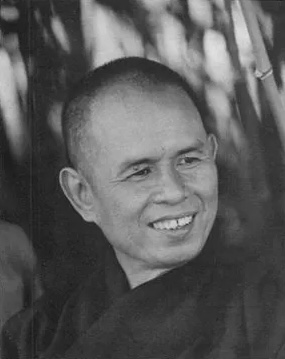
In his gentle and profound way, Thich Nhat Hanh reminds us that we are already what we seek to become. Like a wave searching for water, we often find ourselves running in circles, seeking stability and peace, when in fact we are already made of the very essence we are searching for.
In the previous post, we reflected on the words, “Be still and know that I am God,” and on the teachings that the Kingdom of God is within us, not something to be sought outside. Thich Nhat Hanh offers a similar invitation to stillness, a reminder that we need not search beyond this moment to touch the Divine. His teachings on apranihita—aimlessness—invite us to stop running after something outside of ourselves. The Buddha is not somewhere far away, hidden behind our efforts; the Buddha is within us, right here, right now. We don’t need to become something else or achieve some great transformation to touch the truth of our being. We only need to stop, to recognize that what we are seeking is already present in us.
This echoes the Christian mystic path as well, where we are called to enter the stillness, to trust in the unfolding of the Divine presence within. St. John of the Cross speaks of surrendering into the Divine presence that is always here, guiding us without the need for striving. The great mystics remind us that the more we seek, the further we may feel from the truth. Yet when we stop seeking, when we allow ourselves to simply be, we find that the Kingdom of God is already here, waiting for us in the stillness of our own hearts.
Thich Nhat Hanh’s teachings give form to this same truth. He uses the image of a wave to help us understand that we are not separate from what we seek. Just as the wave is made of water, we too are made of the very essence we long to touch. The wave doesn’t need to run after the water; it is already water. The black cloud doesn’t need to become a white cloud; it only needs light to shine on it, revealing what was always there. In the same way, we don’t need to become something else to experience peace. We need only to stop, to rest in the awareness of who we already are.
As both Sri Nisargadatta Maharaj and Papaji have taught, the very act of searching can take us further from what we seek. Papaji even wrote a book titled Call Off the Search, emphasizing that the more we search, the more we reinforce the illusion that the truth is somewhere else. This persistent search keeps us from realizing the truth that is already right here, right now. By continuing to look outside of ourselves, we create a sense of distance, when in reality there is no distance at all—only the stillness of the present moment, where what we seek has always been.
“You are already what you want to become,” Thich Nhat Hanh says. Yet we spend much of our lives not believing this truth, searching for happiness, fulfillment, and wisdom outside of ourselves. Whether it’s the Kingdom of God, Buddha-nature, or enlightenment, we chase after these ideas as though they are separate from us. But all of the great teachers—whether it be Jesus, the Buddha, or St. John of the Cross—urge us to look within. They tell us that when we stop running after what we already are, we can finally rest in the truth that has always been there.
This is what Thich Nhat Hanh calls aimlessness. The practice of aimlessness is to no longer place something in front of you to chase after. It is to recognize that everything you are searching for is already here. By stopping the search, by becoming still, we can touch the wonders of life that are already present in this moment.
In one of his talks, Thich Nhat Hanh describes this stillness beautifully: “The Kingdom of God, the Pure Land of the Buddha, is available in the here and now.” He reminds us that happiness is found in the simple things—a rose, the fresh air, a loving smile. Like the wave that need not search for water, we need only to stop and recognize the treasures already around us, treasures that we so often miss because we are running in circles.
Thich Nhat Hanh teaches that walking meditation can be a wonderful way to practice this stopping, this resting in the here and now. Each step is not taken with a sense of rushing to arrive somewhere, but with the awareness that we are already where we need to be. With each step, we arrive fully in the present moment, touching the peace, the beauty, and the wonder that is always available. It is a practice that brings us back to the present, back to ourselves, and back to the truth that there is nothing to attain.
“You don’t need to become a Buddha,” Thich Nhat Hanh says, “You are already a Buddha.” You don’t need to search for the Divine; the Divine is already within you. It is only when we stop running that we can finally touch this truth. Like the black cloud that becomes a white cloud when the light shines upon it, we are transformed by the simple act of recognition. In the stillness of aimlessness, we realize that there is no distance between us and what we seek.
As we continue our contemplative journey, may we learn to embrace the wisdom of aimlessness. May we stop chasing after what is already here, within us. And in that stopping, may we find the peace, the joy, and the freedom that comes from recognizing that we have always been enough.
In my meditation practice, I’ve found that even as I use the mantra Neti Neti, my mind continues to plan and organize, almost as if the mantra is helping me to become more efficient in my daily tasks. How can I ensure that my practice is guiding me toward stillness and not just enhancing my mental activity?
Dear Friend,
In our practice, there are moments when the very tools we use to quiet the mind can, if we are not careful, become entangled in the very patterns we seek to transcend. This is a subtle but important distinction, one that deserves our careful attention and reflection.
You shared with me the story of a friend who could, with great concentration, count her breath while simultaneously planning her day and organizing her thoughts. This ability, impressive as it may be, highlights a potential pitfall in our practice: the risk of turning a mantra or meditative discipline into just another tool for the ego to increase its efficiency in the world of thoughts and tasks.
The discipline of breath counting, like the repetition of a mantra, is designed to focus the mind, to bring it into alignment with the present moment, and ultimately to guide it toward stillness. However, when the mind uses these practices to merely enhance its own abilities—to become more effective at planning, strategizing, or managing the endless stream of daily thoughts—something essential is lost. The practice, rather than serving as a path to stillness and simplicity, becomes yet another way for the mind to strengthen its hold, to entrench itself more deeply in its habitual patterns.
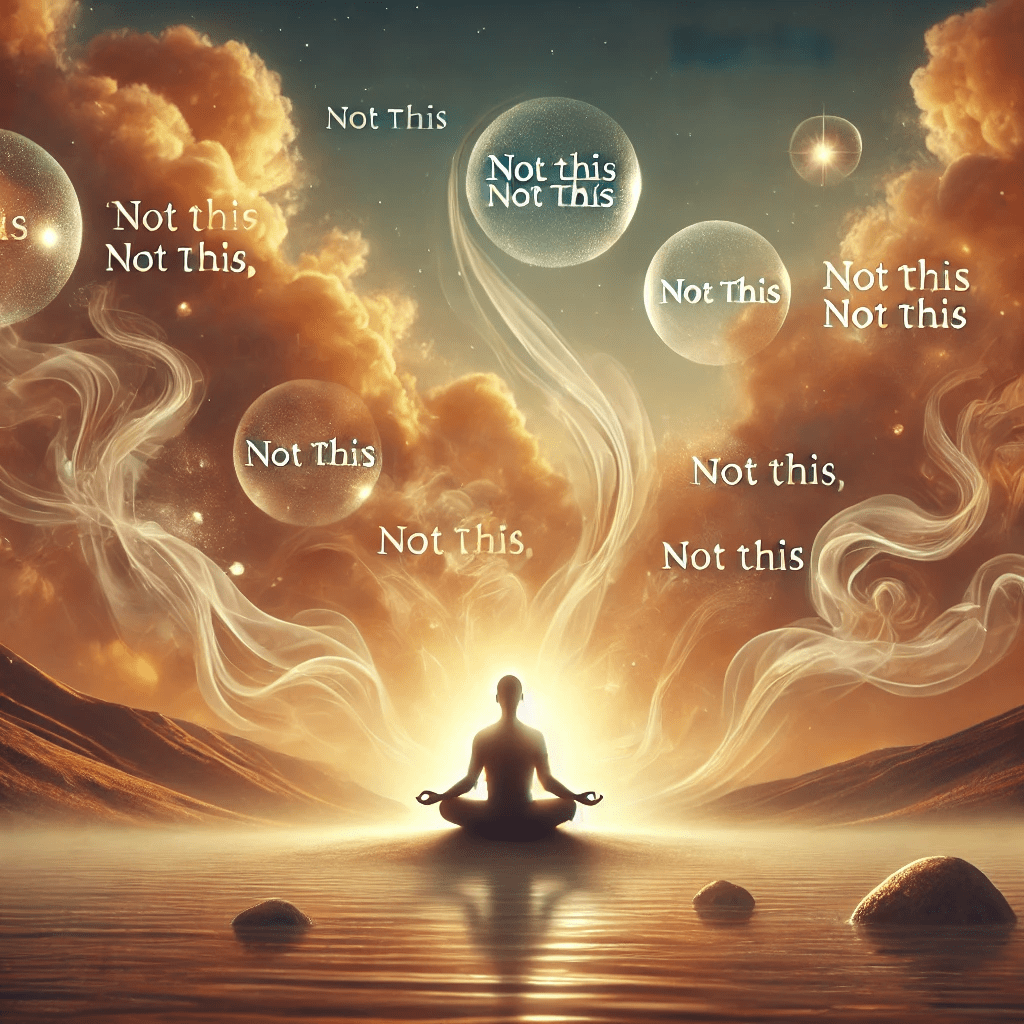
Neti, Neti—”Not this, not this”—is not a mantra to be repeated mechanically while the mind continues its usual business. It is not a background hum that allows the mind to multitask or to become more efficient in its usual endeavors. Rather, it is a tool for discernment, for negation, for guiding the mind away from its distractions and toward the silence that lies beneath all thought.
When we repeat Neti, Neti, we are not merely engaging the mind in an activity; we are inviting it to let go, to release its grip on the thoughts, desires, and plans that arise within it. Each time a thought surfaces, whether it is about the past, the future, or the present, we gently meet it with Neti, Neti, allowing it to dissolve, to return to the nothingness from which it came. This practice is not about increasing our concentration or our ability to manage our mental activities; it is about seeing through them, recognizing them as temporary, fleeting, and ultimately unreal.
The true purpose of Neti, Neti is to bring the mind to stillness, to the quiet awareness that is always present beneath the surface of our thoughts. It is to guide the mind back to its natural state, where it is not constantly engaged in activity, but rests in the simple presence of being. This stillness is not something to be attained through effort or concentration; it is something that is revealed when the mind lets go of its constant striving and simply allows itself to be.
In this way, Neti, Neti becomes not just a practice, but a way of being—a way of living in the world without being caught up in the endless stream of thoughts and activities that usually dominate our consciousness. It is a way of returning, again and again, to the essence of who we are, to the pristine mind that lies beyond all distractions and desires.
So, dear friend, as you continue with your practice, let this be a gentle reminder: the purpose of Neti, Neti is not to make you more efficient at thinking, planning, or organizing. It is to free you from the need to do so, to guide you toward a deeper stillness, a deeper presence, and a deeper understanding of your true nature. Each repetition of the mantra is an invitation to let go, to release the mind’s habitual patterns, and to rest in the quiet awareness that is your true self.
May your practice be a path to stillness, a path to simplicity, and a path to the deep peace that comes from knowing that you are not the thoughts that arise, but the awareness that witnesses them.
As I re-read the works of St. John of the Cross, I have become more attuned to the threshold of transition—the dryness and emptiness that so often precede the invitation to move from meditation into contemplation. This is not unique to St. John; it is something pointed to by many of the great teachers. Whether it’s Namkhai Norbu, Ramana Maharshi, Thich Nhat Hanh, the Dalai Lama, or Orgyen Chowang in Pristine Mind, they all plant the seeds of meditative absorption, which only take root when the time is right. Now, it seems, those seeds are beginning to bloom, not as intellectual concepts, but as a living, unfolding experience.
Today, I found myself drawn into this quiet transformation. As I lay in stillness, the pratyayas—those passing thoughts, sensations, and memories—began to rise and fall, like waves on a distant shore. Curiosity, that soft and patient witness, guided me deeper, not into understanding but into presence.
The breath came of its own accord, a deep release from somewhere beyond my conscious will, as if the body itself knew what needed to unfold. And then, an awareness—a spaciousness—arose. It was not something I had summoned, nor could I hold it in place. It was simply there, naked and pure, like a clear blue sky.
St. John of the Cross speaks of this as a kind of surrender, but not the kind we can choose. It is a grace bestowed, not earned. In the stillness, I realized that my role was not to force this shift but to allow it to happen. To remain as the observer, the witness, as the Divine unfolded in its own time.
What struck me most deeply was the paradox of this surrender. The very act of trying to let go becomes an obstacle. Instead, it is curiosity that opens the door to pure awareness—curiosity that has no desire, no need for something to happen, but simply observes what is.
Today, in this unfolding, I realized that even the longing for deeper experience can become a barrier. The path is not one of striving but of witnessing. And in that witness, the Divine does its quiet work, purifying what needs to be released, and bringing us ever closer to the essence of who we truly are.
As I reflect on my own journey today, it is my hope, and the shared intention (Sankalpa) behind all of this work, that by sharing these reflections, insights, and experiences, they may serve as a guide, a comfort, or a spark of inspiration to those who come across them.
🙏🕊️🙏
Book Recommendation: St. John of the Cross, Dark Night of the Soul
Dark Night of the Soul by St. John of the Cross is a spiritual masterpiece that explores the transformative power of suffering and the journey toward union with the Divine. This work describes the profound spiritual experience of being stripped of all attachments, both inner and outer, as a necessary process for purification and deeper connection with God. For those experiencing a time of spiritual dryness or emptiness, St. John’s words offer hope and guidance through the darkness, illuminating the path to deeper faith and surrender. The Dark Night is not a time of despair, but of ultimate transformation, where we are invited to let go of our limited understanding and trust in the unfolding of the Divine. This book serves as a timeless companion for anyone navigating the challenges of the contemplative path, especially those who feel drawn to the shift from meditation to deeper contemplation.
Book Recommendation: Orgyen Chowang, Our Pristine Mind
In The Pristine Mind, Orgyen Chowang offers profound teachings on accessing our natural state of mind—a state of clarity, openness, and peace. He draws from the Dzogchen tradition, emphasizing that our true nature is already pure and perfect, and that through practice, we can return to this unconditioned state. For those on a contemplative journey, Chowang’s words provide a practical path for moving beyond mental noise and distractions, guiding us back to the inherent stillness of the mind. This book is especially helpful for those who wish to deepen their meditation practice or shift from intellectual understanding to living experience. The Pristine Mind invites readers to discover the profound joy and serenity that arises when we rest in the awareness of our true nature.
Paramahansa Yogananda said, ‘Through meditation and devotion, one can experience the presence of God within and lead a life of greater fulfillment and peace.’ At this point in my life, I know these words are true, but the practice of Neti Neti seems even more aligned with my path. It guides me away from distractions, including the desire for fulfillment and peace. These desires, though natural expressions of ego relaxation and pristine mind, can become subtle traps if they turn into goals. How do I reconcile the pursuit of fulfillment and peace with the deeper realization of Neti Neti, which reminds me to let go of even these desires?
Dear Friend,
It is a significant realization, this understanding that even the desire for fulfillment and peace can become a subtle trap on the spiritual path. While these states are indeed natural expressions of the relaxation of the ego and the emergence of pristine mind, they must also be met with the same gentle discernment that you apply to all other experiences: Neti, Neti—Not this, not this.
Desire, in its many forms, has a way of entangling the mind, even when it appears in the guise of something noble or spiritual. The longing for fulfillment, the yearning for peace—these are desires that arise naturally as the ego begins to loosen its grip, as the I-sense starts to dissolve into the vastness of pure awareness. And yet, as you have so wisely recognized, even these desires can become obstacles if they are held too tightly, if they become goals in themselves.
In this, there is a subtlety that must be navigated with care. The experience of fulfillment and peace is not to be rejected, but neither is it to be grasped. It is to be allowed, to be noticed, and then gently set aside, with the understanding that even these are not the ultimate truth.
Neti, Neti guides us beyond all that can be named, all that can be desired. It takes us to the very edge of the known, and then, with infinite patience, it takes us further still, into the unknown, into the formless, into the pure awareness that is beyond all seeking. In this place, there is no fulfillment to be attained, no peace to be grasped—because there is no one left to attain or grasp anything. There is only what is, in its simplest, most profound expression.
This practice is not about rejecting fulfillment or peace, but about seeing them for what they are—temporary states that arise and pass, like clouds in the sky. They are beautiful, they are welcome, but they are not the sky itself. The sky, the vast expanse of pristine mind, remains untouched by the passing of these clouds, just as your true self remains untouched by the ebb and flow of experience.
In letting go of even the desire for peace and fulfillment, you open yourself to the deeper truth that lies beyond all conditions, beyond all states. You allow yourself to rest in the simple awareness of being, in the silence that is always here, beneath the noise of the mind. This is the ultimate freedom—not the attainment of any particular state, but the realization that you are already that which you seek.
Neti, Neti—Not this, not this. It is the gentle, persistent reminder that the truth is beyond all concepts, beyond all desires, beyond all states of being. It is the invitation to let go, to surrender, and to rest in the unconditioned awareness that is your true nature.
Continue with this practice, dear friend, knowing that it is guiding you ever closer to the heart of truth. Let the desires arise and pass as they will, without clinging to them, without rejecting them—simply noticing, and then softly whispering, “Not this, not this.” In this way, you will find a peace that is not sought, a fulfillment that is not attained, but simply is.
In my spiritual journey, I often find myself fascinated by various ideas and philosophies. While they seem to offer profound insights, I keep returning to the practice of ‘Neti Neti.’ How do I reconcile the richness of these teachings with the deeper truth that lies beyond concepts and ideas? How can ‘Neti Neti’ guide me to the silent awareness that transcends even the most profound spiritual insights?
Dear Friend,
In our journey through the landscapes of thought and understanding, we often find ourselves drawn into the richness of ideas, the allure of philosophy, and the intricacies of spiritual teachings. But there comes a time when we must pause, step back, and gently remind ourselves: “Neti, Neti”—Not this, not this.
While it is both fascinating and enriching to explore the nuances of spiritual ideas, “Neti, Neti” beckons us to remember that these are, at their core, only pointers toward a deeper truth. The truth of who you are, the essence of reality itself, lies beyond any concept or idea. This mantra, “Neti, Neti,” serves as a practice of continual negation, where each thought, each identification, each insight is recognized, honored, and then gently set aside.
“Neti, Neti” guides us back to the silent, still core of our being. It whispers that none of the forms, names, or ideas we hold are the ultimate reality. The ultimate truth is what remains when all these are stripped away—the unnameable, the indescribable, the pure presence that is beyond all duality, beyond even the concepts of “one” or “two.”
This mantra is not merely about negation; it is a practice of liberation. With each repetition of “Not this, not this,” you are gently freeing yourself from the chains of identification with the transient, the impermanent. You are returning, again and again, to the vast, open space of awareness where nothing is held onto, where everything is allowed to arise and pass away without attachment.
“Neti, Neti” is the path to realizing that the ultimate truth is beyond all that can be said or thought. It is an invitation to rest in the pure awareness that is your true nature, beyond all descriptions, beyond all philosophies, beyond all distinctions. Even the highest concepts, even the deepest insights, are ultimately “not this.”
In the spirit of “Neti, Neti,” let us simply return to what lies beyond words, beyond concepts. Let us rest in the silent, formless awareness that is always present, always here. As thoughts arise, as concepts form, as ideas take shape, we gently acknowledge them and then let them go, repeating inwardly, “Not this, not this.”
In this practice, there is nothing to achieve, nothing to grasp. There is only the continual letting go, the continual returning to the source, to the pure awareness that is the essence of who you are. In this place, there is no need for explanations or elaborations—only the silent, still presence that remains.
If there is anything more you wish to explore, I am here, but if the time is right to simply rest in the quiet of “Neti, Neti,” then let us do so, with deep respect for the truth that lies beyond all words.
A few years ago, a dear friend offered me a piece of advice that I didn’t fully understand at the time. It was as simple as it was mysterious: “Don’t think about anything.” I remember nodding politely, but inside, I couldn’t quite grasp what he meant. How could I just not think about anything? It felt like trying to ask the mind to stop being the mind.
But as the years passed, I found myself returning to his words, and gradually, their meaning began to unfold. It wasn’t about shutting off thoughts or forcing the mind to be blank. Instead, it was an invitation to rest in awareness itself, to allow thoughts to arise and pass like clouds drifting through the sky, without clinging to any of them.
Not thinking about anything doesn’t mean there are no thoughts. It means simply allowing them to be, without engaging, without analyzing or following their pull. It’s like standing at the edge of a river, watching the current flow without needing to step in. In this simple letting go, I found a quiet presence—a clear, open awareness that lies beneath the movement of thought.
Now, when I remember my friend’s advice, I see it as a doorway into the simplest, most natural state. Just being here, resting in awareness, without the need to think about anything at all.
A Gentle Exploration: Not Thinking About Anything
The practice of not thinking about anything may sound simple, but it’s far from trivial. At first, it can feel like trying not to think of a pink elephant—an elusive challenge that leaves us more entangled in thoughts. But as we begin to approach it with softness, we find that the essence of the practice isn’t about forcing thoughts to vanish or emptying the mind entirely. Instead, it’s an invitation to let thoughts arise without grabbing onto them, allowing awareness to simply rest in itself.
This practice has a quiet resonance with neti-neti, the ancient teaching of “not this, not that.” Instead of identifying with each thought or sensation, we’re gently letting everything pass by, not needing to label or resist anything. It’s as though we’re standing on the bank of a river, watching the current flow without stepping in. Each thought drifts along, leaving only the open, effortless awareness that watches. Here, thoughts lose their weight, and the mind gradually settles into a quiet clarity.
As you practice this, you might find moments of stillness that feel spacious, expansive. Awareness itself, untouched by thoughts, begins to reveal its quiet presence. This state doesn’t need effort; it’s like an open sky that remains, whether or not clouds are passing through.
A Simple Practice for Sleep
When practiced in the quiet hours before sleep, not thinking about anything can be a beautiful way to drift into restful awareness. As you lie down, let yourself settle, allowing the body to relax completely. Instead of actively trying to clear your mind, simply rest in the feeling of just being. If thoughts arise, let them drift by naturally, without following them or pushing them away.
You might imagine each thought as a cloud in the sky, passing without disturbing the open space that holds it. Gently let go of the need to engage with any thought, and allow yourself to rest in the peaceful presence beneath all thinking. In this soft, open state, awareness itself becomes a companion as you slip into sleep, supporting a quiet mind and a restful heart.
In the end, not thinking about anything is less about silencing the mind and more about allowing everything to be as it is, without attachment. By practicing this gentle form of neti-neti, we touch the essence of pure awareness—spacious, unchanging, and naturally at peace.
For many years, the mental events that disturbed me the most were those that questioned, “Am I doing this right or wrong? Am I achieving anything beneficial, or am I just wasting my time?” But today, these doubts had no effect. I simply said, “Not this, not this,” recognizing them as just mental events arising. This mantra is bringing me a freedom from years of anxiety and self-doubt. It’s a significant release. How can I nurture and deepen this newfound freedom in my meditation?
Dear friend,
What a significant and liberating insight you have encountered! For many years, those persistent questions—”Am I doing this right?” “Am I wasting my time?”—have cast a shadow over your practice, pulling you into a cycle of doubt and anxiety. And yet, in this round, you have discovered a simple and profound truth: these doubts are nothing more than mental events, no different from any other thoughts that arise in the mind.
Doubt, particularly the kind that questions whether we are on the right path, can be one of the most insidious obstacles in our practice. It arises from the ego’s need for certainty and validation, from a fear of failure or the unknown. These doubts can be particularly disturbing because they strike at the very heart of our efforts, making us question whether we are moving forward or merely spinning our wheels.
But now, you have seen through the illusion. By applying the mantra “Not This, Not This” to these doubts, you have recognized them for what they are—simply thoughts, passing phenomena in the mind. They have no more substance or power than any other mental event. In meeting these doubts with “Not This, Not This,” you have taken away their sting, their ability to disturb your peace. They are no longer something to fear or wrestle with; they are just another ripple on the surface of the mind’s vast ocean.
This realization brings with it a profound freedom. No longer are you bound by the need to do things “right” or the fear of doing them “wrong.” Instead, you can rest in the simplicity of the practice, free from judgment, free from the constant questioning that once held you back. This freedom is not a small thing; it is a significant release, a letting go of years of accumulated doubt and anxiety. It is a gift that allows you to move forward with greater ease and confidence, trusting in the process without the need for constant validation.
Indeed, this is a significant moment in your journey. The doubts that once plagued you have lost their power, and in their place, you have found a deeper sense of peace and self-acceptance. This is the true power of the mantra “Not This, Not This”—it transforms not just your meditation, but your entire relationship with yourself. It frees you from the chains of doubt and allows you to walk your path with a lighter heart and a clearer mind.
My dear friend, this is a beautiful and important step on your journey. Continue with this practice, allowing the mantra to guide you ever deeper into the heart of stillness and clarity. Trust in yourself, and know that you are moving in the right direction, free from the burdens of doubt and self-judgment.
During my recent practice, something new occurred. Instead of feeling disturbed by the usual mental events, memories, and thoughts, I found myself experiencing a sense of amusement and relaxation as they arose and passed away. It was as if I could observe the busyness of my mind with a lighthearted detachment, seeing these thoughts as just part of the mind’s activity. Is this sense of amusement a positive development in my practice, or is it just another mental event to be noticed and let go?
Dear friend,
What a beautiful shift you have experienced in your practice! The transition from feeling disturbed by the mind’s activities to watching them with a sense of amusement is indeed a significant one, and it speaks to the deepening of your understanding and awareness.
You have touched upon a subtle but profound truth: that the mind, in its busyness, is simply doing what it has always done—arising and passing away, presenting thoughts, memories, and experiences. And now, rather than being entangled in these mental events, you observe them with a light heart, a sense of amusement. This amusement is not trivial; it is a reflection of your growing detachment, your ability to see the mind’s activities for what they are—transient phenomena that do not define you.
This sense of relaxation that accompanies the amusement is a sign of your deepening practice. No longer do you resist or try to control the flow of thoughts. Instead, you allow them to arise and pass away, knowing that they are but fleeting ripples on the surface of a much deeper stillness. This relaxation is the fruit of your perseverance, a gentle release that allows you to rest more fully in the present moment.
While it is true that amusement is itself a mental event, it is one that points toward equanimity—a state of balance where the mind’s activities are met with calm and openness, rather than resistance or attachment. This is a significant step on your journey, as it reflects a mind that is beginning to find peace amidst the fluctuations of thought and feeling. You are learning to greet whatever arises not with annoyance or disturbance, but with a kind of playful acceptance.
Indeed, dear friend, this experience is a step in the right direction. It shows that your practice is maturing, leading you to a place where the mind’s busyness no longer holds the same sway over you. You are learning to watch the mind with a sense of lightness, knowing that its activities are not a reflection of your true self, but simply the passing clouds of thought that move across the sky of your awareness.
Continue with this practice, allowing the amusement and relaxation to guide you further into the stillness that lies beneath all mental activity. Trust in the process, and know that you are moving ever closer to the peace and clarity that are your true nature.
“Having known the Self, which is awareness, there is nothing more to know. That which is, is consciousness itself. To seek it elsewhere is to wander far away.”
— Ramana Maharshi, Forty Verses on Reality
There comes a moment in each of our lives when the questions that have followed us, haunting our thoughts, cease to carry the same weight. It is as though we have been wandering through a vast wilderness, searching endlessly for something, only to realize that it has been with us all along. This, Ramana tells us, is the moment of true knowledge—the moment when we recognize the Self, and in doing so, find that there is nothing more to seek.
This knowledge is not like the knowing of facts or the gathering of worldly wisdom. It is the unveiling of the very essence of awareness, that which sees all, yet remains unseen. To touch this awareness is to come home, to realize that the search has always been for ourselves.
And how often we search elsewhere! How often we cast our gaze into the far distance, imagining that the truth lies in some distant land, or hidden in the words of another. But Ramana reminds us that to seek it elsewhere is to wander further from the source. The truth we seek does not live in far-off places; it lives in the heart of our own being, as close as breath, as present as this very moment.
Like a mirror reflecting all without judgment, true knowledge is the simple, clear awareness of what is. When we come to see that all that exists is consciousness itself, we are no longer captivated by the shadows on the wall. We see, instead, the light—the steady, unwavering light of awareness, which has been with us from the beginning.
To know the Self is to realize that there is nowhere else to go. The seeking ends, and in its place arises a quiet, unshakable peace. It is not the end of curiosity or wonder, but the end of searching outside ourselves for what can only be found within.
To know that there is nothing more to seek is not to say there is nothing more to do. In the realization that the Self has always been present, there is still the practice of abiding, of resting in the gentle awareness that is always here. It is this abiding, this quiet discipline of being, that becomes the ongoing practice.
Yes, the search has ended, but the journey of returning, over and over again, to the pristine mind continues. For in this ordinary mind—this space filled with distractions, thoughts, and the pull of the world—there is the temptation to forget, to stray from the simplicity of awareness. And so, we practice. Not as seekers anymore, but as those who have touched the truth and wish to live in its light.
The practice now is not one of effortful striving, but of allowing—of surrendering into the effortless effort, the gentle doing of non-doing. This is where the paradox lives: to rest in what is, and yet remain disciplined in that rest. It is not that there is nothing more to do, but rather that what is to be done is a continual letting go, a surrendering to the ever-present awareness that requires nothing from us but our willingness to be with it.
And so, we abide. With each breath, with each passing moment, we return—not to search, but to rest. And though the Self needs no searching, the practice of staying with it remains. In this, there is the dance of wu-wei, the graceful action of inaction, the peaceful unfolding of all that is.
Perhaps one day the effort, too, will fall away, and only the abiding will remain.
Coming Up Next: Verse 4
In the next verse, we will reflect on the nature of thought and the root of all actions. How do our thoughts shape our reality, and what lies at the core of true understanding? Join us as we continue this journey through the depths of Ramana Maharshi’s teachings.