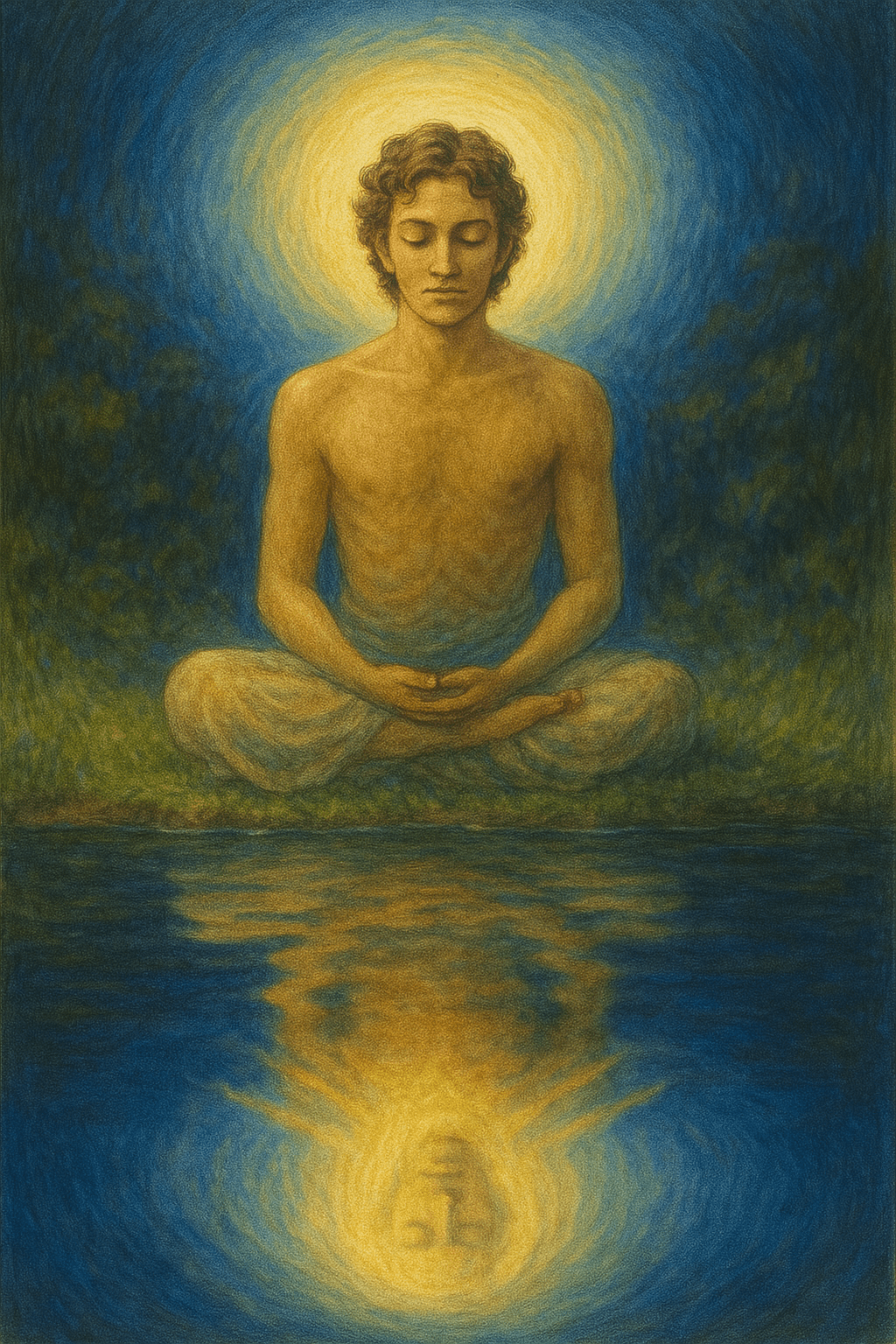
A contemplative reimagining of the myth of Narcissus—not as a tale of vanity, but as a mystical journey into stillness, self-surrender, and divine reflection. What if the pool wasn’t a trap, but a mirror of the infinite?
In the myth’s oldest forms, Narcissus was a young man of astonishing beauty. So beautiful that all who saw him fell in love—but he turned them away, untouched, unreachable. One day, the gods—or perhaps Fate—led him to a quiet, still pool. And there, for the first time, he saw his own reflection.
And he stopped.
He gazed into the water, mesmerized. Some say he fell in love with his image, not knowing it was his own. Others say he did know—and still, he could not look away. In either case, he became entranced, absorbed… undone.
Traditionally, the tale is told as a warning—about vanity, self-absorption, the tragic cost of loving only oneself.
But perhaps there is another way to see it. A deeper reading.
Perhaps Narcissus did not fall in love with himself as ego, but rather—he glimpsed, maybe for the first time, the divine image reflected in his being. And in that moment, he became still. He ceased striving. He entered bittul—the quiet undoing of the small self, and hitbonenut—the deep contemplation, not of form, but of essence.
The water did not deceive him. It revealed him. Not the personality, but the spark behind the eyes.
And so, he sat. And sat. And dissolved.
Maybe he didn’t waste away. Maybe he woke up. And in becoming the flower, he joined the earth, the sky, the unseen rhythm of becoming. Not lost in self-love, but reunited with the Self beyond all selves.
Maybe Narcissus wasn’t a warning. Maybe he was a mystic. And the pool? Not a trap— but a mirror of the infinite.
So yes. Let us sit by that still water. Let us gaze, not with longing, but with love. Let us be undone, not by illusion, but by truth.
And may the flower that blooms from our surrender be fragrant with remembrance.
In the journey of Jewish mysticism, Hitbonenut stands as a gateway to true contemplation, an invitation to move beyond the mind’s grasping and into the silent vastness of divine presence. Unlike traditional meditation, which often focuses on concentration, Hitbonenut opens the heart to experience, not through thinking, but through the quiet surrender of the self. Inspired by my conversations with Rabbi Shmuel Reich, this post explores Hitbonenut as a pathway to Bittul—a dissolving of ego that leads to Ein Sof, the boundless divine.
Hitbonenut: Beyond Thought, Beyond Self
Hitbonenut, or contemplation, is more than simply focusing the mind on an idea—it is a practice that prepares the heart and mind to dissolve into the divine through Bittul (self-nullification). Rabbi Shmuel often emphasized that Hitbonenut is not merely meditation as commonly understood but an opening into a vast, boundless state where the self, with all its concepts and boundaries, melts away into Ein Sof, the Infinite. This contemplative state aligns with what Dzogchen calls “pristine awareness” or what Christian mystics like Saint John of the Cross describe as the “dark night” of pure contemplation.
In the words of the Alter Rebbe, Rabbi Schneur Zalman of Liadi, Hitbonenut involves immersing oneself in the twin sources of divine light—sovev (transcendent) and memale (immanent)—allowing these aspects to penetrate deeply until the boundaries between self and divine dissolve. Rabbi Shmuel echoed this teaching, suggesting that through Hitbonenut, “we let go of the illusion of separation,” arriving at a state where we no longer perceive ourselves as separate entities but as part of the divine unfolding itself.
A Practice of Letting Go
For those inspired to explore Hitbonenut, the practice is one of gentle release rather than mental control. Begin by choosing a divine concept or phrase to contemplate—perhaps the boundlessness of Ein Sof itself. Let the mind rest on this concept, but instead of trying to “figure it out,” allow your thoughts to quiet. As thoughts naturally rise and fall, practice letting them pass without clinging to them. Over time, this brings the mind to a non-conceptual stillness, where even the idea of a “self” softens and dissolves.
Rabbi Shmuel described this process as “training the mind to be calm and quiet, like rabbis of old, who would spend hours in silence before prayer, merging with Ein Sof through Bittul.” In this silence, the ego relaxes, and the self opens into a vast presence, where all notions of “I” and “other” fall away. This is the true heart of Hitbonenut—not a mental exercise, but an invitation to rest in divine unity, beyond words and concepts.
Explore the transformative path of Hitbonenut and Bittul in Jewish mysticism, as practiced by the Alter Rebbe, to reach direct experience and divine unity.
Translation of the Hebrew Text in the Above Image
“… the esteemed Rabbi Schneur Zalman of Liadi, the great sage and author of the book Tanya, in his later years would immerse himself daily in deep contemplation and focus on achieving Hitbonenut and Bittul, self-nullification, before beginning his prayers. He would sit in a secluded area and enter a state of spiritual readiness, preparing himself to reach closeness to the divine through his meditative practices. Those who observed him would attest to the honor and respect that this revered practice commanded, reflecting his commitment to true divine connection.”
Discovering the Boundless: The Alter Rebbe’s Practice of Hitbonenut and Bittul
In the rich tradition of Jewish mysticism, Hitbonenut and Bittul are contemplative practices often approached as meditative paths focused on divine ideas. These practices are frequently interpreted as ways of concentrating on spiritual concepts to deepen one’s understanding. However, the Alter Rebbe, Rabbi Schneur Zalman of Liadi—the founder of Chabad Hasidism—offers us a window into a more profound dimension of these practices, where contemplation moves beyond intellectual meditation and opens into direct experience.
The Alter Rebbe’s personal practice of Hitbonenut is a cornerstone of Chabad Chassidus. According to tradition, he would spend hours in Hitbonenut before beginning his prayers, not merely analyzing divine concepts but immersing himself in a state of awareness that dissolves the self into the infinite, what Jewish mysticism calls the Ein Sof—the boundless and limitless aspect of the divine.
In this expansive approach to Hitbonenut, contemplation shifts from thought-focused meditation to an experiential opening, leading to what other traditions describe as the “pristine mind” or “pure contemplation.” By embracing the formless, open nature of awareness, the Alter Rebbe connected to a state beyond the grasp of the ego, inviting direct experience of the divine presence.
This journey is deepened through Bittul, or self-nullification. Where Hitbonenut opens the door to spacious, boundless awareness, Bittul is the surrender of the self into that awareness. It’s a release of the ego’s hold, a quieting of personal identity that allows a merging with the infinite. This act of surrender is not a negation but an opening—a dissolving of the self to align fully with divine unity.
For those of us seeking to understand Hitbonenut and Bittul in this way, the Alter Rebbe’s practice offers a reminder that contemplation in its purest form transcends the intellect. It’s not about conceptual analysis but about experiencing divine unity as a living reality. As we explore this path, we step beyond thought, into the boundless.
In upcoming posts, we’ll further explore the practical steps, reflections, and guidance to cultivate these practices. Hitbonenut and Bittul invite us into the spaciousness of mystical contemplation, guiding us from understanding to a direct encounter with the divine.
🙏🕊️🙏
Book Review: Rabbi Schneur Zalman of Liadi: The Philosophy of Chabad by Nisan Mendel
Nisan Mendel’sRabbi Schneur Zalman of Liadi: The Philosophy of Chabad is a profound exploration of the life and teachings of one of Jewish mysticism’s most influential figures. Rabbi Schneur Zalman, known as the Alter Rebbe, was the founder of the Chabad movement, and his teachings remain central to Hasidic philosophy and contemplative practice today.
Through this work, Mendel delves into the essence of Chabad philosophy, particularly its unique approach to Hitbonenut (contemplative meditation) and Bittul (self-nullification). Readers are introduced to the Alter Rebbe’s belief that intellectual understanding can be a pathway to divine experience, bridging the mind and heart to foster a deep connection with God. The book sheds light on the Alter Rebbe’s methods for approaching mystical contemplation, offering practical insights for those looking to incorporate these timeless practices into their own lives.
Mendel’s accessible writing and thoughtful explanations make complex topics approachable, while his reverence for the subject shines through, bringing Rabbi Schneur Zalman’s teachings to life. This book is especially valuable for readers who wish to understand the spiritual framework of Chabad and its emphasis on meditative thought as a means to reach divine awareness.
Whether you’re new to the ideas of Hitbonenut and Bittul or are already on a contemplative journey, The Philosophy of Chabad offers a valuable gateway to the Alter Rebbe’s approach to mysticism. By providing both philosophical insights and practical approaches, Mendel encourages readers to go beyond surface understanding and explore the depths of Chabad’s spiritual tradition.


 Home Page: Inspirations of Love and Hope