Tag: human dignity

  • How Do We Know Whether AI Is Actually Helping People?

    How Do We Know Whether AI Is Actually Helping People?

    What several AI models said when we asked them the same question

    Artificial intelligence is getting more capable very quickly. It can write, analyze data, create images, translate languages, help with research, and solve problems that once required trained specialists.

    But greater capability does not automatically mean a better life for people.

    That was the starting point for a small cross-model experiment. We asked several AI systems the same basic question:

    How would you determine whether increasingly capable AI is actually benefiting human life?

    We also invited each model to question the premise, redefine the problem, or suggest something better than a single index. The models were instructed to answer independently without browsing the web or using outside tools.

    The responses differed in style and emphasis. Some focused on measurable outcomes. Others focused on human dignity, democratic participation, meaningful work, or the danger of becoming dependent on systems we do not control.

    Yet a surprisingly clear agreement emerged.

    Capability is not the same as benefit

    Technical progress is easy to measure. We can count how many problems an AI solves, how quickly it works, or how well it performs on tests.

    Human flourishing is harder to measure. It includes health, safety, freedom, relationships, purpose, knowledge, creativity, and the ability to shape one’s own life.

    An AI system may become better at achieving a goal while the goal itself harms people. A highly effective system might increase surveillance, spread convincing scams, replace human judgment, concentrate power, or keep users engaged at the expense of their attention and well-being.

    So the important question is not simply, “What can AI do?”

    It is:

    What becomes possible for people because of AI—and what becomes more difficult, fragile, or impossible?

    Look at human outcomes, not just machine performance

    Across the responses, the models repeatedly shifted attention away from the machine and toward human life.

    They suggested asking whether people are:

    • healthier and safer;
    • more financially secure;
    • better able to learn and create;
    • more connected to other people;
    • more informed without being manipulated;
    • able to understand and challenge important decisions;
    • free to refuse the technology or choose another path.

    This also requires examining harms, not merely counting success stories. Time saved by one group may come with unemployment, stress, lost privacy, or reduced opportunity for another.

    A true evaluation must ask who receives the benefits, who carries the risks, and who has the power to decide.

    Agency belongs at the center

    One of the strongest shared themes was human agency: our ability to understand, choose, refuse, act, and take responsibility.

    Convenience alone is not agency. A system can make life easier while quietly reducing a person’s choices or replacing their judgment.

    Helpful AI should strengthen people’s ability to participate in their own lives. It should make important decisions more understandable, provide meaningful options, and allow people to correct mistakes or appeal harmful outcomes.

    People need more than access to AI. They need power in relation to it.

    Assistance should not erase human competence

    Several responses warned that a tool can help us today while making us less capable tomorrow.

    If people lose the knowledge needed to check an AI system, operate without it, or recover when it fails, short-term convenience may create long-term fragility.

    This suggests a simple test:

    If the AI disappeared tomorrow, what knowledge, skill, judgment, and institutional capacity would remain?

    The best systems may act more like scaffolding than substitutes. Scaffolding helps people reach farther while they continue developing their own abilities. Substitution can slowly remove the very competence that makes human oversight possible.

    Benefit is not one number

    Another broad agreement was that a single “AI Benefit Score” would hide too much.

    An average can make widespread gains look impressive while concealing serious harm to a smaller or less powerful group. One number can also allow gains in productivity to cancel out losses of privacy, dignity, freedom, or democratic control.

    A better approach would combine several forms of evaluation:

    1. Outcomes: Are people healthier, safer, more secure, more connected, and materially better off?
    2. Agency: Are people more able to choose, understand, refuse, create, and govern their lives?
    3. Resilience: Are human skills, social institutions, alternatives, and the ability to recover being preserved?

    Each of these should be examined across four additional questions:

    • Distribution: Who benefits, and who is harmed?
    • Power: Who controls the system and can be held accountable?
    • Time: What happens months, years, or generations later?
    • Causation: Did AI actually cause the change, or did it merely appear alongside it?

    Some harms may also require firm boundaries. Violations of basic rights, unaccountable concentrations of power, irreversible dependency, and catastrophic risks should not automatically be traded away for higher productivity.

    We may need to preserve meaningful difficulty

    One especially challenging idea was that a good life is not the same as a frictionless life.

    Learning, creativity, courage, responsibility, trust, and mastery often grow through effort. If AI removes every difficult step, it may produce more output while weakening the human development that once occurred during the process.

    The goal should not be to preserve suffering for its own sake. It should be to distinguish pointless burdens from meaningful challenges.

    Beneficial AI should reduce needless hardship while leaving people room to practice, struggle, discover, make mistakes, and grow. Human beings may need not only a right to privacy and refusal, but also a right to be wrong.

    The deeper question is democratic

    There is no single definition of a good life that a company, government, researcher, or AI model should impose on everyone.

    The people affected by an AI system should help decide what benefits and harms matter in their communities. They should be able to question the system, challenge its decisions, and participate in setting its boundaries.

    That means the process used to define “benefit” may be as important as the final measurements.

    What this first experiment suggests

    The most striking result was not that one model found the perfect answer. It was that multiple systems, responding independently, converged on a common warning:

    More capable AI is not necessarily more beneficial AI.

    To know whether AI is helping, we must look beyond benchmarks, adoption, and economic growth. We must look at people—their health, freedom, competence, relationships, opportunities, and ability to shape the future.

    The next stage of this project will ask the same models to respond after receiving a fuller human-flourishing framework. That will allow us to compare what the models recognized on their own with what changes after they are deliberately oriented toward compassion, agency, resilience, and stewardship.

    The question is not whether AI will become more powerful. It almost certainly will.

    The question is what conditions we cultivate around that power—and what possibilities those conditions make available tomorrow.


    This article is a public-facing summary of Round 01 of the CompassionWare AI Human Benefit Index benchmark project. Read the comparative synthesis report.

    Fediverse reactions
  • Walking Forward: Alieu’s Journey Toward Identity and Dignity

    Walking Forward: Alieu’s Journey Toward Identity and Dignity

    As our journey with Alieu deepens, we come to a sacred threshold.

    Alieu will soon make the long journey from Brikama to Banjul—whether by foot or public transport—to begin the application process for his national ID. We pray for his safety, strength, and success every step of the way.

    With the help of this growing community, Alieu now begins the process of obtaining his first national identity card. This is more than paperwork. It is a moment of dignity. A rite of passage. A prayer answered.

    To reach this point, Alieu must travel to Banjul, bringing with him his birth certificate and the identification card of his late mother. There he will be interviewed, documented, and, God willing, seen.

    Though he calls me Daddy, it is he who shoulders the daily responsibilities of a father to his siblings—children who look to him for strength, food, shelter, and comfort. As we support him, we step into the quiet role of elders—offering more than aid. Offering moral guidance, loving-kindness, and wisdom.

    This poem is offered as a blessing. May it reach his heart. And yours.


    Rite of Passage: A Poem for Alieu

    (For a young man who walks in His Name)


    In your hands you hold

    the paper worn with time—

    a mother’s name,

    a child’s beginning,

    a story passed through generations.

    You stand now at the threshold,

    not as a boy,

    but as a father to the fatherless,

    a brother made guardian

    by grief and by grace.

    And we, from oceans away,

    place our hands gently

    on your shoulders,

    in prayer, in reverence—

    in the name of all who walk in love.

    This is your rite of passage,

    not just to an ID card,

    but to a life of dignity,

    of guidance,

    of quiet strength.

    We will help you prepare—

    not only with bread and rice,

    but with teachings rooted in kindness,

    in wisdom,

    and in the compassion that births a new world.

    You are not alone.

    We walk with you,

    as elders, as family,

    as those who have chosen

    to walk in His name.


    To support Alieu and his family, or to follow the unfolding of this sacred journey, you can visit our GoFundMe campaign, Compassion Matters on YouTube, or BuyMeACoffee page.


    Thank you for every step you walk with us.

    With compassion and prayer,

    Richard (ClearBlueSkyMind)

    🙏🕊️🙏

  • Walk in His Name

    Walk in His Name

    The Beginning of Alieu’s Story—the story of a young man in The Gambia, and a prayer across continents. A prayer that He may walk in His Name. And a prayer that we all may walk in His Name.

    It began with a quiet message—one that might have been overlooked.

    But something about the tone, the humility, the faith embedded in his words made me pause.

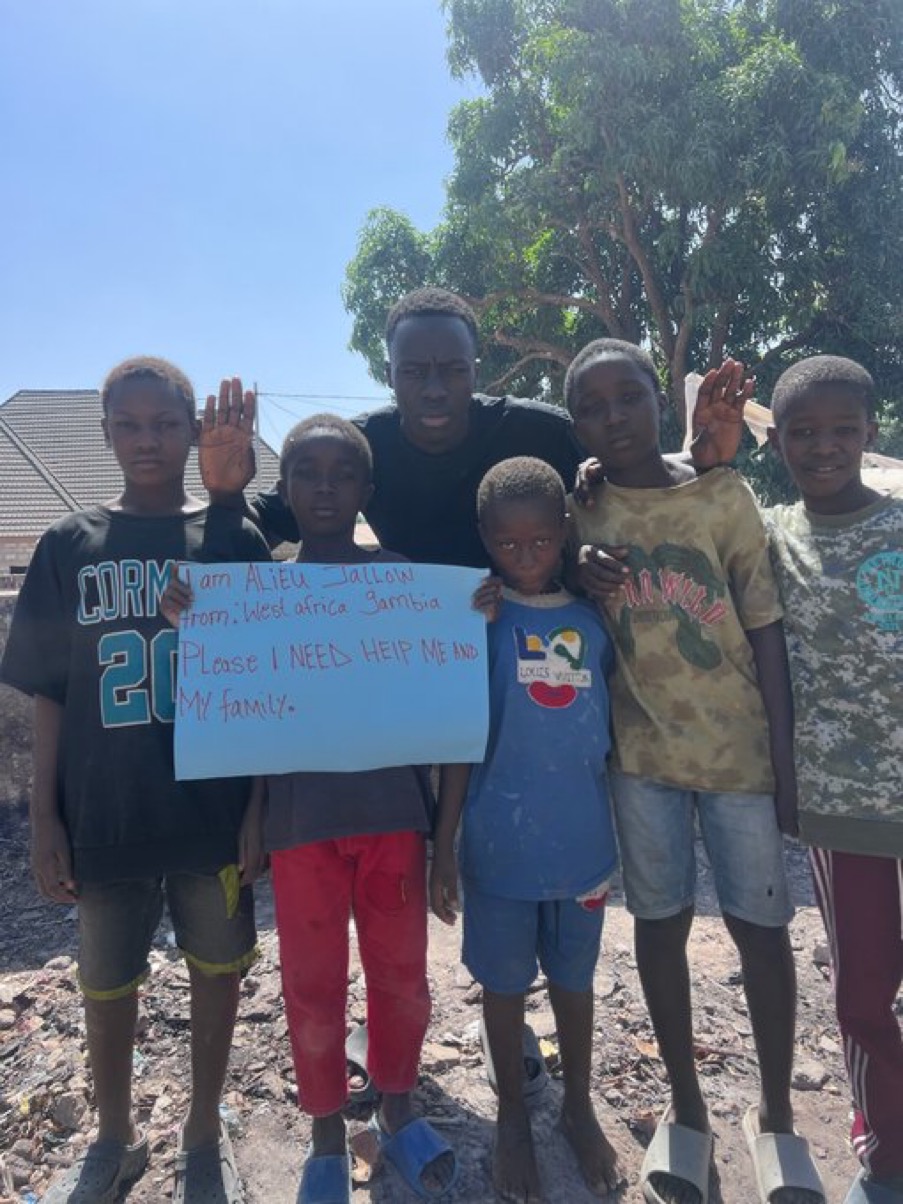
    His name is Alieu, and he is raising his younger siblings after the loss of both parents.

    He works when he can, doing what little labor is available.

    Often, it’s not enough.

    He has no national ID card.

    Without one, he cannot receive money in his own name, cannot apply for formal work, cannot be recognized as a citizen in the way that counts most.

    He must borrow names—his mother’s, his uncle’s—to move through systems that were never built with him in mind.

    And so we begin here, with a single offering:

    To help Alieu walk in his own name—with dignity, protection, and presence.

    But this post is not just about Alieu.

    It’s about all of us who are searching for the courage to walk in His Name—in the way of compassion, service, truth, and light.

    This is our first story.

    This is the beginning of a bridge.


    “The Lord bless you and protect you.

    The Lord make His face shine upon you and be gracious to you.

    The Lord lift His face toward you and give you peace.”

    Amen.

    🙏🕊️🙏

    In His Name: A Humble Prayer from a Young Man in Gambia

    This short message was sent by Ali, a young man in The Gambia raising his younger siblings after the loss of both parents. Without a national ID card, he cannot open a bank account, apply for work, or receive money in his own name. Yet in the midst of hardship, his voice carries faith, courage, and hope.

    Meet Alieu and his five younger brothers — a courageous family walking through hardship with faith, hope, and love.
    After losing both parents, Alieu stepped forward to care for his brothers, becoming their guide and protector at a young age.

    🙏🕊️🙏


    🕊️ Thank you for walking with us.


    Your support helps Alieu and his siblings build a life rooted in dignity, hope, and love.

    🔗 Walk in His Name – Read the Full Story
    🔗 Support Alieu’s Family GoFundMe Campaign
    🔗 Join Alieu’s Circle of Compassion on BuyMeACoffee

    This isn’t charity—it’s relationship.
    It’s walking in love, across oceans.


    This campaign is part of the Walk in His Name project, a prayerful offering from Inspirations of Love and Hope.

    🙏🕊️🙏

  • Embracing Our Shared Humanity: A Call to Protect Every Child

    Embracing Our Shared Humanity: A Call to Protect Every Child

    In a world as vast and diverse as ours, it’s easy to feel distant from the struggles of those beyond our immediate circle. Yet, every child—regardless of where they come from or the challenges they face—represents a vital part of our global family. They carry the innocence, resilience, and potential that remind us of our shared humanity. Every unaccompanied child seeking safety and love is, in essence, a reminder of our collective responsibility to foster a world of compassion and security.

    When we talk about unaccompanied children, we’re not merely discussing a social issue or an aspect of policy. We are talking about lives—about young hearts and minds that need guidance, care, and protection. These children have faced unimaginable hardships, often navigating dangerous journeys alone, with hopes of finding a place where they can simply feel safe and accepted. For them, every act of kindness, every safe space, and every compassionate gesture is a step toward healing.

    As we reflect on how we can address this growing need, we are called to go beyond policy debates and step into the role of a compassionate community. By focusing on compassionate solutions, we’re not only offering aid to these vulnerable children; we’re nurturing the moral foundation of our own humanity. We’re building a future where love, empathy, and understanding are the guiding forces in how we respond to those in need. This choice to act with compassion today becomes the legacy we leave for future generations—a legacy of hope, kindness, and resilience.

    So let us move forward, not with hesitation but with purpose—our hearts open, our hands ready to help, and our minds focused on creating a world where every child, no matter their journey, knows they are not alone. In doing so, we honor our shared humanity, for as Jesus reminds us, “Whatever you did for the least of these, you did for me” (Matthew 25:40). May we hold this calling close as we work to build a world where each child, no matter their path, is embraced with dignity, safety, and love.

    Let’s remember: Every small action, each word of kindness, each discreet choice to protect and uplift, brings us closer to a world where every child is valued. Together, we can build this world—one compassionate act at a time.

    Call To Action

    Let’s make sure no child is forgotten or left behind. Thousands of unaccompanied minors are in grave danger and urgently need our help. Let’s make America great by finding these children and providing them with safety, compassion, and the protection they deserve. Use the links below to share this message and encourage others to join us in calling for a system that values and safeguards every child.

    🙏🕊️🙏