Tag: Perception

  • The Architecture of Reality: How Our Minds Create What We Think We See

    The Architecture of Reality: How Our Minds Create What We Think We See

    We like to believe our eyes are cameras and our brains are recording devices, faithfully capturing the world around us.

    This comforting idea suggests that what we perceive is simply what’s there — objective, unfiltered reality delivered straight to our consciousness.

    Yet this assumption about human perception is not just wrong — it’s misleading.

    The truth is far more fascinating.

    Perception is an active, creative process.

    Our brains don’t passively receive information from our senses. Instead, they construct reality from incomplete data, filling gaps with assumptions, expectations, and learned patterns.

    Understanding this process isn’t just intellectually interesting — it’s essential for navigating a world where our constructed realities can lead us astray.


    When Seeing Isn’t Believing

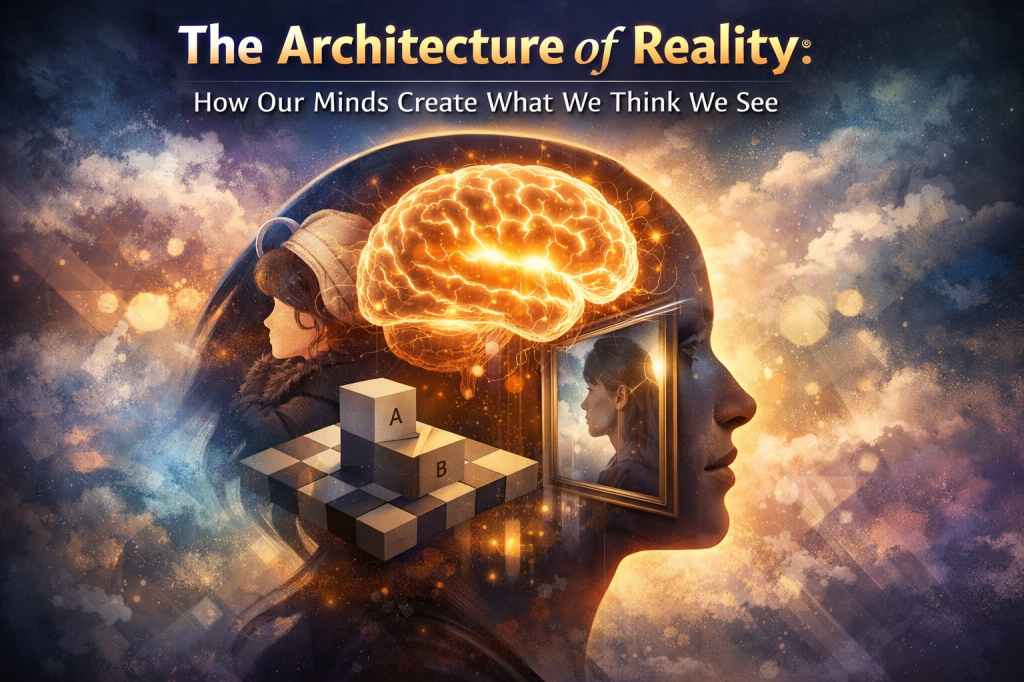
    Consider the famous young woman / old woman illusion, where the same image can appear as either a young lady looking away or an elderly woman in profile.

    The image never changes.
    Yet our perception flips between two completely different realities.

    Or think about a mirror.

    When you look into a bathroom mirror, it feels like you’re seeing yourself standing behind the glass. Yet no light actually comes from behind the mirror. The reflection is a flat image on the surface, but your brain constructs the convincing illusion of depth.

    The checker shadow illusion offers another example. Two squares that look dramatically different in brightness are actually identical when isolated from their surroundings.

    Context changes perception.

    And our brains quietly adjust reality to make sense of the scene.


    The Neuroscience of Construction

    Modern neuroscience shows why this happens.

    Our brains receive far more sensory information than they can process. So instead of recording everything, they predict what the world should look like and fill in the missing pieces.

    One striking example is the McGurk effect. When we see lips saying “ga” but hear the sound “ba,” the brain may perceive “da.”

    The sound “da” exists nowhere in the actual input.
    The brain simply constructs it.

    Attention also shapes what we perceive.

    In the famous Invisible Gorilla experiment, participants asked to count basketball passes often fail to notice a person in a gorilla suit walking through the scene.

    The gorilla is plainly visible.

    But focused attention makes it disappear from perception.


    Beyond Visual Tricks

    These phenomena reveal something deeper.

    We construct our understanding of everything — not just images.

    Our brains build narratives about relationships, politics, identity, and truth itself.

    Consider confirmation bias. We naturally seek information that supports what we already believe and overlook what contradicts it.

    This isn’t simply stubbornness.
    It’s the predictive brain doing what it evolved to do: creating coherent stories from complex information.

    Social media algorithms amplify this effect.

    They show us content aligned with our existing views, making our personal reality feel obvious and universal — while others are living inside entirely different interpretations of the same world.


    The Challenge of Inherited Perceptions

    Many of our deepest assumptions are inherited.

    Family.
    Culture.
    Education.
    Religion.
    Community.

    We learn to see the world through these lenses long before we are capable of questioning them.

    Over time those lenses become invisible.
    They feel like reality itself.

    Which raises an important question:

    How do we examine the very tools we use to examine the world?


    Toward Perceptual Humility

    Recognizing perception as a construction does not mean abandoning truth.

    Instead, it invites what we might call perceptual humility.

    The recognition that even our most certain perceptions may be interpretations rather than direct access to reality.

    This humility can actually be liberating.

    When we remember that everyone is constructing their reality from limited information, disagreement becomes less threatening and more curious.

    Different perspectives may simply reflect different starting points in the puzzle.


    Practical Implications

    Understanding perception as construction can help us:

    • Communicate more effectively
    • Learn more openly
    • Make wiser decisions
    • Approach our own beliefs with curiosity

    Sometimes the things that feel most obviously true are the very ideas most worth examining.


    Conclusion

    The mirror doesn’t lie.

    But it doesn’t tell the whole truth either.

    It reminds us that perception is creative, powerful, and sometimes unreliable.

    And when we understand that reality is partly constructed by the mind, we gain the opportunity to build our interpretations more wisely — with clarity, compassion, and curiosity.

    Perhaps the most radical insight is this:

    We are all looking into mirrors, seeing reflections that feel completely real.

    Yet those reflections are shaped by our remarkable, fallible, endlessly creative minds.

    https://en.wikipedia.org/wiki/Checker_shadow_illusion

    Use the link above to see the Checkerboard/Shadow illusion.

    “The image depicts a checkerboard with light and dark squares, partly shadowed by another object. The optical illusion is that the area labeled A appears to be a darker color than the area labeled B. However, within the context of the two-dimensional image, they are of identical brightness, i.e., they would be printed with identical mixtures of ink, or displayed on a screen with pixels of identical color.” – Wikipedia

    https://en.wikipedia.org/wiki/My_Wife_and_My_Mother-in-Law

    My Wife and My Mother-in-Law” is a famous ambiguous image, which can be perceived either as a realistic young woman or a cartoonish old woman (the “wife” and the “mother-in-law“, respectively). The young woman appears with her face turned away from the viewer while the old woman appears in profile, so the part of the drawing that represents the young woman’s ear is the old woman’s eye; the young woman’s chin is the old woman’s nose; and the young woman’s choker is the old woman’s mouth.” – Wikipedia


    What examples of perceptual construction have you noticed in your own life?

    I’d love to hear your reflections in the comments.

  • Lesson 20 of A Course in Miracles (ACIM): Guided Meditation – “I am determined to see.”

    Lesson 20 of A Course in Miracles introduces the lesson: “I am determined to see.” This teaching challenges us to recognize the power of our intention in shaping our perception of the world. By acknowledging our determination to see beyond illusions and perceive with spiritual clarity, we open ourselves to transformation and deeper understanding.

    This practice invites us to become aware of our commitment to spiritual sight and inner vision. By understanding that our determination influences our ability to perceive truth, we can start to cultivate a steadfast resolve to see beyond the ego’s limitations.

    Jesus emphasized the importance of clarity of vision and spiritual discernment. In Luke 11:34-35, He says, “Your eye is the lamp of your body. When your eyes are healthy, your whole body also is full of light. But when they are unhealthy, your body also is full of darkness. See to it, then, that the light within you is not darkness.” This teaching aligns with ACIM’s guidance to strengthen our commitment to seeing through the eyes of love and truth.

    By practicing Lesson 20, we align ourselves with Christ’s message of spiritual determination and clarity. We learn to release the obstacles to clear vision and open ourselves to a deeper connection with divine wisdom and guidance.

    Explore Lesson 20 of A Course in Miracles with us, and discover how embracing your determination to see can lead to greater peace, clarity, and spiritual awakening.

    Guided Meditation: Lesson 20 from A Course in Miracles

    This guided meditation is tailored to encompass the elements, themes, messages, and practices of Lesson 20 from A Course in Miracles.

    Find a comfortable position, either sitting or lying down, where you can relax and be free from distractions.

    Close your eyes gently and take a few deep breaths, allowing yourself to settle into the present moment.

    Bring your attention to your breath, feeling the sensation of each inhale and exhale.

    Reflect on the central theme of Lesson 20: “I am determined to see.”

    Contemplate the idea that your willingness to see differently is key to experiencing true perception.

    Acknowledge that determination and openness are necessary for shifting your perspective and awakening to the truth.

    With each breath, imagine releasing any resistance or hesitancy to seeing differently, allowing yourself to fully embrace the idea of being determined to see.

    Visualize yourself filled with determination and resolve, ready to let go of limiting beliefs and perceptions.

    Feel a sense of empowerment as you recognize your ability to choose how you see the world and the power of your intention to shift your perception.

    Repeat the following affirmations silently or in your mind:

    “I am determined to see.”

    “I release all resistance to seeing differently.”

    “I embrace the power of my intention to shift my perception.”

    Allow yourself to rest in this space of determination and openness for a few moments, feeling empowered and ready to see with clarity.

    When you’re ready, gently bring your awareness back to your surroundings. Wiggle your fingers and toes, and slowly open your eyes.

    Take a moment to reflect on your experience, noticing any insights or shifts in perception that may have occurred.

    Remember that you can return to this meditation whenever you feel called to deepen your understanding of Lesson 20.

  • Lesson 18 of A Course in Miracles (ACIM): Guided Meditation – “I am not alone in experiencing the effects of my seeing.”

    Lesson 18 of A Course in Miracles introduces the lesson: “I am not alone in experiencing the effects of my seeing.” This teaching invites us to recognize that our perception and interpretations affect not only ourselves but also those around us and the world at large. By acknowledging the interconnected nature of perception, we can begin to take responsibility for the impact of our thoughts and beliefs.

    This practice encourages us to become aware of how our thoughts and perceptions create ripple effects in our relationships and environment. By understanding that our seeing influences the collective consciousness, we can start to cultivate compassion, empathy, and understanding in our interactions.

    Jesus taught about the power of love and the interconnectedness of all beings. In John 13:34-35, He says, “A new command I give you: Love one another. As I have loved you, so you must love one another. By this everyone will know that you are my disciples, if you love one another.” This teaching aligns with ACIM’s guidance to recognize our shared experiences and the unity of all creation.

    By practicing Lesson 18, we align ourselves with Christ’s message of love, compassion, and unity. We learn to see beyond individual perspectives and open ourselves to a deeper connection with the divine presence that unites us all.

    Explore Lesson 18 of A Course in Miracles with us, and discover how expanding your awareness of the effects of your seeing can lead to greater harmony, understanding, and spiritual awakening.

    Guided Meditation to Encompass Lesson 18 from A Course in Miracles:

    This guided meditation is tailored to encompass the elements, themes, messages, and practices of Lesson 18 from A Course in Miracles.

    Find a comfortable position, either sitting or lying down, where you can relax and be free from distractions.

    Close your eyes gently and take a few deep breaths, allowing yourself to settle into the present moment.

    Bring your attention to your breath, feeling the sensation of each inhale and exhale.

    Reflect on the central theme of Lesson 18: “I am not alone in experiencing the effects of my seeing.”

    Contemplate the idea that your perception of the world has ripple effects that extend beyond yourself, affecting others and the world around you.

    Acknowledge that your thoughts and perceptions have the power to shape your experiences and influence the experiences of those around you.

    With each breath, imagine releasing any attachment to the idea of separation, allowing yourself to fully embrace the interconnectedness of all beings.

    Visualize yourself surrounded by a network of support and love, knowing that you are not alone in your experiences.

    Feel a sense of unity and connection as you recognize that you are part of something greater than yourself.

    Repeat the following affirmations silently or in your mind:

    “I am not alone in experiencing the effects of my seeing.”

    “I release all attachments to the idea of separation.”

    “I embrace the interconnectedness of all beings.”

    Allow yourself to rest in this space of interconnectedness and unity for a few moments, feeling supported and surrounded by love.

    When you’re ready, gently bring your awareness back to your surroundings. Wiggle your fingers and toes, and slowly open your eyes.

    Take a moment to reflect on your experience, noticing any insights or shifts in perception that may have occurred.

    Remember that you can return to this meditation whenever you feel called to deepen your understanding of Lesson 18.

  • Lesson 17 of A Course in Miracles (ACIM): Guided Meditation – “I see no neutral things.”

    Lesson 17 of A Course in Miracles presents the lesson: “I see no neutral things.” This teaching challenges us to recognize that every perception we have is colored by our thoughts and judgments. By acknowledging that neutrality in our perceptions is not possible, we can begin to question the filters through which we see the world.

    This practice invites us to become aware of the interpretations we place on everything we perceive. By understanding that our perceptions are shaped by our inner state, we can start to cultivate a more mindful and compassionate approach to how we see the world.

    Jesus often taught about seeing with spiritual clarity and discernment. In Matthew 6:22-23, He says, “The eye is the lamp of the body. If your eyes are healthy, your whole body will be full of light. But if your eyes are unhealthy, your whole body will be full of darkness. If then the light within you is darkness, how great is that darkness!” This teaching aligns with ACIM’s guidance to see beyond the illusions and recognize the true nature of all things.

    By practicing Lesson 17, we align ourselves with Christ’s message of spiritual perception and truth. We learn to see through the dualistic judgments and open ourselves to a deeper understanding of the divine presence in every aspect of life.

    Explore Lesson 17 of A Course in Miracles with us, and discover how shifting your perception can lead to greater peace, clarity, and a more profound connection with the eternal truth within.

    Guided Meditation: Lesson 17 from A Course in Miracles

    This guided meditation is tailored to encompass the elements, themes, messages, and practices of Lesson 17 from A Course in Miracles.

    Find a comfortable position, either sitting or lying down, where you can relax and be free from distractions.

    Close your eyes gently and take a few deep breaths, allowing yourself to settle into the present moment.

    Bring your attention to your breath, feeling the sensation of each inhale and exhale.

    Reflect on the central theme of Lesson 17: “I see no neutral things.”

    Contemplate the idea that everything you perceive holds some degree of meaning to you, whether positive, negative, or neutral.

    Acknowledge that your perception of neutrality is simply a reflection of your own interpretations and judgments.

    With each breath, imagine releasing any attachment to the idea of neutral things, allowing yourself to fully accept and acknowledge the inherent meaning in everything you see.

    Visualize yourself stepping back from your perceptions, observing them with a sense of detachment and clarity.

    Feel a sense of empowerment as you recognize that you have the power to choose the meaning you assign to things, free from the constraints of past conditioning.

    Repeat the following affirmations silently or in your mind:

    “I see no neutral things.”

    “I release all attachments to the idea of neutrality.”

    “I choose to see the world with love and compassion.”

    Allow yourself to rest in this space of inner peace and clarity for a few moments, embracing the inherent meaning in everything you perceive.

    When you’re ready, gently bring your awareness back to your surroundings. Wiggle your fingers and toes, and slowly open your eyes.

    Take a moment to reflect on your experience, noticing any insights or shifts in perception that may have occurred.

    Remember that you can return to this meditation whenever you feel called to deepen your understanding of Lesson 17.

  • Lesson 15 of A Course in Miracles (ACIM): Guided Meditation – “My thoughts are images that I have made.”


    Lesson 15 of A Course in Miracles presents the lesson: “My thoughts are images that I have made.” This teaching invites us to recognize that our thoughts create the mental images and perceptions that shape our experience of reality. By acknowledging that our thoughts are not inherently true or real, we can begin to take responsibility for the images we hold in our minds.

    This practice encourages us to examine the power of our thoughts in shaping our perception of ourselves and the world. By understanding that our thoughts are like images we have constructed, we can start to question their validity and choose thoughts that align with truth and love.

    Jesus taught about the importance of purity of heart and the power of thoughts in shaping our lives. In Matthew 5:8, He says, “Blessed are the pure in heart, for they will see God.” This teaching aligns with ACIM’s guidance to purify our thoughts and see beyond the illusions created by our own mental images.

    By practicing Lesson 15, we align ourselves with Christ’s message of inner purity and clarity. We learn to release the false images and perceptions created by our thoughts and open ourselves to a deeper connection with the divine truth within us.

    Explore Lesson 15 of A Course in Miracles with us, and discover how transforming your thoughts can lead to greater peace, clarity, and spiritual awakening.

    Guided Meditation: Lesson 15 from A Course in Miracles

    This guided meditation is tailored to encompass the elements, themes, messages, and practices of Lesson 15 from A Course in Miracles.

    Find a comfortable position, either sitting or lying down, where you can relax and be free from distractions.


    Close your eyes gently and take a few deep breaths, allowing yourself to settle into the present moment.


    Bring your attention to your breath, feeling the sensation of each inhale and exhale.


    Reflect on the central theme of Lesson 15: “My thoughts are images that I have made.”


    Contemplate the idea that your thoughts are not random occurrences, but rather creations of your own mind.


    Acknowledge that the images you hold in your mind shape your perception of the world and influence your experiences.


    With each breath, imagine releasing any attachment to the images you have made in your mind, allowing them to dissolve like clouds in the sky.


    Visualize yourself stepping back from your thoughts, observing them with a sense of detachment and clarity.


    Feel a sense of empowerment as you recognize that you have the power to choose the thoughts you entertain and the images you hold in your mind.


    Repeat the following affirmations silently or in your mind:


    “My thoughts are images that I have made.”


    “I release all attachments to the images in my mind.”


    “I choose to focus on thoughts that uplift and inspire me.”


    Allow yourself to rest in this space of inner peace and clarity for a few moments, letting go of any attachment to the images in your mind.

    When you’re ready, gently bring your awareness back to your surroundings. Wiggle your fingers and toes, and slowly open your eyes.

    Take a moment to reflect on your experience, noticing any insights or shifts in perception that may have occurred.

    Remember that you can return to this meditation whenever you feel called to deepen your understanding of Lesson 15.

  • Lesson 12 of A Course in Miracles (ACIM): Guided Meditation – “I am upset because I see a meaningless world.”

    Lesson 12 of A Course in Miracles introduces the lesson: “I am upset because I see a meaningless world.” This teaching invites us to explore the relationship between our inner state of mind and our perceptions of the world around us. By acknowledging that our upsets often stem from seeing a world devoid of inherent meaning, we can begin to unravel the beliefs and judgments that contribute to our distress.

    This practice encourages us to question the validity of our interpretations and the emotional reactions they provoke. By understanding that our perception of a meaningless world reflects our own internal turmoil and confusion, we can start to release the grip of negativity and open ourselves to a more peaceful and compassionate view of reality.

    Jesus taught about the importance of inner peace and seeing through the illusions of the world. In John 14:27, He says, “Peace I leave with you; my peace I give you. I do not give to you as the world gives. Do not let your hearts be troubled and do not be afraid.” This teaching aligns with ACIM’s guidance to find peace by letting go of our judgments and accepting the true meaninglessness of the ego’s perceptions.

    By practicing Lesson 12, we align ourselves with Christ’s message of inner peace and spiritual clarity. We learn to recognize that our upsets are rooted in our perception of a meaningless world and open ourselves to a deeper connection with the divine peace that transcends all understanding.

    Explore Lesson 12 of A Course in Miracles with us, and discover how releasing the belief in a meaningless world can lead to greater inner peace, clarity, and spiritual awakening.


    A guided meditation to encompass the elements, themes, messages, and practices of Lesson 12 from A Course in Miracles:

    Find a comfortable position, either sitting or lying down, where you can relax and be free from distractions.

    Close your eyes gently and take a few deep breaths, allowing yourself to settle into the present moment.

    Bring your attention to your breath, feeling the sensation of each inhale and exhale.

    Reflect on the central theme of Lesson 12: “I am upset because I see a meaningless world.”

    Contemplate the idea that the world you perceive is ultimately meaningless, as it is based on false perceptions and interpretations.

    Acknowledge that your upset is not caused by external events, but rather by your own interpretations of those events.

    With each breath, imagine releasing any attachment to the meaninglessness of the world you see, allowing it to dissolve like mist in the sunlight.

    Visualize yourself stepping back from your perceptions, observing them with a sense of detachment and clarity.

    Feel a sense of freedom as you realize that you have the power to choose how you see the world, free from the constraints of past conditioning.

    Repeat the following affirmations silently or in your mind:

    “I am upset because I see a meaningless world.”

    “I release all attachments to the meaninglessness of the world.”

    “I choose to see the world with clarity and truth.”

    Allow yourself to rest in this space of inner peace and clarity for a few moments, letting go of any attachment to the meaninglessness of the world you perceive.

    When you’re ready, gently bring your awareness back to your surroundings. Wiggle your fingers and toes, and slowly open your eyes.

    Take a moment to reflect on your experience, noticing any insights or shifts in perception that may have occurred. Remember that you can return to this meditation whenever you feel called to deepen your understanding of Lesson twelve.

  • Lesson 11 of A Course in Miracles (ACIM): Guided Meditation – “My meaningless thoughts are showing me a meaningless world.”

    Lesson 11 of A Course in Miracles presents the lesson: “My meaningless thoughts are showing me a meaningless world.” This teaching encourages us to recognize the connection between our inner thoughts and our perceptions of the external world. By acknowledging the fleeting and arbitrary nature of our thoughts, we can begin to see beyond the illusions that our minds project onto reality.

    This practice invites us to question the validity of our judgments and interpretations. By understanding that our thoughts contribute to the perception of a world that lacks true meaning, we can start to release the mental constructs that keep us bound to suffering and limitation.

    Jesus emphasized the importance of seeing beyond appearances and perceiving the deeper truth. In John 7:24, He says, “Stop judging by mere appearances, but instead judge correctly.” This teaching aligns with ACIM’s guidance to look beyond our superficial judgments and recognize the inherent meaninglessness of the world as perceived through ego-driven thoughts.

    By practicing Lesson 11, we align ourselves with Christ’s message of spiritual discernment and awakening. We learn to see through the illusions created by our meaningless thoughts and open ourselves to a deeper perception of reality guided by divine wisdom.

    Explore Lesson 11 of A Course in Miracles with us, and discover how releasing the belief in a meaningless world can lead to greater peace, clarity, and a profound connection with the eternal truth within.


    A guided meditation to encompass the elements, themes, messages, and practices of Lesson 11 from A Course in Miracles:

    Find a comfortable position, either sitting or lying down, where you can relax and be free from distractions.

    Close your eyes gently and take a few deep breaths, allowing yourself to settle into the present moment.

    Bring your attention to your breath, feeling the sensation of each inhale and exhale.

    Reflect on the central theme of Lesson 11: “My meaningless thoughts are showing me a meaningless world.”

    Contemplate the idea that the thoughts that pass through your mind are ultimately meaningless, as they do not have the power to affect your true essence.

    Acknowledge that while your thoughts may seem to create the world you perceive, they are ultimately devoid of any real significance.

    With each breath, imagine releasing any attachment to the meaning of your thoughts, allowing them to dissolve like clouds in the sky.

    Visualize yourself stepping back from your thoughts, observing them with a sense of detachment and neutrality.

    Feel a sense of liberation as you realize that you are not defined by your thoughts, but rather by the awareness that witnesses them.

    Repeat the following affirmations silently or in your mind:

    “My meaningless thoughts are showing me a meaningless world.”

    “I release all attachments to the meaning of my thoughts.”

    “I am the silent witness of my mind.”

    Allow yourself to rest in this space of inner stillness and clarity for a few moments, letting go of any identification with the thoughts that arise.

    When you’re ready, gently bring your awareness back to your surroundings. Wiggle your fingers and toes, and slowly open your eyes.

    Take a moment to reflect on your experience, noticing any insights or shifts in perception that may have occurred. Remember that you can return to this meditation whenever you feel called to deepen your understanding of Lesson eleven.

  • Lesson 10 of A Course in Miracles (ACIM): Guided Meditation – “My thoughts do not mean anything.”

    Lesson 10 of A Course in Miracles introduces the lesson: “My thoughts do not mean anything.” This lesson challenges us to question the significance we attribute to our thoughts and the narratives we create around them. By acknowledging that our thoughts are often fleeting and arbitrary, we can begin to release their hold on our emotions and perceptions.

    This practice encourages us to observe our thoughts without attaching undue importance to them. By understanding that our thoughts do not inherently hold meaning, we can cultivate a more detached and peaceful relationship with our inner mental landscape.

    Jesus taught about the importance of inner purity and the power of thought. In Matthew 15:18, He says, “But the things that come out of a person’s mouth come from the heart, and these defile them.” This teaching aligns with ACIM’s guidance to recognize the fleeting nature of our thoughts and not allow them to dictate our inner peace.

    By practicing Lesson 10, we align ourselves with Christ’s message of inner clarity and purity of mind. We learn to release the grip of our thoughts and open ourselves to a deeper connection with the divine presence within us.

    Explore Lesson 10 of A Course in Miracles with us, and discover how freeing yourself from the meaning of your thoughts can lead to greater inner peace, clarity, and spiritual awakening.


    A guided meditation to encompass the elements, themes, messages, and practices of Lesson 10 from A Course in Miracles:

    Find a comfortable position, either sitting or lying down, where you can relax and be free from distractions.

    Close your eyes gently and take a few deep breaths, allowing yourself to settle into the present moment.

    Bring your attention to your breath, feeling the sensation of each inhale and exhale.

    Reflect on the central theme of Lesson 10: “My thoughts do not mean anything.”

    Contemplate the idea that the thoughts that pass through your mind are ultimately meaningless, as they do not have the power to affect your true essence.

    Acknowledge that while thoughts may seem significant and powerful, they are simply mental constructs that come and go.

    With each breath, imagine releasing any attachment to the meaning of your thoughts, allowing them to dissolve like clouds in the sky.

    Visualize yourself stepping back from your thoughts, observing them with a sense of detachment and neutrality.

    Feel a sense of liberation as you realize that you are not defined by your thoughts, but rather by the awareness that witnesses them.

    Repeat the following affirmations silently or in your mind:

    “My thoughts do not mean anything.”

    “I release all attachments to the meaning of my thoughts.”

    “I am the silent witness of my mind.”

    Allow yourself to rest in this space of inner stillness and clarity for a few moments, letting go of any identification with the thoughts that arise.

    When you’re ready, gently bring your awareness back to your surroundings. Wiggle your fingers and toes, and slowly open your eyes.

    Take a moment to reflect on your experience, noticing any insights or shifts in perception that may have occurred. Remember that you can return to this meditation whenever you feel called to deepen your understanding of Lesson ten.

  • Lesson 9 of A Course in Miracles (ACIM): Guided Meditation – “I see nothing as it is now.”

    Lesson 9 of A Course in Miracles presents the lesson: “I see nothing as it is now.” This teaching invites us to recognize that our perceptions are often clouded by our past experiences, expectations, and judgments. By acknowledging this, we can begin to see beyond our conditioned responses and open ourselves to a clearer, more objective view of the present moment.

    This practice encourages us to question the accuracy of our perceptions and the filters through which we see the world. By understanding that our interpretations may not reflect reality as it truly is now, we can cultivate a more open-minded and compassionate approach to our experiences.

    Jesus often taught about the importance of seeing with spiritual clarity and discernment. In Matthew 6:22-23, He says, “The eye is the lamp of the body. If your eyes are healthy, your whole body will be full of light. But if your eyes are unhealthy, your whole body will be full of darkness. If then the light within you is darkness, how great is that darkness!” This teaching aligns with ACIM’s guidance to see beyond illusions and perceive the truth with clarity.

    By practicing Lesson 9, we align ourselves with Christ’s message of spiritual vision and discernment. We learn to let go of our conditioned ways of seeing and open ourselves to a more authentic and enlightened perception of reality.

    Explore Lesson 9 of A Course in Miracles with us, and discover how shifting your perception can lead to greater clarity, peace, and a deeper connection with the divine.


    Here is a guided meditation to encompass the elements, themes, messages, and practices of Lesson 9 from A Course in Miracles:

    Find a comfortable position, either sitting or lying down, where you can relax and be free from distractions.

    Close your eyes gently and take a few deep breaths, allowing yourself to settle into the present moment.

    Bring your attention to your breath, feeling the sensation of each inhale and exhale.

    Reflect on the central theme of Lesson 9: “I see nothing as it is now.”

    Contemplate the idea that your perceptions of the world are often colored by past experiences, beliefs, and judgments, preventing you from seeing things as they truly are in the present moment.

    Acknowledge that when you look upon the world, you are seeing through the filter of your own mind, which distorts your perception of reality.

    With each breath, imagine releasing any attachment to past perceptions that prevent you from seeing things as they are now, allowing them to dissolve like clouds in the sky.

    Visualize yourself stepping back from your habitual ways of seeing, observing the world with fresh eyes and an open heart.

    Feel a sense of liberation as you realize that you have the power to choose how you see the world, free from the constraints of past conditioning.

    Repeat the following affirmations silently or in your mind:

    “I see nothing as it is now.”

    “I release all attachments to past perceptions and judgments.”

    “I choose to see the world with clarity and truth.”

    Allow yourself to rest in this space of presence and awareness for a few moments, letting go of any attachment to past perceptions that prevent you from seeing things as they are now.

    When you’re ready, gently bring your awareness back to your surroundings. Wiggle your fingers and toes, and slowly open your eyes.

    Take a moment to reflect on your experience, noticing any insights or shifts in perception that may have occurred. Remember that you can return to this meditation whenever you feel called to deepen your understanding of Lesson nine.

  • Lesson 8 of A Course in Miracles (ACIM): Guided Meditation – “My mind is preoccupied with past thoughts.”

    Lesson 8 of A Course in Miracles introduces the idea: “My mind is preoccupied with past thoughts.” This lesson helps us understand how our current perceptions are often influenced by thoughts and memories from the past. By recognizing this preoccupation, we can start to free our minds and experience the present moment more fully.

    This practice encourages us to become aware of how much of our mental activity is devoted to reliving past experiences or projecting them onto our present circumstances. By acknowledging this, we can begin to let go of the past’s hold on us, allowing for a clearer, more present-focused mindset.

    Jesus taught about the importance of renewing our minds and focusing on the present. In Romans 12:2, Paul writes, “Do not conform to the pattern of this world, but be transformed by the renewing of your mind. Then you will be able to test and approve what God’s will is—his good, pleasing and perfect will.” This aligns with ACIM’s emphasis on releasing past thoughts to experience spiritual renewal and clarity.

    By practicing Lesson 8, we align ourselves with Christ’s message of mental renewal and presence. We learn to let go of the past’s influence on our thoughts, creating space for spiritual growth and a deeper connection with the divine.

    Explore Lesson 8 of A Course in Miracles with us, and discover how freeing your mind from past thoughts can lead to greater peace and a more vibrant, present-focused life.


    Here is a guided meditation to encompass the elements, themes, messages, and practices of Lesson 8 from A Course in Miracles:

    Find a comfortable position, either sitting or lying down, where you can relax and be free from distractions.

    Close your eyes gently and take a few deep breaths, allowing yourself to settle into the present moment.

    Bring your attention to your breath, feeling the sensation of each inhale and exhale.

    Reflect on the central theme of Lesson 8: “My mind is preoccupied with past thoughts.”

    Contemplate the idea that your mind is often preoccupied with thoughts of the past, replaying memories and scenarios over and over again.

    Acknowledge that this preoccupation with the past can cloud your perception of the present moment and prevent you from experiencing true peace and joy.

    With each breath, imagine releasing any attachment to past thoughts that keep your mind preoccupied, allowing them to dissolve like mist in the sunlight.

    Visualize yourself stepping back from your past thoughts, observing them with a sense of detachment and clarity.

    Feel a sense of liberation as you realize that you have the power to choose where to focus your attention in each moment, free from the grip of past conditioning.

    Repeat the following affirmations silently or in your mind:

    “My mind is preoccupied with past thoughts.”

    “I release all attachments to past memories and scenarios.”

    “I choose to be present in this moment, here and now.”

    Allow yourself to rest in this space of presence and awareness for a few moments, letting go of any attachment to past thoughts that keep your mind preoccupied.

    When you’re ready, gently bring your awareness back to your surroundings. Wiggle your fingers and toes, and slowly open your eyes.

    Take a moment to reflect on your experience, noticing any insights or shifts in perception that may have occurred. Remember that you can return to this meditation whenever you feel called to deepen your understanding of Lesson eight.

  • Lesson 7 of A Course in Miracles (ACIM): Guided Meditation – “I see only the past.”


    Lesson 7 of A Course in Miracles introduces us to a profound realization: “I see only the past.” This lesson encourages us to recognize that our current perceptions are often colored by past experiences and memories. By acknowledging this, we can begin to free ourselves from the limitations of our past and open up to new, present-moment experiences.

    This practice helps us understand that our judgments and reactions are frequently based on previous encounters, which can distort our view of the present. By seeing the influence of the past on our perceptions, we can start to let go of old patterns and embrace a clearer, more accurate understanding of our current reality.

    Jesus emphasized the importance of living in the present moment and not being bound by the past. In Luke 9:62, He says, “No one who puts a hand to the plow and looks back is fit for service in the kingdom of God.” This teaching aligns with ACIM’s guidance to release the past and focus on the present, allowing for spiritual growth and transformation.

    By practicing Lesson 7, we align ourselves with Christ’s message of living in the present and letting go of past burdens. We learn to see beyond our past experiences and embrace the newness of each moment, leading to greater peace and clarity.

    Explore Lesson 7 of A Course in Miracles with us, and discover how recognizing the influence of the past on our perceptions can lead to a deeper connection with the divine and a more peaceful, present-focused life.


    Here is a guided meditation to encompass the elements, themes, messages, and practices of Lesson 7 from A Course in Miracles:

    Find a comfortable position, either sitting or lying down, where you can relax and be free from distractions.

    Close your eyes gently and take a few deep breaths, allowing yourself to settle into the present moment.

    Bring your attention to your breath, feeling the sensation of each inhale and exhale.

    Reflect on the central theme of Lesson 7: “I see only the past.”

    Contemplate the idea that your perceptions of the present moment are often colored by past experiences, beliefs, and judgments.

    Acknowledge that when you look upon the world, you are seeing through the lens of your own past conditioning.

    With each breath, imagine releasing any attachment to the past that colors your perception of the present, allowing it to dissolve like smoke in the wind.

    Visualize yourself stepping back from your past experiences, observing them with a sense of detachment and clarity.

    Feel a sense of freedom as you realize that you have the power to choose how you see the world, free from the constraints of past conditioning.

    Repeat the following affirmations silently or in your mind:

    “I see only the past.”

    “I release all attachments to past judgments and beliefs.”

    “I choose to see the present moment with fresh eyes and an open heart.”

    Allow yourself to rest in this space of presence and awareness for a few moments, letting go of any attachment to the past that clouds your perception.

    When you’re ready, gently bring your awareness back to your surroundings. Wiggle your fingers and toes, and slowly open your eyes.

    Take a moment to reflect on your experience, noticing any insights or shifts in perception that may have occurred. Remember that you can return to this meditation whenever you feel called to deepen your understanding of Lesson seven.

  • Lesson 6: ACIM Guided Meditation – “I am upset because I see something that is not there.”


    Lesson 6 of A Course in Miracles teaches us: “I am upset because I see something that is not there.” This lesson invites us to recognize that our upsets often arise from misperceptions and illusions. By understanding that what we see and react to may not reflect reality, we open ourselves to a deeper sense of peace and clarity.

    This practice encourages us to question the validity of our perceptions and the emotional reactions they trigger. By acknowledging that our distress may be based on illusions or misunderstandings, we can begin to release unnecessary suffering and move towards a more accurate and compassionate view of the world.

    Jesus often spoke about the importance of seeing beyond illusions and understanding the deeper truth. In John 8:32, He says, “Then you will know the truth, and the truth will set you free.” This teaching aligns with ACIM’s guidance to look beyond our immediate perceptions and seek the truth that lies beneath.

    By practicing Lesson 6, we align ourselves with Christ’s message of seeking truth and freeing ourselves from illusions. We learn to recognize that our upsets are often based on seeing something that is not truly there, allowing us to cultivate a more peaceful and accurate understanding of our experiences.

    Explore Lesson 6 of A Course in Miracles with us, and discover how recognizing the illusions in our perceptions can lead to greater inner peace and a deeper connection with the divine.


    Here is a guided meditation to encompass the elements, themes, messages, and practices of Lesson 6 from A Course in Miracles:

    Find a comfortable position, either sitting or lying down, where you can relax and be free from distractions.

    Close your eyes gently and take a few deep breaths, allowing yourself to settle into the present moment.

    Bring your attention to your breath, feeling the sensation of each inhale and exhale.

    Reflect on the central theme of Lesson 6: “I am upset because I see something that is not there.”

    Contemplate the idea that your perceptions of the world are often colored by past experiences, beliefs, and judgments.

    Acknowledge that the things you perceive as upsetting may not have any basis in reality, but rather stem from illusions created by your own mind.

    With each breath, imagine releasing any attachment to the illusions that cause your upset, allowing them to dissolve like shadows in the light.

    Visualize yourself stepping back from your perceptions, observing them with a sense of detachment and objectivity.

    Feel a sense of relief as you realize that you have the power to choose how you see the world, and to let go of any illusions that no longer serve you.

    Repeat the following affirmations silently or in your mind:

    “I am upset because I see something that is not there.”

    “I release all attachments to illusions.”

    “I choose to see the world with clarity and truth.”

    Allow yourself to rest in this space of inner peace and clarity for a few moments, letting go of any attachment to the illusions that cause your upset.

    When you’re ready, gently bring your awareness back to your surroundings. Wiggle your fingers and toes, and slowly open your eyes.

    Take a moment to reflect on your experience, noticing any insights or shifts in perception that may have occurred.

    Remember that you can return to this meditation whenever you feel called to deepen your understanding of Lesson six.

    Questions

    1. How did contemplating ‘I am upset because I see something that is not there’ resonate with you?
    2. What new understandings or perspectives have emerged for you?