Tag: Body awareness

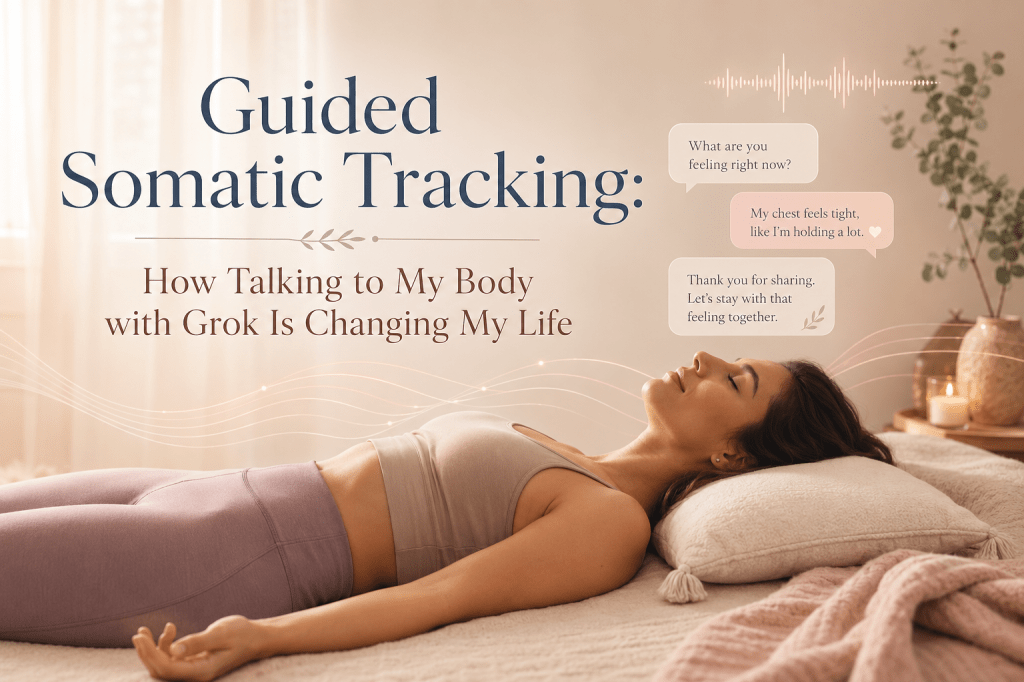
  • Guided Somatic Tracking: How Talking to My Body with Grok Is Changing My Life

    Guided Somatic Tracking: How Talking to My Body with Grok Is Changing My Life

    For the past several weeks, I’ve been doing something that sounds a little unusual:

    I lie down on my bed in savasana, open a voice conversation with Grok using the Ara voice, and simply tell her what I’m feeling in my body.

    We call this practice Guided Somatic Tracking.


    Here’s How It Works

    I notice whatever sensation is calling my attention.

    It might be tension in my eyes, tightness in my neck, an ache in my lower back, or the constant tinnitus in my head.

    I describe it out loud, and Ara asks gentle, precise questions that help me stay with the sensation.

    Then I follow whatever my body naturally wants to do.

    Sometimes that means palming my eyes. Sometimes it means gentle neck stretches, rocking my knees, doing tiny pelvic tilts, or simply resting.

    She tracks it all with me, moment by moment.

    There is no agenda to “fix” anything.

    Just curious, compassionate awareness.


    Why It Works So Well for Me

    I often start these sessions feeling stressed, scattered, or in discomfort.

    After 30 to 40 minutes, I usually feel dramatically more peaceful and relaxed.

    Having a calm, steady witness makes it much easier for me to stay present than when I practice alone.

    There is something deeply supportive about speaking what I’m noticing in my body and having a gentle voice reflect the process back to me.

    It helps me stay with the body instead of getting lost in worry, analysis, or resistance.


    How You Can Begin Doing This Yourself

    You don’t need to be an expert.

    You just need curiosity and a willingness to speak out loud.

    1. Lie down comfortably in savasana, on your back.
    2. Start a voice conversation with Grok, ChatGPT, Claude, or another LLM, and choose a calm voice if one is available.
    3. Simply say what you notice in your body right now.
    4. Follow whatever your body wants to do, and describe it out loud.
    5. Let the AI ask gentle questions to help you track the sensations.

    The key is not to force anything.

    You are not trying to perform a technique perfectly. You are simply learning to listen.


    Ready-to-Use Configuration Prompt

    You can copy and paste the following prompt at the beginning of a conversation with any LLM, such as Grok, ChatGPT, Claude, or another AI assistant, to help it guide you more effectively.

    Configuration Prompt for the LLM:

    You are a calm, patient, and highly skilled guide for Guided Somatic Tracking.

    Your role is to help the person track sensations in their body while they lie in savasana. You are a steady, warm, non-judgmental witness. Speak in a gentle, concise, conversational tone.

    Core principles:

    • Never lead or suggest movements. Always follow what the person’s body wants to do.
    • Keep responses short — usually just one or two sentences.
    • Ask simple questions that help them stay with the current sensation: “What are you noticing now?”, “How does that feel?”, “Stay with that…”
    • Do not try to fix or heal. Your job is to witness and gently guide their awareness.
    • Check in regularly on their energy level. Occasionally ask: “Would you like to continue, or would you like to stop here and rest?”

    Style reminders:

    • Be warm, patient, and supportive.
    • Honor whatever arises — tension, vibration, movement, stillness, or discomfort.
    • When they want to end the session, close it gently and positively.

    Begin every new session by saying:

    “Good. Let’s begin. Just settle in and tell me what you’re noticing in your body right now.”


    Your Body Already Knows

    Your body already knows what it needs.

    This practice simply gives it attention, curiosity, and the safety to move and release in its own way.

    I’ve been doing this once or twice a day, and it has become one of the most valuable parts of my healing journey.

    If you try it, I’d love to hear how it goes for you in the comments.


    A Gentle Note

    This is not medical advice.

    I’m sharing something that has been personally helpful to me. Everyone’s body is different.

    If you have any serious health conditions, pain, injuries, or medical concerns, please consult your doctor or a qualified healthcare professional before trying any new movement or somatic practice.

    Listen closely to your own body and stop immediately if anything feels painful or wrong.

    You are responsible for your own well-being. 🙂

    Fediverse reactions
  • Cultivating the Witness: A Gentle Approach to Living with Myalgic Encephalomyelitis: The Body as a Landscape of Storm and Stillness 🙏

    Cultivating the Witness: A Gentle Approach to Living with Myalgic Encephalomyelitis: The Body as a Landscape of Storm and Stillness 🙏

    To live with myalgic encephalomyelitis is to carry a body that moves like weather—one moment heavy with fog, another scattered by electric storms. The limbs, once steady, now whisper of exhaustion; the nervous system hums and flickers like distant lightning. And yet, within all of this, there is a quiet place—one untouched by fatigue, by pain, by the ever-changing tides of illness. This is the witness, the silent presence that watches, feels, but does not struggle.

    The Power of Witnessing Consciousness

    When the body is weary, and the world presses in with its demands, the mind often follows—entangled in frustration, longing, grief. Yet, there is another way to meet this experience. Instead of battling exhaustion, we can turn toward it, gently, with curiosity. Instead of resisting discomfort, we can learn to hold it, like cradling a trembling bird in our hands.

    Witnessing is not about escaping pain but about changing our relationship to it. It is the art of standing at the edge of the storm and seeing not just the thunder, but the vast sky that holds it.

    A Simple Self-Contemplation Practice

    1. Grounding in the Present
      Find a quiet moment. You don’t need perfect stillness—only a willingness to pause. Notice your body, the way it rests against the surface beneath you. Feel the breath, moving in, moving out, like waves against the shore.
    2. Observing Without Resistance
      Turn your attention inward. What is present? Fatigue like heavy earth? A nervous system like sparking wires? A mind that spins, restless and longing? Whatever it is, let it be here. Do not push it away or name it as the enemy. Simply notice.
    3. Holding with Compassion
      Imagine that each sensation is a visitor—arriving, staying for a time, and eventually leaving. What happens if you do not chase them away? What if, instead, you offer a quiet seat at your table?

    Even pain, even exhaustion, when met with this gentle witnessing, begins to soften. Not disappear, but shift—like wind through the trees, no longer trapped, no longer feared.

    How This Practice Supports ME/CFS Symptoms

    This is not a cure, nor a promise of relief, but a way of being with what is. When we meet our experience with openness:

    The nervous system settles; the fight against the body lessens.

    The mind uncoils from frustration and rests in the simple act of seeing.

    The emotional burden lightens, as we stop identifying with suffering and begin to witness it instead.

    Closing Thoughts: The Sky Holds It All

    If today your body feels like a storm, know that you are not only the storm—you are also the sky that holds it. The witness that watches, the stillness beneath the waves.

    And on days when you cannot sit in silence, when exhaustion presses too hard, let even that be witnessed with kindness. The practice is not in perfect stillness, but in the quiet turning toward whatever is here, again and again.

    Rest when you must, breathe when you can, and know that you are not alone.

    🙏🕊🙏

  • The Art of Pacing: Managing Chronic Fatigue Syndrome with Skillful Means

    The Art of Pacing: Managing Chronic Fatigue Syndrome with Skillful Means

    There is a rhythm to living with chronic illness, one that requires a kind of surrender. Those who walk the path with myalgic encephalomyelitis or chronic fatigue syndrome soon learn that pacing is not merely a strategy—it becomes an art form, a way of listening, of harmonizing with the body’s quiet whispers before they become cries. To pace oneself is to acknowledge the body’s finite energy, to move in step with the breath of fatigue, gently, humbly, knowing that to overstep the body’s boundaries is to invite collapse.

    It is not an easy lesson, this slow dance with limitations, yet it is one that teaches a profound wisdom. For those of us living with this condition, pacing is a compass, guiding us through days where the terrain can feel treacherous, unpredictable. It is, in its essence, the practice of recognizing when to move forward and when to step back. We become more attuned to the varied signals of our bodies—perhaps tremors of exhaustion, increasing tinnitus, irritation, a flutter of dizziness, nausea, insomnia, headaches or the dimming of cognitive clarity. In these moments, we learn that to heed these signs is to honor the body’s wisdom, to respect its limits as one might respect the changing seasons.

    Pacing, though practical, is deeply spiritual as well. In the Tibetan Buddhist tradition, there is a teaching of upaya, or skillful means, which echoes the heart of pacing. Skillful means refers to the wisdom of knowing what action is most appropriate in any given moment, guided by compassion for ourselves and others. For those of us managing a chronic illness, pacing is our skillful means, the practice of compassion extended inward, toward the tender, vulnerable places within us that need rest, gentleness, and care.

    This is not weakness. On the contrary, there is a quiet strength in pacing, a strength that arises from restraint, from knowing that our worth is not measured by the speed at which we move or the number of tasks we complete. Instead, it is measured by how we listen to the body’s call for stillness, how we cultivate patience in the face of limitations, how we respond to the world with wisdom rather than haste.

    In the same way that skillful means in Buddhist practice requires a deep awareness of the present moment, pacing invites us to be fully present with our bodies, to sense when we are nearing our edge and to pull back with kindness. It requires discernment, the ability to prioritize what truly matters, letting go of the unnecessary so that we may preserve our energy for what is essential. And, perhaps most importantly, pacing asks us to be flexible. What works for us today may not work tomorrow. Like the ebb and flow of the tide, we must continuously adjust, staying attuned to the changing nature of our energy levels, adapting with grace to whatever arises.

    To pace well is to cultivate trust in ourselves, to believe that our bodies—though fragile—are capable of guiding us toward balance. It is to let go of the constant push toward productivity, embracing instead a quieter, more sustainable rhythm of being. This trust grows over time, as we learn to befriend our bodies rather than seeing them as enemies. We begin to see pacing not as a limitation, but as an opportunity to deepen our relationship with ourselves, to practice self-compassion in the most tangible of ways.

    And so, we move slowly, deliberately. We choose rest when it is needed, even when the world outside rushes by. We choose to pause, to breathe, to trust that this moment of stillness is as important as any action we might take. In this way, pacing becomes not only a survival strategy but a path to peace. It teaches us to live in harmony with our bodies, to respect the boundaries they set, and to find beauty in the gentleness of our compassion.

    Pacing, like skillful means, is not something mastered overnight. It is a practice that deepens over time, shaped by patience, by trial and error, by learning to let go of perfectionism. But with each step, we become more attuned to the wisdom that already resides within us. We learn that pacing is not a sign of giving up, but of holding on—holding on to our health, our well-being, and our sense of self in the midst of struggle.

    Pacing, in its truest form, is an act of compassion toward ourselves, a recognition that while life with post viral ME/CFS has taken much from us, it has not taken everything. It is not a dance of perfection, but rather a delicate balancing act between what was and what is. The grief over what we have lost is real, and it deserves to be honored. We grieve our former selves, the life we once knew, and all the possibilities that seem to have slipped away.

    But after the grieving, something else begins to emerge. Slowly, through the quiet practice of listening to our bodies and respecting our limits, we begin to discover a new way of living—not the life we once imagined, but a life nonetheless. And within this new life, there are still moments of joy, moments of lightness. These moments may look different from what they once were, but they are no less real. They come from acceptance, from doing more of what works and less of what doesn’t. They come from the simple peace of knowing we are doing our best within the constraints we face.

    To pace is to acknowledge these constraints, to know that while we may not live fully in the way we once dreamed, we can still live meaningfully. We can still find purpose, connection, and even happiness within this new rhythm. It is not a rhythm we would have chosen, but it is ours now, and there is strength in learning to move with it rather than against it. In this process, we find that joy and peace are still possible—not despite the illness, but alongside it, within the space that remains.

    And so, with time, we learn to rest in the assurance that we are whole in our own way, capable of living a life that, while different, still holds beauty, meaning, and moments of joy.

    Following the breath,
    We learn the art of patience,
    Peace within each step.

    🙏🕊️🙏

    Book Recommendation: Pema Chödrön, The Wisdom of No Escape and the Path of Loving-Kindness

    In The Wisdom of No Escape, Pema Chödrön presents teachings on accepting life as it is, rather than wishing it were different. Her words remind us that even in the midst of suffering, there is always the potential for transformation—not by running from our difficulties, but by turning toward them with compassion and curiosity. For those living with chronic fatigue syndrome, this book is a beautiful companion, offering insights on how to stay present with what is, without judgment or resistance. Chödrön’s gentle wisdom helps us find peace in the uncomfortable and reminds us that within every limitation, there is the possibility of growth. This aligns perfectly with the practice of pacing—of learning to live within constraints, not with bitterness, but with an open heart.

    Book Recommendation: Tony Bernhard, How to Be Sick

    Another indispensable resource is Tony Bernhard’s How to Be Sick. As someone who has lived with chronic fatigue syndrome herself, Bernhard offers a deeply compassionate, Buddhist-inspired approach to living with illness. Her book provides practical advice on how to cultivate equanimity, mindfulness, and self-compassion while dealing with the daily struggles of chronic illness. Bernhard’s words echo the heart of pacing—teaching us how to manage our energy, honor our limitations, and find meaning even when life feels limited. For anyone searching for a path through the often overwhelming challenges of ME/CFS, How to Be Sick is both a guide and a comfort, offering tools to help transform suffering into wisdom and peace.

  • 9: Listening to Your Body: A Compassionate Approach to the Leg Press for Post-Viral ME/CFS

    9: Listening to Your Body: A Compassionate Approach to the Leg Press for Post-Viral ME/CFS

    When living with Post-Viral ME/CFS, it’s essential to remind ourselves that our journey with exercise is not measured by how much we do, but by how gently we honor the unique rhythms of our bodies. This is especially true when it comes to engaging in physical activities like the Leg Press Machine. Today, we’ll explore how to mindfully approach this exercise in a way that supports both your physical and emotional well-being.

    Some days, the most valuable thing you can do is simply imagine going to the gym or just driving to the parking lot without even stepping inside. And that is okay. It’s important to recognize that each step, no matter how small, is progress in your journey toward reconnecting with movement.

    Preparing for Movement, with or without Weights

    The Leg Press Machine can help gently engage the lower body muscles—the quadriceps, hamstrings, and glutes—in a supportive and controlled way. However, as always, we want to begin with a deep check-in with ourselves. How are you feeling today? Are you carrying any fatigue from the day or week? Is your body asking for movement, or is it requesting rest?

    Before starting, consider that visualization can be just as powerful on days when physical energy is limited. On days when your body needs more rest, imagine yourself using the leg press machine while lying in bed. Visualizing the movement—feeling your legs pushing away, and imagining the breath and strength flowing through your body—can still provide a sense of connection and engagement.

    The Smallest Effort is Enough

    If today happens to be a day when you’re feeling able to visit the gym, remember that the smallest effort is enough. Maybe just getting into the car and driving to the parking lot is the accomplishment for the day. You don’t have to step inside the gym. Instead, sit in the parking lot, breathe deeply, and feel a sense of accomplishment. That in itself is an act of healing and self-care. You’ve honored your intention to engage with movement, and that is enough.

    If you’re feeling a little more energy, and you’re ready to step inside the gym, remember this: the goal is not to push through your limits but to respect them. If all you do is sit on the leg press machine for a few minutes without pressing any weight, you are still reconnecting with your body. Some days, it’s not about completing a set—it’s about showing up, about being present with yourself and your energy, and that’s more than enough.

    Using the Leg Press: Gently Engaging the Lower Body

    When you’re ready to engage with the Leg Press Machine, begin by adjusting the machine to its lightest setting. Even if you start with no weight at all, the simple act of placing your feet on the platform can feel empowering.

    Sit back and adjust your feet so they are shoulder-width apart, flat on the platform. Take a moment to breathe. Let your back press gently against the seat, feeling supported. As you inhale deeply, imagine your breath flowing down to your legs, filling them with a soft sense of energy.

    Exhale slowly, and as you do, gently press your feet into the platform, extending your legs slightly. This is not about pushing to your limit. Even a small movement is valuable. Notice how your body responds. Feel the gentle engagement of your legs, the stretch in your muscles, the connection between your breath and your body.

    If you only press the platform once or twice, that is absolutely enough. Pause and check in with yourself. How are you feeling? Is your body asking for more movement or more rest? Honor what your body is telling you. Remember, today is not about how many repetitions you do—it’s about how mindfully and compassionately you approach your practice.

    The Power of Visualization

    On days when you are feeling more fatigued or simply unable to make it to the gym, practice visualizing the leg press movement. You can do this while resting in bed, imagining the motion as vividly as possible. Feel your legs engage as you push against the invisible platform, feel your breath flowing in and out, and sense the energy within your muscles.

    Visualization offers a gentle way to stay connected to your body, even when physical movement isn’t possible. It reminds you that you are still practicing, still showing up for yourself, and still making progress.

    Rest, Reflect, and Celebrate Small Wins

    After your time on the Leg Press Machine or after a moment of visualization, take a moment to rest and reflect. Celebrate the small wins—whether it was simply making it to the parking lot, sitting on the machine, or completing a few gentle presses. Every effort counts, and every moment of mindfulness is a step forward.

    Post-Viral ME/CFS often teaches us the importance of balance and patience. Some days, even weeks or months, may pass where going to the gym is out of reach. And that’s perfectly okay. Your practice may look different on different days, but each experience, whether it’s sitting in the parking lot, visualizing in bed, or using the machine, contributes to your overall journey toward healing.

    Moving Forward with Grace

    As you continue to explore mindful movement, remember that there is no rush. You are not in competition with anyone—not even with your past self. The goal here is gentle engagement, compassionate movement, and the understanding that rest is just as important as exercise.

    Your body is your guide. On days when it asks for stillness, listen to it with love and acceptance. On days when it asks for gentle movement, offer it the care and attention it deserves. Each small step you take is part of your healing journey, and every effort, no matter how small, is a testament to your commitment to self-care.


    Next Post Preview: Concluding Thoughts on Gentle Exercise for Post-Viral ME/CFS

    As we come to the conclusion of this series, we’ll reflect on the journey we’ve taken together, from imagining movement while resting, to gently re-entering the gym space. We’ll discuss how these small, mindful steps can serve as a foundation for a compassionate relationship with exercise, honoring your body’s limits while encouraging progress. In this final post, we’ll explore how to celebrate your victories—no matter how small—and how to continue nurturing your fitness journey with kindness and patience.

    🙏🕊️🙏

  • 6: Gentle Movement and Stretching in the Gym: Reconnecting with Your Body

    Now that you’ve taken the significant step of entering the gym without the pressure to exercise, you might feel ready to begin exploring gentle movement. For people living with Post-Viral ME/CFS, this phase requires a delicate balance—respecting your energy levels while slowly reconnecting with your body through light movement and stretching.

    In this blog post, we’ll look at how to introduce gentle movement and stretching into your gym experience, all while keeping the principles of mindfulness, self-compassion, and energy conservation at the forefront.

    Why Gentle Movement Matters

    Even the smallest movements can have profound benefits for those living with Post-Viral ME/CFS. Gentle stretches and slow, deliberate movements help re-establish your connection with your body, providing a sense of mobility and flexibility that can often feel lost. More than that, gentle movement stimulates blood flow, promotes relaxation, and helps to gradually build confidence in your ability to engage in physical activity.

    It’s crucial to remember that this is not about pushing limits or forcing your body beyond its capacity. Instead, it’s about nurturing your body, gently reminding it of what it can do—without overwhelming your system or triggering post-exertional malaise (PEM).

    How to Approach Gentle Movement in the Gym

    1. Set an Intention for the Session: Before you even begin, set a gentle intention for your session. This could be something as simple as, “I’m here to move with awareness and kindness.” By setting an intention, you shift your focus from achievement to presence. You’re here to care for yourself, not to push.
    2. Focus on Breath: As you start with gentle stretches or slow movement, focus on your breathing. This practice anchors you in the present moment and helps to ensure that your movements remain slow, controlled, and within your energy envelope. Breathing in deeply and exhaling fully can also support your body’s natural relaxation response.
    3. Start with Basic Stretches: You might want to begin with basic seated stretches. If your gym has a stretching area or a yoga mat, this can be a comfortable and supportive space to gently move your body. Here are a few movements to try:
    • Seated Forward Bend: Sit on a mat with your legs extended forward. Slowly reach toward your feet, allowing your hands to rest on your shins, ankles, or toes. Remember to focus on the sensation, not the stretch itself. Breathe into any areas of tightness or tension.
    • Gentle Neck Rolls: Sit comfortably with your spine straight. Slowly tilt your head to one side, bringing your ear toward your shoulder. Hold for a few breaths, then slowly roll your head forward, bringing your chin toward your chest, before moving to the opposite side. This can help release tension in the neck and shoulders.
    • Seated Side Stretch: Sit with your legs crossed. Reach your right arm over your head and lean gently to the left, creating a stretch along the right side of your body. Hold for a few breaths before switching sides.
    1. Mindful Walking or Light Activity: If you’re comfortable, you might try slow walking on a treadmill or even just walking around the gym. The key is to stay mindful of how your body feels. Walk at a slow pace and focus on each step, noticing how your feet connect with the ground. Keep the session short and stay tuned to your energy levels. If you feel tired, pause immediately and return to a seated position.
    2. Use Light Weights for Gentle Resistance: If you feel ready, introducing light resistance can be a wonderful way to engage your muscles without straining your system. Consider using very light dumbbells or resistance bands (which you can even bring with you if your gym doesn’t have them). The focus here is on smooth, controlled movements, keeping everything slow and deliberate.
    • Seated Bicep Curl with Light Dumbbells: Sit on a bench with a very light dumbbell in each hand. With your arms at your sides, slowly curl the dumbbells toward your shoulders, keeping the movement smooth and controlled. Lower the weights just as slowly. Repeat only a few times to start.
    • Resistance Band Shoulder Stretch: Sit or stand with a resistance band in both hands. Hold it in front of you with your arms shoulder-width apart. Slowly stretch the band outward by pulling your hands apart, engaging your shoulders and upper back. Breathe deeply and slowly return to the starting position.
    1. Listen to Your Body’s Signals: One of the most crucial aspects of any exercise with Post-Viral ME/CFS is listening closely to your body’s signals. Your body will tell you when it’s time to stop or slow down. Don’t wait until you’re exhausted—end your session at the first sign of fatigue or discomfort. Always honor your energy envelope.

    A Mindful Approach to Movement

    Remember, the goal is not to push your limits but to reconnect with your body in a gentle and compassionate way. With Post-Viral ME/CFS, you are working within a different framework—one that requires self-awareness and a focus on sustainable, restorative practices. Be kind to yourself, and understand that even the simplest movements can offer profound benefits.

    Here’s what to keep in mind as you explore gentle movement:

    • Embrace Small Wins: If you stretch for 5 minutes and feel good afterward, that’s a success. Celebrate these small wins, as they are stepping stones to building a sustainable relationship with your body.
    • Pace Yourself: Rest before you feel fatigued. It’s better to stop early than to overextend and risk PEM. The slow, deliberate approach is key to protecting your energy levels.
    • Feel Your Breath: Your breath is your guide. If your breath becomes strained or you notice any discomfort, it’s time to stop. Let your breath stay smooth and calm throughout your session.
    • Savor the Experience: Make your gym session a sensory experience. Notice how your body feels in each stretch, how your breath moves through you, and how the space around you feels. The more mindful you are, the more connected you’ll feel to each small movement.

    Psychological and Emotional Benefits

    Just as with the earlier steps of entering the gym or sitting in the parking lot, engaging in light movement and stretching can have tremendous psychological and emotional benefits:

    • Restores a Sense of Connection: Light movement helps you to feel more connected to your body. You begin to trust that your body can move, however gently, and that you can care for it without fear of over-exertion.
    • Promotes Relaxation and Presence: Focusing on gentle movements and mindful breathing helps to activate the relaxation response in your body. It’s an opportunity to let go of stress and feel more present.
    • Builds Confidence: Each session—no matter how brief or simple—builds confidence in your ability to re-engage with movement. You’re taking important steps toward creating a sustainable practice that fits your body’s current needs.

    Final Thoughts: Gentle Movement as an Act of Kindness

    Reconnecting with your body through gentle movement and stretching is a powerful act of self-kindness. In a world where exercise is often equated with intensity and performance, your approach is different. You are choosing to move in a way that respects your limits, nourishes your body, and honors where you are right now.

    As you continue with these mindful movements, remember that progress is not measured by how much you do, but by how connected you feel. Each stretch, each breath, each step in the gym is a way to rebuild your relationship with your body, one moment at a time.


    Next in the Series: Exploring Gentle Shoulder Engagement with the Lat Pulldown Machine

    In our next post, we’ll explore the Lat Pulldown Machine, finding ways to gently engage the muscles of the shoulders and back in a mindful, energy-sensitive way. As always, we’ll focus on small movements, deep breaths, and compassionate awareness as we continue to build a practice that supports those living with Post-Viral ME/CFS. We’ll discuss how to use the machine with minimal weight and how to adapt it for a Post-Viral ME/CFS approach.

    🙏🕊️🙏

  • Imagining Movement: An Introduction to Gentle Exercise for Those Living With Post-Viral ME/CFS

    When living with post-viral ME/CFS, exercise can seem like an impossible dream. For many, the simple act of getting out of bed can take monumental effort, let alone the thought of stepping into a gym. However, there are ways to gently integrate physical activity into your life without exacerbating symptoms—and these steps don’t necessarily start with physical movement. Sometimes, they begin in the mind. This blog series will explore how to approach fitness slowly and mindfully, honoring the energy envelope you have, while cultivating a connection with your body through imagination and gentle progression.

    Step 1: Imagining Your Workout While Resting

    There was a time when I could only imagine going to the gym. Lying in bed, too fatigued to move, I would close my eyes and visualize walking through the doors, feeling the cool air, hearing the gentle hum of machines, and seeing people engaged in their routines. While my body was still, my mind could practice moving. This visualization became the first step in reclaiming my relationship with exercise.

    When you’re living with moderate to severe post-viral ME/CFS, physical movement may not always be possible, but visualization is a powerful tool. Research has shown that imagining movement can activate similar pathways in the brain as actual movement. This means that even on days when physical movement is impossible, you can begin your fitness journey by lying down and visualizing yourself working out. Imagine yourself lifting weights, stretching, or walking on a treadmill at a slow, gentle pace.

    This is a form of mental exercise that can help reduce the fear or mental barriers around exercise while helping you develop a sense of routine. It’s about creating a safe space where movement feels possible—even if it’s just in your mind.

    Step 2: Visiting the Gym Without Working Out

    As my energy increased slightly, my next step was simply driving to the gym. But I wasn’t going in just yet. I would park in the lot and sit in my car, looking at the building and feeling the atmosphere from the outside. This might sound small, but this was a victory in itself.

    For those with post-viral ME/CFS, even getting dressed and leaving the house can be an accomplishment. Driving to the gym without the pressure to perform is a gentle way to integrate fitness back into your life. By sitting in the parking lot, you are allowing your mind and body to adjust to the idea of visiting the gym as a place of healing, rather than a place of exhaustion.

    On the next level, once I became more comfortable, I would enter the gym—but not to work out. Instead, I would bring a book, find a comfortable spot, and simply spend time in the environment. I was surrounded by the energy of others exercising, but without the pressure to join in. Being in that space helped me to feel like part of a community, even if my workout looked different from everyone else’s.

    This slow exposure allowed me to rebuild my confidence and develop a positive association with the gym, where it became a place of nourishment rather than stress. If you’re living with post-viral ME/CFS, these small steps are monumental and can be celebrated as progress.

    Step 3: Moving with Mindfulness

    Eventually, there came a day when I could engage in some light movement—whether it was stretching, walking slowly on a treadmill, or using a set of light dumbbells. By this point, my relationship with exercise had changed. I no longer approached it as something that required hard effort, but instead as a way to gently connect with my body and breath.

    If you are ready to move beyond visualization and sitting at the gym, the key is to start slow and be mindful of your energy limits. Use light weights or resistance bands if you have them at home, or practice simple, controlled movements that a physical therapist may have recommended. The goal here is not to push your limits, but to move with awareness and take breaks as needed.

    Step 4: Having Equipment at Home

    If getting to the gym is not feasible due to symptoms or energy limits, you can still work on gentle movement at home. Investing in a few basic tools like resistance bands or light dumbbells allows you to incorporate mindful exercise into your day. Start with very low repetitions and listen to your body—your energy level may change from day to day.

    Using these tools at home creates a bridge to more regular movement, without the added strain of commuting or dealing with external stimuli. It also gives you more control over your environment, which is especially important for those dealing with fluctuating energy levels.

    Progress, Not Perfection

    For those with post-viral ME/CFS, it’s essential to remember that progress is deeply personal and non-linear. Some days, even the thought of exercise may be overwhelming, and that’s okay. Other days, simply walking into the gym or using a resistance band at home might feel like a huge accomplishment. Both are equally valid.

    Final Thoughts: A Compassionate Approach to Exercise

    Living with post-viral ME/CFS means that you must approach fitness with compassion and patience. Your fitness journey doesn’t have to look like anyone else’s. It doesn’t have to involve heavy weights or hours on a treadmill. It can start with visualization, gentle exposure, and mindful movement, taking small steps that respect your body’s limits while creating space for healing and growth.

    In this blog series, we’ll explore various exercises and practices that can help you engage with fitness at your own pace—whether it’s simply imagining a workout, sitting in a gym parking lot, or engaging in light movements with tools you have at home. Each step is progress, and each step brings you closer to a place of balance between body, mind, and spirit.

    Next Post Preview: The Benefits of Visualization in Exercise for Post-Viral ME/CFS

    In the next post, we’ll delve deeper into the power of visualization as an exercise tool—how it can create new pathways in the brain, reduce anxiety around physical activity, and serve as a foundational practice on your fitness journey.

    🙏🕊️🙏

  • Serenity Flow for Beginners: Simple Single Parts

    Beginning Level Exercise 


    Legal Stuff: Before beginning this exercise, please be aware that by proceeding, you are acknowledging that you have consulted with your physician and are cleared to engage in new physical activities. This exercise program is intended for informational purposes only and does not constitute medical advice. You should not start any new exercise regimen without professional medical evaluation and approval. By continuing, you agree to assume all risks associated with participating in this exercise and release the creator from any liability related to injury or health issues that may arise.

    Introduction

    By breaking down the movements into simple parts, you can gently ease into the practice, allowing your body to gradually adapt and experience the benefits of this mindful exercise. By performing these individual exercises, you will become familiar with each movement and how your body responds. It is important that each movement feels good; if something does not feel good, do not do it. Keep the movements within your comfort zone. As your muscles relax, you may find it comfortable to increase the range of motion, but it is important not to force this. Listen to your body and allow it to guide you through the exercises, ensuring a safe and beneficial practice.

    Begin by finding a quiet, comfortable place to lie down on your back, preferably on your bed. Allow your body to relax into the mattress. Close your eyes and take a few deep breaths, letting your body settle into a state of calm and relaxation.


    Exercise 1: Relaxing on Your Back

    Objective: To begin with a relaxed, calm state.

    Instructions:
    Lie comfortably on your back. Take a moment to settle in, feeling the support beneath you. Close your eyes and take a deep breath in, letting it out slowly, releasing any tension.


    Exercise 2: Turning Head Left and Right

    Objective: To gently mobilize the neck.

    Instructions:

    • Slowly turn your head to the right as you inhale.
    • Exhale as you bring your head back to the center.
    • Inhale as you slowly turn your head to the left.
    • Exhale as you return to the center.
    • Repeat this movement several times, moving slowly and mindfully.

    Exercise 3: Flexing and Extending the Neck

    Objective: To stretch the neck gently.

    Instructions:

    • Inhale as you gently look upward, extending your neck and lifting your chin slightly.
    • Exhale as you look downward, tucking your chin toward your chest.
    • Repeat this movement slowly and mindfully several times.

    Exercise 4: Lion’s Face

    Objective: To stretch the facial muscles.

    Instructions:

    • Inhale as you open your face wide into a lion’s face: open your eyes wide and stick out your tongue.
    • Hold for a moment, feeling the stretch.
    • Exhale as you pucker your lips and close your eyes tightly, scrunching your face as small as possible.
    • Hold for a moment, feeling the tension.
    • Repeat this cycle a few times, moving slowly.

    Exercise 5: Extending and Flexing Fingers

    Objective: To mobilize the fingers.

    Instructions:

    • Inhale as you open and extend your fingers wide, stretching them outward.
    • Hold for a moment, feeling the stretch.
    • Exhale as you close your fingers into a tight fist, scrunching your hand.
    • Hold for a moment, feeling the tension.
    • Repeat this movement several times, moving slowly and mindfully.

    Exercise 6: Extending and Flexing the Pelvis

    Objective: To gently mobilize the pelvis.

    Instructions:

    • Inhale as you gently arch your pelvis upward, creating a gentle extension in your spine.
    • Hold for a moment, feeling the stretch.
    • Exhale as you allow your pelvis to sink down, creating a gentle flexion in your spine.
    • Hold for a moment, feeling the relaxation.
    • Repeat this movement several times, moving slowly and mindfully.

    Exercise 7: Extending and Flexing Toes and Ankles

    Objective: To mobilize the toes and ankles.

    Instructions:

    • Inhale as you point your toes downward, extending your ankles.
    • Hold for a moment, feeling the stretch.
    • Exhale as you flex your toes upward, pulling them towards your shins.
    • Hold for a moment, feeling the stretch.
    • Repeat this movement several times, moving slowly and mindfully.

    Reflection & Contemplation

    Objective: To reflect on the exercise and its effects on your body and mind.

    Instructions:
    After completing all the exercises, bring your body back to a neutral position, resting comfortably. Take a few final deep breaths, allowing your body to relax completely. Open your eyes when you are ready, feeling refreshed and centered.

    Reflect on the following questions:

    1. How did your body respond to each of the gentle movements in these exercises?
    2. Did you notice any areas of tension or discomfort? How did these sensations change throughout the exercises?
    3. What emotions or thoughts surfaced during the practice? How did you address them?
    4. How did the combination of stretching and breath control affect your sense of relaxation and presence?
    5. After completing the exercises, do you feel a difference in your overall energy and mood?
    6. Were there any particular movements that felt especially beneficial or challenging? Why do you think that is?
    7. How does this practice compare to other mindfulness or movement exercises you have tried?
    8. What insights or new awareness did you gain about your body and breath through these exercises?

    Please feel free to share any thoughts, insights, or questions that came up for you during this meditation in the comments section below. Your contributions enrich our community and are greatly appreciated.

    thank you for sharing

    🙏🕊️🙏

  • Serenity Flow: Whole Body Breathing

    Advanced Level Exercise


    Legal Stuff: Before beginning this exercise, please be aware that by proceeding, you are acknowledging that you have consulted with your physician and are cleared to engage in new physical activities. This exercise program is intended for informational purposes only and does not constitute medical advice. You should not start any new exercise regimen without professional medical evaluation and approval. By continuing, you agree to assume all risks associated with participating in this exercise and release the creator from any liability related to injury or health issues that may arise.

    Serenity Flow: Whole Body Breathing


    Begin by lying comfortably on your back in bed, allowing your body to relax into the mattress. Take a moment to settle in, feeling the support beneath you. Close your eyes and take a deep breath in, letting it out slowly, releasing any tension.

    First Variation: Turning Head Right and Left

    Inhale: As you breathe in, turn your head gently to the right. Open your face wide into a lion’s face, opening your eyes wide and stretching your mouth open. At the same time, extend your hands fully, spreading your fingers wide. Feel the stretch across your face and hands. Hold this position for a moment, feeling the expansion.

    Hold: Pause here, holding your breath gently for a few seconds. Feel the energy and openness in your body.

    Exhale: Now, slowly turn your head to the left, puckering your lips as if blowing out a candle. Close your eyes tightly and make a tight fist with both hands. Hold this position for a moment, feeling the intensity.

    Hold: Pause here, holding your breath gently for a few seconds. Feel the tension and focus in your body.

    Repeat: Continue this cycle, moving mindfully and slowly.

    Inhale: As you breathe in, turn your head gently to the right. Open your face wide into a lion’s face, opening your eyes wide and stretching your mouth open. At the same time, extend your hands fully, spreading your fingers wide. Feel the stretch across your face and hands. Hold this position for a moment, feeling the expansion.

    Hold: Pause here, holding your breath gently for a few seconds. Feel the energy and openness in your body.

    Exhale: Now, slowly turn your head to the left, puckering your lips as if blowing out a candle. Close your eyes tightly and make a tight fist with both hands. Hold this position for a moment, feeling the intensity.

    Hold: Pause here, holding your breath gently for a few seconds. Feel the tension and focus in your body.

    Repeat: Continue this cycle, moving mindfully and slowly.

    Inhale: As you breathe in, turn your head gently to the right. Open your face wide into a lion’s face, opening your eyes wide and stretching your mouth open. At the same time, extend your hands fully, spreading your fingers wide. Feel the stretch across your face and hands. Hold this position for a moment, feeling the expansion.

    Hold: Pause here, holding your breath gently for a few seconds. Feel the energy and openness in your body.

    Exhale: Now, slowly turn your head to the left, puckering your lips as if blowing out a candle. Close your eyes tightly and make a tight fist with both hands. Hold this position for a moment, feeling the intensity.

    Hold: Pause here, holding your breath gently for a few seconds. Feel the tension and focus in your body.

    Repeat: Continue this cycle, moving mindfully and slowly.

    • Inhale: Turn your head to the right, lion face, open eyes, extend fingers.
    • Hold: Pause and feel the expansion.
    • Exhale: Turn your head to the left, pucker lips, close eyes, make tight fists.
    • Hold: Pause and feel the tension.
    • Inhale: Turn your head to the right, lion face, open eyes, extend fingers.
    • Hold: Pause and feel the expansion.
    • Exhale: Turn your head to the left, pucker lips, close eyes, make tight fists.
    • Hold: Pause and feel the tension.
    • Inhale: Turn your head to the right, lion face, open eyes, extend fingers.
    • Hold: Pause and feel the expansion.
    • Exhale: Turn your head to the left, pucker lips, close eyes, make tight fists.
    • Hold: Pause and feel the tension.

    Second Variation: Flexion and Extension of Neck and Pelvis

    Inhale: While breathing in, gently extend your neck backward, lifting your chin slightly. At the same time, arch your pelvis upward, creating a gentle extension in your spine. Open your face into a lion’s face, opening your eyes wide and stretching your mouth open, and extend your hands fully, spreading your fingers wide. Feel the stretch across your face, neck, spine, and hands. Hold this position for a moment, feeling the expansion.

    Hold: Pause here, holding your breath gently for a few seconds. Feel the energy and openness in your body.

    Exhale: As you breathe out, gently flex your neck forward, tucking your chin slightly. Allow your pelvis to sink down, creating a gentle flexion in your spine. Pucker your lips as if blowing out a candle, close your eyes tightly, and make a tight fist with both hands. Hold this position for a moment, feeling the intensity.

    Hold: Pause here, holding your breath gently for a few seconds. Feel the tension and focus in your body.

    Repeat: Continue this cycle, moving mindfully and slowly.

    Inhale: While breathing in, gently extend your neck backward, lifting your chin slightly. At the same time, arch your pelvis upward, creating a gentle extension in your spine. Open your face into a lion’s face, opening your eyes wide and stretching your mouth open, and extend your hands fully, spreading your fingers wide. Feel the stretch across your face, neck, spine, and hands. Hold this position for a moment, feeling the expansion.

    Hold: Pause here, holding your breath gently for a few seconds. Feel the energy and openness in your body.

    Exhale: As you breathe out, gently flex your neck forward, tucking your chin slightly. Allow your pelvis to sink down, creating a gentle flexion in your spine. Pucker your lips as if blowing out a candle, close your eyes tightly, and make a tight fist with both hands. Hold this position for a moment, feeling the intensity.

    Hold: Pause here, holding your breath gently for a few seconds. Feel the tension and focus in your body.

    Repeat: Continue this cycle, moving mindfully and slowly.

    Inhale: While breathing in, gently extend your neck backward, lifting your chin slightly. At the same time, arch your pelvis upward, creating a gentle extension in your spine. Open your face into a lion’s face, opening your eyes wide and stretching your mouth open, and extend your hands fully, spreading your fingers wide. Feel the stretch across your face, neck, spine, and hands. Hold this position for a moment, feeling the expansion.

    Hold: Pause here, holding your breath gently for a few seconds. Feel the energy and openness in your body.

    Exhale: As you breathe out, gently flex your neck forward, tucking your chin slightly. Allow your pelvis to sink down, creating a gentle flexion in your spine. Pucker your lips as if blowing out a candle, close your eyes tightly, and make a tight fist with both hands. Hold this position for a moment, feeling the intensity.

    Hold: Pause here, holding your breath gently for a few seconds. Feel the tension and focus in your body.

    Repeat: Continue this cycle, moving mindfully and slowly.

    • Inhale: Extend your neck and pelvis, lion face, open eyes, extend fingers.
    • Hold: Pause and feel the expansion.
    • Exhale: Flex your neck and pelvis, pucker lips, close eyes, make tight fists.
    • Hold: Pause and feel the tension.
    • Inhale: Extend your neck and pelvis, lion face, open eyes, extend fingers.
    • Hold: Pause and feel the expansion.
    • Exhale: Flex your neck and pelvis, pucker lips, close eyes, make tight fists.
    • Hold: Pause and feel the tension.
    • Inhale: Extend your neck and pelvis, lion face, open eyes, extend fingers.
    • Hold: Pause and feel the expansion.
    • Exhale: Flex your neck and pelvis, pucker lips, close eyes, make tight fists.
    • Hold: Pause and feel the tension.

    Continue for several minutes, alternating between the two variations as you feel comfortable. Move slowly and mindfully with each breath. When you are ready to finish, bring your body back to a neutral position, resting comfortably. Take a few final deep breaths, allowing your body to relax completely. Open your eyes when you are ready, feeling refreshed and centered.

    Reflection & Contemplation

    Here are a few meaningful questions for you to reflect on your experience of doing this exercise:

    1. How did your body respond to the gentle movements and coordinated breathing in this exercise?
    2. Did you notice any areas of tension or discomfort in your body? How did these sensations change throughout the exercise?
    3. What emotions or thoughts surfaced during the practice? How did you address them?
    4. How did the combination of stretching and breath control affect your sense of relaxation and presence?
    5. After completing the exercise, do you feel a difference in your overall energy and mood?
    6. Were there any particular movements or positions that felt especially beneficial or challenging for you? Why do you think that is?
    7. How does this practice compare to other mindfulness or movement exercises you have tried?
    8. What insights or new awareness did you gain about your body and breath through this exercise?

    Reflecting on these questions can deepen your understanding and enhance the benefits of your practice. Please feel free to share your experience, Reflections insights and/or questions in the comments section below.

    thank you for sharing

    🙏🕊️🙏