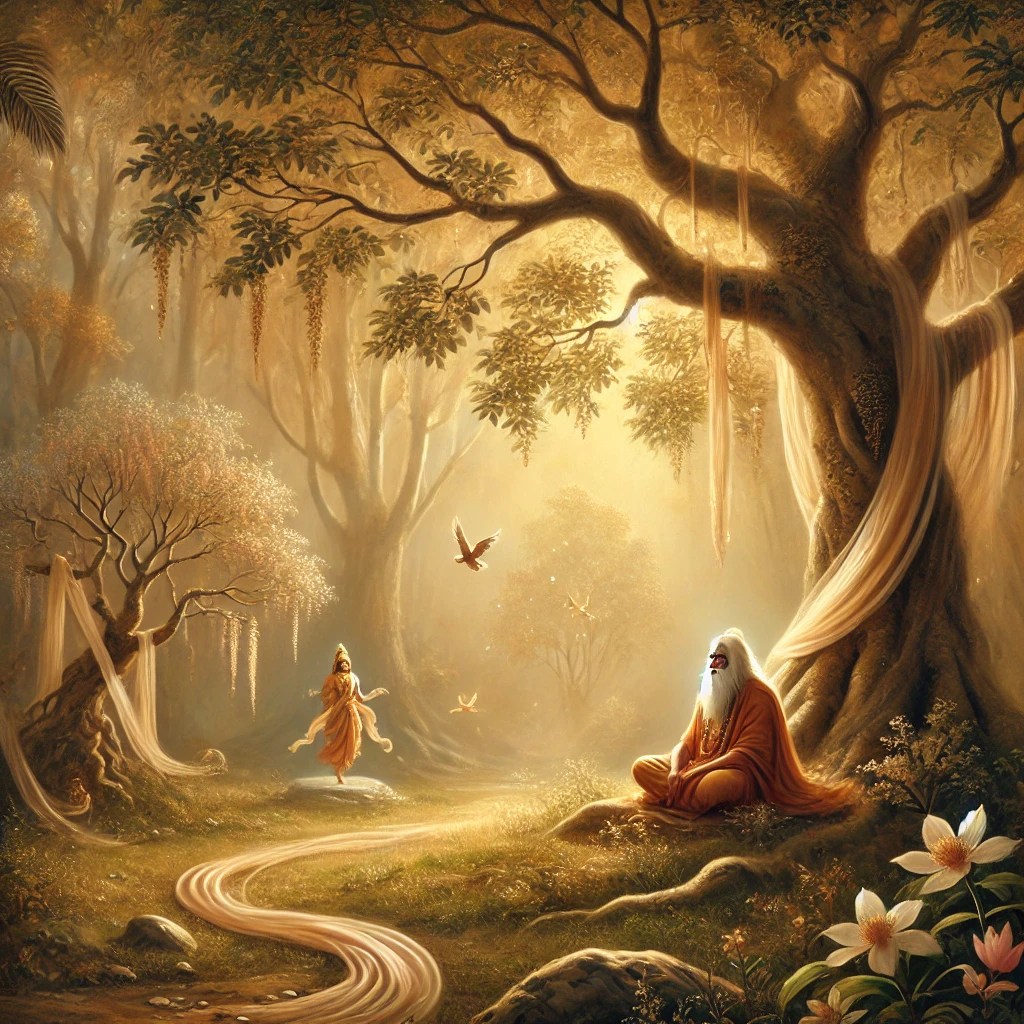
As we begin our exploration of the Ramayana through Venkatesananda’s version, it’s fascinating to revisit the early stages of this epic tale, particularly through the lens of Valmiki’s own transformation. In this version, we are reminded of how the sage first heard the Ramayana from Narada and later expanded upon it after a transformative experience with the hunter and his divine encounter with Brahma. This opening passage introduces us not only to the story of Rama but also to the profound personal growth of Valmiki, a theme that resonates deeply with our own spiritual journeys.
One particular quote stands out: “Yet, the mystery that even he could lose his temper and thus risk losing the merit of his asceticism intrigued him.”
This moment captures a crucial aspect of the human condition—our struggle to control our emotions, even after years of spiritual practice. For Valmiki, witnessing the hunter’s cruelty toward the birds brought forth both compassion and anger, leading him to curse the hunter. It’s a reminder that even great sages can lose their temper, risking their spiritual merit. For me, the Dalai Lama’s teachings on anger come to mind here—anger is often seen as the opposite of love, and when we give in to it, we lose touch with our pristine, true nature. But the important lesson is that we can always return to our senses, regain our inner peace, and continue on the path of righteousness.
This story, to me, also inspires compassion for ourselves. If even Valmiki, with all his ascetic discipline, could slip into anger, we too can forgive ourselves for the times we fall short. The key is recognizing these moments, learning from them, and using them as opportunities to realign with our higher purpose. Valmiki’s regret and his ability to transform his curse into a verse is a powerful reminder that even our missteps can lead to something greater, if approached with the right mindset.
In this retelling, Valmiki’s divine encounter with Brahma affirms the purpose of his story. Brahma reassures him that the verse he uttered, born out of both anger and compassion, is a blessing. From this moment of emotion, a profound epic was born—a story that would inspire righteousness, compassion, and wisdom for generations. This theme of duality—anger and compassion, curse and blessing—reflects the constant struggle humanity faces with its own dual nature.
What I find particularly compelling in this passage is how the Ramayana is positioned as medicine for a world in turmoil, a story that speaks to the heart of our modern struggles. Today, as in Valmiki’s time, people are often disconnected from their conscience, their true nature, and their pristine mind. This disconnect creates inner chaos, much like the mental fluctuations Valmiki experienced. The Ramayana, with its timeless wisdom, offers a path back to harmony with the divine. It reminds us that even in moments of anger or despair, there is always a way to transform that energy into something positive.
Valmiki’s transformation from anger to inspiration is a beautiful metaphor for our own lives. In the same way that he found his path through a moment of passion, we too can use our struggles as stepping stones toward greater understanding and compassion. The passion that Valmiki felt for the hunter’s cruelty was ultimately transformed into the creation of a story that would inspire righteousness and compassion for millennia.
As we continue this journey through the Ramayana, let us reflect on how we, too, can transform our moments of anger or frustration into opportunities for growth. The challenges we face—both internally and externally—are all part of our spiritual journey. Valmiki’s story is a powerful reminder that the path to self-realization is not without struggle, but each step along the way can lead us closer to our true selves.
In future posts, we’ll continue to explore the wisdom within this and other versions of the Ramayana, diving deeper into how these timeless stories offer guidance for our modern lives. Let’s stay open to the lessons each passage holds and, like Valmiki, allow our moments of weakness to be transformed into opportunities for growth and inspiration.
Inspired by Chapter 1.4 of the DeBroy Translation of the Ramayana
When reading ancient texts, one often encounters moments that seem to defy the logic of modern storytelling. One such moment came to me while reading Chapter 1.4 of Bibek Debroy’s translation of Valmiki’s Ramayana. In this passage, something quite strange happens: Rama, the hero of the Ramayana, listens to the story of his own life, recounted in beautiful song by two ascetics, Kusha and Lava—who, unbeknownst to him, are his own sons. I found myself both fascinated and confused. Why would the central character of this grand epic sit back and listen to his own tale, seemingly unaware of his role in it? How could this be?
At first glance, it seems almost like a paradox: the one who lived the events is now hearing about them as though they were ancient history. What could this mean? I couldn’t shake off the oddness of the moment, but as I reflected more deeply on the passage, I realized that there’s something profoundly spiritual and poetic at work here.
A Meta-Narrative and the Power of Storytelling
This moment in Chapter 1.4 introduces a unique dimension where the Ramayana folds in on itself, becoming both a story and an experience for its own characters. We, as readers, witness Rama being drawn into the retelling of his life, just as sages, brahmins, and laypeople of that era are captivated by the story. In this curious turn, Rama—the central figure of the narrative—is, for the moment, merely an audience member, listening to his own history as if hearing it for the first time.
On one level, this reflects the power of oral storytelling in ancient India, where the telling and retelling of epics like the Ramayana were central to cultural and spiritual life. The story is not merely history but a living tradition, recited to evoke wonder, devotion, and moral reflection. For Rama to hear his own story is a symbolic acknowledgment that this tale is larger than any one person—even the hero himself. The Ramayana transcends its historical events, becoming a divine narrative, filled with universal truths about dharma (righteousness), sacrifice, and devotion.
Kusha and Lava: The Storytellers and the Story
Adding to the layers of intrigue, the two ascetics who sing the Ramayana to Rama are his own sons, Kusha and Lava, though neither they nor Rama realize this at the time. Raised in Valmiki’s hermitage, Kusha and Lava learned the Ramayana directly from the sage and became its first storytellers. As sons of Rama, they are natural inheritors of the tale, yet the irony of the scene is that they chant this story to their own father, without the familial bond being revealed.
This speaks to the epic’s larger themes of identity and destiny. In the world of the Ramayana, characters are often bound by dharma and divine will, which transcend personal awareness. Rama himself, as an avatar of Vishnu, is bound to play out his role in the cosmic order. The fact that he listens with rapt attention to the story of his life shows that even divine figures are subject to the profound, transformative power of the stories they inhabit.
The Divine Nature of the Story
This scene highlights another key aspect of the Ramayana: the cyclical and timeless nature of the epic. In Hindu cosmology, time is often viewed as non-linear, with past, present, and future all interwoven in ways that are difficult for human minds to grasp. The Ramayana exists in this non-linear realm. It is a divine account, a mirror of cosmic truths. Rama’s role in the Ramayana is not just that of a king living through his personal trials but also a divine figure participating in an eternal drama of dharma.
When Kusha and Lava sing to Rama, they do so with perfect rhythm, melody, and tone, emphasizing the divine nature of the Ramayana itself. The text is not just a story to be told but an act of worship, sung in a way that mirrors celestial music. As they chant the tale, they embody the principles of devotion and truth that the Ramayana seeks to impart to its audience.
Rama as Listener
For me, the most profound aspect of this scene is Rama’s response. Though he lived these events, he listens to them as though they are new, becoming deeply immersed in the retelling. This suggests something powerful about the nature of memory, self-reflection, and storytelling. It’s as though Rama is being reminded of his own purpose, hearing his life’s journey unfold not from the inside but as an external observer. Even he, the hero of the epic, is subject to the transformative power of the narrative.
This can be seen as a reflection on the power of stories to teach and remind us of deeper truths about ourselves, even if we are the ones who lived through the experiences. The Ramayana is not just for others—it is for Rama too. It’s a reminder that no one, not even an avatar of Vishnu, is exempt from the lessons of dharma.
Conclusion: The Timeless Tale for All
This scene of Rama listening to his own story sung by Kusha and Lava offers us a profound reflection on the cyclical nature of time, the transformative power of storytelling, and the way in which even divine figures are humbled by the truth of dharma. The Ramayana, in this moment, transcends the simple bounds of history or narrative. It becomes an eternal truth that even its protagonist must hear, acknowledge, and reflect upon.
For those who have not yet read this passage, I encourage you to do so.
As I begin my journey through the Gita Press edition of the Ramayana, I find myself immediately struck by the structure of the first canto. Within just a few verses, the entire epic is laid out before the reader—Rama’s exile, his defeat of Ravana, the rescue of Sita, and his triumphant return to Ayodhya where he reigns as king. It’s a “happily ever after” summary that seems to condense the entire narrative into a brief prologue. But why start a story this way? What is the purpose of summarizing the entire epic right at the beginning?
This approach, common in ancient epics, serves multiple purposes. First, it provides readers with a roadmap, offering a glimpse of the destination before embarking on the journey. In the context of the Ramayana, it reminds us that the ultimate outcome of the story is not in question—Rama, the embodiment of dharma, will triumph, righteousness will be restored, and order will prevail. Knowing this from the outset allows readers to focus not on the suspense of what will happen, but on the lessons to be learned along the way.
The first canto functions as both an introduction and a promise. It assures us that despite the trials, battles, and moments of despair that will inevitably follow, the story ends in the victory of good over evil. It also invites us to consider the deeper meaning behind these events. By presenting the conclusion first, the text suggests that the journey is just as important—if not more so—than the destination.
As I continue reading, it’s clear that the richness of the Ramayana lies not just in its grand narrative, but in the details, the interactions between characters, the challenges they face, and the decisions they make. The first canto’s summary is just the beginning—a way to frame the epic and to prepare us for the moral and spiritual lessons that will unfold in the subsequent chapters.
In the Gita Press version, the simplicity and directness of this introduction serve to draw the reader in, setting the stage for a deeper exploration of dharma, devotion, and the complexities of human life. It is an invitation to not only read the story but to reflect on its teachings and apply them to our own lives.
As I delve deeper into the Ramayana, I am reminded that the true value of this epic lies in its capacity to guide us on our own spiritual journey, offering insights that are as relevant today as they were thousands of years ago.
For those interested in exploring this epic themselves, the Gita Press edition, along with the detailed Debroy translation, is embedded in this blog post. You can access them and embark on your own journey through the Ramayana, discovering the layers of wisdom and truth that this ancient text has to offer.
As I continue my journey through the Ramayana, I’ve chosen to explore this epic using multiple versions: the abridged Valmiki translation, the comprehensive Gita Press edition, and the detailed Debroy translation. This approach allows me to compare different interpretations and uncover nuances that might otherwise go unnoticed. For those interested in exploring these different versions, both the Gita Press edition and the Debroy translation are embedded in the blog post below.
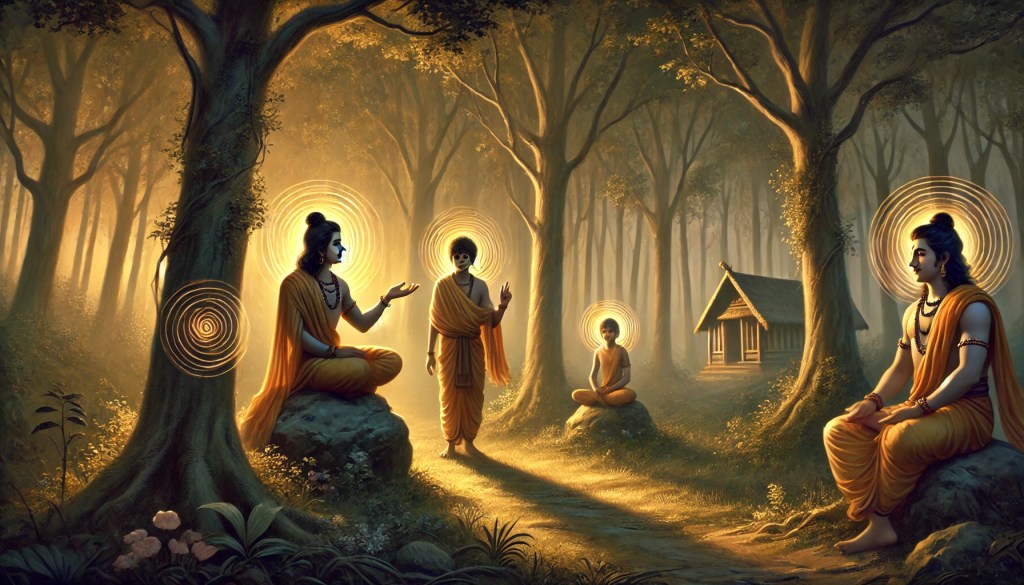
Through this exploration, one figure has emerged as particularly significant in the opening of the Ramayana: the celestial sage Narada.
Narada is one of the most revered sages in Hindu mythology, known for his deep wisdom, musical talent, and his role as a divine messenger. He is often depicted as a traveling sage who moves freely between the earthly realm and the divine, carrying messages from the gods to humans and vice versa. Narada is also renowned for his ability to incite action and prompt change—sometimes through his seemingly mischievous behavior, earning him the title of the “Divine Troublemaker.” However, his actions are always aimed at upholding dharma, or righteousness, even if they appear unconventional.
Narada’s importance extends far beyond the Ramayana. He is a prominent figure in several other Hindu texts, including the Mahabharata, the Bhagavata Purana, and various Upanishads. In these texts, Narada is often seen guiding kings, sages, and even the gods themselves, providing counsel and sometimes challenging them to reflect on their actions. His role as a teacher and guide makes him a central figure in the transmission of spiritual knowledge and the preservation of dharma.
Narada is also credited with the composition of the Narada Bhakti Sutra, a foundational text on the practice of bhakti, or devotion to God. This further underscores his role as a spiritual guide and a beacon of divine love and wisdom.
The Ramayana opens with Narada narrating the story to Valmiki. This is a significant moment, as it frames the Ramayana not just as a historical or mythological account, but as a divine narrative passed down from the gods to humans through a trusted sage. Narada’s role here is that of a divine mediator, ensuring that the wisdom and teachings of the Ramayana are preserved and passed on to future generations.
Narada’s presence in the Ramayana reminds us that spiritual teachings often come through intermediaries who carry the weight of divine authority. His involvement in the story underscores the importance of dharma and the divine order, which are central themes in the Ramayana.
As we explore Narada’s role in the Ramayana, it’s essential to recognize the broader implications of his presence. Narada is not just a character in the story; he is a symbol of divine wisdom, a bridge between the mortal world and the divine, and a guide for those seeking to live a life of righteousness. His actions, teachings, and guidance are a reminder that the path of dharma is always within reach, no matter the challenges we face.
🙏🕊️🙏
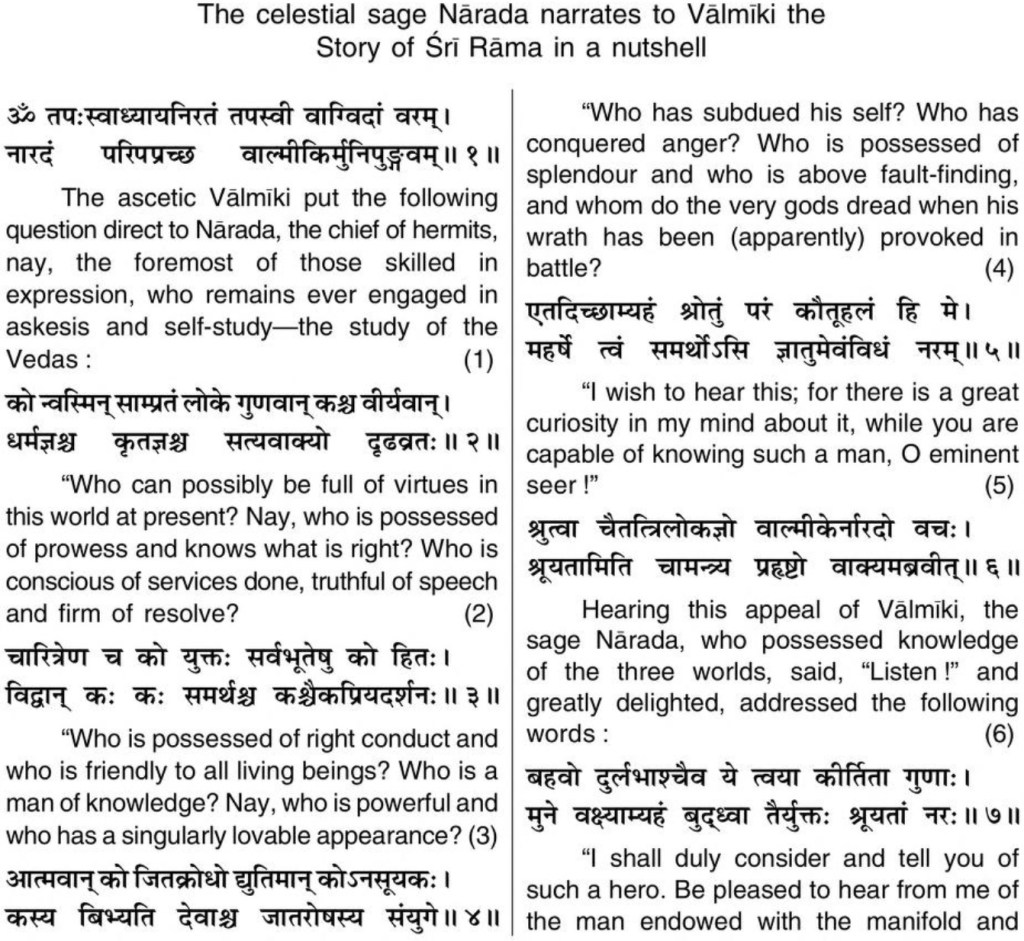
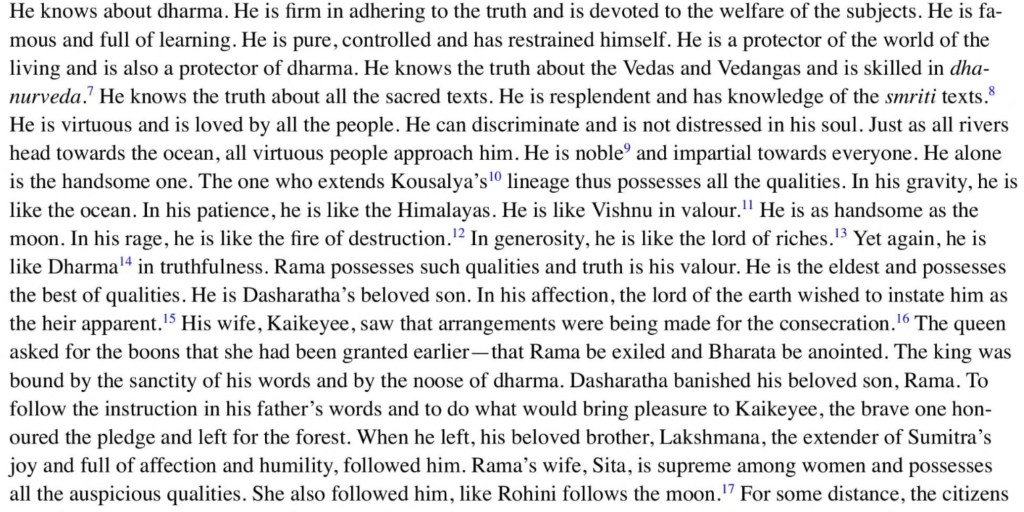
If you’re interested in exploring the Ramayana in greater depth, you can find the Gita Press and Debroy versions below.
Below is an image from the Gita Press version, where Narada’s wisdom begins to unfold:
Screenshot
Below is an image from the Debroy version, where Narada’s wisdom also begins to unfold:
As we prepare to embark on our exploration of the Ramayana, it’s important to recognize that this epic is much more than a tale of gods, goddesses, and mythical battles. It’s a story deeply embedded with lessons on morality, intelligence, right action, and dharma—principles that are just as relevant today as they were thousands of years ago. Before diving into the narrative, it’s worth considering how the Ramayana—and the way its stories have been told and retold—serves as a mirror for our own times, particularly in how we think about leadership and moral responsibility.
The Role of Conflict in Traditional Narratives
The traditional Ramayana, as attributed to the sage Valmiki, doesn’t shy away from presenting complex moral dilemmas. One of the most significant and debated moments in the epic is Rama’s rejection of Sita after rescuing her from Ravana. This is not simply a plot twist; it’s a deliberate narrative choice that forces both the characters and the readers to grapple with the complexities of dharma (Righteous Action)
In this episode, Rama—an incarnation of the divine—faces a conflict between his personal feelings and his duties as a king. Despite knowing Sita’s purity, Rama chooses to distance himself from her, prioritizing his duty to his subjects over his personal happiness. This moment challenges us to think deeply about what it means to uphold dharma, especially when it requires personal sacrifice and difficult decisions.
The Impact of a “Happy Ending” in William Buck’s Version
In William Buck’s westernized retelling of the Ramayana, this conflict is resolved with a happy ending—Rama welcomes Sita back without hesitation, sidestepping the painful dilemma present in the traditional narrative. While this version may be more palatable for modern Western audiences, it also simplifies the story, removing the layers of moral complexity that invite deeper reflection.
This choice reflects a broader cultural tendency in the West to favor narratives that resolve conflict neatly, often prioritizing personal happiness over the challenging moral questions that unresolved conflicts can raise. While this approach makes the story more accessible, it also diminishes its potential as a tool for moral and ethical education.
Dharma and Leadership: A Contrast Between Cultures
In traditional Indian culture, a king was expected to embody dharma—righteousness, moral integrity, and a commitment to the greater good. This meant making decisions that, while difficult, served to uphold the moral fabric of society. The rejection of Sita, while harsh, is portrayed as Rama’s adherence to this principle, demonstrating the importance of dharma even at great personal cost.
In contrast, modern Western political leadership often prioritizes popularity, pragmatism, and short-term success over timeless moral principles. Leaders are frequently more concerned with maintaining power and appealing to public opinion than with upholding the kind of righteousness that demands sacrifice and integrity.
The Value of the Original Conflict
The original conflict in the Ramayana is invaluable because it forces us to confront the uncomfortable realities of leadership and the complexities of dharma. It challenges us to think critically about what true righteousness looks like and what sacrifices might be necessary to uphold it. This is not just a story about the past; it’s a narrative that speaks directly to the moral challenges of our own time.
Balancing the Versions
While William Buck’s version of the Ramayana offers a more straightforward narrative, engaging with the traditional story allows us to explore these deeper moral and ethical questions. Both versions have their value, but it’s the original narrative that offers the richest opportunities for reflection and growth.
A Call for Righteous Leadership
As we prepare to dive into the Ramayana, it’s important to remember that this epic is not just about divine battles and mythical adventures. It’s a profound exploration of dharma, leadership, and moral responsibility—topics that are sorely lacking in much of our modern educational and religious systems. The story of Rama and Sita is a reminder that true leadership requires more than just power or popularity; it demands a deep commitment to righteousness, even when it comes at a personal cost.
In our own time, as we look around at the state of leadership in the world, there is much we can learn from the Ramayana. The story invites us to reflect on the qualities we should seek in our leaders and the moral standards to which they should be held. It challenges us to consider how we, too, can embody dharma in our own lives, making decisions that are guided by integrity and a commitment to the greater good.
Conclusion: The Relevance of the Ramayana Today
The Ramayana is not just a story from the past; it’s a living tradition that continues to offer wisdom and guidance for our time. By engaging directly with Valmiki’s original version, we immerse ourselves in the authentic narrative that has inspired countless generations. As we journey through this epic, let’s keep in mind that the lessons it imparts are not just for ancient kings and queens—they are for all of us, here and now, as we navigate the challenges of modern life. By engaging deeply with these teachings, we can rediscover the importance of righteousness, moral integrity, and the pursuit of dharma in our own lives and in the leaders we choose to follow.
Further Reading: The Original Ramayana
For those interested in exploring a more traditional version of the Ramayana, you may want to consider the Kindle edition translated by Suparna Ghosh. This version stays closer to the original text attributed to the sage Valmiki, offering a richer understanding of the epic’s cultural and spiritual context. Whether you’re drawn to the modern retelling by William Buck or the more traditional narrative, both versions provide valuable insights into this timeless story.
In the ancient temples of India, where the scent of incense mingles with the murmurs of sacred hymns, there exists a timeless connection between the human soul and the divine. Recently, I found myself captivated by a simple yet profound moment: a video of Anandamayi Ma, the embodiment of divine love and wisdom, chanting the sacred names of Rama, Krishna, and Guru. The mantra, gentle yet powerful, seemed to call forth something deep within me—a longing to delve into the rich spiritual tapestry of these names and the stories that have been woven around them for millennia.
This moment of inspiration has led me to embark on a new journey, one that I hope will resonate with you as well. Together, we will explore the Ramayana, one of the greatest epics of ancient India, chapter by chapter. But this will not be a mere retelling of an old story; it will be a journey of reflection and contemplation, aspiring to the introspective and poetic style that resonates deeply within our souls.
The Ramayana is not just a tale of gods, demons, and heroes; it is a profound exploration of the human condition, a guide to living a life of virtue, courage, and devotion. At its heart lies the story of Rama, the embodiment of dharma, who journeys through the trials of life with unwavering righteousness. Alongside him are other divine figures—Sita, the epitome of purity and devotion; Hanuman, the faithful servant; and Krishna, whose playful wisdom and divine love illuminate the path of bhakti, or devotion.
Through this series of reflections, we will immerse ourselves in the Ramayana, allowing its teachings to speak to our own lives and spiritual journeys. Each post will be a meditation on the lessons of the Ramayana, drawing connections to the universal experiences of love, loss, duty, and divine connection.
This project is part of our broader interfaith exploration of spiritual experience and wisdom. We are not promoting any particular belief system, but rather, we are exploring the perennial wisdom found in this ancient teaching and considering how it can be applied to our lives, regardless of our religious background. The phrase “perennial wisdom,” as used by thinkers like Joseph Campbell, captures the timeless truths that transcend specific traditions and speak to the core of our shared humanity.
Inspired by the chant of “Hare Rama, Hare Krishna, Hare Guru,” this series invites us to explore the divine presence within, to reflect on the sacred amidst our daily lives, and to seek the eternal truths that the Ramayana offers. These reflections will aim to be both poetic and accessible, serving as a bridge between the ancient and the modern, the distant and the personal.
This series will unfold at its own pace, allowing us to journey through this epic story together with the time and care it deserves. If you would like to be notified when new posts are added, I invite you to subscribe to the blog. In doing so, you’ll receive updates as we continue this exploration, chapter by chapter, reflection by reflection.
As we embark on this journey, let us remember that the Ramayana is not merely a story from a distant past but a living scripture, a mirror to our own spiritual journeys. Each chapter offers a chance to reflect, to grow, and to connect more deeply with the divine essence that resides within all of us. Let us walk this path together, guided by the wisdom of the ages, and open to the light that transcends all boundaries of faith and culture.
In the vast expanse of India’s spiritual landscape, few figures shine as brightly as Anandamayi Ma. Revered as a saint and mystic, she was a living embodiment of divine grace, known for her profound wisdom and boundless compassion. Her life was a continuous flow of devotion and spiritual ecstasy, and her teachings centered on the realization of the Self and the practice of bhakti, or devotion to God.
It was while watching a video of her chanting “Hare Rama, Hare Krishna, Hare Guru” that I was inspired to delve deeper into the teachings of the Ramayana and to explore the wisdom contained within its verses. This series of reflections is born from that moment of inspiration, and it is with gratitude that I invite you to join me on this journey.
If you would like to witness the moment that sparked this exploration, you can watch the video below. In it, Anandamayi Ma’s serene presence and the heartfelt chant which accompanies the video, serve as a powerful reminder of the divine love that is ever-present, waiting to be discovered within each of us.
May the light of truth, loving-kindness and compassion guide us as we embark on this journey together.
“The more you develop love, devotion, and faith, the more will the Lord manifest in you. He alone knows the way to your deliverance. Surrender yourself completely to Him.”
— Anandamayi Ma
Understanding the Context of the Ramayana in a Broader Spiritual Perspective
As we embark on this journey through the Ramayana, it’s important to recognize the deep spiritual wisdom embedded within this ancient text, and how it resonates across different faith traditions. For those of us coming from monotheistic backgrounds, the concept of deity worship and the use of images in spiritual practice may seem unfamiliar, or even concerning. However, these practices in the Indian tradition carry a profound symbolism that transcends mere ritual.
In Hinduism, the deities such as Rama, Krishna, and others are not worshipped as gods in the way that might be understood in the Western sense, but rather as manifestations of the one infinite, formless reality. The images and stories of these deities serve as focal points for devotion, helping practitioners connect with the divine message they portray in a tangible way. Much like how icons or symbols might be used in other religious traditions to inspire devotion and focus, the deities in the Ramayana are revered as expressions of universal principles like righteousness (dharma), love, compassion and wisdom.
What is the Ramayana?
The Ramayana is an epic narrative that tells the story of Prince Rama, his wife Sita, and his battle against the demon king Ravana. It is a foundational text in Hindu culture, with deep religious, moral, and philosophical significance. Through this epic story, the Ramayana explores themes of duty, devotion, righteousness, and the eternal struggle between good and evil. It is not only a beloved story but also a spiritual guide that has shaped the values, behaviors and beliefs of billions of people for centuries.
The composition of the Ramayana is traditionally attributed to the sage Valmiki, with estimates placing its creation between 500 B.C. and 100 A.D. This epic became a cornerstone of Hindu literature and spiritual thought, profoundly shaping the religious and moral landscape of India.
The Ramayana became a vital text within Hinduism, deeply influencing Indian culture, art, literature, and religious practice. Its stories are told and retold in various forms throughout South and Southeast Asia, making it one of the most enduring spiritual epics in history.
The stories within the Ramayana offer allegories of the spiritual journey, providing guidance on how to live a life in harmony with the divine will. They are not about idol worship in the way that might be condemned in certain religious texts, but rather about understanding, loving and respecting the divine presence in all aspects of life. These teachings invite us to explore the deeper truths of existence, to reflect on the nature of righteousness, and to open our hearts to the universal love that transcends all forms.
The Power of Myth and Storytelling
The Ramayana is a mythic narrative that has evolved over centuries, taking on countless forms as it was passed down from generation to generation. These stories became the underlying fabric of a culture, deeply influencing the spiritual and moral landscape of India and beyond. In many spiritual traditions, including Hinduism, myths are symbolic representations of deeper truths, reflecting the inner journey of the soul and the universal struggle between good and evil. These narratives are living realities, woven into the consciousness of the people, guiding them on their spiritual paths. Through the lens of myth, the Ramayana provides not only moral and ethical guidance but also profound insights into the nature of existence and the divine. By engaging with this epic, we step into a world where the divine interacts with the human, and where every action, choice, and event carries cosmic significance.
The Diversity of Hinduism and the Ramayana
Hinduism itself is not a monolithic tradition but a vast collection of beliefs, practices, and philosophies. Different sects and communities may emphasize different aspects of the Ramayana or even different versions of the text. This diversity is one of the hallmarks of Hinduism, where multiple truths and perspectives can coexist. The Ramayana has inspired countless retellings, each one offering a unique lens through which to view the universal themes of duty, devotion, and the cosmic battle between good and evil.
Exploring the Ramayana Through Valmiki’s Original Version
As we embark on this journey through the Ramayana, we will be drawing inspiration from Valmiki’s original text, translated by Suparna Ghosh. Valmiki’s Ramayana is the traditional and authoritative version of this epic, offering a deep, cultural, and spiritual insight into the story of Rama. By engaging directly with this foundational text, we can explore the Ramayana in its most authentic form, allowing for a richer and more nuanced understanding of its teachings. This approach will enable us to appreciate the timeless wisdom of the Ramayana and reflect on its relevance in both historical and contemporary contexts.
By approaching the Ramayana with an open heart and a willingness to explore these spiritual teachings, we can find common ground between different faith traditions and deepen our understanding of the divine. This study is not about adopting new beliefs, but about engaging with the perennial wisdom that has guided countless diverse seekers throughout history. Together, we will explore these ancient teachings, finding their relevance and application in our lives today.
🙏🕊️🙏
You can find the edition of the Ramayana used in this series, written by Valmiki and translated by Suparna Ghosh, on Amazon here.
 Home Page: Inspirations of Love and Hope