Tag: Indian Epics

  • Ramayana No. 17: The Journey of Life: Lessons from Rama’s Epic Story

    Ramayana No. 17: The Journey of Life: Lessons from Rama’s Epic Story

    Inspired by Chapter 1.3 of the DeBroy Translation of the Ramayana

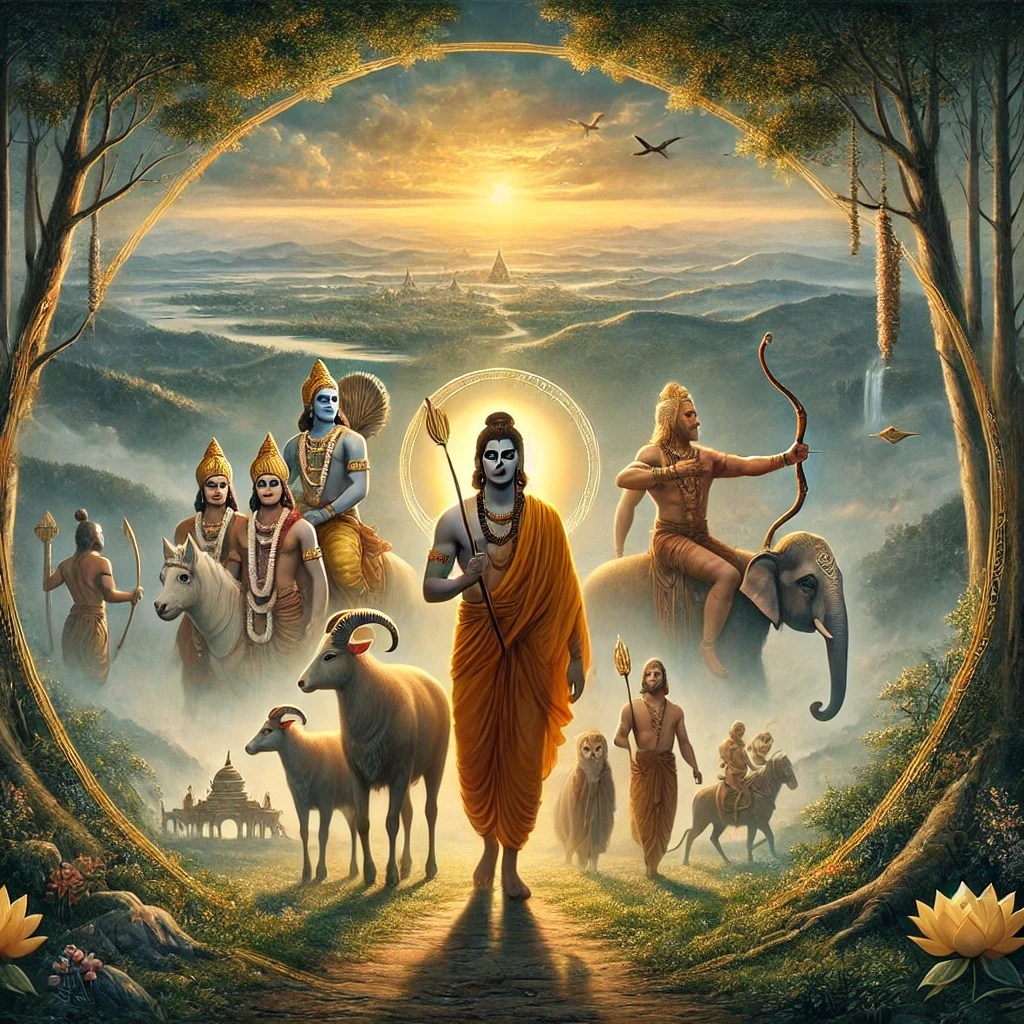
    In the Ramayana, we follow Rama on an extraordinary journey filled with triumphs and tribulations. As we explore his life, we come to realize that it is not just a story of a prince, but a reflection of the very fabric of human existence. From his birth as a noble soul to his struggles, battles, and eventual return to Ayodhya, Rama’s journey offers a mirror for the journey each of us takes through life.

    This timeless epic, as retold by Valmiki, holds deep truths that resonate as powerfully today as they did in ancient times. Below are some key lessons from Rama’s life that provide valuable insights for the modern world.

    Adversity is Part of the Journey

    Rama’s life is marked by periods of great adversity, including his unjust exile from Ayodhya and the abduction of his wife, Sita. Despite the hardships, Rama never wavers in his resolve to uphold dharma (righteousness).

    In today’s world, we often face our own versions of exile—whether it’s personal setbacks, professional struggles, or moments of loss. Rama’s journey teaches us that adversity is not something to avoid but to embrace as part of life. How we respond to these challenges defines who we are. Like Rama, we can face our difficulties with resilience, staying true to our values, and knowing that every trial brings growth.

    The Power of Friendship and Support

    Rama does not walk the path of exile alone. His unwavering companions—his brother Lakshmana, his devoted friend Hanuman, and the loyal Sugriva—each play crucial roles in helping him overcome seemingly insurmountable obstacles.

    In a world where individualism is often prized, the Ramayana reminds us of the importance of relationships and support networks. We are not meant to face life’s challenges alone. Surrounding ourselves with people who uplift and support us can make all the difference when facing hardships. True friends, like Hanuman and Lakshmana, offer strength when we need it most.

    The Balance Between Duty and Personal Desires

    One of the most powerful themes of the Ramayana is the constant tension between personal desires and duty (dharma). Rama is exiled because of his stepmother’s wishes, yet he chooses to honor his father’s promise, even at the cost of his own happiness.

    In today’s fast-paced and achievement-oriented society, we are often pulled between pursuing personal goals and fulfilling our responsibilities to others. The story of Rama reminds us that living with integrity sometimes means placing duty above personal ambition. This does not mean sacrificing our happiness; instead, it’s about finding harmony between the two and understanding that a life lived in accordance with one’s principles brings long-lasting peace.

    Redemption and Return: The Cycle of Life

    After years of struggle, Rama defeats Ravana, rescues Sita, and returns to Ayodhya to claim his rightful place as king. His return represents not only a physical homecoming but a symbolic redemption after enduring exile and loss.

    This mirrors the cycles we experience in life. Periods of difficulty and hardship eventually give way to renewal and recovery. Rama’s return reminds us that no matter how long the journey or how deep the struggle, there is always a path back to peace, fulfillment, and purpose. In moments when we feel lost, we can take comfort in the knowledge that challenges are temporary, and our personal “return to Ayodhya” is always on the horizon.

    The Enduring Power of Faith and Devotion

    Throughout the Ramayana, Rama places his faith in the larger forces at work. Whether in his interactions with sages, his prayers to deities, or his reliance on his loyal companions, his life demonstrates the importance of faith and devotion—not just in the divine, but in the power of goodness and righteousness.

    In our modern lives, where uncertainty often reigns, faith can serve as an anchor. Whether it’s faith in ourselves, in a higher power, or in the principles of justice and kindness, maintaining a sense of devotion can guide us through life’s challenges. Like Rama, when we stay connected to a sense of purpose greater than ourselves, we find strength, clarity, and peace.

    Conclusion: The Ramayana as a Guide for Our Times

    Rama’s journey is a timeless reflection of the human experience. His life teaches us that hardship, sacrifice, and redemption are all part of our own stories. By embracing adversity, cultivating meaningful relationships, honoring our duties, and holding onto faith, we can navigate the challenges of modern life with grace and resilience.

    The Ramayana, as retold by Valmiki and beautifully translated by DeBroy, continues to inspire countless generations. Its wisdom transcends time, offering guidance for anyone seeking a life of purpose, integrity, and fulfillment. Just as Rama found his way back to Ayodhya, we too can find our way through the trials of life, emerging stronger and wiser.

    Read Chapter 1.3 of the DeBroy Translation of the Ramayana

  • Ramayana No. 15: The Timeless Virtues of Rama: Lessons for the Modern Age

    Ramayana No. 15: The Timeless Virtues of Rama: Lessons for the Modern Age

    Inspired by Chapter 1.1 of the DeBroy Translation of the Ramayana

    In the ancient texts of the Ramayana, the sage Valmiki asks the wise Narada to describe a man who embodies the highest virtues. Narada’s response is a detailed description of Lord Rama, a king known for his valor, wisdom, and unwavering commitment to truth and righteousness. Though these stories are thousands of years old, the values they promote are as relevant today as they were then. In a world where we often look for heroes, role models, and guiding principles, the virtues of Rama offer profound lessons that can help us navigate the complexities of modern life.

    The Power of Truth and Integrity

    One of the most remarkable qualities of Rama is his commitment to truth. Even when faced with great personal loss, such as being exiled from his kingdom due to his stepmother’s wishes, Rama adheres to his principles without wavering. He follows his father’s word, honoring the sanctity of promises, even when it causes him immense personal sacrifice.

    In today’s world, where truth can sometimes feel like a rare commodity, Rama’s example reminds us of the importance of integrity. Living in accordance with our values, keeping our promises, and being truthful not only to others but also to ourselves, are keys to building trust and respect in our personal and professional lives.

    Strength in Compassion and Duty

    Rama is not only depicted as a strong and skilled warrior but also as a compassionate leader who is deeply committed to the welfare of his people. His strength is not just physical but moral—he rules with kindness, fairness, and a deep sense of duty toward all beings.

    In our times, where leadership is often equated with power and domination, the model of compassionate leadership stands out as a much-needed ideal. Whether in the corporate world, in our communities, or at home, leading with empathy and prioritizing the well-being of others fosters unity and trust, creating environments where everyone can thrive.

    The Balance of Emotion and Reason

    Rama’s ability to control his anger and emotions is another defining trait. Even in situations that provoke great emotional turmoil—whether it’s the abduction of his wife Sita or the betrayal of those closest to him—he does not act impulsively. Instead, Rama demonstrates the importance of mastering one’s emotions, using reason and wisdom to guide his decisions.

    In today’s high-pressure world, emotional intelligence has become a key skill for success and well-being. Like Rama, we too are often faced with situations that test our patience and provoke our emotions. By learning to balance our emotions with reason, we can respond to challenges with clarity and make decisions that reflect our best selves.

    The Journey of Growth Through Sacrifice

    Rama’s exile into the forest can be seen as a metaphor for the journey of personal growth. In the face of adversity, Rama never loses sight of his purpose, and through each trial, he emerges stronger and wiser. His ability to turn hardship into a path of self-refinement is one of the most powerful lessons of his life.

    In the modern age, we are constantly faced with challenges, whether personal, professional, or societal. Instead of viewing these challenges as setbacks, we can reframe them as opportunities for growth and transformation. Every difficulty we encounter, much like Rama’s exile, has the potential to shape us into better versions of ourselves.

    The Role of Dharma: Living with Purpose

    Dharma, or living in accordance with the natural law of righteousness, is central to Rama’s life. Every action he takes is aligned with his duty—whether to his family, his people, or the greater good. His unwavering commitment to dharma ensures that he lives a life of purpose, clarity, and fulfillment.

    In our fast-paced, goal-driven world, it’s easy to lose sight of our deeper purpose. Rama’s example invites us to reconnect with our own dharma, to reflect on what truly matters in our lives, and to live in a way that is meaningful, ethical, and aligned with our highest values.

    Conclusion: Finding Rama Within

    The story of Rama is not just an ancient myth; it is a blueprint for living a life of virtue, strength, and purpose. Each of us, in our own ways, can strive to embody the qualities that make Rama such a revered figure—truthfulness, compassion, emotional resilience, and a commitment to doing what is right.

    As we navigate the complexities of modern life, let us draw inspiration from these timeless virtues. In doing so, we may find that the path to fulfillment, peace, and greatness is not as far away as it seems—it begins within each of us.

    Here is the link to the free online version of the Ramayana, translated by DeBroy, which inspired these reflections. Feel free to explore the full text for a deeper understanding of this timeless epic.

    Read chapter 1/1 of the free online version of the DeBroy Translation of the Ramayana here.

  • Ramayana No. 2: Ayodhya—The Unsubdued Kingdom Within

    Rama’s Exile and Our Spiritual Journey: Reclaiming the Pristine Mind


    As I sit with the first chapter of the Ramayana, I find myself drawn to the idea of Ayodhya—the city that cannot be subdued by war. This simple yet profound description speaks to something deeper, something within each of us that remains untouched by the chaos of the world.

    Ayodhya, the capital of King Dasharatha’s kingdom, is not just a physical city, but a symbol—a metaphor for the pristine mind, the true self that resides within us all. Just as Ayodhya stands strong against external threats, so too does our innermost self, the Atman, remain pure and invincible against the storms of life and the fluctuations of our mind.

    In the early pages of the Ramayana, we find ourselves in a kingdom of righteousness, where the people live in harmony under the guidance of a just king. It is a vision of what life can be when we are in tune with our true nature, when the mind is calm and clear, and the heart is aligned with the divine. Ayodhya, in this sense, is our inner sanctuary, a place of peace and stability, untouched by the turmoil of the external world and the inner conflicts of ego and desire.

    But as the story unfolds, we know that Rama, the hero of the epic, is exiled from this idyllic kingdom. He leaves Ayodhya, and with that, he leaves behind the safety and serenity of his home. This exile, I realize, is not just a physical journey, but a reflection of our own experience as we move from the innocence of childhood into the complexities of the world.

    We are all, in a way, exiled from our own Ayodhya. As we grow, we face the trials and tribulations of life, and our minds become cluttered with the noise of the world—the vrittis and pratyayas, the mental fluctuations and impressions that cloud our true nature. The ego begins to take shape, and we lose touch with that pristine mind, that inner Ayodhya where peace and purity reside.

    Rama’s battles during his exile are not just against external enemies, but against the forces that seek to pull him away from his true self. And so it is with us. The challenges we face in life—be they loss, betrayal, or the struggles within our own hearts—are the battles we must fight to reclaim our inner Ayodhya. These are the trials that, if met with courage and wisdom, can lead us back to the realization of who we truly are.

    In this way, the Ramayana is more than just a story; it is a map of the spiritual journey. It teaches us that the path to self-realization is not without struggle, but that each challenge is an opportunity to return to the pristine mind, to reclaim the peace and purity that are our true nature.

    As I read these early chapters, I find inspiration in this metaphor. Ayodhya is not just a city in an ancient epic; it is the capital of our inner kingdom, the seat of our soul, where the divine presence within us reigns. The journey of Rama is our journey—a journey of exile and return, of losing ourselves in the world only to find our way back to the heart of who we are.

    So, as we embark on this exploration of the Ramayana, let us keep in mind this deeper layer of the story. Let us see Ayodhya not just as a distant, mythical city, but as a reflection of our own pristine mind, untouched by the chaos of life. And let us approach each chapter not just as a narrative of ancient battles and heroic deeds, but as a guide to our own spiritual journey, where the ultimate victory is the realization of our true self.

    As we read the Ramayana, and reflect on Ayodhya, the unassailable kingdom within, we may find ourselves drawn to its promise of peace, purity, and unwavering truth. Though we may not yet dwell fully within this sacred space, the very knowledge of its existence and the awareness of its presence within us is a profound gift. To aspire to be a citizen of Ayodhya is to commit to the journey of self-realization, to seek the pristine mind that remains untouched by the world’s chaos and the fluctuations of the ego.

    Let us consider it a great fortune to even know of Ayodhya’s whereabouts, its possibility, and its promise. This awareness is the first step on the path toward reclaiming our true nature. Each day, with every thought, word, and action, we move closer to aligning with this unshakable core of our being.

    May this reflection, and each future post in this series, inspire you, dear reader, to continue on your own journey with a heart full of devotion, wisdom, and love, always keeping the inner Ayodhya in sight. Together, let us aspire to dwell in that place of peace, as we explore the depths of the Ramayana and the timeless wisdom it offers.

    🙏🕊️🙏

    You can find the edition of the Ramayana used in this series, written by Valmiki and translated by Suparna Ghosh, on Amazon here.

    🙏🕊️🙏