Tag: Post-Viral fatigue

  • 🙂 Turning Music into a Gentle, Adaptive Practice While Living with Chronic Fatigue (ME/CFS)

    🙂 Turning Music into a Gentle, Adaptive Practice While Living with Chronic Fatigue (ME/CFS)

    🌿A Gentle Reminder Before Reading

    This post contains 38 sentences. If you have brain fog or limited energy, please take your time. You don’t need to read it all at once—just absorb what you can, when you can. If you find something helpful, pause and rest before continuing. There’s no rush. This is meant to be supportive, not overwhelming. 💙

    Turning Music into a Gentle, Adaptive Practice

    Lately, I’ve been reflecting on how much my body has been changing. For a long time, I spent most of my time in bed, and simply sitting up felt like a challenge. But recently, I’ve started to feel just a little stronger, and that’s why I feel drawn to incorporating more sitting and standing into my day. The muscles involved in standing and sitting had atrophied from so much time in bed, so this shift—this ability to stand, even for short moments—feels like a miracle.

    As part of this, I’ve been exploring a way to bring music into my life in a way that supports my body instead of draining it.

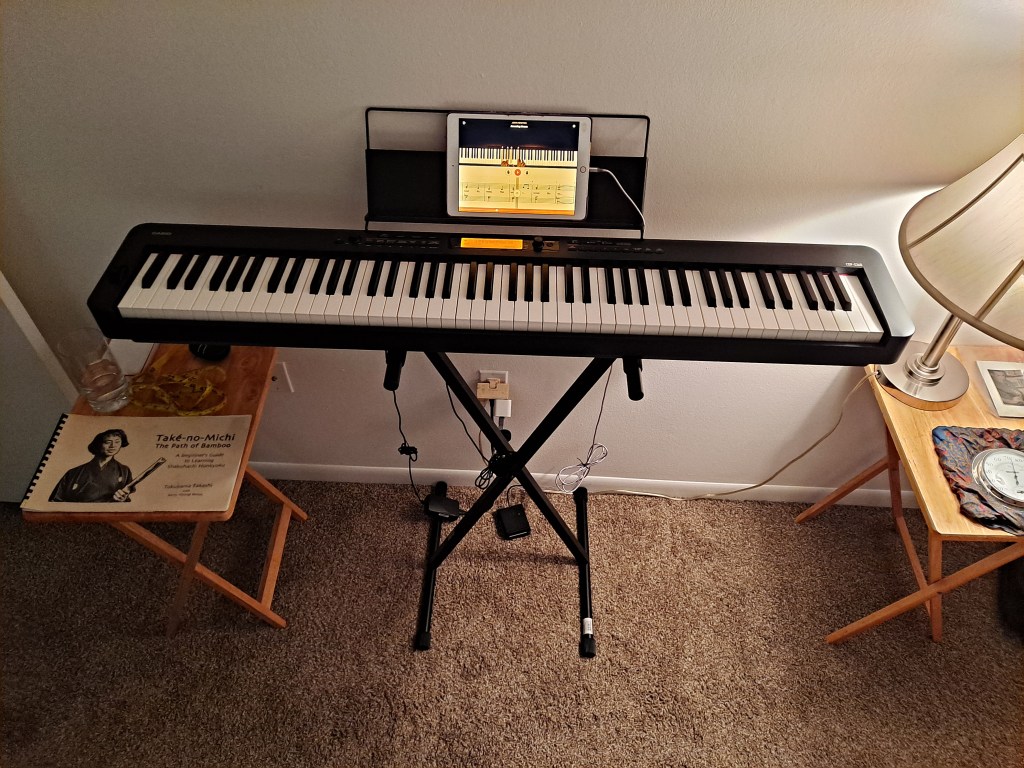
    Like many of you, I find that sitting for long periods is uncomfortable, so I decided to raise my keyboard stand to standing height. What I’ve found is that standing while playing allows for gentle movement—I can shift my weight, circle my hips, and let my breath flow naturally, almost like Tai Chi at the keyboard.

    But the most important shift has been learning how to relax. I’ve realized that when I play, I tend to hold my breath and tense up, which drains my energy. So my new focus is breathing and playing with as little tension as possible, using a 4-note breathing pattern:
    ✔ Inhale: A → C → E → C
    ✔ Exhale: A → C → E → C
    This simple rhythm helps me stay grounded, present, and relaxed.

    Another key part of this setup is having my keyboard at the end of my bed. This means I can lay down to rest anytime, and when I feel ready, I can stand for just a minute or two to play, then lay back down again. There’s no pressure, no need to push myself—just a gentle cycle of music and rest.

    Options for Engaging with Music at Any Energy Level

    I know that not everyone has the ability to stand or sit for long, so I wanted to share a few ways to incorporate music at any stage—always prioritizing relaxation and staying within your pacing envelope to avoid PEM.

    🎵 Lying in Bed: When I was primarily bedridden and didn’t have a keyboard, I Velcroed my iPad about a foot and a half above my head. This let me lay flat and play simple notes with an app, without any strain. It worked beautifully.

    🎵 Small Keyboard for Bed Use: On Facebook Marketplace, you can find very small, lightweight keyboards that you can keep in bed with you. You don’t need a full-size keyboard to start—just something simple to play a few notes when you feel able.

    🎵 Seated or Standing with an Adjustable Keyboard: If sitting for long is difficult, you can use a keyboard stand that adjusts in height so you can switch between sitting and standing, allowing for movement and rest as needed.

    🎵 Completely Resting & Humming (Minimal Effort Required): For those who need to lay flat and remain mostly inactive, music can still be part of your healing. Some keyboards or apps allow you to automatically play simple notes (like A → C → E → C) very, very slowly. Instead of physically playing, you can simply breathe in rhythm with the notes and gently hum along—only if it feels comfortable. Even this small engagement should be done within your energy limits, ensuring it stays restorative rather than draining.

    🎵 Music Visualization (No Physical Effort Required): If even humming feels like too much, you can still experience music through visualization. I used this method when I realized I couldn’t go to the beach anymore—I would simply imagine walking along the shore, and it was surprisingly powerful. In the same way, you can lay in bed and visualize yourself sitting at a piano, pressing one note at a time, hearing the sound in your mind, and breathing gently. You don’t have to hum or move at all—just allow the imagery and imagined sound to soothe you.

    The Primary Goal: Relaxation & Parasympathetic Activation

    The most important thing is to find the simplest, most relaxing way to engage with music—one that matches your current energy levels and does not trigger PEM. Whether that’s playing, humming, breathing, or simply visualizing, the goal is to activate the parasympathetic nervous system and promote deep rest and healing.

    Having a piano that moves with me rather than forcing me to adjust to it has been life-changing. I just wanted to share this in case it helps anyone else looking for a way to bring music into their life—with gentleness, breath, and ease. 💙


  • From Suffering to Compassion: Transforming Life with ME/CFS

    From Suffering to Compassion: Transforming Life with ME/CFS

    Living with chronic fatigue syndrome (ME/CFS) often feels like carrying an invisible weight that never goes away. The exhaustion is far beyond ordinary tiredness, permeating not just the body but the mind and heart as well. For many of us, this illness can feel like a curse, a complete derailment of life’s trajectory. Yet, over the years, I’ve come to see it also as a strange and unexpected blessing—one that has thrown me deeper into spiritual practice, into moments of stillness and contemplation I might not have otherwise known.

    At its worst, the illness can leave me in bed, lights off, no sound, in a state of complete sensory deprivation. And it is in these moments, when there is nothing to distract me from my thoughts, that I’ve had to learn how to truly be alone. Learning to witness my reactions, cultivating equanimity, and practicing calm-abiding meditation have become vital companions on this journey. For many years, I focused on the Tibetan practice of Samatha, or calm-abiding meditation, as well as Vipassana, which allows for a deep awareness of the present moment. Sitting in stillness, aware of whatever calm I could find within, helped me cultivate equanimity—though it remains a practice I still have much to learn from.

    But there was another essential practice that transformed how I related to my suffering. The practice of Metta—or loving-kindness—invites us to take our own pain and suffering and recognize that in this vast world, we are not alone in what we feel. When my illness has been most acute, whether through mental anguish or physical symptoms, I’ve practiced thinking: In the same way that I am experiencing this illness, this suffering, this pain, there are others in the world who experience this too. And then, from the heart, I offer the prayer: May I, and all beings, be free from this suffering and its causes.

    This simple yet profound shift in perspective allowed me to transform my experience from one of isolation and misery into a practice of compassion. Instead of being stuck in my own pain, it became a way to benefit others by cultivating loving-kindness for all those who suffer. In this way, even my most difficult experiences became part of my spiritual path. ME/CFS was no longer just an illness—it was an opportunity to deepen my compassion, both for myself and for others.

    Of course, this hasn’t been an overnight transformation. It took many years of spiritual study and practice, drawing from teachings like the Four Noble Truths of the Buddha, the Noble Eightfold Path, and eventually the teachings of Advaita Vedanta. Through these teachings, I came to recognize the fluctuations of the mind, or vrittis, and learned to observe the content of my thoughts—pratyayas—without identifying with them. This practice of witnessing the mind has allowed me to find peace in the midst of the storm, much like the Dark Night of the Soul described by St. John of the Cross.

    For me, it has felt less like a dark night and more like twenty years of spiritual darkness, but nonetheless, this darkness has also been a teacher. Learning to be present with my suffering, rather than resisting it, has become an integral part of my life with ME/CFS. And while the illness has forced me to withdraw from many aspects of life, it has also drawn me into the heart of spiritual practice.

    To anyone living with this illness, or any chronic illness, I offer this: it’s okay to feel overwhelmed by the weight of it all. It’s okay to grieve the life you once had or the future you imagined. But there are also practices—like Metta, calm-abiding meditation, and witnessing the mind—that can transform this suffering into something that nourishes not only your soul but the souls of others as well.

    May you, and all beings, be free from suffering and its causes. May this invisible weight become a doorway into the mystic, where even in solitude, you find that you are never truly alone.

    🙏🕊️🙏

  • The Six Types of Courage in the Journey with Chronic Fatigue Syndrome

    The Six Types of Courage in the Journey with Chronic Fatigue Syndrome

    For those of us living with post-viral chronic fatigue syndrome (ME/CFS), the path we walk is not a simple one. Each day brings its own set of challenges, often invisible to the outside world but deeply felt within. Yet, amid the fatigue, the uncertainty, and the pain, there are moments where we are called to draw on reserves of strength we didn’t even know we had. Courage, in its many forms, becomes a quiet companion on this journey.

    As I reflect on the Six Types of Courage, I am reminded that courage isn’t always the grand, heroic act we see in stories. Sometimes it is found in the smallest actions, the quietest moments, and the internal shifts of perspective that allow us to keep moving forward. Let me share how each of these types of courage has come to life in my experience, and perhaps in yours, as we navigate the complexities of chronic illness.

    Physical Courage

    Living with ME/CFS requires a deep well of physical courage. On the days when even getting out of bed feels like a monumental task, there is a certain bravery in simply continuing. To keep going, not by pushing beyond our limits, but by embracing our body’s need for rest, balance, and awareness, is its own form of resilience. The courage to honor what our body is telling us, to move slowly and deliberately through the fatigue, is often invisible to others—but it is no less powerful.

    I’ve learned, often the hard way, that physical courage isn’t about “fighting” the illness. Instead, it’s about recognizing that even the act of getting through a day, with gentle awareness of my body’s limits, is a courageous act of self-care.

    Social Courage

    One of the most difficult aspects of living with chronic illness is feeling misunderstood by those around us. Social courage asks us to be unapologetically ourselves, even when we feel like our world is shrinking. It takes bravery to share our reality with others, to say, “This is who I am right now,” even when we worry about judgment or pity.

    For me, social courage has meant being honest about my limitations, even when it’s uncomfortable. It’s meant declining invitations or stepping back from commitments without feeling the need to apologize. In a world that often celebrates busyness and productivity, social courage allows us to stand firm in our truth, even when it doesn’t align with society’s expectations.

    Moral Courage

    Moral courage comes into play when we choose to do what’s right for our well-being, even when it’s not popular or easy. It might mean saying no to well-meaning advice that doesn’t resonate, or it might mean standing up for ourselves in medical settings, advocating for the care we know we deserve.

    In my own journey, I’ve had to practice moral courage by trusting my intuition, even when others disagreed. Whether it was turning down treatments that didn’t feel right for me, or advocating for pacing and rest in a world that pushes us to keep going, moral courage has been about honoring my inner knowing and standing up for my own health and well-being.

    Emotional Courage

    Emotional courage asks us to feel everything—without guilt or attachment. Living with chronic illness brings a rollercoaster of emotions, from frustration and sadness to moments of peace and even joy. It takes real bravery to allow ourselves to feel the depth of these emotions, without judgment.

    For those of us living with ME/CFS, there is often a fear of being consumed by the negative emotions that come with illness. But emotional courage teaches us that by allowing ourselves to fully experience these feelings, we create space for healing. It’s okay to feel angry, to feel sad, to grieve the life we once had. And it’s equally okay to feel moments of joy, to savor the small victories without fear of losing them. Emotional courage is the bridge between feeling and acceptance.

    Intellectual Courage

    There is a constant need to learn, unlearn, and relearn when living with chronic illness. Intellectual courage encourages us to stay open, to question what we think we know about our illness, and to be willing to adapt as new information comes to light.

    In my own life, this has meant learning to let go of certain beliefs—like the idea that I must always be productive to have value. It has meant embracing new ways of thinking about rest, about healing, and about what it means to live a meaningful life, even in the face of limitations. Intellectual courage reminds us that growth is always possible, even when we feel stuck.

    Spiritual Courage

    Spiritual courage is perhaps the most profound of all. It asks us to live with purpose and meaning, even when our outer world feels small. For me, spiritual courage has been about embracing the stillness that chronic illness brings, finding the deeper meaning in quiet moments, and trusting that this path, though difficult, has its own beauty.

    Living with ME/CFS has drawn me inward, toward a heart-centered approach to life. Spiritual courage has helped me see that even when my body is weak, my spirit can remain strong. It’s about connecting with something larger than myself, whether that’s through mindfulness, prayer, or simply finding peace in the present moment. It’s about living with purpose, even when the world outside feels far away.

    As I reflect on these six types of courage, I am reminded that each of them plays a role in the journey we are on. Courage doesn’t always roar. Sometimes, it is the quiet voice at the end of the day saying, “I will try again tomorrow.” For those of us living with chronic fatigue syndrome, courage is found not in grand gestures, but in the small, everyday acts of resilience, hope, and self-compassion.

    We are all courageous, in ways both seen and unseen. Let us honor that courage in ourselves and in each other, as we continue to walk this path with grace, gentleness, and the quiet strength that comes from within.

    🙏🕊️🙏

  • Managing Post-Exertional Malaise: Finding Balance and Peace in Life with ME/CFS

    Managing Post-Exertional Malaise: Finding Balance and Peace in Life with ME/CFS

    A Gentle Reflection on Pacing, Rest, and Navigating the Challenges of Chronic Fatigue Syndrome

    There are days when the body speaks softly, a whisper of weariness that hints at the storm ahead. And though we move carefully, mindful of each step, there are moments when the smallest effort—a turn of the mind, a spark of emotion—awakens something deeper. This is the dance with post-exertional malaise, the hidden tide that comes and goes, often when we least expect it.

    Gentle Reminder: Take Care of Yourself

    This post is lengthy, and it’s important to honor your pacing needs. Feel free to read a little at a time, take breaks, and come back to it when you’re ready. Your well-being is paramount, even as you engage with information that supports your journey.

    In this slow unfolding, I’ve learned the art of listening. Not just to the body’s loud protests, but to the subtle shifts that rise like shadows before a dusk. It’s a practice, really—this gentle balancing act of life. Pacing myself through the hours, I find that it’s not about doing as much as I can, but rather, doing only as much as I must, and stopping long before the weight of fatigue pulls me under.

    Some days, I count my energy like a miser with gold, tucking it away in small corners, resting in the quiet between breaths. I know now that to keep moving without pause is to invite the flood, so I rest—not in surrender, but in reverence. It’s a kind of devotion, to honor these limits as something sacred, to see the necessity of stillness as part of the rhythm of being. I don’t always succeed. But when I do, I glimpse a peace that feels fragile, yet profound.

    And when the world presses in with its demands, I remind myself that it’s okay to say no, or not now. There is a quiet strength in bowing out, in knowing that tomorrow will ask more of me than today ever could, and I must be ready. There is also grace in understanding that not every task, not every moment, requires my full self. I can do less, and in doing less, I give myself more space to breathe, to be.

    There are the days after—the days when the fog of PEM descends like a heavy mist over the mind, the limbs. When it comes, I am learning not to fight it. I lie still, like a tree after the storm, gathering strength in the pause. I have found that recovery is an art, as delicate as anything else. Resting, not out of defeat, but out of wisdom, out of love for the body that has carried me through so much already. The act of resting becomes an offering of peace, a gift I give myself in this long, uncharted journey.

    And so, I move slowly, gently, always aware of the fine thread that connects exertion and ease, action and rest. I have begun to cherish the quiet moments of pause, the spaces where life still hums softly, even in the absence of movement. These are the moments when I remind myself that managing this strange, invisible storm is not about conquering it, but learning to live alongside it, to move with it as gracefully as I can. There is beauty here, too—a beauty in the stillness, in the small victories of simply being.

    In those moments, I find a sense of peace that is mine to keep. And in that peace, I remind myself that even on the hardest days, I am enough.And so, as I offer these thoughts, I send with them a quiet wish for your well-being. May you find moments of rest that nourish you deeply, and may the days of ease, however fleeting, linger softly in your memory. If you ever feel the weight of this journey pressing too hard, know that you are not alone.

    Dear friends,

    I know these days may feel heavier than usual. The storm outside has passed, but inside, your bodies may feel as though they’re weathering one of their own. Post-exertional malaise (PEM) comes like that—quiet and uninvited, a deep exhaustion that touches every part of you. Whether it’s the physical toll of surviving the hurricane or the emotional weight of the aftermath, you’re feeling it now, maybe more intensely than you have in years.

    Please know that what you are experiencing is valid. You’ve already shown such strength, simply by navigating these storms and their many demands. But right now, in this moment, the strongest thing you can do is rest. Not as a surrender, but as a way of caring for yourself in the most compassionate way possible. Rest, because your body is asking for it. Rest, because this is how you heal.

    Pacing is not easy when the world around you spins in chaos, but I encourage you to listen to the subtle signs your body gives. You don’t have to meet every demand or engage with every worry. It’s okay to step back, to breathe, and to honor your limits. In doing less, you are doing what is necessary to recover.

    If the fog of PEM feels too thick to see through, know that it will lift. Maybe not all at once, but in small, tender ways. There is stillness, there is peace, waiting for you on the other side of this exhaustion. You are not alone in this experience—many of us are moving slowly through these same waters, learning the rhythm of rest, of patience, of letting go.

    For now, take each moment as it comes. Let yourselves be. Let yourselves rest. And in that rest, know that you are enough. You are resilient. This, too, will pass.

    With all my warmth and understanding,
    Richard Silverman

    Feel free to leave your thoughts, your questions, or simply your presence here—I will meet you with understandingh and warmth. Together, in our shared quiet, we will honor the pace that life has asked of us.

    🙏🕊️🙏

  • Calling All Beings to Send Love and Peace: A Message for Our Community

    Harnessing Inner Peace: A Pacing Toolkit Tool for Those Living with ME/CFS or Long Covid


    As I reflect on the approaching Hurricane Milton, I’m reminded of the powerful moment when Jesus calmed the storm on the Sea of Galilee. His disciples, gripped by fear, watched as He simply said: “Peace! Be still!” and the storm settled. In this moment, I feel called to do the same—to access the peace of God within me and speak to the storm, “Peace! Be still.” I truly believe this is what Jesus asks of us, to practice this promise, and to remember that even faith the size of a mustard seed can move mountains.

    But this call to peace and stillness isn’t just about the external storm. As someone who lives with chronic fatigue, I know how much of a difference it makes to calm the storms within as well. The mental and emotional stress can often intensify symptoms like post-exertional malaise (PEM). So, I remind myself to relax my mind and heart, to let go of worry and concern, and to give my body the space it needs to heal.

    One of the tools I turn to in these moments is Pristine Mind Meditation, as taught by Orgyen Chowang in his book Pristine Mind: Journey to Unconditional Happiness. Pristine Mind is the pure, natural awareness that exists within all of us, untouched by thoughts or emotional turmoil. By resting in this space, I find that it helps me manage my symptoms, reduce stress, and pace myself more effectively. It’s an essential part of my pacing toolkit, allowing me to not only physically rest, but also calm my mind and emotions, preventing flare-ups of PEM and other symptoms.

    In this moment, I invite us all to join together in saying to the storm—whether it’s the physical hurricane or the inner storms we face—“Peace! Be still.” Let’s tap into the divine promise that’s always been ours and use the tools we have to cultivate peace, clarity, and healing within ourselves.

    Let us, from a place of faith and trust, send love to this storm and say to it: “Peace, be still.”


    🙏🕊🙏

  • Coping with ME/CFS in the Aftermath of Hurricane Helene: On-the-Spot Practices for Pacing and Recovery

    Rest now, breath by breath,
    Let each moment cradle you—
    And nourish your soul.


    As we recover from the aftermath of Hurricane Helene here in Florida, many of us are left not only dealing with physical damage and power outages but also with the internal toll such intense stress can take. For those of us living with chronic fatigue syndrome (ME/CFS), the impact can be particularly difficult, as our systems are already strained and now must cope with the post-storm chaos. This is a time when all of our skills for stress management, pacing, and self-care become essential—what Chögyam Trungpa might call “on-the-spot” practice.

    Understanding ME/CFS and Post-Exertional Malaise (PEM)

    Living with post-viral myalgic encephalomyelitis (ME/CFS) means managing a complex condition that affects multiple body systems, including energy production, the nervous system, and immune responses. One of the hallmark symptoms is post-exertional malaise (PEM), which refers to the worsening of symptoms after even small amounts of physical, emotional, or mental exertion. This could manifest as extreme fatigue, brain fog, muscle pain, increased sensitivity to noise and light, and a host of other symptoms that flare up after the body has been pushed past its limits.

    After a high-stress event like a hurricane, PEM can be easily triggered, making the recovery process even more difficult. The combination of exhaustion, nausea, sensory overload, and emotional stress all contribute to a heightened flare-up.

    On-the-Spot Strategies for Coping with Stress and PEM During Recovery

    Here are some pacing and stress management strategies that can be helpful as you recover from the storm:

    1. Cultivate the Witness

    Instead of trying to fix or fight the sensations in your body—like tinnitus, sensitivity, nausea, shakiness, or nervous system overwhelm—focus on observing them. This approach allows you to witness the intensity of your experience without adding the extra layer of resistance. Take a few deep breaths and simply notice the physical sensations, the loudness of the tinnitus, the shakiness in your limbs, the agitation in your mind, as if you’re watching a storm pass through.

    This is also an opportunity to remind ourselves of the Buddhist teaching of the second arrow. The first arrow is the physical or emotional pain we experience in a situation like this—our symptoms, the stress, and discomfort. The second arrow is the suffering we add on by resisting, judging, or wishing things were different. By simply observing the experience and letting go of the need to fix it, we avoid the second arrow of mental anguish. In this moment, it’s enough to just be with what is, without adding layers of judgment or frustration.

    1. Mindful Pacing

    Pacing is key to managing ME/CFS, especially during stressful recovery periods. Even though you may feel the need to push yourself—to clean up, reconnect with loved ones, or restore normalcy—it’s essential to honor your limits. Break tasks into the smallest chunks possible, rest frequently, and give yourself permission to not complete everything in one go.

    Physical pacing: Limit physical tasks to just a few minutes at a time, followed by equal or greater rest.

    Mental pacing: Engaging with recovery efforts, media, or news updates in small doses can prevent mental exhaustion.

    Emotional pacing: Allow yourself to step back from intense emotions when needed. Take breaks from conversations or situations that feel overwhelming.

    1. Tinnitus and Sensory Overload

    For many of us, stress exacerbates tinnitus, turning the ringing into an almost unbearable roar. One approach is to “lean into” the sound—not to fight it but to witness it, as mentioned earlier. Another option is to use low background sounds that are soothing to your system, such as nature sounds, white noise, or calming music, to soften the intensity of tinnitus. Remember, the goal isn’t to eliminate the sound but to cultivate a gentler relationship with it.

    1. Grounding Practices

    In times of heightened anxiety and post-storm disarray, grounding techniques can help calm the nervous system. Simple practices like feeling your feet on the floor, focusing on your breath, or using gentle touch (like placing a hand over your heart) can remind your body that you are safe in this moment, despite the external chaos.

    Breathing exercise: Try the 4-7-8 breath. Inhale for a count of 4, hold for a count of 7, and exhale slowly for a count of 8. This practice helps soothe the nervous system and bring a sense of calm.

    1. Resting in Stillness

    Though silence may feel elusive with tinnitus and nervous system overwhelm, there is a different kind of stillness available—the stillness of simply being aware. You don’t need to find literal quiet; instead, notice the quiet space that exists beneath all the sensations and noise. This is where your mind can rest, even when your body cannot.

    1. Pacing Your Recovery

    In the days following the hurricane, continue to pace yourself. Power outages, disrupted routines, and the emotional and physical toll of cleanup efforts can keep you in a heightened state of alert. Be mindful not to overdo it as you engage with recovery tasks, and remember that healing from PEM takes time. Even small tasks can be enough to push your body too far, so take frequent breaks and allow your body the space it needs to recover.


    Post-Hurricane Care for ME/CFS

    As we navigate the chaos left by Hurricane Helene, it’s vital to be gentle with ourselves and recognize the profound impact that stress can have on our health. Recovery is not just about cleaning up the physical aftermath but also giving our bodies the rest and care they need to heal from the exertion and stress.

    Take things moment by moment, and know that it’s okay to ask for help. Whether from neighbors, online support groups, or local resources, you don’t have to navigate this alone. The storm has passed, and now is the time to focus on restoration—both externally and internally.


    By integrating these on-the-spot practices into your routine, even during the stress of post-hurricane recovery, you can help your body manage the intensity of post-exertional malaise, tinnitus, and the other challenges that come with ME/CFS during such times. Stay safe and prioritize your well-being above all.

    Rest now, breath by breath,
    Let each moment cradle you—
    And nourish your soul.

    🙏🕊🙏


  • Transforming the Suffering of ME/CFS into a Path of Healing

    For those of us living with post-viral myalgic encephalomyelitis (ME/CFS), the experience of life often feels like moving through a landscape filled with unseen obstacles. There is the fatigue—so heavy, so relentless—that it can feel like a weight we will never shake. There are the moments when even the simplest tasks become insurmountable, and the pain becomes a constant companion, whispering in the background of every day.

    When I first encountered the teaching “Transforming Suffering and Happiness into Enlightenment” by Dodrupchen Jigme Tenpe Nyima, it felt like someone had gently opened a door I hadn’t known existed. At the time, I was entrenched in my own struggle—fighting the fatigue, resisting the pain, angry at the injustice of it all. I didn’t see it then, but my resistance, my frustration, and my desperate need for things to be different were only making me sicker. Each day felt like another battle against my body, and it was exhausting in every sense of the word.

    The teaching introduced me to an entirely different way of relating to my experience. It was an invitation, not to fight against my suffering, but to sit with it, to gently turn toward it with a kind of curiosity. At first, the idea seemed absurd—how could I welcome something that was robbing me of so much? But as I read further, I began to understand that the more I resisted, the more I labeled my suffering as the enemy, the stronger it became. Everything around me had started to feel like an enemy—my body, the illness, even the world itself.

    The first time I truly absorbed the idea that suffering, like anything else, grows stronger with the attention we give it, it was a revelation. I started to realize that I had been feeding my suffering through my resistance. In a way, I was making myself worse by constantly pushing against the reality of what I was experiencing. This was the first eye-opener: that my own mind was contributing to the intensity of my suffering.

    I remember vividly when I decided to start putting this teaching into practice. I had signed up for a meditation class, feeling both hopeful and uncertain, and around that time, I also came across Tony Bernhardt’s book How to Be Sick. Little by little, I began to change how I approached the fatigue and pain. It didn’t happen overnight. In fact, it felt like planting seeds in the darkest soil—there were days when nothing seemed to grow, and I wondered if this new approach would ever bear fruit. But gradually, something did begin to shift.

    The more I learned to observe my suffering without immediately pushing it away, the more space I created around it. It wasn’t that the fatigue disappeared—far from it—but my relationship to it began to change. Instead of seeing every wave of exhaustion as something to fight, I started to meet it with a kind of quiet acceptance. This didn’t mean I liked it, but I stopped resisting it quite so fiercely. In time, the constant anger and frustration began to soften.

    As I practiced more, something else began to emerge—equanimity. I began to realize that the less I resisted both the suffering and the rare moments of joy, the steadier I felt inside. Over the years, my confidence in my ability to face difficulties has grown. There’s a quiet knowing now, a calmness that wasn’t there before, that when challenges arise, I can meet them without being completely swept away.

    Of course, this is still a work in progress, and I expect it will be for the rest of my life. Some days are harder than others, but the difference is that I no longer see the hard days as failures. They are simply part of the ebb and flow. And in learning to embrace both the suffering and the moments of peace, I’ve discovered a kind of strength that doesn’t come from fighting but from surrendering—surrendering to the reality of my experience without letting it define me.

    This teaching has shown me that suffering, far from being something to avoid, can become a profound teacher. When we allow ourselves to meet it with openness, we can begin to transform it. It doesn’t mean the pain or the fatigue will disappear, but our relationship to it changes. We become less fragile, more resilient. Over time, the suffering no longer feels like something that has complete power over us.

    For those of us living with ME/CFS, this teaching offers a way to shift the narrative. Instead of seeing our illness as something that has taken everything from us, we can begin to see it as part of our path. By practicing mindfulness, by gently turning toward our suffering instead of away from it, we begin to cultivate a heart that is steady, a heart that can hold both the fatigue and the fleeting moments of ease without being shaken by either.

    It’s a slow process, and it requires patience—patience with ourselves and with the process of healing. But there is a quiet beauty in this work. Each time we meet our suffering with compassion, we are planting a seed. And while the fruits may take time to blossom, they do eventually grow.

    For those of you who are interested in exploring this teaching more deeply, I encourage you to take your time with it. Let it sit with you, and consider how it might apply to your own experience. And if you’d like to read the full teaching by Dodrupchen Jigme Tenpe Nyima, you can find it freely available online here.

    This journey isn’t easy, but together we can learn to transform our suffering into something that doesn’t just weigh us down but also lifts us toward a deeper understanding of ourselves and the world around us.

    🙏🕊️🙏

    Biography of Dodrubchen Jigme Tenpai Nyima

    Dodrubchen Jigme Tenpai Nyima, the Third Dodrubchen, was born in 1865 in the sacred Ma valley of Golok, Tibet, into a family deeply rooted in the spiritual lineage of his father, Dudjom Lingpa. From the very beginning, his life was marked by extraordinary recognition, with his teachers and mentors seeing in him the incarnation of profound wisdom. But his journey was not without struggle. As a young boy, he found study difficult, often frustrated to the point of tears. Yet, through perseverance and the support of his teachers, his understanding blossomed, revealing a deep capacity for spiritual insight.

    What makes Dodrubchen Jigme Tenpai Nyima so relatable is his humanity. Even as a master of Tibetan Buddhist teachings, he encountered challenges that shaped him into the teacher he became—a man of great compassion, who dedicated his life to training countless students in both Nyingma and Sarma traditions. His accomplishments were vast: he rebuilt his monastery, composed celebrated commentaries, and gave teachings tirelessly. And though he eventually retreated into seclusion due to his failing health, he continued to guide his closest disciples with unwavering dedication. His life, both ordinary and extraordinary, stands as a testament to the power of persistence, humility, and the profound depth of spiritual commitment.

    About Lotsawa House

    Lotsawa House is a rich and invaluable resource for those seeking authentic Tibetan Buddhist teachings. The website offers an extensive collection of translations from Tibetan texts, including teachings from many great masters such as Dodrubchen Jigme Tenpai Nyima. This is where the teaching “Transforming Suffering and Happiness into Enlightenment” can be found, along with countless other treasures, all freely available for anyone to access.

    Whether you are new to Tibetan Buddhism or have been practicing for years, Lotsawa House provides a space to explore the wisdom of these great teachings. The site is dedicated to making the profound texts of Tibetan Buddhism accessible to a global audience, offering translations in English and other languages, so that anyone, regardless of background, can benefit from these ancient spiritual insights. It’s a place where the wisdom of the Tibetan masters is preserved and shared, so that all who seek it may find the path to peace and understanding.

    You can explore the full collection of teachings and discover more about the great teachers who brought them to life by visiting Lotsawa House.

  • 1: Introduction to the Exercise Series: Gentle Movement for Body, Mind, and Spirit with Post-Viral ME/CFS

    Dear Friends,

    As we embark on this series exploring exercise and movement for those living with Post-Viral ME/CFS, it’s important to begin by acknowledging a simple truth: your path to wellness may look different from anyone else’s—and that is completely okay. The nature of living with Post-Viral ME/CFS requires us to redefine what exercise means, adapting to a new rhythm that is in harmony with our energy levels, symptoms, and the realities of daily life.

    Exercise in the traditional sense may bring up images of intense workouts, lifting heavy weights, or running miles. But for those of us living with Post-Viral ME/CFS, exercise might mean something entirely different. It might mean resting in bed, visualizing a workout, or simply getting to the gym parking lot for a few minutes on your way home from grocery shopping. It could mean gentle stretching in bed, doing a few light tasks around the house, or taking time to breathe mindfully.

    This series is meant to serve as a guide for embracing a new kind of exercise—one that is not about pushing limits or chasing goals but about nurturing your body, mind, and spirit through gentle movement, mindfulness, and above all, compassion.

    A Journey of Imagination, Gentle Action, and Acceptance

    In the first few posts of this series, we will explore the power of imagination and visualization. There may be days (or even weeks or months) when your body cannot physically engage in any form of movement, but that doesn’t mean you are disconnected from your body’s potential. Visualization is a powerful practice, one that allows your mind to engage with the idea of movement without needing to physically exert yourself. We’ll talk about how you can visualize workouts, stretching, or gentle movements while lying in bed, creating a mental connection that keeps your awareness sharp without triggering post-exertional malaise.

    We’ll also talk about small steps—like driving to the gym and sitting in the parking lot, even if you don’t have the energy to go inside. There’s value in simply getting closer to the idea of movement. Over time, you might find yourself taking steps further, maybe walking into the gym, sitting in the environment, and just absorbing the energy of people moving around you.

    Titrating Activity: Finding Balance and Progress

    As we move forward in this series, we’ll explore how to approach physical activity in a way that’s both mindful and sustainable. Small, controlled movements—whether they’re simple stretches at home or slow, mindful exercises at the gym—are a way to begin reconnecting with your body without overstepping your energy limits. Remember, movement for us is a delicate balancing act, and we’ll emphasize the importance of checking in with yourself frequently and avoiding the temptation to push too hard.

    This series isn’t about getting you to the point of running marathons or lifting heavy weights. It’s about honoring where you are on any given day. Some days, the most compassionate action you can take is visualizing movement while lying in bed. Other days, you might find that you’re able to move a little more—maybe stretch gently, walk for a few minutes, or do light movements with a resistance band. Every step, no matter how small, is progress.

    Exercise as Self-Care, Not Striving

    Throughout this series, we’ll emphasize that exercise is not about striving for perfection or chasing after big milestones. It’s about tuning into your body, listening to its needs, and responding with kindness. Exercise, in this new sense, is about moving in harmony with your energy and creating a relationship with your body that’s built on trust and compassion.

    This journey is personal, and each day will bring different challenges and opportunities. The important thing is that you approach this path with an open heart, celebrating the small victories and honoring the moments when rest is the best thing you can offer yourself.

    As we conclude this introduction, I want to emphasize that this series is not meant to be a strict, linear guide. What I’ve shared is simply how the process unfolded for me, step by step, over the course of years. You may find that your own journey takes a different path. Perhaps you’ll stay with the visualization step for days, weeks, or even months before feeling ready to move forward. You may visit the gym parking lot a few times, or perhaps many times, before stepping inside.

    For me, it took over two years—before I was able to enter the gym and engage in light, respectful exercise. At first, I could only manage it once in a while, then eventually once a month, and after a few more years, I was sometimes able to go twice a month. A few years later, I found myself exercising once a week, but not always. I still need to be careful to honor my body’s limits and energy reserves so as not to trigger PEM. Over the years I have been smoothing out the valleys and hills.

    Please know that this series is not a guideline to be followed strictly but a set of ideas to explore at your own pace. The path of recovery, movement, and exercise for someone living with Post-Viral ME/CFS is unique to each individual. My hope is that my experience offers some encouragement and helps you find your own rhythm and approach as you reconnect with your body. It is my sincere wish that this series will be of benefit to you.

    In the final post of this series, we’ll reflect on the entire journey—offering you a comprehensive conclusion, a reminder that this is an ongoing process of listening, adapting, and finding peace with where you are. Until then, I invite you to take each post as a gentle nudge toward reconnecting with your body, whether that’s through imagination, small actions, quiet reflection or visiting a gym.

    Looking Ahead

    Next up, we’ll talk about imagining movement as the first step in reclaiming your relationship with exercise. Visualization is a powerful tool, and I’ll show you how to use it as a way to reconnect with your body without draining your energy. Even when physical movement feels impossible, the mind can still engage in the process of healing and renewal.

    Thank you for joining me on this journey, and I look forward to walking this path together.

    With compassion and gentle encouragement,
    Richard Silverman

    🙏🕊️🙏