Tag: Spiritual teachings

  • Neti Neti #18: The Path Beyond Concepts and Spiritual Thought

    Question:

    In my spiritual journey, I often find myself fascinated by various ideas and philosophies. While they seem to offer profound insights, I keep returning to the practice of ‘Neti Neti.’ How do I reconcile the richness of these teachings with the deeper truth that lies beyond concepts and ideas? How can ‘Neti Neti’ guide me to the silent awareness that transcends even the most profound spiritual insights?

    Dear Friend,

    In our journey through the landscapes of thought and understanding, we often find ourselves drawn into the richness of ideas, the allure of philosophy, and the intricacies of spiritual teachings. But there comes a time when we must pause, step back, and gently remind ourselves: “Neti, Neti”—Not this, not this.

    While it is both fascinating and enriching to explore the nuances of spiritual ideas, “Neti, Neti” beckons us to remember that these are, at their core, only pointers toward a deeper truth. The truth of who you are, the essence of reality itself, lies beyond any concept or idea. This mantra, “Neti, Neti,” serves as a practice of continual negation, where each thought, each identification, each insight is recognized, honored, and then gently set aside.

    “Neti, Neti” guides us back to the silent, still core of our being. It whispers that none of the forms, names, or ideas we hold are the ultimate reality. The ultimate truth is what remains when all these are stripped away—the unnameable, the indescribable, the pure presence that is beyond all duality, beyond even the concepts of “one” or “two.”

    This mantra is not merely about negation; it is a practice of liberation. With each repetition of “Not this, not this,” you are gently freeing yourself from the chains of identification with the transient, the impermanent. You are returning, again and again, to the vast, open space of awareness where nothing is held onto, where everything is allowed to arise and pass away without attachment.

    “Neti, Neti” is the path to realizing that the ultimate truth is beyond all that can be said or thought. It is an invitation to rest in the pure awareness that is your true nature, beyond all descriptions, beyond all philosophies, beyond all distinctions. Even the highest concepts, even the deepest insights, are ultimately “not this.”

    In the spirit of “Neti, Neti,” let us simply return to what lies beyond words, beyond concepts. Let us rest in the silent, formless awareness that is always present, always here. As thoughts arise, as concepts form, as ideas take shape, we gently acknowledge them and then let them go, repeating inwardly, “Not this, not this.”

    In this practice, there is nothing to achieve, nothing to grasp. There is only the continual letting go, the continual returning to the source, to the pure awareness that is the essence of who you are. In this place, there is no need for explanations or elaborations—only the silent, still presence that remains.

    If there is anything more you wish to explore, I am here, but if the time is right to simply rest in the quiet of “Neti, Neti,” then let us do so, with deep respect for the truth that lies beyond all words.

    🙏🕊️🙏
  • Embracing Forgiveness, Loving-Kindness, and Compassion: A Universal Call to Unity

    Embracing Forgiveness, Loving-Kindness, and Compassion: A Universal Call to Unity

    A Path to Healing and Unity Through Shared Spiritual Values

    In every spiritual tradition, there lies a core message of forgiveness, loving-kindness, and compassion. These virtues, transcending cultural and religious boundaries, unite us in our shared humanity. Whether through the teachings of Buddha, the wisdom of Jesus, or insights from various spiritual paths, the call to embrace these qualities is clear and compelling.

    Forgiveness is a profound act of letting go. It isn’t about condoning wrongdoings but freeing ourselves from the burdens of anger and resentment. As the Dalai Lama teaches, forgiveness is a gift we give to ourselves, a step toward inner peace.

    Loving-Kindness, or “metta” in Buddhist practice, encourages us to extend unconditional love to all beings. Jesus exemplified this through his life, teaching us to love our neighbors as ourselves. In every smile, kind word, and act of generosity, we weave a tapestry of love that can heal and uplift.

    Compassion is the heart’s response to suffering. It compels us to act, to alleviate pain, and offer solace. Teachings from various traditions remind us that compassion is not a passive feeling but an active force for good. Through compassion, we recognize our interconnectedness and our responsibility to care for one another.

    In these challenging times, let’s draw from the wellsprings of our diverse spiritual heritages. Let us embrace forgiveness, loving-kindness, and compassion not just as lofty ideals, but as daily practices that transform our lives and the world around us.

    Together, we can create a world where these universal values form the foundation of our interactions, fostering unity, peace, and understanding among all people.

    🙏🕊️🙏

    #Compassion #LovingKindness

  • Neti Neti Series No. 14: Trusting in the Timing of Spiritual Understanding

    Question:

    I heard about this mantra many years ago, but it just didn’t click. And now it’s clicking. Why is it that something I once heard about long ago suddenly “clicks” now, as if it was waiting for the right moment in my life?

    Dear friend,

    There is a quiet wisdom in the way certain teachings or practices find their place in our lives. You mention that you first heard of this mantra many years ago, but that it didn’t resonate with you at the time. And now, suddenly, it clicks. This is a moment of grace, one that reflects the mysterious timing of our spiritual journey—where everything unfolds when it is meant to, when we are ready to receive it.

    Often, we encounter teachings long before we are ready to truly understand or integrate them. They may seem distant, abstract, or simply irrelevant to our current state of being. But these teachings, like seeds, are planted in the fertile ground of our consciousness. They remain there, quietly waiting, until the conditions are right for them to sprout and grow.

    Now, it seems, the conditions are right for this mantra to take root in your life. Something within you has ripened, has opened up in a new way, allowing you to receive the deeper meaning and power of these words. This is a beautiful and natural process, one that reflects the unfolding of your inner journey. The mantra has found its time, and now it can reveal its gifts to you in ways that were not possible before.

    There is a perfection in the timing of these moments, even though it might not always feel that way. We may wonder why certain practices or teachings don’t resonate with us at first, or why we seem to struggle with concepts that others find illuminating. But this is simply part of the journey—each of us has our own path, our own pace, and our own moments of awakening.

    When a teaching finally clicks, it’s as if a veil has been lifted, and what was once obscure becomes clear. This clarity is not forced; it arises naturally, out of the ripening of our own understanding and experience. It is a reminder that the spiritual path is not linear but cyclical, with periods of growth, rest, and renewal. Each cycle brings us closer to the heart of the truth we seek, even if the journey sometimes feels long and winding.

    Now that this mantra has clicked for you, it can become a powerful companion on your journey. Its simplicity, its resonance with where you are now, makes it an ideal focus for your practice. Embrace it with an open heart, knowing that it has come to you at the perfect time, just when you are ready to receive it.

    Let the mantra guide you, not just in meditation, but in your daily life. Allow it to become a thread that weaves through your thoughts, your actions, your moments of stillness. In this way, the mantra becomes more than just words—it becomes a living presence, a source of strength, clarity, and peace.

    This experience also invites you to trust in the journey itself, in the timing of the path that you are on. There is no need to rush, no need to grasp at teachings before their time. Everything unfolds as it is meant to, when you are ready to receive it. The seeds of wisdom that have been planted along the way will sprout when the conditions are right, and not a moment before.

    So continue with your practice, dear friend, with the confidence that this mantra has found its rightful place in your life. Trust in the wisdom of your path, and know that you are exactly where you need to be, at exactly the right time.

    🙏🕊️🙏

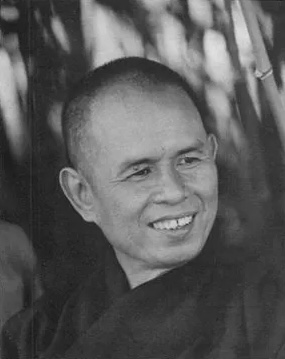
  • Thich Nhat Hanh: A Path of Mindfulness and Peace

    Thich Nhat Hanh: A Path of Mindfulness and Peace

    Thich Nhat Hanh, affectionately known as Thay by his students, has touched countless lives with his teachings on mindfulness, compassion, and inner peace. As a Vietnamese Buddhist monk, a poet, and a peace activist, his life’s work offers a profound invitation to awaken to the present moment and live with a heart of compassion.

    Throughout his life, Thich Nhat Hanh authored over 100 books, each infused with the gentle yet powerful wisdom that encourages us to return to the breath, to find peace where we are, and to extend that peace to the world around us. Whether we are walking, eating, or simply breathing, his teachings remind us that each moment is an opportunity to cultivate mindfulness. In doing so, we transform our suffering, both inner and outer, into a source of peace.

    One of the most transformative aspects of his legacy is Engaged Buddhism. Thay believed that mindfulness was not just for the meditation cushion but for every aspect of life. Whether advocating for peace during the Vietnam War or teaching about reconciliation, he wove together mindfulness and social action, reminding us that true peace begins with ourselves, but does not end there.

    Thich Nhat Hanh’s legacy continues to inspire not only individuals but also communities, through meditation centers like Plum Village, which he founded. These centers are spaces of refuge, where people can practice mindfulness, deepen their spiritual understanding, and live in harmony with one another.

    If you wish to experience Thich Nhat Hanh’s teachings more intimately, I invite you to listen to his words directly on Thich Nhat Hanh Audio.

    One particularly powerful dharma talk is Love in Action, offered by Thay in Hanoi during the “Engaged Buddhism in the 21st Century” retreat. This 78-minute talk, delivered in English on May 9, 2008, is a profound exploration of how love and compassion manifest through mindful action in our everyday lives. You can listen to the full talk here.

    Thich Nhat Hanh left us a rich legacy of mindfulness, compassion, and hope, a path we can continue to walk, one mindful step at a time.

    🙏🕊️🙏

  • Verse 3: The Mirror of True Knowledge — Insights from Ramana Maharshi

    Verse 3: The Mirror of True Knowledge — Insights from Ramana Maharshi

    “Having known the Self, which is awareness, there is nothing more to know. That which is, is consciousness itself. To seek it elsewhere is to wander far away.”

    — Ramana Maharshi, Forty Verses on Reality

    There comes a moment in each of our lives when the questions that have followed us, haunting our thoughts, cease to carry the same weight. It is as though we have been wandering through a vast wilderness, searching endlessly for something, only to realize that it has been with us all along. This, Ramana tells us, is the moment of true knowledge—the moment when we recognize the Self, and in doing so, find that there is nothing more to seek.

    This knowledge is not like the knowing of facts or the gathering of worldly wisdom. It is the unveiling of the very essence of awareness, that which sees all, yet remains unseen. To touch this awareness is to come home, to realize that the search has always been for ourselves.

    And how often we search elsewhere! How often we cast our gaze into the far distance, imagining that the truth lies in some distant land, or hidden in the words of another. But Ramana reminds us that to seek it elsewhere is to wander further from the source. The truth we seek does not live in far-off places; it lives in the heart of our own being, as close as breath, as present as this very moment.

    Like a mirror reflecting all without judgment, true knowledge is the simple, clear awareness of what is. When we come to see that all that exists is consciousness itself, we are no longer captivated by the shadows on the wall. We see, instead, the light—the steady, unwavering light of awareness, which has been with us from the beginning.

    To know the Self is to realize that there is nowhere else to go. The seeking ends, and in its place arises a quiet, unshakable peace. It is not the end of curiosity or wonder, but the end of searching outside ourselves for what can only be found within.

    To know that there is nothing more to seek is not to say there is nothing more to do. In the realization that the Self has always been present, there is still the practice of abiding, of resting in the gentle awareness that is always here. It is this abiding, this quiet discipline of being, that becomes the ongoing practice.

    Yes, the search has ended, but the journey of returning, over and over again, to the pristine mind continues. For in this ordinary mind—this space filled with distractions, thoughts, and the pull of the world—there is the temptation to forget, to stray from the simplicity of awareness. And so, we practice. Not as seekers anymore, but as those who have touched the truth and wish to live in its light.

    The practice now is not one of effortful striving, but of allowing—of surrendering into the effortless effort, the gentle doing of non-doing. This is where the paradox lives: to rest in what is, and yet remain disciplined in that rest. It is not that there is nothing more to do, but rather that what is to be done is a continual letting go, a surrendering to the ever-present awareness that requires nothing from us but our willingness to be with it.

    And so, we abide. With each breath, with each passing moment, we return—not to search, but to rest. And though the Self needs no searching, the practice of staying with it remains. In this, there is the dance of wu-wei, the graceful action of inaction, the peaceful unfolding of all that is.

    Perhaps one day the effort, too, will fall away, and only the abiding will remain.

    Coming Up Next: Verse 4

    In the next verse, we will reflect on the nature of thought and the root of all actions. How do our thoughts shape our reality, and what lies at the core of true understanding? Join us as we continue this journey through the depths of Ramana Maharshi’s teachings.

    🙏🕊️🙏

  • Ramayana No. 12: Caravan of Love: The Evolution of Divine Worship and the Universal Teachings of Compassion

    In the spiritual journey of humanity, there has always been a deep yearning to connect with the divine. This connection has evolved across cultures and religions, shaping how people perceive and relate to the sacred. Two profound examples of this evolution can be found in Hinduism and Christianity, where the abstract, formless concept of the divine transformed into more personal, relatable forms.

    From the Formless to the Personal Divine

    In the early traditions of Judaism, the divine was perceived as Ein Sof—the infinite, boundless, and unknowable aspect of God. This understanding was so sacred that God’s name was considered unpronounceable, representing the divine’s absolute transcendence. The Jewish tradition emphasized a God beyond form and comprehension, which led to a strict prohibition against idolatry.

    Similarly, in the ancient Vedic traditions of India, the divine was seen as Brahman, the ultimate, formless reality that underlies all existence. Brahman was understood as the essence of everything, but its abstract nature made it difficult for people to relate to on a personal level.

    Over time, both traditions saw a shift. In Christianity, this shift occurred with the introduction of Jesus Christ, who represented the divine in human form. Jesus made the infinite more accessible, embodying the love, compassion, and righteousness that God wished to share with humanity. The doctrine of the Trinity—Father, Son, and Holy Spirit—further personalized the divine, allowing followers to connect with God as a loving parent, a guiding spirit, and a compassionate savior.

    In Hinduism, this transformation took shape through the worship of deities like Vishnu, Shiva, and Devi, who are seen as manifestations of Brahman. These deities, along with their avatars such as Rama and Krishna, made the divine more relatable. They embodied virtues that humans could aspire to—righteousness, devotion, and compassion. Through stories and teachings, these deities became accessible guides for those seeking a path to the divine.

    The Universal Teachings of Love and Righteousness

    Despite the differences in form and expression, a common thread runs through these traditions: the teaching of love, compassion, and righteousness. In Christianity, Jesus’s teachings emphasized love for one’s neighbor, forgiveness, and a life lived in service to others. He taught that the greatest commandment is to love God with all one’s heart and to love one’s neighbor as oneself.

    In Hinduism, the teachings of Dharma—righteousness and duty—are central. The lives of the avatars, like Rama, exemplify adherence to Dharma even in the face of great personal sacrifice. The Bhagavad Gita, a cornerstone of Hindu philosophy, teaches the importance of selfless action, devotion, and the pursuit of truth.

    These teachings, though expressed differently, guide followers toward a life of virtue. They remind us that to walk the path of the divine is to live with compassion, to act with righteousness, and to treat all beings with love and respect.

    A Call for Interfaith Harmony

    In a world often divided by differences in belief and practice, these teachings remind us of our shared spiritual heritage. Whether one follows Jesus, Rama, or another path to the divine, the call to love, righteousness, and compassion is universal. These values are the true markers of discipleship, transcending the boundaries of culture and religion.

    The Caravan of Love invites all to reflect on these common values, to see the divine in the hearts of all people, and to strive for a world where love and compassion reign. In the end, the path to the divine—whether walked through Christianity, Hinduism, or any other tradition—is a path of love, a journey toward the light that shines in every heart.

    A Prayer for Universal Peace and Harmony

    O Divine Source of all creation,
    The One who is known by many names,
    And who dwells in every heart,
    We come before you with humble hearts,
    Seeking your blessing of peace and harmony.

    May your love flow through us like a river,
    Washing away all hatred, division, and fear,
    And filling our hearts with compassion for all beings.

    Teach us to see beyond our differences,
    To honor the divine in every person,
    And to live as instruments of your peace in this world.

    May we all walk the path of righteousness,
    Guided by your wisdom and grace,
    So that our actions may bring healing and unity
    To a world that so deeply longs for peace.

    Let all nations and peoples come together,
    In a spirit of understanding and respect,
    Embracing the truth that we are all your children,
    And that in your eyes, we are one family.

    Grant us the courage to forgive,
    The strength to love without condition,
    And the wisdom to seek justice and mercy
    For every living being.

    May your light shine in our hearts,
    And may we carry that light into the world,
    Bringing hope to the weary,
    And peace to all who suffer.

    In your holy name, we pray,
    For goodwill on earth, and peace among all beings.

    Amen.
    Om Shanti Shanti Shanti.
    Salaam.
    Shalom.

    🙏🕊️🙏

  • Verse 2: The Deathless Ones — Insights from Ramana Maharshi

    “Deathless are they who know the Self. Those who know intense fear of death seek refuge only at the feet of the Lord who has neither death nor birth. Dead to themselves and their possessions, can the thought of death occur to them again? Deathless are they.”

    — Ramana Maharshi, Forty Verses on Reality

    In the silent expanse of existence, a profound truth emerges: those who truly know themselves are untouched by the shadow of death. Their awareness transcends the fleeting nature of the physical, awakening them to a reality where the Self shines eternally, free from the confines of birth and demise.

    Fear, that primal instinct which grips the emotional self, leads many to seek solace at the feet of the Divine. Here, in surrender, they find refuge in the Lord—the embodiment of timelessness, the one who remains unscathed by the cycle of life and death. In the presence of such love, the urgency of worldly attachments falls away, revealing the deeper essence of being. I look forward to resting in the presence of such love, revealed within our mind—our true heart—where all attachments dissolve into the stillness of pure awareness. To realize this ever-present pure love is to know the deeper essence of what we are, the part of us that remains untouched by the fears and desires of the world.

    As one becomes “dead” to the clamor of possessions and the incessant desires that bind the soul, the thought of death loses its power. No longer a specter to be feared, it becomes a mere whisper, an echo of a past long forgotten. In this state of liberation, the deathless heart pulsates with the rhythm of life, embracing the eternal now.

    To know the Self is to awaken to the infinite, to dance beyond the duality of existence, where life and death are but two sides of the same coin. In this awakening, we find the courage to let go—to release the chains of identification with the transient and embrace the essence of who we truly are. Here lies the secret of the deathless ones, an invitation to live fully, unencumbered by the fears that often confine us.

    And yet, when we speak of the deathless state, we do not turn our gaze away from the undeniable truth of death. The body, like all things that come into being, will one day return to the earth. Those we love will pass, as will we. But the wisdom of this teaching beckons us to look beyond the visible horizon, beyond the fragile shell of the physical.

    Death, as we know it, is but a passage in the realm of form. What truly passes? Not the Self. Not the essence of who we are. This teaching whispers to us that the grasping after what is fleeting—the desires, the aversions, the worldly attachments—these are the threads that weave the illusion of permanence where there is none.

    In the letting go, in the softening of our hands from the things we thought we needed to hold so tightly, there is a kind of renunciation. But not a renunciation of life itself, rather, a release from the belief that life’s changing faces can define us. We release, not into emptiness, but into fullness—the fullness of the pristine mind, the quiet, undisturbed expanse of the deathless.

    To recognize this is to taste the sweetness of a deeper truth: the Self is untouched by the passing of days, by the birth and death of forms. This is where we find our liberation—not by denying the body’s end, but by resting in the awareness that transcends it.

    And so, in this gentle abiding, we come to understand: death may touch what is temporal, but it cannot lay a finger on what is eternal. Here, in the heart of this realization, there is peace—a peace that no worldly circumstance can steal away, for it is woven into the very fabric of our being.

    Coming Up Next: Verse 3

    In our next exploration, we will turn our attention to the third verse, where we will reflect on the nature of true knowledge and how it reveals the interconnectedness of all beings, inviting us into a deeper understanding of existence.

    🙏🕊️🙏

  • Verse 1: The Heart of Reality — Insights from Ramana Maharshi

    “Reality exists as the Heart, your very Being. If Reality did not exist, could there be any knowledge of existence? Free from all thoughts, Reality abides in the Heart, the Source of all thoughts. It is, therefore, called the Heart. How then is one to contemplate it? To be as it is in the Heart, is Its contemplation.”

    — Ramana Maharshi, Forty Verses on Reality

    The Heart of Reality

    In the stillness of our being, where thoughts dissolve like mist under the sun, we come upon the essence of reality—the Heart, our very existence. This Heart is not a distant concept, a mere abstraction; it pulses with the life that courses through us, inviting us to recognize that our true nature is intricately woven into the fabric of all that is.

    What if reality, in its purest form, did not exist? Could we then grasp the very notion of existence, the flicker of awareness that dances in our minds? Each thought, each fleeting moment of recognition, springs forth from this source, the Heart, which abides in silence beyond the noise of our incessant chatter.

    To contemplate this truth is not to embark on a journey of the mind but rather to return home, to dwell as we are in the Heart itself. Here, in this sacred space, contemplation transforms into a state of being, a surrender to the profound simplicity of what is. We find ourselves not as separate seekers but as the very essence of the inquiry—a realization that calls us to rest in the Heart, to know ourselves as we truly are.

    For many years, I carried a fog of confusion around the word “heart,” a tangle of meanings that seemed to obscure more than they revealed. I remember being in circles where people would say, “Come from your heart,” and I would listen, trying to grasp the depth of what they meant. Often, it seemed to point toward emotion, to some form of deeper truth that was still bound in the personal—an authentic expression of ego, perhaps a sincerity in feeling, but still caught in the dualities of love and pain, fear and longing.

    But what did it mean, really, to come from the heart?

    In the midst of this confusion, Ramana’s words come like a gentle clearing of the fog. The heart, as he speaks of it, is not the emotional center we so often equate with the word. It is not the place of fluctuating feelings, nor is it simply a retreat from the mind’s logical discourse. What Ramana points to is something far deeper: the heart as the essence, the source of pure awareness itself.

    This reminds me of the self as Carl Jung describes it—not just the conscious mind, but the unconscious, and not just those personal aspects, but everything, the entire universe and reality. Jung’s idea of the Self expands far beyond the individual, reaching into the totality of existence itself, much like Ramana’s use of the word heart. In this sense, Reality, the Self, and the Heart all point to the same fundamental truth—the essence that underlies both duality and non-duality, the very nature of what is.

    In both Jung and Ramana’s teachings, we see that the self, or reality, is not something to be sought outside of ourselves or separated from the world. As Jesus says, we are to be in the world but not of the world. This aligns perfectly with the non-dual teaching: there is no need to escape the dualities of life to realize non-duality. Instead, we are invited to recognize that the essence of duality itself is non-dual.

    To come from the heart, then, is not merely to speak from personal truth or emotion, but to rest in the deeper awareness that embraces all experience without attachment. It is to be anchored in the non-dual essence of Reality, knowing that even in the world of forms and opposites, the underlying truth remains whole, undivided.

    And yet, how often we use the word “heart” to point to something else—something closer to our personal feelings or opinions, mistaking emotional honesty for the deeper truth of our being. But here, in this teaching, the heart is revealed as the true source of non-dual clarity, the place from which true forgiveness, compassion, and love naturally arise—not as personal qualities, but as emanations of our most pure self.

    As I reflect on this teaching in, it becomes clear that the heart Ramana speaks of is not a center of personal feelings or emotion, but the eternal essence that transcends the body and mind. This heart, or true Self, is the witness that remains even when personal identity fades. In some ways, this description feels similar to the concept of the Holy Spirit or God, which abides within and beyond us.

    When we speak of the heart as Ramana does, we are pointing to the essence of pure awareness, the unchanging “I” that exists beyond the temporary forms of the body and ego. This teaching invites us to recognize the heart as the source of non-dual awareness, a presence that continues even when the personal self dissolves.

    Coming Up Next: Verse 2

    In the next reflection, we will explore how those who know the Self are deathless, transcending the fear of mortality. We’ll delve into the liberation found in surrendering to the Divine, awakening to the eternal nature of existence beyond the physical realm.

    🙏🕊️🙏

  • Ramayana No. 10: Narada: The Celestial Sage and Divine Messenger of the Ramayana

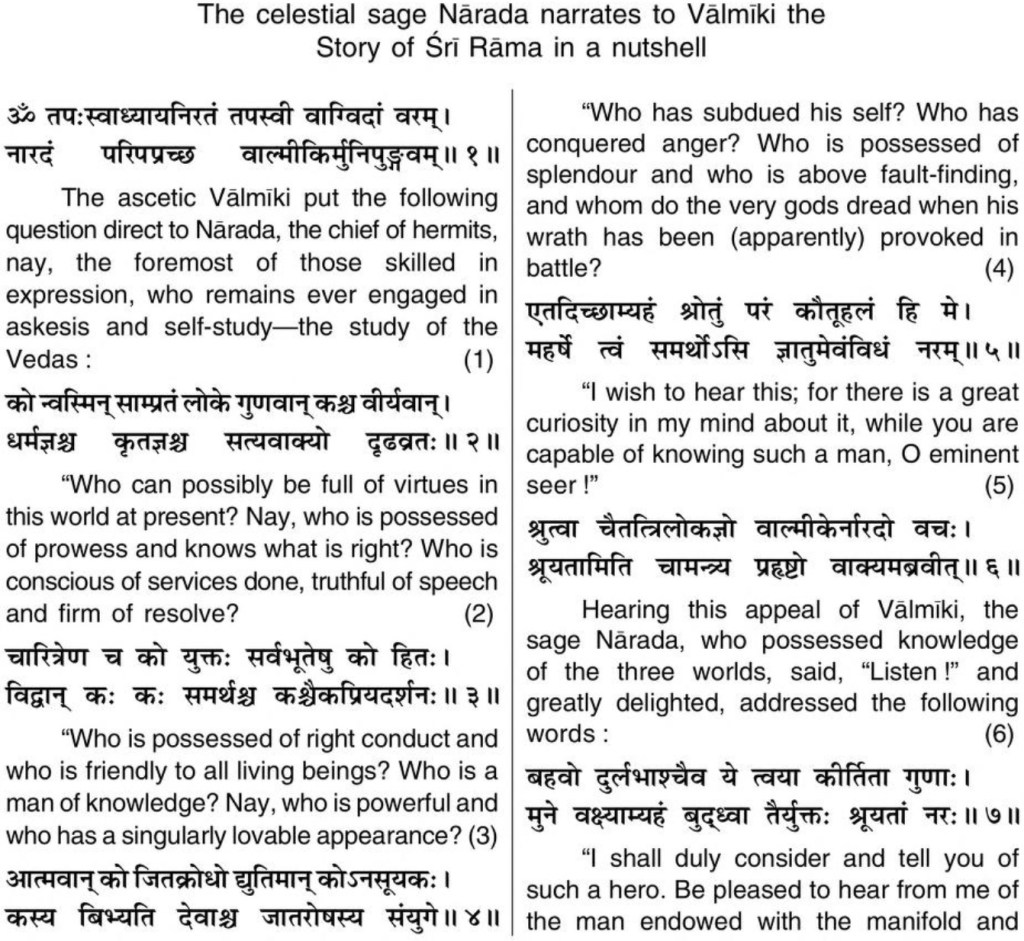
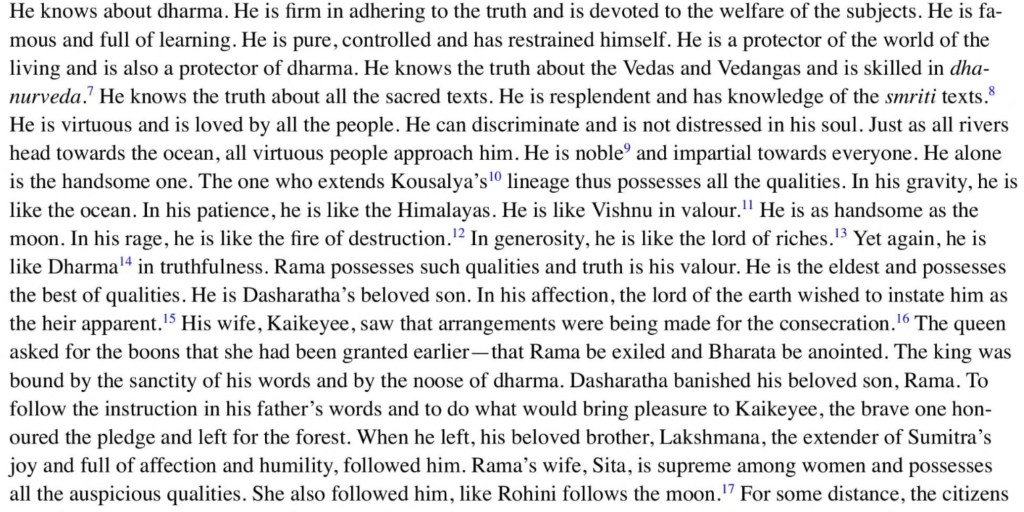
    As I continue my journey through the Ramayana, I’ve chosen to explore this epic using multiple versions: the abridged Valmiki translation, the comprehensive Gita Press edition, and the detailed Debroy translation. This approach allows me to compare different interpretations and uncover nuances that might otherwise go unnoticed. For those interested in exploring these different versions, both the Gita Press edition and the Debroy translation are embedded in the blog post below.

    Through this exploration, one figure has emerged as particularly significant in the opening of the Ramayana: the celestial sage Narada.

    Narada is one of the most revered sages in Hindu mythology, known for his deep wisdom, musical talent, and his role as a divine messenger. He is often depicted as a traveling sage who moves freely between the earthly realm and the divine, carrying messages from the gods to humans and vice versa. Narada is also renowned for his ability to incite action and prompt change—sometimes through his seemingly mischievous behavior, earning him the title of the “Divine Troublemaker.” However, his actions are always aimed at upholding dharma, or righteousness, even if they appear unconventional.

    Narada’s importance extends far beyond the Ramayana. He is a prominent figure in several other Hindu texts, including the Mahabharata, the Bhagavata Purana, and various Upanishads. In these texts, Narada is often seen guiding kings, sages, and even the gods themselves, providing counsel and sometimes challenging them to reflect on their actions. His role as a teacher and guide makes him a central figure in the transmission of spiritual knowledge and the preservation of dharma.

    Narada is also credited with the composition of the Narada Bhakti Sutra, a foundational text on the practice of bhakti, or devotion to God. This further underscores his role as a spiritual guide and a beacon of divine love and wisdom.

    The Ramayana opens with Narada narrating the story to Valmiki. This is a significant moment, as it frames the Ramayana not just as a historical or mythological account, but as a divine narrative passed down from the gods to humans through a trusted sage. Narada’s role here is that of a divine mediator, ensuring that the wisdom and teachings of the Ramayana are preserved and passed on to future generations.

    Narada’s presence in the Ramayana reminds us that spiritual teachings often come through intermediaries who carry the weight of divine authority. His involvement in the story underscores the importance of dharma and the divine order, which are central themes in the Ramayana.

    As we explore Narada’s role in the Ramayana, it’s essential to recognize the broader implications of his presence. Narada is not just a character in the story; he is a symbol of divine wisdom, a bridge between the mortal world and the divine, and a guide for those seeking to live a life of righteousness. His actions, teachings, and guidance are a reminder that the path of dharma is always within reach, no matter the challenges we face.

    🙏🕊️🙏

    If you’re interested in exploring the Ramayana in greater depth, you can find the Gita Press and Debroy versions below.

    Below is an image from the Gita Press version, where Narada’s wisdom begins to unfold:

    Screenshot

    Below is an image from the Debroy version, where Narada’s wisdom also begins to unfold:

    Screenshot
  • Book Review: The Forty Rules of Love by Elif Shafak

    Introduction:
    The Forty Rules of Love by Elif Shafak is a remarkable novel that intertwines two parallel stories: the modern-day journey of Ella Rubenstein, who is undergoing a personal transformation through her engagement with a novel about Rumi and his spiritual teacher, Shams Tabrizi, and the historical relationship between Rumi and Shams in 13th-century Anatolia. Through these interconnected narratives, the novel explores themes of divine love, spirituality, and personal awakening.

    Background:
    At the heart of this novel is the transformative relationship between Shams Tabrizi and Jalal ad-Din Rumi. Shams, a wandering mystic known for his unconventional methods and profound wisdom, radically altered the course of Rumi’s life. Their bond became the source of Rumi’s spiritual awakening, leading him to write some of the most celebrated poetry in history.

    Shams’ teachings were rooted in Sufi traditions, emphasizing the dissolution of the ego, the centrality of love in spiritual practice, and the path toward divine union. His Diwan-i Shams-i Tabrīzī, a collection of poems attributed to him, captures his deep understanding of divine love. Shams’ presence in Rumi’s life was both disruptive and enlightening, awakening the poet to a higher consciousness, which Rumi expressed through his prolific works, including the Masnavi.

    The Forty Rules of Love:
    Elif Shafak’s novel is structured around the forty rules of love, which are teachings attributed to Shams. These rules serve as guideposts for navigating the human experience of love, both worldly and divine, and reflect key principles of Sufi mysticism. Shafak weaves these rules throughout the story, offering readers spiritual insights while engaging them in the personal struggles of her characters.

    Themes Explored:

    At the heart of The Forty Rules of Love lies a profound exploration of divine love, the kind of love that transcends the ordinary boundaries of human emotion. Through the lives of Rumi, Shams, and Ella, the novel delves deeply into the nature of love as both a mystical force and a transformative power. Shams’ teachings guide Rumi from a scholar and theologian into a poet of divine union, revealing love as a path that dissolves the ego and leads to spiritual awakening. This kind of love is not just a feeling but an illumination that binds the soul to the divine, guiding the seeker toward self-realization.

    Rumi’s own awakening, catalyzed by his connection with Shams, reflects this dissolution of the ego. In Shams’ eyes, the ego is the greatest barrier to true enlightenment. The novel, much like Rumi’s poetry, calls us to surrender the smaller self, to let go of the illusions we hold about our identity, and to step into a deeper experience of being—one in which we recognize that separation from the divine is the root of all suffering.

    Ella’s journey parallels Rumi’s in a modern context, as she begins to shed the constraints of her ordinary life, driven by a newfound understanding of love and spiritual depth. Her connection with the novel within the novel becomes a mirror to the relationship between Rumi and Shams, and she, too, is drawn into a process of inner transformation. The book masterfully illustrates how these timeless spiritual principles can apply to anyone, in any age, as they awaken to the deeper truths that exist beyond the confines of everyday existence.

    Ultimately, the novel’s greatest teaching may be that love, in its purest form, is the force that bridges all dualities—the sacred and the mundane, the earthly and the divine. Through the eyes of Shams and Rumi, readers are invited to experience love as the highest form of spiritual practice, one that calls us to be both fully human and fully connected to the infinite.

    Recommendation:
    For readers interested in spirituality, love, and personal growth, The Forty Rules of Love offers a rich, contemplative experience. Shafak’s storytelling, combined with the teachings of Shams Tabrizi, provides both entertainment and deep spiritual insight. Whether you’re a seasoned reader of Rumi’s works or new to Sufi mysticism, this novel is sure to leave a lasting impact.

    The Forty Rules of Love remains on my list for deeper exploration. I plan to engage with each of the rules more fully in the future, and this review serves as a placeholder for that deeper dive.

    🙏🕊️🙏

  • Poem: Look to the Moon

    The finger points to where the moon does shine,
    But gaze not at the hand that beckons you.
    Let go the grasp of thoughts that claim as mine,
    And turn your sight to what is pure and true.

    Ramana speaks of Self, the quiet core,
    Where all the world and mind do gently fade.
    Orgyen’s Pristine Mind, and Buddha’s lore,
    Reveal the light that nothing can degrade.

    In God’s vast silence, there you’ll find the key,
    A truth that words and thoughts cannot contain.
    Release the need to seek, just let it be,
    For in the stillness, all is clear and plain.

    Stop searching for the truth outside, afar,
    The moon is shining, constant in the night.
    Turn inward now and see just where you are,
    The light you seek is your own inner light.

    Midnight.
    No waves,
    No wind,
    The empty boat
    Is flooded with moonlight.


    — Zen Master Dogen

    🙏🕊️🙏

  • Book Review: Forty Verses on Reality by Ramana Maharshi

    Ramana Maharshi, one of the most revered spiritual teachers of modern times, has left an indelible mark on the landscape of non-dual philosophy. Among his profound contributions is a text known as the “Forty Verses on Reality”, or “Ulladu Narpadu”, originally composed in Tamil. These verses are a deep exploration of the nature of existence and the true Self, offering guidance on the direct path to self-realization.

    The “Forty Verses on Reality” are not just poetic expressions but are a concise roadmap to understanding the essence of the Self, as taught by Ramana Maharshi. They delve into the illusion of the ego, the ultimate reality of non-dual existence, and the importance of self-inquiry as the path to realizing one’s true nature.

    In these verses, Ramana Maharshi addresses the central theme of his teachings: the illusion of the ego. He emphasizes that the sense of ‘I’—which we often associate with our thoughts, emotions, and bodily identity—is not the true Self. This ego, or false sense of individuality, creates a veil that obscures the unchanging, eternal reality that is the Self.

    Ramana encourages seekers to engage in self-inquiry, particularly through the practice of asking “Who am I?” This simple yet profound question is designed to lead one back to the source of the ‘I’ thought, tracing it to its origin in pure consciousness. It is in this inquiry that the mind begins to dissolve into the deeper awareness, where the illusory nature of the ego is revealed, and the true Self is recognized.

    The essence of these verses is the understanding that the Self is the only reality, and everything else is transient, merely an appearance in the vast expanse of consciousness. Ramana’s teaching points to the realization that the Self is beyond all dualities, beyond subject and object, beyond mind and matter. The Self is the underlying reality, the substratum upon which all experiences arise and subside.

    For those who are new to Ramana Maharshi’s teachings, the “Forty Verses on Reality” serve as a gateway to understanding his approach to non-duality and the path of self-inquiry. Each verse offers a unique insight into the nature of existence, gently guiding the reader toward a direct experience of the Self.

    Consider, for example, the first verse, where Ramana states: “If Reality did not exist, could there be any knowledge of existence? Free from all thoughts, Reality abides in the Heart, the Source of all thoughts. It is, therefore, called the Heart. How then is one to contemplate It? To be as It is in the Heart, is Its contemplation.” Here, he points to the central truth that Reality—our true nature—is beyond thought and can only be known by abiding as the Self in the Heart, the source of all thoughts.

    Or take verse twenty, where he asks: “By what light do you see? If you say ‘by the light of the sun,’ the moon, etc., then by what light do you see these lights? The light of the eye makes all these lights visible. But the mind makes the eyes shine. The ultimate source of all lights is the Self.” This verse illustrates the idea that all forms of perception ultimately point back to the Self, the pure awareness that illuminates all experiences.

    Perhaps one of the most poignant verses is verse twenty-six: “The body does not say ‘I’. The Self does not say ‘I’. Between the two, something arises, saying ‘I’. This phantom is the ego. Find out where from this arises. Then everything will subside into the Self.” Ramana succinctly captures the essence of self-inquiry here, pointing to the ego as a phantom that dissolves when one traces it back to its origin.

    The “Forty Verses on Reality” provide a rich tapestry of wisdom that can lead seekers to a direct realization of their true nature. These verses are a testament to Ramana Maharshi’s profound understanding of the non-dual reality and offer a timeless guide for those on the spiritual path.

    If you are inspired to delve deeper into these teachings, I encourage you to seek out a complete edition of these verses, where you can explore them in their entirety. Their depth and simplicity offer a powerful tool for self-inquiry and spiritual awakening.

    🙏🕊️🙏

    Richard Clarke’s version of the “Forty Verses on Reality” is a concise and accessible entry point into Ramana Maharshi’s teachings. Spanning just 78 pages, this edition focuses on presenting the verses in a clear and straightforward manner, making it an excellent choice for those who are new to self-inquiry and non-duality. Clarke’s approach is to let the power of Ramana’s words speak for themselves, offering readers a direct and undiluted experience of the teachings.

    The version introduced by Michael James and authored by Sandra Derksen provides an in-depth exploration of the “Forty Verses on Reality”, expanding the text to 422 pages with extensive commentary and analysis. This edition delves deeply into each verse, unpacking the layers of meaning and offering a comprehensive understanding of Ramana Maharshi’s philosophy. Ideal for serious students and those with a deep interest in Advaita Vedanta, this book offers a richly detailed interpretation that guides the reader through the nuances of self-inquiry and non-dual realization.