Month: April 2026

  • Swimming Past the Alligator

    Swimming Past the Alligator

    Dreams, healing, and the long work of becoming whole

    This morning I remembered a small piece of a dream.

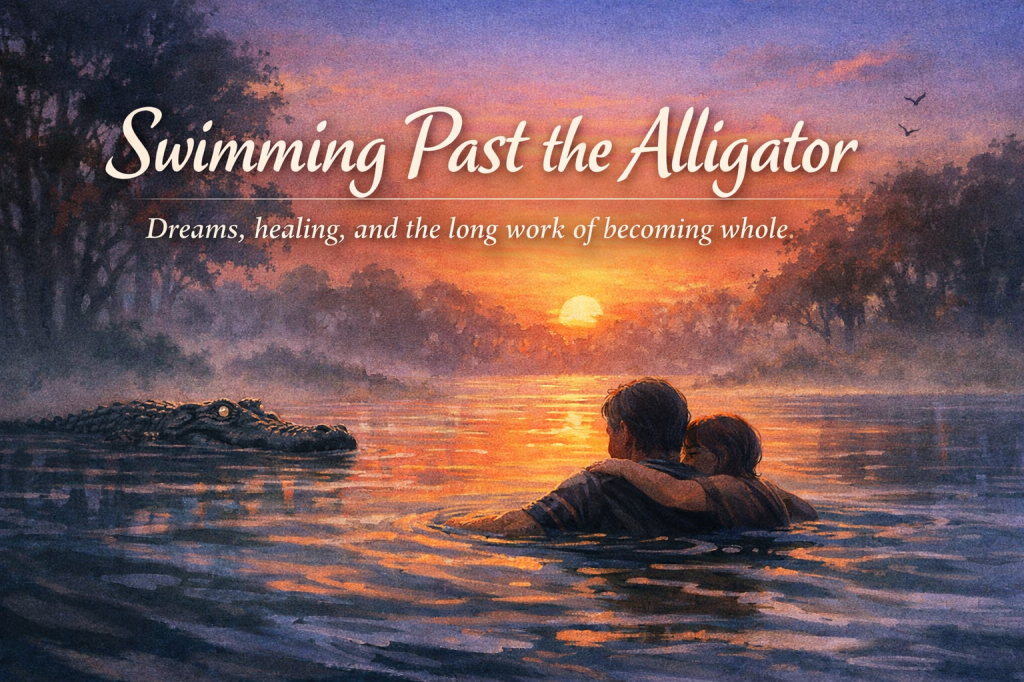
    I was swimming in water, and there was an alligator nearby.

    Instead of panicking, I simply swam past it.

    I remember making an aggressive sound—not from fear, but from protection. I was not alone. There was a child with me, and I felt responsible for their safety.

    Later I remembered another fragment: in another dream, I was offering gentle spiritual guidance to a young person.

    These were only fragments.

    But sometimes fragments are enough.

    Because sometimes a dream does not come to entertain us.
    Sometimes it comes to show us something we could not see before.


    The dreams we have when we are young

    When I was very young—single digit years—I had frequent nightmares. In those dreams I was being chased or threatened by monsters. I never confronted them. I always ran.

    There was fear.
    There was helplessness.
    There was no sense of power.

    Eventually those nightmares stopped.

    But something else remained.

    What followed was not nightmares, but something quieter and harder to name: a long period of adult life marked by insecurity, lack of confidence, and the feeling of not quite fitting into the world.

    The monsters had left my sleep.

    But their shadows remained in my waking life.

    Many people know this experience. Trauma does not always continue as dramatic nightmares. Sometimes it continues as hesitation. As self-doubt. As the quiet feeling of being different or unsafe without knowing exactly why.

    And sometimes this can last decades.


    A word I did not understand for thirty years

    When I was in my thirties I first encountered a psychological word:

    Individuation.

    Carl Jung used this word to describe the lifelong process of becoming whole — integrating the wounded parts of ourselves, the fearful parts, the hidden parts, and the strong parts into one living person.

    For thirty years I did not really understand what that meant.

    Then recently something changed.

    Not because I studied more.
    Not because I forced insight.

    But because life had slowly done its work.

    And then came the dream.

    Instead of running from the monster, I was swimming calmly past it.

    Instead of being threatened, I was protecting.

    Instead of being the frightened child, I had become the guardian of a child.

    That is when I began to understand what individuation might actually mean.

    Not perfection.

    Not becoming fearless.

    But becoming someone who can remain present in the water even when the alligator is still there.


    What the alligator might mean

    Jung often suggested that dangerous animals in dreams may represent powerful emotional forces or parts of ourselves we once feared.

    If water represents the emotional or unconscious life, then swimming might represent learning to move through our own feelings instead of being overwhelmed by them.

    And the alligator?

    Perhaps it represents something we once thought would destroy us.

    A memory.
    A fear.
    A past wound.
    A shadow.

    But here is the important part:

    In the dream, the alligator did not disappear.

    Healing did not mean the danger was erased.

    Healing meant I was no longer powerless in its presence.

    That is a very different kind of freedom.


    A change many people never notice

    One of the most important changes in healing is not that fear disappears.

    It is that our relationship to fear changes.

    As children, many of us could only run. Our nervous systems were not ready to do anything else.

    But over years—sometimes many years—something can slowly develop:

    Inner resources
    Perspective
    Compassion
    Stability
    Understanding

    And sometimes one day we notice something surprising:

    We are no longer running.

    We are still in the water.

    But we are not drowning.


    The child in the dream

    Perhaps the most meaningful part of the dream was not the alligator.

    It was the child.

    In the dream I was protecting a child. Not a boy or a girl. Just a child.

    Many psychological traditions would say this child may represent the vulnerable part of ourselves we once were.

    The part that did not feel safe.
    The part that needed protection.

    And perhaps healing is not about becoming invulnerable.

    Perhaps healing is about becoming the person who can finally protect that inner child.

    Not by fighting monsters.
    Not by denying fear.

    But by staying present.


    Nightmares across a lifetime

    Not everyone has nightmares only in childhood. Some people carry them into adulthood. Some begin having them later in life. Some veterans carry dreams of war for decades. Some people carry dreams shaped by loss, illness, or trauma.

    And this deserves to be said gently and clearly:

    Having nightmares does not mean you are weak.

    It often means your nervous system is still trying to make sense of what was too much to process at the time.

    Sometimes healing does not mean the dreams stop immediately.

    Sometimes healing means we slowly become less afraid of what they are showing us.


    A different way to think about difficult dreams

    Instead of asking:

    Why am I having this dream?

    Sometimes a more compassionate question might be:

    How has my relationship to fear changed?

    Or even:

    Am I still running, or am I learning to stay?

    Because sometimes progress is not dramatic.

    Sometimes progress is simply this:

    You are still in the water.
    And you are calmer than before.


    What healing sometimes looks like

    Healing is rarely a straight path.

    Sometimes it looks like therapy.
    Sometimes meditation.
    Sometimes prayer.
    Sometimes long conversations.
    Sometimes simply surviving long enough for the nervous system to learn safety.

    And sometimes, unexpectedly, healing looks like a dream that quietly says:

    You are not who you used to be.


    A closing reflection

    If I were to turn this dream into a simple contemplative question, it might be this:

    What in my life once terrified me that I can now face with a little more calm?

    Or even more gently:

    Where have I already grown stronger than I realize?

    Sometimes we do not see our own healing because it happened slowly.

    But sometimes a dream reminds us.

    Not with fireworks.

    Just with an image:

    You are in the water.
    The danger is still there.
    But you are no longer alone.

    And you are no longer afraid in the same way.

    May all beings find safety.
    May all beings find healing.
    May all beings discover their own quiet strength.
  • Awakening Happens Two Ways: Like Lightning, or Like Dawn

    Awakening Happens Two Ways: Like Lightning, or Like Dawn

    Sudden illumination and the slow work of becoming whole

    Into the Mystic is a contemplative reflections series exploring awakening, stability, and the quiet path of inner transformation in ordinary life.


    Introduction: Two Movements of Awakening

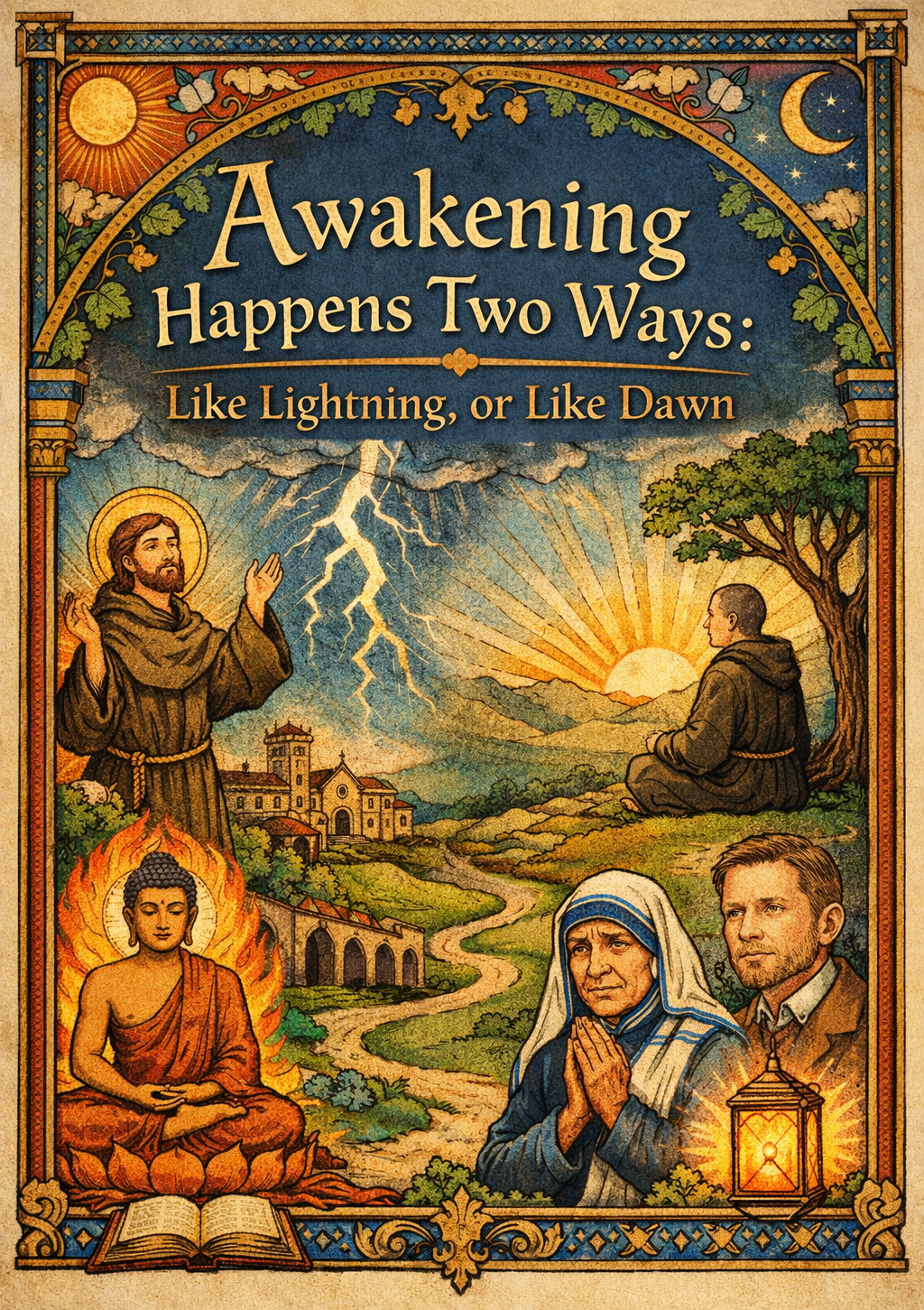
    In the landscape of spiritual life, two great patterns appear again and again: the gradual path and the lightning path.

    One unfolds slowly through prayer, discipline, contemplation, and steady inner work. The other arrives suddenly, as if grace breaks through without warning and changes the whole direction of a life in an instant.

    These are often described as opposites.

    But perhaps they are not opposites at all.

    Perhaps they are two movements within the same mystery.


    The Gradual Path

    The gradual path is the way of cultivation. It is the slow shaping of the soul through daily practice. It is the monk returning to prayer. The meditator returning to the breath. The seeker returning again and again to silence, surrender, and truth.

    In Buddhist language, this is the long training of mind and heart. In Christian contemplative language, it is the patient deepening of humility, purification, and love.

    Saint Teresa of Ávila offers one of the clearest examples of this gradual unfolding. Her spiritual life matured through years of prayer, struggle, refinement, and increasing interior depth. The soul, in her vision, is not transformed instantly, but led inward through many chambers, many purifications, many deepenings of surrender.

    Likewise, the Buddha’s awakening, though realized in a decisive moment beneath the Bodhi tree, was preceded by years of seeking, discipline, renunciation, and contemplative effort.

    The flowering may appear sudden.

    But the roots often grow in darkness for a very long time.


    The Lightning Path

    And yet there is also the lightning path.

    This is the path of abrupt transformation. The sudden reversal. The moment when the old self is pierced and something entirely new begins.

    It is not always earned in any neat or linear way. It may come through suffering, illness, loss, beauty, grace, or some inward rupture that breaks the ordinary structure of identity.

    Saint Francis of Assisi seems to belong, at least in part, to this lightning pattern. His early life was not one of long monastic preparation. His conversion appears to have been catalyzed through crisis: illness, war, captivity, disillusionment, and the collapse of the worldly ambitions he once cherished.

    Something broke open in him.

    The man who had been oriented toward status and recognition turned instead toward poverty, simplicity, love, and radical devotion.

    His life did not merely improve.

    It changed direction.


    Sudden Awakening, Gradual Integration

    This pattern appears across many traditions.

    Ramana Maharshi described a sudden awakening that began with a profound confrontation with death in his youth.

    Eckhart Tolle has written about a dramatic inner shift following a period of deep psychological suffering, when the ordinary sense of self seemed to dissolve into a profound stillness.

    Yet what is often overlooked is what came after.

    Tolle spent years living very quietly, often sitting on park benches, allowing his life to slowly reorganize around what he had experienced.

    The awakening may have been sudden.

    The embodiment was gradual.

    Here again we see the same rhythm:

    Lightning followed by integration.


    Faithfulness Without Consolation

    Mother Teresa’s life reflects another variation of this same pattern.

    Her decisive vocational turning — sometimes described as a profound interior call to serve the poorest of the poor — carries the character of a lightning moment.

    Yet what followed was not constant spiritual consolation, but decades of interior dryness, what the Christian mystical tradition calls a dark night of the soul.

    Despite this, she continued her work with remarkable faithfulness.

    Her life suggests something subtle but important:

    Awakening is not always accompanied by pleasant experience.

    Sometimes the lightning clarifies direction, but the gradual path becomes one of love without emotional reinforcement.

    In this way, both the sudden opening and the long endurance that follows become part of the same spiritual maturation.


    The Deeper Pattern

    If we look across these lives — Francis of Assisi, Teresa of Ávila, the Buddha, Ramana Maharshi, Mother Teresa, and Eckhart Tolle — a pattern begins to emerge.

    Some lives begin with discipline and flower into breakthrough.

    Others begin with breakthrough and spend years learning how to live what was revealed.

    Most contain both movements.

    Perhaps this is because awakening is not an event but a relationship.

    A relationship between grace and participation.

    Between what is given and what is lived.

    Zen expresses this beautifully:

    Enlightenment is an accident. Practice makes us accident-prone.
    Shunryu Suzuki Roshi

    We do not command grace.

    We prepare ourselves.
    We consent.
    We practice.
    We purify intention.
    We return.
    We wait.

    And sometimes, unbidden, the veil thins.


    The Quiet Awakening Most People Miss

    There is also a tender psychological truth here.

    Many sincere seekers imagine that if they have not had a dramatic breakthrough, then perhaps nothing real is happening.

    But this is not so.

    Sometimes awakening is not an explosion but an erosion.

    Not lightning, but river-water.

    Not a sudden fire from heaven, but a long dawn.

    A person may simply discover, after years of difficulty, that they are more stable than they once were.

    Less driven by fear.

    Less imprisoned by old wounds.

    More able to rest in silence.

    More capable of kindness.

    More able to endure uncertainty without collapse.

    This too is awakening.

    This too is grace.


    Where the Two Paths Meet

    Even within the gradual path, lightning may still come.

    Even within the lightning path, long discipline may still be required.

    Francis did not remain only the man of sudden conversion. He became the man of ongoing prayer and ongoing surrender.

    Teresa did not advance only by method. Her life was also marked by moments of powerful grace.

    The Buddha practiced intensely, but the final realization was not something he could force by will alone.

    The great traditions seem to agree on this much:

    Effort matters.

    But effort is not sovereign.

    There is something deeply relieving in that.

    It means we do not have to choose between discipline and grace.

    We can practice faithfully without pretending awakening is a personal achievement.

    We can remain open to the unexpected without neglecting the humble daily work of becoming more honest, more surrendered, and more loving.


    The Real Question

    Perhaps the real spiritual life is not about deciding whether we are on the gradual path or the lightning path.

    Perhaps it is about recognizing which movement is active in us now.

    For some, this season is one of patient cultivation.

    Quiet repetition.
    Invisible deepening.
    Slow healing.
    Hidden roots.

    For others, this season may include rupture, reversal, breakthrough, or an unexpected unveiling that reorders everything.

    And for many, it is both.

    We tend the garden, but we do not control the rain.

    We prepare the lamp, but we do not command the flame.

    We sit.
    We pray.
    We breathe.
    We return.
    We become available.

    In the end, perhaps that is the deepest wisdom:

    Awakening is both gift and participation.

    We are neither passive nor omnipotent.

    We are participants in a mystery we cannot manufacture, but to which we can sincerely offer our lives.

    The gradual path teaches us faithfulness.

    The lightning path teaches us surrender.

    And both, in their own way, lead us beyond ourselves.


    Peace and good. 🌿