For those of us living with chronic fatigue syndrome (ME/CFS), finding peace can often feel like an elusive dream. The body aches, the mind fogs, and even the simple act of resting can feel like a challenge.
But beneath the surface of our struggles—beneath the exhaustion, frustration, and the endless cycle of unfinished stories—there is a refuge that has never left us. A place within that remains untouched, waiting patiently to be noticed.
Across traditions, this inner sanctuary is described in many ways. In Christianity, it is the peace that passeth understanding, the quiet presence of the Holy Spirit that calms the heart. In Buddhism, it is our Buddha nature, the still, pristine mind that shines beneath our thoughts. In Jewish practice, Shabbat offers a sacred pause from the world’s demands, a time to rest in the presence of the I AM. Whether through Vipassana’s gentle observation, Samatha’s calming focus, or the surrender of “Let go and let God,” the invitation is the same: to rest in the peace that is always there, even if just for a moment.
But here’s the truth that many of us don’t expect—when we set the intention to relax, to find that peace, it’s common for our minds to do the exact opposite. The very moment we try to slow down, all the unsettled thoughts, worries, and frustrations rise to the surface. It’s like sitting down to meditate and suddenly realizing just how noisy the mind really is. For those of us with ME/CFS, this can feel especially overwhelming. Our bodies are already weighed down by fatigue, and now our minds seem unwilling to give us the rest we crave.
But this isn’t a sign of failure—it’s part of the process. Just as clouds drift across the sky without altering the vastness behind them, our thoughts come and go without touching the deeper peace within us. The key is not to fight these thoughts, not to grow frustrated or discouraged, but to witness them with gentle curiosity. To let them rise and fall, trusting that underneath the noise, the stillness remains.
This practice takes more than just patience—it requires self-compassion. We have to be kind to ourselves, especially when the mind feels restless or when peace feels far away. Forgiveness becomes a part of the journey: forgiving ourselves for not feeling better, for being frustrated, for wishing things were different. And most of all, it requires surrender. To let go of the need to control how or when peace arrives, and to trust that it will reveal itself in its own time.
Over the past month, I’ve faced one challenge after another—the sale of my RV, packing up a home that had been my refuge for over 30 years, and the physical demands of moving into a new apartment. Each step of the process required me to push beyond my body’s natural limits, triggering post-exertional malaise. There were moments I had to override the signals of fatigue just to get through the next task, knowing full well the cost it would bring later. And yet, I approached it as mindfully as I could, listening when possible, resting when needed, and trusting that I would eventually return to the gentle rhythm of proper pacing.
Now, as I settle into this new space, I look forward to reclaiming that mindful practice of pacing—of finding the balance between effort and rest, between doing and simply being. Even though my body is still recovering, I know that the peace I’m seeking is not dependent on my circumstances. It’s always there, beneath the surface, waiting for me to slow down, to breathe, and to notice.
And so, I offer this to you—whether you live with ME/CFS, face chronic challenges, or are simply navigating the complexities of life. The path to peace isn’t always smooth, and the mind may resist at first. But beneath the noise, the frustration, and the exhaustion, there is a refuge that has never left you. It’s not something you have to create or chase—it’s already there, waiting to be noticed.
Let go. Be kind to yourself. Trust the process.
And when you least expect it, that peace—the one that passeth understanding, that shines with the light of your Buddha nature, that whispers with the breath of the Holy Spirit—will rise to meet you.
Because the truth is, that refuge is never truly out of reach.
May you feel at ease today, in body and mind, Flowing naturally with the unfolding Tao. May the winds be gentle, the clouds at peace, And with each day, may wellness arise.
Spanish / Español
Que hoy sientas paz en cuerpo y mente, Fluyendo con el Tao en su danza infinita. Que los vientos sean suaves, las nubes en calma, Y con cada día, la dicha te acompañe.
Italian / Italiano
Che tu possa sentirti in pace oggi, nel corpo e nella mente, Scorrendo naturalmente con il fluire del Tao. Che i venti siano dolci, le nuvole serene, E che ogni giorno porti benessere.
أتمنى لك راحة البال والجسد اليوم، متناغمًا مع تدفق الطاو الطبيعي. لتكن الرياح لطيفة، والسحب في سلام، ومع كل يوم، ليزهر الهدوء والرفاهية.
Hebrew / עברית
שיהיה לך שקט ושלווה בגוף ובנפש היום, זורם בטבעיות עם התפתחות הטאו. שהרוחות יהיו עדינות והעננים שלווים, ועם כל יום, תצמח רווחה וברכה.
Russian / Русский
Пусть сегодня твое тело и разум будут в покое, Теча естественно вместе с раскрывающимся Дао. Пусть ветер будет мягким, облака спокойными, И с каждым днем пусть благополучие возрастает.
Ukrainian / Українська
Нехай сьогодні твоє тіло йo розум будуть у спокої, Течучи природно разом із розкриттям Дао. Нехай вітер буде лагідним, а хмари спокійними, І з кожним днем нехай зростає благополуччя.
Native American (Lakota / Lakȟótiyapi)
Lél uŋči makȟóčhe kiŋ ičháǧapi, ni én čhaŋtéwašteya waŋká yo. Čháŋ šíč’iya, maȟpíya wašté. Tatȟáŋka yuhá waštélaka, Lé wíyukčaŋ kiŋ, tȟawášte ye.
(Here on Grandmother Earth, may you stand with a good heart. May the trees be strong, and the clouds be kind. Buffalo watches over you with love, And this day brings you peace.)
To live with myalgic encephalomyelitis is to carry a body that moves like weather—one moment heavy with fog, another scattered by electric storms. The limbs, once steady, now whisper of exhaustion; the nervous system hums and flickers like distant lightning. And yet, within all of this, there is a quiet place—one untouched by fatigue, by pain, by the ever-changing tides of illness. This is the witness, the silent presence that watches, feels, but does not struggle.
The Power of Witnessing Consciousness
When the body is weary, and the world presses in with its demands, the mind often follows—entangled in frustration, longing, grief. Yet, there is another way to meet this experience. Instead of battling exhaustion, we can turn toward it, gently, with curiosity. Instead of resisting discomfort, we can learn to hold it, like cradling a trembling bird in our hands.
Witnessing is not about escaping pain but about changing our relationship to it. It is the art of standing at the edge of the storm and seeing not just the thunder, but the vast sky that holds it.
A Simple Self-Contemplation Practice
Grounding in the Present Find a quiet moment. You don’t need perfect stillness—only a willingness to pause. Notice your body, the way it rests against the surface beneath you. Feel the breath, moving in, moving out, like waves against the shore.
Observing Without Resistance Turn your attention inward. What is present? Fatigue like heavy earth? A nervous system like sparking wires? A mind that spins, restless and longing? Whatever it is, let it be here. Do not push it away or name it as the enemy. Simply notice.
Holding with Compassion Imagine that each sensation is a visitor—arriving, staying for a time, and eventually leaving. What happens if you do not chase them away? What if, instead, you offer a quiet seat at your table?
Even pain, even exhaustion, when met with this gentle witnessing, begins to soften. Not disappear, but shift—like wind through the trees, no longer trapped, no longer feared.
How This Practice Supports ME/CFS Symptoms
This is not a cure, nor a promise of relief, but a way of being with what is. When we meet our experience with openness:
The nervous system settles; the fight against the body lessens.
The mind uncoils from frustration and rests in the simple act of seeing.
The emotional burden lightens, as we stop identifying with suffering and begin to witness it instead.
Closing Thoughts: The Sky Holds It All
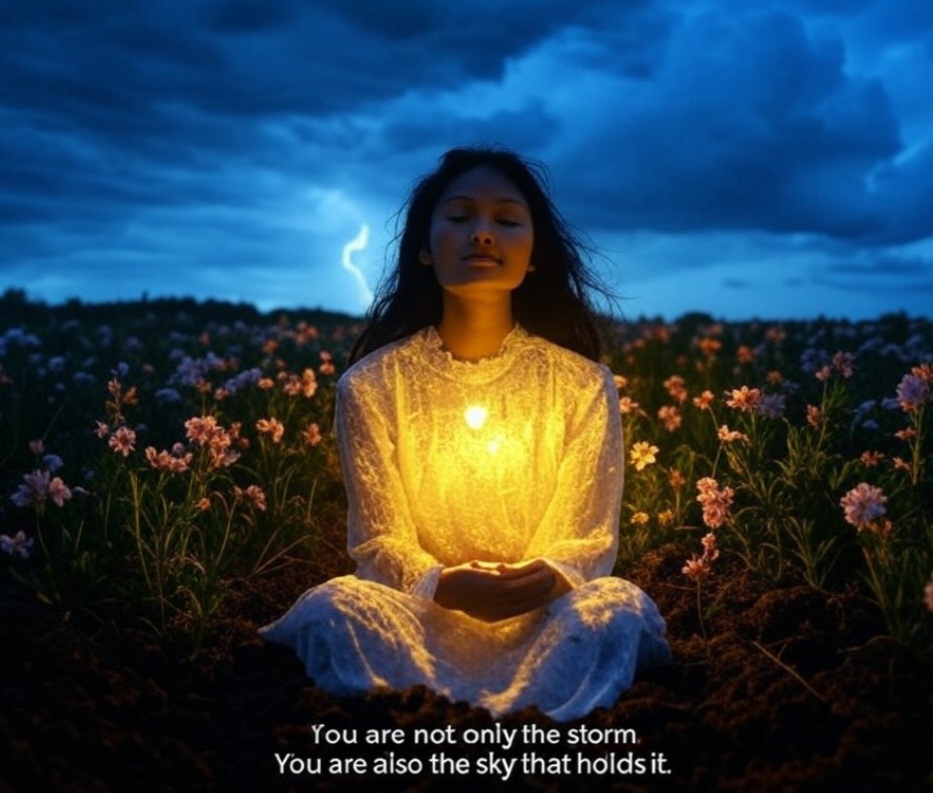
If today your body feels like a storm, know that you are not only the storm—you are also the sky that holds it. The witness that watches, the stillness beneath the waves.
And on days when you cannot sit in silence, when exhaustion presses too hard, let even that be witnessed with kindness. The practice is not in perfect stillness, but in the quiet turning toward whatever is here, again and again.
Rest when you must, breathe when you can, and know that you are not alone.
Some goodbyes are not endings but beginnings in disguise. This past week, Grace, my beloved 1977 American Clipper, embarked on the next chapter of her journey. As I prepared to say farewell, the day unfolded not as a solemn departure, but as a celebration of possibility, joy, and new connections.
Friends and neighbors gathered to mark the occasion with food, drink, and laughter. It was important to me that this day—this beginning of Grace’s new life—felt festive and hopeful rather than a somber goodbye. As we shared snacks, stories, and warm embraces, Grace became the centerpiece of a moment filled with gratitude and lightheartedness.
I handed José, Gabriel’s son, a bouquet of flowers and a bottle of champagne to give to his father, a small token of the hope and beauty I know Grace will bring to their lives. It was as if Grace herself rejoiced, knowing she had found a home filled with love and possibility.
As I reflect on this transition, I am struck by the serendipity of it all. When Estelle disappeared, leaving Grace without a buyer, I had no idea what would come next. Yet life had its plan, one more perfect than I could have imagined. Alberto and Gabriel arrived just in time, bringing not only a new home for Grace, but also a new family and friendship for me.
Grace is no longer mine, but her spirit continues to teach me. This journey with her has been a reminder to trust life’s unfolding, to embrace uncertainty, and to open my heart to what is yet to come. Her story has always been one of adventure, and I know that in the hands of her new family, she will continue to inspire and delight.
As I watched her being carefully towed away, I felt a profound peace settle over me. Grace is exactly where she is meant to be, and her journey is far from over.
To Grace, her new family, and the adventures yet to come.
There are moments in life when plans fall apart, when what once seemed secure slips through your fingers like sand. These moments often arrive uninvited, leaving us wondering what, if anything, will take their place. When Estelle disappeared—a buyer who seemed certain to restore Grace and lead her into a new chapter—I was left with uncertainty.
Grace, the beloved 1977 American Clipper motorhome that has been my home, my refuge, and my companion for over three decades, suddenly seemed to have no clear future. When Estelle vanished weeks before my move, not only did I feel disappointed, but I was left with an empty space where hope once resided. It would have been easy to let despair take hold. However, something deeper within me whispered: Wait. Trust.
So, I waited. And I surrendered—not with resignation, but with a quiet faith that the story of Grace, and mine, was still unfolding. In moments of doubt, I asked the universe: What’s happening? Where are we going?
And then came Alberto.
He entered like a gentle breeze, curious and thoughtful, speaking of his love for solitude and his desire for a space to write and reflect. His words reminded me of my own time with Grace—those weeks spent deep in the national forest, where stillness extended like an open hand, inviting me to rest. In Alberto’s dream, I saw a reflection of my own.
As we talked and shared stories, considering this exchange, it became clear that restoring Grace to her former glory would not be easy. And at that moment, something changed within me. The idea that Grace would find a home where she would be loved and cared for felt more important than any practical or financial concern. Without hesitation, I told Alberto: Take her. She’s yours.
It wasn’t an act of charity, but one of trust—the trust that Grace had found the right hands.
And through Alberto, I met Gabriel and José, kindred spirits whose warmth and curiosity revealed a shared love for life, storytelling, and connection. Grace, my home and faithful companion for decades, has become a bridge to new friendships.
Grace has been, for me, a sanctuary of stillness and simplicity. And though being stationary for ten years has taken its toll, her spirit has remained intact, ready, willing, and waiting for her restoration. I had hoped to find her a future full of care, adventure, and love, and now, seeing the passion of Alberto and Gabriel, I know she has found it.
Grace is no longer mine. Perhaps she never was. Because Grace is truly a free spirit that has deeply touched my life. And now, as she continues to travel, she will carry her joy to a new family. In doing so, she will continue to teach the beauty of the present moment, of letting go, and of trusting in the unfolding of life.
As I watched them standing by Grace, with warm smiles despite the gray sky, I felt something I hadn’t felt in months: peace. This is what surrender brings, I realized—not just answers to our questions, but connections that surprise and transform us.
My heart blossomed with happiness when Gabriel, Grace’s new owner and caretaker, looked at me and, with light in his eyes, declared: I love Grace. I love Grace.
Dear friends, stay tuned for more stories of Grace, both of her past adventures and the new journeys that await her.
With gratitude and hope, Richard
El Regalo de Grace: Una Historia de Rendición, Confianza y Conexión
Queridos Amigos,
Hay momentos en la vida en los que los planes se desmoronan, cuando lo que antes parecía seguro se desliza entre los dedos como arena. Estos momentos suelen llegar sin invitación, dejándonos preguntando qué, si es que hay algo, tomará su lugar. Cuando Estelle desapareció—una compradora que parecía segura de restaurar a Grace y llevarla a un nuevo capítulo—me quedé con incertidumbre.
Grace, la amada autocaravana American Clipper de 1977 que ha sido mi hogar, mi refugio y mi compañera durante más de tres décadas, de repente parecía no tener un futuro claro. Cuando Estelle desapareció semanas antes de mi mudanza, no solo me sentí decepcionado, sino que me quedé con un espacio vacío donde antes residía la esperanza. Habría sido fácil dejar que la desesperación se apoderara de mí. Sin embargo, algo más profundo dentro de mí susurraba: Espera. Confía.
Así que esperé. Y me rendí—no con resignación, sino con una fe tranquila en que la historia de Grace, y la mía, aún estaban desarrollándose. En momentos de duda, le pregunté al universo: ¿Qué está pasando? ¿A dónde vamos?
Y entonces llegó Alberto.
Entró como una suave brisa, curioso y reflexivo, hablando de su amor por la soledad y su deseo de un espacio para escribir y reflexionar. Sus palabras me recordaron mi propio tiempo con Grace—esas semanas pasadas en lo profundo del bosque nacional, donde la quietud se extendía como una mano abierta, invitándome a descansar. En el sueño de Alberto, vi un reflejo del mío propio.
Mientras hablábamos y compartíamos historias, y considerábamos este intercambio, quedó claro que restaurar a Grace a su antigua gloria no sería fácil. Y en ese momento, algo cambió dentro de mí. La idea de que Grace encontrara un hogar donde sería amada y cuidada se sintió más importante que cualquier preocupación práctica o financiera. Sin dudarlo, le dije a Alberto: Llévatela. Es tuya.
No fue un acto de caridad, sino de confianza—la confianza de que Grace había encontrado las manos adecuadas.
Y a través de Alberto, conocí a Gabriel y José, espíritus afines cuya calidez y curiosidad revelaron un amor compartido por la vida, la narración de historias y la conexión. Grace, mi hogar y compañera fiel durante décadas, se ha convertido en el puente hacia nuevas amistades.
Grace ha sido, para mí, un santuario de quietud y simplicidad. Y aunque el hecho de permanecer estacionada durante diez años le ha pasado factura, su espíritu ha permanecido intacto, lista, dispuesta y esperando su restauración. Había esperado encontrarle un futuro lleno de cuidado, aventura y amor, y ahora, al ver la pasión de Alberto y Gabriel, sé que lo ha encontrado.
Grace ya no es mía. Quizás nunca lo fue. Porque Grace es verdaderamente un espíritu libre que ha tocado profundamente mi vida. Y ahora, mientras sigue viajando, llevará su alegría a una nueva familia. Al hacerlo, continuará enseñando la belleza del momento presente, de dejar ir, y de confiar en el desarrollo de la vida.
Mientras los observaba de pie junto a Grace, con sonrisas cálidas a pesar del cielo gris, sentí algo que no había sentido en meses: paz. Esto es lo que trae la rendición, me di cuenta—no solo respuestas a nuestras preguntas, sino conexiones que nos sorprenden y nos transforman.
Mi corazón floreció de felicidad cuando Gabriel, el nuevo dueño y cuidador de Grace, me miró y, con luz en sus ojos, declaró: Amo a Grace. Amo a Grace.
Queridos amigos, estén atentos a más historias de Grace, tanto de sus aventuras pasadas como de los nuevos viajes que le esperan.
Con gratitud y esperanza, Richard
Il Dono di Grace: Una Storia di Abbandono, Fiducia e Connessione
Cari Amici,
Ci sono momenti nella vita in cui i piani si sgretolano, quando ciò che una volta sembrava sicuro scivola via tra le dita come sabbia. Questi momenti spesso arrivano senza invito, lasciandoci a chiederci cosa, se c’è qualcosa, prenderà il loro posto. Quando Estelle è scomparsa—una compratrice che sembrava certa di restaurare Grace e guidarla verso un nuovo capitolo—mi sono ritrovato con un’incertezza.
Grace, l’amata autocaravan American Clipper del 1977 che è stata la mia casa, il mio rifugio e la mia compagna per oltre tre decenni, improvvisamente sembrava non avere un futuro chiaro. Quando Estelle è scomparsa settimane prima del mio trasloco, non solo mi sono sentito deluso, ma mi sono trovato con uno spazio vuoto dove una volta risiedeva la speranza. Sarebbe stato facile lasciare che la disperazione prendesse il sopravvento. Tuttavia, qualcosa di più profondo dentro di me sussurrava: Aspetta. Fidati.
Così ho aspettato. E mi sono arreso—non con rassegnazione, ma con una quieta fede che la storia di Grace, e la mia, stesse ancora prendendo forma. Nei momenti di dubbio, ho chiesto all’universo: Cosa sta succedendo? Dove stiamo andando?
E poi è arrivato Alberto.
È entrato come una dolce brezza, curioso e riflessivo, parlando del suo amore per la solitudine e del suo desiderio di uno spazio per scrivere e riflettere. Le sue parole mi hanno ricordato il mio tempo con Grace—quelle settimane passate nelle profondità della foresta nazionale, dove la quiete si estendeva come una mano aperta, invitandomi a riposare. Nel sogno di Alberto, ho visto un riflesso del mio.
Mentre parlavamo e condividevamo storie, considerando questo scambio, è diventato chiaro che riportare Grace al suo antico splendore non sarebbe stato facile. E in quel momento, qualcosa è cambiato dentro di me. L’idea che Grace trovasse una casa dove sarebbe stata amata e curata mi è sembrata più importante di qualsiasi preoccupazione pratica o finanziaria. Senza esitazione, ho detto ad Alberto: Prendila. È tua.
Non è stato un atto di carità, ma di fiducia—la fiducia che Grace avesse trovato le mani giuste.
E attraverso Alberto, ho incontrato Gabriel e José, spiriti affini la cui calda accoglienza e curiosità hanno rivelato un amore condiviso per la vita, la narrazione e la connessione. Grace, la mia casa e fedele compagna per decenni, è diventata un ponte verso nuove amicizie.
Grace è stata, per me, un santuario di quiete e semplicità. E anche se essere rimasta ferma per dieci anni ha lasciato il segno, il suo spirito è rimasto intatto, pronto, volenteroso e in attesa di essere restaurato. Avevo sperato di trovarle un futuro pieno di cura, avventura e amore, e ora, vedendo la passione di Alberto e Gabriel, so che lo ha trovato.
Grace non è più mia. Forse non lo è mai stata. Perché Grace è davvero uno spirito libero che ha toccato profondamente la mia vita. E ora, mentre continua a viaggiare, porterà la sua gioia a una nuova famiglia. Così facendo, continuerà a insegnare la bellezza del momento presente, del lasciar andare e del fidarsi dell’evoluzione della vita.
Mentre li osservavo accanto a Grace, con sorrisi caldi nonostante il cielo grigio, ho sentito qualcosa che non provavo da mesi: pace. Questo è ciò che porta l’abbandono, ho capito—non solo risposte alle nostre domande, ma connessioni che ci sorprendono e ci trasformano.
Il mio cuore è sbocciato di felicità quando Gabriel, il nuovo proprietario e custode di Grace, mi ha guardato e, con la luce negli occhi, ha dichiarato: Amo Grace. Amo Grace.
Cari amici, rimanete sintonizzati per altre storie su Grace, sia delle sue avventure passate che dei nuovi viaggi che l’aspettano.
Global Well-Being: The Creation of Healing, Love, and Compassion Every Day and in Every Way—Especially on the New Moon, Around the World.
Hello Everyone! Let’s come together again as a Global Community!
Every New Moon, we have the opportunity to unite in prayer and meditation to create strong waves of vibrational intentionality—focusing on Loving-kindness and compassion. Whether we connect at the same time globally or in planetary waves, the energy we co-create will ripple outward, touching all life with healing and love.
Join us on the New Moon, whenever it appears in your location, to synchronize in a global community of prayer and/or meditation. Together, we can generate waveforms and vibrations of love and compassion that will radiate outward from this day onward and forever. These vibrations will continue to blanket the Earth and all life in a palpable field of love and compassion, benefiting all.
The more love and compassion we consciously generate, the more of it becomes available in our world and universe for others to feel, enjoy, and be nurtured by. Let’s co-create a living, vibrating, pulsing web of love and compassion that surrounds the planet, lifting us all to higher vibrations of healing, love, and compassion for every being.
May we, the Earth, and all life benefit.
May we all be free from suffering, greed, hatred, and delusion, as well as the causes of suffering. May we all have wholesome happiness and its causes. May our prayers and meditations be a cause for global healing and well-being for all now and forever.
Join us in any way that works best for you.
On the New Moon, let’s come together with strong intentions, knowing that others around the world will be doing the same. Choose a time that works for you—whether it’s morning, noon, or evening—and feel the connection with others participating across the globe. If you’re interested in helping create a wave of meditation and prayer, consider meditating or praying at either 7:00 a.m. or 7:00 p.m. in your local time zone. By doing this, we create an ongoing ripple effect of love and compassion, as hour by hour, new groups of people join in, sending vibrations of loving-kindness around the planet. Together, we build a global field of healing energy that envelops the Earth and all its inhabitants. However you choose to participate—whether in synchronized times or your own flow—the collective intention benefits all.
Feel free to express your love and compassion in any form. Be creative. Share poetry, reflections, prayers, or experiences in the comments below, and let’s fill the Earth’s atmosphere and beyond with vibrations of love and compassion. All forms of loving-kindness are welcome here.
Loving-kindness and compassion are universal qualities.
No one person or group owns them. They transcend race, nationality, religion, or background. The more we can nurture and generate these heart qualities, the more we collectively benefit. How beautiful is that?
If you plan to join us, let us know in the comments!
Your presence matters. Sharing your intentions, reflections, or experiences can inspire and motivate others. Together, we’re building a global community of healing and love. Whether you join for 5 minutes or longer, or in synchronized or local time, every contribution is valued.
If you have suggestions for how we can better collaborate on generating global waves of loving-kindness and compassion, please share them below!
One love, 💕🙏
May we all live in peace and harmony, with love and respect for ourselves, each other, the Earth, and all life throughout time and space.
Rest, my mind, like the vast, open sky, Where clouds of thought drift freely by. No need to chase, no need to cling, All dissolves in the spacious knowing.
The light of awareness shines so clear, Its essence untouched by hope or fear. Mountains may rise, rivers may flow, But the sky remains, steady and whole.
Look within—there is nothing to find, Yet the treasures abound in the unbound mind. No path to walk, no goal to see, For you are already infinite and free.
Let the waves of life crash and play, The ocean beneath does not sway. Rest, my being, in your natural state, For in this moment, you hold all fate.
There is a practice in yoga known as Kapalabhati, the “Shining Forehead Breath.” The very name carries with it a sense of poetry and mystery. “Kapala” means forehead, and “Bhati” means light or radiance. Together, they evoke an image of clarity, brightness, and inner illumination. This is no mere exercise but an invitation to cleanse not only the breath but also the mind and spirit, polishing the very space from which insight and intuition arise.
In ancient times, practitioners likened this breath to polishing a mirror so that it might reflect the light of the divine. Each exhalation sweeps away impurities, and each inhalation invites the brilliance of life itself. To engage in this practice is to embark on a journey into your own radiant stillness.
Here is how you may begin:
Find Your Seat: Sit comfortably, with your spine straight and your hands resting gently on your knees. Feel the earth beneath you, steady and supportive.
Breathe to Center Yourself: Take 5–7 slow, deep breaths. Let these breaths settle your thoughts and prepare you for the journey ahead.
Engage the Shining Breath:
Take a full, deep inhale to begin.
Begin a series of sharp, active exhalations through your nose, allowing the inhalations to come naturally and passively.
Focus on the rhythm, like the steady beat of a drum, as your abdominal muscles contract with each exhalation.
Start with 20–30 breaths per round, letting the breath carry you into its natural rhythm.
Pause and Hold: At the end of the round, take a deep inhale. Hold the breath for a moment, feeling the stillness that arises, as if the universe itself has paused with you.
Return to Natural Breathing: Exhale gently and let your breath return to its natural flow. Rest here, simply observing the quiet within.
This is the essence of Kapalabhati. It is not about striving or achieving but about clearing away what obscures the light already present within you.
As you continue to practice, you may notice the effects: a sharper mind, a lighter body, and a heart more attuned to the subtle rhythms of life. The breath becomes not just a function but a bridge—connecting you to the luminous self that watches over all.
In the modern world, where distractions abound and our minds are pulled in countless directions, Kapalabhati offers a sanctuary. It invites you to return to simplicity, to the purity of breath, and to the stillness that holds all things. In this way, it is both a practice for the moment and a gift to carry with you into all moments.
Dedication of Merit
At the conclusion of this practice, let us dedicate whatever merit has arisen for the benefit of all sentient beings:
May whatever merit has been accumulated in this practice flow outward, boundless and unending, for the benefit of all sentient beings.
May all beings be free from suffering and the causes of suffering.
May all beings experience happiness and the causes of happiness.
May all beings awaken to enlightenment and the causes of enlightenment.
May this moment of intention ripple through the universe, bringing peace, harmony, and light to all.
Namo Buddhaya, Namo Dharmaya, Namo Sanghaya.
I leave you with this reflection: Each breath you take is an opportunity to renew, to let go, and to shine. May this practice bring you clarity, lightness, and peace. And may it remind you of the brilliance that has always been yours.
Resting in the Stillness of Witness Consciousness:
To rest in Witness Consciousness is to embrace the stillness that exists beneath the surface of all thoughts, sensations, and emotions. It is the quiet awareness that watches without judgment, attachment, or resistance. Begin by settling into a comfortable position and turning your attention inward. Notice the thoughts or feelings that arise, but instead of engaging with them, observe them as you would clouds passing through a vast, open sky. With each breath, allow yourself to sink deeper into the stillness that holds everything. In this state of spacious awareness, you can release striving and simply be, knowing that your true self—the witness—is always present, whole, and at peace. Rest here, in the gentle embrace of the present moment, where the burdens of the mind are lifted, and the essence of stillness is revealed.
Living with chronic fatigue syndrome (ME/CFS) brings immense challenges, not only to the body but also to the mind. The limitations imposed by this debilitating illness—constant fatigue, pain, and reduced capacity—can lead to frustration, grief, and a restless mind struggling to accept a life that feels constrained. In such a reality, the practice of meditation and cultivating witness consciousness becomes a refuge. By training the mind to rest in stillness and observe thoughts, emotions, and sensations without attachment, we can find a sense of inner peace amidst the turbulence. Witness consciousness helps us step back from our suffering, creating a space where we can gently acknowledge our experiences without being consumed by them. This compassionate awareness offers not only relief but also a pathway to greater resilience, even in the face of profound physical challenges.
For centuries, human beings have grappled with the challenges of their minds. In simpler times, free of today’s overwhelming distractions, people focused on surviving through work, relationships, and health. Yet, even then, the teachings of the Buddha recognized the mind as the source of both suffering and liberation, offering practices to cultivate awareness and find peace amidst life’s trials.
Today, the challenges of the mind remain, but they are compounded by endless distractions—technology, entertainment, and the allure of constant stimulation. These temporary escapes may numb the restless mind, but they do not heal its core discontent. The wisdom of meditation and mindfulness remains vital, offering a path back to inner stillness, even as the modern world pulls us in countless directions. Whether in the quiet of ancient times or the noise of today, the path of presence and witness consciousness offers clarity, resilience, and peace to those who walk it.
Conclusion: An Invitation to Explore Witness Consciousness
Witness Consciousness offers a refuge for anyone seeking peace amidst the challenges of living with chronic fatigue syndrome (ME/CFS). By embracing this practice, we learn to release the grip of mental and emotional struggles, finding a stillness that can transform our relationship with illness and limitations. This journey of cultivating awareness and resting in the present moment is not only a path to inner peace but a way to reconnect with the profound resilience and wisdom already within us.
I invite you to share your experiences or questions as you explore this practice. Whether you are new to meditation or looking to deepen your journey, your insights and reflections are invaluable. Let’s create a space of shared learning and support, where we can grow together in this practice of stillness and presence.
Please feel free to share and let others know if you find this practice of cultivating a Witness Consciousness of benefit to your experience of living with ME/CFS.
This poem speaks so eloquently of the journey into spaciousness—a letting go of grasping, of needing to figure things out, and instead, simply resting in what is. It mirrors the practice of pristine mind, where we allow each thought and impression (pratyaya) to arise and dissolve without clinging or resistance.
In my reflection on this poem, what resonates deeply is the invitation to stop striving, to stop “clawing the air” for answers or solutions, and to surrender to the vastness within. The line “there is nothing left to figure out” holds a powerful truth, especially for those on a spiritual or healing journey. It’s a reminder that sometimes, all we need to do is release our hold on everything and let the spaciousness carry us, much like the pristine mind, which holds and releases all without attachment.
As we rest in this openness, it’s as if we’re learning “how to relax after all these years,” finding a state of effortless being. This is not a passivity, but an active participation in the dance of awareness, where each breath becomes part of that vast translucence, and each moment is met with gentle curiosity.
The poem’s wisdom echoes in the practice itself—there is nothing to do but rest in this spaciousness. Just as in pristine mind meditation, we find healing in the simple act of being present, embracing each moment without striving. In this space, each difficulty becomes a wave that carries us along to a place of “right seeing,” a deeper way of understanding and relating to life.
This practice, like the poem, is an invitation to embrace the blueness of the open sky, to let Mother Nature “caress you,” and to find satisfaction not in doing, but in surrendering to the spaciousness within. There is nothing to resist, nothing to change. Only the gentle acceptance of what already is.
It’s poignant to think that this poem, Falling Into Your Own Arms At Last, has been present in my life for over twenty years. For all these years, it has quietly waited, a gentle reminder, holding space while I’ve walked my path. Now, as I return to its words, I find myself learning—perhaps for the first time—to rest into the stillness it describes.
This journey into spaciousness, into the invitation to simply be, is a process that unfolds gradually, like layers of patience revealing themselves. It reminds me that learning to let go, to soften into the present moment, isn’t something that can be forced or hurried. There’s grace in returning to something familiar and discovering new depths, new ways to rest into its wisdom.
After all this time, the poem has become more than just words on a wall; it feels like a companion, a guide that has been with me through it all. And now, as I embrace its invitation to relax, to stop “clawing the air” and “decontract and become lofty,” I find a new willingness to surrender to its spaciousness.
This practice of resting in pristine mind, of finding quiet openness within, is an unfolding—a timeless process that doesn’t demand speed or achievement. Here, in the stillness, there is a beauty in simply allowing, in trusting that each breath brings me closer to the essence of this journey.
Falling Into Your Own Arms At Lastby Mari Stein
Dreams and delusions are dashed
The illusory bubble of protection has burst
There is nothing but spaciousness
Space is good
Space is wonderful
It’s just a bit tricky learning how to relax after all these years
Stop clawing the air
Ease your grip
Decontract and become lofty
Let yourself be liberated by the space
Heir to the ethers.
How do you fall effortlessly
And ecstatically
Moment to moment
In this vast translucence
With no north or south
East or west
Up or down?
In or out?
Now the emptiness full of heart called life
Dissolves through the darkness and light
Of the mysterious emptiness called death
Fear, the concealing foe, cannot be held at bay
But can be worn like a life jacket
The transmuting of each difficulty
Becomes the energy,
The wave that carries you along
To those shores of right seeing
With each blink of an eye
And with each breath.
Alas and hurrah
There is nothing left to figure out
Just a leap
Into this circle of infinite compassion
Its color so pale it is invisible
But the eye will still see
The ocean and the sky as deep blue
Embrace the blueness
Even as you gaze through its transparency
Court that moment
Don your best gear
Let Mother Nature caress you
There is no other lover to satisfy you now
Resist nothing.
You cannot, can you?
Much of the inspiration for this reflection and practice comes from Our Pristine Mind by Orgyen Chowang Rinpoche. His teachings have deepened my understanding of resting in clear, effortless awareness. If you feel drawn to explore this path further, I highly recommend his book. I’ll leave a link below for those interested in diving deeper into the practice of pristine mind and discovering the peaceful spaciousness it offers.
“Discover how pristine mind meditation may offer a gentle, restorative state of awareness without the energy costs that often come with post-exertional malaise.”
Living with Chronic Fatigue Syndrome means every action, every exertion, has a cost. For many, even a few minutes of focus or effort can lead to post-exertional malaise—a profound worsening of symptoms that can last for days. But what if there was a way to rest deeply, to allow the mind to settle in a way that doesn’t deplete but actually nourishes? This is where the practice of pristine mind meditation comes in, offering an effortless awareness that exists beyond thought, beyond strain, and without the toll of traditional exertion.
Pristine mind meditation is rooted in the idea of simply being. Rather than trying to clear the mind or enter a specific state, it invites you to rest in pure, unaltered awareness. This isn’t an act of concentration or focus, but a gentle allowing—a way to let thoughts and sensations come and go without attaching or resisting. The experience of resting in the pristine mind is often described as spacious, calm, and effortlessly open. For someone with ME/CFS, this could mean a path to real rest without the demand on physical energy that so often comes with other practices.
Theoretically, because pristine mind meditation is free from physical or mental strain, it offers a way to access peace and stillness without triggering the kind of post-exertional fatigue that can worsen symptoms. It’s an invitation to explore a new way of being with chronic fatigue, where healing is not about doing but about resting in the quiet awareness that’s already within you.
This journey is a gentle experiment, a compassionate practice of meeting yourself exactly as you are. Whether you experience even a few moments of pristine awareness or simply rest in the intention, the practice becomes a way of honoring the body’s limits and nourishing the mind. Take this path slowly, with openness, knowing that each step is its own quiet gift.
If you’re curious, I invite you to join in this exploration, allowing yourself to simply rest in the pristine mind, noticing what it brings without expectation or need for change. This is a practice of ease, not of effort—a resting place for the soul amidst the demands of daily life with Chronic Fatigue Syndrome.
For those interested in going deeper, much of this understanding is inspired by the teachings in Our Pristine Mind by Orgyen Chowang Rinpoche. His book provides a profound exploration of this approach to awareness, offering guidance on accessing the clear, effortless state of the pristine mind. If this resonates with you, I’ll leave a link below to help you find the book and discover more about this gentle, transformative practice.
In the name of honoring my chronic fatigue syndrome, I’m experimenting with a different approach to healing. I’m trying out the idea that it doesn’t have to be complicated or effortful—that maybe simplicity and gentle choices can be enough. By tending to myself in this way, I’m exploring what it means to honor both my needs and my limitations, and I’m finding that this, too, might be a path to healing.
I don’t know all the answers, but I’m noticing that healing isn’t always about pushing or doing more. Sometimes, it’s about making a quiet, deliberate choice to conserve energy, to rest, and to be. This journey toward simplicity and ease feels like a step toward well-being, and I’m curious to see where it leads.